Ames Laboratory Conference Papers, Posters, and
Presentations
Ames Laboratory
6-1989
Structural Steps in Oxidation of Metal Surfaces:
(100) Faces of Pd and Ni
W. -D. Wang
Iowa State University
N. J. Wu
Iowa State University
S. -L. Chang
Iowa State University
Patricia A. Thiel
Iowa State University
, [email protected]
Follow this and additional works at:
http://lib.dr.iastate.edu/ameslab_conf
Part of the
Chemistry Commons
, and the
Materials Science and Engineering Commons
This Conference Proceeding is brought to you for free and open access by the Ames Laboratory at Iowa State University Digital Repository. It has been accepted for inclusion in Ames Laboratory Conference Papers, Posters, and Presentations by an authorized administrator of Iowa State University Digital Repository. For more information, please [email protected].
Recommended Citation
Wang, W. -D.; Wu, N. J.; Chang, S. -L.; and Thiel, Patricia A., "Structural Steps in Oxidation of Metal Surfaces: (100) Faces of Pd and
Ni" (1989).
Ames Laboratory Conference Papers, Posters, and Presentations
. 74.
Structural Steps in Oxidation of Metal Surfaces: (100) Faces of Pd and Ni
Abstract
We compare the structural transformations which take place during oxidation of Pd(100) and Ni(100)
surfaces, and the ways in which these structural changes affect surface properties. The structural steps are
characterized with low-energy electron diffraction, and the latter effects are measured using temperature
programmed desorption and Auger electron spectroscopy.
Keywords
Chemistry, Materials Science and Engineering
Disciplines
Chemistry | Materials Science and Engineering
Comments
This article is from
Chemically Modified Oxide Surfaces: Proceedings of the Chemically Modified Surfaces
Symposium
1990: pp. 221—231
STRUCTURAL STEPS IN OXIDATION OF METAL SURFACES: (100) FACES OF Pd AND Ni
W.-D. WANG, N. J. WU*, S.-L. CHANG** AND P. A. THIELt Ames Laboratory and Department of Chemistry, Iowa State University, Ames, Iowa 50011, U.S.A.
Abstract We compare the structural transformations which take place during oxidation of Pd(lOO) and Ni(lOO) surfaces, and the ways in which these structural changes affect surface properties. The structural steps are characterized with low-energy electron diffraction, and the latter effects are measured using
temperature programmed desorption and Auger electron spectroscopy.
INTRODUCTION
Chemisorption of oxygen on Pd(lOO) and Ni(lOO) surfaces proceeds very similarly at low coverages. In the limit of zero coverage, the oxygen sticking coefficient is on the order of unity between 80 and 300 K. 1• 2
On both metals, oxygen forms p(2x2) and c(2x2) structures, with ideal coverages of 0.25 and 0.50 monolayers, respectively.3• 4•5 In all cases oxygen is thought to reside on or near the four-fold hollow sites of an unreconstructed metal. 1•6-10 At higher oxygen coverages, both
metals tend to form the bulk monoxide, since its heat of formation is large and negative.11 The heat of formation is more negative for NiO than for PdO by 163 kJjmol11, which reflects the common trend toward less stable oxides upon moving downward along any column of Group VIIIB of the Periodic Table. 11
But do these and other metals form the bulk oxide directly? Often, the answer appears to be "no". For Ni(lOO) and Pd(lOO), an oxygen-rich surface, or near-surface, layer can form via lateral displacement of the metal atoms from their bulk-like positions ("reconstruction"), but the epitaxial orientation of this layer is distinctly different from that of the bulk oxide. 1•4•12 These structures, apparently form under conditions where the bulk oxide is
222 W.-D. WANG et at.
kinetically inaccessible. That is to say, they are metastable with respect to the bulk oxide epitaxy.
For Pd(lOO), two such oxygen-induced reconstructions have been reported.4 These exhibit p(5x5) and (}5 x )5)R27" unit cells, with
ideal coverages of 0.64 and 0.80 monolayers, respectively.4 The oxygen adlayer is thought to remain at the surface, i.e. not to penetrate below the first layer of metal atoms in these structures.4•12
Although no structural determination has yet been made, these unit cells can be rationalized in terms of low-index planes of bulk PdO, with less than 2% lattice distortion required to achieve coincidence with the underlying Pd(lOO) substrate.4 Adsorption temperatures of 400 K and above are necessary for these structures to form.4•12 At T ~
600 K, bulk PdO forms upon adsorption of oxygen, leading to a distinctively different diffraction pattern than either of the two fifth-order structures.4
The bulk oxide of Ni is more stable than that of Pd. Correspondingly, the oxide-like "skin" on Ni(lOO) forms at lower temperatures (as low as 80 K), and is two to three layers deep.1 A diffraction pattern associated with the (111) orientation of Ni015•16
is often observed at room temperature.1•17-19 Recently, a (7x7) pattern has also been reported, and interpreted as a strained form of
Ni0(100). 20 These structures are both metastable with respect to bulk NiO, which grows in the (100) orientation with little strain, but only at temperatures of 500 K or above. 1, 13, 17,18
In this paper, we review and compare our results concerning these surface and near-surface, oxygen-induced structures. We find strong similarities in the ways in which they form, and in the ways in which they influence oxygen adsorption probability. The temperature-dependence of the epitaxial orientation of NiO on Ni(lOO) also lends insight to the factors which may make structures such as these kinetically accessible.13
EXPERIMENTAL DESCRIPTION
STRUCTURAL STEPS IN OXIDATION OF METAL SURFACES 223
given elsewhere. 12•13 The data presented here are obtained via temperature-programmed desorption (TPD), Auger electron spectroscopy (AES), and low-energy-electron diffraction (LEED). We use a computer-interfaced Video camera14 to monitor changes in the LEED patterns as a function of temperature and exposure.
COVE&AGE-EXPOSQRE RE1ATIONSHIP
It is well-established that the oxide-like "skin" on Ni(lOO) begins to form before the ideal coverage of the c(2x2) structure (0.50
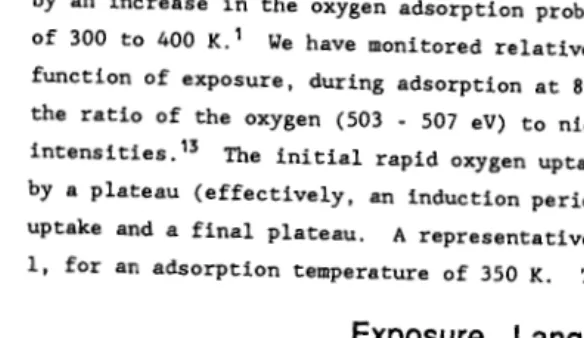
monolayers) is attained. Coverages of 0.35 to 0.45 monolayers are most often reported1•17"20• It is also known that this is accompanied by an increase in the oxygen adsorption probability, at temperatures of 300 to 400 K.1 We have monitored relative oxygen coverage as a function of exposure, during adsorption at 80 K to 400 K, by measuring the ratio of the oxygen (503 - 507 eV) to nickel (848 eV) Auger signal intensities.13 The initial rapid oxygen uptake is invariably followed by a plateau (effectively, an induction period), then a second rapid uptake and a final plateau. A representative curve is shown in Fig. 1, for an adsorption temperature of 350 K. The beginning of the
Exposure, Langmuir
0
20
40
60
80
160
240
320
0
60
~
ctl
a:
End of first
...
40
plateau
Q) 0>
'
::l<(
20
z
..
--....
0
[image:5.612.28.320.334.503.2]0~---~
FIGURE 1 Ratio of oxygen exposure to have been observed by The unit of exposure,
224 W.-D. WANG eta/.
second region of rapid uptake, shown by an arrow in Fig. 1, signals the onset of formation of the oxide-like layer.1
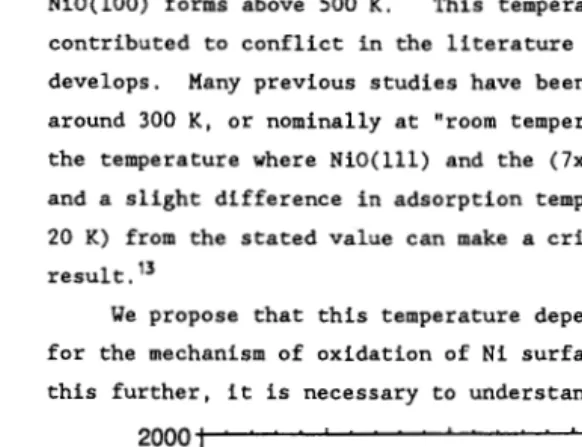
We have used LEED to measure the intensities of the diffraction spots associated with the oxide-like layer as a function of exposure, in this same range of adsorption temperature. We find that the oxidation onset (measured with AES) correlates very well with the emergence of the associated superstructure pattern in LEED. This result is shown in Fig. 2, and lays to rest a previous assertion that the correlation between LEED and AES in this respect is poor. 1•17
The oxygen coverage (measured from the area of the oxygen TPD trace) varies with exposure in a qualitatively similar way for Pd(l00).12 That is, there is an initial rapid uptake, then a plateau, and then the sequence is repeated.12 This occurs only if adsorption
takes place at T ~ 400 K, however, which is also the condition for formation of the fifth-order superstructures. We find the p(5x5) pattern emerges at the same exposure as the first plateau in the
c
Ni0(111) pattern
120
...
·:;
Q)E
Ni0(7x7) pattern
~g>
rJlca
8_....J
80
0AES
X
-wg
~~
rJl X40
~0
..c ....
I-.E
o+-~~~~~~~~~
0
100
200
300
400
Surface Temperature, K
FIGURE 2 Threshold exposure for oxidation of Ni(lOO), as a function of surface temperature. The thresholds are measured from LEED intensity data (squares and triangles), and from AES data
[image:6.612.57.356.181.487.2]STRUCTURAL STEPS IN OXIDATION OF METAL SURFACES 225
coverage-exposure function ends, and that both of these events occur at a coverage of about 0.4 monolayers.12 Like Ni(lOO), these
(presumably) oxide-like structures form well below the ideal coverage of the c(2x2) adlayer.
For both metals, it has been proposed that the shape of the coverage-exposure curve, with its "induction-period" plateau, reflects the fact that the oxide-like layer forms by nucleation from the c(2x2) adlayer.1•12 Nucleation is difficult, which leads to the plateau. Once nucleation has begun, growth proceeds more rapidly, which leads to the second regime of rapid uptake.
The length of the first plateau (in exposure) varies with temperature as shown in Fig. 2, for Ni(l00).13 [We have not measured
this function for Pd(lOO) above 400 K.12 However, we expect that some function analogous to that of Fig. 2 would result, given the other many parallels between 0/Pd (100) and 0/Ni(lOO). The plateau is only observable above 400 K, for 0/Pd(lOO), since the oxide-like "skin" cannot form at lower temperature.12] Holloway and Hudson have suggested that oxide growth depends upon diffusion of a (molecular) mobile precursor, whose lifetime diminishes as temperature increases, at all temperatures.17 However, Brundle and Broughton have argued persuasively against this interpretation. Instead, they propose that the oxide nucleates preferentially at defects in the c(2x2) adlayer,
and that these defects are less plentiful at high temperature.1 For
Pd(lOO), Chang and Thiel hypothesize that the p(SxS) reconstruction nucleates from domains of c(2x2) which must reach a critical size before the local structural conversion can occur.12 This would also
226
W.-D. WANG et al. KINETIC FACTORS CONTROLLING OXIDE EPITAXYWe have quantitatively measured diffraction spot intensities during oxidation of Ni(lOO). We find that the maximum intensity achieved by a superstructure pattern depends strongly on the adsorption
temperature, as shown by Fig. 3. The ring pattern, which corresponds to NiO(lll), reaches maximum intensity below room temperature, while
the (7x7) pattern, which may represent a strained form of Ni0(100) 20 , reaches maximum intensity between 300 and 400 K. Finally, true NiO(lOO) forms above 500 K. This temperature-dependence may have contributed to conflict in the literature over which oxide epitaxy develops. Many previous studies have been at adsorption temperatures around 300 K, or nominally at "room temperature. "1•17•18 This is just the temperature where NiO(lll) and the (7x7) structure "cross over", and a slight difference in adsorption temperature (by as little as 10-20 K) from the stated value can make a critical difference in the result. 13
We propose that this temperature dependence carries implications for the mechanism of oxidation of Ni surfaces.13 In order to explain
this further, it is necessary to understand that NiO(lll) is a
11
Ni0(111) pattern
•
::i
c:(
o Ni0(111) pattern
•
Ni0-(7x7) pattern
1000
0~~--~~~~~~~~
100
200
300
400
Surface Temperature, K
FIGURE 3 Normalized maximum intensity of the associated with NiO(lll) and Ni0-(7x7) structures. pattern is measured at two different beam energies circles) which are then normalized.
[image:8.612.61.352.289.513.2]STRUCTURAL STEPS IN OXIDATION OF METAL SURFACES 227
nonpolar surface consisting of layers of nickel and oxygen atoms
parallel to the surface.21 This orientation is favored kinetically, since it forms preferentially by oxidation at low temperatures. The NiO(lOO) surface, however, is a more polar oxide in which each layer is a mixture of nickel and oxygen atoms. This is the more
thermodynamically-stable form of the oxide, since it forms irreversibly when the sample is heated.
The layered NiO(lll) can form when oxygen "slips between" layers of metallic nickel, accompanied by rearrangement of the nickel atoms within these layers. However, most of the Ni-Ni bonds within the
metallic layers need not break completely as this oxide forms; the integrity of each layer of Ni atoms can remain somewhat intact as the
process occurs. The density of Ni within each layer must decrease by 17% as the metal transforms to the oxide,21 but perhaps this density
change is accomplished by formation of domain boundaries and steps at the surface. By contrast, the (100) face of NiO can only form ifNi atoms move into adjacent layers, forming sheets of Ni atoms which are not parallel to the metal substrate. We propose that this leads to a higher activation barrier for formation of the (100) oxide than for the (111) oxide.
It is quite interesting to compare these results with those of other authors. The ion shadowing and blocking measurements of Frenken, van der Veen, and coworkers22 •23 , show that adsorption of oxygen on Ni(lOO) induces outward relaxation of the topmost Ni layer as shown in Fig. 4, accompanied by a substantial weakening of the
[1 00]
f
-dl--
---=
Ni (100) Clean
d=1.70A p(2x2) d=1.soA c(2x2) d=1.85A Ni0(111)
d=2.41A
FIGURE 4 Schematic representation of changes in Ni-Ni
interlayers spacings (d) which occur as oxidation proceeds on Ni(lOO). The black boxes represent layers of Ni atoms, and the gray boxes represent layers of oxygen atoms. Values of dare taken from References 22 and 23.
'.
-, : :}·.' .' •• · , . J •.
::i·:
':~·: ~~~im:~·":',::!:·:· ~.~::·-~:~t~~;.f''·''
..
~"-228 W.-O. WANG et al.
force constants between first- and second-layer Ni atoms. Although
the clean surface spacing is contracted by 0.06
A,
relative to thebulk interlayer separation (1.76 A), the p(2x2) oxygen layer induces an expansion by 0.04
A,
and the c(2x2) leads to an even larger expansion of 0.09A.
The separation between adjacent Ni planes in NiO(lll) is 2.41A,
or 0.65A
larger than the bulk value. Clearly, the outward expansion induced by simple chemisorption is much smallerthan that required for oxidation, but it is nonetheless a step in the
direction leading to NiO(lll). In fact, Frenken, van der Veen, and
coworkers speculate that the chemisorption-induced expansion might be
a necessary precursor to surface oxidation22 •23 . The scenario which we
propose is illustrated in Fig. 4.
Christensen, et al.24 , describe the effect of oxidation temperature on oxide epitaxy between 290 and 770 K, starting from
metallic Ni(lll). They find that NiO(lll) forms exclusively up to
adsorption temperatures of 470 K, but that NiO(lOO) tends to form
irreversibly at temperatures above 470 K, again indicating that the
latter is the thermodynamically-favored form of the oxide. Indeed,
theoretical calculations demonstrate that the (100) face of NiO is
thermodynamically most stable. 25•26 Thus, the results of Christensen, et al. parallel ours. In both cases, NiO(lll) is the
kinetically-favored epitaxial orientation, whereas NiO(lOO) is
thermodynamically-favored.
The comparison between the metallic Ni(lll) and (100) faces, as
starting points for oxidation, is an important one. This is because
Christensen, et al. previously suggested that the greater ease of
formation of NiO(lll), relative to NiO(lOO), is due entirely to the
better symmetry match between oxide and metal. (Both oxide and metal
are of hexagonal symmetry in this case.) However, we find analogous
results starting from the (100) face of the metal. Therefore, we
propose that symmetry is unimportant. Rather, the controlling factor
is the energy barrier to formation of a layered (nonpolar) oxide
epitaxy, relative to the energy barrier for a more polar oxide
STRUCfURAL STEPS IN OXIDATION OF METAL SURFACES 229
We have compared the formation of surface and near-surface, metastable, oxide-like layers on Pd(lOO) and Ni(lOO). Whereas differences exist - the oxide-like "skin" is thinner on Pd, and the activation barrier to its formation is higher, - there are also similarities. In both cases, the oxygen-rich layer appears to form by a nucleation mechanism, specifically, by nucleation from the c(2x2) adlayer. The "induction period" which precedes nucleation during exposure to oxygen generates a plateau in the coverage-exposure relationship whose length increases with surface temperature. According to one model, nucleation occurs at defects in the c(2x2) adlayer1, whose density decreases with increasing temperature; in an alternative model, nucleation occurs when c(2x2) domains reach a critical size12, and the probability of reaching that critical size diminishes as temperature increases. At present, there is no data available to judge the relative merits of these two models.
We have also found that between 80 and 400 K, the development of LEED patterns associated with NiO is very temperature-dependent. The formation of NiO(lll) is favored by adsorption temperatures below 300 K, whereas a (7x7) structure is favored by adsorption temperatures of 300 to 400 K. Room temperature is a "crossover" point between these two forms of the oxide. We suggest that the low-temperature epitaxy is kinetically favored because it consists of nickel and oxygen atoms in sheets parallel to the substrate.
ACKNOWLEDGMENT
230 W.-O. WANG et al.
REFERENCES
*Permanent address: Institute of Physics, Chinese Academy of Sciences, Beijing, People's Republic of China.
**Present address: Department of Physics, Montana State University, Bozeman, Montana 59715
tNational Science Foundation Presidential Young Investigator (1985-1989) and Camille and Henry Dreyfus Foundation Teacher-Scholar (1986-1990).
1. C. R. Brundle and J. Q. Broughton, in The Chemical Physics of Solid Surfaces and Heterogeneous Catalysis, edited by D. A. King and D. P. Woodurff (Elsevier, Amsterdam, in press) Vol. 3, and references therein.
2. S.-L. Chang and P. A. Thiel, Phys. Rev. Letters~. 296 (1987). 3. G. Ertl and J. Koch, Z. Phys. Chem. 69, 323 (1970).
4. T. W. Orent and S. D. Bader, Surface Sci. 115, 323 (1982).
5. A. U. MacRae, Surface Sci.
1.
319 (1964).6. J. E. Demuth, N. J. DiNardo and G. S. Cargill III, Phys. Rev. Letters 2Q, 1373 (1983).
7. U. Starke, P. L. DeAndres, D. K. Saldin, K. Heinz and J. B. Pendry, Phys., Rev. B 38, 12277 (1988).
8. C. Nyberg and C. G. Tengstil, Surface Sci. 126, 163 (1983).
9. K. H. Rieder and W. Stocker, Surface Sci. 150, L66 (1985).
10. H. Richter and U. Gerhardt, Phys. Rev. Letters 51, 1570 (1983).
11. D. D. Wagman, W. H. Evans, V. B. Parker, R. H. Schumm, I. Halow, S. M. Bailey, K. L. Churney and R. L. Nuttall, J. Phys. Chem. Ref. Data 11, Suppl. 2 (1982).
12. S.-L. Chang and P. A. Thiel, J. Chem. Phys. 88, 2071 (1988).
13. W.-D. Wang, N. J. Wu and P. A. Thiel, J. Chem. Phys., submitted (1989).
14. J. W. Anderegg and P. A. Thiel, J. Vac. Sci. Technol. A~. 1367 (1986).
15. G. Dalmai-Imelik, J. C. Bertolini and J. Rousseau, Surface Sci. 63. 67 (1977).
STRUCTURAL STEPS IN OXIDATION OF METAL SURFACES 231
17. P. H. Holloway and
J.
B. Hudson, Surface Sci. 43, 123 (1974). 18. D. F. Mitchell, P. B. Sewell and M. Cohen, Surface Sci. Ql, 355(1976).
19. F. T. Wagner and T. E. Moylan, J. Electrochem. Soc., in press (1989).
20. R. S. Saiki, A. P. Kaduwela, J. Osterwalden, C. S. Fadley and C. R. Brundle, Phys. Rev. B, in press (1989).
21. R. A. Robie, P. M. Bethke and K. M. Beardsley, "Selected X-Ray Crystallographic Data, Molar Volumes, and Densities of Minerals and Related Substrates," Geological Survey Bulletin 1248, U. S. Government Printing Office, Washington (1967).
22. J. W. M. Frenken, J. F. van der Veen and G. Allan, Phys. Rev. Letters 51, 1876 (1983).
23. J. W. M. Frenken, R. G. Smeenk and J. F. van der Veen, Surface Sci.
1J2,
147 (1983).24. T. M. Christensen, C. Raoul and J. M. Blakeley, Appl. Surface Sci.