UNIVERSITI TEKNIKAL MALAYSIA MELAKA
Development of An Educational Quiz Kit that Test Student
Knowledge on Control System’s Second Order Transient
Response by using DC Motor Speed Control as Application
(Transient Response Quiz Box)
This report is submitted in accordance with the requirement of the Universiti Teknikal Malaysia Melaka (UTeM) for the Bachelor of Electronic Engineering
Technology (Industrial Power) with Honours.
by
MUHAMMAD FARHAN ZUHAILI BIN MOHD ZAKARIA B071410827
920726-14-5121
UNIVERSITI TEKNIKAL MALAYSIA MELAKA
BORANG PENGESAHAN STATUS LAPORAN PROJEK SARJANA MUDA
TAJUK: Development of An Educational Quiz Kit that Test Student Knowledge on
Control System’s Second Order Transient Response by using DC Motor Speed Control as Application
SESI PENGAJIAN: 2017/18 Semester 1
Saya MUHAMMAD FARHAN ZUHAILI BIN MOHD ZAKARIA
mengaku membenarkan Laporan PSM ini disimpan di Perpustakaan Universiti Teknikal Malaysia Melaka (UTeM) dengan syarat-syarat kegunaan seperti berikut:
1. Laporan PSM adalah hak milik Universiti Teknikal Malaysia Melaka dan penulis. 2. Perpustakaan Universiti Teknikal Malaysia Melaka dibenarkan membuat salinan untuk
tujuan pengajian sahaja dengan izin penulis.
3. Perpustakaan dibenarkan membuat salinan laporan PSM ini sebagai bahan pertukaran antara institusi pengajian tinggi.
4. **Sila tandakan ( )
SULIT
TERHAD
TIDAK TERHAD
(Mengandungi maklumat yang berdarjah keselamatan atau kepentingan Malaysia sebagaimana yang termaktub dalam AKTA RAHSIA RASMI 1972)
(Mengandungi maklumat TERHAD yang telah ditentukan oleh organisasi/badan di mana penyelidikan dijalankan)
Alamat Tetap:
N0 39, JALAN SATU,
KAMPUNG PANDAN,
55100 KUALA LUMPUR,
W.P KUALA LUMPUR.
Tarikh: ________________________
Disahkan oleh:
Cop Rasmi:
Tarikh: _______________________
i
DECLARATION
I hereby, declared this report entitled “Development of An Educational Quiz Kit that Test Student Knowledge on Control System’s Second Order Transient Response by
using DC Motor Speed Control as Application” is the results of my own research except as cited in references.
Signature : ……….
Author’s Name : MUHAMMAD FARHAN ZUHAILI
ii
APPROVAL
This report is submitted to the Faculty of Engineering Technology of UTeM as a partial fulfillment of the requirements for the degree of Bachelor of Electronic Engineering Technology (Industrial Electronics) (Hons.). The member of the supervisory is as follow:
iii
ABSTRACT
iv
DEDICATION
v
ACKNOWLEDGEMENT
Bismillahirrahmanirrahim,
Alhamdulillah. Thanks to Allah SWT, who with His willing give me the opportunity to complete Bachelor Degree Project with title “Development of An Educational Quiz Kit that Test Student Knowledge on Control System’s Second Order Transient Response by using DC Motor Speed Control as Application”. This bachelor degree project was prepared for Universiti Teknikal Malaysia Melaka (UTeM), basically for student in final year to complete the undergraduate program that leads to the degree of Bachelor of Electronics Engineering Technology (Industrial Electronics) (Hons.). This report is based on the methods given by the university.
Firstly, a million thanks to Amar Faiz Bin Zainal Abidin, a lecturer at Faculty of Engineering Technology and also assign, as my supervisor who had guided me a lot of task during this semester. I also would like to express my deepest thanks and appreciation to my parents, family, special mate of mine and others for their cooperation, encouragement, constructive suggestion and full of support for the report completion, from the beginning until the end of this Bachelor Degree Project. Also, deepest thanks to all of my friends and everyone, that has been contributed by supporting my work and helps myself during the Bachelor Degree Project until its fully completed.
vi
TABLE OF CONTENT
Declaration i
Approval ii
Abstract iii
Dedication iv
Acknowledgement v
List of abbreviations, symbols and nomenclature ix
CHAPTER 1: INTRODUCTION 1
1.0 Introduction 1
1.1 Project Background 1
1.2 Problem Statement 2
1.3 Objectives 3
1.4 Scope of Work 4
1.5 Project Contribution 5
CHAPTER 2: LITERATURE REVIEW 6
2.0 Introduction 6
2.1 Past Related Research 6
2.1.1 Educational Kit Using Robotic 6
2.1.2 Educational Kit for Learning Control System by Using Hot Air Blower 9
2.1.3 e-Logic Gate Translator 10
2.1.4 Teaching digital control using a low-cost microcontroller-based TCK 12
2.2 Equipment and Hardware Used 13
2.2.1 Arduino MEGA 2560 13
vii
2.2.3 I2C 1602 LCD 15
2.2.4 4x4 Matrix Keypad 16
2.2.5 20x4 LCD 17
2.2.6 Buzzer 18
CHAPTER 3: METHODOLOGY 20
3.0 Introduction 20
3.1 Project Planning 20
3.1.1 Project Planning Phase 1 21
3.2 Project Layout 23
3.3 Block Diagram 24
3.4 Flowchart of the programming 25
3.5 Purchasing components of project 27
3.6 Programming of the hardware 28
3.6.1 Controlling DC motor speed 28
3.6.2 Plotting the graph 28
CHAPTER 4: RESULT & DISCUSSION 30
4.0 Introduction 30
4.1 Prototype 30
4.2 Result 34
4.2.1 Answering the quiz 34
4.2.2 Survey Analysis 38
CHAPTER 5: CONCLUSION & FUTURE WORK 44
5.1 Conclusion 44
5.2 Recommendation 45
viii APPENDICES
A Datasheet
1. Arduino Mega 2560 Datasheet 2. L298N (motor driver) Datasheet
ix
LIST OF ABBREVIATIONS, SYMBOLS AND
NOMENCLATURE
IDE - Integrated Development Environment I/O - Input Output
SSID - Short set identifier LED - Light Emitting Diode LCD - Liquid Crystal Display
IR - Infrared
PWM - Pulse-Width Modulation USB - Universal Serial Bus
CLK - Clock
V - Voltage
MHz - Mega Hertz
KB - Kilo Bytes
PC - Personal Computer
PIC - Peripheral Interface Controller
GND - Ground
TFT - Thin-film transistor PCB - Printed Circuit Board RPM - Rotation per minutes DAQ - Data acquisition
I2C - Inter-integrated Circuit (I2C)
1
CHAPTER 1
INTRODUCTION
1.0 Introduction
The aim of this chapter is to create framework of this project. It contains detail of the project requirement. The background of this project will be explained briefly.
In this chapter, the topic that will be cover for this project is problem statement, objective, scope of work and project contribution.
1.1 Project Background
According to Ashaari (1999), educational kit is another alternative that used by lecture to teach student. Educational kit also defines as an equipment that used in teaching that act as an introduction of the hands on for the student in their learning session.
2 Transient Response Quiz box is a trainer kit that test student understanding in control principle subject but just focus in second order transient response. This trainer kit will generate a graph and ask the user question about transient response based on the graph. Student is required to key in their answer and the trainer kit will check the answer given. Once user finished answer all the question, the trainer kit will display the score.
1.2 Problem Statement
In Universiti Teknikal Malaysia Melaka (UTeM), Control Principle subject will focus to student electric and electronic engineering. For this subject student will learn in theoretically and practically. For theoretical student will learn in lecture and tutorial but for practical student will learn in lab session.
During lecture, it will be held in a hall with a lot of students. Power Point slide will use to display the lecture note for this subject. Lecturer will explain that slide to student by theoretically. Not all student can stay focus in class like this, some student will feel bored and sleepy.
After each chapter finish covered, lecturer will have prepared some exercise for student. Student need to answer all questions and it will be discussed during tutorial session. During tutorial session, not all student will understand that chapter because majority lecturer only calls one student to solve one of the question and another student to solve another question. Furthermore, student just understand theoretical but do not know application for that chapter.
3 is student need the procedure to do that lab assessment. It cannot be done if that lab assessment does not have the procedure. Students also need a lecturer to guide them to make that assessment.
1.3 Objectives
The primary objective of this project is to purpose the development of an electronic educational quiz kit based on control system second order transient response by using DC motor speed control application. At the end of this project, the objective that are going to be archive are:
1. To design a proof of concept of an electronic educational kit hardware that can help the student to get exposed with control system knowledge which require no supervision from the teacher.
2. To build the proof of concept of the compatible (21x28 cm box which can be store in a bag and carry it anywhere) low cost (less than RM350) educational kit that using Arduino Mega as the controller.
3. To verify the functionality of the educational kit by performing a set of system testing which will be based on a checklist.
4 1.4 Scope of Work
In designing Transient Response Quiz box this project had limited certain criteria such as the maximum number of the dc motor RPM value. For starting it will only cover until 2000 RPM. This LCD will display question and answer based on graph generated on TFT LCD. I use the LCD to display the question and answer because the graph will be small if the question and answer display on the TFT LCD. As for the question set, this quiz box has 3 difficulty choice that is easy, medium and hard. Each set has four question that cover the topic of control principle second order transient response.
There is limitation in designing the external hardware. For hardware casing 8x10x4” project box was used because this box lightweight. This size are enough to represent the idea of this Final Year Project (FYP). This casing also can reduce cost to finish this project.
5 1.5 Project Contribution
The project is about learning and understanding the basic of Control System. The students can apply the theory of control system on this educational kit.
This project can help student to understand a lot more about control system especially about transient response due to the lack of knowledge in class. Students will not feel bored if they understand this project instead they want to try another question.
This educational kit helps student to comprehend the application of control system for all intents and purposes. Students can understand about the control system by the application from this educational kit.
6
CHAPTER 2
LITERATURE REVIEW
2.0 Introduction
Literature review is an essential part before beginning any project. It provides all required data that related to the project and based on that, the correct direction in developing the project can be performed proficiently.
In this chapter, topic that will be explained are equipment and hardware that going to be implemented and previous related work.
2.1 Past Related Research
The research that will focus on each product and equipment that used to build up this venture. The source of these inquiries about must be satisfactory in the system format, for example, books, journals, articles and website that are authorized.
2.1.1 Educational Kit Using Robotic
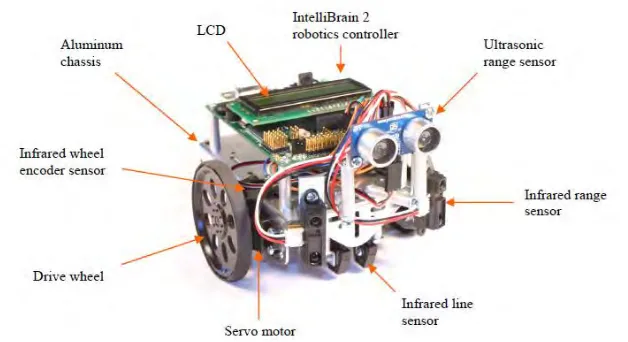
7 from your robot’s sensors, and controlling your robot’s motors. In year 2009 RidgeSoft (2009), RidgeSoft™ provide education robotic platform for improving teaching-learning processes of technology in developing countries, the product is known as IntelliBrain™ Bot Deluxe. For this product, it was sold in two states in which $459 for assembled and $439 for unassembled. This product is used in education for embeded system or computer interfacing which are using java programming.
[image:18.612.151.546.323.686.2]By creating and loading different programs you can program your robot to perform an extensive variety of functions.
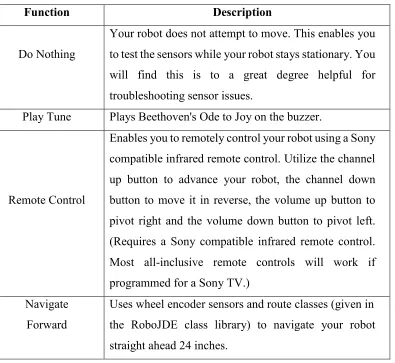
Table 2.1: IntelliBrain-Bot Demo Program Functions (RidgeSoft, 2009)
Function Description
Do Nothing
Your robot does not attempt to move. This enables you to test the sensors while your robot stays stationary. You will find this is to a great degree helpful for troubleshooting sensor issues.
Play Tune Plays Beethoven's Ode to Joy on the buzzer.
Remote Control
Enables you to remotely control your robot using a Sony compatible infrared remote control. Utilize the channel up button to advance your robot, the channel down button to move it in reverse, the volume up button to pivot right and the volume down button to pivot left. (Requires a Sony compatible infrared remote control. Most all-inclusive remote controls will work if programmed for a Sony TV.)
Navigate Forward
8 Rotate 180 Uses wheel encoder sensors and route classes to turn
your robot set up 180 degrees.
Navigate Square
Uses wheel encoder sensors and route classes to navigate
your robot around a 16-inch square.
Random Dance Uses programming created random numbers to play out a "move" consisting of random movements.
Follow Line Uses line sensors to enable your robot to follow a dark line on a white surface.
Avoid Obstacles
Uses wheel encoder sensors, route classes, and infrared range sensors to navigate your robot 24 inches forward then back to where it began, dodging obstacles along the way.
Follow Object
Uses the ultrasonic range sensor to keep up a separation of 6 inches from an object before your robot, creating a "tractor shaft" effect.
9 Figure 2.1: IntelliBrain-Bot Deluxe Robot (RidgeSoft, 2009)
2.1.2 Educational Kit for Learning Control System by Using Hot Air Blower
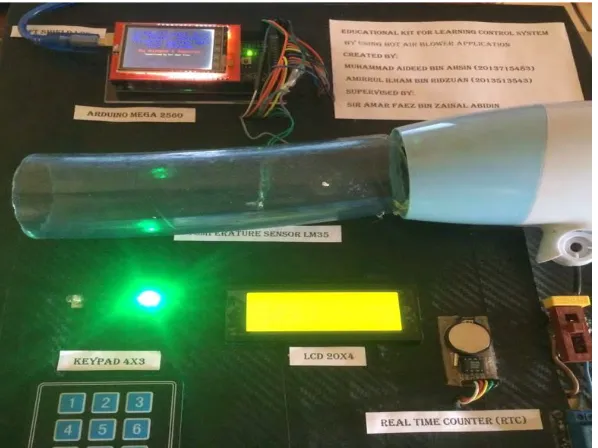
Educational Kit for Learning Control System is a quiz kit that used hot air blower as application to generate transient response by controlling the temperature blow from the hot air blower. M. Aideed and A.Ilham (2016) state that, these days many projects had utilized idea of educational toolkit for university and high school students to help them in their education. The cost for this project is RM 317 for one unit. This project is used in education for subject Control Principle which are learn by BETE course student during 4th semesters.
10 The advantages of the project are, it used the temperature from hot air blower to generate the graph, so the programming is not so complicated as Transient Response Quiz Box where DC motor are used to generate the graph based on the speed value. In order to calculate the speed value, photoelectric speed sensor was used to count the RPM of the DC motor. The disadvantages of this project are, it consumes a lot of power in order to turn on the hot air blower. As for Transient Response Quiz Box, it used DC motor which only need 5v supply to turn it on.
Figure 2.2: Educational Kit for Learning Control System Prototype (M. Aideed and A.Ilham, 2016)
2.1.3 e-Logic Gate Translator
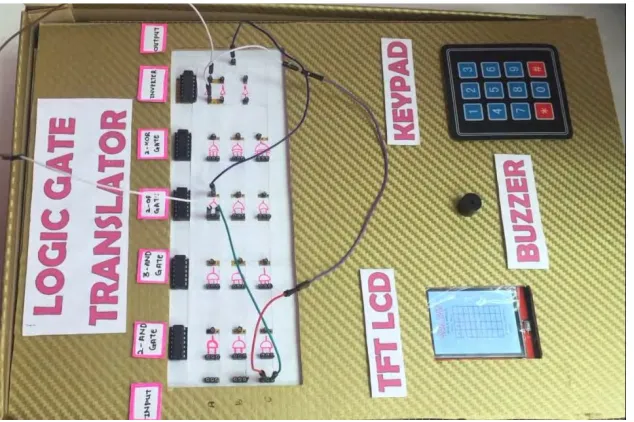
11 they couldn't comprehend the basics of logic gate circuit and how to control them by using it. The cost for one unit is RM 282. This project is used in education for subject Digital Electronic that was learn by student BETE during 3 semesters.
User have to make logic gate connection on the donut board, the truth table will be generated and Boolean equation, for example, Y = A + B + C will show up as the output result on a TFT LCD. It only provides AND, OR and NOT logic gates in this project. Even though not all type of logic gate provides on this device, there are 255 possibilities equation that are available with this device.
[image:22.612.201.518.359.570.2]The advantages of this project are, it covers some of Digital Electronic syllabus which not cover by Transient Response Quiz Box. The disadvantages of this project are, it does not cover for Control Principle subject syllabus.
12 2.1.4 Teaching digital control using a low-cost microcontroller-based TCK
Temperature control kit is a device that based on PIC16F877 model microcontroller. According to Ibrahim (2003), “with the availability of low-cost computer and microcontrollers, digital control has gained popularity and most current control system are based on digital technique.” The cost for the kit is around $200 where it is below the cost of other similar available educational temperature control kit. This kit only containing of low cost material which make so simple. There is a round plastic container that used to store the water and also immersed with it is the heater element and sensor.
The system used non-parametric modelling to identify the dynamic behavior by a reaction curve method. The feedback loop is open, and a step PWM input is applied to the heater driver by microcontroller. Then, the temperature of the water is measure and record for every second by connecting the sensor output to the voltage input of DrDaq hardware and Picolog software.
13 Figure 2.4: Block diagram of temperature control kit (Ibrahim, 2003)
2.2 Equipment and Hardware Used
2.2.1 Arduino MEGA 2560
According to Mellis (2011), “Arduino Mega 2560 is a microcontroller board based on the ATmega2560”. This device has 54 digital input/output pins. Among the pins, there is 14 pins can be use as PWM output, 16 pins as analog input, 4 pins as UARTs ports and other 20 pins as digital input/output.