NJF – seminar no.372
NJF Report Vol.1 No. 2 2005
Proceedings from the seminar
Manure – an agronomic and environmental
challenge
5-6 September 2005
Nils Holgerssongymnasiet, Skurup, Sweden
Session III: Anaerobic processes and treatment
Nutrient balance of a two-phase solid manure biogas plant
Winfried Schäfer1, Lars Evers2, Marja Lehto1, Sanna Sorvala1, Frederick.Teye1, Artur
Granstedt2, 1Agricultural Engineering Research (VAKOLA) MTT Agrifood Research Finland, Vakolantie 55, 03400 Vihti Finland, +358 9 224 252 20, [email protected], www.mtt.fi. 2Biodynamic Research Institute, Skilleby gård, S-15391 Järna, Sweden.
Key Words: biogas, compost, nutrients, carbon, anaerobic digestion, dry fermentation
Abstract
The Biodynamic Research Institute in Järna developed a two-phase on-farm biogas plant. The plant digests manure of dairy cattle and organic residues originating from the farm and the surrounding food processing units containing 17.7-19.6 % total solids. A new technology for continuously filling and discharging the hydrolysis reactor was developed and implemented. The output of the hydrolysis reactor is separated into a solid and liquid fraction. The solid fraction is composted. The liquid fraction is further digested in a methane reactor and the effluent used as liquid fertiliser. Initial results show that anaerobic digestion followed by aerobic composting of the solid fraction improves the nutrient balance of the farm compared to mere aerobic composting. Composted solid fraction and effluent together contain 70-81 % of total input nitrogen and 94-111 % of input NH4. The manure that was merely aerobic
digested contained about 51-70 % of total input nitrogen and 3.9 % of input NH4.
Additionally anaerobic digestion improves the energy balance of the farm producing up to 269 l biogas kg-1 volatile solids or 1.7 kWh heat kg-1 volatile solids.
Introduction/Problem
During the last decade some so called ‘dry fermentation’ prototype plants were developed for anaerobic digestion of organic material containing 15-50 % total solids (Hoffman, 2001). These plants show added advantages compared to slurry digestion plants: Less reactor volume, less process energy, less transport capacity, less odour emissions. However on-farm dry fermentation plants are not common and rarely commercially available. We assume that lack of tested technical solutions, difficult and time-consuming feeding and discharging, and scarceness of on-site research results are the main reason for low acceptance of dry
fermentation technology. Recent on-farm research (Kusch & Oechsner, 2004) and prototype research (Linke, 2004) show promising technical solutions for dry fermentation batch reactors on-farm. This paper reports about an innovative two phase prototype biogas plant. The plant continuously digests dairy cattle manure and organic residues of the farm and the surrounding food processing units. The two phase reactor technology was chosen for two reasons: First it offers the separation of a solid and a liquid fraction for composting after hydrolysis and secondly the methanisation of the liquid fraction using fixed film technology results in a very short hydraulic retention time, reduction in reactor volume, and higher methane content of the biogas (Lo et al., 1984).
Methodology
and oat husks. From the feeder channel the manure is pressed via a 400 mm wide feeder pipe to the top of the 30° inclined hydrolysis reactor of 53 m3 capacity. The manure mixes itself with the substrate sinking down by gravity force. After a hydraulic retention time of about 22-25 days at 38°C, the substrate is discharged by a bottomless drawer from the lower part of the reactor. Every drawer cycle removes about 100 l substrate from the hydrolysis reactor to be discharged into the transport screw underneath. From the transport screw the substrate partly drops into a down crossing extruder screw where it is separated into solid and liquid fractions. The remaining material is conveyed back to the feeder channel and inoculated into the fresh manure. The solid fraction from the extruder screw is stored at the dung yard for composting. The liquid fraction is collected into a buffer and from there pumped into the methane reactor with 17.6 m3 capacity. Liquid from the buffer and from the methane reactor partly returns into the feeder pipe to improve the flow ability. After a hydraulic retention time of 19-21 days at 38°C the effluent is pumped into a slurry store covered by a floating canvas. The gas
generated by both reactors is stored in a sack and fed by a compressor to the process heater and the furnace of the estate for heating purposes. We took samples on 3.3., 6.5, and
26.10.2004 from the input manure, solid fraction, effluent, straw, and oat husks. The gas yield of each reactor was measured by a gas meter (Actaris G6 RF1) and the reading was daily recorded. CO2-content of the biogas was measured once by falling out soda in soda lye.
Process B: For the compost trials (10.5.2004-13.8.2004 and 27.10.2004-16.3.2005) samples of 50 l manure and 50 l solid fraction from the hydrolysis reactor were aerobically digested at 15°C in the climate chamber of MTT/Vakola. During the trial period the samples were turned three times and 1.3 l water was added.
Total solids and nutrient content were analysed by HS Miljölab Ltd. in Kalmar, Sweden and Novalab Ltd. in Karkkila, Finland. Volatile solids were analysed at the laboratory of
MTT/Vakola by heating samples for 3 h at 550 °C.
Resultsand brief discussion
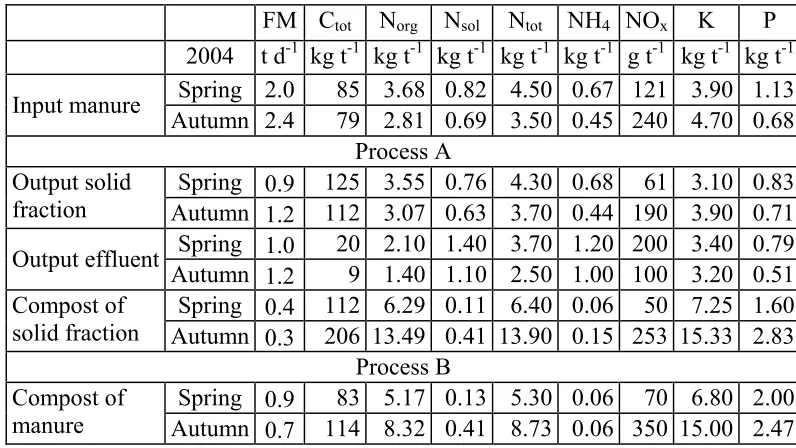
[image:3.595.96.494.505.729.2]The results concerning the nutrient contents are presented in table 1. Spring refers to the mean values of samples on 3.3. and 6.5.2004, autumn to the samples from 26.10.2004.
Table 1: Nutrient content of the organic material input and output.
FM Ctot Norg Nsol Ntot NH4 NOx K P
2004 t d-1 kg t-1 kg t-1 kg t-1 kg t-1 kg t-1 g t-1 kg t-1 kg t-1 Spring 2.0 85 3.68 0.82 4.50 0.67 121 3.90 1.13 Input manure
Autumn 2.4 79 2.81 0.69 3.50 0.45 240 4.70 0.68 Process A
Spring 0.9 125 3.55 0.76 4.30 0.68 61 3.10 0.83 Output solid
fraction Autumn 1.2 112 3.07 0.63 3.70 0.44 190 3.90 0.71 Spring 1.0 20 2.10 1.40 3.70 1.20 200 3.40 0.79 Output effluent
Autumn 1.2 9 1.40 1.10 2.50 1.00 100 3.20 0.51 Spring 0.4 112 6.29 0.11 6.40 0.06 50 7.25 1.60 Compost of
solid fraction Autumn 0.3 206 13.49 0.41 13.90 0.15 253 15.33 2.83 Process B
Spring 0.9 83 5.17 0.13 5.30 0.06 70 6.80 2.00 Compost of
From oat husks and straw originate 53-70 % of the volatile solids of the input material. In the solid fraction remained 70-75 % of the total solids, in the effluent 10-15 % and within the biogas 14.5-15 %. The ripe compost of the solid fraction and the effluent together contained about 48% of the input dry matter of process A. During process B about 47-49 % of total solids escaped into the atmosphere.
During the anaerobic digestion in process A, 14.6-15.4 % of carbon was found in the biogas. During aerobic composting escaped 26-31 % of the input carbon of the solid fraction. In process B 58-60 % of the carbon escaped during aerobic composting. Even if the biogas yield would be threefold more, there would still be 41-42.5 % carbon available for composting of the solid fraction. This confirms the hypothesis that biogas production before composting hardly has a negative impact on the humus balance (Möller, 2002) compared to mere aerobic composting.
Total nitrogen losses ranged between 30% and 48% in process B and between 19% and 29% in process A. Similar values we found for NH4: up to 6% losses in process A versus 96% in
process B. Potassium and phosphorus losses were higher in process A than process B. The results confirm the calculations of Möller (2002) that biogas production increases recycling of NH4 and reduces overall nitrogen losses compared to mere aerobic composting.
In process A enterococcus in manure ranged between 3.3·105 and 2.5·106 colony forming units (cfu) g-1 and in the solid fraction between 4.2·104 and 4.5·104 cfu g-1. After composting the solid fraction we found still 300 to 4.4·104 cfu g-1. During process B enterococcus was reduced to 270-275 cfu g-1. The results mirror the fact, that temperature during aerobic process is usually higher than within the biogas reactor. Nevertheless, anaerobic digestion improves the hygienic quality of manure too.
The results cannot yet be statistically confirmed because there are up to now mean values of only three measuring-days on-farm available. Especially the daily input of oat husks and straw vary widely depending on the person working in the stanchion bar. Farmers usually do not weigh and analyse the spread litter. The quantity and quality of faeces in terms of volatile solids depends on the quantity and quality of fodder, the metabolism of the animals and the environmental conditions like temperature, air humidity, and behaviour of farm staff and may also change in a wide range.
Conclusions
The two phase prototype biogas plant in Järna is suitable for digestion of organic residues of the farm and the surrounding food processing units. The prototype put many recent research results into practice. But there is still a lack of appropriate technical solutions in terms of handling organic material of high dry matter content, and process optimisation. The
innovative continuously feeding and discharging technique is appropriate for the consistency and the dry matter content of the organic residues of the farm. It is probably not suitable for larger quantities of unchopped straw or green cut.
Anaerobic digestion of manure and organic residues followed by composting the dry fraction of the hydrolysis reactor improves the energy and nutrient balance on-farm compared to mere aerobic composting. Appropriate new technical design as used at the prototype biogas plant in Järna is a key factor.
plant but also the nutrient circle of a whole crop rotation period of the farm organism. The quality of the nutrients is finally related to soil fertility, fodder quality and animal health. From different scientific publication databases we found about 10,000 references concerning biogas research during the past 10 years. Less than ten are dealing with biogas reactors for non liquid substrates on-farm. Recent research mainly concentrates on basic research, biogas process research for communal waste, large scale biogas plants, and research on laboratory level. Our conclusion is that it seems worldwide to be very difficult or even impossible to find financial support for on site research, especially for on-farm prototype biogas reactors. We suppose the following reasons for this fact: biogas plant research requires proficiency in many different scientific disciplines, lack of co-operation between engineering and life sciences, high development costs to transfer basic research results into practical technical solutions, low interest of researchers because on site and on-farm research enjoys low appreciation in terms of scientific credits, portability of farm specific design and process solutions is difficult. Our conclusion is, that on site and on-farm research using a “radical holistic research strategy” (Baars, 2002) has to be supported by funding agencies if integration of biogas and bio energy into the farm organism is target within the agriculture policy framework.
References
Baars, T. 2002. Reconciling scientific approaches for organic farming research. Ph.D. Thesis, Louis Bolk Institute Driebergen, Netherlands.
Boxberger, J., Amon, Th., Weber, A. 2002. Biogasnutzung im Kontext von Agrar-, Umwelt- und Energiepolitik. In Berichte zur 11. Jahrestagung des Fachverbandes Biogas e.V. in Borken Tagungsbericht 2002: Biogas – die universelle Energie von morgen (Ed. Fachverband Biogas e.V.), pp. 7-13.
Hoffmann, M. 2001. Trockenfermentation. Entwicklungsstand und Perspektiven. Landtechnik 56, 410-411.
Kusch, S., Oechsner, H. 2004. Feststoffvergärung in Batchreaktoren – erste
Veruchsergebnisse. In Tagungsband zur 13. Jahrestagung „Biogas und Bioenergie in der Landwirtschaft“. 2.-4. Dezember 2004 in Wolpertshausen. (Ed. Internationales Biogas und Bioenergie Kompetenzzentrum, Fachgruppe Biogas), pp. 115-124.
Linke, B. 2004. Substrateinsatz bei der Trockenfermentation – Einschätzung des F+E-Bedarfs. In Gülzower Fachgespräche23 (Ed. Fachagentur Nachwachsende Rohstoffe), pp. 35-48.
Lo, K. V., Liao, P. H., Bulley, N. R., Chieng, S. T. 1984. A comparison of biogas production from dairy manure filtrate using conventional and fixed-film reactors. Canadian
Agricultural Engineering26, 73-78.
Möller, K. 2003. Systemwirkungen einer "Biogaswirtschaft" im ökologischen Landbau: Pflanzenbauliche Aspekte, Auswirkungen auf den N-Haushalt und auf die
Spurengasemissionen. Biogas Journal1, 20-29.