Communicating Effectively in Resource-Constrained Multi-Agent Systems
Partha S. Dutta
School of ECS
University of Southampton
Southampton SO171BJ, UK.
[email protected]
Claudia V. Goldman
Samsung Telecom Research Israel
Herzliya, Israel.
[email protected]
Nicholas R. Jennings
School of ECS
University of Southampton
Southampton SO171BJ, UK.
[email protected]
Abstract
Agents with partial observability need to share in-formation to achieve decentralised coordination. However, in resource-constrained systems, indis-criminate communication can create performance bottlenecks by consuming valuable bandwidth. Therefore, there is a tradeoff between the utility at-tained by communication and its cost. Here we ad-dress this tradeoff by developing a novel strategy to make communication selective based on informa-tion redundancy; ensuring communicainforma-tion only oc-curs when necessary, while maintaining acceptable coordination. We apply this strategy to a state-of-the-art communication protocol to evaluate its re-source saving benefit in a distributed network rout-ing problem. Furthermore, we design a mecha-nism to adapt its selectivity level to the prevail-ing resource constraints to ensure further improve-ments. Empirical studies show our selective strat-egy achieves relative savings in bandwidth usage of 50-90%, with only a 5-10% relative reduction in coordination effectiveness and the adaptive strategy further improves relative bandwidth usage by up to 10% and also relative coordination effectiveness by up to 12% over the non-adaptive approach.
1
Introduction
In many distributed systems, such as sensor networks, P2P
systems, and grid applications, decision-making is performed by individual agents in a decentralised fashion under incom-plete global knowledge. Now, to effectively coordinate their actions under these circumstances, the agents need to share information [Xuan et al., 2001; Goldman and Zilberstein, 2003]. Specifically, the fact that such exchanges can signif-icantly improve distributed task processing has been shown in [Dutta et al., 2005] where a state-of-the-art information-sharing protocol is developed. However, their solution does not consider communication cost, which is the extra band-width required for communication and is limited in all prac-tical applications. Given this, this paper develops a novel de-centralised strategy that agents can employ to decide when to exchange information. This strategy is practical for real-istic applications and balances the need to communicate (to
improve coordination) with the need to reduce overhead (to save valuable bandwidth).
In more detail, the issue of planning when to communi-cate is a non-trivial problem. In particular, Goldman and Zil-berstein [2004] show that solving this problem optimally is intractable. Given this, a number of non-optimal solutions to the problem have been proposed. For example, in [Gmy-trasiewicz and Durfee, 2001], agents communicate to im-prove their own utilities, but this may be at the expense of the overall system performance. Zhang et al. [2004] require all possible communication acts of agents to compute team utility gained due to communication: an impractical proposi-tion in real applicaproposi-tions. The algorithms to solve the DEC-MDP formulation in [Shen et al., 2003] need expensive of-fline planning and so cannot readily be applied to dynamic environments. Finally, centralised solutions are equally in-applicable [Haas et al., 2000] as they are not scalable and present a single point of failure.
Against this background, this paper presents a compro-mising but scalable approach: agents exchange information selectively such that it improves coordination, but without incurring the high costs associated with computing exactly when it is best to communicate. Here, the main challenge is to find the right level of selectiveness that will restrict resource usage, thereby allowing its use for realistic task processing, while limiting performance degradation to non-significant levels compared to strategies that permit uncon-strained communication.
the information transmitted would be useful or redundant to the recipient (Section 3). Such redundancy is captured using a selectivity threshold,
, which is by how much the cur-rent information (the value of an agent’s local state) differs from what was previously transmitted. Now, various selec-tivity values affect a system’s performance differently: the higher the threshold, the more restricted the communication, which lessens coordination quality but takes up less resource. To improve resource usage still further, we then develop an algorithm for adaptively setting the selectivity threshold so that its level can be chosen according to the prevailing con-text. This allows more informed communication decisions, thereby reducing bandwidth usage and also increasing coor-dination effectiveness compared to using a fixed threshold. We then empirically assess the effectiveness of our selective information exchange (SIE) and adaptive selective informa-tion exchange (ASIE) protocols by comparing their perfor-mances against NSIE (Section 4). In particular, for a dis-tributed task processing problem, we measure the amount of degradation (if any) in the quality of solutions and the amount of savings (if any) in resource usage achieved by our strate-gies compared toNSIE. The evaluations are carried out on an exemplar problem: distributed network routing. This is the same domain used in [Dutta et al., 2005] which allows valid comparisons. That ourSIEapproach extends the state-of-the-art significantly is confirmed by these empirical studies: SIE
achieves a 50-90% saving in bandwidth usage while reducing throughput by only 5-10% compared toNSIEacross various network environments. ASIEfurther improves relative band-width usage by about 10% and also the relative throughput by about 12% compared toSIE.
2
Routing in Resource-Constrained Networks
This section outlines the call routing application on which our selective information exchange protocol is evaluated. Note, however, our protocol is generic and can be used to conserve bandwidth in any system with resource constraints and using information-sharing at some level to operate efficiently. Also note, in systems where communication is different from ex-changing state values (as happens in our application), we need a suitable way of formalising the redundancy metric.1 In our application, each node communicates directly with those that are within its communication range. The system’s task is to connect a call between the node where the call originates and the one where it is destined. The originating node forwards a call setup request to one of its neighbours. As each agent only has local information, it chooses that neighbour for which it estimates that the call would be placed via the most efficient overall route.
Specifically, each node maintains a routing table ,
where each element ( : the destination node, :
a neighbour of) represents’s estimate of the best
end-to-end bandwidth availability in going from to . Node
chooses a neighbour using a Boltzmann distribution over
its values: ! #"%$&'
(
/)+*,%- ./0 #"%$
*
'
(
, where
1
is the importance given to higher values. Each node chooses the next hop until the call setup request reaches the
1
E.g., a measure of the “distance” between information elements.
destination. After this happens, the destination sends “up-stream” along the call route an ack message indicating a successful call connection. Each node also appends its
state value to theack. In this application, a node’s state is the bandwidth available expressed as a fraction of the max-imum availability. Thus, a node2 receiving theack from
the immediate “downstream” node3 gets the set of state
val-ues that were appended by all “downstream” nodes on this call route. Node 2 then updates its RT as: 4 56 387
!9 :<;= >4 56 3=?@;BAC %D
FE#E#EG
"
, whereAHI is an
aggrega-tion funcaggrega-tion on a set of node state values, and; is a discount
factor (JLK ; K 9 ). Here, we chooseA as the minimum of the
set of states since it is the minimum available bandwidth that determines the maximum number of calls on a given path.
The above description of information exchange after every call connection is called non-selective information exchange (NSIE) which is the approach of [Dutta et al., 2005] and, therefore, treated as the baseline algorithm in this paper. In
NSIE, information exchanged via theackmessages is signif-icant in updating RTs and, hence, performing decentralised routing efficiently. On the other hand, these messages con-sume valuable bandwidth and, hence, act as overhead. The larger the ack’s size is, the more the bandwidth it con-sumes. To counter this, we make information exchange selec-tive to restrict theacksize. Thus, we are essentially solving the problem of controlling resource usage by communication, while retaining system performance.
3
The Information Exchange Strategies
The state value that a node transmits to another at a given time can be identical to what it sent to that node on the previous occasion. This happens if, since the last transmission, exactly as many new calls have been connected through this node as existing calls on this node have terminated and, hence, the re-sultant bandwidth availability on this node is unchanged. In general, an agent’s local state can be identical or similar in terms of information content to what it perceived when it last communicated its state. In such cases, sending state informa-tion is redundant and can be discarded. The goal, therefore, is to communicate only when there is a significant enough change in an agent’s state. Making information exchange se-lective (SIE) in this way, the acksize can be reduced. To this end, we discuss the requirements and the design ofSIE, howSIEaffects system performance, and the notion of com-munication selectivity. Finally, the adaptive (ASIE) protocol is introduced.
Selective Information Exchange: To implement SIE, a node should have the following:
Transmitter memory (M ): To store the state values sent to
each neighbour on the most recent transmission. So,M NO is
the most recent state-value transmitted by to neighbour .
These are compared against the current state value to deter-mine a redundancy. Thus, a node needs a memory of size
P/Q
P
, where
Q
is its set of neighbours, for its decision of
when to transmit.
Receiver memory (R ): To store the state values received
from any other node on the most recent transmission from the latter. So,R
is the most recent state-value received by
it receives anackthat does not include the current state of .
This happens if detects a redundancy and does not transmit.
On the other hand, when it receives the state value of (when
has not identified a redundancy), it replacesR with this
value and updates its RT with this new information. Thus, a node needs a memory of size
P P
: 9 , where is the set of
all nodes, for its RT-update decision.
GivenM andR , a formal description of the selective
infor-mation exchange decision and RT-update action follows:
Transmitting State Value Selectively. In SIE, a node
(9 K@ ) transmits its state to its “upstream” node% : 9
if:
M N : 9 !9/. If condition (1) holds and transmits
its state
to%: 9 , then updatesM : 9/ to:M : 9/
E
However, if condition (1) is not true, then does not append
to theackbefore sending it to% :@9 .
Updating RT. A node (9 K ) uses the following
set of state values of the “downstream” nodes to update its RT:
P
9%EGE#E#% :
is the latest of R ?
and
. In the values in (2),
determines the
“recency” of state information by checking if the value of node
?
is present in the message. If it is, then %
?
has
transmitted this value by determining that this transmission is not redundant (using condition (1)). Then, uses this value to
update its RT (as stated in Section 2) and also updatesR N ?
to be
. However, if does not find the state value of % ?
in the message, then it uses the last value received
from ?
,R ?
, to update its RT.
Using the above-mentioned, we now analyse the effects of
SIEon decentralised routing along different dimensions:
Memory size. Each node needs a memory of size PIQ
P
+
P
P
-1 to storeR andM . Thus, memory size is linear with
the number of nodes, but remains constant at run-time. Now, hardware memory is cheap and can be easily incorporated into the nodes.
Message size. This has a positive correlation with band-width use. It increases only if a node appends a state value. Using SIE, therefore, the message size cannot be any more thanNSIE. In fact, node states remain unchanged over time intervals when new calls do not originate and when existing calls are ongoing. In these scenarios,SIE would restrict the size ofack, thus reducing overhead and freeing up valuable bandwidth.
Quality of routing table. Information exchange allows RTs to remain up-to-date with the actual end-to-end band-width availabilities. Now, sinceSIErestricts communication, the concern is whether it adversely affects the quality of RTs (hence, the overall routing quality). However,SIE prevents information exchange only if it is identical to what has been communicated previously. Thus, by storing in memory the latest transmissions (M ), any new information is guaranteed
to be transmitted. Hence,SIEkeeps the RTs up-to-date in ex-actly the same way asNSIE; so routing performance should be as good asNSIE.
The definition of SIE implies that information exchange is restricted only when there is an exact equality between the current state-value and the one transmitted most recently. This is a very restrictive condition for defining redundancy and, hence, for information exchange being selective. It can
be relaxed from zero difference (condition (1)) by incorporat-ing a “threshold difference” between present and past state values. Such relaxation would further restrict information exchange resulting in further bandwidth savings, although it may deteriorate the quality of RTs.
In more detail, a threshold difference (TD) is the amount of change in state-value that a node needs to observe before transmitting its value. Thus, aTDof
for node implies
that transmits to its neighbour iff:
P
: M P
L E
The higher the value of
, the more selective the communi-cation, the lower the number of transmissions, and the smaller the message size (a large
implies nodes communicate only when there is at least an equally large state-change). How-ever, when
is small, nodes communicate for both large and small state changes.
Adaptive Selective Information Exchange: In SIE, all agents use a common, pre-set, threshold to communicate. However, agents can choose different levels of communica-tion selectivity and each such combinacommunica-tion can affect the sys-tem performance differently. Thus,SIE searches only a lim-ited region of the solution space. We now alleviate this by letting each agent choose adaptively its own TD over time (thus, exploring a larger number of combinations of commu-nication behaviours). By so doing, we could have a more effective system by improving upon the efficiencies of both task processing and resource usage than achieved bySIE. To use such adaptive selective information exchange (ASIE), we
need to determine how an agent should choose a particular
TDat a given time. To do this, we use stored performance profiles [Zilberstein and Russell, 1996] of a network.
In more detail, to generate performance profiles, we let a single agent useSIE(with differentTDvalues) and all others use NSIE. Then, for eachTDvalue, we measure the differ-ence of this system’s performance from that where all agents useNSIE. This determines how a single agent’s communica-tion selectivity affects global performance over time and, in turn, defines our performance profiles. Subsequently, ASIE
is implemented when each agent selects, at a given time, the
TDwhich generated the best performance profile. Thus, the stored profiles are re-used at run time by each agent to dy-namically select its ownTD.
differ-ent agdiffer-ents can impact global performance differdiffer-ently. In this case, the performance profiles of different agents will be dif-ferent. Nevertheless, we assume that by choosing a “repre-sentative” agent, we can generate a performance profile that will be fairly close to those of any agent. Moreover, perfor-mance profiles of multiple agents can be stored in case of systems with heterogeneous agents.
4
Experimental Evaluation
For our experiments, we use the network simulator of [Dutta et al., 2005]. We create different network environments by changing the following simulation parameters so that the re-sults on performance tradeoffs can be generalised.
Topology: Different network structures can affect system
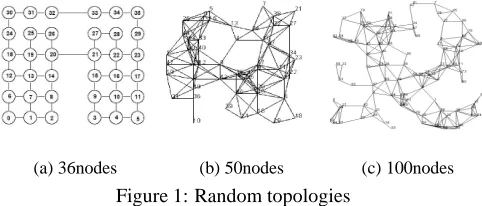
performance differently, although we would want to establish some general conclusions about performance trends. To this end, we use a 36-node irregular grid topology (fig 1(a)) used previously in [Boyan and Littman, 1993] to make valid com-parisons. Also, two random topologies of 50 nodes (fig 1(b)) and 100 nodes (fig 1(c)) are used.
Traffic patterns: Both uniform and non-uniform network
traffic is used. In the former, a common call origination probability (COP) exists for all nodes and remains constant throughout an experiment. Thus, the network faces a steady traffic inflow. In the latter, theCOPis selected randomly per node and then used to generate a call.
Information exchange algorithms: We compare SIE
against NSIE (with various TD values) by comparing their routing quality and message overheads across different topologies and load patterns. ASIEandNSIE are compared
similarly.
[image:4.612.314.566.97.160.2](a) 36nodes (b) 50nodes (c) 100nodes
Figure 1: Random topologies
We choose the following performance measures (as per [Dutta et al., 2005]):
Call success rate (CSR): This is the fraction of the number
of calls originating that actually get connected to their des-tinations. Given a network load and maximum node band-width, the more accurate the routing tables, the more likely it is that calls will be connected. Thus,CSRis a measure of routing quality (the coordination effectiveness).
Message size (MS): The size of an ack message is the number of state-values appended to it. The smaller the mes-sage size, the higher the bandwidth saved (the more efficient the information-sharing algorithm).
[image:4.612.59.300.402.505.2]We study the impact of communication selectivity (TD) on network performance. Such empirical results allow a system designer or user to examine performance tradeoffs across dif-ferent network environments. In this context, we can form subjective hypotheses such as: (i) smallTD generates good
Table 1:NSIEperformance: uniform load
COP
Topology 1 Topology 2 Topology 3
CSR MS CSR MS CSR MS
Avg Stdev Avg Stdev Avg Stdev Avg Stdev Avg Stdev Avg Stdev 0.1 0.487 0.003 3.86 0.022 0.493 0.003 3.52 0.015 0.287 0.003 4.026 0.042 0.2 0.328 0.001 3.16 0.014 0.363 0.002 2.95 0.009 0.217 0.002 3.31 0.023 0.4 0.213 0.0001 2.58 0.01 0.247 0.001 2.32 0.012 0.158 0.001 2.676 0.016 0.6 0.164 0.0004 2.26 0.009 0.191 0.0005 1.996 0.009 0.128 0.0006 2.365 0.016 0.8 0.134 0.0004 2.06 0.006 0.158 0.0004 1.80 0.007 0.108 0.0007 2.159 0.008
bandwidth savings and only slightly deteriorates call routing; or (ii) highTDgenerates significant bandwidth savings but significantly deteriorates call routing. In our experiments, first, the CSR and MS of the SIE and ASIE are compared against those ofNSIE using uniform load, followed by us-ing non-uniform load. The followus-ing parameter values are used (as per [Dutta et al., 2005]): ;
J EJ ,
1
J E#9 , and
maximum number of simultaneous calls per node is 10.
4.1
Uniform Load
Each experiment uses a constant COP chosen from the set
J EG9-J E J E
J E J E . Note, the higher theCOPvalue, the
more calls originate and, hence, the higher the network load.
Performance ofNSIE: Our baseline results (NSIE) are summarized in Table 1, showing the steady state averageCSR
and averageMSvalues for different topologies. For all topolo-gies, the averageCSRdecreases as the COPincreases (calls originating increase). With limited bandwidth (10 units per node), as theCOPincreases, larger percentages of originating calls fail to be connected. Hence, the CSRdecreases. Also, the average MS decreases with increasing COP. At higher
COPs, when all nodes generate large number of calls, only the short-distance calls connect. Having limited bandwidth, a node gets saturated with the calls that it originates. Then, the extent to which a node routes calls originating elsewhere decreases with increasingCOP. Sinceacksize is determined by the route length,MSdecreases with less long-distance calls connecting at highCOP.
Performance ofSIE: Table 2 shows the steady state
aver-age CSRandMSin the different topologies usingSIE when
J E#9 . This is the minimum value that
can take to have any communication selectivity, generating a baseline
SIE. For all other
, we get the same trends (excluded due to limited space).
In Table 2, the trends in bothCSRandMSare identical to those in Table 1. However, both of these in Table 2 are lower than the corresponding values in Table 1. Hence,SIEuses less bandwidth thanNSIE, but it has a slightly reduced call suc-cess rate. We then compare these across allCOPand
val-ues by generating the relative differences of the averageCSRs andMSs as:CSR
"
CSRNSIE: CSRSIE/CSRNSIE,
andMS
"
MSNSIEH: MSSIE/MSNSIE. Thus, the
higher the value ofCSR
"
, the poorer is the solution quality
ofSIE compared to NSIE. However, the higher theMS
"
,
the more efficient the communication ofSIE.
Studying the CSR
"
values (figure 2(a)) of topology 1,
we learn: (1) At anyCOP, for small
, theCSR of SIE is very close to that ofNSIE. Thus, when
K J E
Table 2:SIEperformance (
= 0.1): uniform load
COP
Topology 1 Topology 2 Topology 3
CSR MS CSR MS CSR MS
Avg Stdev Avg Stdev Avg Stdev Avg Stdev Avg Stdev Avg Stdev 0.1 0.484 0.002 1.938 0.015 0.492 0.004 2.455 0.016 0.274 0.003 1.89 0.02 0.2 0.325 0.001 1.50 0.011 0.363 0.002 2.067 0.011 0.212 0.001 1.60 0.011 0.4 0.207 0.0006 1.098 0.004 0.246 0.0009 1.612 0.006 0.156 0.0008 1.298 0.006 0.6 0.157 0.0005 0.891 0.006 0.190 0.0007 1.352 0.004 0.127 0.0006 1.124 0.005 0.8 0.128 0.0005 0.755 0.004 0.156 0.0005 1.18 0.003 0.107 0.0004 0.985 0.005
is less than 4.0% for anyCOP. When L
is low, communi-cation occurs for both small and large state-changes. Now, small state-changes occur at anyCOPvalue because the orig-ination and termorig-ination of few calls are more common than a larger number. Larger state-changes, however, occur more at higher COPs. Thus, for anyCOP, a low
value allows frequent communication. This keeps the RTs updated fairly well, thus, generating good call success rates (close toNSIE). (2) At larger
L
, theSIE CSRis significantly lower thanNSIE
whenCOPis small, but remains close toNSIEat higherCOPs. Thus,
L
J E causes a 32.0%CSR
"
whenCOPis 0.1,
but it is only about 3.0% when COP is 0.8. High
L
al-lows communication only for large state-changes. Now, large state-changes are rare at smallCOPs when nodes are sparsely occupied, and so is communication. Thus, the RTs are not up-to-date, causing poor routing and reducing theCSRofSIE. But, at higherCOPs, large state-changes (and communication) are more frequent; henceCSRofSIEis close toNSIE.
Studying the MS
"
values (figure 2(b)) of topology 1,
we learn: (1) At any COP, the larger the
L
, the larger is the MS
"
value. Since communication reduces with
, so does the MS of SIE (but not influencing the MS of
NSIE). These results confirm that larger bandwidth savings are achieved by making communication ever more selective. (2) At anyL
, a change inCOPdoes not significantly change theMS
"
value. Thus,SIE maintains a uniform advantage
overNSIEin terms of saving bandwidth for allCOPvalues. In summary, the significant result is that the bandwidth us-age improvement of SIE (up to 99%) clearly offsets its de-grading in routing (as low as 35%). More typically, we obtain 30-80% improvement in bandwidth efficiency at the expense of less than 5% degradation in routing quality. The results from the other topologies show similar trends.
[image:5.612.323.562.486.689.2](a) CSR difference (b) MS difference
Figure 2: CSRandMSdifferences betweenSIEandNSIE
Performance ofASIE: We study ASIE on a regular 6 6
grid where the centroid is the representative node (
) (sec-tion 3). Here, performance profiles ( ) represent
time-variations of the percentage deviations of globalCSRandMS
between NSIE and the one where only
uses SIE and all others useNSIE. InASIE, node selects that
which
gen-erates the least degradation inCSRfor theCOPvalue, at that time, in the profile. It then uses this
for its
communica-tion decision (equacommunica-tion (3)) until it chooses a new
. We select a period of 1000 time steps for storing performance profiles and, thus, for choosing a new
.
For each COP, we studied the frequency with which the
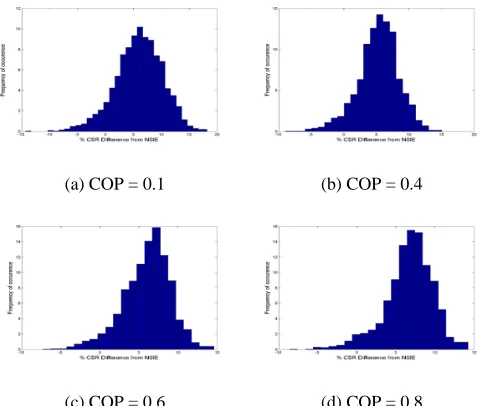
CSRofASIEdeviated from that ofNSIE (figure 3). In each graph, using a differentCOP, the x-axis shows the different (percentage) CSR deviations between ASIE andNSIE. The y-axis shows the (percentage) duration of a simulation run for which the correspondingCSRdeviation (the x-value) was observed. Thus, in figure 3(a), a 6%CSRdeviation was ob-served (ASIEworse thanNSIEby 6%) for 10.2% time of the simulation. We conclude: (1) At smallerCOPvalues,ASIE
performs better thanSIEby generatingCSRs that are closer to the baseline NSIE. Thus, the majority of the CSR differ-ences betweenASIEandNSIEis 4-6% forCOPless than 0.6. For the sameCOPvalues, the meanCSRdifferences between
SIEandNSIEis 8-16% (measured on the same topology but omitted here due to lack of space). So, theCSRofASIE is up to 12% closer to the benchmark thanSIE, implying a fur-ther improvement in the quality of task processing. (2) At higherCOPvalues,SIEperforms slightly better thanASIEby achieveingCSRs closer toNSIE. Thus, forCOPs 0.6 and 0.8, theCSRdifference inASIEis mostly 6-9%, while forSIEit is 4.5-5.6%. The slight decrease inASIEperformance compared toSIE is due to the limitation of a myopic algorithm (ASIE) in a dynamic environment (largeCOP).
Now studying theMSofASIEandSIE, we observe: For all
COP,ASIEensures higher bandwidth savings thanSIE:ASIE
saves up to 85-100% compared toNSIE, which is greater (by up to 10%) than the bandwidth savings ofSIE compared to
NSIE(plots omitted due to limited space).
(a) COP = 0.1 (b) COP = 0.4
(c) COP = 0.6 (d) COP = 0.8
[image:5.612.62.303.561.674.2]4.2
Non-Uniform Load
Having a dynamicCOP(varies between 0.1 and 0.9), we mea-sure performances over time instead of steady-state averages.
Performance ofSIE: Figure 4 shows the percentage dif-ferences of the CSR and the MS between SIE and NSIE for topology 1 (other topologies show similar trends). We con-clude: (1) The higher theTD, the smaller is theCSRofSIE
thanNSIE(poorer routing thanNSIE, figure 4(a)), and (2) the smaller is theMSofSIEthanNSIE(more bandwidth savings thanNSIE, figure 4(b)). More typically, 60-90% bandwidth
saving is achieved incurring less than 10% loss inCSR; fur-ther confirming thatSIE is more bandwidth efficient and its advantage thoroughly offsets its limitation.
0 2 4 6 8 10 12 14 16 18
0 10 20 30 40 50 60 70 80 90 100
% CSR Deviation from Non-Selective Comm
Time (x 20000) TD = 0.1
TD = 0.4 TD = 0.6 TD = 0.8 TD = 0.9
(a) CSR difference
50 60 70 80 90 100 110
0 10 20 30 40 50 60 70 80 90 100
% MS Deviation from Non-Selective Comm
Time (x 20000) TD = 0.1
TD = 0.2 TD = 0.4 TD = 0.6 TD = 0.9
[image:6.612.324.561.45.144.2](b) MS difference
Figure 4: CSRandMSdifferences betweenSIEandNSIE
Performance ofASIE: Here, we use the performance pro-files of uniform load experiments using the 6 6 grid
topol-ogy. This is a myopic choice since, with dynamic load, the COP values are different across nodes which was not
the case in uniform load. Now, at run-time, each agent es-timates the average COP (
) at its node over the past
(=1000) time steps. Then, it determines its
value as:
&
&
, where
CSR is the CSR
per-formance profile. TheCSRandMSdifferences between the above-mentioned ASIE system and NSIE are shown in fig-ure 5. We also runSIE to compare it against NSIE(results omitted due to space limitation). Our results show, with non-uniform load, ASIE performed better than SIE over all
. Thus, the mean CSR difference in figure 5(a), about 7%, is smaller than the minimumCSRdifference, about 8.1%, achieved bySIEacross all
, and the meanMSdifference in figure 5(b), about 99.9%, is larger than the maximumMS dif-ference, about 99%, achieved bySIE, across all
values. A fixedTDfor all nodes (as inSIE) is not an effective strat-egy in dynamic load. Rather, the nodes should adapt their communication behaviours; hence,ASIEoutperformsSIE.
5
Conclusions
Our novel protocol for selective information-sharing effec-tively trades off communication utility and cost in resource constrained MAS. It uses information redundancy for com-munication decisions to save bandwidth and achieve good coordination. Furthermore, it adapts the selectivity levels us-ing stored performance profiles. Empirical studies on a call routing problem shows, compared to the most effective com-munication strategy currently available, our protocol achieves
[image:6.612.58.299.229.339.2](a) CSR Difference (b) MS Difference
Figure 5: CSRandMSdifferences betweenASIEandNSIE
significant bandwidth savings, while achieving only a slightly lower throughput. The adaptive strategy achieves further im-provements over the non-adaptive one.
Acknowledgements: This research was undertaken as part of the ALADDIN (Autonomous Learning Agents for Decentralised Data and Information Systems) project and is jointly funded by a BAE Systems and EPSRC (Engineering and Physical Research Council) strategic partnership (EP/C548051/1).
References
[Boyan and Littman, 1993] J. A. Boyan and M. L. Littman. Packet routing in dynamically changing networks: A re-inforcement learning approach. In NIPS, pages 671–678, 1993.
[Dutta et al., 2005] P. S. Dutta, N. R. Jennings, and L. Moreau. Cooperative information sharing to improve distributed learning in multi-agent systems. JAIR, 24:407– 463, 2005.
[Gmytrasiewicz and Durfee, 2001] P. J. Gmytrasiewicz and E. H. Durfee. Rational communication in multi-agent en-vironments. JAAMAS, 4:233–272, 2001.
[Goldman and Zilberstein, 2003] C. V. Goldman and S. Zil-berstein. Optimizing information exchange in cooperative multi-agent systems. In AAMAS, pages 137–144, 2003. [Goldman and Zilberstein, 2004] C. V. Goldman and S.
Zil-berstein. Decentralized control of cooperative systems: Categorization and complexity analysis. JAIR, 22:143– 174, 2004.
[Haas et al., 2000] Z. Haas, J. Y. Halpern, L. Li, and S. B. Wicker. A decision-theoretic approach to resource alloca-tion in wireless multimedia networks. In Proc. of the
DIALM Workshop, pages 86–95, 2000.
[Shen et al., 2003] J. Shen, V. Lesser, and N. Carver. Mini-mizing communication cost in a distributed bayesian net-work using a decentralized MDP. In AAMAS, pages 678– 685, 2003.
[Xuan et al., 2001] P. Xuan, V. Lesser, and S. Zilberstein. Communication decisions in multi-agent cooperation: model and experiments. In Agents, pages 616–623, 2001. [Zhang et al., 2004] Y. Zhang, R. A. Volz, T. R. Ioerger, and
J. Yen. A decision-theoretic approach for designing proac-tive communication in multi-agent teamwork. In ACM Symp. on Applied Computing, pages 64–71, 2004. [Zilberstein and Russell, 1996] S. Zilberstein and S. Russell.