THE KEY TO EFFECTIVENESS.
CYNTHIA J. TURNBULL, B.Ed.
A DISSERTATION SUBMITTED IN PARTIAL FULFILMENT OF THE REQUIREMENT FOR THE DEGREE OF MASTER OF EDUCATIONAL STUDIES. CENTRE FOR EDUCATION,
; UNIVERSITY OF TASMANIA.
This dissertation contains no material which has been accepted for the award of any other higher degree or graduate diploma in any tertiary institution, and , to the best of my knowledge and belief, the dissertation contains no material previously published or written by another person, except when due reference is made in the text of the
dissertation.
ABSTRACT.
Professional development of staff members, from an organisational perspective, is an area to which minimal attention has been given within the hospital system. Those programs which have been provided have focused on a basic orientation program for new employees, and some continuing education sessions emphasising the use of equipment and new procedures. The allocation of fiscal resources to this area has been minimal, a planned, evaluated approach to the educational needs of staff being perceived as relatively unimportant.
achievement of organisational goals.
A positive correlation between organisational effectiveness and staff development is suggested within this dissertation, this hypothesis being supported by an examination of relevant literature. The distinction between professional development programs, emphasising clinical skills and updating of specialist knowledge, and staff development programs is made , the latter aimed at providing opportunities for personal and professional growth .
eliciting
The responses to a midwifery staff's
questionnaire aimed at perceptions about their educational needs are analysed, and an outline of possible programs for implementation discussed, attention being given to cost-effectiveness and evaluation.
ACKNOWLEDGEMENTS.
I would like to thank:
Dr. Brian Caldwell, of the Centre for Education, University of Tasmania, who has been my supervisor during the compilation of this dissertation.
The Nursing Administration staff at the Queen
Alexandra Division, Royal Hobart Hospital, who have acted as my sounding board during the development of my ideas for this dissertation.
The midwifery staff for their assistance with the completion of the questionnaire.
CHAPTER 1. CHAPTER 2. CHAPTER 3.
CHAPTER 4.
CHAPTER 5.
CHAPTER 6. CHAPTER 7.
TABLE OF CONTENTS.
STATEMENT OF ORIGINALITY ABSTRACT
ACKNOWLEDGEMENTS CONTENTS
LIST OF TABLES LIST OF FIGURES LIST OF APPENDICES
INTRODUCTION. PAGE
LITERATURE REVIEW. PAGE AN EVALUATION OF ORGANISATIONAL
EFFECTIVENESS. PAGE
ELICITING THE PERCEIVED STAFF DEVELOPMENT NEEDS WITHIN THE
ORGANISATION. PAGE
PROFESSIONAL DEVELOPMENT
PROGRAMS. PAGE
STAFF DEVELOPMENT PROGRAMS. PAGE THE KEY TO EFFECTIVENESS. PAGE
BIBLIOGRAPHY. PAGE
APPENDICES. PAGE
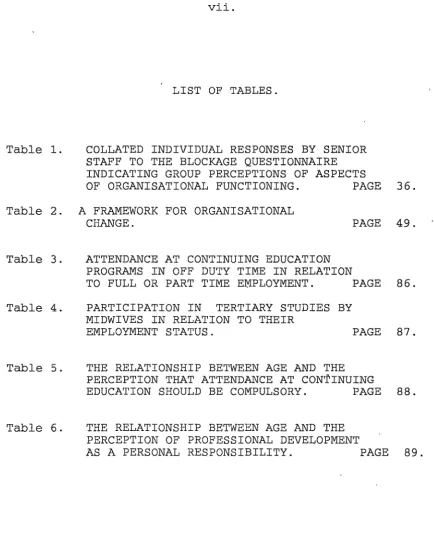
Table 1.
LIST OF TABLES.
COLLATED INDIVIDUAL RESPONSES BY SENIOR STAFF TO THE BLOCKAGE QUESTIONNAIRE INDICATING GROUP PERCEPTIONS OF ASPECTS
OF ORGANISATIONAL FUNCTIONING. PAGE 36. Table 2. A FRAMEWORK FOR ORGANISATIONAL
CHANGE. PAGE 49.
Table 3.
Table 4.
Table 5.
Table 6.
ATTENDANCE AT CONTINUING EDUCATION PROGRAMS IN OFF DUTY TIME IN RELATION
TO FULL OR PART TIME E~PLOYMENT. PAGE 86. PARTICIPATION IN TERTIARY STUDIES BY
MIDWIVES IN RELATION TO THEIR
EMPLOYMENT STATUS. PAGE 87.
THE RELATIONSHIP BETWEEN AGE AND THE PERCEPTION THAT ATTENDANCE AT CONTINUING
EDUCATION SHOULD BE COMPULSORY. PAGE 88.
THE RELATIONSHIP BETWEEN AGE AND THE PERCEPTION OF PROFESSIONAL DEVELOPMENT
[image:8.574.66.501.66.600.2]TABLE OF FIGURES.
Figure 1. DISTRIBUTION OF RESPONDENTS BY
AGE. PAGE 71.
Figure 2. TIME SINCE COMPLETION OF
MIDWIFERY. PAGE 72.
Figure 3 . LOCATION OF TRAINING SCHOOL. PAGE 74.
Figure 4. NURSING QUALIFICATIONS. PAGE 75.
Figure 5. PERCEPTION OF PROFESSIONAL DEVELOPMENT AS A PERSONAL
RESPONSIBILITY. PAGE 77.
Figure 6. SUPPORT FOR A PROFESSIONAL
DEVELOPMENT PROGRAM. PAGE 78.
Figure 7. FREQUENCY OF A WARD-BASED
PROGRAM. PAGE 80.
Figure 8. LENGTH OF SESSIONS FOR A HOSPITAL-BASED EDUCATION
PROGRAM. PAGE 82.
Figure 9 • INITIATION OF RESEARCH. PAGE 83.
Figure 11. FACTORS INFLUENCING PROFESSIONAL COMPETENCE AND EFFECTIVE
APPENDIX 1.
APPENDIX 2.
APPENDIX 3.
APPENDICES.
BLOCKAGE QUESTIONNAIRE. PAGE 152.
PROFESSIONAL DEVELOPMENT NEEDS
QUESTIONNAIRE. PAGE 158.
PEARSON PRODUCT-MOMENT
CORRELATION COEFFICIENT ANALYSIS.
INTRODUCTION.
'The failure to measure the economic value of people may cause managers
to ignore the effects of their decisions upon the value of human resources. The problem is a tendency for management to base decisions only on variables which can be quantified. Thus, so-called
intangibles such as human resources tend to be ignored. Consequently, a decision or policy that seems beneficial may actually harm an organization by
unintentionally depleting human resources. For example, decisions to undertake cost-control programs are typically based upon expected cost savings without consider-ation of the effects of such programs upon employee attitudes, motivation and satisfaction. Yet, these programs may cause deterioration in employee motivation and satisfaction which is equivalent to a liquidation of human asset value.'
(Flamholtz, cited in Owens, 1981. p. 325.)
personal growth potential within each individual midwife, the effective use of all available human resources can be encouraged, with the resultant improvement in both staff satisfaction, and the achievement of organisational goals.
The failure of nurse administrators to recognise and effectively utilize the potential within each member of the nursing staff to improve organisational effectiveness
has been demonstrated within the hospital system Little attention has been given to aspects of organisational
functioning which encourage creativity and
intrapreneurship, and nurses have not traditionally been included in the decision making processes. This results in both wasted human resources, and diminished job satisfaction
A literature review was undertaken, this demonstrating the need to differentiate between those programs focusing on professional development, such as orientation and continuing education programs, and staff development, which encourages personal growth as an adjunct to improving organisational effectiveness. Neither of these
programs, however, will be successful without an
organisational climate which is encouraging of participation by staff members. The identification of constraints within the Organisation which may mitigate against the success of the planned program implementation are outlined, emphasis being placed on the means by which lack of motivation could be overcome.
Before an educational program could be developed, i t is necessary to evaluate the present functioning of the Division. This is undertaken from two perspectives - the
senior staff were asked to evaluate aspects of
organisational effectiveness, using a Blockage
articulated concerns. The ability of the Organisation to change is also assessed, based on a model suggested by Peebles, 1987. The results of this assessment indicated i t was possible for the Organisation to change in order for the planned professional development program to be successfully implemented.
The perceptions of staff members concerning the need for a professional development program are elicited through a developed questionnaire. If such a program was to be accepted by staff members, who would be participants, i t is considered necessary
proposed implementation.
to canvass their opinions on the Demographic data is also elicited as part of the questionnaire, this providing some valuable information upon which future staffing requirements can be based. The responses to the questionnaire are analysed, these providing an indication of the frequency, type, and subjects preferred by respondents in relation to educational opportunities which may be provided.
Professional development programs, including orientation programs, and ward based continuing education sessions, are outlined, some aspects of costing and evaluation being included. Staff development programs, aimed at improving staff participation in organisational functioning, while increasing job satisfaction and personal growth, are investigated from the
members, the curriculum
perspective including
of differing those personal
group and leadership skills which could assist the attainment of organisational goals.
Throughout this dissertation the relationship between staff participation in planned educational programs, and the effective achievement of organisational goals has-been highlighted. All available human resources need to be efficiently utilized for the benefit of the organisation, and i t is hypothesised that an educational program focusing on professional and personal development could provide a basis which ensures all members of the midwifery staff at the Queen Alexandra Division are given ~rk~ opportunity to participate in the planning, implementatio~
patient care is achieved.
In summary, the dissertation comprises seven chapters, outlined below. The relevant literature is reviewed, emphasis being placed on those aspects related to professional development, staff development, organisational climate, and the constraints which hinder participation in educational
functioning
programs.
and climate is
The present assessed by
organisational means of two questionnaires, one evaluating aspects of organisational management, and the other indicative of the Organisation's ability to change. The development of a questionnaire aimed at eliciting midwifery staff's perceived professional development needs is discussed, and responses analysed. Attention is then paid to the possible programs which could be developed, these being outlined under the differentiation of professional development and staff development programs.
CHAPTER 2.
LITERATURE REVIEW.
'The quality of working life is enhanced not just by meeting people but through working and learning with others. The work place is rich in possibilities of
creating something new through cooperation, i t is a place where human beings can both give and take and mean something to each other, and develop and mature.
(Skertchly, 1981, p 15.)
INTRODUCTION.
which has been largely underutilized in recent times. Due to lack of challenging educational opportunities within a safe organisational climate, many individuals are unaware of their own
potential~
(Skertchly, 1981, p. 19).An analysis of the means by which this potential can be realised forms the basis for this study.The need to define the terms used in the development of a staff improvement program has created some divergence
in the literature, but for this discussion the
differentiation outlined in Duke (198~ p. 162) has been chosen as the most appropriate. The three areas outlined are professional development, organisational development, and staff development, although there is a common goal implicit in each of these - namely effective outcomes for the organisation as a whole.
program for staff within the Queen Alexandra Division. There are a number of constraints which need to be elucidated as their influence on the success of the planned program is crucial. Motivation is one of these factors which is examined, and research findings in relation to the implementation of similar programs is evaluated to assess their relevance to this project.
PLANNING FOR A PROFESSIONAL DEVELOPMENT PROGRAM
Duke ( 1987) has addressed his thoughts to the education system, but there appear to be many parallels between this and the practice of midwifery within the health care system. Professional growth, based on those experiences which bring about an improvement in performance, attitudes or understanding, is an essential component of professional practice, and as such needs to be nurtured and encouraged by supervisors within an organisation. Scrima (1987, p. 41) has noted that
discipline, has
nursing, of a knowledge base
which midwifery with a half life
maintain clinical skills in a climate which is dynamic and technicologically advancing, are means by which the stressors associated with decreased job satisfaction can be minimized or, in some instances, overcome. However, as noted by Dodwell and Lathlean ( 1987) 'by viewing nursing as primarily a manual craft, too much emphasis has been put on the mechanics of nursing, and not nearly enough on the intellectual, social and creative elements of nursing.' (p. 311), The authors go on to suggest:
'The time is now right to supplement the deficiencies of the ·past by offering innovative training programmes that are creative, job related and flexible enough to meet the needs and the complexities of this role, thus enabling individuals to contribute further to their organization, enhance their_ future career prospects and promote excellence in nursing.'
(Dodwell & Lathlean, 1987, p,312.)
levels of motivation and enthusiasm, a tendency towards creative thinking, and acceptance of the need for change and development among the participants. (Dodwell & Lathlean, 1987, p 317.) These altered behaviours have implications for improving organisational effectiveness.
Key attributes affecting the outcome of professional development experiences have been noted as level of competence,
orientation
personal expectations,
to change, and
openness to familiarity
criticism, with the organisation. (Duke, 1987, p.139. ). By focusing on each of these, desired outcomes of personal and professional growth may be enhanced, although aspects of supervision and evaluation play an important role in their achievement. Three stages of professional development have been defined within a beginning practitioner. (Fuller, cited in Duke,
1987, p.140 ) If these are applied to registered midwives, the analogy made would suggest that initial concerns are focused on survival issues - practice within a work setting, with its concomitant requirements of knowledge and
responsibility. Once mastery of these has been obtained,
~--the second level of concern focuses on the work situation
itself the resources available, the planning and
of clinical practice are maintained, and this differentiation is discussed in the next section.
STAFF DEVELOPMENT PROGRAMS.
Staff development focuses on changes in people (Duke, 1987, p. 162), including changes in knowledge, behaviour, understandingJand attitude. It may be considered as the promotion of group improvement, ensuring that there is growth and movement towards a cornmo~ly defined goal, or outcome. Little, evaluating the outcomes of two teacher staff development programs, suggests that :
' ... staff development is most influential where it: (1) ensures collaboration adequate to
produce shared understanding, shared investment, thoughtful development, and the fair, rigorous test of selected ideas; (2) requires collective participation in training and implementation;
(3) is focused on crucial problems of curriculum and instruction; (4) is conducted often enough and long enough to ensure progressive gains in knowledge, skill and confidence; and (S)is congruent with and contributes to professional habits and norms of collegiality and experi-mentation.'
( cited in Duke, 1987, p 166.)
the needs of registered midwives, the outcomes above would remain valid goals, although the focus of the problems mentioned above would be on knowledge and its clinical
application.
mastery, requires participation in increasing areas of responsibility, self governance, standards of practice in relation to education, practice and research, and participation in activities on a wider front, such as within the community. (Sovie, 1982, p. 29 ) There appears to be a strong correlation between these three identified components of a professional career path, and the three areas of concern identified by Fuller.
'Personal expectations play a key role in determining behaviour.' (Duke, 1987, p. 140.) The recognition of personal expectations in relation to a staff development program can assist in both the development of such a program, and in diagnosing problems related to participation and outcomes. Individual expectations may be associated with perceived level of competence, or with personal goals. Associated with personal expectations, the need to view a learning program from the perspective of a mature learner is of utmost importance. Skertchly· (1981, p.16 ) has outlined four basic assumptions about adult learners:
themselves as self-directing, responsible people. 2. Previous experience is the basis for future
learning, which necessitate learning activities which encourage the participation of group member.
3. Adults enter learning activities with a quality of experience and developmental tasks which differ from younger learners.
4. A learning activity is undertaken with the more immediate intention of application to life I work problems.
Wood et al (1982 have outlined a model for staff development based on ten assumptions. These are:
1. All professional personnel need inservice
throughout their career.
2. Significant improvement in professional practice takes time and long term educational opportunities.
3. Inservice education should focus on improving the quality of the end product.
4. Professional practitioners are motivated to learn when they have some control over their learning, and are
free from threat.
5. Practitioners vary widely in their competencies and readiness to learn.
6. Professional growth requires a commitment to altered performance standards.
7. The success of professional development is influenced by the organisational climate.
8. The practice setting is the most appropriate target for change.
for allocating resources for inservice education.
10. The leader is the key element for the adoption and maintenance of new practices and programs within the organisation.
(Wood et al, 1982, pp.29-29.)
The ability to recognise the need for change is also an important component if professional and personal growth is to occur, and associated with this is the need for organisational change, and the 'development of an organisational climate which encourages participation in available programs. The third aspect of differentiation suggested by Duke (1987) as crucial in the development of staff, organisational development, is investigated in the following section.
ORGANISATIONAL DEVELOPMENT
organisational outcomes, can be differentiated from staff development, although there is a tangible link between the two.
'One of the dominant concepts that has
of planned, controlled, and directed social change. It is a world-wide belief today that societies need not be confined to events as they unfold but they can
consciously direct the forces of change
to suit predetermined goals and social values. A related and equally important trend ... is the emphasis upon the growing belief that planned and control- led change in individual lives are not only possible but necessary if the long range goals of each one of us are to be realized ... Although there is some debate about the power of education systems to create societies, there is little argument that
planned social change is supported by compatible educational systems.
(Owens, 1981, p. 234.)
The analogy could be made that a hospital is a society in itself, and thus change could be achieved through the development of an effective educational program. One measure of organisational health is the continuing ability
resource utilization, cohesiveness, morale, innovativeness, autonomy, adaptation and problem solving adequacy. All of these equate with the characteristics of effective companies categorised by Peters and Waterman (1982) as follows:
1. They have a bias for action.
2. They are responsive to the needs of their customers.
3. They encourage autonomy and intrapreneurship. 4. Emphasis is placed on equality among employees.
5. Values are articulated and form the basis for action.
6. They recognise their particular expertise and
maintain this.
7. The management structure is simple.
8. They encourage autonomy and decentralization, whilst maintaining core values.
(Peters and Waterman, 1982, pp 13 - 15.)
'administration must be an active partner involved in the development process' (1981, p. 257), a point which is emphasised in Millohig, (1986, p, 71). The need to reallocate resources remains one of the crucial factors in facilitating change within the organisation if participation in staff development programs is to be achieved. The establishment of a climate within the organisation which encourages growth is a very important adjunct to the planning of professional development programs.
'Organizational climate is a relatively enduring quality of internal environment of an organization that (a) is experienced by its members, (b) influences their
behaviour, and (c) can be described in terms of the values of a particular set of characteristics (or attributes) of an organization.
(Taguiri & Litwin, cited in Owens, 1981,
p 193.)
enhancing organizational climate.' He goes on to say: 'This is a climate that characteristically a) is intellectually, politically and
aesthetically stimulating.
b) emphasises individual and group achievement.
c) places high value on the pe~sonal dignity of individuals.
d) accepts divergent feelings and views in a non-judgmental way.
e) is oriented to problem solving rather than winning or losing in intraorganizational skirmishes.
(Owens, 1981. p 263.)
' I t seems useful to differentiate between two major sources of rewards for group members. One reward source is the mutual satisfaction, or reinforcement,
that individuals get from interacting with other individuals. The more satisfaction for group members as a result of this interaction, the higher the interactional effectiveness of the group. Interactional effectiveness is an important characteristic of a pychological group. Another source of rewards for group members comes from actual implementation of the group's purposes. The more satisfaction for group members as a result of doing the task, the higher the task effectiveness of the group. Task effectiveness
and interaction effectivness compose group effectiveness. The more
satisfaction for group members as a result of interaction effectiveness and task effectiveness, the higher the group effectiveness.'
(Sergiovanni & Starratt, 1983, pp 157 -158.)
1
Transformation emphasises an expanded sense of personal identity and an increased awareness of the inter-connection of persons within an organisation as well as the
relationship of the organisation to a larger culture ... The under-lying belief is that responsible participation can serve to empower the whole and create a work life that is meaningful and satisfying to everyone. This empowerment is brought about by creating working conditions that encourage people to work towards their full potential.'
(Peterson & Allen, 1986, p 10)
IDENTIFICATION OF CONSTRAINT FACTORS.
Some major constraints to the successful
implementation of an educational program for staff are limited time, lack of replacement staff, and reluctance by midwives to accept responsibility for the maintenance of their clinical skills and professional development.
(Davies, 1984.) However, Zahder ( 1983 ) has noted that the actual costs to the organisation for providing its own educational programs are far outweighed by the benefits obtained. A survey conducted by Haw et al (1984) identified the following facets as impacting positively on nursing job satisfaction, morale and turnover: learning opportunities; promotion opportunities; recognition; participation in decision making; helping patients; work load; amount of
responsibility; use of skills; relationships with
co-workers; and the work schedule. (p. 10 An analysis of these illustrates a close analogy to the motivating factors outlined in Herzberg's model of motivational forces.
care and educational opportunities provided the major sources of job satisfaction irrespective of the level of training, experience, work setting, position or age of the respondentst (Rowe and Manning, 1987.)
One of the development educators
major problems faced is that of motivating
by staff nurses to participate in the programs offered. Herzberg (cited in Owens, 1981, pp. 120 - 127 )postulated that organisational rewards can be divided into two broad categories maintenance or extrinsic factors, and motivators or
~ntrin~ic factors. Maintenance factors are largely related to preventing job dissatisfaction, while motivators are closely related to increasing job satisfaction, and t~us
organisation :
1. Redesign work. practices to tap the motivational potential of individuals.
2. Increase autonomy, which could be improved by participative decision making.
3. Increase the motivational factors present within the
work situation by a changing focus on personnel
administration.
-been
It would appear successfully adapted
professional growth. There is a visible commitment to educational improvement for staff. Staff members are encouraged to be innovative and creative in their approach to patient care, and the resulting effect on hospital staffing is most noticable - retention rates are greatly ~ increased. Critics of Herzberg have suggested the implied relationship between job satisfaction and organisational effectiveness which is inherent in the model has not been proven, although i t is acknowledged that that dissatisfied workers are not usually effective. (Owens, 1981. p 124.) However, the connection between job satisfaction, staff retention and organisation effectiveness - measured by the quality of patient care has been made by Kramer and Schmalenberg. (1988, p 14.)
'Whatever the dynamics, the inference and
relationship between retention of qug,_~ified ()( nursing staff and quality patient care is
exant throughout the magnet hospital report.'
I
The motivational problem, however, goes beyond r encouraging midwives to attend educational programs - they must also be motivated to active learning, and to the
(O'Connor, 1982.) A survey of adult learning behaviour
demonstrated that the single most important predictor of participation in a educational program is the learner's past level of educational attainment. (Cross, cited in Millonig, 1986 p. 70) The level of position held is also a factor -staff nurses participated least, with administrators participating the most. (Millonig, 1986, p 71.) One conclusion which could be postulated from this latter research is that administrators have the ability to manipulate their time schedules to allow participation, a conclusion which demonstrates the need for a climate of acceptance for the need for continuing education programs, for all levels of staff within the organisational hierarchy. It may also be necessary to ensure some form of recognition is given for participation in educational programs, particularly for those staff with low motivational levels or inflexible roster schedules.
participation. The social group whom these nurses indicated most frequently as supporting their attendance at continuing educational programs was their professional organisation, with professional peers being the second most significant group. The least mentioned social group was the family, and yet the respondents indicated that the family was the group with whom they would normally comply. 82% of respondents indicated that their primary reason for attending educational programs was to keep up with changes and keep informed. (Parochka, 1985, p. 34.) Participation barriers were listed, in order of priority, as money, time, work conflict, family commitment, illness, transportation, child care, and miscellaneous others. These findings should be given consideration if a commitment to continuing professional development programs is sought. Sugarman,
family commitments. Sugarman commented ' i t is interesting to note that although 74% of the staff midwives did feel that study group sessions organised specifically for them were a good idea, there was still a relatively low attendance rate.' (1988. p · 36) However, in this study the greatest hindrance to attendance was part-time employment. Participants in this study noted that i t was necessary for each study day/topic to be completed within one session, as attendance on a continuing basis could not be guaranteed
There is a need for planned development programs for midwives - whether these be orientation programs, continuing education,; or staff development. As noted by Grant ( 1987)
' (these programs) can be regarded as an investment both for the present and the future, and one which pays dividends.'
SUMMARY.
implementation of a staff education program. Such a program would need to be implemented from two main perspectives - professional development, in which emphasis is placed on orientation and continuing education programs to ensure syandards ...__ of care and current knowledge is maintained; and staff develppment, in which emphasis is placed on the individual staff members, and is aimed at providing an opportunity to enhance job satisfaction, personal satisfaction, and organisational health. The major constraints to the implementation of an educational program have been highlighted, and these will be considered in later chapters when implementation processes are discussed.
Organisational change, and the need to provide a
/v-e..N...-supportive 'climate, was highlighted, and this aspect will be
r
CHAPTER 3.
AN EVALUATION OF ORGANISATIONAL EFFECTIVENESS.
INTRODUCTION.
There is a perceived need to evaluate the organisational effectiveness of the Queen Alexandra Division prior to commencing a staff development program to ensure that the change involved in such an implementation would be
successful. This chapter evaluates organisational
effectiveness from two perspectives firstly, senior nursing staff's perception of the organisation and its present structure and function is outlined, using the Blockage Questionnaire developed by Woodcock and Francis
(1979).
that an organisational climate which is not conducive to change will need altering prior to the implementation of the proposed staff development program.
AN ASSESSMENT OF. ORGANISATIONAL FUNCTIONING .
. Woodcock and Francis (1979), in outlining aspects of organisational behaviour which may influence effectiveness have suggested twelve areas in which 'blockages' may occur. These are recruitment and selection; organisational structure; level of management control; staff development; motivation; creativity; team work; management philosophy; management development; aims and goals; rewards;and personal stagnation. A Blockage Questionnaire, aimed at assessing these components of organisational effectiveness, was developed by Woodcock and Francis as a tool to assist in evaluation. (Appendix 1.) This questionnaire was completed by the senior staff at the Queen
A&/l:.,
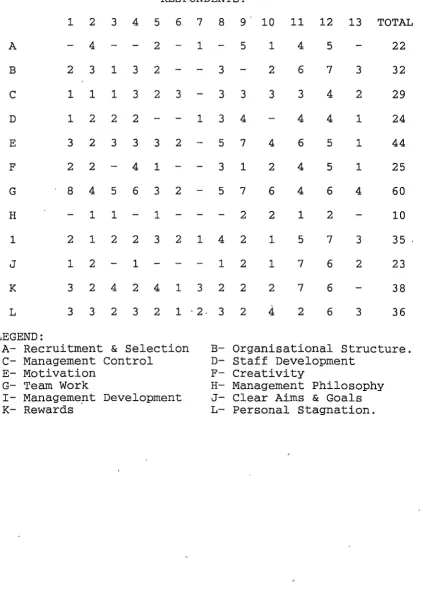
TABLE 1.
COLLATED INDIVIDUAL RESPONSES BY SENIOR STAFF TO THE BLOCKAGE QUESTIONNAIRE INDICATING GROUP PERCEPTIONS OF ASPECTS OF ORGANISATIONAL FUNCTIONING.
RESPONDENTS.
1 2 3 4 5 6 7 8 9 10 11 12 13 TOTAL
A 4 2 1 5 1 4 5 22
B 2 3 1 3 2 3 2 6 7 3 32
c
1 1 1 3 2 3 3 3 3 3 4 2 29D 1 2 2 2 1 3 4 4 4 1 24
E 3 2 3 3 3 2 5 7 4 6 5 1 44
F 2 2 4 1 3 1 2 4 5 1 25
G 8 4 5 6 3 2 5 7 6 4 6 4 60
H 1 1 1 2 2 1 2 10
1 2 1 2 2 3 2 1 4 2 1 5 7 3 35
J 1 2 1 1 2 1 7 6 2 23
K 3 2 4 2 4 1 3 2 2 2 7 6 38
L 3 3 2 3 2 1 '2- 3 2
4
2 6 3 36 LEGEND:A- Recruitment & Selection B- Organisational Structure.
c-
Management Control D- Staff DevelopmentE- Motivation F- Creativity
G- Team Work H- Management Philosophy I- Manageme,nt Development J- Clear Aims & Goals
[image:46.573.77.501.176.770.2]An analysis of participating staff indicated there were six charge sisters, three education staff, two
supervisors and two deputy charge sisters who completed the Blockage Questionnaire. Some individual analysis is warranted to explain some of the wide variations in perception prior to commenting on the results as a whole.
considered motivation a problem within the Division, and this needs to be addressed.
As a group, there was perceived difficulty with team work, motivation, rewards, personal stagnation, management development and organisational structure. These will be investigated individually. The lack of team work within the Queen Alexandra Division is seen by the author as
one of the major problems at present affecting
organisational effectiveness. This is due to a variety of reasons, the major ones being the geographical isolation between the different units, the lack of opportunity for grovp discussion and problem solving, and limited management experience, both theoretically and practically within the senior staff.
qualifications Chapter Three
As indicated of the staff
the majority
by an analysis of educational at the Queen Alexandra (see of staff have not attended further educational institutions on completion
in part due
of their to lack of midwifery certificate. This is
positions to have such qualifications, and there are limited inservice programs available. One of the problems associated with previous inservice programs is that, due to staffing difficulties, senior staff could not be released from ward duties. Poor teamwork can be recognised by a failure to ·reach organisational goals; lethargy and lack of motivation amongst team members; competition between group members; and a lack of integration. (Woodcock and Francis, 1987, p. 69.) It is the author's belief that aspects of poor team work within the Division can be demonstrated by some of the above. Organisational goals have been articulated, but many staff members are mainly concerned with the goals of
their particular unit ( there are seven individual units within the Division) rather than the overall organisational
goals. This could be overcome in part. by increased opportunity for the senior staff to meet and discuss their goals and problems, this opportunity being one of the major benefits of the proposed staff development program.
the Blockage Questionnaire - and this is one area which clearly needs to be addressed. Since the appointment of a staff development officer for the Queen Alexandra Division there has been a noticeable improvement in the motivation levels of staff at all levels, and i t is felt that the implementation of a planned program would greatly increase this already started motivational force. Due to the unitisation of the Division, and the perceived need to compete for both power and resources, the staff have not been functioning as a team. Improved communication between the individual units, and a planned rotation of junior staff through each unit is expected to have the positive effect of improving team work for the Division as a whole.
This could be supported by the very low level of concern expressed by most respondents to the Blockage Questionnaire in relation to the aspect of management philosophy. Staff members are actively encouraged to participate in organisational committees, both on a voluntary and a co-opted basis. An 'open-door' policy is espoused, with every staff member being encouraged to seek assistance as necessary.
conununication is improving and becoming more open, and there appears to be a wider concern for the problems faced by individual group members.
As mentioned previously, motivation was perceived as an area of high concern. Herzberg (cited in Owens, 1981)has postulated that maintenance factors, such as monetary rewards, are not motivating factors, but that motivation comes from such aspects as achievement,
recognition, responsibility, advancement, and personal and professional growth. It is therefore to these aspects that
~
are encouraged. Personal and professional growth is the basic criterion for the proposed staff development program, and i t is perceived that, on implero7ientation
v of this ~
program, motivation should increase within the participating staff members. At the present time a career structure for nurses is being sought industrially, and this should provide an overt means for advancement, which may also lead to improved motivation.
performance.
·Personal stagnation was articulated as an area of concern within the Queen Alexandra Division. Woodstock and Francis (1979) have noted that the unique capacities and inclinations of individuals can often be lost within a bureaucracy (p 89) but this can be prevented by creating conditions which encourage personal growth. They suggest that the setting of organisational standards which challenge individuals can assist in the development of an organisational climate
involvement in problem
which encourages creativity and solving. Much of the discussion related to preventing personal stagnation can be equated to the principles of adult learning, and this is one of the underlying concepts which would be espoused by the proposed staff development program.
the development of sound management principles for senior personnel, and this needs to be addressed as a matter of priority. The organisational structure may alter with the proposed implementation of a career structure, but in the short term, attempts are being made to encourage senior staff to accept more responsibility for the management of their individual units, thus effectively flattening organisational control.
The assessment of the Blockage Questionnaire has provided a valuable tool by which present organisational functioning, as perceived by senior staff, could be evaluated. However, if organisational effectiveness is to be improved, th~\ ability of the Division to change and "\' accept an altered perspective is an important consideration. To this end, the model to assess an organisation's ability to respond to change proposed by Peebles (1987) is utilized.
EVALUATING ORGANISATIONAL CHANGE.
framework for the model covered change strategies, corporate planning, cormnunication and consultation, organisational culture, participant management and leadership. The use of this model to assess the ability of the Queen Alexandra Division to change may provide a further indication for the possible success of the planned staff development program. The questionnaire was completed (See Table 2.) and from this i t was obvious that the organisation did have the ability to accept change, the majority of responses being in the affirmative. However, i t is considered necessary to expand upon some aspects of each section of the questionnaire. CHANGE STRATEGIES.
this answer was given in the affirmative.
Goals within the Queen Alexandra Division have been prioritised. An articulated vision for the Nursing Division has been circulated, and from this short and long term goals developed. These have been distributed to all units, and are freely available to the staff for discussion. These will form one of the bases for evaluation of organisational goals at the end of a twelve month period, when they will be reviewed and re-articulated as necessary.
A support network has been established to support the planned change. Within each of the planned educational programs an evaluation and group discussion session is planned to ensure the goals of both the organisation and the participants have been met. The staff development officer has, as one of her functions, a counselling role, and within this is the expectation of support for individual staff members.
A FRAHE"JIORK FOR ORGANISATIONAL CHANGE
1. CHANGE STRATEGIES:
a) Has the change to the organisation been planned? b) Is there evidence of prioritising organisational
goals?
c) d)
e)
Is there a provision for a support network to assist the change process?
Is there a feedback and change process?
evaluation
Is the organisation prepared for the change?
YES NO
0
D
0
D
D
IZI D
0
D
[Katz & Kahn; Owens and Steinhoff; Havelock; Cunningham; Toffler; Schein & Bennis; Ackoff; Kanter.]
2. CORPORATE PLAN
a) Does a Corporate Plan exist?
(If NO, do not continue in this section) b) Does the Corporate Plan
include:-i) goal setting? ii) policy making? iii) short-term plans?
iv) medium-term plans? v) long-term plans? vi) budget implications? vii) an evaluation process?
c) Does the Corporate Plan cover the entire org-anisation? (i.e. "all-over-at-once"planning)?
d)
e)
f)
Is the Corporate Plan interactive? Is the Corporate Plan the result participative process?
Is the organisation's continuous process?
52
Corporate
of a
Plan a
YES NO
D D
D
D
D D
D D
D D
D D
D D
g)
h)
i)
Has the Corporate Planning process considered the environment in which the organisation operates?
Have strategic and operational plans been clearly identified?
Does the Corporate Plan belong: to the entire organisation?
YES NO
D
D
[J
D
D D
[Caldwell; Ackof f ;. Howe; Owens & Steinhoff; Have lock; Cunningham; Bowles & Gintis]
3) a) b) c) d) e) f) g) h)
COMMUNICATION AND CONSULTATION
Are these adequate and effective communication "channels" within the organisation?
I f so, are these "channels" multi-diiectional? Does the organisation discourage "short circuiting" communications channels?
Does the organisation discourage specific exclusion from information sharing?
Are staff who have a stake in the outcome of decisions allowed or encouraged to make an input
i~to such decisions?
Are staff who have an expertise in particular areas always consulted before decisions affecting those areas are taken?
Is management open and honest with staff? Is information easily shared between management and staff?
[Barry & Tye; Cunningham; Bridges; Hoy & Miskell
4) ORGANISATIONAL CULTURE
a)
b)
Is the "culture" of the organisation recognisable?
Have the common beliefs and values of staff within the organisation been considered in view of the planned change?
53
YES NO
~
~
[!]
0
D
0
D
G2f
D
lZJ D
D
YES NO
c) d) e) f) g) h)
Have all accepted organisational conventions and courtesies been extended?
If the organisation operates at more than one location, has allowances been made for variances
of culture~
Ha~e staff been encouraged to express their "vision" for the organisation?
If so, have staff visions been considered in the planned change process?
Does the organisation's management share the common culture of the organisation?
Are staff committed to the success of the organisat:j.on?
YES NO
D D
D
D
[Fink; Jenks & Willits; Hoy & Miskel; Hilmer; Sergiovanni]
5) a) b) c) d) e) f) g)
PARTICIPATIVE MANAGEMENT
Do workers participate in decision processes which effect them?
Do formal work teams exist?
making
Are all groups and key personnel represented in organisational decision makingJ
Are group interactions easy?
Are staff sharing authority and responsibility with management?
Is the staff "satisfied" with their work? Is productivity up to the level it could be? [Abrahamsson; Watson; Cunningham]
6) LEADERSHIP
a) Does the leader have the same "vision" for the organisation as the staff?
b) Does the leadership style suit the organi-sation's culture?
54
YES NO
D
D
EI D
~
D
D
0
YES NO
0
D
c) d) e) f) g) h) i) j) k) 1)
Does the leadership style suit the situation? Is the leader a good communicator?
Is the leader a good listener?
Does the leader allow involvement in decision making?
Is the leader "in touch" and understanding of the history and culture of the organisation? Does the
variables?
leader focus on key issues and
Does the leader express strong feelings about attaining the organisation's purpose?
Does the leader trust others?
Does the leader approach problems in terms of the present and future?
Is the leader capable of continuing without approval and recognition from others?
YES NO
D
0 D
D
D
D
0
D
0
D
D
[Fiedler & Chemers; Kanter; Bennis & Nanus; Peters & Waterman; Owens; Vaill; Hersey & Blanchard; Sergiovanni]
the Division are aware of the planned change, and appear very supportive.
CORPORATE PLAN.
There is no overall corporate plan for the Queen Alexandra Division, or for the Royal Hobart Hospital, although the latter is in the process of development. This creates a great deal of difficulty in program budgeting, and this omission needs to be addressed at the earliest opportunity. However, i t is outside the jurisdiction of the author to develop such an encompassing document, although the need for one is clearly recognised. This section of the model for assessing organisational change is therefore answered in the negative,
COMMUNICATION AND CONSULTATION.
communication on an administrative or planning level between the medical and nursing staff, although efforts have been made to remedy this. This is an ongoing problem, and must be addressed. This communication channel, however, will not effect the planned change, as i t is directed at nursing staff only. Some difficulty exists in ensuring adequate communication below senior staff level. This is being addressed by the provision of monthly staff meetings, held between registered midwives and the Assistant Director of Nursing. Senior personnel are requested not to attend, this being the request of the registered staff. The agenda for these meetings encompasses three main goals - to enable staff to raise any issue they see as important, to pass on the happenings around the Division from an administrative point of view, and to enable staff from all units to have the opportunity of talking together. These meetings have proved to be of great value, in that comments and discussion
~~~c ~
has originated from staff members themselves, afild attendance
--'·numbers from all areas has been good. It is planned these meetings will continue on a permanent basis.
availability to staff, and through this i t is hoped "short circuiting" of communication channels is achieved. New initiatives are encouraged, and all staff are encouraged to participate on committees investigating current issues. Obviously numbersbf such committees need to be limited, but
!
the opportunity is offered to as many as possible. This has already proved to be one very successful means by which personal development has occurred in those staff members who have participated. It is hoped all , information is shared with all staff members - this is one of the short term goals of the Nursing Division, and there does appear to be an improvement in this area. In instances when particular expertise is needed, committees are formed by invitatipn to ensure that all possible relevant input has been sought.
It is the author's contention that the communication channels within the Division are adequate,although there is an articulated aim of improving these. Effectiveness of communication is improving, and this has led to a largely affirmative response to the diagnostic questions developed by Peebles.
ORGANISATIONAL CULTURE.
If consideration is given to the organisational culture from a nursing perspective, this is recognised by a clear majority of the staff. A philosophy is articulated, the aims of the organisation have been outlined, and the norms and values well understood. Most midwives agree with the philosophy of the Division, and their practice is based accordingly. However, i t would be negligent to assume that there is no dissent. The author would assert that this dissent is in fact healthy, and can provide a basis for both discussion and evaluation of goals. The Nursing Division
philosophy is based on a family-centred,
non-interventionist, participatory model of maternity care. This does not necessarily agree with the medical philosophy, and at this point the organisational culture may be at variance. This latter fact does create some ambivalence within the nursing staff.
have indicated their support for the education program, and are thus committed to its success. As the approach to the planning of the educational program will be based on the articulated needs of the participants, in line with adult learning theory, i t is postulated that this commitment will be overt.
PARTICIPATIVE MANAGEMENT
The means by which participation in the decision making processes within the Queen Alexandra Division is encouraged has· already been noted. Formal teams do exist within the Division, if i t is considered that each unit works separately for a common goal. It is hoped that other teams will develop as a result of the planned educational programs. Group interactions are not always easy, although this is improving. It is the contention of the author that the majority of the staff do experience job satisfaction, a fact that is supported by the very low turnover of staff, and the usually full staff establishment.
reasons for the initiation of this planned change is to improve productivity - both from the client's perspective, and from that of the staff. This question was therefore answered in the negative.
LEADERSHIP.
This was a difficult section to assess, as the author was basically undertaking a self assessment. Most questions were answered in the affirmative, although that related to
management previously
style could skills among
be questionned. some of the
A GENERAL EVALUATION OF THE ORGANISATION.
The analysis undertaken above demonstrates a
relationship to those aspects of organisational
effectiveness outlined in Chapter 2. A reiteration of those aspects delineated by Peters and Waterman ( 1982) suggest some alternatives could be considered. One of the major problems seen by the author is the relative slowness with which the Queen Alexandra Division responds to articulated comsumer needs. Many of these are not accepted as valid by some medical and midwifery staff, and as a result division can occur. This problem is outside the scope of this dissertation, but i t is necessary to acknowledge this v aspects of organisational inefficiency.
l'f'- \ •
Autonomy among the midwifery staff is not readily accepted as a professional responsibility, and i t is hoped that one of the outcomes of the planned program will lead to an extention of this role. Similarly, the opportunity for
lntr~preneurship
has not traditionally been encouraged among' \
SUMMARY.
Organisational effectiveness has been examined from two main perspectives. A questionnaire investigating blockages , developed by Woodstock and Francis, was given to senior staff, and the analysis of their responses provided an indication of the problem areas within the organisation which need to be addressed if the planned change is to be successful. The ability of the organisation to change was outlined by the use of a model of diagnostic questions suggested by Peebles (1987).
The above analysis indicated that there is the potential for the successful implementation of change within the organisation, although attention needs to be directed to communication networks, the development of team work, motivation and rewards. The success of the planned change
is dependent upon acceptance by the staff, and for this reason their opinions were sought. A questionnaire was developed to provide an opportunity for all registered midwives to comment on the proposed educational program, and
CHAPTER 4.
ELICITING THE PERCEIVED STAFF DEVELOPMENT NEEDS WITHIN THE ORGANISATION.
INTRODUCTION.
(Appendix 2) , the processes of this development, and an analysis of the results being the subject for this
chapter. Discussion focuses on the developmental
processes, the reason for inclusion of the various components of the questionnaire, an analysis of the results, including the statistical methods employed; and tne general information which will assist in the development of specific educational offerings within the overall planned staff improvement program.
QUESTIONNAIRE DEVELOPMENT.
An analysis of the literature had suggested that, when considering a staff improvement program, delineation
attitude. Associated with this is the need to evaluate organisational development and effectiveness, for i t is only within a climate of support that personal growth will occur. Consideration needed to be given, therefore, to these aspects during the questionnaire development process.
The questionnaire was divided into six sections -general information, which sought to establish a demographic data base about the respondents, and from this to establish an outline of the organisational membership; opinions about
the need t t an orientation program for new staff; the
~
perceived need for a ward based professional development program, and perceptions concerning its format; the need for a hospital based education program, and its frequency; research within the Division; and the support for a first year rotation I management program. General comments were also sought.such an analysis performed within the Queen Alexandra Division previously, planning being based on assumptions rather than actual demographic information. The age of the respondents was sought, as this may impact on both the programs chosen, and the presentation style necessary if consideration is given to adult learning principles. Time since completion of the respondent's midwifery education course was sought, mainly to assess the number of respondents who could participate in the planned programs -for example, the first year rotation program. It was perceived as necessary that some peer group sessions should be offered within the overall program, as if a valid assessment of cost was to be made, this information would be necessary.
gained into the frequency with which such orientation programs would need to be provided. If most of the respondents, and therefore hypothetically the participants in the offered programs, have been educated within the Queen Alexandra Division, some assumptions can be made about their previous educational opportunities and experiences, and this may impact upon the subjects chosen for these programs.
Sugarman ( 1988) had noted that the greatest hindrance to attendance at educational programs was part-time
employment~!\
question on the employment status ofy/tlv.J
the respondents/\ therefore included in the
Three questions were included to elicit the respondents perceptions on the relationship betwe~n personal responsibility and professional development, support for the concept of a professional and personal development program , and whether such a program should be compulsory. The first two questions in this bracket were attached to a five point Likert scale, with responses requested between not important / minimal support to very important I strong support.
The need to undertake research as a basis for clinical practice has long been recognised within nursing disciplines,
undertaken.
but there is still relatively little As the author would like to increase
being this aspect of professional practice among staff members within the Queen Alexandra DivisionJ a series of questions was included in relation to this topic, and the opportunity to comment on possible research topics was given.
DISTRIBUTION OF THE QUESTIONNAIRE.
in the survey. There are very few staff members who are not registered midwives, or undertaking the Course in Midwifery Nursing. The actual numbers of these staff members are two Tasmanian Auxiliary Nurses, and nine Mothercraft -Nurses, five of whom are employed on a full time basis. Due to the changing management and perceptions of midwifery practice, these staff ,members are unlikely to be replaced should they decide to resign from the organisation. There is also a perceived difficulty in providing educational programs for their specific needs, as they are deployed in differing units within the organisation, and do not move to other wards. Half of these staff members work on night duty on a -permanent basis, which increases their lack of
accessibility to educational programs.
~~~~~
THE GENERAL ANALYSIS OF QUESTIONNAIRE RESPONSES.
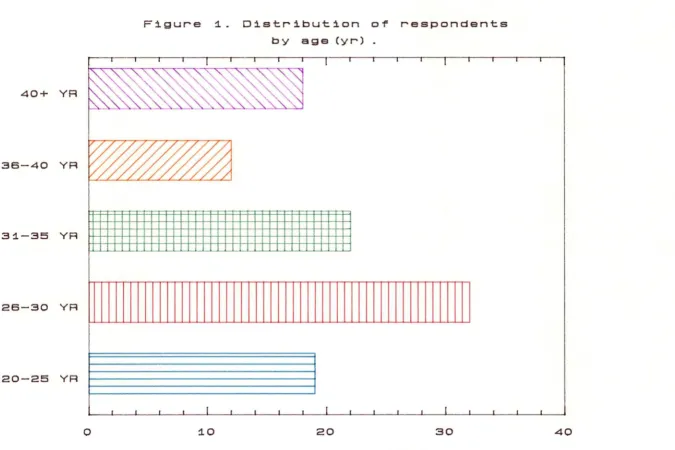
The majority of the respondents were aged between 26 and 30 years, although the age distribution was relatively even over all age groups. (Figure 1.)
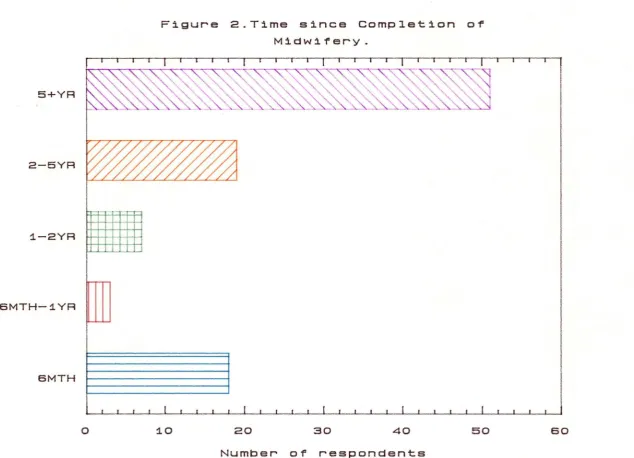
Time in years since· the completion of the midwifery course indicated that there was a marked level of
senior staff employed at the Queen Alexandra Division, the actual distribution of experienced staff indicative of the fact that women are the predominant employees, and many of these choose to have their families within the time period of 6 months to five years following completion of their studies. (Figure 2). The fact that the majority of the staff midwives completed their midwifery education more than
five years previously has implications for the any education program which is implemented.
costing of Within the Nursing Awards, increased renumeration is made for each year of service up to a maximum of five years, and thus the majority of staff are payed at the highest rate per hour for
40+ YR
36-40 YR
31-35 YR
26-30 YR
20-25 YR
I I I I I I I I I I
' ' I I I I
~~~~~
~
I I I I I I I I I I I I I I I I I
0 10 20 30
Number of respondents
I I
I I
40
-..J
'-'
[image:81.837.80.756.62.512.2]5+YA
2-SYR
1.-2YA
SMTH-1.YR
SMTH
0 1.0 20 30 40 50
Number of respondents
60
·...J
N
[image:82.835.81.716.60.518.2]I I
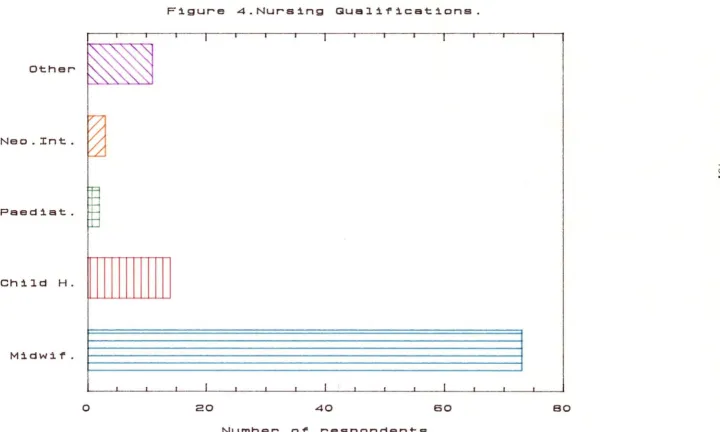
Significantly, most of the respondents had undertaken their midwifery training in Hobart. ~ (Figure 3). '\ Most respondents (73) did not have other postgraduate nursing qualifications, (Figure 4) and only 18 were at present undertaking tertiary studies. This figure is of concern when consideration is given to the changes which are occurring at present within nursing and midwifery. Promotional opportunities will be limited with the implementation of the planned career structure unless there is a demonstrated commitment to professional development and educational qualifications.
Many of the respondents worked on a part time basis. This percentage (38.8%) equates closely with the actual percentage of partime registered midwife employees at the Queen Alexandra Division (39.9%), a fact which validates the use of the information gained as a basis for the planning of educational needs within the hospital.
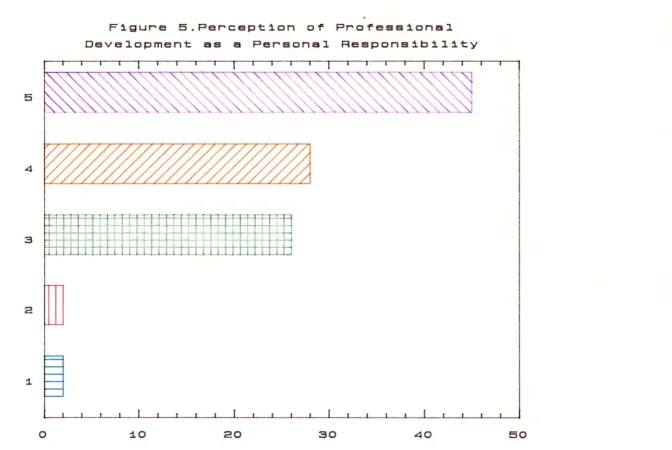
A clear majority of respondents perceived that professional development was a personal responsibility8