Page 1 of 11
Open Access
Methodology
Micro-scaled high-throughput digestion of plant tissue samples for
multi-elemental analysis
Thomas H Hansen, Kristian H Laursen, Daniel P Persson, Pai Pedas,
Søren Husted and Jan K Schjoerring*
Address: Plant and Soil Science Laboratory, Department of Agriculture and Ecology, Faculty of Life Sciences, University of Copenhagen, Thorvaldsensvej 40, DK-1871 Frederiksberg C, Denmark
Email: Thomas H Hansen - [email protected]; Kristian H Laursen - [email protected]; Daniel P Persson - [email protected]; Pai Pedas - [email protected]; Søren Husted - [email protected]; Jan K Schjoerring* - [email protected]
* Corresponding author
Abstract
Background: Quantitative multi-elemental analysis by inductively coupled plasma (ICP) spectrometry depends on a complete digestion of solid samples. However, fast and thorough sample digestion is a challenging analytical task which constitutes a bottleneck in modern multi-elemental analysis. Additional obstacles may be that sample quantities are limited and multi-elemental concentrations low. In such cases, digestion in small volumes with minimum dilution and contamination is required in order to obtain high accuracy data.
Results: We have developed a micro-scaled microwave digestion procedure and optimized it for accurate elemental profiling of plant materials (1-20 mg dry weight). A commercially available 64-position rotor with 5 ml disposable glass vials, originally designed for microwave-based parallel organic synthesis, was used as a platform for the digestion. The novel micro-scaled method was successfully validated by the use of various certified reference materials (CRM) with matrices rich in starch, lipid or protein. When the micro-scaled digestion procedure was applied on single rice grains or small batches of Arabidopsis seeds (1 mg, corresponding to approximately 50 seeds), the obtained elemental profiles closely matched those obtained by conventional analysis using digestion in large volume vessels. Accumulated elemental contents derived from separate analyses of rice grain fractions (aleurone, embryo and endosperm) closely matched the total content obtained by analysis of the whole rice grain.
Conclusion: A high-throughput micro-scaled method has been developed which enables digestion of small quantities of plant samples for subsequent elemental profiling by ICP-spectrometry. The method constitutes a valuable tool for screening of mutants and transformants. In addition, the method facilitates studies of the distribution of essential trace elements between and within plant organs which is relevant for, e.g., breeding programmes aiming at improvement of the micronutrient density in edible plant parts. Compared to existing vial-in-vial systems, the new method developed here represents a significant methodological advancement in terms of higher capacity, reduced labour consumption, lower material costs, less contamination and, as a consequence, improved analytical accuracy following micro-scaled digestion of plant samples.
Published: 26 September 2009
Plant Methods 2009, 5:12 doi:10.1186/1746-4811-5-12
Received: 14 June 2009 Accepted: 26 September 2009
This article is available from: http://www.plantmethods.com/content/5/1/12
© 2009 Hansen et al; licensee BioMed Central Ltd.
This is an Open Access article distributed under the terms of the Creative Commons Attribution License (http://creativecommons.org/licenses/by/2.0), which permits unrestricted use, distribution, and reproduction in any medium, provided the original work is properly cited.
Archived
at
Background
The concentration of essential plant nutrients must be maintained within certain concentration ranges in plant tissues. Analysis of the elemental composition is accord-ingly an important tool for diagnosis of nutritional disor-ders. Even before nutritional imbalances arise, changes in the elemental composition may constitute an important physiological indicator of plant responses to environmen-tal parameters [1]. Also with respect to human nutrition,
the content of essential trace elements, e.g. Fe and Zn, in
vegetable food products is an important trait and large resources are devoted to improvement of the content and bio-availability of essential micro-nutrients in crops by bio-fortification [2-4].
Development of new genotypes of crop plants with improved stress tolerance and nutritional quality requires information about the genes and molecular processes underlying elemental transport and homeostasis in plants. Mutants and transformants of the plant model species Arabidopsis constitute a valuable tool for this pur-pose [5]. However, often a large number of lines have to be screened and a limited number of seeds may be availa-ble for elemental analysis. The same proavaila-blem may occur in breeding programmes aiming at attracting new cereal lines with improved mineral composition by genetic modification or conventional breeding. In these cases, not only the total grain concentrations are relevant, but also the distribution of elements between grain tissues as well as their binding forms (speciation) [6]. Procedures for accurate analysis of the mineral composition in sub-grain tissue fractions available in limited quantity are therefore required.
Quantitative elemental analysis by ICP-spectrometry requires a complete digestion of solid samples in order to degrade the matrix components and obtain a homoge-nous liquid phase. The digestion of samples is usually the most time consuming step, thus constituting a bottleneck for high-throughput analysis and screening of large sam-ple sets. Furthermore, when the amount of samsam-ple is lim-ited and/or the elements of interest are present in trace or ultra-trace concentration, one of the main analytical chal-lenges is to perform a rapid and thorough digestion in small volumes with minimum dilution and contamina-tion [7-9].
Plant samples consist of an organic matrix that may cause analytical bias and block the sample introduction system if not fully decomposed. The most commonly used meth-ods for destruction of organic matter are based on high-temperature-oxidation (dry ashing) or wet digestion in vessels using strong acids with or without the addition of oxidizing solvents. Wet digestion is usually carried out in a pressurised system using closed vessels heated in a
microwave oven or autoclave [10-14]. Systems using closed vessels have several advantages relative to open sys-tems, including significantly reduced risks of contamina-tion and loss of volatile analytes [14,15]. In addicontamina-tion, the boiling point of the acid is elevated when the pressure inside the closed vessel increases, leading to a much faster and more thorough matrix digestion. Using a mixture of
HNO3 and H2O2, most biological samples can be
com-pletely digested in closed vessels except if they have a high content of silicates. In such case, hydrogen fluoride must be added [16-18]. It is important to note that microwave
HNO3/H2O2 digestion may not always provide a full
recovery of elements such as Fe, Al and Se. Consequently, certified reference materials with a matrix comparable to the sample should always be included in the sample sets analysed.
The typical vessel volumes (50-120 ml) used in most con-ventional microwave rotors are too large for optimal digestion of small sample quantities [19]. In addition, the PTFE (polytetrafluoroethylene, TEFLON™) vessels used in these rotors require time consuming steps associated with liquid transfer to auto sampler vials. The PTFE vessels are expensive and need to be carefully cleaned between ana-lytical cycles in order to avoid memory effects from the previous sample. A modified open vessel method using smaller polystyrene liners in an 80-position rotor allowed high-throughput digestion of small sample weights at low temperature [19,20]. For micro-scaling, various vial-in-vial setups have been employed to overcome the problem of incomplete digestion at low temperature [8,21-23]. However, physical limitation due to thick vial walls pre-vents high capacity rotors (48 positions) to be used. In addition, the PTFE screw thread frequently causes leakage problems.
Several analytical methods can be applied for elemental quantification of biological samples, including induc-tively coupled plasma-mass spectrometry (ICP-MS) and ICP-optical emission spectrometry (ICP-OES) [24,25]. The multi-elemental capacity in combination with an
excellent precision and sensitivity (10-18 g l-1) makes
ICP-MS an ideal choice for analysis of digested plant samples.
The use of micro-nebulization (<100 μl min-1) decreases
Page 3 of 11 The objective of the present work was to develop a
high-throughput digestion method for multi-elemental analy-sis of plant samples available in small quantities. A com-mercially available 64-position rotor accommodating disposable glass vials, originally designed for microwave-based parallel organic synthesis [28] was used as platform for the digestion. The disposable glass vials were closed with special PFTE seals in polyetheretherketone (PEEK) screw caps allowing temperatures up to 200°C and pres-sures up to 20 bar, thus matching digestion conditions required for even fairly recalcitrant plant tissues such as seeds. The 64-position rotor also accommodated vials with dimensions fitting standard ICP auto samplers, thereby enabling direct measurement in the digestion vials without time consuming liquid transfer between containers. The use of small glass vials instead of a vial-in-vial system allowed fast heating in the microwave oven and subsequent cooling. By facilitating simultaneous digestion of many samples, the method developed here substantially decreases labour consumption.
The micro-scaled digestion method was validated using certified reference materials of durum wheat flour, apple leaves and bovine muscle, representing matrices differing in starch, lipids and protein contents. An accuracy better than 90% of the true value was achieved for the essential plant nutrients Cu, Fe, K, Mg, Mo, Mn, P, S and Zn, as well as for the elements Cd, Se and Al. Further validation of the developed micro-scaled digestion method was obtained by analysis of single rice seeds and their sub-fractions (endosperm, embryo and aleurone). Finally, it was shown that the elemental composition of small batches of Arabi-dopsis seeds (1 mg, corresponding to approx. 50 seeds) could be accurately determined.
Results
Analysis of certified reference materials
The efficiency of the developed micro-digestion procedure was evaluated for three very different certified reference
materials, viz. apple leaf (CRM 1515), durum wheat flour
(CRM 8436), and bovine muscle (CRM 8414). Beside dif-ferences in matrix composition, the three reference mate-rials varied in elemental composition, spanning several decades of concentrations.
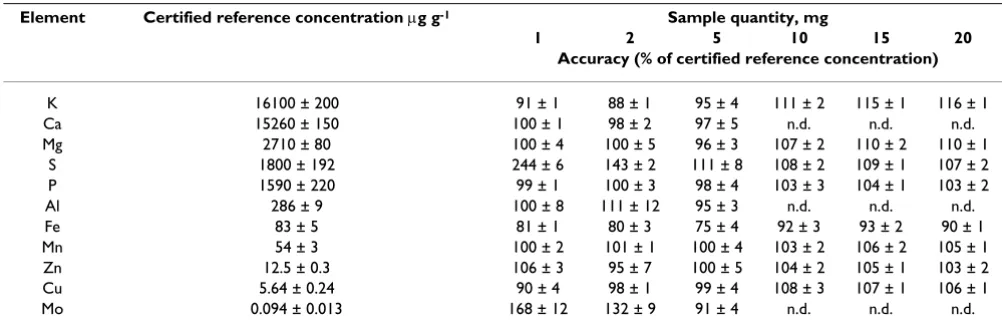
In apple leaves, very good agreement with the certified values was obtained for K, Ca, Mg, P, Al, Mn, Zn and Cu down to the lowest sample quantity of 1 mg (Table 1). Fe was in all cases 10-20% lower than the certified value. Similar underestimation was observed in a conventional large scale digestion (data not shown), suggesting a sys-tematic bias not related to the micro-digestion procedure. The concentration of the trace element Mo agreed with the certified value for sample quantities of 5 mg, but not for smaller quantities. A similar observation was made for S, where a considerable over-estimation occurred below 5 mg sample weights.
Durum wheat flour is more difficult to digest than apple leaves due to a higher content of starch and lipids. This was illustrated by the fact that S was slightly underesti-mated even in the large scale digestion (Table 2). P, Mg, Mn, Zn, Se and Mo were measured accurately (less than ± 10% deviation from the certified value) down to sample quantities of 1 mg. In 2 mg samples, K, Fe and Cd were satisfactorily quantified for most sample weights. Particu-larly for Cd this was remarkable, considering the very low concentration of this element. As for the apple leaves, con-siderable over-estimation of S occurred in the analysis of 1 and 2 mg samples.
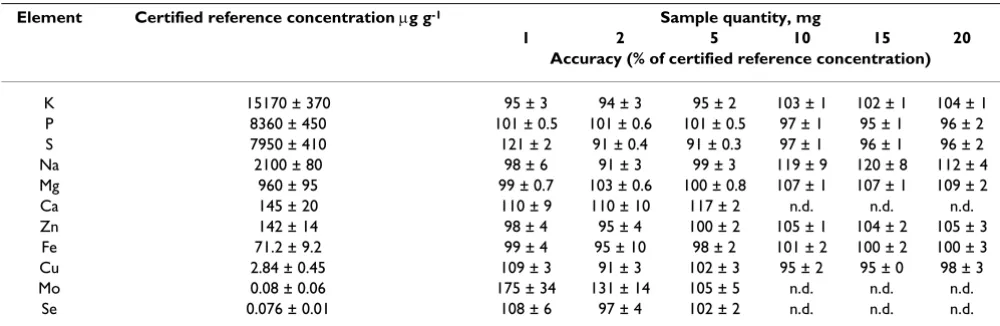
Samples of bovine muscle reference material were included as a representative of material with high protein content. The samples were analysed accurately for K, P, Na, Mg, Zn, Fe, Cu and Se even in the most extreme case where only 1 mg of sample was digested (Table 3). Also S was satisfactorily analysed, reflecting a higher
concentra-Table 1: Accuracy of elemental concentrations in certified reference material of apple leaves (CRM 1515) measured after micro-scaled digestion.
Element Certified reference concentration μg g-1 Sample quantity, mg
1 2 5 10 15 20
Accuracy (% of certified reference concentration)
K 16100 ± 200 91 ± 1 88 ± 1 95 ± 4 111 ± 2 115 ± 1 116 ± 1
Ca 15260 ± 150 100 ± 1 98 ± 2 97 ± 5 n.d. n.d. n.d.
Mg 2710 ± 80 100 ± 4 100 ± 5 96 ± 3 107 ± 2 110 ± 2 110 ± 1
S 1800 ± 192 244 ± 6 143 ± 2 111 ± 8 108 ± 2 109 ± 1 107 ± 2
P 1590 ± 220 99 ± 1 100 ± 3 98 ± 4 103 ± 3 104 ± 1 103 ± 2
Al 286 ± 9 100 ± 8 111 ± 12 95 ± 3 n.d. n.d. n.d.
Fe 83 ± 5 81 ± 1 80 ± 3 75 ± 4 92 ± 3 93 ± 2 90 ± 1
Mn 54 ± 3 100 ± 2 101 ± 1 100 ± 4 103 ± 2 106 ± 2 105 ± 1
Zn 12.5 ± 0.3 106 ± 3 95 ± 7 100 ± 5 104 ± 2 105 ± 1 103 ± 2
Cu 5.64 ± 0.24 90 ± 4 98 ± 1 99 ± 4 108 ± 3 107 ± 1 106 ± 1
Mo 0.094 ± 0.013 168 ± 12 132 ± 9 91 ± 4 n.d. n.d. n.d.
[image:3.612.53.554.579.742.2]tion than in the reference materials consisting of apple leaf and durum wheat flour.
Analysis of Arabidopsis seeds
Analysis of the elemental composition of seeds of Arabi-dopsis mutants may often be restricted by the number of seeds available. The micro-scaled digestion method was therefore applied to seed batches of 1 mg, corresponding to approximately 50 seeds. The reproducibility of the results was generally very good, both for macro- and micro-nutrients, as shown by the low coefficient of vari-ance of the mean values of four replicate batches (Table 4). Furthermore, it was possible to determine the concen-tration of Cd with only 3% variation following micro-scaled digestion despite the very low concentration of this element.
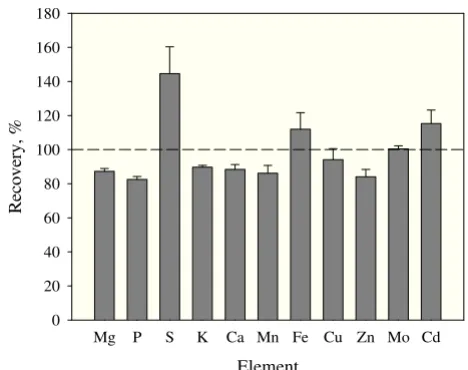
The accuracy of the micro-scaled digestion method was evaluated based on comparison with data obtained from
analysis of a larger seed batch (20 mg, corresponding to ~1000 seeds). Following micro-scaled digestion of 1 mg, there was a tendency to underestimate the concentration of several elements, but the difference was always <15% (Fig. 1). The largest deviation occurred for S which was overestimated by 40% following the micro-scaled diges-tion procedure (Fig. 1). This overestimadiges-tion was of the same magnitude as in the analyses of the certified refer-ence materials (see Table 3).
Micro-scaled analysis of single rice grains
[image:4.612.53.556.110.283.2]Single, unpolished rice grains of three genotypes, on aver-age weighing 21.6 ± 0.3 mg, were micro-scale digested without prior milling and analysed for their composition of essential macro- and micro-nutrients. The single grain analysis of Mg, P, S and K was accurate when compared to the corresponding results from macro-scaled analysis of finely pulverized grains of the same cultivars (Fig. 2). The Ca concentrations were slightly (~10%) underestimated.
Table 2: Accuracy of elemental concentrations in certified reference material of durum wheat grain (CRM 8436) measured after micro-scaled digestion.
Element Certified reference concentration μg g-1 Sample quantity, mg
1 2 5 10 15 20
Accuracy (% of certified reference concentration)
K 3180 ± 140 60 ± 1 91 ± 3 98 ± 2 93 ± 3 96 ± 2 96 ± 2
P 2900 ± 220 97 ± 2 84 ± 1 97 ± 2 90 ± 3 89 ± 1 89 ± 1
S 1930 ± 280 207 ± 4 123 ± 4 98 ± 2 86 ± 5 87 ± 2 87 ± 2
Mg 1070 ± 80 107 ± 4 97 ± 2 95 ± 1 95v2 99 ± 4 98 ± 1
Fe 41.5 ± 4 133 ± 20 97 ± 3 98 ± 7 92 ± 2 91 ± 2 91 ± 2
Mn 16 ± 1 96 ± 1 97 ± 1 97 ± 2 86 ± 2 93 ± 2 93 ± 2
Zn 12.5 ± 0.3 110 ± 2 99 ± 3 98 ± 1 97 ± 3 98 ± 3 98 ± 1
Cu 4.3 ± 0.69 45 ± 1 77 ± 5 91 ± 6 94 ± 6 97 ± 4 97 ± 4
Se 1.23 ± 0.09 100 ± 2 92 ± 4 93 ± 1 n.d. n.d. n.d.
Mo 0.7 ± 0.12 108 ± 13 98 ± 2 91 ± 2 102 ± 9 101 ± 7 92 ± 4
Cd 0.11 ± 0.05 137 ± 4 108 ± 2 95 ± 1 n.d. n.d. n.d.
Values are means ± SE (n = 4).
Table 3: Accuracy of elemental concentrations in certified reference material of bovine muscle (CRM 8414) measured after micro-scaled digestion.
Element Certified reference concentration μg g-1 Sample quantity, mg
1 2 5 10 15 20
Accuracy (% of certified reference concentration)
K 15170 ± 370 95 ± 3 94 ± 3 95 ± 2 103 ± 1 102 ± 1 104 ± 1
P 8360 ± 450 101 ± 0.5 101 ± 0.6 101 ± 0.5 97 ± 1 95 ± 1 96 ± 2
S 7950 ± 410 121 ± 2 91 ± 0.4 91 ± 0.3 97 ± 1 96 ± 1 96 ± 2
Na 2100 ± 80 98 ± 6 91 ± 3 99 ± 3 119 ± 9 120 ± 8 112 ± 4
Mg 960 ± 95 99 ± 0.7 103 ± 0.6 100 ± 0.8 107 ± 1 107 ± 1 109 ± 2
Ca 145 ± 20 110 ± 9 110 ± 10 117 ± 2 n.d. n.d. n.d.
Zn 142 ± 14 98 ± 4 95 ± 4 100 ± 2 105 ± 1 104 ± 2 105 ± 3
Fe 71.2 ± 9.2 99 ± 4 95 ± 10 98 ± 2 101 ± 2 100 ± 2 100 ± 3
Cu 2.84 ± 0.45 109 ± 3 91 ± 3 102 ± 3 95 ± 2 95 ± 0 98 ± 3
Mo 0.08 ± 0.06 175 ± 34 131 ± 14 105 ± 5 n.d. n.d. n.d.
Se 0.076 ± 0.01 108 ± 6 97 ± 4 102 ± 2 n.d. n.d. n.d.
[image:4.612.54.554.555.718.2]Page 5 of 11 The same was the case for the micro-nutrients Mn and Mo,
while Fe and Zn were more accurately determined (Fig. 2). In genotype C, Cu was significantly overestimated, while Se was underestimated. Part of the recorded variation may derive from sampling heterogeneities, indicating that 10 replicate seeds were not representative for a pulverized large batch. Taken as a whole, the micro-scaled digestion
of single seeds were able to provide reliable result for most essential macro- and micro-nutrients in single rice grains.
Micro-scaled analysis of rice grain tissues
Rice grains of the same three cultivars as used for the
sin-gle grain analysis were fractionated into (i) an outer layer
(aleurone incl. testa), constituting about 13% of total seed
weight, (ii) the endosperm (~84% of seed weight) and
(iii) the embryo, accounting for only ~2% of the seed
weight. The individual fractions were subsequently ana-lysed for Zn, Fe, P and S, which are all essential elements in human nutrition. The first two of these elements are particularly important due to their low bioavailability, causing human malnutrition on a global scale. The latter two elements are major constituents of phytic acid and proteins, respectively, potentially involved in Fe and Zn binding in the rice grain.
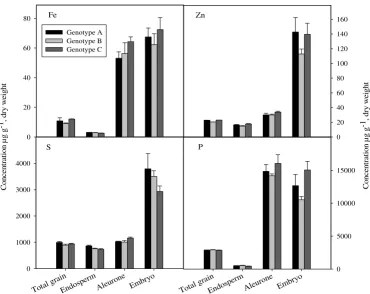
[image:5.612.315.550.92.256.2]The endosperm had a much lower concentration of the four analysed elements than the two other grain tissue fractions (Fig. 3). The highest concentrations of Zn were found in the embryo, particularly of genotypes A and C (Fig. 3). The aleurone layer had a Zn concentration which was approximately 2-fold higher than in the endosperm, but 4-fold lower than in the embryo. The embryo also contained the highest concentrations of S. The three gen-otypes had very similar Fe concentrations in the endosperm. Compared to Zn, Fe concentrations were con-siderably lower in all tissue fractions, including the endosperm (Fig. 3). The Fe, as well as the P concentration, was similar in the embryo and in the aleurone layer.
Table 4: Concentration of elements in seeds of wild type Arabidopsis (Col 0) analysed in batches of 1 mg (~50 seeds) or 20 mg (~1000 seeds).
Element Seed quantity analysed
1 mg 20 mg
Concentration
μg g-1 %
Concentration
μg g-1 %
Mg 2301 ± 23 1 2638 ± 33 1
P 5987 ± 64 1 7258 ± 136 2
S 8799 ± 478 5 6084 ± 135 2
K 9817 ± 59 1 10946 ± 288 3
Ca 5069 ± 83 2 5736 ± 112 2
Mn 37 ± 1 3 43 ± 0.7 2
Fe 84 ± 3.7 4 75 ± 2 3
Cu 5.3 ± 0.2 3 5.6 ± 0.1 2
Zn 39 ± 1 3 47 ± 0.9 2
Mo 2.0 ± 0.02 1 2.0 ± 0.06 3
Cd 0.1 ± 0.004 3 0.1 ± 0.002 2
Values are means ± SE (n = 4). denotes the coefficient of
variance of the mean value.
CVx CVx
CVx
Accuracy of elemental concentrations measured by ICP-MS on 1 mg micro-scale digested Arabidopsis seeds (~50 seeds) compared to the corresponding concentrations in a larger seed batch of 20 mg (~1000 seeds)
Figure 1
Accuracy of elemental concentrations measured by ICP-MS on 1 mg micro-scale digested Arabidopsis seeds (~50 seeds) compared to the corresponding concentrations in a larger seed batch of 20 mg (~1000 seeds). Values are means + SE (n = 4).
Element
Mg P S K Ca Mn Fe Cu Zn Mo Cd
R
ecovery, %
0 20 40 60 80 100 120 140 160 180
Tissue concentrations of mineral elements in single grains of
[image:5.612.58.292.461.646.2]Oryza sativa L. cvs TSN1 (genotype A), Hom Nang Nouan (genotype B) and Kai Noi Leuang (genotype C)
Figure 2
Tissue concentrations of mineral elements in single grains of Oryza sativa L. cvs TSN1 (genotype A), Hom Nang Nouan (genotype B) and Kai Noi Leuang (genotype C). Values are expressed relative to data from macro-scaled analysis (250 mg) of finely pulverized grains of the same cultivars. Values are means + SE (n = 10).
Element
Mg P S K Ca Mn Fe Cu Zn Se Mo
R
ecover
y
, %
0 20 40 60 80 100 120 140 160
The elemental recoveries following micro-scaled digestion of individual rice grain tissues were checked by a mass bal-ance analysis in which the Zn, Fe, P and S concentrations in each of the three grain fractions were multiplied with the corresponding dry weights in order to estimate the quantity of each element in the individual tissue types. Thereafter, the resulting quantity for the three grain frac-tions was summed up and the cumulated recoveries com-pared with the total grain contents derived from analysis of a large batch of pulverized grain material. More than 90% of the Zn, Fe, P and S contained in the rice grain were recovered after dissection and micro-digestion of the indi-vidual tissue fractions (Fig. 4). Thus, the micro-scaled digestion procedure was able to provide reliable results for the distribution of the four investigated elements in a small quantity of rice grain. Zn and S were similarly dis-tributed in the rice grain, with the endosperm being the most important compartment containing about 60-70% of the total content (Fig. 4). Conversely, the major part of Fe and P (>65%) was localized in the aleurone layer despite the fact that this compartment only constituted around 13% of the total grain weight. Only about 15-20%
of the Fe was present in the endosperm. The embryo con-tained a similar proportion of all four elements (5-10%).
Discussion
Three very different certified reference materials; viz. apple
leaves, durum wheat flour and bovine muscle were used to evaluate the efficiency of the developed digestion pro-cedure. These matrices differed considerably in digestibil-ity, the apple leaves being most easily destructed due to their lower content of in particular starch, lipid and pro-tein [29]. The three certified reference materials differed not only in their matrix composition but also in their
physical texture with particle sizes ranging from 75 μm for
apple leaf samples to >200 μm and >250 μm for durum
wheat grains and bovine muscle, respectively. In micro-scaled digestion procedures, sample homogeneity is a very important factor, usually having a strong influence on the final results [21,30]. Some of the variation in the accura-cies of the data presented in Tables 2 and 3 may thus derive from sampling since the particle unit size of the
wheat grain material was relatively large (200 μm).
[image:6.612.117.488.92.386.2]Tissue concentrations of Zn, Fe, P and S in grain tissues of rice genotype A, B and C, Four rice grains per batch were separated into an outer aleurone layer (incl. testa), the endosperm and the embryo
Figure 3
Tissue concentrations of Zn, Fe, P and S in grain tissues of rice genotype A, B and C, Four rice grains per batch were separated into an outer aleurone layer (incl. testa), the endosperm and the embryo. The three fractions were weighed, micro-scale digested and analysed by ICP-MS to obtain tissue elemental concentrations. Values are means + SE (n = 4).
P
Total
grain
Endos
perm
Aleuro
ne
Embry
o
0 5000 10000 15000
S
Total
grain
Endos
perm
Aleuro
ne
Embry
o
C
o
n
cen
tr
atio
n
μ
g
g
-1, dr
y
w
ei
g
ht
0 1000 2000 3000 4000
Zn
C
o
n
ce
n
tr
atio
n
μ
g
g
-1, dry w
ei
g
ht
0 20 40 60 80 100 120 140 160
Fe
0 20 40 60 80
Page 7 of 11 Even though the digestion procedure may result in a
solu-tion that appears fully transparent, residual carbon may still persist and cause analytical bias during the subse-quent ICP analysis. One of the main reasons for this bias is that non-oxidized carbon acts as a surfactant, changing the efficiency of the nebulizer [31]. Moreover, a fluctuat-ing carbon load to the plasma may interfere with the ion-isation efficiency of analyte ions and create polyatomic interferences [32,33]. A minimum temperature of 300°C is needed for complete oxidation with nitric acid, while lower temperatures between 220 and 250°C result in residual carbon, although in low concentrations [34]. The addition of hydrogen peroxide to the digestion solution can lower the temperature requirements for total diges-tion. Nevertheless, most matrices still have to be digested in a closed vessel system in order to elevate the tempera-ture above the boiling point [29]. In the present work, a 2:1 mixture of 70% nitric acid and 30% hydrogen perox-ide made it possible to digest pulverized samples of bovine muscle and apple leaves at a temperature of 140°C. This was evidenced by the fact that the elemental analyses following digestion of 10 and 20 mg samples gave results matching the certified values (Tables 1 and 3). For durum wheat flour, a slight (11-14%) underestima-tion occurred for P and S, indicating incomplete digesunderestima-tion (Table 2). Reinforcing the lip seals with an extra seal and increasing the temperature above 140°C improved the recovery of P and S (data not shown), but also caused
sev-eral vials to burst. Thus, vials with higher pressure resist-ance would be an advantage, but were not commercially available to fit the system. It has previously been shown that a temperature of 220°C during digestion of coal in vessels resulted in a pressure of 20 bar, which decreased to 9 bar upon lowering of the temperature to 180°C [20]. The standard glass vials used in our work had according to the manufacturer a pressure resistance of 20 bar (290 psi) but could still not resist temperatures >140°C. Thus, the matrix of the biological samples clearly behaved very dif-ferently from coal.
When small sample quantities are digested special care has to be taken in order to avoid contamination. The dilu-tion factor for the 1 mg samples was more than 10 times higher compared to the large scale digestions and there-fore the influence of contamination would have a greater influence on the results. For each individual element included in the analyses, the level of quantification
(LOQ), i.e. the lowest concentration of a given target
ele-ment that could be quantified on the ICP-MS, was calcu-lated as 10 times the standard deviation of 7 blank
samples. The LOQ values for e.g. S, P, Fe and Zn were 217,
20, 10 and 2.3 μg l-1, respectively. Following digestion of
1 mg samples, the resulting S concentration in the
solu-tion was 419, 391 and 1725 μg l-1 for apple leaves, durum
[image:7.612.66.550.96.299.2]wheat grain and bovine muscle, respectively. The prob-lems with over-estimation of S in the first two of these ref-Distribution of dry matter and Zn, Fe, P and S in grains of rice genotype A, B and C
Figure 4
Distribution of dry matter and Zn, Fe, P and S in grains of rice genotype A, B and C. Rice grain was separated into an outer layer of aleurone (incl. testa), the endosperm and the embryo. The three fractions were weighed, micro-scale digested and analysed by ICP-MS to obtain tissue elemental concentrations. Elemental recoveries represent the summed up quantity in the three grain fractions relative to the total grain content derived from analysis of a large batch of pulverized grain material. Values are means + SE (n = 4).
P
A B C
S
A B C
Fe
A B C
Zn
A B C
Recover
y
, %
0 20 40 60 80 100 120 140
Genotype
A B C
Dr
y weig
ht
,
%
0 20 40 60 80 100 120 140
Endosperm Aleurone Embryo
A B C
erence materials (Tables 1 and 2) were thus not exclusively caused by too low concentrations in the digest solution as these were higher than the LOQ.
Problems with overestimation of the S concentration also appeared in the micro-scaled digestion of 1 mg Arabidop-sis seeds (Fig. 1), while for several other elements a ten-dency of slight underestimation (Fig. 1) was observed. This underestimation may represent sampling uncertain-ties.
All samples ≤ 5 mg were analysed by ICP-MS, while
sam-ples ≥ 10 mg were analysed by ICP-OES. The ICP-MS was
equipped with a low consumption PFA nebulizer which
minimises sample uptake to 0.1 ml min-1 enabling more
elements to be quantified when only a limited amount of sample is available. The ICP-OES was equipped with a
Meinhard nebulizer with a sample flow of 1.5 ml min-1.
The final diluted sample volume used for both ICP-MS and ICP-OES was 4.6 ml, enabling direct sample aspira-tion from the digesaspira-tion vessels as these fitted into the standard auto samplers.
In addition to the analyses of certified reference materials, the micro-scaled digestion method was validated by a mass-balance approach in which the sum of the elemental contents determined for separate rice grain tissue fractions (aleurone, embryo and endosperm) was shown to satis-factorily match that obtained by analysis of whole rice grains (Fig. 3). The good overall recoveries obtained show that the micro-scaled method was able to digest samples between 1 and 20 mg accurately. In addition, the method was capable of dealing with different matrices, the embryo having a relatively high fat and protein content, the aleu-rone a relatively high protein content, and the endosperm a high starch concentration. The possibility of elemental profiling of sub-grain tissue fractions in small quantities will be a very valuable tool in future studies investigating how essential trace elements are distributed within the cereal grain. Such information is essential in relation to
biotechnological strategies aiming at increasing, e.g., the
Fe and Zn content in the endosperm [35]. The three differ-ent genotypes analysed in the presdiffer-ent work, including two traditional Laotian varieties and a high yielding variety, did not exhibit remarkable differences, neither in total Fe and Zn concentrations, nor with respect to the distribu-tion of these elements within the grain (Fig. 4). However, genotypic differences exist and breeding programmes attempting to select cultivars with elevated content of micro-nutrients are ongoing. For rapid screening of the elemental composition of grain tissues in such breeding programmes, the method developed and presented here will indeed be useful.
The micro-scaled digestion method made it possible to analyse single rice grain as evidenced by the good match
between single seed concentrations and those obtained by analysis of a large batch of milled rice grain (Fig. 2). The elemental profiling of single rice grain showed that there was little variation in the macro-nutrient concentrations (Mg, P, S, K, Ca) between seeds in the same batch (Fig. 2). For micro-nutrients (Mn, Cu, Zn, Se and Mo) larger varia-bility was recorded (Fig. 2). The possivaria-bility of analysing single grains of cereal species provides a valuable tool for high-throughput screening of breeding lines and trans-genic rice lines. In addition, the micro-scaled digestion procedure will make it possible to follow the grain load-ing of essential minerals inside a sload-ingle rice panicle, thereby providing information on the physiological con-trols and responses to changing environmental condi-tions.
Conclusion
A micro-scaled method was developed which enables digestion of small quantities of plant samples for subse-quent elemental profiling by ICP spectrometry. The method is based on a commercially available 64-position microwave rotor accommodating closed glass vials which are capable of withstanding sufficiently high temperatures and pressures to ensure digestion of even fairly recalci-trant plant tissues. The advantages of the new method compared to existing vial-in-vial methods are:
• The glass vials fit commercially available multi-posi-tion microwave rotors and standard ICP auto sam-plers, thereby enabling direct measurements without time consuming liquid transfer between vessels and without the accompanying risks of contamination.
• The glass vials allow fast and direct microwave heat-ing and temperature control by IR sensors present in state-of-the-art microwave ovens, ensuring correct temperature readings and uniform thermodynamic conditions during the digestion. In contrast, the vial-in-vial procedure uses thermal convection, very often with water as ballast between the microwave bomb/ liner and the vial to increase the thermal conductivity. This increases the heat capacity significantly and pro-longs the time needed to heat the digestion units.
• Due to the low heat capacity of the vials they can be rapidly cooled which prevents loss of volatile ele-ments before uncapping and facilitates a faster han-dling time.
Page 9 of 11 • The design of the lip seals prevents explosions
because they are only able to withstand a certain pres-sure.
• The current procedure allows a more cost- and labour-effective sample digestion because the glass vials are cheap and disposable. This eliminates time-consuming acid-based cleaning procedures between analytical runs and allows many samples to be pre-pared in advance.
The new method constitutes a valuable tool for high-throughput screening of e.g. mutants, transformants and breeding lines. In addition, the method facilitates studies of the distribution of essential trace elements between and within plant tissue fractions, which is highly relevant in relation to breeding programmes aiming at improved micro-nutrient density in edible plant parts.
Methods
Reference materials and plant samples
The following certified reference materials (CRMs) were used: NIST 8436 (durum wheat flour, particle size <200
μm), NIST 1515 (apple leaves, particle size <75 μm) and
NIST 8414 (bovine muscle, particle size <250 μm). All of
these were purchased from US Department of Commerce, National Institute of Standards and Technology, Gaithers-burgh, MD, USA.
Brown rice grain (Oryza sativa L. cvs TSN1, Hom Nang
Nouan and Kai Noi Leung) was supplied by the Interna-tional Rice Research Institute (IRRI) as part of the Lao-IRRI Rice Research and Training Project and the EU-FP6 project META-PHOR http://www.meta-phor.eu. The two last genotypes represent traditional Laotian varieties and
the first a high yielding variety. Seeds of Arabidopsis (
Ara-bidopsis thaliana) were wild type (Col 0). Before analysis, rice grains and Arabidopsis seeds were rapidly rinsed 3
times in Milli-Q water (18.2 Ω; Milli-Q Plus, Millipore
Corporation, MA. USA) and subsequently freeze dried at 0.5 mbar for 24 h (Christ Alpha 2-4, Martin Christ GmbH, Osterode, Germany).
The rice grains were sectioned into three main tissue frac-tions: (1) The bran layers (including pericarp, testa and aleurone), (2) the embryo (including the scutellum) and (3) the endosperm. First, the embryo was gently loosened and removed by use of the tip of a scalpel. To separate the bran and the endosperm, a polishing process was per-formed by high speed shaking in a ball mill (Retsch MM301). The mill was operated at 30 Hz for 120 s and mounted with a rack containing micro-centrifuge tubes with 200 mg of acid washed quartz sand and 4 rice grains. The mixture of sand and abraded material from the grain was collected as bran layers. The remains of the grain
(endosperm) were washed three times with milli-Q water to remove surface dust and dried.
Micro-scaled digestion
Using a high-accuracy balance (Mettler Toledo MT5), between 1 and 20 mg of the three certified reference mate-rials were weighed and transferred to digestion tubes
con-sisting of disposable standard glass vials (Wheaton® 15 ×
46 mm, Cap 13-425). A mixture of 125 μL 30% H2O2 (J.T.
Baker, The Netherlands) and 250 μL 65% HNO3
(Sigma-Aldrich, UK) was added to each vial containing ≤ 5 mg
material, while the double volume of reagents was used for the higher sample quantities. To ensure tightness and stability at elevated temperatures, the vials were closed with special PEEK screw caps (MG5, Anton Paar GmbH, Graz, Austria) and disposable PFTE lip-type seals (Mat. No. 41186, Anton Paar GmbH, Graz, Austria; Fig. 5). Sample digestion was carried out in a microwave oven (Multiwave 3000, mode: Synthos, Software version 2.01, Anton Paar GmbH, Graz, Austria) mounted with a 64 position carousel (64MG5, Anton Paar GmbH, Graz, Aus-tria). A 10 min ramping period was used to reach a diges-tion temperature of 140°C, which thereupon was maintained for 80 min. After cooling for 10 min, the vials were put in a freezer before releasing the pressure by uncapping. The freezing step ensured better recovery of volatile elements such as S and Se. Finally, samples were
diluted to a final concentration of 3.5 or 7% HNO3 (4.6
ml) and analysed directly in the vial.
Disposable glass vials closed with polytetrafluoroethylene (PFTE) lip-seals in polyetheretherketone (PEEK) screw caps ensuring a thermo stabile and tight digestion bomb at ele-vated temperatures
Figure 5
Rice grain materials and Arabidopsis seeds were digested by the same procedure as used for certified reference mate-rials except that the micro-wave digestion period was elongated with 30 min, now lasting 110 min instead of 80 min. Traditional large-scale digestion of 250 mg CRM and milled rice grain samples was carried out for comparison with the micro-scaled digestion procedure. Samples were micro-waved for 50 min at 210°C at a maximum pressure of 40 bar in 100 ml closed tubes. The digestion medium
consisted of 5 ml 65% HNO3 and 5 ml 15% H2O2.
Instrumentation for multi-elemental analysis
Multi-elemental analysis of samples weighing ≤ 5 mg was
performed using ICP-MS (Agilent 7500ce, Agilent Tech-nologies, UK) equipped with a PFA micro-flow nebulizer. ICP-MS chromatographic data were processed using Plasma Chromatographic Software v. B-03-07 (Agilent Technologies, UK). The ICP-MS was tuned in standard mode (no reaction/collision gas used) to achieve a
sensi-tivity higher than 18000, 36000 and 18000 cps ppb-1 on
the masses 7Li, 89Y and 205Tl, respectively, while at the
same time ensuring that the oxide level at m/z 156/140 was below 0.5%. The plasma power was operated at 1450 ± 50 W and the carrier and make-up gases were typically
set at 0.83 and 0.17 l min-1. Sample uptake was
main-tained at approximately 0.1 ml min-1 by the self-aspirating
PFA nebulizer. Larger samples quantities (≥ 10 mg) were
analysed by ICP-OES (Optima 5300 DV, PerkinElmer, USA) equipped with a Meinhard nebulizer and a cyclonic spray chamber. The RF Power was 1400 W and nebulizer
and auxiliary flows 0.65 and 0.2 l min-1. Sample flow was
set at 1.5 ml min-1. ICP-OES data was processed using
Winlab 32 (Ver. 3.1.0.0107, PerkinElmer, USA).
Competing interests
The authors declare that they have no competing interests.
Authors' contributions
THH, KHL, DPP and PP carried out the experimental work. SHU and JKS conceived the study and devised the experimental design. THH, SHU and JKS wrote the script. All authors read and approved the final manu-script.
Acknowledgements
The authors are grateful to Bente Broeng and Bente Postvang for their skil-ful technical assistance. Research support was provided by the EU-FP6 projects META-PHOR 2006-03622) and PHIME (FOOD-CT-2006-016253), HarvestPlus/DANIDA, the ICROFS research program ORGTRACE and the Ministry of Sciences, Technology, and Innovation (grant no. 274-06-0325).
References
1. Baxter IR, Vitek O, Lahner B, Muthukumar B, Borghi M, Morrissey J, Guerinot ML, Salt DE: The leaf ionome as a multivariable sys-tem to detect a plant's physiological status. Proceedings of the
National Academy of Sciences of the United States of America 2008,
105:12081-12086.
2. Cakmak I: Enrichment of cereal grains with zinc: Agronomic or genetic biofortification? Plant and Soil 2008, 302:1-17. 3. Palmgren MG, Clemens S, Williams LE, Kraemer U, Borg S, Schjorring
JK, Sanders D: Zinc biofortification of cereals: problems and solutions. Trends in Plant Science 2008, 13:464-473.
4. White PJ, Broadley MR: Biofortification of crops with seven mineral elements often lacking in human diets - iron, zinc, copper, calcium, magnesium, selenium and iodine. New Phy-tologist 2009, 182:49-84.
5. Lahner B, Gong JM, Mahmoudian M, Smith EL, Abid KB, Rogers EE, Guerinot ML, Harper JF, Ward JM, McIntyre L, et al.: Genomic scale profiling of nutrient and trace elements in Arabidopsis thal-iana. Nature Biotechnology 2003, 21:1215-1221.
6. Persson DP, Hansen TH, Laursen KH, Schjoerring JK, Husted S:
Simultaneous iron, zinc, sulphur and phosphorus speciation analysis of barley grain tissues using SEC-ICP-MS and IP-ICP-MS. Metallomics 2009, 1:418-426.
7. Vandecasteele C, Block CB: Modern Methods for Trace Element Deter-mination John Wiley and Sons; 1997.
8. Jakobsen MK, Poulsen LR, Schulz A, Fleurat-Lessard P, Moller A, Hus-ted S, Schiott M, Amtmann A, Palmgren MG: Pollen development and fertilization in Arabidopsis is dependent on the MALE GAMETOGENESIS IMPAIRED ANTHERS gene encoding a type VP-type ATPase. Genes & Development 2005, 19:2757-2769. 9. Danku JM, Gumaelius L, Baxter I, Salt DE: A high-throughput method for Saccharomyces cerevisiae (yeast) ionomics. Jour-nal of AJour-nalytical Atomic Spectrometry 2009, 24:103-107.
10. Friel JK, Skinner CS, Jackson SE, Longerich HP: Analysis of biologi-cal reference materials, prepared by microwave dissolution, using inductively coupled plasma mass spectrometry. Analyst
1990, 115:269-273.
11. Wu SL, Feng XB, Wittmeier A: Microwave digestion of plant and grain reference materials in nitric acid or a mixture of nitric acid and hydrogen peroxide for the determination of multi-elements by inductively coupled plasma mass spectrometry.
Journal of Analytical Atomic Spectrometry 1997, 12:797-806.
12. Dombovari J, Papp L: Comparison of sample preparation meth-ods for elemental analysis of human hair. Microchemical Journal
1998, 59:187-193.
13. Azizi M, Emanueli C, Peyrard S, Maddedu P, Alhenc-Gelas F, Campbell DJ: Genetic and dietary control of plasma tissue kallikrein secretion and urinary kinins exretion in man. Journal of Hyper-tension 2008, 26:714-720.
14. Bocca B, Alimonti A, Forte G, Petrucci F, Pirola C, Senofonte O, Violante N: High-throughput microwave-digestion proce-dures to monitor neurotoxic elements in body fluids by means of inductively coupled plasma mass spectrometry.
Analytical and Bioanalytical Chemistry 2003, 377:65-70.
15. Dapiaggi M, Leva F, Rabuffetti D, Ayrault S, Gaudry A, Cenci RM:
Reliability and accuracy of environmental analytical data on moss samples: An interlaboratory comparison. Environmental Technology 2001, 22:1183-1192.
16. Quevauviller P, Maier EA, Vercoutere K, Muntau H, Griepink B: Cer-tified Reference Material (Crm-397) for the Quality-Control of Trace-Element Analysis of Human Hair. Fresenius Journal of Analytical Chemistry 1992, 343:335-338.
17. Bulska E, Kandler W, Paslawski P, Hulanicki A: Atomic-Absorption Spectrometric Determination of Mercury in Soil Standard Reference Material Following Microwave Sample Pretreat-ment. Microchimica Acta 1995, 119:137-146.
18. Koplik R, Curdova E, Suchanek M: Trace element analysis in CRM of plant origin by inductively coupled plasma mass spectrometry. Fresenius Journal of Analytical Chemistry 1998,
360:449-451.
19. Bocca B, Conti ME, Pino A, Mattei D, Forte G, Alimonti A: Simple, fast, and low-contamination microwave-assisted digestion procedures for the determination of chemical elements in biological and environmental matrices by sector field ICP-MS. International Journal of Environmental Analytical Chemistry 2007,
87:1111-1123.
Publish with BioMed Central and every scientist can read your work free of charge "BioMed Central will be the most significant development for disseminating the results of biomedical researc h in our lifetime."
Sir Paul Nurse, Cancer Research UK
Your research papers will be:
available free of charge to the entire biomedical community
peer reviewed and published immediately upon acceptance
cited in PubMed and archived on PubMed Central
yours — you keep the copyright
Submit your manuscript here:
http://www.biomedcentral.com/info/publishing_adv.asp
BioMedcentral
Page 11 of 11
preliminary baseline levels. Rapid Communications in Mass Spec-trometry 2007, 21:1776-1782.
21. Dombovari J, Becker JS, Dietze HJ: Multielemental analysis in small amounts of environmental reference materials with inductively coupled plasma mass spectrometry. Fresenius Jour-nal of AJour-nalytical Chemistry 2000, 367:407-413.
22. Millos J, Costas-Rodriguez M, Lavilla I, Bendicho C: Multiple small volume microwave-assisted digestions using conventional equipment for multielemental analysis of human breast biopsies by inductively coupled plasma optical emission spectrometry. Talanta 2009, 77:1490-1496.
23. Millos J, Costas-Rodriguez M, Lavilla I, Bendicho C: Multielemental determination in breast cancerous and non-cancerous biop-sies by inductively coupled plasma-mass spectrometry fol-lowing small volume microwave-assisted digestion. Analytica Chimica Acta 2008, 622:77-84.
24. Salt DE, Baxter I, Lahner B: Ionomics and the study of the plant ionome. Annual Review of Plant Biology 2008, 59:709-733.
25. Laursen KH, Hansen TH, Persson DP, Schjoerring JK, Husted S:
Multi-elemental fingerprinting of plant tissue by semi-quan-titative ICP-MS and chemometrics. Journal of Analytical Atomic Spectrometry 2009, 24:1198-1207.
26. Vickers GH, Ross BS, Hieftje GM: Reduction of Mass-Dependent Interferences in Inductively Coupled Plasma-Mass Spec-trometry by Using Flow-Injection Analysis. Applied Spectros-copy 1989, 43:1330-1333.
27. Wang H, Nakazato T, Sakanishi K, Yamada O, Tao H, Saito I: Micro-wave digestion with HNO3/H2O2 mixture at high tempera-tures for determination of trace elements in coal by ICP-OES and ICP-MS. Analytica Chimica Acta 2004, 514:115-124. 28. Treu M, Karner T, Kousek R, Berger H, Mayer M, McConnell DB,
Sta-dler A: Microwave-Assisted Parallel Synthesis of Fused Hete-rocycles in a Novel Parallel Multimode Reactor. Journal of Combinatorial Chemistry 2008, 10:863-868.
29. Reid HJ, Greenfield S, Edmonds TE: Investigation of Decomposi-tion Products of Microwave DigesDecomposi-tion of Food Samples. Ana-lyst 1995, 120:1543-1548.
30. von Bohlen A, Klockenkamper R, Messerschmidt J, Alt F: Develop-ment and application of a micro-digestion device for elemen-tal analysis of biological samples. Analytica Chimica Acta 2002,
451:279-284.
31. Wurfels M, Jackwerth E, Stoeppler M: About the Problem of Dis-turbances of Inverse Voltammetric Trace Analysis After Pressure Decomposition of Biological Samples. Fresenius Zeitschrift fur Analytische Chemie 1987, 329:459-461.
32. Wasilewska M, Goessler W, Zischka M, Maichin B, Knapp G: Effi-ciency of oxidation in wet digestion procedures and influence from the residual organic carbon content on selected tech-niques for determination of trace elements. Journal of Analytical Atomic Spectrometry 2002, 17:1121-1125.
33. Engstrom E, Stenberg A, Senioukh S, Edelbro R, Baxter DC, Rodush-kin I: Multi-elemental characterization of soft biological tis-sues by inductively coupled plasma-sector field mass spectrometry. Analytica Chimica Acta 2004, 521:123-135. 34. Flores EM, Barin JS, Mesko MF, Knapp G: Sample preparation
techniques based on combustion reactions in closed vessels - A brief overview and recent applications. Spectrochimica Acta Part B-Atomic Spectroscopy 2007, 62:1051-1064.
35. Welch RM, Graham RD: A new paradigm for world agriculture: meeting human needs - Productive, sustainable, nutritious.