DEVELOPING STUDY SKILLS IN A FIRST YEAR MATHEMATICS
COURSE
TAYLOR, J. A. & MANDER, D.
The University of Southern Queensland, Toowoomba, Australia
Students who enrol in first year courses are novices to learning at university with the result that many of them have an uncertain start. One of the main contributing factors to this uncertain start is the student’s unrealistic expectation of the amount of work and time involved in university study. This combined with the fact that increasing numbers of full time students participate in paid work means that development of time management and other study skills are more important than ever before. Literature on development of study skills in students indicates that the most effective programs are those in which study skills are integrated into the curriculum. This paper investigates what study skills are necessary for success in a first year service mathematics course and proposes a model of integration based on a management structure in which students participate in a cycle of planning, organising, leading and controlling. Implementation of the model is described in a first year mathematics course that services science, information technology, engineering and surveying students in both on campus and distance modes. Examples from and preliminary evaluations of study materials, assessment practice and development of group problem solving skills are presented.
Introduction
For many years the profile of students enrolling in first year courses has been changing in tandem with the broader social and technological changes within our society. In Australia, McInnis, James, and Hartley [1] found in a national study of the first year on-campus that students often had an uncertain start to university studies with many indicating that they were not well prepared, were unmotivated to study and did not get satisfaction from their participation in study. More students now than ever before [2] combine full time study and work. Although many students cope well with this, McInnis and Hartley [3] found in a survey of 1563 full-time students, that 40% agreed that their paid work got in the way of their academic studies and 63% (more women than men) claimed that they were often overwhelmed by all they had to do. For some time now academic staff have also expressed related concerns about student participation and performance. and Bedford [4] found that staff believed the major contributing factors to non-completion were related to what students brought with them to university: their level of preparedness, motivation and abilities to manage study. The best available summaries of factors that may have negative effects on student completion has been provided by Yorke [5] and Weston [6], who both, among other things, highlight the importance of student planning and organisational skills.
engineering courses, held that it may take months for them to organise themselves and their work to get the most out of study. Cerrito and Levi [9] found that students in a pre-calculus college course were not spending sufficient time studying and more specifically, Anthony [10] investigating the factors influencing first year students’ success in mathematics stated:
…studies had found considerable variation in how well students are ‘cued into’ the kind of work that is necessary to achieve examination success. ‘Cue deaf’ students can put in a lot of hard work, achieve significant understanding, yet because of ineffective study skills achieve little success in terms of grades.’
Clearly, pressures are now on course developers to address the issue of study skills. But how is this best achieved with such a diverse student population in a discipline in which knowledge is hierarchical? Traditionally study skills programs have been offered to all commencing students through stand-alone programs in orientations or in the early weeks of study. They rarely offer specific strategies to assist students in their learning of mathematics, although recently numerous books (eg [11]) and web sites have become available. Evidence has gradually emerged that indicates that such skills are best developed within specific contexts [12, 13] and is currently being reinforced by the drive to incorporate generic skills into undergraduate programs [14]. Examples of successful integration of study skills into mathematics courses have been described [15, 16, 17, 18].
For some years now the authors have worked with first year students in an undergraduate mathematics course designed as a core subject in associate degree programs in engineering and degree programs in technology, science, information technology and engineering. The curriculum design of the course is reported elsewhere [7]. This paper aims to detail study skills necessary for the study of mathematics at first year and to describe how these can be integrated into a first year service mathematics course without sacrificing further content.
Theoretical Framework
The integration of study skills and strategies into the Foundation Mathematics curriculum has been built around management theory practice, often termed POLC (planning, organising, leading, controlling). This framework has been used elsewhere [13, 19] and is based on the proposition that generic management skills provide an organising framework to assist students to manage their learning programs, while simultaneously acquiring other generic study skills and discipline-related content. Bedford [13], in an extensive summary of the skills located within each stage of the framework, indicated that planning and organising might involve the constructive use of information to develop study action planning, scheduling and time-tabling skills, to identify study resource requirements and potential barriers to progress with study. Leading is applicable to self-management of a study program in which self-assessment, action planning and reflective evaluation can be used to assist students become aware of their situation and to initiate constructive action. Controlling brings together all three levels into a comprehensive and coherent approach to study management, as well as to develop specific control skills.
About Foundation Mathematics
traditional first year calculus/algebra course and repeats and reinforces many of the topics covered in senior school mathematics syllabuses.
In 2002 (711 enrolled students), the course was characterised by an extremely diverse mix of students, indicated by variables such as age (55% under 20 years, 45% mature aged), mathematical background (3% junior maths, 20% general senior maths, 77% senior maths with calculus1), time away from study (43% recent school leavers, 57% between 2-40 years since previous study), attitudes and beliefs about studying mathematics (34% enjoy maths, 44% do not enjoy it, 22% have no opinion) and mode of study (49% study on campus, 51% by distance education). The majority of students studying by distance education were in paid employment while studying, but increasingly in Australia, full time on-campus students also work. For example in this course in 2002, 40% of on-campus students were in paid employment averaging 12 hours per week. The level of mathematical understanding on entry to the course is indicated by an entry point, which is determined by a test at the commencement of the course. Entry point 1 students are unable to do simple algebra and graphing (25% of students), entry point 2 students can perform simple algebraic manipulations and graphing (31%), while entry point 3 students can solve and manipulate a range of algebraic expressions and show some exposure to calculus (44%). Forty per cent of students who enrol in the course indicate that they have found mathematics difficult in the past, while 42% indicate that maths was not difficult for them, 18% had no opinion.
The diversity in mode of offer and in the mathematical experiences of entering students necessitates a uniquely designed course. No lectures are offered and all students acquire mathematical information from a set of print-based study materials and through participation in a number of problem-based workshops. Workshops are face-to-face for on campus students and online for distance education students. Depending on their entry point, students complete a different range of modules (a mixture of bridging and undergraduate mathematical topics) and are allowed to complete in either in one or two semesters. Six different types of assessments are set to allow achievement of the course objectives. Specific details of the course are described elsewhere [7].
Mathematical study skills
The authors’ previous experiences indicated that students had particular study problems relating to Foundation Mathematics. Many of these were related to procrastination and a lack of ability to manage a self-paced flexible course [20], but others related to the general inability of students to solve and communicate solutions of mathematical problems. Our experience corresponds to others’ experiences of teaching mathematics to novice students [11, 15, 16, 17, 18]. Using these sources we have developed a list of study skills and strategies that we have found necessary for students in Foundation Mathematics. These include:
• The ability to manage time, develop a timetable for study and set goals. • Personal reflection skills in relation to learning.
• General study skills such as ability to read mathematical texts, strategies to assist when you don’t understand, note-making ability, mathematical exam taking skills. • Planning and development of mathematical problem solving strategies.
• Mathematical communication skills.
Strategies for incorporating study skills
Study strategies are explicitly included throughout the course materials, both printed and online, within the assessments tasks, and within workshop discussions using the POLC framework. Within the course materials some are included in a course introductory book and some are included within the core study materials at places where they will be most useful. This could be termed a ‘just in time’ strategy.
Development of time management skills and reflective practice
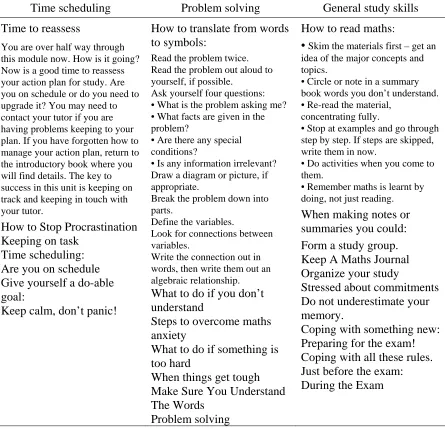
The key to development of time management skills was the inclusion of a reflective, planning assignment in week 2 of the course. In this assignment students are first asked to reflect on their past mathematics experiences, to write a few words about how they feel about studying Foundation Mathematics and how they think their past experiences might affect their learning in this subject. The second part of the assignment is the development of a study plan (a proforma is provided) which includes assessment dates for Foundation Mathematics, assessment dates for all other enrolled courses and times of other activities, for example periods of shift work or planned absences. Students are given specific details of what is expected in this assignment through a number of topics and activities in the course introductory book. Topics include What is Mathematics?, Reflections by past students, How to develop, complete and maintain a study plan. This assignment is marked (complete/not-complete) and returned within two weeks with tutors making comments on students’ previous experiences and the appropriateness of the submitted plan. This assignment is followed up in the 8th week with an attachment to the second assessment (problem solving) that asks students to reflect on their ability to maintain their study plan. Throughout the study materials students are prompted with hints called ‘Hints for success’ some of which make suggestions about time scheduling (see Table 1 for examples).
Development of general study skills
Development of general study skills is first addressed in the Introductory Book for the course in the form of a ‘Foundation Maths Toolbox’. The tool box contains information on how best to read and work through the study materials, as well as general strategies on how to succeed at maths which addresses beliefs about mathematics, general problem solving strategies and ‘what to do if you get stuck’. These general strategies are reinforced by the ‘Hints for success’ which are strategically placed throughout the study materials at places where they are most useful. Table 1 details examples of these hints in the general study skills category. Finally, exam preparation and exam taking skills are addressed through specific references towards the end of the study materials and then generally in the online materials associated with the course.
Development of problem solving skills
Problem solving skills are addressed using three separate strategies. Initially through specific information in the introductory book, secondly through specific ‘Hints for success’ strategically placed in the study materials (Table 1), but most importantly through the problem solving workshops. The aims of the problems solving workshops are to:
• promote the usefulness and value of mathematics • address the attitudes of students to mathematics
• build group cohesiveness and sense of community within Foundation Maths • provide a personal face to assistance available in Foundation Maths
The workshops are held weekly for on-campus students and in an online discussion group for distance education students. New problems are introduced each week with students expected to work through the problems in small groups, facilitated by a tutor. The problems are open ended and designed so that students on any entry point can achieve success. Students are initially instructed both in class and in the Introductory Book on the aims and mechanics of successful group work. Distance Education students are allocated to asynchronous online discussion groups and similarly given a new problem each week. In both cases students are placed in the groups on the basis of entry point and are encouraged to think of problems in terms of the aim, method of solution, working and results and conclusions. Problem solving strategies based on the work of Polya [21] are discussed with students in the initial classes and online discussions. Overall nine problems are presented during the semester. Students are assessed each week. On campus students are expected to submit a written group summary of the session at the end of each week. Distance education students are expected to submit two online postings and write up one entire problem by the end of the semester.
Development of mathematical communication skills
Mathematical communication skills are primarily developed through the problem solving sessions when students are actively encouraged to talk (and discuss online) with each other about their mathematical solutions and in the case of the on-campus students to present a written group solution. Students are provided with formal feedback each week when their written submissions are marked and returned. Two formal problem solving assignments are presented throughout the semester totalling 30% of the marks for the course. As well as the weekly feedback from the problem write-ups, as part of the build-up to the completion of these assessments students are provided with guidelines for mathematical communication, the structure required for the assignments and a number of exemplar assignments. Extensive feedback is provided on the first assignment, with an option to resubmit an alternative assignment if deemed necessary.
Student views
Although a formal evaluation of this strategy has not as yet been completed the responses of students and staff have been positive. Comments indicate that assignment 1, the planning assignment, has had positive effects on student participation in the course. In 2001, the year the planning assignment was first introduced the pass rates for entry point 1 and 2 students doubled, raising the overall pass rate by 5 percentage points. In 2002 when students were asked if they had used the plan in assignment 1 to assist in their studies only 28% indicated that they had not used it. In interviews students made comments such as:
it made me realize how much stuff’s actually due, and when they’re due, and how busy it’s going to be.
TABLE 1
Examples of ‘Hints for success’ included in study materials
Time scheduling Problem solving General study skills
Time to reassess
You are over half way through this module now. How is it going? Now is a good time to reassess your action plan for study. Are you on schedule or do you need to upgrade it? You may need to contact your tutor if you are having problems keeping to your plan. If you have forgotten how to manage your action plan, return to the introductory book where you will find details. The key to success in this unit is keeping on track and keeping in touch with your tutor.
How to Stop Procrastination Keeping on task
Time scheduling: Are you on schedule Give yourself a do-able goal:
Keep calm, don’t panic!
How to translate from words to symbols:
Read the problem twice. Read the problem out aloud to yourself, if possible.
Ask yourself four questions: • What is the problem asking me? • What facts are given in the problem?
• Are there any special conditions?
• Is any information irrelevant? Draw a diagram or picture, if appropriate.
Break the problem down into parts.
Define the variables.
Look for connections between variables.
Write the connection out in words, then write them out an algebraic relationship. What to do if you don’t understand
Steps to overcome maths anxiety
What to do if something is too hard
When things get tough Make Sure You Understand The Words
Problem solving
How to read maths:
• Skim the materials first – get an idea of the major concepts and topics.
• Circle or note in a summary book words you don’t understand. • Re-read the material,
concentrating fully.
• Stop at examples and go through step by step. If steps are skipped, write them in now.
• Do activities when you come to them.
• Remember maths is learnt by doing, not just reading. When making notes or summaries you could: Form a study group. Keep A Maths Journal Organize your study
Stressed about commitments Do not underestimate your memory.
Coping with something new: Preparing for the exam! Coping with all these rules. Just before the exam: During the Exam
The overall structure of the course which included, Foundation Mathematics Toolbox and the Hints for success were also appreciated by students with only 7% indicating that the structure of the course had a negative effect on their success.
The setting out of material is excellent. Worked answers to activity questions are very good. I enjoyed the topic on Matrices. What about Vectors? The ‘Hints for Success’ and ‘CMA Test’ are very good.
Discussion
Management theory practice has been used as a framework for developing required study skills in first year mathematics students. Planning and organising, the first two levels of the POLC framework require the students to create a study plan involving gathering information on what is to be done, when it needs to be done and how it can fit into other demands in their life. It requires them to think about resources required to complete there learning task. For most students the main resource required is their time. Students entering university find many aspects of study different from their experience of study at school. The most apparent difference is the increased control of their own time as against school regimes where what was to be done and when was largely determined by others. Skills in managing use of time cannot be assumed in any students entering university either straight from school or after some time away from study. The use of time management techniques in the first assignment provides students with a structure to develop these skills.
The leading step of the POLC framework is interpreted here as self leadership, the stage in which action, reflective evaluation and self-assessment are performed. Students are shown how to develop mathematical skills, problem solving skills and mathematical communication skills. They are given information and advice on what to do to resolve difficulties encountered in the process of developing these skills. This information and advice is in the form of the Foundation Maths Toolbox section in the Introductory Book, embedded study skills advice in the study materials in the form of ‘Hints for Success’, feedback from tutors and other students in the problem solving workshops and guidelines for assignments. They are given numerous opportunities to assess their skills through online testing, assignment feedback and reflection within workshops. The final step in the structure, controlling, brings together all of the above stages to assist students to evaluate their effect, reflect on their planning and to generate solutions to problems encountered. Assignment 2 facilitates the development of this skill.
In conclusion, our experience and the responses of students indicate that it is now essential that strategies that were once thought to be acquired almost by osmosis are now an explicit component of first year university study.
References
1. C. McInnis, R. James, & R Hartley, Trends in the first year experience in Australian universities. AGPS. Canberra, Australia, 2000.
2. AVCC Fact Sheet University Students meeting their living costs. (2003) http://www.avcc.edu.au/news/public_statements/publications/facts03/UniStudentsMeet ingLivingCosts_facts.pdf
3. C. McInnis, & R. Hartley, Managing Study and Work: The impact of full time study and paid work on the undergraduate experiences in Australian universities,
Evaluations and Investigation Program, DEST (2002), Australia, Retrieved 22 October 2002, http://www.dest.gov.au/highered/eippubs/eip02_6/eip02_6.pdf
4. J. A. & T. Bedford, Staff perceptions of factors related to non-completion in higher education, Studies in Higher Education 29 (3), (in press).
5. M. Yorke, Leaving early: Undergraduate non-completion in higher education,
6. J. M. Weston, Higher education and the student profile: A reconceptualised model of retention and attrition, The University of Southern Queensland, Toowoomba, 1998. 7. J. A. , & D. , Managing diversity in first year service mathematics course:
integration of effective numeracy teaching principles and management theory. 6th Pacific Rim, First Year in Higher Education Conference Proceedings, 2002.
http://www.qut.edu.au/daa/asdu/fye/abstracts02/Taylor&MurrayAbstract.htm
8. P. Nunn, C. MacDonald, & K. Lowden, K. Helping adults cope: mature students on science, mathematics and engineering courses. The Scottish Council for Research in Education Report 59 (1992), 1-52.
9. P. B. Cerrito, & I Levi, An Investigation of Student Habits in Mathematics Courses. The College Student Journal, 33(4): 584-588. (1999).
10. G. Anthony, Factors influencing first-year students’ success in mathematics. International Journal of Mathematical Education in Science and Technology 31(1)
(2000), 3-14.
11. P. Nolting, Winning at Math: your guide to learning mathematics through successful study skills. Academic Success Press Inc. Bradenton, USA, 1997P. Nunn, C. MacDonald, & K. Lowden, Helping adults cope: mature students on science, mathematics and engineering courses. The Scottish Council for Research in Education Report 59 (1992), 1-52.
12. R. Keimig, Raising academic standard: a guide to learning improvement, ASHE-ERIC/Higher education Research Report 4 (1983).
13. T. Bedford, Developing Expert Learners: A Curriculum Design Strategy for Responding to Student Diversity, Tertiary Teaching and Learning: Dealing with Diversity, Conference Proceedings of Teaching and Learning Conference Northern Territory University, Darwin, July 2001.
14. A. Goldsworthy, Developing Generic Skills: examples of best practice, B-HERT News
16 (2003), 1-39.
15. L. Hirsch, Teaching students how to learn mathematics. Mathematics in College 1983, 27-30.
16. L. Hagedorn, Y. Sagher, & S. Vali, S. Building study skills in a college mathematics classroom. Journal of General Education 49(2) (2000), 132-155.
17. Y. Seon, & R King, Study skills can make a major difference. Paper presented at the 23rd Annual Conference of the American Mathematical Association of Two-year Colleges, Atlanta, ED 417 791 (1997).
18. G. Weinstein, An annotated chronicle of a students' introduction to learning strategies for mathematics, Primus 9(3) (1999), 193-204.
19. L. Olivier, Using Metacognitive Tools to Improve Learning in Higher Education. Proceedings Academic Development: Changes and Challenges, Rhodes University, South Africa, December 2000. Accessed June 2003,
http://www.ru.ac.za/academic/adc/papers/olivier.htm
20. D. , Problems and proposals for reform in an individualised self-paced bridging maths course, Bridging Mathematics Network 8th Annual Conference: Bridging the Distance, Toowoomba, 1998.