Rochester Institute of Technology
RIT Scholar Works
Theses
Thesis/Dissertation Collections
8-11-2017
Finding Practical Way to Minimize the Time and
Space Needed at the Temporary Donation Places
Reema Aldossari
Follow this and additional works at:
http://scholarworks.rit.edu/theses
Recommended Citation
RIT
Finding Practical Way to Minimize the Time and Space Needed at the Temporary
Donation Places
By
Reema Aldossari
A Thesis Submitted to the Faculty of the College of Imaging Arts and Sciences
School of Design
In Candidacy for the Degree of Master of Fine Arts
In Industrial Design
________________________
Rochester Institute of Technology
Rochester, NY
Committee Approval:
__________________________________________________________________
Alex Lobos Date
Graduate Director, Industrial Design - Associate Professor Design, Advisor, Committee member
__________________________________________________________________
Mindy Magyar Date
Abstract
This study exploits and describes how to manage donations and send them to the affected people when
natural disaster occurs. Throughout my experience in working with some organizations for collecting donations, I
found out that there are many problems that harden the goods. Since affected people need the help and the
goods immediately, it will take time to reach and be delivered to the people who need them. The process takes a
long period of time due to the following reasons: first, the donor ships unsolicited donations and that will
consequently waist time and money because no one need them. Second, there is a time gap between receiving
and sorting the donations. Third, donations’ spaces need to be large and flexible. Fourth, the volunteers who work
in good management put massive effort in sorting donations. Fifth, more volunteers are always needed. Finally,
recipients still have to sort through donated goods to make them useful.
In this research project, I came up with a solution that will help in these temporary donation places. I
created a system that contains of 3 parts which will work together. The first part is a website that is designed as a
source for the donors to know about if a disaster takes place and what donations are needed in each specific
situation. The second part is the “GoMa” stand which will be located in temporary donation places, so after you
receive and know all the information about what people exactly need, you can take the donations to these places
and find the stand to help minimizing time, place, and effort. The last part of the system is the labeling that will
help the donors to consistently sort across multiple events and locations. Also, it will help the senders to
streamline their logistics process, and to help the recipients understand what items they have gotten and how to
Contents
Figures ... 1
Interdiction ... 3
Chapter 1 ... 4
Donations Definition and 3 ways people usually use in donations ... 4
Type of disaster ... 4
Chapter 2 ... 5
How People Usually Manage the Temporary Donation Places? ... 5
Collecting and Sorting ... 6
Needed Volunteers ... 7
Chapter 3 ... 8
Different Concepts with Implementation and Experimental ... 8
Mockup 1 ... 14
Mockup 2 ... 15
Mockup 3 ... 16
Mockup 4 ... 17
Mockup 5 ... 18
Mockup 6 ... 19
GoMa Website ... 20
GoMa Stand ... 22
GoMa Box Labeling ... 24
System’s Procedure ... 25
Conclusion ... 26
Figures
Figure 1 Collect Clothes at office (Career Clothing Open House at RIT in Sept. 2016 ... 6
Figure 2 clothes sorting into categories (Career Clothing Open House at RIT in Sept.2016) ... 6
Figure 3 How the system works ... 8
Figure 4 Samaritans’ Purse’s Poster ... 9
Figure 5 Samaritans’ Purse’s Donation ... 9
Figure 6 Categories Labeling idea ... 10
Figure 7 Way to print the label on the box ... 10
Figure 8 Samaritans’ Purse’s box labeled ... 10
Figure 9 Samaritans’ Purse’s box labeled ... 10
Figure 10 The majority of people has chosen the second of baby supplies which shows the different types of baby supplies ... 11
Figure 11 The majority of people has chosen the third image of clothes which shows the different types of clothing ... 11
Figure 12 The majority of people has chosen the second image of canned food which shows the real canned food . 11 Figure 13 The majority of people has chosen the third image of health kit which shows the bag of health kit ... 11
Figure 14 The majority of people has chosen the second image of toiletries food which shows the real canned food ... 12
Figure 18 Mockup 1 ... 14
Figure 19 Mockup 2 ... 15
Figure 20 Mockup 3 ... 16
Figure 21 Mockup 4 ... 16
Figure 22 Mockup 5 ... 18
Figure 23 Mockup 6 ... 19
Figure 24 GoMa website ... 21
Figure 25 GoMa stand (Ergonomic-Attractive) ... 22
Figure 26 GoMa Stand Dimensions ... 22
Figure 27 GoMa Stand (Lightweight-movable-sortable) ... 23
Figure 28Goma Stand (durable) ... 23
Figure 29 Goma Stand (easy to use) ... 23
Figure 30 Box Labeling (Canned Food ... 24
Figure 31 Box Labeling (Baby Supplies) ... 24
Figure 32 Box Labeling (clothes) ... 24
Figure 33Box Labeling (Health Kit) ... 24
Figure 34 Box Labeling (Toiletries) ... 24
Figure 35GoMa Box Labeling ... 25
Introduction
When natural disasters, such as volcanos, earthquakes, and floods happen, many people suffer and
everything gets destroyed such as houses, cars, buildings … etc. These people face difficulties searching for life
necessities and basic supplies such as clothes, canned food, health kits, hygiene feminine, and toiletries 1. Such
supplies are important for the survivors to cope with the disasters consequences. Therefore, other people who live in
different or same cities start to allocate temporary places to collect donations. For example, based on my work
experience in some temporary donation places in Saudi Arabia and the United States, I once worked in Jeddah with
a charity association who was helping in collecting donations for thousands of people who suffered after the 2013
deadly floods. I noticed that the employers faced obstacles while receiving donations and organizing them. They
have only announced that they need donations, but they did not specify what types of donations are needed. Hence, I
realized that the donation process itself needs considerable time and a massive effort in order to create a useful
donation source. Volunteers are also needed to help in such a project, as well as having a large space that would
adjust the required donation source. Thus, this research focuses on how to find practical ways to minimize time and
space needed in temporary donation places.
Chapter 1
Donations Definition and 3 ways people usually use in donations
First of all, Donation is defined as somethings such as money, food, clothes … etc. that are given in order
to help a person or organization 2. Therefore, donations defer depending on the situation or the people who need
them. Also, the way of helping will be different; so there are three ways that people use in donations. First, direct
donations between a person to another. For example, if a person needs money or clothes, the donator will give
him/her directly. Second, collaborated donations through organizations; donors give money or goods to some
organization, then the organization will send it to people who are in need. Third, temporary donation places; where
donations are collected when a disaster happens. However, people will make the disaster worse due to their lack of
information and experience. Due the fact, many news and magazines publicized expressions and articles that warn
people not to donate; for instance, Around the Nation News posted a title in their news on January 9, 2013 that says
“Thank but No Thanks: When Post- Disaster Donations Overwhelm” 3. Regardless of what has been written under
the title, there are a lot of people who need these donations immediately.
Type of disaster
Experience from other disasters indicates that a large proportion of what was donated may eventually have
to be disposed of, causing further expenditure and potential outrage from the public 4. That is why people should
understand that not all of the disaster sources are the same. Disaster sources are divided into two categories; the first
is man-made disasters, such as hazmat contamination, Electromagnetic pulse (EMP), chemical accident, dam or
levee failure, radiological release, fire, and building water loss. The other category is the naturally occurring
disasters, such as wildfire, pandemic, ice storms, floods, volcanos, thunderstorms, hurricanes, earthquakes, tsunamis,
tornados, and landslide 5. These disaster sources can have a significant adverse effect on people. Also, they cause
some serious injuries that may affect people who may need treatment for (survivors – victims) 5. As a result of the
different disaster sources, people should be aware that donations will defer from person to another, as well as from
place to place. Thus, resulting in unsolicited donated goods. As early as in 1957, Fritz and Mathewson provided a
“The spontaneous generosity and outpourings of unsolicited aid to disaster stricken populations can be
documented in every peacetime disaster. The value of such aid in facilitating both material and psychological
recuperation cannot be underestimated. Nevertheless, this spontaneous generosity often has negative consequences
which are unanticipated by both the donors and the recipient population” 6.
Chapter 2
How People Usually Manage the Temporary Donation Places?
It is a human nature that people tend to help each other, but sometimes they experience some difficulties
that make the situations worse. Similarly, when people start giving donations, they are not aware that these
donations will go through different steps in order to reach the target locations. Therefore, this spontaneous
generosity often has negative consequences which are unanticipated by both the donors and the recipient population
7. For example, those who are collecting the donations receive and place them in one temporary place. Then, they
divide them into different categories. Finally, they ship the donations to individuals who are in need. However, there
will be a huge time gap between receiving the donations and dividing them, and this is due to two reasons: first, they
receive all of the different donations, and they categorize them later; second, sometimes people donate things that
either will not cover people’s needs or will be needless 8.
For example, in 2004, following the Indian Ocean tsunami, a beach in Indonesia was piled with used
clothing. There was no time for disaster workers to sort and clean old clothes. So the contributions just sat and
rotted, and most of the clothes were winter coats as known the climate in Indonesia is tropical 4.
Sometimes they have a lot of uncertainties that make operations very complicated in disaster relief. The
supply chains have to be also fast, agile and flexible in order to rapidly provide the appropriate amount and type of
Collecting and Sorting
Working on goods sorting and distribution takes large chunks of time and massive effort, so that will
negatively affect the beneficiaries. The main cause is the huge time gap between receiving the donations and
dividing them, and this happens because they receive all the donations then they categorize them later. Therefore, it
will take more time compared to if the items are sorted from the beginning. All that were evident when I was
working at the Career Clothing Open House at RIT in September 2016. Being one of the volunteers made me
understand how much space, effort, and time needed at temporary donation places. That organization works in many
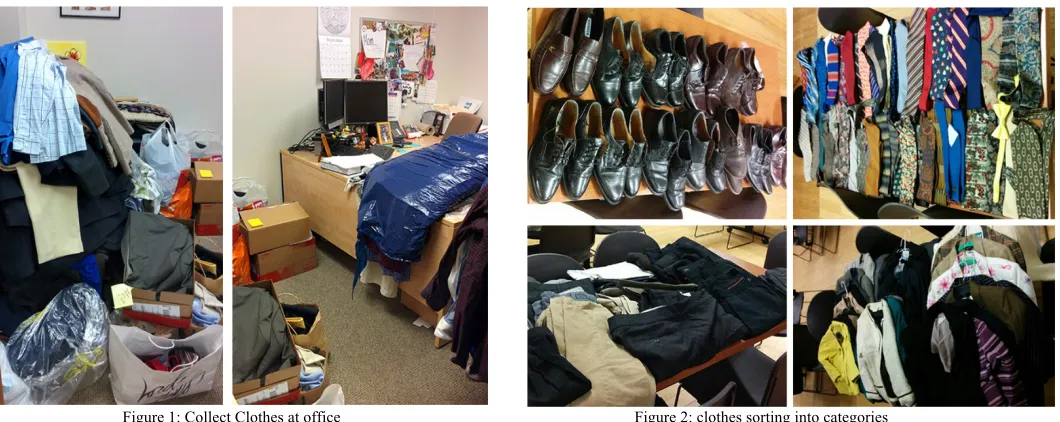
stages. First, employers and volunteers collect all the clothes from the offices without sorting them (figs.1). Then, an
exact date and time will be scheduled to sort all the clothes, and then move them from one space to another (figs.2);
that takes time and huge effort as well as big spaces to sort everything out in different categories 10.
Figure 1: Collect Clothes at office Figure 2: clothes sorting into categories
(Career Clothing Open House at RIT in September 2016) (Career Clothing Open House at RIT in September 2016)
Also, Wegmans store has a similar experience with sorting, but they figured out a solution at the end that
helped them a lot. Wegmans has a project called “Fill the Bus”. It is a yearly project that feeds poor children during
the weekend.What Wegmans used to have was a list of foods that the children need and was placed at the entrance
[image:12.612.43.573.345.556.2]organized as a bus and it was located after the cashier.However, Wegmans realized that they were wasting time and
spending double the time. They noted that if people have the exact thing in the bags with different prices (5$ 15$
-20$ -25$), it will be easier for both Wegmans and the donors, and it will save time. Donors only should take the
bags with the price they want, then buy the item they are interested in and put it in the bus, so it can reach to the
children faster.
Speaking about the amount of effort needed in such a project, there is another situation where a lot of
volunteers are required to help in sorting the donations when donors donate things that are unused. For example,
“Clothing usually comes in small quantities, making it hard to distribute effectively. When it comes in a semi-truck,
it takes 20 people three whole days to unload, sort and prepare.” 11. Enid Cardinal also advises students who run
RIT’s “Good Bye, Good Buy” to have a lot of volunteers which can work in different areas. First, volunteers collect
all the donations and sort them at the same time. Then, they move the materials to 7 trucks trailers which weigh up
to 3.5 tons of materials. After that, they move the materials to a specific location to store them. After 3 months, they
move them to another locations and sort them. Ms. Cardinal reported that a massive effort is needed to do this
project with the help of a lot of volunteers 12
Needed Volunteers
In this context, volunteers are the people who give their free time to assist those who are affected by the
disaster. Hence, not all those volunteers will gather at the same time in the location. Some volunteers will come and
help in different times during the day than other volunteers, which will be difficult to manage. Also, it will be
difficult to explain the tasks more than one time based on the different shifts that the volunteers come in. Therefore,
there is a waste of time while working on the administration of the organization. The volunteers may also do
something wrong or make a mistake that would exacerbate the entire project.
We cannot underestimate the donations especially when there are millions of people who need help.
Although there are a lot of time and massive effort to help these needy people, a great system will decrease the time
Chapter 3
Different Concepts with Implementation and Experimental
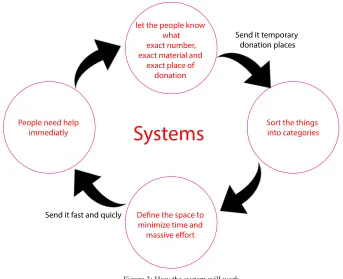
To solve the problem, there should be a system that works in many areas starting from getting the
[image:14.612.125.468.194.473.2]information until delivering the goods to whom in need (figs 3).
Figure 3: How the system will work
To avoid the huge quantities of unused and often unusable items which need to be disposed, people should
know the exact item that they should donate. That will happen if we implemented an awareness campaigns through
educating the public and the media. We also should understand the views and attitudes of recipients of donated
goods.
When I was working on the Shoe Box Project that related to the operation of Christmas Child Organization,
I realized that when they sent the posters through the emails. [13] There was writing a rule and the exact thing that
people should donate with specifying the places and dates of collecting the goods (figs.4). People responded and 90
% of the donations at that time was correct. It is totally different when a disaster happens without any information
about what people should donate, and what would be needed (figs.5).
Systems
People need help immediatly
let the people know what exact number, exact material and
exact place of donation
Sort the things into categories
Define the space to minimize time and
massive effort Send it fast and quicly
Figure 4: Samaritans’ Purse’s Poster Figure 5: Samaritans’ Purse’s Donation
The first idea that I came up with is to have a website that has a list of organizations, in which each
organization provides information about the date that they can collect the goods, the items that people donate, and
the location of where they can receive the donations. Organizations may also specify the number of things that they
would like to receive, so people will know exactly the amount of goods needed. In this way, that will help the
organization and the donors to have the exact item in the exact place to the exact people.
Second idea is to label the categories; these labels will be the same on the boxes of donation. I also
searched for a language that could be understandable by different people from different background, but I found that
placing pictures rather than writing names would be more practical. Therefore, I designed samples that would
resemble the types of donations (figs.6) (figs.7).. That will help in different area: First, it will help the volunteers to
sort the things in the appropriate boxes without a lot of explanation from the administration. Second, it will help the
people who receive the boxes to know what is inside the boxes without opening them The red cross manager of
Disaster Jose’ A. Latalladi. Jr Said “ they received a big container, but they need to open it to see what is inside the
[image:15.612.334.553.89.343.2]Figure 6: Categories Labeling idea Figure 7: Way to print the label on the box
I would also define the categories into more specific details if needed. For example, labeling categoriesof
clothes first, I will define the gender, then define the age groups: adults, children, Babies. After that, I define the
sizes by years for babies and children, and by sizes for adults. For example, Boxes for babies would be categorized
from 0 months to 3 months – 3 months to 6 months – 6 months to 9 months – 9 months to 12 months- 12 months to
18 months – 18 months to 24 months. If it for children, it will be (2 to 4 years – 5 to 9 years – 10 to 14 years. For
adults, it will be men sizes (S – M – L – XL ) and women sizes ( S – M – L – XL).
Labeling helped a lot on packaging party day of shoebox project, and made the project much easier and
faster. What they did is having different papers in which each paper has different categories with the name of the
items and the quantity that should be in each box, so volunteers will have the shoebox and they will choose the age
and the gender that they want to give them the gifts. Then, they have to go through the table to see how many items
they should have. At the end, the boxes will be filled with the exact items and the exact amount. Also, labeled with
the age and gender, so it can reach easily to the children at the end. [13] (figs.8) (figs.9).
However, understanding the people’s viewpoint about the samples categories will make the design simple.
I created a survey of different categories for donations to know how people think about the sample and how they
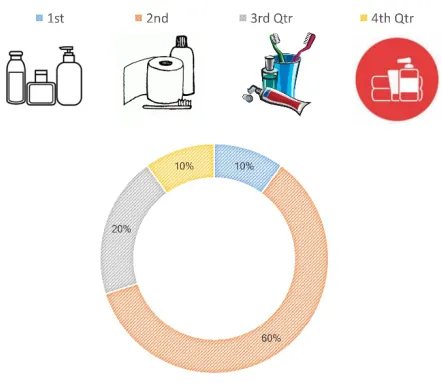
read it (figs.10) (figs.11) (figs.12) (figs.13) (figs.14).
Figure 10: The majority of people has chosen the second Figure 11: The majority of people has chosen the third image of baby supplies which shows the different types of baby supplies image of clothes which shows the different types of clothing
[image:17.612.53.287.171.352.2][image:17.612.328.523.175.350.2] [image:17.612.329.544.411.594.2]
Figure 14: The majority of people has chosen the second image of toiletries food which shows the real canned food
Most of the numbers and the comments that I got is: first, pictures should be understandable enough for the
users. Second, avoid the abstract pictures. Third, if I want to define a category that has many types under it, the
picture should show that. For example, if I represented the category of clothes as T-Shirt, people will understand in
this way. They might think it is a T-shirt category.
My third idea is to have boxes in 30 angle so it can allocate two boxes above each other (figs.15). That will
help to save place rather than to look for a big space to sort the donations; it can be smaller around the half space. To
keep this small place, holders should be created, and to make these holders, I should know the actual sizes that
people usually use in donations. There are three different sizes that are mostcommon. First size is 18, 24 ,18 IN.
Second size is 16, 16, 12 IN. Third size is 18, 18, 16 IN. (figs.16).
[image:18.612.85.227.549.693.2]By doing the small samples, I was thinking of the material that will be used as it should be very strong; because the
weight of the boxes is around 50 pounds each (figs.17).
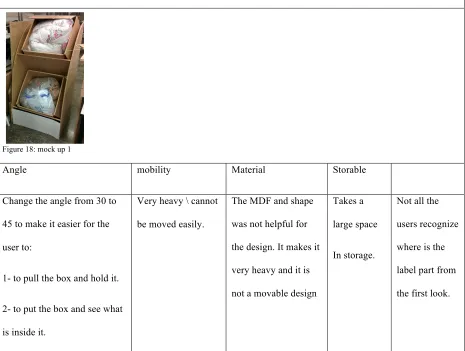
Mockup 1
Figure 18: mock up 1
Angle mobility Material Storable
Change the angle from 30 to
45 to make it easier for the
user to:
1- to pull the box and hold it.
2- to put the box and see what
is inside it.
Very heavy \ cannot
be moved easily.
The MDF and shape
was not helpful for
the design. It makes it
very heavy and it is
not a movable design
Takes a
large space
In storage.
Not all the
users recognize
where is the
label part from
the first look.
Shape: works very well in saving the space which we have two boxes allocated on the top of each other at the
same time; the users can put the goods inside the box.
Also, the height work very well for everyone.
Comments and suggestions:
1- light for the labeling part. (to use it at night if it is in place that doesn't have enough light)
2- have some opening in the sides which give the user more freedom to take out the boxes.
Mockup 2
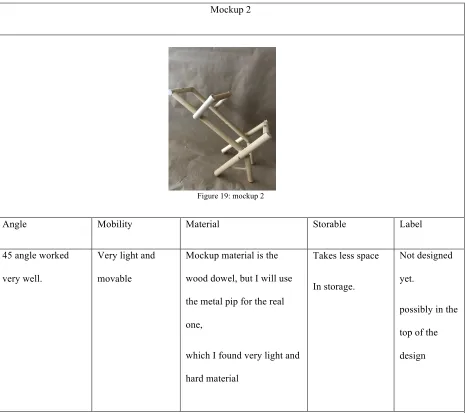
Figure 19: mockup 2
Angle Mobility Material Storable Label
45 angle worked
very well.
Very light and
movable
Mockup material is the
wood dowel, but I will use
the metal pip for the real
one,
which I found very light and
hard material
Takes less space
In storage.
Not designed
yet.
possibly in the
top of the
design
Shape: the design works very well and it is very light to be carried and stored. The problem is that the shape goes
in horizontal way which maximizes the space. Also, it is not very hard for the top part; if the box is very heavy, it
will fall.
Comments and suggestions:
1- have wheels; that will help in moving the heavy boxes from and to other places.
Mockup 3
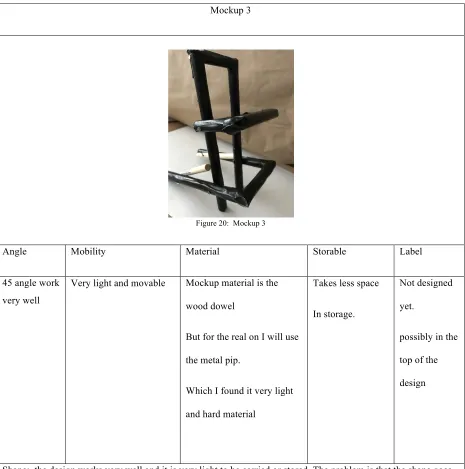
Figure 20: Mockup 3
Angle Mobility Material Storable Label
45 angle work very well
Very light and movable Mockup material is the
wood dowel
But for the real on I will use
the metal pip.
Which I found it very light
and hard material
Takes less space
In storage.
Not designed
yet.
possibly in the
top of the
design
Shape: the design works very well and it is very light to be carried or stored. The problem is that the shape goes
in a horizontal way which maximizes the space.
Comments and suggestions:
1- Try to have the same characteristics of the design but with a different design
Mockup 4
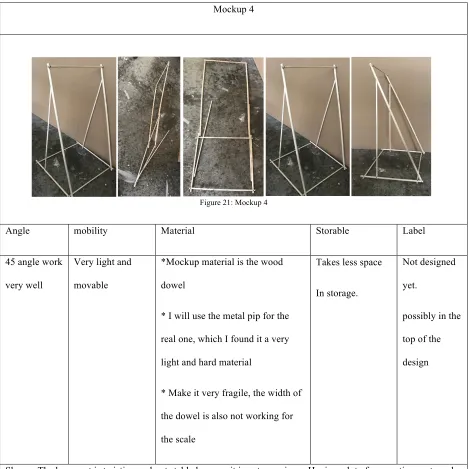
Figure 21: Mockup 4
Angle mobility Material Storable Label
45 angle work
very well
Very light and
movable
*Mockup material is the wood
dowel
* I will use the metal pip for the
real one, which I found it a very
light and hard material
* Make it very fragile, the width of
the dowel is also not working for
the scale
Takes less space
In storage.
Not designed
yet.
possibly in the
top of the
design
Shape: The base part is twisting and not stable because it is not one piece. Having a lot of connecting parts make
the design very fragile.
Comments and suggestions:
1- Use a different material.
Mockup 5
Figure 22: Mockup 5
Angle mobility Material Storable Label
45 angle work very
well
Very light and
movable
Mockup material is a Plastic
pipe which has the same
lightness and shape of the
metal pipe
It works very well.
Takes less space
In storage.
Can be moved to
anywhere
works very
well in the top
of the boxes
Shape: modular components that help to have less cost in manufactory. Works very well. Both shelves have the
space to have heavy or light boxes.
Comments and suggestions:
1- prefer connecting shelves
2- try to make it more sortable if that possible
Mockup 6
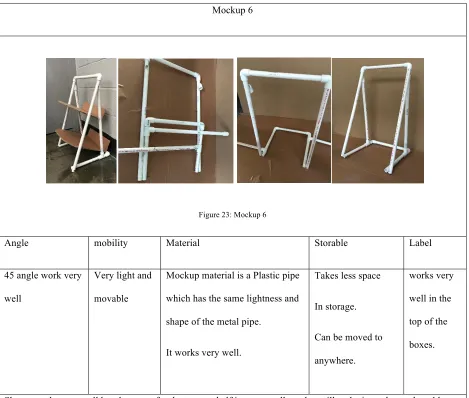
Figure 23: Mockup 6
Angle mobility Material Storable Label
45 angle work very
well
Very light and
movable
Mockup material is a Plastic pipe
which has the same lightness and
shape of the metal pipe.
It works very well.
Takes less space
In storage.
Can be moved to
anywhere.
works very
well in the
top of the
boxes.
Shape: works very well but the space for the topper shelf is very small, so that will make it weaker and could not
hold heavy stuff.
Comments and suggestions:
1- change the frame of the design to give more space to the topper shelf.
Chapter 4:
Final concept design: GoMa: an organization system for donation centers
It is to design an integrated and adaptable system that organizes donations and delivers them in a timely
and sorted manner.
GoMa Website
:
The website is designed as a source for donors to know more about disasters and what donations are needed
in each specific situation. Different information will be organized and posted on the website (figs.24). First, the
website will include a list of the international accredited organizations that will make the donors aware of
differentiating between the real organization from the delusive organization. Second, the website will also show
what organizations are available to receive donations within the area of donors who are interested; which will
facilitate the process so donations can be sent to the nearest location of the organization. Third, the website will
include a statistical information with detailed charts that illustrate the number of people who are affected by the
current disasters and are in need for donations. Fourth, information about people needs and required donations will
be ordered based on how much a specific donated item is needed. In other words, donors will be able to know what
items are important to be provided as soon as possible on the first day of recovery versus items that are less
important. According to Pauline Cole’s research, it was found that affected people’s needs on the first day of
recovery are different from their needs in the first week. On the first day, people usually need accommodation,
foods, lightings or candles, batteries, new toiletries, medications (e.g. antiseptic lotions, bandages, throat pastilles,
saline solution, goggles, cotton wool, and pain killers ...etc), and water for drinking, washing, and cleaning.
However, what people need in the first week are money, larger quantities of water, foods. There as well, for stock,
furniture, clothing which is needed to tide people, and a power source; e.g. generator. Since people’s needs are
different based on the situation and the days of recovery, the website will be a helpful online tool for donors to get
GoMa Stand
After the donors get the information for the web page, they will go to the temporary donation places and
they will find the GoMa Stand. It has two shelves at forty-five degree angles, which save space and provides more
ergonomic lifting of boxes. The color and material create an energetic, coherent atmosphere in spaces that are
typically thrown together or undersigned. Open sides allow donors to see the labels without gettingcloser to read it.
The stand is designed to be made from dowels, which means that it will need less materials, and it can be easily
sourced and manufactured where it is needed. All of these features benefit the busy volunteers when sorting and
[image:28.612.62.547.288.620.2]delivering donations to those in need (figs.25) (figs.26) (figs.27) (figs.28) (figs.29).
Figure 25: GoMa stand (Ergonomic-Attractive) Figure 26: GoMa Stand Dimensions
x 20 8”
3”
x 4 1.5” 2.5”
x 20
1.5” 2.5”
1” 22”
x 6 50”
[image:28.612.54.262.298.610.2]
Figure 27: GoMa Stand (Lightweight-movable-sortable)
GoMa Box Labeling
The third part of the system is the labeling. Labeling will help a lot for three reasons: First, it will help the
donors to consistently sort across multiple events and locations. Second, it will help the senders to streamline their
logistics process. Third, to help the recipients understand what items they have gotten and how to deploy them.
[image:30.612.81.532.172.645.2] [image:30.612.327.460.436.573.2](figs.30) (figs.31) (figs.32) (figs.33) (figs.34) (figs.35) (figs.36).
Figure 30: Box Labeling (Canned Food) Figure 31 Box Labeling ( Baby Supplies) Figure 32: Box Labeling ( Clothes)
Figure 33: Box Labeling (Health Kit) Figure 34: Box Labeling (Toiletries)
Figure 35: GoMa Box Labeling Figure 36: GoMa Box Labeling (Clothes schedule)
System’s Procedure
.Once the donor knows that a disaster has happened. He\she will check the website to know some information
that share people’s needs, as well as explain where to take these needs and the exact quantity. As a result, that will
help to send the affected people the right things without wasting any materials. Once the donors reach to the location
with the items that they would like to donate, they will find the GoMa stand. Each stand will have two boxes. The
label on the top of the stand will show where to put each item based on the predefined categories that are also
labeled and printed on the box. Sometimes, same items can be in the same box and sometimes it carries different
items depending on the quantities and the situation where people need donations. When the box is completely
packed, the volunteers or who is responsible on the organization will write how many quantities inside the box along
with any information needed, then print this note and attach it to the box. After that, they make sure that the box is
taped and closed and is ready for shipping. The volunteers then send out the boxes to the people whom in need; once
these people receive the boxes, they will be able to recognize the items from the note and the labels without even
opening the boxes. Also, the printed information will help them to see if these items are enough to satisfy their needs
Conclusion:
The nature of the human being is to help each other when they feel that there is someone who needs help,
but sometimes the lack of experience will make everything worse especially in temporary donation places.
However, if we educate the society and teach them the right way to donate, that will help to minimize the time and
spaces. Thus, it will help the volunteers to have less work. Also, it will help in sending the donation to the right
people in a short period of time with the exact items that they need. Moreover, the GoMa system will help a lot in
many areas that can facilitate donors and volunteers’ work. Also, it will lead to deliver goods to the affected people
in a timely and sorted manner. Starting from getting the information until the recipients understand what items they
Bibliography:
1- Interview Jose’ A. Latalladi, Jr. Disaster Program Manager Serving Livingston, Monroe & Ontario Oct 7 2016
2- "Dictionary.com - The World's Favorite Online Dictionary!" Dictionary.com. Accessed November 30, 2016.
http://www.dictionary.com/
3- "Thanks, But No Thanks: When Post-Disaster Donation Overwhelm." Around the Nation, January 9, 2013.
Accessed 2016.
http://www.npr.org/2013/01/09/168946170/thanks-but-no-thanks-when-post-disaster-donations-overwhelm.
4- "When Disaster Relief Brings Anything but Relief." Sunday Morning, April/May, 2016. Accessed 2016.
http://www.cbsnews.com/news/when-disaster-relief-brings-anything-but-relief/
5- Rapp, Randy R. Disaster Recovery Project Management: Bringing Order from Chaos. West Lafayette, IN: Purdue
University Press, 2011. Chapter 1 page 4
6- Convergence Behaviour in Disasters – A Problem in social control” Charles E Fritz and J H Mathewson.1957
7- Convergence Behavior in Disasters. A Problem in social control” Charles E Fritz and J H Mathewson.1957
8- Cole, Pauline. Management of Donated Goods following a Disaster. Canberra: Australia. Attorney - General's
Dept., 2010
9- Decker, Michael. Last Mile Logistics for Disaster Relief Supply Chain Management: Challenges and
Opportunities for Humanitarian Aid and Emergency Relief. Anchor Academic Pub., 2014.
10- Working in the Career clothing open house at Rochester Institute of Technology’s 09-26-2016
11- Ketcham, Jim. "Dnn How to Help > Clothing Donations: The Trouble with Trousers." Disaster News Network.
Accessed May 20, 1999. http://www.disasternews.net/news/article.php?type=howtohelp&articleid=2936.
12- Interview Enid Cardinal, Advises the students who run Rochester Institute of Technology’s “Good Bye, Good
Buy”
13- Working on pack shoeboxes project at Rochester Institute of technology to Samaritan’s Purse Operation
November 18.
14- Red Cross manager of Disaster Jose’ A. Latalladi, Jr Rochester, NY
15- Senior Project Officer, State Recovery Office Department for Families and Communities, South Australia