Optimal selection of topologies for the
minimum-weight design of continuum structures
with stress constraints
Q Q Liang1*, Y M Xie1andG P Steven2
1School of the Built Environment, Victoria University of Technology, Melbourne, Victoria, Australia 2Department of Aeronautical Engineering, The University of Sydney, New South Wales, Australia
Abstract: This paper presents a method for assisting the optimal selection of topologies for the minimum-weight design of continuum structures subject to stress constraints by using the performance index (PI ). A performance index is developed for evaluating the efficiency of structural topologies based on the scaling design approach. This performance index is incorporated in the evolutionary structural optimization (ESO) method to monitor the optimization process when gradually removing inefficient material from the structure. The optimal topology can be identified from the performance index history. Various structures with stress and height constraints are investigated by using this performance index, which is also employed to compare the efficiency of structural topologies generated by different optimization methods. It is shown that the proposed performance index is capable of measuring the efficiency of structural topologies obtained by various structural optimization methods and is a valuable design tool for engineers in selecting optimal topologies in structural design.
Keywords: performance index, topology, stress constraint, evolutionary structural optimization, finite element analysis
Ws
i scaled weight of the current design at the NOTATION
ith iteration (kg) W
0 weight of the initial design domain (kg)
E Young’s modulus (GPa)
Ws
0 scaled weight of the initial design domain (kg)
h height (mm)
x
e design variable Ks stiffness matrix of a scaled structure (N/mm)
xs
e scaled design variable L length (mm)
P force vector (N )
s stress vector of elements (MPa) PI performance index
ss scaled stress vector of elements (MPa) t thickness of elements (mm)
s* prescribed stress limit (MPa) t
e thickness of theeth element sVM
i,max maximum von Mises stress of elements in the
u actual displacement vector (mm)
current design (MPa)
us scaled displacement vector (mm)
sVM
max maximum von Mises stress of elements in the
V
i volume of the current design at theith iteration (mm3) structure (MPa)
sVM
0,max maximum von Mises stress of elements in the
V
0 volume of the initial design domain (mm3) initial design domain (MPa) w
e weight of theeth element (kg) Q scaling factor W total weight of a structure (kg)
W
i weight of the current design at theith iteration (kg)
1 INTRODUCTION
The MS was received on 18 August 1998 and was accepted for publication The topology optimization of structures has increasingly
on 15 December 1998. gained popularity in recent years as it is realized that the
* Corresponding author: School of the Built Environment, Victoria
optimization of topologies can significantly improve the
University of Technology, PO Box 14428, Melbourne City, Victoria
the weight of structures with optimal topologies is gener- topologies of various continuum structures with stress and height constraints and to compare the efficiency of ally more significant than that obtained by sizing
optim-ization [1]. There have been a large number of structural structural topologies obtained by different methods. Finally, the factors affecting the performance indices and topologies in the literature, produced by various
struc-tural optimization methods such as presented by the optimal topologies of continuum structures are discussed.
Bendsøe and Mota Soares [2] and by Stevenet al.[3]. Although optimization methods can be examined by comparing the results with classical solutions such as
2 DERIVATION OF PERFORMANCE INDEX
those presented by Michell [4] and Hemp [5], the final topologies obtained may vary with the criteria and
methods used. Since there are no simple rules for meas- 2.1 Scaling of the design uring the efficiency of structural topologies, engineers
Scaling of the design has been used in some optimization face difficulty in selecting these topologies in the design
algorithms after each iteration to obtain the best feasible of engineering structures.
constrained design [13]. The advantages of scaling the Performance indices have been attempted by several
design are that it can trace the history of the reduction researchers for assisting the selection of materials and
in the weight of the structure after each iteration and geometry for structures in design. Boiten [6] has used a
pick the most active constraints. This method can be performance index to optimize the energy storage device.
applied to structural optimization when the stiffness Ashby [7] has derived a set of performance indices for
matrix of the structure is a linear function of the design the selection of materials and cross-section shapes for
variable. By scaling the design, the scaled design variable structural elements. Weaver and Ashby [8] have also
is expressed by employed such performance indices for assisting the
selection of material and section shapes. The method xs
e=Qxe (1)
outlined by Ashby has recently been used by Burgess
in whichxs
eis the scaled value of the design variable such [9,10] to derive performance indices known as form
fac-as the element thickness for theeth element,Qis a scaling tors for optimizing the structural layouts of trusses and
factor that is the same for all elements and x e is the beams with strength and stiffness constraints
respect-actual design variable of the eth element. The force– ively. Burgess has also used these performance indices
displacement relationship in the finite element method to compare the efficiency of structural topologies
can be written as obtained by different optimization methods. However,
it is difficult to extend this approach to the optimization 1
QKsu=P (2)
of continuum structures because the objective function can no longer be expressed by the separable functional,
where Ks is the stiffness matrix of the scaled structure geometrical and material parameter functions, as would
and is calculated by using the scaled design variable be the case for single-element and truss structures.
xs
e. The equilibrium equation for the scaled design can An attempt to derive a performance index (PI ) for
be expressed in terms of the scaled design variable by measuring the efficiency of structural topologies for
con-tinuum structures, which are discretized into finite Ksus=P (3)
elements, has also been undertaken by Querin [11].
From equations (2) and (3), the following is obtained: However, the performance index formula given by
Querin does not consider any type of constraint and its
us=1
Qu (4)
meaningful application may be very limited. Xie and Steven [12] have measured the efficiency of structural
From the expressions of the strain–displacement and topologies by comparing the volume of the new design
stress–strain relations in terms of the scaled design vari-with that of the optimized uniform design, which is
able, the scaled stress vector can be derived as established by uniformly reducing the thickness of the
initial design domain until the prescribed displacement
ss=1
Qs (5)
reaches the limit.
This paper presents a methodology for developing a
in whichsis the stress vector of elements. Therefore, in performance index to assist the selection of optimal
top-order to satisfy the stress constraint in a structure, the ologies for the minimum-weight design of continuum
actual design needs to be scaled by structures with stress constraints. The derivation of a
performance index is firstly formulated on the basis of
Q=sVMmax
s* (6)
the scaling design concept. The evolutionary structural optimization (ESO) method based on the stress ratio
criterion is then outlined. The performance index devel- where sVM
limit. By changing the value of the scaling factor Q in terms of the volume of the structure as the structural optimization process, the best feasible
design can be obtained and this is the optimal topology PI=sVM0,maxV0
sVM i,maxVi
(11) for the structure considered.
whereV
0is the volume of the initial design domain and
V
iis the volume of the current design at theith iteration. It can be seen from equation (11) that the perform-2.2 Performance index
ance index is a dimensionless number that measures the efficiency of structural topologies. The performance The topology optimization of a structure is the selection
index reflects the changes in the volume and the maxi-of the geometry that minimizes the weight maxi-of the
struc-mum stress levels in the structure in an optimization ture while satisfying the requirements of constraints
process. For the initial design, the performance index is imposed on the structure. The nature of the material
equal to unity. The efficiency of a structural topology is layouts in an optimized structure depends on the type
gained by removing lowly stressed materials from the of constraint. A different type of constraint leads to
structure. Since the performance index is inversely pro-different optimal topology. In this paper the maximum
portional to the volume of the current design, minimiz-stress constraint in the structure is considered as the most
ing the weight of a structure with stress constraint can active constraint so that the requirement on the strength
be achieved by maximizing the performance index in the limit state needs to be satisfied.
optimization process. In addition, it indicates that the The optimization of continuum structures subject to
optimal topology for the minimum-weight design of a stress constraint can be expressed as
continuum structure with a given support and loading condition is the same for any value of prescribed stress minimize W= ∑N
e=1 w
e(te) (7a) limits. The optimal topology that corresponds to the maximum value of the performance index can be ident-subject to sVM
max∏s* (7b) ified from the performance index history. The higher the value of the performance indices, the better is the top-wherew
eis the weight of the eth element, which varies ology of the structure. with the element thickness. For the linear elastic plane
The performance index proposed here is not specific stress problems, the stiffness matrix is a linear function
to the optimization methods used, so it can be incorpor-of the design variable such as the thickness incorpor-of elements.
ated in any structural optimization method such as the By scaling the design with respect to the stress constraint,
homogenization [14] and ESO [12] algorithms to trace the scaled weight of the initial design domain can be
the performance history and to predict the optimal top-represented by
ology. Moreover, the performance index can also be used to compare the efficiency of structural topologies W0s=
A
sVM0,maxs*
B
W0 (8) obtained by different optimization methods.in which W
0 is the actual weight of the initial design
3 EVOLUTIONARY OPTIMIZATION
domain andsVM
0,maxis the maximum von Mises stress of an element in the initial design domain under applied
loads. In an iterative optimization process, the scaled The evolutionary structural optimization ( ESO) method weight of the current design at theith iteration is given proposed by Xie and Steven [12,15,16] is based on the by scaling the design as concept that, by gradually removing inefficient material from a structure, the topology of the remaining design evolves towards an optimum. In this approach, the Wis=
A
sVMi,maxs*
B
Wi (9) design domain, which is large enough to cover the final design, is divided into a fine mesh of finite elements. The where Wi is the actual weight of the current design at structure is firstly analysed by undertaking a finite theith iteration and sVM
i,max is the maximum von Mises element analysis. For problems with stress constraints, stress of an element in the current design at the ith
the maximum von Mises stress is used as the element iteration.
removal criterion, which is expressed by The performance index at theith iteration is proposed
as sVMe
sVM i,max
<RR
k (12)
PI=W0s Ws i
=(sVM0,max/s*)W0 (sVM
i,max/s*)Wi
=sVM0,maxW0
sVM i,maxWi
(10) where sVM
e is the von Mises stress of the eth element, and RR
k is the rejection ratio at the kth steady state. All elements that satisfy equation (12) are removed from If the material density is uniformly distributed within
the element removal is repeated by using the same RR k until no more elements can be removed from the struc-ture at the current state. At this stage, an evolution rate ER is added to RR
k, and the rejection ratio becomes RR
k+1=RRk+ER (13)
As the element removal and the finite element analysis process is continued, the structure gradually evolves towards a more uniformly stressed design.
The above traditional ESO procedure can generate more efficient structural topologies. However, it is not possible to decide which topology is the optimum for the minimum-weight design of a continuum structure because there is no objective function and stress con-straints involved in the optimization process. This prob-lem can be overcome by using the performance index proposed in this paper. By simply recording the
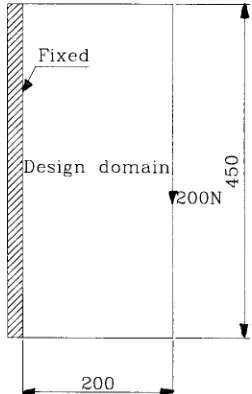
maxi-mum von Mises stress of elements and the volume of Fig. 1 Design domain for the cantilever beam the current structure at each iteration, the performance
index can be calculated using equation (11) for each iteration. Consequently, the optimal topology can be determined from the performance index history.
It has been found that the magnitude of stress con-straints might have significant effects on the weight of a final design but not on the optimal topology. Therefore, the structural optimization process can be divided into two steps. The first step is to obtain the optimal topology of the continuum structure using the PI formula and any structural optimization method such as ESO regardless of the value of the stress limit. The second step is to size the obtained optimal topology in order to satisfy the stress constraints. Only the first step is considered in this paper.
Fig. 2 Performance index history of the cantilever beam
which indicates that the weight of the initial design
4 EXAMPLES
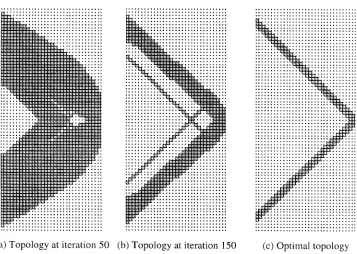
domain is 10.86 times that of the optimal design obtained if the maximum von Mises stress of elements in the struc-4.1 Deep cantilever beam ture reaches the prescribed stress limit. The topologies
at iterations 50 and 150 and the optimal topology The design domain for a deep cantilever beam with
maxi-obtained are shown in Fig. 3. The optimal topology of mum stress constraint whose value is not specified here
the deep cantilever beam evolves towards a two-bar is shown in Fig. 1. The design domain is discretized into
truss-like structure which has been proved to be an opti-a 32×72 mesh using four-node plane stress elements.
mum design under the condition described in this The support of the cantilever beam is fixed. A point load
example. Table 1 presents a comparison of material vol-of 200 N is applied to the centre vol-of the free end. The
umes required for the initial design and the three top-Young’s modulusE=200 GPa, the Poisson’s ration=
ologies shown in Fig. 3 for various stress limits. It can 0.3 and the thickness of elementst=1 mm. Plane stress
be seen from the table that the volumes of the optimal conditions are assumed. An initial rejection ratio RR
0 topology are always less than those of the other three of 1 per cent and an evolution rate ER of 1 per cent are
topologies for each stress limit. This illustrates that the used in the optimization process.
topology shown in Fig. 3c is the best topology, irrespec-The performance index history for the deep cantilever
tive of the prescribed stress limits. beam is presented in Fig. 2. It can be seen that at the
initial iteration the performance index is equal to unity
because no elements have been removed at this stage. 4.2 Michell-type structures with height constraints By gradually removing lowly stressed elements from the
[image:4.595.364.490.40.237.2] [image:4.595.315.539.263.426.2]Fig. 3 Evolutionary history of topology optimization for the cantilever beam
Table 1 Material volumes required at different iterations for various stress limits
s* Vs0 Vs50 Vs150 Voptimals
(MPa) (mm3) (mm3) (mm3) (mm3) PI
max=Vs0/Vsoptimal
100 18 855 11 117 4086 1735 10.86
150 12 570 7412 2724 1157 10.86
250 7542 4447 1634 694 10.86
in Fig. 4. In case (a), the design domain withh/L=1/2 ture. For cases (b) to (d ), RR
0=1 per cent and ER= 1 per cent are used. Plane stress conditions are assumed is divided into a 100×50 mesh using four-node plane
stress elements and RR
0=1 per cent and ER=0.5 per for all cases.
Figure 5 shows the performance index history for cent are used in the optimization process. In case (b),
the design domain with h/L=1/4 is divided into a case (a). It can be seen that the performance index is increased when inefficient material is removed from the 100×25 mesh. In case (c), the design domain withh/L=
1/8 is divided into a 100×13 mesh. In case (d), a 100×9 mesh is used for the structure withh/L=1/12. The mate-rial properties for all cases areE=200 GPa,n=0.3 and t=2 mm. A point loadP=400 N is applied to the
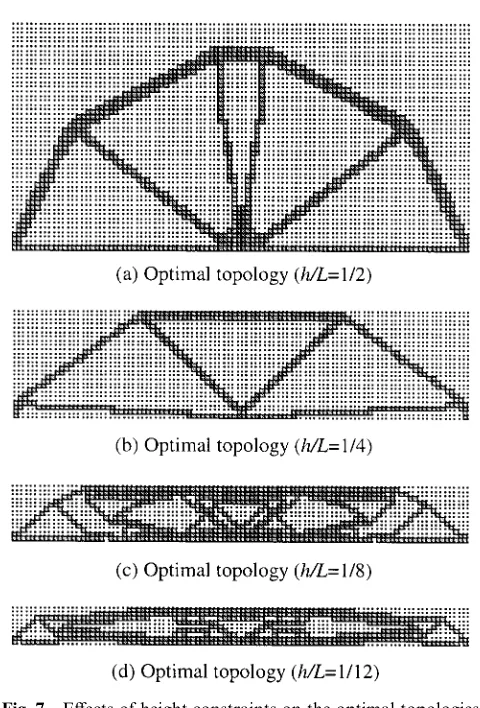
[image:5.595.129.464.349.411.2] [image:5.595.317.538.543.702.2] [image:5.595.55.275.589.705.2]structure. However, further element removal from the in Figs 7a and b exhibit truss-like structures that can be designed as trusses. When h%L, the optimal topology optimal design eventually leads to collapse of the
struc-ture. The effects of height constraints on the performance as shown in Fig. 7d evolves to a continuum structure. index of the Michell-type structures are illustrated in
Fig. 6. It can be seen that the performance index
increases with increase in height when compared with 4.3 Efficiency of structural topology the initial design domains. The maximum performance
The performance index developed here can be used to indices for cases (a) to (d ) are 6.8, 4.97, 1.89 and 1.44
compare the efficiency of structural topologies produced respectively. The optimal topologies obtained for each
by different optimization methods. A transverse beam case are shown in Fig. 7. The optimal topologies shown
[image:6.595.56.273.174.333.2]of homogeneous material with fixed supports shown in Fig. 8 is optimized by using the ESO procedure. The design domain is discretized into a 90×30 mesh using four-node plane stress elements. A concentrated load of 400 N is applied to the centre of the bottom. The mate-rial properties are E=200 GPa, n=0.3 and t=2 mm. In this plane stress problem, RR
0=1 per cent and ER=1 per cent are used.
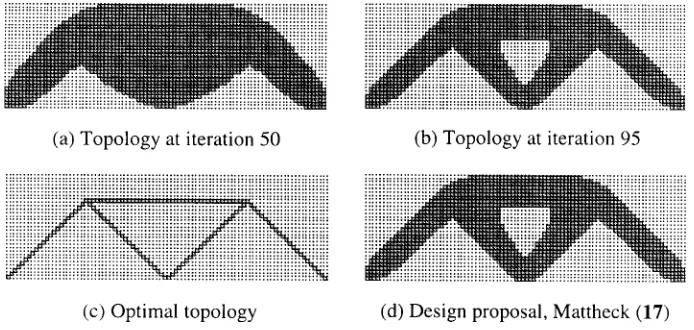
The evolutionary history of the performance index for this beam is presented in Fig. 9. The maximum perform-ance index is 14.32. The topologies obtained at different iterations are shown in Fig. 10, where the optimal top-ology is uniformly stressed. Figure 10d shows the final design proposal presented by Mattheck [17] using the soft kill option (SKO) approach. This proposal is regen-erated here using the same mesh as used in the ESO. A
Fig. 6 Effects of height constraints on the performance index linear static finite element analysis is carried out to
ana-lyse the design proposal. The performance index of the proposal calculated using equation (11) is 1.92, which is
Fig. 8 Design domain for the beam with fixed supports
[image:6.595.45.285.360.714.2] [image:6.595.311.543.400.498.2] [image:6.595.311.546.536.690.2]Fig. 10 Evolutionary topology optimization for the beam with fixed supports
much less than that obtained by the ESO method. In the height constraints imposed on the initial design domains. The efficiency of the final design of a structure fact, it can be seen that this final proposal given by
Mattheck is very similar to the topology shown in is improved when increasing the height of the initial design domains as shown in Fig. 6. For the simply sup-Fig. 10b, which is far from the optimum for the
light-weight design of the beam with stress constraint. ported Michell structures, the optimal height is close to the valueh/L=1/2. Whenh%L, the performance index Therefore, it can be concluded that the proposed
per-formance index is a useful tool for measuring the of the optimized design will be close to unity, which is the performance index of the initial design domain. efficiency of structural topologies and identifying the
most efficient topology. The magnitude of the load may have a significant impact on the weight of a final design but not on the optimal topology. However, the loading position obvi-ously determines the optimal material layouts of
con-5 DISCUSSION
tinuum structures. It can be seen from equation (11) that the load applied to the structure is eliminated from The examples presented have shown that the proposed
the performance index which only depends on the top-performance index can predict the evolutionary history
ology and not on the scale of the loads. The proposed of the structural efficiency in an optimization process
performance index can also be used to optimize struc-and the optimal topology. The performance indices struc-and
tures under multiple load cases. the optimal topologies of continuum structures with
stress constraints are affected by the uniformity of stress within the structure, the height constraints and the
pos-6 CONCLUSIONS
ition of the loads. These factors need to be considered in the selection of optimal topologies in structural
design. This paper has presented a performance index for
assist-ing the selection of best topologies for the least-weight The stress distribution within the initial design domain
of a continuum structure is hardly uniform owing to the design of continuum structures with stress constraints. A performance index has been developed using the sca-stress concentration in the region of loading and
sup-ports. The performance index formulated by considering ling design approach. This is valid for systems where the stiffness matrix of a structure is a linear function of the the maximum stress constraint can indicate the process
of maximizing the uniformity of stresses in the optimal design variable. The proposed performance index has been used successfully in the evolutionary structural topology. For example, the performance index of the
cantilever beam at the optimum is constant at the later optimization ( ESO) procedure to monitor the optimiz-ation process and to identify the optimal topology of stage of iterations as shown in Fig. 2. This means that
element stresses in the optimum are approximately uni- various structures with stress and height constraints. The performance index can indicate the uniformity of form. In contrast, for the Michell-type structures with
simple supports, the performance index drops sharply stress within the optimal topology of continuum struc-tures. Increasing the height of the initial design domain after reaching the maximum value, as illustrated in
Fig. 5. In this case, there are still lowly stressed elements usually improves the efficiency of the final optimal design. The proposed performance index can be incor-in the design, but the range of stress levels has been
4 Michell, A. G. M. The limits of economy of material in
efficiency of structural topologies obtained by different
frame-structures.Phil. Mag., 1904,8, 589–597.
structural optimization methods. Furthermore, the
per-5 Hemp, W. S.Optimum Structures, 1973 (Clarendon Press,
formance index can also be applied to continuum
struc-Oxford ).
tures under multiple load cases.
6 Boiten, R. G. Mechanics of instrumentation. Proc. Instn Mech. Engrs, 1963,177, 269.
7 Ashby, M. F. Materials Selection in Mechanical Design, 1992 (Pergamon Press, Oxford ).
ACKNOWLEDGEMENTS
8 Weaver, P. M.andAshby, M. F.The optimal selection of material and section-shape. J. Engng Des., 1996, 7(2),
This paper forms part of a programme of research into 129–150.
evolutionary structural optimization as an efficient 9 Burgess, S. C.The ranking of efficiency of structural layouts
and reliable design tool being undertaken at Victoria using form factors. Part 1: design for stiffness.Proc. Instn Mech. Engrs, Part C, Journal of Mechanical Engineering University of Technology and The University of Sydney.
Science, 1998,212(C2), 117–128.
This programme is funded by the Australian Research
10 Burgess, S. C.The ranking of efficiency of structural layouts
Council under the Large Grants Scheme. The first author
using form factors. Part 2: design for strength.Proc. Instn is supported by an Australian Postgraduate Award and
Mech. Engrs, Part C, Journal of Mechanical Engineering a Faculty of Engineering and Science Scholarship.
Science, 1998,212(C2), 129–140.
11 Querin, O. M.Evolutionary structural optimization: stress based formulation and implementation. PhD thesis, Department of Aeronautical Engineering, The University REFERENCES
of Sydney, 1997.
12 Xie, Y. M. and Steven, G. P. Evolutionary Structural
1 Kirsch, U. Fundamental properties of optimal topologies. Optimization, 1997 (Springer-Verlag, Berlin).
In Proceedings of NATO Advanced Research Workshop 13 Kirsch, U.Optimal design based on approximate scaling. onTopology Design of Structures( Eds M. P. Bendsøe and J. Struct. Engng, 1982,108(ST4), 888–909.
C. A. Mota Soares), 1993, pp. 3–18 ( Kluwer Academic 14 Bendsøe, M. P.Optimization of Structural Topology, Shape, Publishers, Dordrecht). and Material, 1995 (Springer-Verlag, Berlin).
2 In Proceedings of NATO Advanced Research Workshop 15 Xie, Y. M.andSteven, G. P.A simple evolutionary pro-onTopology Design of Structures( Eds M. P. Bendsøe and cedure for structural optimization. Comput. and Struct., C. A. Mota Soares), 1993 ( Kluwer Academic Publishers, 1993,49(5), 885–896.
Dordrecht). 16 Xie, Y. M.andSteven, G. P.Evolutionary structural optim-3 In Proceedings of the Australasian Conference on ization for dynamic problems.Comput. and Struct., 1996,
Structural Optimization( Eds G. P. Steven, O. M. Querin, 58, 1067–1073.
H. Guan and Y. M. Xie), 1998 (Oxbridge Press, 17 Mattheck, C.Design in Nature: Learning from Trees, 1998 (Springer-Verlag, Berlin).