An assessment strategy for a first year engineering
problem solving course
Peter Gibbings
University of Southern Queensland, Toowoomba, Australia [email protected]
Lyn Brodie
University of Southern Queensland, Toowoomba, Australia [email protected]
Abstract: This paper describes an assessment strategy for an Engineering
problem-based learning course offered to first year students at the University of Southern Queensland. The assessment involves initial auditing of existing skills and competence of each student to facilitate the effective allocation of students with different levels of expertise in various discipline areas, into well balanced teams. This balance in combination with the formal assessments in the course, have been shown to encourage effective mentoring within and between teams.
The formal assessment strategy includes a mix of both summative and formative assessment. The summative assessment of objectives combines team and individual assessment and is tailored to individual students’ existing skill levels. The emphasis is on advancement of skills and competence rather than simply achieving a minimum standard. This strategy provides the flexibility for equitable assessment of students with different initial skill and competence levels. This is particularly relevant to students studying in the distance mode who may have considerable professional experience and advanced skills and competence.
By tracking progress towards the achievement of objectives, students develop an individual portfolio of achievements that can be continued throughout the remainder of their programs and professional lives.
Keywords: Problem Based Learning, Assessment, Teams
Introduction and Background
The University of Southern Queensland (USQ) has been in operation since 1967 and has developed an international reputation for offering high quality academic programmes in the on-campus (internal), off-campus (distance), and on-line delivery modes. The USQ operates several satellite campuses throughout the world with the principal campus situated at
In these PBL courses, students learn to work together in teams to solve problems by collaboration (Frank & Barzilai, 2004) using a system similar to the interdisciplinary PBL platform described by Acar (2004). Rather than led education (PLE) or project-organised learning (POL), which are projects supported by theory-based lecture courses (Powell, 2004) and usually focus on team-based activity relating to large scale open-ended problems (Powell & Weenk, 2003), in the courses developed at USQ the teams are given a number of smaller scale open-ended problems to solve, and hence the strategy is truly PBL.
The courses form a PBL strand, which consists of a series of four consecutive courses and an additional final year research project that is seen as the capstone of the strand. The main objectives of the first two PBL courses, which are compulsory for all students in the faculty, are to develop the fundamental skills needed by students to participate effectively in multi-disciplinary teams, develop communication skills, and to expose students to a wide range of problem-solving tools. This paper concentrates on the first of these PBL courses.
Student Diversity
Students enrolled in the first PBL course are placed into teams of up to eight members. Current practice is to randomly allocate students to teams, but it is recognised that a better system may be to balance members’ existing skills within the teams (Gibbings & Brodie, 2006 (in press)). Each team is allocated a staff member to act as a facilitator as explained by Gibbings and Morgan (2005). The facilitator is also responsible for assessing his/her teams, although others have cautioned against this since there can be a conflict in roles in being a judge and facilitator at the same time (Powell, 2004). To help alleviate this conflict, an examiner is appointed to the course who has overall responsibility for administration and assessment of the course, staff training and coordination.
Great student diversity is observed within the PBL teams because: • students may elect to study in the internal or distance modes,
• distance students study from various geographic locations around the world,
• students may study at Associate Degree (two year), Bachelor of Technology (three year), Bachelor (four year), or double degree (five year) levels, and
• students may study different majors offered in FoES: Agricultural, Civil and
Environmental; Electrical, Mechanical and Mechatronic Engineering; and Surveying and Land Information.
It is interesting to note that most of these elements of diversity were also identified by Knowles, Holton & Swanson (1998) as core principles that need to be considered when designing education for adult learners. Because of this student diversity, the variation in learning objectives between individual students can be profound, which can complicate the assessment process.
Most students studying in distance mode do so because they are already employed in some capacity in industry, and the distance mode allows them to study and work at the same time. Consequently, many have different skill levels and personal competency attributes compared to internal students, and their ‘learner context’ (Haggis, 2002; Savin-Baden, 2004, p. 224) is quite different.
developed significant skills through experience in the work force. And this must be done in an equitable manner so as not to advantage or disadvantaging any group or individual. It seems logical that, to do this effectively, the learning objectives and assessments should be, at least partly, individualised for each student. It is also recognised that peer assisted learning (mentoring within teams), which can have a motivating effect on the teams (Frank & Barzilai, 2004), and mentoring between teams, should be encouraged and rewarded. In this way the course successfully uses the rich diversity within the teams to assist in the learning process.
Critical Analysis of Previous Assessment Scheme
In 2005 the assessment scheme in the course was updated to account for the following shortcomings in the previous assessment scheme:
• some students in teams wanting to do all of the work themselves and not share the workload with other team members. This may have occurred for several reasons, the most common was that the ‘high achievers’ didn’t want to rely on others to carry out tasks that could ultimately affect their own ‘marks’.
• some students not wanting to participate at all, or contribute very little to the team effort.
• those who were proficient at a particular skill would tend to adopt that role in all projects because that would give the team its best chance of receiving a ‘good mark’ for the projects. No incentive was provided for students to learn new skills, and existing competence was not recognised.
• no real incentive was provided to encourage mentoring within the teams. Students did not get to see a sample project nor could they benchmark what they did against any other team.
• no incentive was provided to individuals to encourage the appraisal of other teams’ proposals (mentoring between teams) and to provide appropriate feedback to these teams.
A major weakness of the earlier approach was that it did not provide appropriate incentive, through assessment, for the types of behaviour that were considered desirable such as collaborative learning and mentoring.
Revised Assessment
The assessments are used as an incentive to discourage undesirable activity and to encourage desirable behaviour, such as mentoring within the teams and mentoring between teams. The assessment scheme was revised to place less emphasis on the team mark for the projects and on the project solution, and more emphasis on what the individual has learned, and how and why the individuals’ skill and competence levels increased. The revised assessment strategy was designed to reward advancement of skills, and learning new skills, rather than just reaching a minimum standard. This is achieved by each student individually negotiating, and being assessed on (as suggested by Heron, 1989), objectives, goals and targets for each
Team Selection
The assessment method involves the initial auditing of existing skills and competencies of each student, as well as continual skill assessment to map student’s progress throughout the full suite of PBL courses. The initial skill assessment is now used to allocate students with different levels of skill in various fields into better balanced teams, which in turn encourages mentoring within the teams. The skills audit is carried out via a series of questions that are linked to the course objectives and presented on the course web site.
To overcome the possibility that some students may either underestimate or overestimate their skill levels, they are advised that:
• the audit is not part of any formal assessment.
• if students underestimate skills in a particular area, they may be placed in a team with someone else, who is supposedly strong in this same area, who may be charged with the responsibility of mentoring them in this skill. This will be ineffective and inefficient for both parties, and their team will be disadvantaged due to not having well balanced skills.
• if they overestimate skills, then they may be asked to mentor another team member in this skill area. In this case mentoring won’t be effective and they and the team will consequently be penalised.
Assessment Overview
As a first step, the course objectives were changed to better reflect what was considered important outcomes from the course, and were correlated to national competency standards and the USQ graduate attributes. Documentation of objectives is beyond the scope of this paper.
[image:4.595.71.430.496.752.2]The assessment scheme involves both individual and team assessment, and includes a mix of summative and formative assessments. Figure 1 shows how these assessments are linked and how each element contributes to student’s individual marks.
A summary table of individual and team assessments, including due dates, assessment schemes, and submission methods, is provided for students on the course web site. The assessment summary is also directly linked to a study schedule. A link is provided from this table to the specific requirements for each individual project. Marking rubrics are also provided to students with appropriate marks allocated to each element.
The assessment scheme involves five main sections that contribute to the student’s individual mark:
• Communications log
• Team submission of project reports
• Peer assessment of contribution within the team • Individual contributions
• Individual portfolio of set work and individual reflection on learning
Communications log
Management of the course is through use of the WebCT Vista e-learning system. This platform provides access to web-based material, online quizzes and surveys, and
communication facilities such as electronic mail, discussion boards, and synchronous chat sessions. Students are required to use the discussion boards for most communications within their teams. Each team has their own discussion board, which only they and the course administration staff, including their facilitator, can access. In addition, sets of four or more teams are also given access to a combined discussion board to facilitate between-team communications. Students’ contributions to both team and combined discussion boards are assessed. It should be noted though, not all contributions to the discussion boards form part of the summative assessment.
Team project reports
Students are required to negotiate suitable roles within their team for each project. Each team is then required to prepare a plan that includes each individual’s role and responsibility within the team, and their learning objectives. This is in accordance with research that suggests that adult learners want control over learning based on personal goals (Knowles, Holton, & Swanson, 1998). There is convincing evidence that those who take some initiative and become involved with their own learning in this way, will learn more than those who take a more passive approach (Smith, 2002). This approach recognises that not all students have the same learning objectives, nor are they faced with the same issues (particularly considering the student diversity mentioned earlier), so it is necessary to be flexible (Heimbecker, 2005). It also recognises that true ‘engagement’, ‘ownership’, and ‘motivation’ can come from students negotiating their own learning objectives and constructing them within their own context (Heimbecker, 2005).
The main emphasis of the learning and assessment strategy is on advancement of skills, and acquiring new skills. Accordingly, teams can gain bonus assessment marks for individual members accepting different roles in each of the projects and if they can provide evidence of mentoring within their teams.
draft reports are annotated with comments and highlighting in Microsoft Word. The
completed marking rubric and this annotated report are sent back to the teams on their team discussion board so it is not visible to other teams.
Teams then have the opportunity to alter their submissions in light of the feedback from other teams and their facilitator and resubmit the final project report to a course assignment drop box in WebCT. This final submission must provide evidence of changes or actions taken subsequent to the feedback outlining how and why the initial report was improved as a result. This reflection, opportunity to respond to feedback (and to carry out informal assessment of other’s work by providing feedback), and collaboration within the team, are seen as critical to the learning process (Isaacs, n.d.). In this way, the assessment becomes an integral part of the learning process, and will encourage students to engage in the learning tasks associated with the problem solution, which is one of the most fundamental tasks of education (Biggs, 2002). All team final project reports are again formally assessed by their facilitators using an
appropriate marking rubric, and constructive feedback is again provided to the teams at this time.
Consistency of assessment between facilitators is achieved by staff training, documentation of requirements in a course facilitator’s guide (Gibbings & Morgan, 2005), and by use of the standard marking rubric. The examiner performs a moderation role to further promote consistency between facilitators and to ensure due diligence has been applied in the assessment process. A random sample of assessments is ‘blind’ marked by a second facilitator to ensure consistency with interpretation.
Peer assessment of contribution within the team
One of the first tasks required of the teams is that they negotiate, agree, and document a team ‘code of conduct’. This code of conduct sets out roles and responsibilities for all members of the team and includes what is expected of the facilitator. Amongst other ‘rules’, penalties will be detailed for non participation, or less than acceptable contributions, by individuals.
At the completion of each project the teams are required to agree and report on the
contributions of individuals within the team. This is normally expressed as a percentage of the team mark that each individual should receive. Of course there is an appeal mechanism for individuals who feel the team has not allocated them what they consider an appropriate percentage, but experience has shown that this is very rare, mainly because the ‘rules’ were agreed by the team at the beginning and all individual team members know exactly what to expect. The team marks for each project (draft and final report) are multiplied by the stated individual percentage to arrive at an individual mark for each team member.
Individual contributions
The individual contributions comprise two separate parts: • submissions and contributions to the team efforts, and • submissions and contributions to individual tasks.
Contributions to the team effort are evidenced by postings to the discussion board and include:
• contributions to the team weekly reports (team discussion board),
• contributions to initial activities such as team code of conduct, team communication strategy, project key concepts, timelines (team discussion board),
Individual tasks that don’t affect the team, but do contribute to individual marks, include: • postings in response to selected topics for discussion (only some contribute to
summative assessment), for example, teamwork, team dynamics, leadership, conflict resolution, etc. (both team and combined discussion boards),
• Individual portfolio (detailed in the ‘individual portfolio’ section of this paper).
Individual portfolios
Students are required to maintain a portfolio of set work and individual reflections on their learning within the course. Assessment depends more on the process, reflection, and self-evaluation rather than on specific quantitative criteria (Mergel, 1998).
To assist students with this task, a comprehensive list of learning objectives (written as tasks that can be performed) is provided and each of these is linked to one or more course
objectives. Students are encouraged to use this as the beginning of what will become a portfolio of skill and competence.
Of course, students are encouraged to add their own objectives to supplement those provided. Each student’s final reflection on the projects includes their own assessment of level of achievement in these skills. This is submitted in the student’s individual portfolio. As this process is carried out after each project, students can monitor their progress in each of these skills throughout the course.
As described earlier, teams are required to submit a plan for the project, incorporating each team member’s individual learning objectives, and these must all be agreed by peers within the team. A constraint is that these individual learning objectives must be consistent with course objectives (and graduate attributes), and be aligned to areas in which the student requires improvement (rather than an area of existing high level skill and competence). This encourages the development of new skills since the students are assessed on these – teams whose plans demonstrate the development of new skills by its members will potentially receive higher marks. By tracking progress in the achievement of objectives, the students can maintain an individual portfolio of achievements throughout the suite of PBL courses.
Because this improvement by individuals and the team collectively is formally assessed, mentoring within the teams is encouraged.
Evaluation of Assessment Scheme
Reliability, repeatability and consistency in the assessments is achieved by staff training,
use of standard marking rubrics, and ‘blind’ cross marking. Since the process involves peer and self assessment as well as facilitator assessment, any differences of opinion can be easily identified and referred to a third party (another facilitator or examiner). The assessment items are continuous throughout the course and involve evidence of appropriate and effective problem solving, communication, team work and mentoring. A variety of assessment methods are used including: draft and final reports, face-to-face meetings (for on-campus students), online meetings, electronic and other communications, discussion boards, and individual reflections.
All assessment items are linked to course objectives and are therefore considered valid. All relevant criteria, against which students’ work is to be evaluated, are fully and openly communicated to students. Students are also advised of the assessment weighting (marks) allocated to each item of the assessment scheme. This is achieved by publishing marking rubrics and providing examples. The assessments are considered comprehensive since they address each objective in the course specifications. The assessment is flexible and
cooperative since students can also negotiate some of their own learning objectives within
the confines of the course objectives.
Benefits of Revised Assessment Scheme
The revised assessment strategy will place the emphasis on advancement of skills, and learning new skills, rather than just achieving a minimum standard. This will be achieved by each student individually negotiating, and being assessed on (as suggested by Heron, 1989), objectives, goals and targets for each project within the PBL course. The direction will therefore be determined by the learner within the constraints of the problem to be solved, which is seen as desirable for adult learning (Mergel, 1998).
This approach recognises that not all students will have the same learning objectives, nor will they be faced with the same issues, particularly considering the student diversity at USQ. This assessment approach, involving tailoring to individual students’ existing skill and
competence levels, will provide the flexibility to cater for this student diversity. Students who may have highly developed skills in some areas, as is often the case with distance students who are already in the workforce, can now be assessed on an equitable basis with students who may not have the same starting skill level. It will also provide a mechanism whereby achievement above the minimum required can be recognised, assessed and credited. This will encourage students to attain skills and competence in excess of the mandatory requirements for graduation.
Students will be required to develop an individual log to record their progress in the practical realisation and advancement of skills and competencies. These skills and competencies, which will be presented and assessed in the student’s individual portfolio, will be directly linked to course objectives and therefore graduate attributes.
This approach of tracking the development of skill and competence in particular areas is similar to that adopted by several professional associations in Australia that have the responsibility, often under legislation, of assessing individual members against national competency standards before granting professional registration with their associations. It has also been successfully used in various forms in education for example Albert and Morrison (2001, p. 292) and Harley (1996), although it does not appear to be common in engineering or technical education.
This log will provide documentary evidence that each student has achieved the minimum standard expected of a graduate as dictated by PBL course objectives, program attributes, accreditation bodies, professional associations, and defined graduate attributes. Stakeholders can only be given an assurance that the required graduate attributes have been attained if there is some evidence to point to their development by the graduates
This assessment strategy will provide students with guidance and encouragement to:
• take responsibility for their own learning: this is generally referred to as ‘constructive alignment’ (Biggs, 1996; Biggs, 1999), or ‘constructivism’ (Mergel, 1998),
• identify their own individual learning objectives that allow them to extend and build on existing skill and competence, and develop new skills,
• develop suitable strategies to achieve these individual learning objectives, • provide a mechanism for students to monitor their own progress.
Under the revised assessment scheme, mentoring within and between teams will be improved, since it will be formally assessed. It is believed that this increased mentoring will have the added advantage of encouraging better intra-team communication and will therefore foster better teamwork.
Results
Our results to date, demonstrate a considerable improvement in the graduate attributes we are trying to foster within teams and students. This is demonstrated by comments from students taken from both course evaluation forms and personal portfolios and reflections.
An aim of the assessment scheme was for students to be more active in identify and planning to meet individual learning goals. Quote from students typify the success of the strategy:
“The goals I have set for myself are more than just something to make the facilitators happy, they are not just to be seen to be making an effort. Instead I see them as ongoing and applicable outside the realm of this subject and extending even beyond the completion of it…..They have been designed to challenge me in areas I perceive as personal weaknesses or lacking in applied experience.” – (Student comment)
“This was one of my goals for the course, to learn how to use the internet better in my research, and I think I am on my way to accomplishing this goal….Although I found it difficult, it was a valuable experience, experience I can use in the future when sourcing from library databases. It taught me the right way to go about finding journal articles, the right keywords to use and how to narrow down a search to yield the best results.” – (Student comment)
Mentoring within the team has resulted in students learning from each other and valuing the diversity of the team as illustrated by the following student comments:
“One of my team mates had suggested that he would like to learn more about PowerPoint, so we have been paired for this task. As I am quite comfortable with the use of PowerPoint, I developed a simple training package for my team mate to show him the basic tools that you can use with this software. We have also collaborated via MSN Messenger on the content of the presentation. I have enjoyed the opportunity to help a team mate learn a new skill” – (Student comment)
“Diversity works for the team because we: Solve a problem using different viewpoints.; Use each others’ skills to increase the team’s output; Learn skills from one another” – (Student comment)
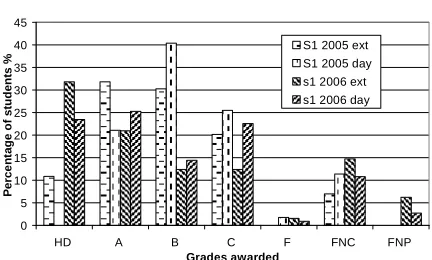
A full statistical analysis is beyond the scope of this paper. A preliminary
comparison of results from 2005 and 2006 (with the new assessment scheme)
[image:9.595.82.298.588.718.2]demonstrates there was considerable improvement in the overall grades of the two student cohorts. This supports the contention that the revised assessment scheme has improved student learning (refer Figure 2). The apparent increase in FNC (Failed – did not complete) of 2006 is the result of makeup work granted to a
Figure 2: Comparison of grades between 2005 and 2006
0 5 10 15 20 25 30 35 40 45
HD A B C F FNC FNP
Grades awarded P e rc e n ta g e o f s tu d e n ts %
S1 2005 ext
S1 2005 day
number of students. This work is still outstanding and it is expected that on submission it will result in the upgrade of a number of students. Although the same course objectives were assessed, several factors may have contributed to the difference in student grades from 2005 to 2006. Consequently this will form the basis of further investigations.
Conclusion
The strategy provides a mechanism to allocate individual assessment marks from team projects. The summative assessment provides the flexibility to assess, on an equitable basis, the attainment of skills and competencies at a higher level than the minimum requirements because it rewards an increase in skill levels and development of new skills, rather than assessment against some predetermined minimum criteria. This encourages students to direct study and energy into areas which will most benefit their future professional careers
The revised assessment strategy will facilitate more effective use of student diversity and encourage mentoring within and between the teams. The summative assessment will provide the flexibility to assess, on an equitable basis, the attainment of skills and competencies at a higher level than the minimum requirements because it will reward an increase in skill levels and development of new skills, rather than assessment against some predetermined minimum criteria. This will encourage students to direct study and energy into areas which will most benefit their future professional careers.
References
Acar, B. S. (2004). Analysis of an assessment method for problem-based learning. European Journal of
Engineering Education, 29(2), 231-240.
Albert, I., & Morrison, I. (2001). Learning objectives in different pedagogical paradigms. Retrieved 3 March 2006, from http://www.ascilite.org.au/conferences/melbourne01/pdf/papers/ipa.pdf
Biggs, J. (1996). Enhancing teaching through constructive alignment. Higher Education, 32, 347-364.
Biggs, J. (1999). Teaching for Quality Learning at University (1st ed.). Buckingham: Society for Research into Higher Education and Open University Press.
Biggs, J. (2002). The Reflective Institution: Assuring and enhancing the quality of teaching and learning. Hong Kong: Learning Teaching Support Network Generic Centre.
Frank, M., & Barzilai, A. (2004). Integrating alternative assessment in a project-based learning course for pre-service science and technology teachers. Assessment & Evaluation in Higher Education, 29(1), 41-61. Gibbings, P. D., & Brodie, L. M. (2006 (in press)). Skills Audit and Competency Assessment for Engineering
Problem Solving Courses. Paper presented at the International Conference on Engineering Education,
Liverpool, England.
Gibbings, P. D., & Morgan, M. (2005). A guide for entry level PBL courses in engineering. Int. J. Cont.
Engineering Education and Lifelong Learning, 15(3-6), 276-290.
Haggis, T. (2002). Exploring the 'Black Box' of process: a comparison of theoretical notions of the 'adult learner' with accounts of post graduate learning experience. Studies in Higher Education, 27(2), 207-220. Harley, F. D. (1996). The use of action learning in British higher education. Retrieved 3 March, 2006, from
http://www.emeraldinsight.com/Insight/ViewContentServlet?Filename=Published/EmeraldFullTextArti cle/Pdf/0040380802.pdf
Heimbecker, B. (2005). Changing ourselves: A gaze in the mirror. Retrieved 1 November, 2005, from http://www.lupinworks.com/ar/changing/bh.html
Heron, J. (1989). The facilitator's handbook. London: Kogan Page.
Isaacs, J. (n.d.). Assessment for Learning. Brisbane: University of Queensland (Teaching & Educational Development Institute).
Knowles, M. S., Holton, E. F., & Swanson, R. A. (1998). The Adult Learner (5th ed.). Houston, Texas: Gulf Publishing Company.
Mergel, B. (1998, May, 1998). Instructional design and learning theory. Retrieved 28 November 2005, from http://www.usask.ca/education/coursework/802papers/mergel/brenda.htm
Powell, P. C. (2004). Assessment of team-based projects in project-led education. European Journal fo
Powell, P. C., & Weenk, G. W. H. (2003). Project-led Engineering Education. Utrecht Lemma.
Savin-Baden, M. (2004). Understanding the impact of assessment on students in problem-based learning.
Innovations in Education and Teaching International, 41(2).
Smith, M. K. (2002). Malcolm Knowles, informal adult education, self-direction and andragogy. Retrieved 9 January, 2006, from http://www.infed.org/thinkers/et-knowl.htm
University_of_South_Australia. (2000, March, 2004, version 2). Graduate Qualities - a brief guide to assessing students for Graduate Qualities. Retrieved 2 January, 2006, from