Design and Development of a Prototype Small-Plot
Research Harvesting System
Guangnan Chen , Justin Schultz , Richard Sulman
1) 1) 2)1
) National Centre for Engineering in Agriculture, Faculty of Engineering & Surveying, University of Southern Queensland, Toowoomba, QLD 4350, AUSTRALIA . Email: [email protected]
2) Bio-systems Engineering, 9 Cristina Court, Highfields, QLD 4352, AUSTRALIA
ABSTRACT
A critical issue for the grain farming industry is the continuous development of new and improved varieties. This often requires field experiments in small plots. Due to the small size of the plots and the large number of them, harvesting these trials often becomes very inefficient and expensive. Contamination and Occupational Health and Safety issues may also be involved. This paper describes the design and development of a prototype small-plot research harvesting system. The system features a beater type thrashing system which combines the dual functions of removing the grain from the crop and the thrashing system. The material then falls under gravity and is inducted into the conveyance air stream by means of a venturi. The grain and the trash are finally separated in a vertical air aspirator. Due to the self-cleaning nature of this design, the possible contamination between different plots has been avoided. The system is also compact and light. The potential improvements for the commercial production are identified.
INTRODUCTION
PREVIOUS DESIGNS OF SMALL HARVESTERS
Although in the past there were several attempts to design a small harvester for research uses, it appears that non of them performs satisfactorily. For example, a patent was previously filed in the US for harvesting single row trial plots (Calvin and Davis, 2000). This system uses a rotating disk as the severing mechanism while the grain is “thrashed” by an impeller fan. The “thrashed” grain is then separated by a cyclone unit, which may not be able to separate them properly because cyclone separators are often only effective for the collection of particles, rather than the separation of between different sizes of particles. A two rows self-propelled plot harvesters has also been designed and built by Kingaroy Engineering Works in Queensland, Australia, which is essentially a smaller version of conventional combine harvester. Because this system is still very expensive, it is out of reach for most researchers. Furthermore, because it is difficult to clean the trash walkers, it would be very difficult for this machine to prevent cross contamination between different trials.
DESIGN REQUIREMENTS AND OBJECTIVES OF NEW SYSTEM
In order to overcome the above difficulties, a new harvesting system has to be deigned. It also needs to meet the following design objectives:
• Due to the research nature of the harvested crop, the maintenance of good data quality is paramount. The new unit therefore must minimize the chances of losing the research data, or damaging the data in such a way that it is not suitable for the intended purpose of the research. Avoiding cross-contamination of plots is particularly important. To do this, the machine must be easy to clean or to be self-cleaning after each operation.
• Minimize OH&S risks. The new harvester also needs to reduce the possible risk of injury to the user or any other persons in the vicinity of the harvester. Ergonomic design should also be incorporated as much as possible, to allow extended periods of operation.
DESIGN FEATURES OF NEW SYSTEM
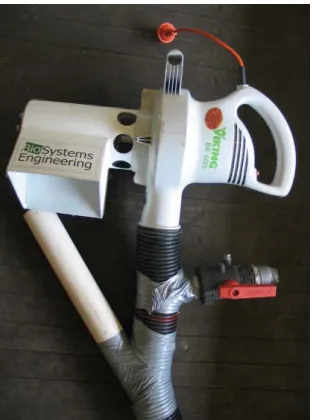
[image:3.595.197.412.287.448.2]After a number of trials and tests, it is resolved that the new system will be featured by a beater type thrashing system which combines the dual functions of removing the grain from the crop and the thrashing system. This is achieved by using the beater of a series of line trimmer cords (Fig.1) to apply a force to the underside of the kernel of grains so that the kernel can be dislodged leaving the stalks. A garden air blower is also used as both the pneumatic power source (for both the conveyance and separation lines) and the drive mechanism for the beater hand-piece. Currently, the beater is directly attached on to the front of the blower to eliminate the need for two separate electric motors.
Figure 1: Initial Prototype of Grain Beater
Figure 2: Hand piece, venturi, conveyance tube, and air splitting control valve
The conveyance line then further continues to the top of a standard cyclone (Fig.3), where the air stream is diffused, allowing the solid material to fall under gravity and the air exit out the top end of the cyclone.
Figure 3: The full prototype test system as built. It is noted that the venturi in this picture has not been connected to the beater handpiece.
[image:4.595.231.379.432.624.2]1979). With a suitable control of separation air, the grains will fall under gravity, with all the other materials having a smaller bulk density than grain being carried vertically up with the air stream and dispersed. The grain that has fallen is trapped and collected at the base of the sorting chamber via a slide gate.
Once the grain is removed and collected, the system will be clean and ready for next plot. Because at no point in the system, the crop material from previous trials will collect, the possible contamination between different plots has therefore been avoided.
FURTHER TESTS AND IMPROVEMENTS
At this point of development, the harvesting system is still only a prototype, as the design work is currently focused on the feasibility of the design principle and to ensure that the a working prototype is developed. In particular, the weight and compactness of the system is not optimized and is significantly larger than that anticipated in the original design specification. This is due to several reasons, including the fact that currently the hand-piece is made out of steel, which may cause the hand piece about 6 to 7kg heavier than what it should be. It is anticipated that a redesign and rearrangement of the handpiece may lead to a new design that have all the major parts of the system (including the blower motor) to be mounted together on one moveable trolley.
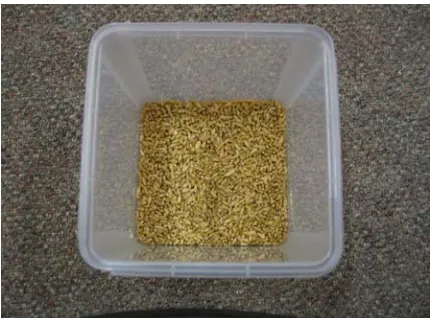
Due to the timing of the growing season of wheat and barley, full prototype testing has also not been undertaken for this project. To test the system, mature heads of grain would be needed to verify that the full system is working and to adjust the design parameters if necessary. However, tests have been carried out in the laboratory on all the sub-systems to ensure that these components perform in accordance with the design specifications (Fig.4).
Figure 4: Grain sample collected from the sorting chamber.
CONCLUSIONS
This paper has described the design and development of a prototype small-plot research harvesting system. The system features a beater type thrashing system which combines the dual functions of removing the grain from the crop and the thrashing system. The material then falls under gravity and is inducted into the conveyance air stream by means of a venturi. The grain and the trash are finally separated in a vertical air aspirator. Due to the self-cleaning nature of this design, the possible contamination between different plots has been avoided. The system has also been shown to be compact and light, with an accurate separation system. The potential improvements for the commercial production have also been identified.
REFERENCES
Calvin F., and Davis M. A., (2000), Single Row or Plant Combine Harvesting Machine, Patent Number WO 00/08915, Northwest Plant Breeding Co., Pullman, U.S.A.