Research Briefing
Additional Learning Needs
(ALN) in Wales
The National Assembly for Wales is
the democratically elected body that
represents the interests of Wales and its
people, makes laws for Wales, agrees
Welsh taxes and holds the Welsh
Government to account.
Contact Us
Research Service
National Assembly for Wales Tŷ Hywel
Cardiff Bay Cardiff CF99 1NA
q: 0300 200 6293
y: Assembly.Wales/InBrief
a: @SeneddResearch
a: Assembly.Wales/Research
© National Assembly for Wales Commission Copyright 2016
The text of this document may be reproduced free of charge in any format or medium providing that it is reproduced accurately and not used in a misleading or derogatory context. The material must be acknowledged as copyright of the National Assembly for Wales Commission and the title of the document specified.
Author: Michael Dauncey
Date: November 2016
Paper Number: 16-059
This Research Briefing updates a previous paper, published in June 2015 (SEN/ ALN in Wales), and provides background information ahead of legislation the Welsh Government expects to introduce before the end of 2016. The antici-pated Bill will replace the current Special Educational Needs (SEN) framework with a reformed system based on Additional Learning Needs (ALN).
This paper gives an overview of the current SEN framework, explains current provisions and processes, and charts the journey of review and reform that has taken place throughout much of the Assembly’s lifetime, most recently the consultation on a draft Bill in 2015. Data on the numbers of learners with SEN/ALN and their academic achievement is also included, along with statistics on funding.
Research Briefing
Contents
Introduction ... 1
What are Special Educational Needs and what is the current position? ... 1
Proposed reform... 2
Objectives of this paper ... 3
The current legal framework in Wales ... 4
Overview of key responsibilities ... 4
Graduated provision for SEN ... 6
Process of statutory assessments and statements ... 9
Numbers of learners with SEN ... 16
Funding SEN provision ... 20
Funding for local authorities from the Welsh Government ...20
Arrangements between local authorities and schools ...20
Statistics on funding ...21
Achievement of learners with SEN ... 25
Previous reviews and proposed reforms ... 29
Three-part Committee inquiry in the Second Assembly ...29
Developments in the Third Assembly ...31
2012 consultation ...32
Post-16 assessment/provision and the Education (Wales) Bill ...33
2014 White Paper ...34
Workforce planning ...35
The decision to introduce a draft Bill ...35
The draft Bill ... 37
Proposals for a single legal framework from age 0-25 (overarching objective) ...38
Proposals for an integrated, collaborative process with early, timely and effective interventions (overarching objective) ...39
Proposals for a fair and transparent system (overarching objective)...40
Cross-cutting core aims ...41
CYPE Committee pre-legislative scrutiny ...41
Reforms in England ... 48
What has changed? ...48
What impact are the reforms having? ...49
Lessons for Wales ...49
Next steps for Additional Learning Needs in Wales ... 50
Contents
Introduction ... 1
What are Special Educational Needs and what is the current position? ... 1
Proposed reform... 2
Objectives of this paper ... 3
The current legal framework in Wales ... 4
Overview of key responsibilities ... 4
Graduated provision for SEN ... 6
Process of statutory assessments and statements ... 9
Numbers of learners with SEN ... 16
Funding SEN provision ... 20
Funding for local authorities from the Welsh Government ...20
Arrangements between local authorities and schools ...20
Statistics on funding ...21
Achievement of learners with SEN ... 25
Previous reviews and proposed reforms ... 29
Three-part Committee inquiry in the Second Assembly ...29
Developments in the Third Assembly ...31
2012 consultation ...32
Post-16 assessment/provision and the Education (Wales) Bill ...33
2014 White Paper ...34
Workforce planning ...35
The decision to introduce a draft Bill ...35
The draft Bill ... 37
Proposals for a single legal framework from age 0-25 (overarching objective) ...38
Proposals for an integrated, collaborative process with early, timely and effective interventions (overarching objective) ...39
Proposals for a fair and transparent system (overarching objective)...40
Cross-cutting core aims ...41
CYPE Committee pre-legislative scrutiny ...41
Introduction
Policymakers in Wales have long intended to legislate to reform the current arrangements for identifying, and subsequently providing for, children and young people’s Special Educational Needs (SEN) (or as they are increasingly, though not yet legally, referred to: Additional Learning Needs (ALN)).
Stakeholders, families and carers have also anticipated, and called for, reform. In the last Assembly (2011-2016), the Welsh Government held three consultations; firstly on outline proposals (2012), secondly on a White Paper (2014) and thirdly on a draft Bill (2015).
The Minister for Lifelong Learning and Welsh Language, Alun Davies AM, is responsible for ALN policy and bringing forward the legislation, although ultimate oversight rests with the Cabinet Secretary for Education, Kirsty Williams AM. In a statement on 14 July 2016, the Minister said he expects to introduce the Bill before the end of 2016. This followed an earlier statement on 1 July 2016 accompanying the publication of responses to the consultation on the Draft Additional Learning Needs and Education Tribunal Wales Bill, as well as a Welsh Government summary.
What are Special Educational Needs and what is the current position?
Section 312(1) of the Education Act 1996 states that children have Special Educational Needs (SEN)
if ‘[they] have a learning difficulty which calls for special educational provision to be made for [them]’,
Under section 312(2), a child has a learning difficulty1 if they:
a) have a significantly greater difficulty in learning than the majority of children of the same age; b) have a disability which either prevents or hinders them from making use of educational facilities of a kind generally provided for children of their age in schools within the area of the local authority; or
c) are under compulsory school age and fall within the definition at a) or b) or would if special educational provision was not made for them.
Section 312(4) states that special educational provision means:
a) for children aged two or over, educational provision that is additional to, or otherwise different from, the educational provision made generally for children of their age in maintained schools, other than special schools, in the area;
b) for children aged under two, educational provision of any kind. [all my emphasis]
Approximately one in five learners in maintained schools in Wales have SEN. These needs are currently met through three graduated stages of intervention:
Firstly, additional support provided by schools themselves (School Action);
Secondly, additional support by schools together with the involvement of external agencies (School Action Plus); and
Thirdly, where deemed necessary, in accordance with a local authority statement of SEN which provides a legal entitlement to a specified package of support.
(Broadly equivalent programmes to School Action and School Action Plus exist within Early Years.) In Wales, there are currently 105,000 learners officially recognised as having SEN, 12,000 of whom have statements (academic year 2015/16). £362 million is currently budgeted by local authorities for SEN provision (financial year 2015-16).
SEN usually fall into at least one of the following four broad areas:
Communication and interaction;
Cognition and learning;
Behaviour, emotional and social development;
Sensory and/or physical.
Proposed reform
For some years now, the Welsh Government has recognised that the current system is ‘no longer fit for purpose’.2It believes that a ‘model introduced more than 30 years ago’ should therefore be
replaced with a ‘more modern approach to multi-agency working to the benefit of the child or young person, which will support them in the journey through education and their life choices’.3 As set out during its consultation on the draft Bill in 2015, the Welsh Government has three overarching objectives for the proposed new system:
A unified legislative framework to support children and young people aged 0-25 with ALN in schools and further education (as opposed to the current system for SEN up to age 16 and Learning Disabilities and/or Disabilities (LDD) for post-16, each of which are covered by separate legislation);
An integrated, collaborative process of assessment, planning and monitoring with early, timely and effective interventions (including duties on health boards and local authorities to collaborate with each other to meet a child or young person’s ALN through an Individual Development Plan);
A fair and transparent system for providing information and advice, and for resolving concerns and appeals (including requiring local authorities to make arrangements for avoiding and resolving disagreements, revising a system described by previous reviews as ‘complex, bewildering and adversarial’).4
2 Welsh Government, Legislative proposals for additional learning needs, Ministerial Foreword (Huw Lewis, Minister for Education and Skills), May 2014, p2
3 Welsh Government, Forward in partnership for children and young people with additional needs: Proposals for reform of the legislative framework for special educational needs, June 2012, p4
Objectives of this paper
This Research Briefing sets out how the current arrangements for identifying and meeting a child or
young person’s SEN/ALN5 operate; provides data on numbers, levels of expenditure and academic achievement of learners with SEN; and explains the previous reviews and reforms that have taken place for much of the devolution era. In doing so, this paper intends to support and stimulate debate and preparations for the forthcoming Additional Learning Needs and Education Tribunal Wales Bill.
The current legal framework in Wales
The current arrangements for identifying and providing for SEN are rooted in the Education Act 1996
(which consolidated the earlier Education Act 1993) and set out in more detail in the SEN Code of Practice for Wales (introduced in 2002 and updated in 2004).
A requirement of the legislation, the first Code of Practice was produced by the UK Government and came into effect in 1994. Following devolution, the then Minister for Education and Lifelong Learning, Jane Davidson, published the first SEN Code of Practice specific to Wales [hereafter ‘the Code’].
This took effect from 1 April 2002 and is still in force today.
The Code sets out the procedures which should be followed for assessing whether a learner has SEN and putting in place interventions to address them. However, there have been evolving changes to
the way in which learners’ needs are identified and provided for and the Code is arguably out of date to an extent. These changes include, for example, increasing use of the wider concept of
‘Additional Learning Needs’ (ALN), which the forthcoming legislation is expected to give a legal foundation to, and a relative shift away from the use of statements.
Nevertheless, when explaining the reasons for delaying the introduction of legislation in summer 2015 to allow for further consultation, the then Minister for Education and Skills, Huw Lewis, asserted that the existing legal requirements remained in place and reminded local authorities of their responsibilities. He reiterated this in correspondence to the Fourth Assembly’s Children, Young People and Education Committee in January 2016 (PDF 219KB).
Relevant agencies must have regard to the Code of Practice and, whilst they may choose exactly how to fulfil their statutory duties, must do so in light of the guidance it provides. The Code is founded on five general principles:
A child with SEN should have their needs met;
The SEN of children will normally be met in mainstream schools or settings;
The views of the child should be sought and taken into account;
Parents have a vital role to play in supporting the child’s education;
Children with SEN should be offered full access to a broad, balanced and relevant education.
Overview of key responsibilities
Paragraph 1.19 of the Code states that local authorities, in partnership with schools, should ‘place
the highest priority on their statutory duty to promote high standards of education for all children,
including those with SEN’. Paragraph 1.20 says an essential function of local authorities is to ensure
the needs of children and young people with SEN are ‘identified and assessed quickly and matched by appropriate provision’.
Local authorities are obliged to publish their SEN policies and information on how they are ‘promoting high standards of education’ for learners with SEN and encouraging them to ‘participate fully in their school and local community’.
must be educated in a mainstream school. Where they have a statement, they must still be educated in a mainstream schools unless parents wish otherwise or it is incompatible with ‘the provision of efficient education for other children’.6
Schools and admission authorities cannot refuse to admit a child solely because they have SEN. For learners with SEN but no statement, the same admissions procedures must be followed as for other children. For learners with statements, a maintained school that is named in a statement must admit the child.
Maintained schools and early years settings must have a written SEN policy. Schools must have a
‘responsible person’ (usually the head teacher although it may be a governor) who ensures all
teachers know about a pupil’s SEN. Paragraph 1.38 of the Code makes it clear that provision for
learners with SEN is a matter for everyone in maintained schools and early years settings, not only the SEN Co-ordinator (SENCo).
The SENCo is the member of staff at a school who has responsibility for co-ordinating SEN provision within that school. In a small school, this may be the head teacher or deputy whilst, in a large school, there may be an SEN co-ordinating team. The SENCo has an instrumental role in working with the
classroom teacher(s) in identifying a pupil’s SEN and what form of intervention is required.
The governing bodies of maintained schools must ‘use their best endeavours’ to ensure the
necessary provision is made for any pupil with SEN. Governing bodies must also report annually to
parents on how the school’s SEN policy is being implemented.7
Where a learner has a statement, the local authority is responsible for ensuring the provision set out in that statement is delivered. Where they do not have a statement, the school is responsible for deciding what is needed and making that provision.
Post-16 provision
Provision for learners aged over 16 who are not in school is set out in separate legislation, the
Learning and Skills Act 2000, which deals with the planning and funding of post-16 education. The legislation uses the term ‘Learning Difficulties and/or Disabilities (LDD)’ rather than SEN. LDD are defined in section 41(5) of the 2000 Act. The definition is essentially the same as for SEN; ie whether the learner has significantly greater difficulty in learning than the majority of their age group, or they have a disability that prevents or hinders them using the education and training generally on offer. The Welsh Ministers currently have a general duty under the Learning and Skills Act 2000 to secure proper (for those aged between 16 and 19) and reasonable (for those over the age of 19) facilities for education and training for learners. In particular, section 140 places a duty on the Welsh
Government to make arrangements for young people under the age of 19 who have a statement of SEN to be assessed, where it believes they are likely to leave school at the end of their last year of compulsory schooling to go on to further or higher education or training. Assessment is carried out during the final year of compulsory education.
The Welsh Government also has a power under section 140 of the 2000 Act to arrange for an
assessment to be conducted of any person under the age of 25 where it appears they have learning difficulties and where they are receiving, or are likely to receive, further or higher education or
training. This applies even where they do not have a statement of SEN and is designed to enable assessments to be carried out in cases where learning difficulties were developed shortly before or after leaving school, or where a learner had learning difficulties which did not result in a statement of SEN being issued.
The Welsh Government currently discharges its duties to assess learners by contracting with Careers Wales. An assessment by Careers Wales results in a report setting out a learner’s educational and training needs, the post-16 education or training required to meet those needs and the provision required.
Where a learner’s LDD can be met in a mainstream setting, the further education institution (FEI) absorbs the costs of this as part of its general budget. Prior to 2015-16 they could also apply to the Welsh Government for supplementary or exceptional funding to cover any additional costs incurred in meeting complex needs, although this budget was then transferred into allocations to FEIs under the new post-16 Planning and Funding Framework. Where a learner requires specialist or residential accommodation, Careers Wales prepares and submits an individual application to the Welsh Government which then makes a decision over funding, including any negotiation for joint funding with local authorities and/or health boards.
Arrangements for the LDD/ALN of post-16 learners is a complex area which has been the subject of considerable review in its own right. This is discussed later in chapter 6 of this paper.
Graduated provision for SEN
The Code advocates a graduated approach to help children with SEN, encompassing a range of strategies and interventions. The Code says this approach recognises there is a continuum of SEN and that schools should make full use of available classroom and school resources before calling upon outside resources and/or more specialist expertise.
The Code emphasises that ‘the importance of early identification, assessment and provision for any
child who may have SEN cannot be over-emphasised’; ‘the earlier action is taken, the more
responsive the child is likely to be’.
There are separate chapters in the Code on identifying, assessing and providing for SEN in each of the early years, primary and secondary sectors. The information provided below is a summary of the guidance in relation to primary schools (chapter 5 of the Code). However, the guidance is broadly the same as for early years (chapter 4) and secondary schools (chapter 6).
Paragraph 5.39 describes the start of the process for identifying that a child may have SEN:
A school’s system for observing and assessing the progress of individual children should provide information about areas where a child is not progressing
satisfactorily even though the teaching style has been differentiated. These
subject. Consideration should then be given to helping the pupil through School Action. [my emphasis]
The key test of the need for action that schools should use is evidence that current rates of progress are inadequate. This does not necessarily mean simply being behind other pupils as children cannot be assumed to progress at the same rate and the Code (para 5.42) gives guidance on how adequate progress may be defined. It is also important to note that a child will not necessarily have SEN if their difficulties in learning could be addressed simply through differentiated teaching.
School Action
School Action is the first of the three tiers of intervention under the graduated approach advocated by the Code. Each tier should not be taken to be a stepping stone to the next, particularly from
School Action Plus to statements.
Pupils receive support under School Action when they are not making adequate progress and this cannot be addressed through regular differentiated teaching. School Actionconsists of ‘interventions
that are additional to or different from those provided as part of the school’s usual differentiated curriculum offer and strategies’.
Paragraph 5.44 explains that the basis for intervention through School Action could be concern, supported by evidence, that a child, despite receiving differentiated learning opportunities:
makes little or no progress even when teaching approaches are targeted particularly in a child’s
identified area of weakness;
shows signs of difficulty in developing literacy or mathematics skills which result in poor attainment in some curriculum areas;
presents persistent emotional or behavioural difficulties which are not ameliorated by the behavioural management techniques usually employed in the school;
has sensory or physical problems, and continues to make little or no progress despite the provision of specialist equipment;
has communication and/or interaction difficulties, and continues to make little or no progress despite the provision of a differentiated curriculum.
The SENCo has an important role in working with the child’s teacher(s) to decide on the action
needed to help the child progress. The Code suggests that different learning materials or special equipment could be among the interventions made. The additional strategies used should be recorded within an Individual Education Plan (IEP), which should also include information about short-term targets, outcomes and success/exit criteria. Paragraph 5.53 says IEPs should be reviewed at least twice a year and ideally, termly.
School Action Plus
If the interventions under School Action are not delivering adequate results, the SENCo and the teacher(s) may decide in consultation with parents and specialists to involve external support services.
continues to make little or no progress in specific areas over a long period;
continues working at National Curriculum levels substantially below that expected of children of a similar age;
continues to have difficulty in developing literacy and numeracy skills;
has emotional or behavioural difficulties which substantially and regularly interfere with the
child’s own learning or that of the class group, despite having an individualised behaviour management programme;
has sensory or physical needs, and requires additional specialist equipment or regular advice or visits by a specialist service;
has ongoing communication or interaction difficulties that impede the development of social relationships and cause substantial barriers to learning.
Services may be provided by the local authority as well as outside agencies, including advice on new IEPs with fresh targets and strategies, more specialist assessments and advice on new specialist strategies or materials. Although developed with the help of external specialists, strategies should usually be implemented as far as possible in the normal classroom setting and their delivery remain the responsibility of the classroom teacher.
Statutory assessments and statements
Where School Action and School Action Plus have not led to sufficient improvement, or where it is
immediately obvious the learner’s needs are sufficiently serious, a statutory assessment may be
undertaken by the local authority. This may in turn lead to the local authority issuing a statement of
the child’s SEN.
The significance of statements is that the local authority assumes legal responsibility for making provision to meet specified needs. It has a duty under section 324 of the Education Act 1996 to arrange the special educational provision in a child’s statement. The wording of the Code when it was
produced early in the last decade demonstrates an expectation that statements be issued as a last resort or in the most serious of cases:
For the vast majority of children their mainstream setting will meet all their SEN. (…) A very small minority of children will have SEN of a severity and complexity that requires the [local authority] to determine and arrange for the special educational provision their learning difficulties call for. (para 1.2) [my emphasis]
However, parents have tended to view statements as the best way to secure intervention for their child, probably reassured by the legal certainty of provision that they offer. This has arguably led the system of statements to become confrontational and protractedbetween local authority and parent. Indeed, the previous Minister for Education and Skills, Huw Lewis, recognised views that the system has become ‘complex, bewildering and adversarial’.8 This is one of the reasons the Welsh Government proposes to replace the system of school-led intervention versus statutory local authority statements with a holistic system where all learners with SEN have an Individual Development Plan (IDP).
There are rules and procedures laid out in legislation and the Code over matters such as when a local authority is obliged to undertake an assessment, the timescale it has to do so and what factors it must consider.
Process of statutory assessments and statements
Chapter 7 of the Code of Practice sets out the procedures which local authorities should follow in relation to learners whose SEN are sufficiently serious that they require a statutory assessment and potentially a statement. These procedures include scenarios where the local authority receives a request to carry out a statutory assessment.
The Code describes requirements on local authorities under sections 321 and 323 of the Education Act 1996 as:
[Local authorities] must identify and make a statutory assessment of those children for whom they are responsible who have special educational needs and who
probably need a statement. (page 73)
There are therefore two main decision-making steps for local authorities.
Firstly, they must decide whether there is a need to undertake a statutory assessment.
Secondly, if an assessment is undertaken, they must decide whether to issue a learner with a statement of their SEN.
Deciding whether to make an assessment
Paragraph 7.7 of the Code sets out three possible routes for a child being referred for an assessment:
A request by the child’s school or setting;
A referral by another agency (for example health authorities or social services departments);
A request by a parent.
If an assessment has not already been made within the previous six months, the local authority must comply with a request from either the school or the parent unless it concludes, upon examining all the evidence, that a statutory assessment is not necessary (paras 7.11 and 7.21). Even where referral is by a health or social services professional, the local authority is not automatically required to carry out an assessment, although they need to collect evidence before considering whether it is
necessary (para 7.15).
Effectively, this means it is up to the local authority to decide whether it undertakes the
In considering whether a statutory assessment is necessary, [local authorities] should pay particular attention to:
Evidence that the school has responded appropriately to the requirements of the National Curriculum;
Evidence provided by the child’s school, parents and other professionals where they have been involved with the child, as to the nature, extent and cause of the child’s learning difficulties;
Evidence of action already taken by the child’s school to meet and overcome these difficulties;
Evidence of the rate and style of the child’s progress;
Evidence that where some progress has been made, it has only been as the result of much additional effort and instruction at a sustained level not usually commensurate with provision through School Action Plus. [my emphasis]
The key question the local authority faces is whether, despite action taken by the school with the help of external specialists, the child’s learning difficulties have not been sufficiently remedied
and there may be a need for the local authority to determine the child’s SEN. However, the local
authority may decide that, even where the child requires some form of intervention or additional assistance, there is no need for a statutory assessment. As the Code states at paragraph 7.46, the
local authority ‘may be able to identify immediate remedies that would mean a statutory assessment was not necessary’, which may include support through School Action or School Action Plus.
Whilst the Code says ‘academic attainment is not in itself sufficient for local authorities to conclude
that statutory assessment is or is not necessary’, it describes it as the ‘essential starting point’. Local
authorities should therefore consider ‘significant discrepancies’ between the child’s attainment
and that of the majority of their classroom peers and children of the same age, as well as in their own attainment within or between core national curriculum subjects.
In addition, paragraphs 7.42–7.45 cite factors other than attainment, which should also be considered, including:
Clear, recorded evidence of clumsiness; significant difficulties of sequencing or visual perception; deficiencies in working memory; or significant delays in language functioning;
Any evidence of impaired social interaction or communication or a significantly restricted repertoire of activities, interests and imaginative development;
Evidence of significant emotional or behavioural difficulties, as indicated by clear recorded examples of withdrawn or disruptive behaviour; a marked and persistent inability to concentrate; signs that the child experiences considerable frustration or distress in relation to his or her learning difficulties; difficulties in establishing and maintaining balanced relationships with his or her fellow pupils or with adults; and any other evidence of a significant delay in the development of life and social skills.
local authorities should seek evidence of any such identifiable factors that could impact on learning outcomes including:
Any evidence that the child’s performance is different in different environments;
Evidence of contributory medical problems;
Evidence from assessments or interventions by child health or social services. With regard to reaching its decision, paragraph 7.29 of the Code states:
The [local authority] should react consistently to requests from parents, schools and settings for assessments and should subsequently make open and objective
judgements as to whether a statement should be issued. [my emphasis]
Paragraph 7.40 adds:
Where the balance of evidence presented to and assessed by the [local authority] suggests that the child’s learning difficulties:
have not responded to relevant and purposeful measures taken by the school or setting and external specialists; and
may call for special educational provision which cannot reasonably be provided within the resources normally available to mainstream maintained schools and setting in the area,
the [local authority] should consider very carefully the case for a statutory assessment of the child’s special educational needs. [my emphasis]
Communication with families
Before deciding whether to make an assessment, the local authority must issue a notice under section 323(1) or 329A(3) of the Education Act 1996, advising the parents and giving certain information about the process.
The Code sets out the steps a local authority must take to communicate its decision whether or not to make an assessment. Paragraph 7.69 states:
If the LEA decides it is not necessary to carry out a statutory assessment they must inform the parents and explain the reasons; they should also set out the provision that they consider would meet the child’s needs appropriately. The decision not to make a statutory assessment may be a severe disappointment to the child’s parents and may also be unwelcome to the child’s school. Regardless of whether the initiative for a possible assessment came from the [local authority] or a request from the
parents or school, the [local authority] should write to the school, as well as the child’s parents, giving full reasons for their decision. [other than ‘must’, bold is my emphasis]
The Code suggests that it may be helpful for the local authority to meet the parents to explain the position in detail. It also says that the local authority may consider inviting a representative of the
school to be present, highlighting that ‘a meeting of this kind will be particularly useful where it is
clear that there is disagreement between the parents and the school’.
Appeals
Under paragraph 7.71, where parents have formally requested a statutory assessment or where their
child’s school or setting has made such a request, the parents may appeal to the SEN Tribunal for Wales against a decision not to make an assessment. Local authorities must inform parents of the right to appeal and the time limits for appeal, the availability of disagreement resolution services and
the fact that these do not affect parents’ right of appeal.
As of 5 January 2015, children themselves also have the right of appeal to the SENTW regarding
local authorities’ decisions about SEN.9
Deciding whether to make a statement
In accordance with paragraphs 7.74 and 7.82 of the Code, after deciding to make a statutory assessment, the local authority must seek the following advice:
Parental advice;
Educational advice;
Medical advice;
Psychological advice;
Social services advice.
Under paragraph 7.85, local authorities should also seek to ascertain the views of children and young people who are being assessed. The learner’s views about their needs and aspirations should,
wherever possible be recorded as part of the statutory assessment process.
Local authorities must also seek any other advice they consider appropriate and, where reasonable, should consult those whom the parents have named. They must give copies of any representations or evidence submitted by the parents to those requested for advice.
At this point, parents must be informed that, as part of the process of putting together all the relevant advice, their child may be called in for an examination or assessment.
When requesting advice, the local authority should ask all concerned to respond within six weeks. Health and social services must normally respond within this six week timeframe, although they are under no obligation to do so where they have no prior knowledge of the child.
Local authorities should make clear that regulations require that advice must relate to the educational, medical, psychological or other features that appear relevant to a child’s current
and future educational needs. The advice must also set out how those features could affect the
child’s current and future educational needs and the provision that is considered appropriate in light of those features.
Paragraph 7.86 states that, having received all the advice, the local authority must decide whether it needs to make a statement or amend an existing statement. It must make that decision within ten weeks of serving notice that it is undertaking a statutory assessment. (This includes the six week period for seeking advice.)
If the local authority decides a statement or amended statement is necessary, it must send a copy of the proposed statement to the child’s parents within a further two weeks. The advice received should also be attached.
If the local authority decides that a statement or amended statement is not necessary, it must notify the parents and give reasons, preferably providing a note in lieu of the statement, also within two weeks.
Parents must normally receive formal notification of the outcome of the assessment within 12 weeks of the start of the statutory assessment. Where this is a proposed statement, the local authority has a further 8 weeks to finalise the statement.
This means that the total process from referral or request for a statutory assessment to having a final statement should be completed within 26 weeks. (This is made up of the original six week period to decide whether to undertake an assessment and 20 weeks for the process of deciding whether a statement is necessary and producing that statement.)
Data from the My Local Council website shows that in 2015-16, 68% of SEN statements were issued within the 26 week target and 94% where there were no special circumstances.
As with decisions whether to carry out the assessment, parents and children have a right to appeal to the SENTW against the decision.
Content of statements
The form and content of a statement issued by a local authority must comply with paragraph 8.29 of the Code. A statement should consist of:
Part 1, Introduction: The child’s name, address and date of birth; the child’s home language and religion; the names and address(es) of the child’s parents.
Part 2, Special Educational Needs: Details of each and every one of the child’s SEN as identified
by the local authority during the statutory assessment; details of the advice received and attached as appendices to the statement.
Part 3, Special Educational Provision: The special educational provision that the local authority
considers necessary to meet the child’s SEN, including the objectives of the provision, the provision itself and the arrangements for monitoring progress.
Part 4, Placement: The type and name of school where the provision is to be made or the local
authority’s arrangements for provision where this is to be otherwise than in school. (This part must be left blank when the proposed statement is issued so as not to pre-empt any parental
Part 6, Non-Educational Provision: Details of relevant non-educational provision required as agreed, including the agreed arrangements for provision.
All the advice obtained and taken into consideration during the assessment must be attached as appendices to the statement.
Parents may express a preference for the maintained school (but not a Pupil Referral Unit or hospital special school) they wish their child to attend, or make representations for a placement in any other school. Local authorities must comply with a parental preference unless the school is
unsuitable to the child’s age, ability, aptitude or SEN, or where the placement would be
incompatible with the efficient education of other children or with the efficient use of resources.
Local authorities must ensure that a child is educated in a mainstream school unless a parent indicates that they do not want their child educated in a mainstream school or it is incompatible with the efficient education of other children.
Residential placements
The Code explains that:
In general [local authorities] are likely to consider that there is a need for residential provision where there is multi-agency agreement that:
the child has severe or multiple SEN that cannot be met in local day provision;
the child has severe or multiple SEN that require a consistent programme both during and after school hours that cannot be provided by parents with support from other agencies;
the child is looked after by the local authority and has complex social and learning needs and placement is joint funded with the social services department;
the child has complex medical needs as well as learning needs that cannot be managed in local day provision and the placement is joint-funded with the health authority. (para 8.74) [my emphasis]
Paragraph 8.75 adds ‘if these conditions apply, a multi-agency plan should be put into place that enables tri-partite funding’.
Ceasing, amending or reviewing statements
The Code provides guidance on procedures that should be followed when ceasing to maintain a statement (paras 8.117–8.124), amending an existing statement (paras 8.125–8.133) and reviewing statements (chapter 9).
It should not be assumed that once a local authority has made a statement, it should maintain that statement until it is no longer responsible for the young person. The Code advises ‘statements
should be maintained only when necessary’ but that the local authority may cease to maintain a
lapse when a young person moves into further or higher education or leaves school at age 16; there is no need to cease a statement when it is going to lapse anyway.
A local authority can only amend a statement following an order from the SENTW, if it is directed to do so by the Welsh Ministersor in accordance with Schedule 27 of the Education Act 1996. Schedule 27 sets out the process local authorities must follow if seeking to amend a statement. If, for example,
a local authority wishes to do this after a learner’s annual review, it must write to the parents and give
them the opportunity to make representations. For amendments to a statement following a re-assessment, the procedure is the same as when making a new statement.
Paragraph 9.1 of the Code requires all statements (other than those for children aged under two) to be reviewed annually. This is so the local authority, the school, the pupil and the parents, and all
professionals involved consider the pupil’s progress in the previous 12 months and whether any
Numbers of learners with SEN
Tables 1-4 provide some statistics on SEN provision in maintained schools in Wales.
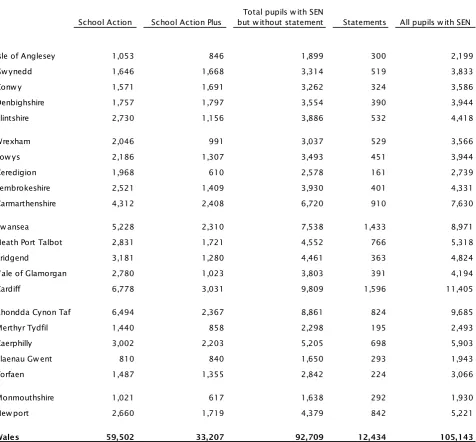
Table 1 presents the numbers of learners in Wales with SEN and how many receive support under each of the three tiers of intervention, over recent years. Table 2 breaks this data down by local authority for the latest year, 2015/16.
Table 3 shows the number of learners with SEN as a proportion of total pupils, as well as how many have a statement as a proportion of total pupils, and of pupils with SEN. Table 4 breaks the 2015/16 data down by local authority, which enables some analysis of their comparative use of statements. From these tables, the following can be observed:
In 2015/16, there were 105,143 pupils with SEN in maintained schools, which is 22.5% of all pupils.
The large majority (88.2%) of pupils with SEN did not have a statement. 11.8% of pupils with SEN did have a statement.
The proportion of learners with SEN who have a statement has reduced year-on-year from 13.9% in 2009/10 to 11.8% in 2014/15 and 2015/16. Over the same period, the overall proportion who have SEN has risen from 21.2% to 22.5%.
The relative issuing of statements to learners with SEN varies amongst local authorities. Whilst the average across Wales in 2015/16 was 11.8%, four local authorities made statements for over 15% of their learners with SEN yet four local authorities used statements for less than 8%.
Monmouthshire had the lowest proportion of learners with SEN (16.7%) but issued one of the highest proportions of statements amongst the SEN cohort (15.1%). Conversely, Ceredigion (28.7%) and Merthyr Tydfil (28.5%) had the highest proportion of learners with SEN but issued two of the lowest proportions of statements (5.9% and 7.8% respectively).
This suggests local authorities are using different means of meeting the SEN/ALN of their pupils, with some retaining the established system of statements and others shifting away from this approach. It should be noted that Estyn has reported that ‘there is not necessarily a correlation
between the percentage of statements and the quality of ALN services being provided’.10
Table 1: Number of pupils with SEN in maintained schools in Wales
Source: Welsh Government, StatsWales, Pupils with special educational needs by local authority, region and type of provision
Table 2: Number of pupils with SEN in maintained schools, by local authority, 2015/16
Source: Welsh Government, StatsWales, Pupils with special educational needs by local authority, region and type of provision
School Action School Action Plus
Total pupils w ith SEN
but w ithout statement Statements All pupils w ith SEN
2015/16 59,502 33,207 92,709 12,434 105,143
2014/15 59,245 33,275 92,520 12,437 104,957
2013/14 58,146 34,627 92,773 12,530 105,303
2012/13 56,000 35,053 91,053 12,738 103,791
2011/12 56,511 33,429 89,940 13,098 103,038
2010/11 54,468 32,055 86,523 13,407 99,930
2009/10 54,256 30,981 85,237 13,767 99,004
number
School Action School Action Plus
Total pupils w ith SEN
but w ithout statement Statements All pupils w ith SEN
Isle of Anglesey 1,053 846 1,899 300 2,199
Gw ynedd 1,646 1,668 3,314 519 3,833
Conw y 1,571 1,691 3,262 324 3,586
Denbighshire 1,757 1,797 3,554 390 3,944
Flintshire 2,730 1,156 3,886 532 4,418
Wrexham 2,046 991 3,037 529 3,566
Pow ys 2,186 1,307 3,493 451 3,944
Ceredigion 1,968 610 2,578 161 2,739
Pembrokeshire 2,521 1,409 3,930 401 4,331
Carmarthenshire 4,312 2,408 6,720 910 7,630
Sw ansea 5,228 2,310 7,538 1,433 8,971
Neath Port Talbot 2,831 1,721 4,552 766 5,318
Bridgend 3,181 1,280 4,461 363 4,824
Vale of Glamorgan 2,780 1,023 3,803 391 4,194
Cardiff 6,778 3,031 9,809 1,596 11,405
Rhondda Cynon Taf 6,494 2,367 8,861 824 9,685
Merthyr Tydfil 1,440 858 2,298 195 2,493
Caerphilly 3,002 2,203 5,205 698 5,903
Blaenau Gw ent 810 840 1,650 293 1,943
Torfaen 1,487 1,355 2,842 224 3,066
Monmouthshire 1,021 617 1,638 292 1,930
New port 2,660 1,719 4,379 842 5,221
Wales 59,502 33,207 92,709 12,434 105,143
[image:23.595.63.540.293.735.2]Table 3: Proportions of pupils with SEN and proportions of pupils with statements of SEN in maintained schools in Wales
Source: Research Service calculations from Welsh Government, StatsWales,Pupils with special educational needs by local authority, region and type of provision, and Pupils by local authority, region and age group
Table 4: Proportions of pupils with SEN and proportions of pupils with statements of SEN in maintained schools, by local authority, 2015/16
Source: Research Service calculations from Welsh Government, StatsWales,Pupils with special educational needs by local authority, region and type of provision, and Pupils by local authority, region and age group
Total pupils Total pupils w ith SEN
Total pupils w ith SEN statements
Percentage of total pupils w ho have SEN
Percentage of total pupils w ho have statements of SEN
Percentage of pupils w ith SEN w ho have statements
2015/16 466,555 105,143 12,434 22.5% 2.7% 11.8%
2014/15 465,704 104,957 12,437 22.5% 2.7% 11.8%
2013/14 465,081 105,303 12,530 22.6% 2.7% 11.9%
2012/13 464,868 103,791 12,738 22.3% 2.7% 12.3%
2011/12 465,943 103,038 13,098 22.1% 2.8% 12.7%
2010/11 466,172 99,930 13,407 21.4% 2.9% 13.4%
2009/10 467,141 99,004 13,767 21.2% 3.0% 13.9%
Total pupils Total pupils w ith SEN
Total pupils w ith SEN statements
Percentage of total pupils w ho have SEN
Percentage of total pupils w ho have statements of SEN
Percentage of pupils w ith SEN w ho have statements
Isle of Anglesey 9,665 2,199 300 22.8% 3.1% 13.6%
Gw ynedd 17,039 3,833 519 22.5% 3.0% 13.5%
Conw y 15,916 3,586 324 22.5% 2.0% 9.0%
Denbighshire 15,655 3,944 390 25.2% 2.5% 9.9%
Flintshire 23,649 4,418 532 18.7% 2.2% 12.0%
Wrexham 19,676 3,566 529 18.1% 2.7% 14.8%
Pow ys 17,997 3,944 451 21.9% 2.5% 11.4%
Ceredigion 9,539 2,739 161 28.7% 1.7% 5.9%
Pembrokeshire 17,716 4,331 401 24.4% 2.3% 9.3%
Carmarthenshire 27,108 7,630 910 28.1% 3.4% 11.9%
Sw ansea 35,818 8,971 1,433 25.0% 4.0% 16.0%
Neath Port Talbot 20,751 5,318 766 25.6% 3.7% 14.4%
Bridgend 22,932 4,824 363 21.0% 1.6% 7.5%
Vale of Glamorgan 22,184 4,194 391 18.9% 1.8% 9.3%
Cardiff 53,774 11,405 1,596 21.2% 3.0% 14.0%
Rhondda Cynon Taf 38,808 9,685 824 25.0% 2.1% 8.5%
Merthyr Tydfil 8,749 2,493 195 28.5% 2.2% 7.8%
Caerphilly 28,532 5,903 698 20.7% 2.4% 11.8%
Blaenau Gw ent 9,318 1,943 293 20.9% 3.1% 15.1%
Torfaen 15,013 3,066 224 20.4% 1.5% 7.3%
Monmouthshire 11,547 1,930 292 16.7% 2.5% 15.1%
New port 25,169 5,221 842 20.7% 3.3% 16.1%
[image:24.595.65.554.307.683.2]Special schools
There were 39 maintained special schools in Wales in 2015/1611 with 4,542 pupils in these schools12. The 2015/16 position is broken down across the four regional consortia areas as follows:
Central South Wales: 1,821 pupils in 15 maintained special schools
South West and Mid Wales: 956 pupils in 10 maintained special schools
South East Wales: 530 pupils in 5 maintained special schools
North Wales: 1,235 pupils in 9 maintained special schools.
Funding SEN provision
Funding for local authorities from the Welsh Government
Local authorities in Wales use money they receive within the Revenue Support Grant (RSG) from the Welsh Government to fund education for pupils with SEN. The amount of RSG each local authority receives to provide services across all of their areas of responsibility is announced annually in the Local Government Settlement.
In 2016-17, the Welsh Government has given local authorities a total of £4.102 billion through the RSG to deliver all of their services. This is a 1.3% decrease (£54 million) from 2015-16, after adjusting for transfers into the settlement.
The RSG is un-hypothecated, which means that local authorities decide themselves how much money to spend on a particular service area such as education, and subsequently on SEN provision for example. However, the RSG settlement does include an Indicator-Based Assessment (IBA) for each service area, which is a notional calculation of what each Council needs to spend to provide a standard level of service.13 This is not a spending target and local authorities can decide how much they spend on SEN provision for example, as long as they meet any statutory requirements on them. In 2016-17, the notional IBA for ‘Special Education’ is £215 million, which is similar to 2015-16. In addition, some funding that is intended for use on SEN provision will also have been included in the
‘Nursery and Primary’ and ‘Secondary’ teaching IBAs. Indeed, the total budgeted gross expenditure on SEN provision in 2016-17 is £362 million.14
Although the vast majority of local government resource funding is un-hypothecated, there remain some specific grants15 which the Welsh Government pays to local authorities for a specific purpose. These have reduced in number over recent years as part of an agreed approach between the Welsh Government and Welsh Local Government Association (WLGA) of a general move towards less hypothecation and greater local decision-making over use of resources. There are currently no specific grants relating to SEN.
Further information on how schools in Wales are funded is available in our separate Research Briefing,
A quick guide to school funding (July 2016).
Arrangements between local authorities and schools
Local authorities fund SEN provision through the following means:
The delegated budgets they provide to schools. This means delegated budgets to special schools where all expenditure is assumed to be on SEN and notional allocations for SEN within the
delegated budgets for mainstream schools (notional because it is for each school to determine how much they actually spend on SEN). Delegated funding makes up 73% of total budgeted SEN
expenditure in 2016-17.
13 The notional IBAs for 2016-17 are listed in table 4d of the Local Government Settlement Excel tables available on the Welsh Government’s website.
14 Welsh Government, Statistical First Release: Budgeted expenditure on Special Educational Needs (SEN) provision: 2016-17, 30 June 2016, p1
Through funds they retain centrally within the Local Authority Education Budget16 or the Schools Budget. 27% of SEN expenditure is retained centrally by local authorities in 2016-17.
Under the provisions of the School Standards and Framework Act 1998, the Welsh Government sets the legal framework within which local authorities allocate their education expenditure to
schools. The framework is set out in the School Funding (Wales) Regulations 2010. The regulations require local authorities to allocate expenditure to three budgets, the Local Authority Budget, the Schools Budget and the Individual Schools Budget (ISB).
The 2010 regulations specify that the ISB must be allocated amongst schools maintained by the authority in the form of budget shares, using a locally determined funding formula. 70% of the funding must be distributed on the basis of pupil numbers. In their formula, local authorities may weight pupil numbers according to a number of factors including SEN.
The SEN Code of Practice says the following in relation to funding:
8.3 Maintained schools, other than special schools, should have within their delegated budget some funding that reflects the additional needs of pupils with special educational needs. They receive this through a funding formula that reflects the incidence of SEN measured in various ways. (…)
8.4 [Local authorities] are required under the Special Educational Needs (Provision of Information by Local Education Authorities) (Wales) Regulations 2002 to publish from April 2002, details of the kinds of support arrangements maintained schools in their area might normally provide from their budgets under School Action and School Action Plus. They are also required to publish their own plans for providing
appropriate SEN support – particularly under School Action Plus.
8.5 Where extra resources are required to enable a school to make the provision specified in statements, the [local authority] can provide those resources directly from central provision, devolve them to schools on an earmarked basis or delegate them.
8.6 However resources are provided, schools and [local authorities] have specific duties in relation to children with special educational needs which funding for SEN should support. [my emphasis]
Statistics on funding
The Welsh Government publishes annual statistics on budgeted expenditure on SEN provision. Tables 5-7 below provide some information on how much money is allocated for SEN in Wales.
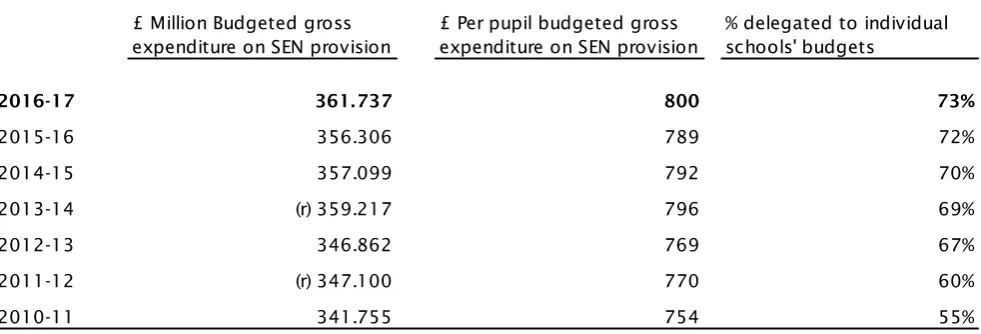
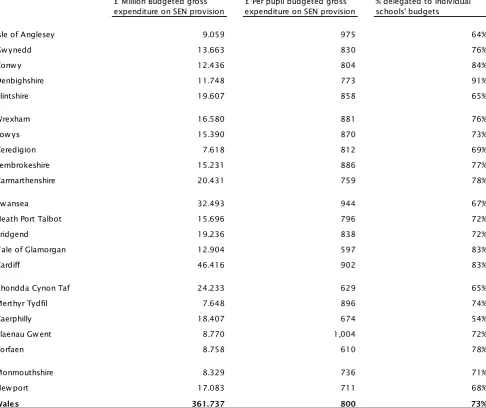
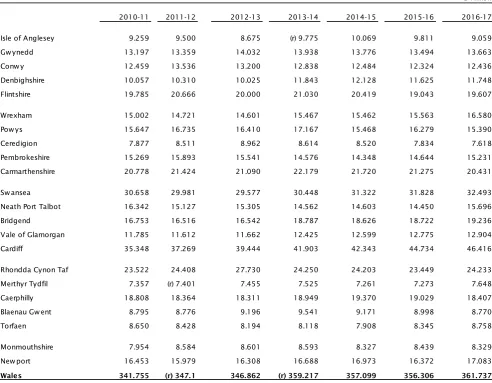
Table 5 shows how much in total was budgeted by local authorities for SEN provision and the amount budgeted per pupil (calculated per total pupils on roll not just those with SEN). It also shows the delegation rate, ie how much of local authorities’ SEN budgets was passed directly to schools. Table 6 breaks this data down by local authority, for the latest year, 2016-17. Table 7 shows how much each local authority has budgeted for SEN in each of the last seven financial years.
From these tables, the following can be observed:
Total budgeted expenditure on SEN in 2016-17 across Wales is £361.737 million. This is a 1.5% rise on 2015-16.
£800 is budgeted for SEN per pupil (total pupils not SEN cohort).
Blaenau Gwent (£1,004), Anglesey (£975) and Swansea (£944) budgeted the most for SEN per pupil in 2016-17. Vale of Glamorgan (£597), Torfaen (£610) and Rhondda Cynon Taf (£629) budgeted the least.
The delegation rate for SEN expenditure across Wales in 2016-17 is 73%. This means that £73 of every £100 budgeted for SEN was passed by local authorities to schools themselves. The delegation rate has risen year-on-year in each of the last six years.
[image:28.595.70.561.295.462.2]Denbighshire (91%) delegated the largest proportion of its SEN budget to schools in 2016-17. Caerphilly (54%) had the lowest delegation rate.
Table 5: Gross budgeted expenditure on SEN provision by local authorities in Wales
Source: Welsh Government, Statistical First Releases: Budgeted expenditure on SEN provision(several editions) Notes:
a) Includes notional allocations to schools for SEN provision as part of local authorities’ formulae for distributing funds to schools. As it is for each school to determine how much of its delegated budget to spend on SEN, the actual expenditure within schools may vary from these notional allocations.
b) The £ per pupil expenditure is based on the whole cohort of pupils on roll rather than only pupils with SEN.
r) These are the revised 2013-14 and 2011-12 budgeted gross expenditure figures that were published in the subsequent year’s release. Updated £ per pupil and delegation rates were not published, hence some caution is advised in comparing these two fields with gross budgets for these years.
£ Million Budgeted gross expenditure on SEN provision
£ Per pupil budgeted gross expenditure on SEN provision
% delegated to individual schools' budgets
2016-17 361.737 800 73%
2015-16 356.306 789 72%
2014-15 357.099 792 70%
2013-14 (r) 359.217 796 69%
2012-13 346.862 769 67%
2011-12 (r) 347.100 770 60%
Table 6: Local authorities' gross budgeted expenditure on SEN provision, 2016-17
Source: Welsh Government, Statistical First Release: Budgeted expenditure on SEN provision 2016-17,30 June 2016 Notes:
a) Includes notional allocations to schools for SEN provision as part of local authorities’ formulae for distributing funds to schools. As it is for each school to determine how much of its delegated budget to spend on SEN, the actual expenditure within schools may vary from these notional allocations.
b) The £ per pupil expenditure is based on the whole cohort of pupils on roll rather than only pupils with SEN.
£ Million Budgeted gross expenditure on SEN provision
£ Per pupil budgeted gross expenditure on SEN provision
% delegated to individual schools' budgets
Isle of Anglesey 9.059 975 64%
Gw ynedd 13.663 830 76%
Conw y 12.436 804 84%
Denbighshire 11.748 773 91%
Flintshire 19.607 858 65%
Wrexham 16.580 881 76%
Pow ys 15.390 870 73%
Ceredigion 7.618 812 69%
Pembrokeshire 15.231 886 77%
Carmarthenshire 20.431 759 78%
Sw ansea 32.493 944 67%
Neath Port Talbot 15.696 796 72%
Bridgend 19.236 838 72%
Vale of Glamorgan 12.904 597 83%
Cardiff 46.416 902 83%
Rhondda Cynon Taf 24.233 629 65%
Merthyr Tydfil 7.648 896 74%
Caerphilly 18.407 674 54%
Blaenau Gw ent 8.770 1,004 72%
Torfaen 8.758 610 78%
Monmouthshire 8.329 736 71%
New port 17.083 711 68%
Table 7: Local authorities' gross budgeted expenditure on SEN provision
Source: Welsh Government, Statistical First Releases: Budgeted expenditure on SEN provision (several editions) Notes:
a) These figures include notional allocations to schools for SEN provision as part of local authorities’ formulae for distributing funds to schools. As it is for each school to determine how much of its delegated budget to spend on SEN, the actual expenditure within schools may vary from these notional allocations.
r) These are the revised 2013-14 and 2011-12 budgeted gross expenditure figures that were published in the subsequent year’s release.
2010-11 2011-12 2012-13 2013-14 2014-15 2015-16 2016-17
Isle of Anglesey 9.259 9.500 8.675 (r) 9.775 10.069 9.811 9.059
Gw ynedd 13.197 13.359 14.032 13.938 13.776 13.494 13.663
Conw y 12.459 13.536 13.200 12.838 12.484 12.324 12.436
Denbighshire 10.057 10.310 10.025 11.843 12.128 11.625 11.748
Flintshire 19.785 20.666 20.000 21.030 20.419 19.043 19.607
Wrexham 15.002 14.721 14.601 15.467 15.462 15.563 16.580
Pow ys 15.647 16.735 16.410 17.167 15.468 16.279 15.390
Ceredigion 7.877 8.511 8.962 8.614 8.520 7.834 7.618
Pembrokeshire 15.269 15.893 15.541 14.576 14.348 14.644 15.231
Carmarthenshire 20.778 21.424 21.090 22.179 21.720 21.275 20.431
Sw ansea 30.658 29.981 29.577 30.448 31.322 31.828 32.493
Neath Port Talbot 16.342 15.127 15.305 14.562 14.603 14.450 15.696
Bridgend 16.753 16.516 16.542 18.787 18.626 18.722 19.236
Vale of Glamorgan 11.785 11.612 11.662 12.425 12.599 12.775 12.904
Cardiff 35.348 37.269 39.444 41.903 42.343 44.734 46.416
Rhondda Cynon Taf 23.522 24.408 27.730 24.250 24.203 23.449 24.233
Merthyr Tydfil 7.357 (r) 7.401 7.455 7.525 7.261 7.273 7.648
Caerphilly 18.808 18.364 18.311 18.949 19.370 19.029 18.407
Blaenau Gw ent 8.795 8.776 9.196 9.541 9.171 8.998 8.770
Torfaen 8.650 8.428 8.194 8.118 7.908 8.345 8.758
Monmouthshire 7.954 8.584 8.601 8.593 8.327 8.439 8.329
New port 16.453 15.979 16.308 16.688 16.973 16.372 17.083
Wales 341.755 (r) 347.1 346.862 (r) 359.217 357.099 356.306 361.737
Achievement of learners with SEN
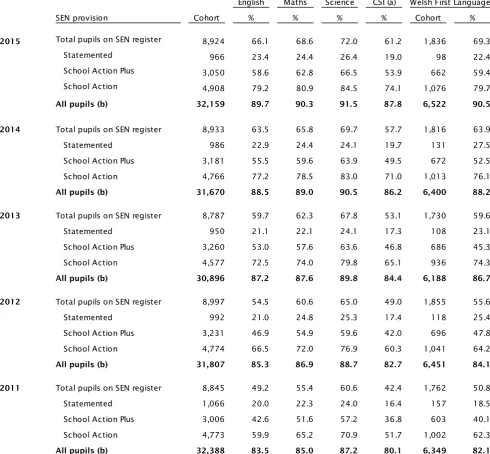
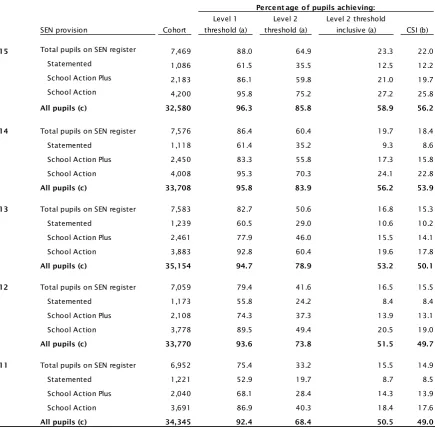
Tables 8-10 provide some information on the achievement of learners in Wales with SEN. Tables 8 and 9 present statistics on the percentage of all pupils with SEN achieving the expected level at Key Stages 2 and 3 respectively, as well as breaking these down for each of the three levels of
intervention. Table 10 presents statistics on achievement at Key Stage 4.
Statistics for all pupils are also given, enabling some comparisons to be made between the achievements of pupils with SEN with that of their peers. The data covers the last five years. From these tables, the following can be observed:
In 2015, at Key Stage 2, 61.2% of all pupils with SEN achieved the Core Subject Indicator (CSI), which is the expected level in English/Welsh, Mathematics and Science combined. This compares to 87.8% of all pupils, meaning there is a 26.6 percentage point gap. This gap has narrowed since 2011 when it was 37.7 percentage points.
At Key Stage 3, 55.2% of all pupils with SEN achieved the CSI in 2015, compared with 84.1% of all pupils. This gap has also narrowed from 41.5 percentage points in 2011 to 28.9 percentage points in 2015.
At Key Stage 4, in 2015, 23.3% of all pupils with SEN achieved the Level 2 threshold inclusive (5 or more GCSEs at grades A*-C including English/Welsh and Mathematics, or equivalent). This compares with 58.9% of all pupils. The gap of 35.6 percentage points is broadly the same as in 2011 when it was 35.0 percentage points.
As would probably be expected, fewer pupils with statements achieve either the CSI at Key Stages 2 and 3, or the Level 2 threshold inclusive at Key Stage 4, than other learners who have their SEN supported through School Action Plus or School Action. Similarly, fewer pupils requiring support through School Action Plus achieve these measures than those only receiving School Action. 12.5% of pupils with statements achieved 5 or more GCSEs at grades A*-C including English/Welsh and Mathematics, or equivalent. This compares to 21.0% at School Action Plus and 27.2% at School Action.
At each of Key Stages 2, 3 and 4, the cohort of pupils with SEN receiving any of the three levels of intervention achieved higher in 2015 than in any year during the five year period examined for this analysis (dating back to 2011 and using the two measures of CSI and Level 2 threshold inclusive).
Table 8: Key Stage 2 achievement by level of SEN provision (percentage of pupils achieving at least the expected level (Level 4) in teacher assessments)
Source: Welsh Government, Academic achievement by pupil characteristics, 28 January 2016, Table 14
Notes:
a) The Core Subject Indicator (CSI) represents the percentage of pupils achieving the expected level or above in English or Welsh (First Language), Mathematics and Science in combination.
b) ‘All pupils’ represents the attainment of all pupils in maintained primary, secondary, special schools or PRUs whose Pupil Level Annual School Census or Education Otherwise Than At School collection and attainment data were successfully matched within the National Pupil Database.
English Maths Science CSI (a)
% % % % Cohort %
2015 Total pupils on SEN register 8,924 66.1 68.6 72.0 61.2 1,836 69.3
Statemented 966 23.4 24.4 26.4 19.0 98 22.4
School Action Plus 3,050 58.6 62.8 66.5 53.9 662 59.4
School Action 4,908 79.2 80.9 84.5 74.1 1,076 79.7
All pupils (b) 32,159 89.7 90.3 91.5 87.8 6,522 90.5
2014 Total pupils on SEN register 8,933 63.5 65.8 69.7 57.7 1,816 63.9
Statemented 986 22.9 24.4 24.1 19.7 131 27.5
School Action Plus 3,181 55.5 59.6 63.9 49.5 672 52.5
School Action 4,766 77.2 78.5 83.0 71.0 1,013 76.1
All pupils (b) 31,670 88.5 89.0 90.5 86.2 6,400 88.2
2013 Total pupils on SEN register 8,787 59.7 62.3 67.8 53.1 1,730 59.6
Statemented 950 21.1 22.1 24.1 17.3 108 23.1
School Action Plus 3,260 53.0 57.6 63.6 46.8 686 45.3
School Action 4,577 72.5 74.0 79.8 65.1 936 74.3
All pupils (b) 30,896 87.2 87.6 89.8 84.4 6,188 86.7
2012 Total pupils on SEN register 8,997 54.5 60.6 65.0 49.0 1,855 55.6
Statemented 992 21.0 24.8 25.3 17.4 118 25.4
School Action Plus 3,231 46.9 54.9 59.6 42.0 696 47.8
School Action 4,774 66.5 72.0 76.9 60.3 1,041 64.2
All pupils (b) 31,807 85.3 86.9 88.7 82.7 6,451 84.1
2011 Total pupils on SEN register 8,845 49.2 55.4 60.6 42.4 1,762 50.8
Statemented 1,066 20.0 22.3 24.0 16.4 157 18.5
School Action Plus 3,006 42.6 51.6 57.2 36.8 603 40.1
School Action 4,773 59.9 65.2 70.9 51.7 1,002 62.3
All pupils (b) 32,388 83.5 85.0 87.2 80.1 6,349 82.1
SEN provision Cohort
Table 9: Key Stage 3 achievement by level of SEN provision (percentage of pupils achieving at least the expected level (Level 5) in teacher assessments)
Source: Welsh Government, Academic achievement by pupil characteristics, 28 January 2016, Table 15 Notes:
a) The Core Subject Indicator (CSI) represents the percentage of pupils achieving the expected level or above in English or Welsh (First Language), Mathematics and Science in combination.
b) ‘All pupils’ represents the attainment of all pupils in maintained primary, secondary, special schools or PRUs whose Pupil Level Annual School Census or Education Otherwise Than At School collection and attainment data were successfully matched within the National Pupil Database.
English Maths Science CSI (a)
% % % % Cohort %
2015 Total pupils on SEN register 8,444 64.2 66.8 75.2 55.2 1,332 71.1 Statemented 1,119 27.6 29.4 36.9 21.4 90 41.1
School Action Plus 2,455 61.3 64.2 72.8 51.6 311 61.7
School Action 4,870 74.1 76.6 85.2 64.8 931 77.1
All pupils (b) 31,547 88.1 88.9 92.0 84.1 5,635 90.9
2014 Total pupils on SEN register 8,518 59.2 61.8 71.2 49.2 1,294 68.4
Statemented 1,236 24.0 27.6 32.1 19.2 101 27.7
School Action Plus 2,523 54.3 58.3 68.7 44.7 328 61.9
School Action 4,759 70.9 72.5 82.7 59.4 865 75.6
All pupils (b) 32,162 86.1 86.7 90.6 81.3 5,537 90.1
2013 Total pupils on SEN register 8,230 50.6 53.9 61.3 39.7 1,120 57.9
Statemented 1,287 20.4 25.1 29.7 16.2 119 31.1
School Action Plus 2,526 46.1 51.4 57.6 36.2 321 53.9
School Action 4,417 61.9 63.6 72.7 48.6 680 64.6
All pupils (b) 33,193 83.0 84.0 87.2 77.2 5,667 87.6
2012 Total pupils on SEN register 8,192 43.8 48.5 53.9 33.3 1,150 49.9
Statemented 1,311 18.0 21.4 24.9 13.3 111 25.2
School Action Plus 2,599 41.1 48.2 51.4 31.3 365 43.6
School Action 4,282 53.3 56.9 64.3 40.7 674 57.4
All pupils (b) 34,289 79.5 81.3 83.9 72.8 5,783 84.2
2011 Total pupils on SEN register 8,319 37.2 42.8 48.2 26.6 1,147 44.4
Statemented 1,482 17.1 20.8 24.1 11.9 124 28.2
School Action Plus 2,572 33.8 41.2 45.3 23.7 329 32.5
School Action 4,265 46.1 51.3 58.4 33.4 694 52.9
All pupils (b) 35,724 76.1 78.0 80.4 68.1 5,858 81.4 SEN provision Cohort
Table 10: Key Stage 4 achievement by level of SEN provision (percentage of pupils aged 15 at the start of the academic year)
Source: Welsh Government, Academic achievement by pupil characteristics, 28 January 2016, Table 16 Notes:
a) Level thresholds represent a volume, or ‘size’, of qualifications at a specific level on the National Qualifications Framework (NQF). Three thresholds have been established: Level 1 – a volume of qualifications at Level 1 equivalent to the volume of 5 GCSEs at grade D-G; Level 2 – a volume of qualifications at Level 2 equivalent to the volume of 5 GCSEs at grade A*-C; Level 2 inclusive – a volume of qualifications at Level 2 equivalent to the volume of 5 GCSEs at grade A*-C including English/Welsh first language and Mathematics.
b) The Core Subject Indicator (CSI) represents the percentage of pupils achieving the expected level or above in English or Welsh (First Language), Mathematics and Science in combination.
c) ‘All pupils’ represents the attainment of all pupils in maintained primary, secondary, special schools or PRUs whose Pupil Level Annual School Census or Education Otherwise Than At School collection and