JOURNAL OFVIROLOGY, Dec. 2003, p. 13335–13347 Vol. 77, No. 24
0022-538X/03/$08.00⫹0 DOI: 10.1128/JVI.77.24.13335–13347.2003 Copyright © 2003, American Society for Microbiology. All Rights Reserved.
Complete Genomic Sequence and Comparative Analysis of the
Tumorigenic Poxvirus Yaba Monkey Tumor Virus
Craig R. Brunetti,
1† Hiroko Amano,
2Yoshiaki Ueda,
2Jing Qin,
1Tatsuo Miyamura,
2Tetsuro Suzuki,
2Xing Li,
3John W. Barrett,
1and Grant McFadden
1,4*
BioTherapeutics Research Group, Robarts Research Institute, London, Ontario, Canada N6G 2V41; Department of Microbiology
and Immunology, University of Western Ontario, London, Ontario, Canada N6A 5C14; Laboratory of Tumor Viruses, National
Institute of Infectious Diseases, Tokyo 162-8640, Japan2; and Viron Therapeutics Inc., London, Ontario, Canada N5G 2V43
Received 15 July 2003/Accepted 4 September 2003
TheYatapoxvirusgenus of poxviruses is comprised ofYaba monkey tumor virus(YMTV),Tanapox virus, and
Yaba-like disease virus(YLDV), which all have the ability to infect primates, including humans. Unlike other
poxviruses, YMTV induces formation of focalized histiocytomas upon infection. To gain a greater understand-ing of the Yatapoxvirus genus and the unique tumor formation properties of YMTV, we sequenced the 134,721-bp genome of YMTV. The genome of YMTV encodes at least 140 open reading frames, all of which are also found as orthologs in the closely related YLDV. However, 13 open reading frames found in YLDV are completely absent from YMTV. Common to both YLDV and YMTV are the unusually large noncoding regions between many open reading frames. To determine whether any of these noncoding regions might be function-ally significant, we carried out a comparative analysis between the putative noncoding regions of YMTV and similar noncoding regions from other poxviruses. This approach identified three new gene poxvirus families, defined as orthologs of YMTV23.5L, YMTV28.5L, and YMTV120.5L, which are highly conserved in virtually all poxvirus species. Furthermore, the comparative analysis also revealed a 40-bp nucleotide sequence at approx-imately 14,700 bases from the left terminus that was 100% identical in the comparable intergene site within members of theYatapoxvirus,Suipoxvirus, andCapripoxvirusgenera and 95% conserved in theLeporipoxvirus
genus. This conserved sequence was shown to function as a poxvirus late promoter element in transfected and infected cells, but other functions, such as an involvement in viral replication or packaging, cannot be excluded. Finally, we summarize the predicted immunomodulatory protein repertoire in the Yatapoxvirus genus as a whole.
Poxviruses are divided into two major groups, the chor-dopoxviruses that infect vertebrates and entomopoxviruses of insects. Chordopoxviruses contain a linear double-stranded DNA genome with covalently closed hairpin loops at either end (19). The extreme left and right termini of the poxvirus genome consist of identical, but oppositely oriented, terminal inverted repeats (TIR). Chordopoxvirus genomes can be di-vided into two broad domains based on the functions of the encoded gene products. The central region of the genome, which ranges in length from 80,000 to 100,000 bases, is en-riched for genes that encode essential conserved functions, such as transcription, replication, and virion assembly. The regions flanking this conserved central region express an array of proteins that function to increase survival of the virus in the infected host, including proteins that determine host range, inhibit apoptosis, or mediate responses to modulate the host immune system (22).
The genome sizes of published chordopoxviruses vary from 145,000 bp for Yaba-like disease virus (YLDV) (15) up to 288,000 bp for fowlpox virus (2) and possess between 151 and 260 assigned open reading frames (ORFs). Complete genomic
sequences of representative members from seven of the eight
Chordopoxvirus genera have now been published, including orthopoxviruses (vaccinia virus strain Copenhagen [11], mod-ified vaccinia virus strain Ankara [6], variola virus strain Ban-gladesh [16], variola virus strain India [24], variola virus strain Garcia [25], camelpox virus [1], and monkeypox virus [26]), capripoxviruses (lumpy skin disease virus [LSDV] [29], goatpox virus, and sheeppox virus [30]), leporipoxviruses (myx-oma virus [8] and Shope fibr(myx-oma virus [31]), suipoxviruses (swinepox virus [SPV] [3]), molluscipoxvirus (molluscum con-tagiosum virus [23]), avipoxviruses (fowlpox [2]), and yatapox-viruses (Yaba-like disease virus [YLDV] [15]).
TheYatapoxvirusgenus of poxviruses is comprised of three virus isolates: YLDV,Tanapox virus(TPV), andYaba monkey tumor virus(YMTV) (14). The yatapoxviruses have a narrow host range, infecting only primates, including humans. Several pieces of data suggest that TPV and YLDV may be different strains of the same virus. For example, TPV and YLDV pro-duce a clinically indistinguishable disease, which includes a mild fever and epidermal lesions (10, 17), and the published genomic sequence of YLDV is more than 98.6% identical with the 8,300 bases of TPV sequence entered into the public da-tabase (GenBank accession no. AY253325, AF245394, and AF153912) (15). This level of sequence identity is comparable to different strains of vaccinia virus and suggests that YLDV and TPV should be considered the monkey and human ver-sions, respectively, of the same virus.
* Corresponding author. Mailing address: BioTherapeutics Re-search Group, Robarts ReRe-search Institute, 1400 Western Rd., London, Ontario, Canada N6G 2V4. Phone: (519) 3184. Fax: (519) 663-3847. E-mail: [email protected].
† Present address: Department of Biology, Trent University, Peter-borough, Ontario K9L 7B8, Canada.
13335
on November 8, 2019 by guest
http://jvi.asm.org/
YMTV was originally characterized to be the agent respon-sible for subcutaneous tumors in a rhesus monkey colony oc-curring in 1956 in Yaba, Nigeria (7). YMTV is one of the few poxviruses that induce substantial tumor formation upon in-fection (5, 12, 20, 27). In rhesus monkeys infected with YMTV, the tumors are thought to be derived from histiocytes that migrate to the site of infection. The histiocytes become in-fected and begin to rapidly proliferate, become multinucle-ated, and eventually form a polyclonal tumor (27). However, the tumors generally do not become invasive and spontane-ously regress, presumably when either viral cytopathic effect kills the infected cells or cell-mediated antiviral immunity be-comes sufficiently effective to clear the infection (12, 27).
The complete genomic sequence of YLDV was recently published, and a number of novel ORFs not found in other chordopoxviruses were identified (15). As well, despite the fact that the noncoding regions between ORFs in most poxviruses are typically only a few nucleotides, there were multiple iden-tified inter-ORF regions of 200 or more nucleotides in YLDV. Typically, the minimum size for a poxvirus ORF is arbitrarily set (e.g., 30 amino acids for SPV, LSDV, molluscum contagio-sum virus, and fowlpox virus [2, 3, 23, 29]; 50 amino acids for myxoma virus [8]; and 60 amino acids for YLDV [15]). If bona fide ORFs were indeed located within these assigned YLDV noncoding regions, then one would predict that these ORFs might be highly conserved between YLDV and YMTV. There-fore, in an effort to understand the clinical differences between YLDV and YMTV and to provide a closely related sequence to YLDV for a comparative genomic approach, we sequenced the genome of the YMTV and provide a comparative genomic analysis of theYatapoxvirusgenus.
MATERIALS AND METHODS
Viruses.YMTV (VR587) was obtained from the American Type Culture Collection (Manassas, Va.) and was propagated on CV1 cells at 35°C in mini-mum essential medium containing 5% fetal bovine serum. Myxoma virus strain Lausanne was obtained from the American Type Culture Collection and prop-agated in BGMK cells at 37°C.
Isolation and sequencing of YMTV genomic fragments.YMTV genomic DNA was isolated from infected CV1 cells and was subjected to restriction enzyme
digestion withPstI,BamHI,SalI,XbaI, orEcoRI. The digested DNA was cloned
into pUC19 or pBR322 vectors and sequenced by the dideoxy sequencing method (21). The remainder of the YMTV genomic sequence was cloned using
overlapping PCR. Briefly, PCR was carried out usingTaqpolymerase, YMTV
genomic DNA, and PCR primers based on the corresponding sequence of YLDV (15). The resulting PCR products were cloned into pGEMT-easy (Pro-mega, Madison, Wis.) and were sequenced by the London Regional Genomics Centre DNA Sequencing Facility using an Applied Biosystems (Foster City, Calif.) ABI Prism 377 DNA sequencer and Big Dye terminators (Applied Bio-systems). Some of the YMTV sequence was previously submitted to GenBank (accession no. AY253324, AB025319, AB018404, and AB015885).
Sequence analysis.The sequence data were assembled using Sequencher 3.0, and ORFs were identified using MacVector 6.5.3 (Oxford Molecular Ltd.).
Cloning a conserved sequence from myxoma virus upstream of an enhanced GFP cassette. PCR was carried out using Taq polymerase; plasmid DNA
pEGFP-N1 (Clontech, Palo Alto, Calif.); the reverse PCR primer 5⬘TTACGC
CTTAAGATACATTG 3⬘, which corresponds to the 3⬘end of the green
fluo-rescent protein (GFP), and the forward PCR primers (with the start codon of
GFP in boldface type) 5⬘TCGCCACCATGGTGAGCAAG 3⬘(PCR-GFP), 5⬘
TTTATTTATGTTATTAGCTAGGATTTATGTTTCATTTTTTACTCGCCA
CCATGGTGAGCAAG 3⬘(PCR-R-GFP), and 5⬘GTAAAAAATGAAACATA
AATCCTAGCTAATAACATAAATAAATCGCCACCATGGTGAGCAAG 3⬘
(PCR-L-GFP). The resulting PCR products were cloned into pGEMT-easy (Pro-mega) and designated GFP, R-GFP, and L-GFP.
Expression of GFP cassette in BGMK cells.Twelve-well dishes of BGMK cells approximately 90% confluent growing in minimum essential medium–5% fetal bovine serum were either infected with myxoma virus at a multiplicity of infec-tion of 10 or mock infected. The cells were incubated at 37°C for 2 h, and this was followed by transfection with GFP, R-GFP, or L-GFP plasmid DNA using Lipofectamine Plus (Invitrogen, Burlington, Ontario, Canada) per the manufac-turer’s protocol. The cells were subsequently incubated at 37°C for 48 h. Cells expressing the GFP construct were detected using a fluorescence microscope.
Nucleotide sequence accession number.Sequence data from this article have been deposited in GenBank under accession number AY386371.
RESULTS
Genome structure of YMTV. The genome of YMTV was sequenced through the subcloning of genomic fragments into plasmid vectors, and clones were individually sequenced. In addition, regions of the genome not represented in the cloned fragments were isolated using PCR, and a minimum of three independent PCR products for each primer set were se-quenced. After assembling the sequence files, a single contin-uous sequence of 134,721 bases was generated, making YMTV the smallest poxvirus genome yet sequenced. This deduced sequence lacks the terminal hairpin region, but evidence sug-gests that all the coding ORFs have been fully sequenced and only the very extreme hairpin termini of the genome were not included. In particular, the putative YMTV concatemer reso-lution sequence was obtained, which is typically found very close to the molecular hairpin loop at the termini (18). Pub-lished reports also confirm that the YMTV genome size is indeed approximately 135,000 bases (4).
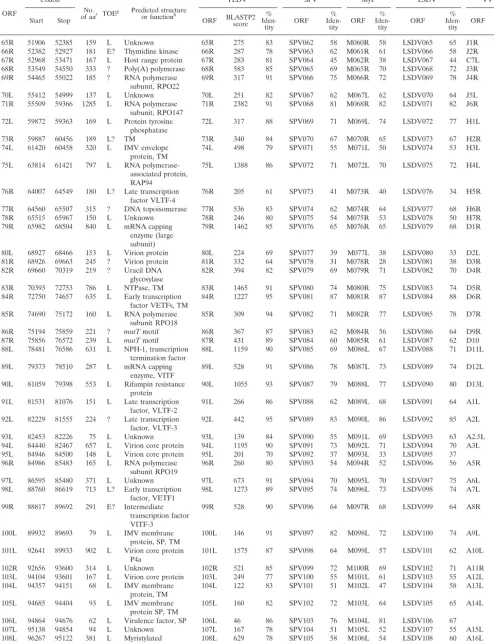
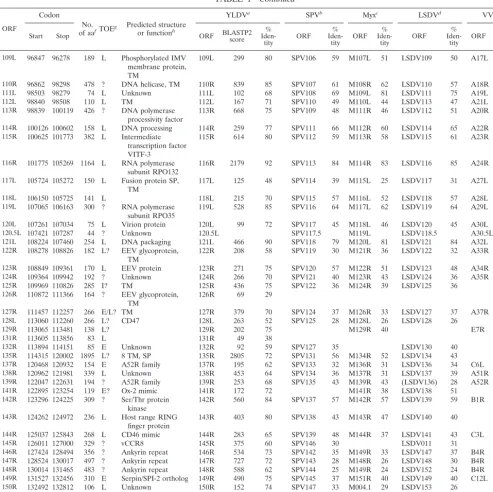
The YMTV genome has an A⫹T content of 70.2% and encodes at least 140 ORFs (Table 1; Fig. 1), of which 139 are single copies and 1 is repeated in each copy of the TIR. In comparison, YLDV has been assigned 151 ORFs (15). YMTV and YLDV is closely related viruses with approximately 75% identity between the viruses at the nucleotide level overall, which is typical for chordopoxvirus members from a single genus. Furthermore, all the ORFs identified in YMTV have a corresponding ortholog in YLDV, but YMTV has lost 13 ORFs that are present in YLDV (Table 2), which accounts for the 10 kb of sequence loss in YMTV. Since YMTV and YLDV are so similar, and to avoid unnecessary confusion, we have adopted the proposed YLDV nomenclature (15) for naming orthologous YMTV ORFs.
The TIR of YMTV are 1,962 bases long and contain a single ORF designated 1L/151R. The noncoding region in the TIR of YMTV and YLDV is relatively large, with 804 and 755 bases (15), respectively, between the terminal ORF and the concate-mer resolution sequence. In comparison, closely related gen-era, such as members of theCapripoxvirus,Leporipoxvirus, and
Suipoxvirus genera, have noncoding regions in their termini ranging from 159 to 366 bases (3, 8, 29). Analysis of the non-coding region from YMTV and YLDV revealed a nucleotide sequence in each that exhibited striking similarity to that of the SPV002 gene (Fig. 2). However, both the YMTV and YLDV sequences lack an initiating methionine (ATG) codon, suggest-ing that either the large noncodsuggest-ing sequence in the TIR of yatapox viruses has evolved into a pseudogene of SPV002, or else the yatapox virus orthologs utilize a nonstandard initiator codon.
Identification of putative orthologs of YMTV23.5L in
mul-13336 BRUNETTI ET AL. J. VIROL.
on November 8, 2019 by guest
http://jvi.asm.org/
TABLE 1. YMTV ORFs
ORF
Codon No.
of aaf TOEg Predicted structureor functionh
YLDVa SPVb Myxc LSDVd VVe
Start Stop ORF BLASTP2score Iden-%
tity ORF %
Iden-tity ORF %
Iden-tity ORF %
Iden-tity ORF %
Iden-tity
1L 1808 804 334 E A52R family 1L 489 72 LSDV007 35 C10L 26
2L 2963 1938 341 ? vTNF-␣bp, SP 2L 497 71 SPV003 34
4L 3722 3003 239 ? ␣-Amanitin sensitivity 4L 340 71 SPV007 28 LSDV009 35 N2L 31
5L 4232 3762 156 L LAP/PHD finger,
TM 5L 200 58 SPV009 36 M153R 32 LSDV010 48
6L 4732 4274 152 E Unknown 6L 265 81 SPV001/150 37 M003.1 28 LSDV001/156 34 B15R 41
7L 5840 4800 346 E? vCCR8 7L 265 70 SPV005 LSDV011 39
11L 8306 6393 637 ? 14 ankyrin domains 11L 1061 79
12L 8574 8308 88 E eIF2␣mimic 12L 111 64 SPV010 36 M156R 32 LSDV014 35 K3L 31
13L 9474 8614 286 L Monoglyceride lipase 13L 406 68 K6L 48
14L 9917 9504 137 I? IL-18 bp, SP 14L 156 55 SPV011 30 LSDV015 37
16L 10584 10066 172 L? Inhibition of
apoptosis 16L 207 64 SPV012 29 LSDV017 30 I1L 24
17L 11066 10635 143 L? dUTPase 17L 215 75 SPV013 52 M012L 48 LSDV018 52 F2L 46
19L 12774 11200 524 L? Kelch-like protein 19L 820 74 SPV015 35 M014L 32 LSDV019 34 F3L 25
20L 13779 12802 325 L Ribonucleotide
reduc-tase (small subunit) 20L 611 91 SPV016 76 M015L 75 LSDV020 79 F4L 76
21L 14054 13806 82 ? SP, TM 21L 114 64 SPV017 33 M016L 42 LSDV021 31
22L 14325 14098 75 E Unknown 22L 45 37
23.5L 14742 14530 70 E Unknown 23.5L 88 86 M018L 45 LSDV023 57 F8L 43
24L 15443 14799 214 L TM 24L 312 74 SPV021 45 M019L 43 LSDV024 43 F9L 48
25L 16758 15421 445 L Ser/Thr protein kinase 25L 845 90 SPV022 77 M020L 74 LSDV025 77 F10L 72
26L 18711 16786 642 L TM 26L 861 65 SPV024 42 M021L 37 LSDV027 40 F12L 31
27L 19845 18736 369 L EEV envelope protein 27L 657 87 SPV025 70 M022L 69 LSDV028 72 F13L 57
28.5L 20085 19909 58 L Unknown 28.5L
29L 20563 20117 148 ? Unknown 29L 263 82 SPV027 60 M024L 49 LSDV029 62 F15L 56
30L 21275 20628 215 ? Unknown 30L 320 73 SPV028 38 M025L 30 LSDV030 36 F16L 37
31R 21335 21649 104 L DNA binding
phosphoprotein 31R 169 79 SPV029 62 M026L 68 LSDV031 63 F17R 59
32L 23058 21646 470 ? Poly(A) polymerase 32L 832 88 SPV030 67 M027L 68 LSDV032 68 E1L 64
33L 25120 23072 683 ? Unknown 33L 1006 71 SPV031 44 M028L 40 LSDV033 40 E2L 37
34L 25700 25146 185 L dsRNA bp 34L 217 57 SPV032 44 M029L 57 LSDV034 42 E3L 38
35L 26311 25745 188 L RNA polymerase
sub-unit RPO30 35L 326 82 SPV033 66 M030L 64 LSDV036 63 E4L 67
36R 26444 27472 342 L? Unknown 36R 512 71 M031R 31 LSDV035 33 E5R 25
37R 27498 29201 567 L? Unknown 37R 1006 85 SPV034 65 M032R 61 LSDV037 67 E6R 60
38R 29219 30025 268 L ER-localized protein,
TM 38R 521 93 SPV035 76 M033R 75 LSDV038 78 E8R 70
39L 33042 30022 1006 ? DNA polymerase 39L 1689 81 SPV036 64 M034L 66 LSDV039 66 E9L 63
40R 33075 33359 94 L Redox protein 40R 181 88 SPV037 67 M035R 69 LSDV040 71 E10R 67
41L 33770 33393 125 L TM 41L 200 74 LSDV041 53 E11L 48
43L 34881 33955 308 L DNA binding protein 43L 472 77 SPV039 60 M038L 64 LSDV043 66 I1L 60
44L 35103 34882 73 L TM 44L 116 77 SPV040 48 M039L 52 LSDV044 51 I2L 45
45L 35898 35104 264 E? DNA binding
phosphoprotein 45L 437 84 SPV041 60 M040L 61 LSDV045 58 I3L 56
46L 36227 35988 79 L IMV protein, SP, TM 46L 138 86 SPV043 55 M041L 48 LSDV046 69 15L 45
47L 37402 36245 385 L TM 47L 625 79 SPV044 51 M042L 52 LSDV047 53 16L 54
48L 38688 37399 429 L Virion core protein 48L 773 87 SPV045 69 M043L 69 LSDV048 71 17L 64
49R 38694 40730 678 ? NPH-II, RNA
helicase 49R 1133 80 SPV046 58 M044R 54 LSDV049 59 18R 54
50L 42496 40727 590 L Metalloproteinase 50L 963 78 SPV047 59 M045L 55 LSDV050 57 G1L 51
51L 42828 42493 111 L TM 51L 167 71 SPV049 54 M046L 48 LSDV052 47 G3L 41
52R 42822 43490 222 ? Transcriptional
elongation factor 52R 349 78 SPV048 45 M047R 44 LSDV051 46 G2R 47
53L 43834 43457 125 L Glutaredoxin 2 53L 255 99 SPV050 64 M048L 69 LSDV053 75 G4L 45
54R 43837 45156 439 ? Unknown 54R 672 76 SPV051 49 M049R 44 LSDV054 49 G5R 43
55R 45159 45350 63 ? RNA polymerase
subunit, RPO7 55R 125 96 SPV052 84 M050R 85 LSDV055 85 G5.5R 79
56R 45350 45895 181 L TM 56R 291 79 SPV053 53 M051R 57 LSDV056 54 G6R 47
57L 46964 45864 366 L Virion core protein,
TM 57L 580 78 SPV054 53 M052L 52 LSDV057 55 G7L 48
58R 46994 47776 260 L Late transcription
factor, VLTF-1, TM 58R 511 97 SPV055 88 M053R 83 LSDV058 86 G8R 83
59R 47808 48806 332 L Myristylated protein 59R 528 78 SPV056 52 M054R 53 LSDV059 57 G9R 45
60R 48807 49550 247 L Myristylated IMV
envelope protein 60R 452 91 SPV057 82 M055R 75 LSDV060 80 L1R 69
61R 49565 49840 91 ? TM 61R 99 57 SPV058 32 LSDV061 34
62L 50763 49816 315 L Unknown 62L 518 80 SPV059 59 M057L 54 LSDV062 60 L3L 51
63R 50788 51546 252 L DNA binding protein 63R 455 92 SPV060 76 M058R 77 LSDV063 79 L4R 60
64R 51566 51964 132 L TM 64R 181 68 SPV061 46 M059R 44 LSDV064 50 L5R 44
Continued on following page
13337
on November 8, 2019 by guest
http://jvi.asm.org/
TABLE 1—Continued
ORF
Codon No.
of aaf TOEg Predicted structureor functionh
YLDVa SPVb Myxc LSDVd VVe
Start Stop ORF BLASTP2score Iden-%
tity ORF %
Iden-tity ORF %
Iden-tity ORF %
Iden-tity ORF %
Iden-tity
65R 51906 52385 159 L Unknown 65R 275 83 SPV062 58 M060R 58 LSDV065 65 J1R 47
66R 52382 52927 181 E? Thymidine kinase 66R 287 78 SPV063 62 M061R 61 LSDV066 58 J2R 61
67R 52968 53471 167 L Host range protein 67R 283 81 SPV064 45 M062R 38 LSDV067 44 C7L 37
68R 53549 54550 333 ? Poly(A) polymerase 68R 583 85 SPV065 69 M065R 70 LSDV068 72 J3R 67
69R 54465 55022 185 ? RNA polymerase
subunit, RPO22 69R 317 91 SPV066 75 M066R 72 LSDV069 78 J4R 72
70L 55412 54999 137 L Unknown 70L 251 82 SPV067 62 M067L 62 LSDV070 64 J5L 60
71R 55509 59366 1285 L RNA polymerase
subunit, RPO147 71R 2382 91 SPV068 81 M068R 82 LSDV071 82 J6R 78
72L 59872 59363 169 L Protein tyrosine
phosphatase 72L 317 88 SPV069 71 M069L 74 LSDV072 77 H1L 63
73R 59887 60456 189 L? TM 73R 340 84 SPV070 67 M070R 65 LSDV073 67 H2R 61
74L 61420 60458 320 L IMV envelope
protein, TM 74L 498 79 SPV071 55 M071L 50 LSDV074 53 H3L 36
75L 63814 61421 797 L RNA
polymerase-associated protein, RAP94
75L 1388 86 SPV072 71 M072L 70 LSDV075 72 H4L 64
76R 64007 64549 180 L? Late transcription
factor VLTF-4 76R 205 61 SPV073 41 M073R 40 LSDV076 34 H5R 34
77R 64560 65507 315 ? DNA topoisomerase 77R 536 83 SPV074 62 M074R 64 LSDV077 68 H6R 63
78R 65515 65967 150 L Unknown 78R 246 80 SPV075 54 M075R 53 LSDV078 50 H7R 36
79R 65982 68504 840 L mRNA capping
enzyme (large subunit)
79R 1462 85 SPV076 65 M076R 65 LSDV079 68 D1R 63
80L 68927 68466 153 L Virion protein 80L 224 69 SPV077 39 M077L 38 LSDV080 33 D2L 42
81R 68926 69663 245 ? Virion protein 81R 332 64 SPV078 31 M078R 28 LSDV081 38 D3R 32
82R 69660 70319 219 ? Uracil DNA
glycosylase 82R 394 82 SPV079 69 M079R 71 LSDV082 70 D4R 67
83R 70393 72753 786 L NTPase, TM 83R 1465 91 SPV080 74 M080R 75 LSDV083 74 D5R 66
84R 72750 74657 635 L Early transcription
factor VETFs, TM 84R 1227 95 SPV081 87 M081R 87 LSDV084 88 D6R 80
85R 74690 75172 160 L RNA polymerase
subunit RPO18 85R 309 94 SPV082 71 M082R 77 LSDV085 78 D7R 73
86R 75194 75859 221 ? mutTmotif 86R 367 87 SPV083 62 M084R 56 LSDV086 64 D9R 55
87R 75856 76572 239 L mutTmotif 87R 431 89 SPV084 60 M085R 61 LSDV087 62 D10 50
88L 78481 76586 631 L NPH-1, transcription
termination factor 88L 1159 90 SPV085 69 M086L 67 LSDV088 71 D11L 69
89L 79373 78510 287 L mRNA capping
enzyme, VITF 89L 528 91 SPV086 78 M087L 73 LSDV089 74 D12L 70
90L 81059 79398 553 L Rifampin resistance
protein 90L 1055 93 SPV087 79 M088L 77 LSDV090 80 D13L 73
91L 81531 81076 151 L Late transcription
factor, VLTF-2 91L 266 86 SPV088 62 M089L 68 LSDV091 64 A1L 62
92L 82229 81555 224 ? Late transcription
factor, VLTF-3 92L 442 95 SPV089 83 M090L 86 LSDV092 85 A2L 84
93L 82453 82226 75 L Unknown 93L 139 84 SPV090 55 M091L 69 LSDV093 63 A2.5L 53
94L 84440 82467 657 L Virion core protein 94L 1195 90 SPV091 73 M092L 71 LSDV094 70 A3L 63
95L 84946 84500 148 L Virion core protein 95L 201 70 SPV092 37 M093L 33 LSDV095 37
96R 84986 85483 165 L RNA polymerase
subunit RPO19 96R 260 80 SPV093 54 M094R 52 LSDV096 56 A5R 58
97L 86595 85480 371 L Unknown 97L 673 91 SPV094 70 M095L 70 LSDV097 75 A6L 56
98L 88760 86619 713 L? Early transcription
factor, VETF1 98L 1273 89 SPV095 74 M096L 73 LSDV098 74 A7L 68
99R 88817 89692 291 E? Intermediate
transcription factor VITF-3
99R 528 90 SPV096 64 M097R 68 LSDV099 64 A8R 61
100L 89932 89693 79 L IMV membrane
protein, SP, TM 100L 146 91 SPV097 82 M098L 72 LSDV100 74 A9L 71
101L 92641 89933 902 L Virion core protein
P4a 101L 1575 87 SPV098 64 M099L 57 LSDV101 62 A10L 50
102R 92656 93600 314 L Unknown 102R 521 85 SPV099 72 M100R 69 LSDV102 71 A11R 52
103L 94104 93601 167 L Virion core protein 103L 249 77 SPV100 55 M101L 61 LSDV103 55 A12L 46
104L 94357 94151 68 L IMV membrane
protein, TM 104L 122 83 SPV101 51 M102L 47 LSDV104 58 A13L 35
105L 94685 94404 93 L IMV membrane
protein SP, TM 105L 160 82 SPV102 72 M103L 64 LSDV105 65 A14L 45
106L 94864 94676 62 L Virulence factor, SP 106L 46 86 SPV103 76 M104L 81 LSDV106 67
107L 95138 94854 94 L Unknown 107L 167 78 SPV104 51 M105L 52 LSDV107 55 A15L 49
108L 96267 95122 381 L Myristylated
membrane protein, TM
108L 629 78 SPV105 58 M106L 54 LSDV108 60 A16L 50
Continued on facing page
13338
on November 8, 2019 by guest
http://jvi.asm.org/
tiple poxviruses.An unusual number of large gaps occur be-tween ORFs in YMTV (Table 1) and YLDV (15). Our as-sumption is that if these presumptive noncoding regions between yatapox virus ORFs have important functions, then
[image:5.603.46.540.76.568.2]they would likely be conserved between YLDV and YMTV. The largest inter-ORF gap in YLDV is 376 bases and maps between 23L and 24L (15). The corresponding region in YMTV is a 474-bp gap between 22L and 24L, with YMTV TABLE 1—Continued
ORF
Codon No.
of aafTOEg Predicted structureor functionh
YLDVa SPVb Myxc LSDVd VVe
Start Stop ORF BLASTP2score Iden-%
tity ORF %
Iden-tity ORF %
Iden-tity ORF %
Iden-tity ORF %
Iden-tity
109L 96847 96278 189 L Phosphorylated IMV
membrane protein, TM
109L 299 80 SPV106 59 M107L 51 LSDV109 50 A17L 37
110R 96862 98298 478 ? DNA helicase, TM 110R 839 85 SPV107 61 M108R 62 LSDV110 57 A18R 55
111L 98503 98279 74 L Unknown 111L 102 68 SPV108 69 M109L 81 LSDV111 75 A19L 58
112L 98840 98508 110 L TM 112L 167 71 SPV110 49 M110L 44 LSDV113 47 A21L 44
113R 98839 100119 426 ? DNA polymerase
processivity factor 113R 668 75 SPV109 48 M111R 46 LSDV112 51 A20R 46
114R 100126 100602 158 L DNA processing 114R 259 77 SPV111 66 M112R 60 LSDV114 65 A22R 63
115R 100625 101773 382 L Intermediate
transcription factor VITF-3
115R 614 80 SPV112 59 M113R 58 LSDV115 61 A23R 59
116R 101775 105269 1164 L RNA polymerase
subunit RPO132 116R 2179 92 SPV113 84 M114R 83 LSDV116 85 A24R 79
117L 105724 105272 150 L Fusion protein SP,
TM 117L 125 48 SPV114 39 M115L 25 LSDV117 31 A27L 56
118L 106150 105725 141 L 118L 215 70 SPV115 57 M116L 52 LSDV118 57 A28L 48
119L 107065 106163 300 ? RNA polymerase
subunit RPO35 119L 528 85 SPV116 64 M117L 62 LSDV119 64 A29L 56
120L 107261 107034 75 L Virion protein 120L 99 72 SPV117 45 M118L 46 LSDV120 45 A30L 51
120.5L 107421 107287 44 ? Unknown 120.5L SPV117.5 M119L LSDV118.5 A30.5L
121L 108224 107460 254 L DNA packaging 121L 466 90 SPV118 79 M120L 81 LSDV121 84 A32L 60
122R 108278 108826 182 L? EEV glycoprotein,
TM 122R 208 58 SPV119 30 M121R 36 LSDV122 32 A33R 27
123R 108849 109361 170 L EEV protein 123R 271 75 SPV120 57 M122R 51 LSDV123 48 A34R 45
124R 109364 109942 192 ? Unknown 124R 266 70 SPV121 40 M123R 43 LSDV124 36 A35R 38
125R 109969 110826 285 I? TM 125R 436 75 SPV122 36 M124R 39 LSDV125 36
126R 110872 111366 164 ? EEV glycoprotein,
TM 126R 69 29
127R 111457 112257 266 E/L? TM 127R 379 70 SPV124 37 M126R 33 LSDV127 37 A37R 26
128L 113060 112260 266 L? CD47 128L 263 52 SPV125 28 M128L 26 LSDV128 26
129R 113065 113481 138 L? 129R 202 75 M129R 40 E7R 26
131R 113605 113856 83 L 131R 49 38
132R 113894 114151 85 E Unknown 132R 92 59 SPV127 35 LSDV130 40
135R 114315 120002 1895 L? 8 TM, SP 135R 2805 72 SPV131 56 M134R 52 LSDV134 43
137R 120468 120932 154 E A52R family 137R 195 62 SPV133 32 M136R 31 LSDV136 34 C6L 28
138R 120962 121981 339 L Unknown 138R 453 64 SPV134 36 M137R 31 LSDV137 39 A51R 34
139R 122047 122631 194 ? A52R family 139R 253 68 SPV135 43 M139R 43 (LSDV136) 28 A52R 34
141R 122895 123254 119 E? Ox-2 mimic 141R 172 72 M141R 38 LSDV138 51
142R 123296 124225 309 ? Ser/Thr protein
kinase 142R 560 84 SPV137 57 M142R 57 LSDV139 59 B1R 47
143R 124262 124972 236 L Host range RING
finger protein 143R 403 80 SPV138 43 M143R 47 LSDV140 40
144R 125037 125843 268 L CD46 mimic 144R 283 65 SPV139 48 M144R 37 LSDV141 43 C3L 37
145R 126011 127000 329 ? vCCR8 145R 375 60 SPV146 30 LSDV011 31
146R 127424 128494 356 ? Ankyrin repeat 146R 534 73 SPV142 35 M149R 33 LSDV147 37 B4R 24
147R 128524 130017 497 ? Ankyrin repeat 147R 727 72 SPV143 28 M148R 26 LSDV148 30 B4R 22
148R 130014 131465 483 ? Ankyrin repeat 148R 588 62 SPV144 25 M149R 24 LSDV152 24 B4R 16
149R 131527 132456 310 E Serpin/SPI-2 ortholog 149R 490 75 SPV145 37 M151R 40 LSDV149 40 C12L 29
150R 132492 132812 106 L Unknown 150R 152 74 SPV147 33 M004.1 29 LSDV153 26
151R 132914 133918 334 E A52R family 151R 491 72 LSDV007 34 C10L 26
aOrtholog from YLDV (accession no. AJ293568).
bOrtholog from SPV (accession no. AF410153).
cOrtholog from myxoma virus (accession no. AF170726).
dOrtholog from LSDV (accession no. AF325528).
eOrtholog from vaccinia virus strain Copenhagen (accession no. M35027).
faa, amino acids.
gPredicted promoters (early [E], intermediate [I], and late [L]) were determined (15). ?, uncertain or unknown; TOE, time of expression.
hPredicted functions were determined by identifying YMTV orthologs from YLDV and SPV. Abbreviations: vTNF-␣, viral tumor necrosis factor alpha; SP, signal
peptide; TM, transmembrane domain; eIF2␣, eukaryotic initiation factor 2␣; IL-18, interleukin-18; EEV, extracellular enveloped virions; bp, binding protein. BLASTP2
scores were determined by performing BLAST searches at http://www.ncbi.nlm.nih.gov/BLAST/.
VOL. 77, 2003 GENOME SEQUENCE OF YABA MONKEY TUMOR VIRUS 13339
on November 8, 2019 by guest
http://jvi.asm.org/
FIG.
1.
YMTV
genomic
map.
The
assigned
ORFs
of
YMTV
are
displayed,
with
an
arrow
indicating
the
direction
of
transcription.
Each
ORF
is
colored
to
indicate
a
general
functional
category.
In
addition,
the
black
arrows
above
the
ORFs
at
either
end
of
the
genome
indicate
the
TIR.
13340 BRUNETTI ET AL. J. VIROL.
on November 8, 2019 by guest
http://jvi.asm.org/
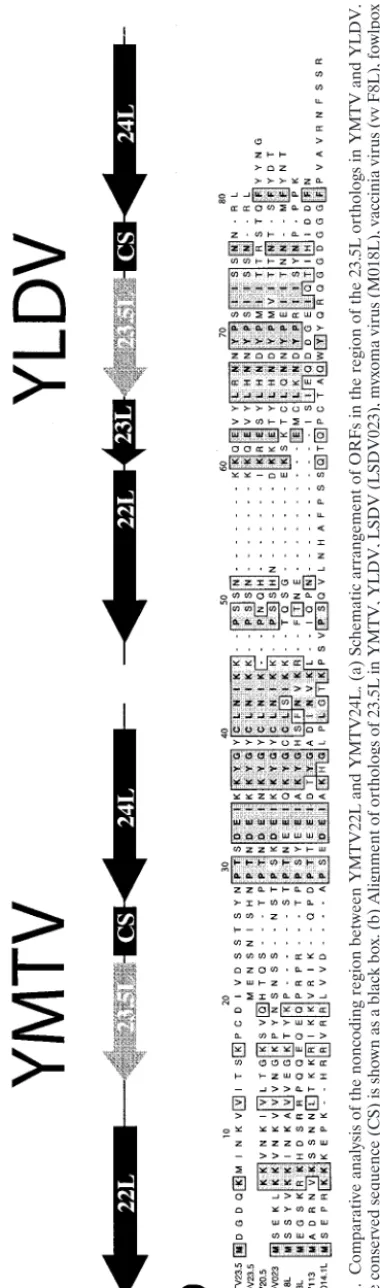
[image:6.603.171.401.69.732.2]lacking any obvious ortholog of 23L. As Table 1 illustrates, a small ORF between 22L and 24L of YMTV was identified and designated 23.5L (Table 1; Fig. 3a). Orthologs of 23.5L were previously reported in myxoma virus, LSDV, and vaccinia virus (8, 13, 29).
Since YMTV23.5L was present in a number of divergent poxvirus species, we wanted to examine whether YLDV and SPV might carry a 23.5L version in their genomes. We exam-ined the large noncoding region between YLDV23L and YLDV24L and identified a 153-bp orthologous ORF, which we have designated 23.5L in YLDV (Fig. 3a). This YLDV ORF was classified as a predicted ORF in the annotated sequence of
YLDV (accession no. AJ293568) but was not classified as an authentic ORF in the published sequence (15). Interestingly, an ortholog of YMTV23.5L was also found in SPV between positions 13229 and 13445 on the genomic sequence map (3) that had significant similarity to other versions of 23.5L (Fig. 3b). However, this potential ORF in SPV lacks a canonical start codon (ATG) (Fig. 3b), suggesting that the SPV version is either a pseudogene or a sequencing error that resulted in the insertion of an extra nucleotide between a potential up-stream start ATG codon in an alternative reading frame six codons upstream of the assigned codon for the first lysine residue.
Unusual conserved promoter-like sequence found in yata-pox, suiyata-pox, capriyata-pox, and leporipox viruses. The identifica-tion of the 212-bp gene YMTV23.5L greatly reduced the amount of assigned noncoding sequence in the region between 22L and 24L. Nevertheless, when we continued our analysis of the noncoding sequence in this region between the ORFs 23.5L and 24L in YMTV and YLDV, we noticed a striking 42-bp sequence that was 100% identical between YMTV and YLDV (Fig. 4a).
[image:7.603.44.285.88.356.2]To determine whether this sequence was conserved in other poxviruses, we examined the region between the orthologs of 23.5L and 24L in SPV (SPV020.5 and SPV021), LSDV (LSDV023 and LSDV024), myxoma virus (M018L and M019L), and vaccinia virus (F8L and F9L). Figure 4a demon-strates that this identical nucleotide sequence is found in SPV, LSDV, goatpox virus, and sheeppox virus and was 95% con-served in myxoma virus but is not present in vaccinia virus or other orthopoxviruses. The unusually high degree of sequence conservation (i.e., 100% identity between positions 2 through 41 [Fig. 4a] for YMTV, YLDV, SPV, and LSDV) suggests that the sequence may have an important and conserved function. Analysis of the sequence identified two 9-bp repeats sepa-rated by 10 bases (Fig. 4a). Since one turn of the DNA double helix is 10.4 bp, this suggests that the two repeats are registered on the same face of the DNA molecule. One possible function for this type of sequence arrangement is the binding of tran-scription factors to the DNA sequence, and indeed the se-quence does resemble a tandem repeat of a canonical poxvirus late promoter (9). To test whether the conserved sequence might function as a viral promoter element, we inserted the conserved 42-bp sequence (derived from myxoma virus) in
FIG. 2. YMTV and YLDV each contain an apparent pseudogene within the noncoding region of the termini. An alignment of the assigned SPV002 ORF (3) with a portion of the noncoding region of the YMTV and YLDV termini is shown.
TABLE 2. Immune evasion ORFs and ORFs absent from YMTV but present in YLDV
YMTV
ORF YLDVORF Putative function(s)a
2L 2L vTNF bp
3L A52R ortholog, TLR signaling inhibitor
7L 7L vCCR8
8L 4 ankyrin domains 9L Ortholog of vv M2L
10L Secreted serpin, myxoma virus SERP-1 ortholog 12L 12L eIF2␣mimic
14L 14L vIL-18 bp 15L EGF domain
16L 16L Inhibition of apoptosis, ortholog of myxoma virus M11L
18L Ortholog of myxoma virus M013L 23L Unknown
28R Unknown 34L 34L dsRNA bp
42L Ortholog of vv O1L 128L 128L CD47 mimic
130L Unknown 133L 133L 3-HSD
134R vIL-10
136R IFN-␣/binding protein
140R Ortholog of vv A54R, kelch-like protein 141R 141R Ox-2 mimic
144R 144R CD46 mimic 145R 145R CCR8 mimic
149R 149R Intracellular serpin, SPI-2 ortholog
aAbbreviations: vTNF, viral tumor necrosis factor; vCCR8, viral CCR8
or-tholog; vv, vaccinia virus; eIF2␣, eukaryotic initiation factor 2␣; vIL-18, viral
interleukin-18; EGF, epidermal growth factor; dsRNA, double-stranded RNA;
vIL-10, viral interleukin-10; IFN-␣/, alpha/beta interferon; bp, binding protein.
VOL. 77, 2003 GENOME SEQUENCE OF YABA MONKEY TUMOR VIRUS 13341
on November 8, 2019 by guest
http://jvi.asm.org/
either the forward (R-GFP) or the reverse complement (L-GFP) orientations in front of a promoterless GFP construct. Cells were either mock infected or infected with myxoma virus and then transfected with promoterless GFP, R-GFP, or L-GFP constructs. The L-L-GFP but not the R-L-GFP sequence was able to drive some detectable GFP expression in the absence of virus infection, but a myxoma virus coinfection greatly in-creased the level of expression of the L-GFP construct (Fig. 4c). From these data we conclude that the conserved sequence could act as a late promoter element for the gene 23.5L; however, other potential functions such as an involvement in viral replication or packaging cannot be excluded. The reason for the unusual conservation of this promoter sequence across four genera of poxviruses remains to be determined.
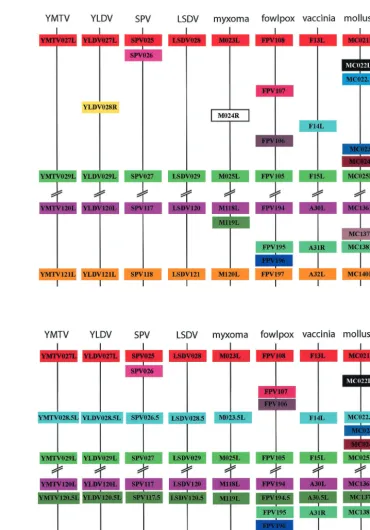
Identification of two new conserved poxvirus gene families. The central region of the poxvirus genome is inevitably en-riched for genes that are highly conserved among all poxvi-ruses. In YMTV, this conserved region maps between YMTV24L and YMTV124R. However, inspection of the genomic sequences from a number of poxviruses revealed that the region between YMTV ORFs 27L and 29L and between ORFs 120L and 121L were unexpectedly divergent (Fig. 5a). Analysis of the region between YMTV27L and YMTV29L identified an ORF, designated 28.5L, which encodes a 58-amino-acid protein (Table 1). Initially we examined the region between 27L and 29L in YLDV, where the previously assigned 28R gene is present. Analysis of the YLDV sequence revealed a clear ortholog of 28.5L (Fig. 6a) which overlaps extensively with 28R. Based on the fact that there are no other reported poxvirus versions of YLDV 28R in the database and there is typically only minor overlap of poxvirus ORFs with each other, we postulate that 28.5L represents the true yatapox virus ORF that maps between 27L and 29L for both YMTV and YLDV and that the slightly longer 28R encoded in the opposite po-larity originally annotated for YLDV might not be expressed. Since 28.5L appeared to be present in both sequenced mem-bers of theYatapoxvirusgenus, we examined members of other poxvirus genera to determine if orthologs of this gene could be identified. We examined the noncoding sequence between the orthologs of 27L and 29L in myxoma virus, SPV, LSDV, vac-cinia virus, molluscum contagiosum virus, and fowlpox virus to determine if a previously unreported version of 28.5L existed in these genomes. Surprisingly, we found closely related or-thologs of 28.5L in all poxvirus species examined, with the exception of fowlpox virus (Fig. 5b and 6b). Interestingly, the deduced ortholog of 23.5L in myxoma virus overlaps exten-sively with M024R (which bears no similarity with YLDV 28R [Fig. 6a]). This conservation of 23.5L in so many poxvirus genera and the lack of any other orthologs for M024R has led us to conclude that M23.5L, rather than the annotated M024R (8), may be the correct ORF that maps between M023L and M025L.
We next examined the 199-bp noncoding region between YMTV ORFs 120L and 121L. A single 44-amino-acid ORF designated YMTV120.5L was identified which lacked se-quence similarity to any gene in the published database. There-fore, as in the case of the gap between 27L and 29L of YMTV, we examined the sequence gap between YMTV120L and YMTV121L (Fig. 5a) and looked for other poxvirus ORFs in this conserved region. This approach yielded clear orthologs of
FIG. 3. Comparative analysis of the noncoding region between YMTV22L and YMTV24L. (a) Schematic arrangement of ORFs in the region of the 23.5L ortholo gs in YMTV and YLDV. A 42-base conserved sequence (CS) is shown as a black box. (b) Alignment of orthologs of 23.5L in YMTV, YLDV, LSDV (LSDV023), myxoma virus (M018L), vacc inia virus (vv F8L), fowlpox (FPV113), and molluscum contagiosum virus (MC014.1L). The SPV (SPV20.5) sequence is also shown, although it lacks a start codon in the published sequence (3).
13342 BRUNETTI ET AL. J. VIROL.
on November 8, 2019 by guest
http://jvi.asm.org/
[image:8.603.71.261.70.714.2]YMTV120.5L in all poxvirus species examined (Fig. 5b and 6c). Interestingly, versions of YMTV120.5L were previously identified in myxoma virus and molluscum contagiosum virus, although originally no relationship was reported between
[image:9.603.78.507.69.580.2]them, presumably because the small gene size made determi-nation of significant identity difficult. However, the position of the conserved ORF in the genomes, the sequence similarities, and the similar gene sizes all indicate that these ORFs are part FIG. 4. Analysis of the conserved promoter-like sequence between YMTV23.5L and YMTV24L. (a) Alignment of a conserved sequence found between orthologs of YMTV23.5L and YMTV24L. The sequence within the red boxes labeled “A” and “B” represents the 9-bp repeat. The numbers above the grey box indicate the nucleotide positions. (b) Schematic of the orientation of the promoterless GFP with respect to the orientation of the cloned myxoma virus conserved sequence. R-GFP contains the conserved sequence from bases 2 to 41. L-GFP contains the reverse complement of the conserved sequence. The red boxes show the location of the two repeats in panel a. (c) Cells were either mock infected or infected with myxoma virus and subsequently transfected with either a promoterless GFP, R-GFP, or L-GFP construct. Forty-eight hours postinfection, the cells were visualized using a fluorescence microscope.
VOL. 77, 2003 GENOME SEQUENCE OF YABA MONKEY TUMOR VIRUS 13343
on November 8, 2019 by guest
http://jvi.asm.org/
FIG. 5. Alignment of two conserved ORF clusters in a variety of poxvirus genera. (a) Alignment of predicted ORFs from representative members from seven of the eight poxvirus genera. Two regions of the genome are shown, the orthologous region between YMTV027L and YMTV029L and the region between YMTV120L and YMTV121L. Orthologous ORFs share the same color. (b) Analysis of the region between YMTV027L/029L and YMTV120L/121L revealed two new conserved gene families. The proposed arrangements of these ORFs are shown, highlighting the arrangement of the two new gene families YMTV028.5L and YMTV120.5L.
13344 BRUNETTI ET AL. J. VIROL.
on November 8, 2019 by guest
http://jvi.asm.org/
of an ancestrally evolved gene cluster that is conserved across multiple poxvirus genera.
DISCUSSION
In this work we report the complete sequence of the YMTV genome and have identified three ORFs previously unidenti-fied in most poxviruses. The YMTV genome size of 134,721 bases represents the smallest poxvirus genome yet sequenced. In contrast, the closely related YLDV genome is approxi-mately 144,575 bases long (15). The difference in genome sizes between YMTV and YLDV is due to the complete deletion of 13 ORFs found in YLDV but absent from YMTV. The bulk of the YMTV deleted ORFs are found at the left end of the genome and represent determinants of immune evasion, host range, or genes of unknown function (Table 2). Clinically, YMTV and YLDV produce distinct diseases, with YMTV producing histiocyte-filled tumors upon infection, whereas YLDV infection resembles a mild form of smallpox (5, 20, 27). It is possible that the absence of various YLDV gene products might, in some way, contribute to the tumorigenic phenotype
produced upon YMTV infection, but the contribution of these 13 deleted genes to disease phenotype awaits further study.
[image:11.603.58.537.83.431.2]The data presented here highlight the utility of using a comparative genomic approach when analyzing viral genomes for predicted genes. One of the difficulties in whether to assign a nucleotide sequence as an annotated ORF, particularly for small ORFs of less than 150 nucleotides, is that there is no way to confirm that a predicted ORF is actually expressed until the translated protein or mRNA is detected experimentally. How-ever, we reasoned that if a putative ORF actually encodes a protein, it would be conserved in at least some other poxvirus genus members. Therefore, we examined the tentatively as-signed noncoding regions between ORFs in poxvirus genomic sequences to identify yatapoxvirus ORFs with demonstrable similarity in terms of size, sequence, and presence of contigu-ous orthologs. This approach identified three new yatapoxvirus gene families (23.5L, 28.5L, and 120.5L) that are clearly con-served throughout many genera of poxviruses (Table 3). These three gene families all appear to encode unique proteins with no significant similarity with any other viral or cellular proteins FIG. 6. Alignments of the predicted YMTV28.5L and YMTV120.5L protein families. (a) Arrangement of YMTV 28.5L orthologs in YMTV, YLDV, and myxoma virus. (b) Alignment of orthologs of YMTV28.5L, including YLDV28.5L, LSDV (LSDV28.5), myxoma virus (M023.5L), vaccinia virus (vvF14L), SPV (SPV26.5), and molluscum contagiosum virus (MC022.1L). (c) Alignment of orthologs of YMTV120.5L, including YLDV120.5L, LSDV (LSDV120.5), myxoma virus (M119L), vaccinia virus (vvA30.5L), swinepox virus (SPV117.5), fowlpox virus (FPV194.5L), and molluscum contagiosum virus (MC137L).
VOL. 77, 2003 GENOME SEQUENCE OF YABA MONKEY TUMOR VIRUS 13345
on November 8, 2019 by guest
http://jvi.asm.org/
in the sequence database, but which are clearly conserved in most of the known poxvirus genera. With the renewed interest in variola virus, the causative agent of smallpox, it is particu-larly relevant to identify new families of conserved viral genes that may have important conserved roles in poxvirus replica-tion or pathogenesis.
An unexpected finding from these observations was that several small ORFs that turned out to be members of con-served poxvirus gene families were originally characterized as unique. For example, fowlpox virus gene FPV113 (2) and mol-luscum contagiosum virus gene MC014.1L (23) were identified as unique genes, but our comparative analysis demonstrated that they are instead part of a larger poxvirus gene family that includes the vaccinia virus F8L gene. The reason that FPV113 and MC014.1L were not identified as being related to vaccinia virus F8L was likely that it is difficult to reach a level of statistical significance with computer database searches when the raw similarity score is reduced because of their small sizes. Comparing genomic sequences from different poxviruses in this fashion can provide insight into the evolutionary history of these viruses. For example, comparing the presumptive non-coding regions of both YLDV and YMTV with the same re-gion of SPV revealed a potential pseudogene in YLDV and YMTV that had significant sequence similarity with the SPV002 gene. The presence of the same pseudogene in both YMTV and YLDV but of a functional copy of the gene in SPV implies that the pseudogene arose after the split of the suipox viruses from the yatapox viruses. In this way, we can develop an evolutionary timeline for some of the major events that differ-entiated members of the diverse poxvirus genera.
In addition to the identification of potential ORFs, the comparative genomic approach resulted in the unexpected identification of a 40-nucleotide stretch of YMTV sequence
that was 100% conserved across members of the Yatapoxvi-rus,Suipoxvirus, andCapripoxvirusgenera. This domain rep-resents the most highly conserved sequence yet described among these poxviruses. Even the highly conserved concate-mer resolution sequence, which is involved in the essential elements of poxvirus replication at the termini, is only 81% conserved between these species. This conserved sequence maps in the noncoding region between YMTV ORFs 23.5L and 24L. Although we demonstrated that this sequence can function as a late promoter element (Fig. 4), it is not yet clear if that is the actual function of this sequence during a viral infection. For example, the poxvirus concatemer reso-lution sequence can function as a poxvirus late promoter element (TAAAT) sequence (28); however, its primary role appears to be in resolving concatemers during viral replica-tion (19). One way to test the potential funcreplica-tion of this conserved promoter-like sequence would be to generate vi-rus deletion mutants in any one of the vivi-rus members that contain a copy of the sequence.
[image:12.603.43.556.80.324.2]The data presented here have illustrated some of the potential applications of taking a comparative approach to analyze poxvirus genomics. Through the comparison of pox-virus genomes across genera we identified three new gene families that had previously been overlooked because of their small size. In addition, conserved sequences that do not encode an ORF but that potentially play an important role in poxvirus replication were also identified. The com-parative genomic analysis that we undertook was originally made possible due to the sequencing of the YMTV genome and the ability to compare its sequence to that of another relatively close species, YLDV (15). However, in theory, the comparative approach that we took could be applied to any viral family and may be particularly valuable when trying to TABLE 3. Members of three new poxvirus gene families
Virus YMTV23.5 family YMTV28.5 family YMTV120.5 family
Gene Start Stop Gene Start Stop Gene Start Stop
YMTV 23.5L 14742 14530 28.5L 20085 19909 120.5L 107287 107421
YLDV 23.5L 17960 17808 28.5L 23539 23366 120.5L 113015 112881
SPV 20.5 13430 13229 26.5 20113 19949 117.5 110742 110617
LSDV 023 15949 15734 28.5 22161 22012 120.5 112519 112394
Goatpox virus strain G20-LKV 023 15430 15211 28.5 21620 21470 120.5 111927 111807
Sheeppox virus 023 15557 15342 28.5 21685 21536 120.5 112134 112009
Myxoma virus 018L 18513 18316 23.5L 23834 23703 119L 114993 114844
Shope fibroma virus 018L 17726 17526 23.5L 23037 22906 119L 114122 114003
Vaccinia virus
Ankara 037L 30731 30534 044L 37105 36884 141.5L 133014 132889
Tian Tan TF8L 35166 35318 TF14L 41537 41758 TA30.5L 141666 141540
Copenhagen F8L 38878 38684 F14L 45318 45100 A30.5L 141046 140918
WR VACWR047 35577 35774 VACWR053 41967 42188 VACWR153.5 142061 141933
Variola virus
Garcia E8L 27400 27579 E14L 33818 34039 A34.5L 133824 133696
Bangladesh 1975 C12L 27031 27228 C18L 33457 33678 A33.5L 133432 133313
India 1967 E8L 27597 27400 E14L 34039 33818 A33.5L 132818 132690
Ectromelia virus EVM031 44331 44528 EVM037 50749 50964 132.5 150491 150363
Camelpox virus CMLV043 38437 38634 CMLV049 44853 45074 CMLV170.5 144313 144185
Monkeypox virus C14L 36022 35828 C20L 42461 42240 A31.5L 141603 141484
Cowpox virus CPXV055 52234 52431 CPXV062 58648 58869 CPVX165.5 159066 158938
Fowlpox virus 113 134861 135058 194.5L 227787 227667
Molluscum contagiosum virus 014.1L 18646 18897 MC22.1L 28628 28807 137L 158648 158812
13346 BRUNETTI ET AL. J. VIROL.
on November 8, 2019 by guest
http://jvi.asm.org/
predict whether small potential ORFs truly encode a pro-tein.
ACKNOWLEDGMENTS
We thank Karim Essani and Koji Ishii for critical reading of the manuscript.
This work was supported by the National Cancer Institute of Canada and by Viron Therapeutics, Inc.
REFERENCES
1. Afonso, C., E. Tulman, Z. Lu, L. Zsak, N. Sandybaev, U. Kerembekova, V. Zaitsev, G. Kutish, and D. Rock.2002. The genome of camelpox virus.
Virology295:1–9.
2. Afonso, C. L., E. R. Tulman, Z. Lu, L. Zsak, G. F. Kutish, and D. L. Rock.
2000. The genome of fowlpox virus. J. Virol.74:3815–3831.
3. Afonso, C. L., E. R. Tulman, Z. Lu, L. Zsak, F. A. Osario, C. Balinsky, G. F. Kutish, and D. L. Rock.2002. The genome of swinepox virus. J. Virol.
76:783–790.
4. Amano, H., Y. Ueda, and T. Miyamura.1995. Identification and
character-ization of the thymidine kinase gene of Yaba virus. J. Gen. Virol.76:1109–
1115.
5. Ambrus, J. L., E. T. Feltz, J. T. Grace, Jr., and G. Owens.1963. A
virus-induced tumor in primates. Natl. Cancer Inst. Monogr.10:447–458.
6. Antoine, G., F. Scheiflinger, F. Dorner, and F. G. Falkner.1998. The com-plete genomic sequence of the modified vaccinia Ankara strain: comparison
with other orthopoxviruses. Virology244:365–395.
7. Bearcroft, W. G. C., and M. F. Jamieson.1958. An outbreak of subcutaneous
tumours in rhesus monkeys. Nature182:195–196.
8. Cameron, C., S. Hota-Mitchell, L. Chen, J. Barrett, J.-X. Cao, C. Macaulay, D. Willer, D. Evans, and G. McFadden.1999. The complete DNA sequence
of myxoma virus. Virology264:298–318.
9. Davison, A. J., and B. Moss.1989. Structure of vaccinia virus late promoters.
J. Mol. Biol.210:771–784.
10. Downie, A. W., and C. Espana.1972. Comparison of Tanapox virus and
Yaba-like viruses causing epidemic disease in monkeys. J. Hyg.70:23–32.
11. Goebel, S. J., G. P. Johnson, M. E. Perkus, S. W. Davis, J. P. Winslow, and E. Paoletti.1990. The complete DNA sequence of vaccinia virus. Virology
179:247–266.
12. Grace, T. T. J., and E. A. Mirand.1963. Human susceptibility to a simian
tumor virus. Ann. N. Y. Acad. Sci.108:1123–1128.
13. Johnson, G. P., S. J. Goebel, and E. Paoletti.1993. An update on the vaccinia
virus genome. Virology196:381–401.
14. Knight, J. C., F. J. Novembre, D. R. Brown, C. S. Goldsmith, and J. J. Esposito.1989. Studies on Tanapox virus. Virology172:116–124. 15. Lee, H.-J., K. Essani, and G. L. Smith.2001. The genome sequence of
Yaba-like disease virus, a Yatapoxvirus. Virology281:170–192.
16. Massung, R. F., L. I. Liu, J. Qi, J. C. Knight, T. E. Yuran, A. R. Kerlavage, J. M. Parsons, J. C. Venter, and J. J. Esposito.1994. Analysis of the com-plete genome of smallpox variola major virus strain Bangladesh-1975.
Vi-rology201:215–240.
17. McNulty, W. P., W. C. Lobitz, F. Hu, C. A. Maruffo, and A. S. Hall.1968. A pox disease in monkeys transmitted to man. Clinical and histological
fea-tures. Arch. Dermatol.97:286–293.
18. Merchlinsky, M., and B. Moss.1989. Nucleotide sequence required for
resolution of the concatemer junction of vaccinia virus DNA. J. Virol.63:
4354–4361.
19. Moss, B.2001.Poxviridae: the viruses and their replication, p. 2849–2883.In
D. M. Knipe and P. M. Howley (ed.), Fields virology, 4th ed., vol. 2. Lip-pincott Williams & Wilkins, Philadelphia, Pa.
20. Niven, J. S. F., J. A. Armstrong, C. H. Andrews, H. G. Pereira, and R. C. Valentine.1961. Subcutaneous ‘growths’ in monkeys produced by a poxvirus.
J. Pathol. Bacteriol.81:1–14.
21. Sanger, F., S. Nicklen, and A. R. Coulson.1977. DNA sequencing with
chain-terminating inhibitors. Proc. Natl. Acad. Sci. USA93:5463–5467.
22. Seet, B. T., J. B. Johnston, C. R. Brunetti, J. W. Barrett, H. Everett, C. Cameron, J. Sypula, S. Nazarian, A. Lucas, and G. McFadden.2003.
Pox-viruses and immune evasion. Annu. Rev. Immunol.21:377–423.
23. Senkevich, T. G., E. V. Koonin, J. J. Bugert, G. Darai, and B. Moss.1997. The genome of molluscum contagiosum virus: analysis and comparison with
other poxviruses. Virology233:19–42.
24. Shchelkunov, S. N., R. F. Massung, and J. J. Esposito.1995. Comparison of the genome DNA sequences of Bangladesh-1975 and India-1967 variola
viruses. Virus Res.36:107–118.
25. Shchelkunov, S. N., A. V. Totmenin, V. N. Loparev, P. F. Safronov, V. V. Gutorov, V. E. Chizhikov, J. C. Knight, J. M. Parsons, R. F. Massung, and J. J. Esposito.2000. Alastrim smallpox variola minor virus genome DNA
sequences. Virology266:361–386.
26. Shchelkunov, S. N., A. V. Totmenin, P. F. Safronov, M. V. Mikheev, V. V. Gutorov, O. I. Ryazankina, N. A. Petrov, I. V. Babkin, E. A. Uvarova, L. S. Sandakhchiev, J. R. Sisler, J. J. Esposito, I. K. Damon, P. B. Jahrling, and B. Moss.2002. Analysis of the monkeypox virus genome. Virology297:172–194. 27. Sproul, E. E., R. S. Metzgar, and J. T. J. Grace.1963. The pathogenesis of
Yaba virus-induced histiocytomas in primates. Cancer Res.23:671–675.
28. Stuart, D., K. Graham, M. Schreiber, C. Macaulay, and G. McFadden.1991. The target DNA sequence for resolution of poxvirus replicative
intermedi-ates is an active late promoter. J. Virol.65:61–70.
29. Tulman, E. R., C. L. Afonso, Z. Lu, L. Zsak, G. F. Kutish, and D. L. Rock.
2001. Genome of lumpy skin disease virus. J. Virol.75:7122–7130.
30. Tulman, E. R., C. L. Afonso, Z. Lu, L. Zsak, J.-H. Sur, N. T. Sandybaev, U. Z. Kerembekova, V. L. Zaitsev, G. F. Kutish, and D. L. Rock.2002. The
genomes of sheeppox and goatpox viruses. J. Virol.76:6054–6061.
31. Willer, D., G. McFadden, and D. H. Evans.1999. The complete genome
sequence of Shope (rabbit) fibroma virus. Virology264:319–343.
VOL. 77, 2003 GENOME SEQUENCE OF YABA MONKEY TUMOR VIRUS 13347