
Solving High-Order Partial Differential Equations
with Indirect Radial Basis Function Networks
N. Mai-Duy
∗and R.I. Tanner
School of Aerospace, Mechanical and Mechatronic Engineering,
The University of Sydney, NSW 2006, Australia
Submitted to
Int. J. Numer. Meth. Engng
, 21st June 2004; revised
25 November 2004
SUMMARY
This paper reports a new numerical method based on radial basis function
net-works (RBFNs) for solving high-order partial differential equations (PDEs). The
variables and their derivatives in the governing equations are represented by
inte-grated RBFNs. The use of the integration process in constructing neural networks
allows the straightforward implementation of multiple boundary conditions and the
accurate approximation of high-order derivatives. The proposed RBFN method is
verified successfully through the solution of thin-plate bending and viscous flow
problems which are governed by biharmonic equations. For thermally driven cavity
flows, the solutions are obtained up to a high Rayleigh number of 107.
KEY WORDS: radial basis functions; approximation; multiple boundary conditions;
1
INTRODUCTION
Neural networks have found application in many disciplines: neurosciences,
math-ematics, statistics, physics, computer science and engineering [1]. The concept of
using radial basis function networks (RBFNs) to solve partial differential equations
(PDEs) was introduced by Kansa in 1990 [2]. Since then it has received much
atten-tion from the science and engineering communities. The construcatten-tion of networks
can be based on a differentiation process (the direct RBFN approach - DRBFNs) [2]
or based on an integration process (the indirect RBFN approach - IRBFNs) [3]. For
a typical RBFN-based numerical method, each dependent variable and its
deriva-tives are represented by DRBFNs/IRBFNs. The governing differential equations
together with boundary conditions are then discretized by point collocation. Most
RBF publications were concerned with the solution of second-order PDEs, e.g.,
[4-9]. Recently, the IRBFN method has been developed for the solution of high-order
ordinary differential equations (ODEs) without prior conversions into the
equiva-lent systems of first-order ODEs [10]. In this paper, the unsymmetric indirect RBF
collocation method is extended to solve high-order PDEs directly.
Consider problems governed by multi-harmonic equations, such as thin-plate
bend-ing and Stokes flow problems involvbend-ing biharmonic equations. To solve these
prob-lems, new variables are usually introduced in order to transform the multi-harmonic
equations into the coupled sets of harmonic equations from which the conventional
low-order methods of discretization such as the boundary element methods (BEMs),
finite difference methods (FDMs) or finite element methods (FEMs) can be applied
for obtaining a numerical solution. However, the drawbacks of this transformation
are that it produces large system matrices as well as one usually needs to derive
the computational boundary conditions for new variables. All of these difficulties
multi-harmonic equations directly. In addition, the high-order methods are known
to have the capability to achieve accurate results using relatively low numbers of
degrees of freedom (DOF) or to allow the savings in computational effort and virtual
storage for a given accuracy [11].
In solving high-order PDEs in a direct manner, special attention needs to be paid
to the two important issues, namely the implementation of multiple boundary
con-ditions and the approximation of high-order derivatives. To properly implement
the multiple boundary conditions, there are a number of techniques available in
the literature, e.g., the δ-technique [12], the modified weighting matrix approach
[13], the approach of directly substituting the boundary conditions into the discrete
governing equations [14], the general approach [15] and the generalized differential
quadrature rule (GDQR) technique [16]. The basic ideas of these techniques are to
try adding “extra boundary points” to the original set of data points so that each
boundary point has only one condition (the δ-technique), reducing the number of
data points used for discretizing the governing equations in an appropriate
man-ner (the direct substitution technique) and employing the same number of unknown
variables as that of the conditions at a point (the GDQR technique), in order to form
a square system matrix. More detailed discussions can be found in [16,17]. In the
context of the numerical solution of differential equations, high-order derivatives are
undesirable in general because they can introduce large approximation error. The
use of higher-order conventional Lagrange polynomials does not guarantee to yield
a better quality (smoothness) of approximation [18].
The two important issues mentioned above can be treated effectively here by using
integrated RBFNs. In the present unsymmetric indirect RBF collocation approach,
the construction of neural networks representing the variable and its derivatives is
based on integration. The governing equations and boundary conditions are
to the presence of integration constants is brought into balance with the increase
of rows due to the discretization of multiple boundary conditions, and hence it can
lead to a square system matrix whatever the order of PDEs. On the other hand,
the integration process appears to be suitable for the approximation of high-order
derivatives. It can be argued as follows. Due to the lack of theory, it is very
dif-ficult to choose RBFN parameters, such as RBF widths, properly. Consequently,
some oscillation can be induced between the nodal function values when using the
RBFN interpolation scheme. This behaviour has no relation at all to that of the
true function. In practice, the oscillation has been often observed in regions near the
boundaries. It can be seen that by differentiating RBFNs, the spurious oscillations
will be strongly magnified with an increase in order of derivatives (the slope of the
curve). However, it is expected that the process of integrating RBFNs (the area
under curve) can suppress “noise”, thereby resulting in smoother approximating
derivatives.
The present unsymmetric IRBFN collocation method will be verified with the
so-lution of thin-plate bending and viscous flow problems that are governed by
bi-harmonic equations. In the simulation of natural convection flows, the resultant
matrices become much larger due to the increased number of the field variables and
the requirement of dense data densities for the simulations at high Rayleigh
num-bers. To keep the system matrix size comparable to that associated with the DRBFN
approach, the multiple spaces of IRBFN weights for each variable are converted into
the single space of nodal variable values.
The remainder of the paper is organized as follows. In section 2, RBFNs and their
two direct and indirect approaches for the approximation of a function and its
deriva-tives are reviewed. Section 3 presents IRBFNs for solving high-order PDEs without
prior conversions into the equivalent systems of low-order PDEs. In sections 4 and
problems and thermally driven cavity flows that are governed by biharmonic
equa-tions. Section 6 gives some concluding remarks. Finally, the analytic forms of new
basis functions obtained from integrating RBFs are given in the appendix.
2
RADIAL BASIS FUNCTION NETWORKS
RBFNs allow a conversion of a function from low-dimensional space (e.g., 1D-3D)
to high-dimensional space in which the function will be expressed as a linear
com-bination of RBFs [1]
y(x)≈f(x) =
m
i=1
w(i)g(i)(x), (1)
where y and f are the exact and approximate functions, respectively, superscripts
denote the elements of a set of neurons,xthe input vector, mthe number of RBFs,
{w(i)}mi=1 the set of network weights to be found, and{g(i)(x)}mi=1 the set of RBFs.
According to Micchelli’s theorem, there is a large class of radial basis functions, e.g.,
multiquadrics, inverse multiquadrics and Gaussian functions, whose design matrices
(interpolation matrices, coefficient matrices) obtained from (1) are always
invert-ible, provided that the data points are distinct. This is all that is required for the
non-singularity of the design matrix, whatever the number of data points and the
dimension of the problem [1]. On the other hand, the Cover’s theorem, which can
be stated as follow “the higher the dimension of hidden space, the more accurate the
approximation will be” [1], indicates the property of “mesh convergence” of RBFNs.
Furthermore, it has been proved that RBFNs are capable of representing any
contin-uous function to a prescribed degree of accuracy (universal approximation theorem)
[19]. These important theorems can be seen to provide the theoretical basis for the
Since multiquadrics (MQ) are ranked as the most accurate among RBFs [20] and
possess exponential convergence with the refinement of spatial discretization [21,22],
this study will employ these basis functions whose form is
g(i)(x) =
(x−c(i))T(x−c(i)) +a(i)2, (2)
wherec(i)anda(i)are the centre and width of theith MQ basis function, respectively, and superscript T denotes the transpose of a vector. To make the training process
simple, the centres and widths of RBFs are chosen in advance. For the former, the
set of centres is chosen to be the same as the set of collocation points, while for the
latter, the following relation is used
a(i) =βd(i), (3)
whereβ is a positive scalar, andd(i)is the minimum of distances from theith center to its neighbours. Relation (3) allows the RBF widtha to be broader in the area of
lower data densities and narrower in the area of higher data densities. The network
weights are then found by minimizing the sum of squares of the difference between
actual and required outputs.
2.1
Direct approach
In the direct RBFN (DRBFN) approach, the RBFN (1) is utilized to represent the
(1) as
y(x) ≈ f(x) =
m
i=1
w(i)g(i)(x), (4)
∂yk(x)
∂xkj ≈
∂kf(x)
∂xkj =
∂kmi=1w(i)g(i)(x)
∂xkj =
m
i=1
w(i)h[[kx](i)
j] (x), (5)
where subscripts j denote the scalar components of a vector, and
h[[kx](i)
j] (x)
m
i=1 = ∂
kg(i)(x)/∂xk j
m
i=1 the set of newly derived basis functions in the
approximation of the kth-order derivative of a function y with respect to the xj
variable.
2.2
Indirect approach
In the indirect (IRBFN) approach, RBFNs (1) are used to represent the
highest-order derivatives of a function y, e.g., ∂ky/∂xkj. Lower-order derivatives and the
function itself are then obtained by integrating those RBFNs as
∂ky(x)
∂xkj ≈
∂kf(x)
∂xkj =
m
i=1
w([xi)
j]g
(i)(x), (6)
∂k−1y(x)
∂xkj−1 ≈
∂k−1f(x)
∂xkj−1 =
m+q1
i=1
w([xi)
j]H
[k−1](i)
[xj] (x), (7)
· · · ·
y(x) ≈ f[xj](x) =
m+qk i=1
w([xi)
j]H
[0](i)
[xj] (x), (8)
where subscripts [xj] denote the quantities associated with the process of integration
in thexj direction; q1,· · · , qk the numbers of nodal constants arising from the inte-gration process (inteinte-gration constants are directly captured here) (q2 = 2q1,· · · , qk =
kq1); and
H[[xk−1](i)
j] =
g(i)dxj, H[[xk−2](i)
j] =
H[k−1](i)dxj,· · · , H[[0](x i)
j] =
(k −2)th-order derivative, · · ·, the original function y, respectively. Note that for
convenience of notation, the integration constants (unknowns) and their associated
basis functions (known polynomials) are also denoted by the notations w(i) and
H[.](i)(x), respectively, but withi > m.
The evaluation of (6)-(8) at a set of collocation points{x(i)}ni=1 yields the following systems of equations
f[[xk]
j](x) = G(x)w[xj], (9)
f[[xk−1]
j] (x) = H
[k−1]
[xj] (x)w[xj], (10)
· · · ·
f[xj](x) = H[0][x
j](x)w[xj], (11)
where G[xj],H[[kx−1]
j] ,· · · ,H
[0]
[xj] are the network-design-matrices associated with the approximation of thekth-order derivative, (k−1)th-order derivative,· · ·, the original
function with respect to the xj variable, respectively; w[xj] = {w([xi)
j]} m+qk
i=1 the set
of network weights in the xj direction to be found; f[xj] = {f[xj](x(i))}ni=1; f[[1]x j] =
{∂f∂x(x(ji))}n
i=1; andf[[xkj]]={
∂kf(x(i))
∂xk
j }
n
i=1. For the purpose of computation, the matrices
G[xj],H[[kx−1]
j] ,· · · ,H
[1]
[xj] will be augmented using zero-submatrices so that they have the same size as the matrix H[0][x
j]. In the approximation of a function and its derivatives, the IRBFN weight vectorsw[xj] with j ={1,2,· · · } can be determined by making use of the functional networks (11).
For convenience of presentation, the following discussions are restricted to
bihar-monic boundary value problems. However, they can be extended straightforwardly
to multi-harmonic ones, and furthermore, all of the advantageous features found in
the case of biharmonic problems can be preserved. The cross derivative∂f4(x)/∂x2i∂x2j
can be computed by using the relevant network-design-matrices associated with the
theoretically, due to numerical error, it will be better to take the average of the two
equivalent representations
∂4f ∂x2i∂x2j =
1 2
∂2 ∂x2i
∂2f ∂x2j
+ ∂
2
∂x2j
∂2f ∂x2i
, (12)
or in the matrix form
f,iijj = 1
2
H[2][x i](H
[0] [xi])
−1H[2]
[xj]w[xj]+
H[2][x j](H
[0] [xj])
−1H[2] [xi]w[xi]
. (13)
Expressions off and its derivatives at point x0 in terms of network weightsw[xj] =
{w[(xi)
j]} m+q4
i=1 can be given by
f(x0) = 1
N
N
j=1
H[[0](1)x
j] (x0),· · · , H
[0](m+1)
[xj] (x0),· · · , H
[0](m+q1+1)
[xj] (x0),· · ·
w[xj]
,
(14)
∂f2(x0)
∂x2j =
H[[2](1)x
j] (x0),· · · , H
[2](m+1)
[xj] (x0),· · · , H
[2](m+q1+1)
[xj] (x0),· · ·
w[xj], (15)
∂4f(x0)
∂x4j =
g[(1)x
j](x0),· · ·,0,· · · ,0,· · ·
w[xj], (16)
∂4f(x0)
∂x2i∂x2j =
1 2(
H[[2](1)x
i] (x0),· · · , H
[2](m+1)
[xi] (x0),· · ·
(H[0][x i])
−1H[2] [xj]w[xj]
+
H[[2](1)x
j] (x0),· · · , H
[2](m+1)
[xj] (x0),· · ·
(H[0][x j])
−1H[2] [xi]w[xi]
), (17)
where N is the dimension of the problem. In (14), due to numerical errors, the
3
IRBFNs for solving high-order PDEs
Indirect RBFNs are employed to represent the solution of high-order PDEs via a
point collocation mechanism. The governing equations are solved without splitting
them into the equivalent systems of low-order PDEs. New constants arising from
the integration process are used for the treatment of multiple boundary conditions.
In constructing system/interpolation matrices, the increase of rows due to the
dis-cretization of multiple boundary conditions is brought into balance with the increase
of columns due to the presence of integration constants, and hence it can lead to a
square system of equations whatever the order of DEs.
The detailed implementation of IRBFNs for the solution of high-order ODEs was
reported previously in [10]. In present work that deals with high-order PDEs, two
versions of indirect RBFNs are employed. The first version uses the IRBFN
for-mulation directly in terms of network weights, while in the second version, the
formulation is expressed in terms of nodal variable values. The following is
con-cerned with biharmonic equations governing thin-plate problems and viscous flows.
However, the formulations can be extended to solve multi-harmonic equations in a
4
THIN-PLATE PROBLEMS
4.1
Governing equations
In this section, the deflection and free vibration of thin rectangular plates are
con-sidered. The governing equations can be written as
∇4v = F(x), (deflection) (18)
∇4v = Ω2v, (free vibration) (19)
and the boundary conditions are given by
v = 0, ∂v
∂n = 0 for a clamped edge, (20)
v = 0, ∂
2v
∂n2 = 0 for a simply supported edge, (21)
wherexis the position vector of a point in the domain of interest,vthe deflection/the
mode shape function, Ω the frequency, F the forcing term, and n the direction
normal to the edge.
4.2
IRBFN formulation
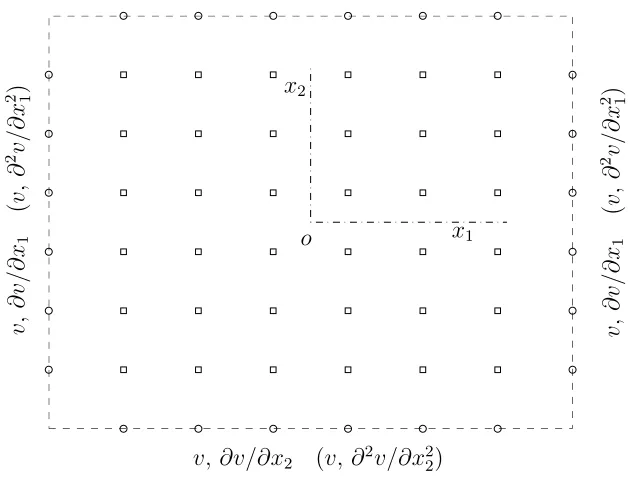
The rectangular domain of interest is discretized as shown in Figure 1. It is different
from the 1D-IRBFN analysis that there exist two RBF networks representing the
variable v here. These functional networks need to be enforced to be identical,
resulting in a constraint equation v[x1](x) = v[x2](x). The IRBFN formulation can be written as
where SSE1, SSE2 and SSE3 are the sums of squared errors which are employed to ensure that IRBFNs satisfy the governing equation, the identical
representa-tions of the original function (i.e., v[x1](x) = v[x2](x)), and the boundary condi-tions, respectively. Let nip and nbpj denote the number of interior points and
the number of boundary points on the plate edge normal to the xj direction,
re-spectively. It can be seen that the direct matrix obtained from (22) will have the
number of rows as [(nip+ 2nbp1 + 2nbp2) + (nip) + (4nbp1 + 4nbp2)] that corre-sponds to SSE1, SSE2 and SSE3, respectively, and the number of columns as [(nip + 2nbp1 + 4nbp1) + (nip+ 2nbp2 + 4nbp2)] that corresponds to the network weights in the x1- and x2- directions, respectively. Hence, the formulation (22) directly results in a square system matrix.
4.3
Numerical examples
A number of examples are presented in this section to demonstrate the effectiveness
of the present method. In all following test cases, the width of the ith RBF (a(i)) is simply chosen to be the minimum distance from the ith centre to neighbouring
centres (β = 1). The accuracy of numerical solution produced by an approximation
scheme can be measured via the norm of relative errors of the solution as follows
Ne=
n
i=1[ve(x(i))−v(x(i))]2 n
i=1ve(x(i))2
, (23)
wheren is the number of collocation points,x(i) the ith collocation point,v and ve
the calculated and exact solutions, respectively. Another important measure is the
convergence rate of the solution with the refinement of spatial discretization
in whichhis the centre spacing, andαandγ are the exponential model’s parameters.
Given a set of observations, these parameters can be found by the general linear least
squares technique.
4.3.1 Benchmark test problem
Consider a typical benchmark test problem [23] governed by the homogeneous
bi-harmonic equation (i.e.,F(x1, x2) = 0). The exact solution is given by
v = 1
2x1(sinx1coshx2−cosx1sinhx2). (25)
The rectangular domain of interest is taken to be [−2,2]×[−2,2]. Eight uniform
den-sities, namely 5×5,7×7,· · · ,19×19 data points, are employed to study convergence.
Two different types of boundary conditions, namely {v;∂v/∂n} and {v;∂2v/∂n2}, are considered (Figure 1). All boundary data are nonzero.
Boundary conditions given in terms of v and ∂v/∂n
Figure 2 shows that the present method yields high accuracy and high rates of
convergence. The obtained solutions converge apparently asO(h5.3) andO(h4.6) for
v and its Laplacian u (u = ∇2v), respectively, where h is the centre spacing. At the highest density of 19×19 data points, the error norms are 5.8×10⁻⁷ forv and 4.8×10⁻⁵ for u.
Boundary conditions given in terms of v and ∂2v/∂n2
Similarly, accurate results and high rates of convergence are obtained for this type
of boundary conditions (Figure 3). The convergence rates are ofO(h5.0) andO(h4.3) for v and u, respectively, where h is the centre spacing. At the finest density of
4.3.2 Thin-plate bending problems
Simply supported thin rectangular plates under sinusoidal load
A functionF(x1, x2) on the right hand side of (18) is given by
F(x1, x2) = q0
Dsin πx1
a sin πx2
b , (26)
where q0 represents the intensity of the load at the centre of a plate, a and b the lengths of the plate edges, and D = Eh3/12(1−ν2) the flexural rigidity in which
E the modulus of elasticity, ν Poisson’s ratio, and h the thickness of a plate. The
bending moments in the x1- and x2- directions are given by
Mx = −D
∂2v ∂x21 +ν
∂2v ∂x22
, (27)
My = −D
∂2v ∂x22 +ν
∂2v ∂x21
. (28)
Analytical solutions can be found in [24]. The following parameters are used
a =b = 200cm, h= 10cm, ν= 0.3, E = 2.1×10⁶kg/cm2 andq0 = 0.5kg/cm2.
Three uniform discretizations of 4×4, 6×6 and 8×8 are employed. With relatively
low numbers of DOF, very accurate results are obtained. For example, at the highest
density of 8×8, error-norms are 1.2×10⁻⁶ and 5.8×10⁻⁵ for the deflection and bending moments, respectively. Convergence with spatial refinement is very fast,
e.g., up toO(h10.1) forv and O(h9.3) for Mx and My.
Clamped thin rectangular plates under a uniform load
results of deflection at the centre and bending moment at (x= a/2, y = 0) for the
ratio b/a varying from 1.0 to 2.0 with an increment of 0.1 are shown in Table 1
together with the analytical results. With only coarse data density of 11×11, the
computed results agree well with the analytical results [24].
4.3.3 Plate vibration problems
To further verify the present unsymmetric IRBFN collocation method, the free
vi-bration of simply supported plates is considered here. The IRBFN discretization of
(19) results in the following system of algebraic equations for the unknown vector
of network weights
Aw = Ω2Bw, (29)
Cw = 0, (30)
whereAand Bare the matrices obtained from discretizing the governing equations,
andCthe matrix obtained from two sources, namely the discretization of boundary
conditions and the condition of unity for two functional networks associated with
thex1- and x2- directions (v[x1](x) = v[x2](x)). To obtain natural frequencies Ωi, the system (29)-(30) needs to be modified as follows
[A1,A2]{w1;w2} = Ω2[B1,B2]{w1;w2}, (31)
[C1,C2]{w1;w2} = 0, (32)
By solving (32), the subsetw2 will be expressed as
Substitution of (33) into (31) yields
A1−A2C2−1C1w1 = Ω2B1−B2C2−1C1w1 (34)
from which the natural frequencies can be found by using the QZ algorithm. The
subsetw2 contains the network weights associated with the interior points and the
integration constants.
Consider a simply supported square plate of a unit size. Three discretizations of
7×7, 9 ×9 and 11 ×11 data points are employed. The results of the natural
frequency for the first five modes are tabulated in Table 2. The solutions obtained
by the differential quadrature method [17] and by the Rayleigh-Ritz method [25] are
also included for comparison. All results are in good agreement. It is found that
using a low density of 7×7 is able to yield accurate results, where the maximum
error relative to the the Rayleigh-Ritz solutions is 0.4%.
5
NATURAL CONVECTION FLOWS
Heat transfer by natural convection in an enclosed cavity has received a great deal of
attention in recent years due to its wide applications in engineering. This problem
is known to provide a good means of testing and validating numerical methods.
5.1
Governing equations
Consider the two-dimensional, steady-state, laminar, buoyancy-induced flow of an
incompressible fluid of densityρand viscosityμ. With the employment of Boussinesq
generation of buoyant force, the dimensionless governing equations in terms of a
stream functionφ and a temperature T can be written as
∇4φ− ∂T
∂x1 = Ra P r ∂φ ∂x2
∂3φ ∂x31 +
∂3φ ∂x1∂x22
− ∂φ
∂x1
∂3φ ∂x21∂x2 +
∂3φ ∂x32
, (35)
∇2T = Ra∂φ
∂x2 ∂T ∂x1 −
∂φ ∂x1 ∂T ∂x2 . (36)
The independent dimensionless parameters appearing in the equations (35)-(36) are
the Rayleigh number (Ra) and the Prandtl number (P r). More details can be found
in [26].
The domain of interest here is a square cavity of a unit size. Non-slip boundary
conditions (φ = 0, ∂φ/∂n = 0) are applied along all the walls. The left and right
vertical walls are kept at temperatures 1 and 0, respectively, while the horizontal
walls are insulated (∂T /∂n= 0). The thermally driven cavity flow contains no
sin-gularities which makes it more realistic than the lid driven cavity flow problem [27].
A Boussinesq fluid of the Prandtl number of 0.71 is considered. The benchmark
solutions for this problem can be found in [28] for 103 ≤ Ra ≤ 106 and in [29] for
Ra ≥ 106. The former used second-order, finite central difference approximations and a Richardson extrapolation scheme, while the latter employed a pseudo-spectral
Chebyshev algorithm with increasing the spatial resolution up to a 128×128
poly-nomial expansion.
5.2
IRBFN formulation
In the simulation of natural convection flows, the obtained system matrices are much
larger due to the increased number of the field variables and the requirement of dense
data densities for the simulations at high Rayleigh numbers. To keep the system
spaces of IRBFN weights for each variable (φ and T) need to be converted into
the single space of nodal variable values. All given derivatives on the boundaries
are treated here by taking them into account in the conversion process as follows.
Consider the field variable φ. The process of converting the multiple spaces of
network weights{w[(xi)
j]} n+q4
i=1 withj ={1,2}into the single space of the nodal variable
values {φ(i)}ni=1 is based on the following sum of squared errors
n
k=1
n+q
4
i=1
H[[0](x i)
j] (x
(k))w(i)
[xj]−φ(x
(k))
2
+
2nbpj k=1
n+q
3
i=1
H[[1](x i)
j] (x
(k))w(i) [xj]−
∂φ(x(k))
∂xj
2
→0,
(37)
where n is the number of collocation points (also centres) including corner points,
nbpj the number of boundary points on the cavity edge normal to the xj direction,
and q3 and q4 the numbers of nodal integration constants. The first term is the functional network representing the variable φ over the whole domain, while the
second term represents the given Neumann boundary conditions ∂φ/∂xj along two
boundaries normal to the xj direction. After solving (37) using the general linear
least squares technique [18], the network weights will be expressed in terms of the
nodal variable values
w[xj]=C−[x1
j]φ, (38)
where C[xj] is the conversion matrix associated with the xj direction. Like the approach previously presented for thin-plate problems, the increased number of
columns due to the integration constants is offset by the increased number of rows
due to the boundary conditions in the construction of conversion matrices C[xj].
expressed as
φ(x0) = 1 2
2
j=1
H[[0](1)x
j] (x0),· · · , H
[0](m+1)
[xj] (x0),· · ·
C−[x1 j]φ
, (39)
∂φ2(x0)
∂x2j =
H[[2](1)x
j] (x0),· · · , H
[2](m+1)
[xj] (x0),· · ·
C−[x1
j]φ, (40)
∂4φ(x0)
∂x4j =
g(1)[x
j](x0),· · ·,0,· · ·
C−[x1
j]φ, (41)
∂4φ(x0)
∂x2i∂x2j =
1 2(
H[[2](1)x
i] (x0),· · · , H
[2](m+1)
[xi] (x0),· · ·
(H[0][x i])
−1H[2] [xj]C
−1 [xj]φ
+
H[[2](1)x
j] (x0),· · · , H
[2](m+1)
[xj] (x0),· · ·
(H[0][x j])
−1H[2] [xi]C
−1 [xi]φ
). (42)
Similarly, the multiple spaces of network weights {w[(xi)
j]} n+q2
i=1 with j = {1,2} for
the field variable T can be converted into the single space of nodal variable values
{T(i)}ni=1. The IRBFN representations forφandT are substituted into the governing equations (35)-(36). By discretizing the governing equations at a set of interior
points and then imposing the given Dirichlet boundary conditions, a square system
of algebraic equations will be obtained. The dimension of the system matrix is
only 2nip×2nip in which nip is the number of interior points. It can be seen that
by making use of all given derivatives on the boundaries in conversion processes,
one can produce a square system of algebraic equations whatever the order of the
governing PDEs.
In present work, the non-linearity of the resultant discretized system is handled by
using trust region methods that retain two best features: rapid local convergence
of the Newtonian iteration method and strong global convergence of the Cauchy
5.3
Numerical results
The width of theith RBF (a(i)) is simply chosen to be the minimum distance from the ith centre to neighbouring centres (β = 1). A number of uniform densities,
namely 11×11, 21×21, 31×31, 41 ×41, 51 ×51 and 57×57 data points, are
employed to study this problem for a wide range of the Rayleigh number from 103 to 107. The natural convection flow is solved as steady flow problem. In the following simulations, the initial solutions are chosen to be zero-solutions (the condition of
fluid at rest) if Ra = 103 and lower-Ra-number solutions if Ra > 103. The sizes of the system matrices obtained here are smaller than those yielded through the
case of introducing a new variable (the vorticity ω = ∇2φ). For example, with a density of 31×31 points, the present matrix size is 58×58, while it is 87×87 in
the case of using the stream function, vorticity and temperature formulation. The
dimensionless velocity in the present non-dimensional scheme is related to the one
in [28] according to
Ra(uj)present = (uj)benchmark.
Some important measures associated with this type of flow are
• Maximum horizontal velocity (u1)max on the vertical mid-plane and its loca-tion,
• Maximum vertical velocity (u2)max on the horizontal mid-plane and its loca-tion,
• The average Nusselt number throughout the cavity, which is defined as
N u =
1
0
N u(x1)dx1, (43)
N u(x1) =
1
0
(u1T − ∂T
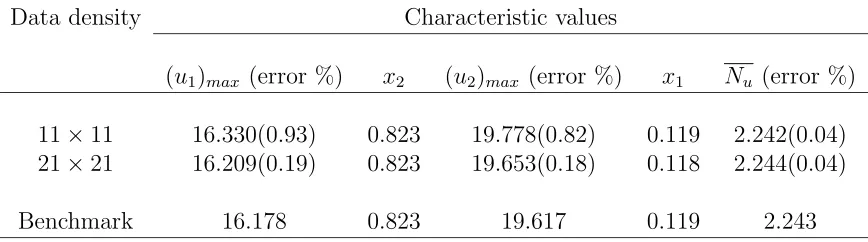
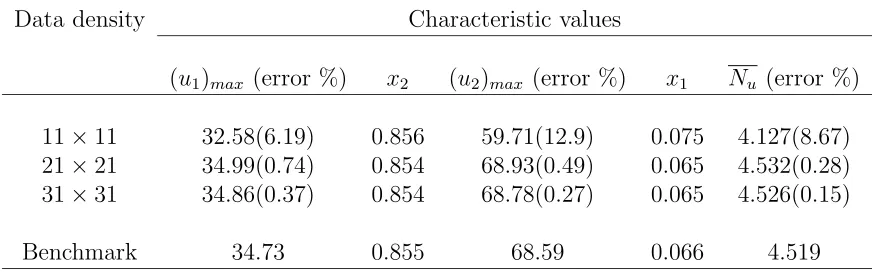
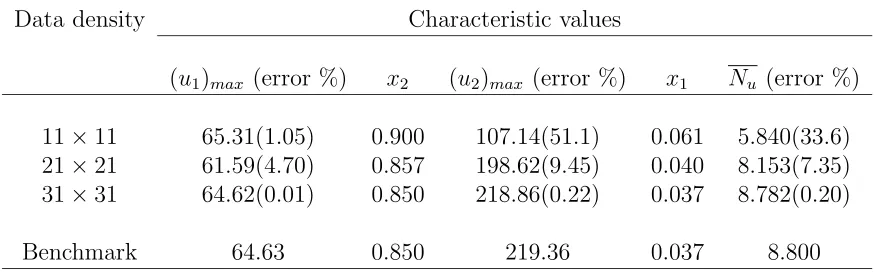
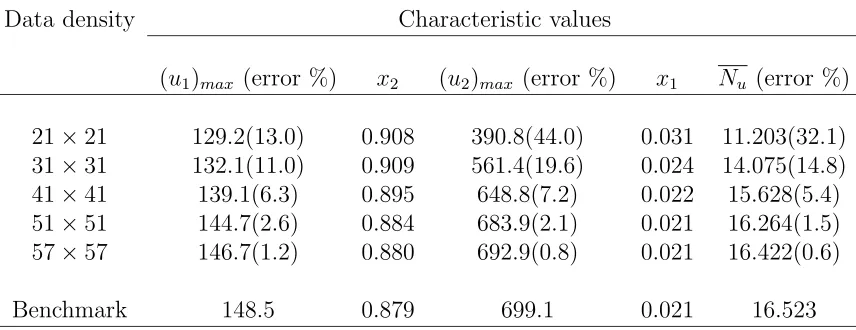
Integrals (44) and (43) are computed using Simpson rule. Results of (u1)max, (u2)max, their positions and Nu for Ra = {104,105,106,107} are displayed in Ta-bles 3-6, respectively, where finer densities are used for higher Ra values. In all
cases, the errors relative to the benchmark solutions consistently reduce with an
increase in data density, indicating “mesh convergence”.
The successful simulations of natural convection flow at Ra = 107 using relatively coarse densities (21×21,· · · ,57×57) demonstrate the effectiveness of the proposed
methods. As can be seen from Figure 4, velocity boundary layers significantly
increase in strength with an increasing Rayleigh number.
General results for flow at Ra = 107 in the form of stream function, vorticity and temperature contour plots are displayed in Figure 5. Each plot draws 21 contour
lines whose values vary uniformly from the minimum to maximum values. The
temperature, vorticity and stream function fields are skew-symmetric with regard
to the geometric centre of the cavity (centro-symmetric).
6
CONCLUDING REMARKS
Two versions of indirect RBFNs are developed for the numerical solution of
high-order PDEs. In the first version, the IRBFN formulations are written directly in
terms of network weights, while in the second version, they are expressed in terms
of nodal variable values. The first version is more straightforward to implement, but
produces much larger system matrices than the second version. The emphasis here
is placed on the advantages of using integration in constructing neural networks with
regard to the implementation of multiple boundary conditions (straightforwardly)
and the approximation of high-order derivatives (accurately). The present
thin-plate bending problems and natural convection flows which are governed by
biharmonic equations. Accurate results and high rates of convergence are achieved.
APPENDIX
The following are new basis functions obtained from integrating MQ-RBFs by using
MATHEMATICA.
H[[3](x i)
j] =
(xj−c(ji))
2 A+
C
2B, (45)
H[[2](x i)
j] =
(xj −c(ji))2
6 −
C
3
A+ C(xj−c
(i)
j )
2 B, (46)
H[[1](x i)
j] =
(xj −c(ji))3
24 −
13C(xj−c(ji)) 48
A+
C(xj−c(ji))2
4 −
C2
16
B, (47)
H[[0](x i)
j] =
C2
45 −
83C(xj−c(ji))2
720 +
(xj−c(ji))4 120
A+
4C(xj −c(ji))3
48 −
3C2(xj −c(ji)) 48
B, (48)
where
r=x−c(i), A=r2+a(i)2, B = ln
(xj −c(ji)) +r2+a(i)2
, C =r2−(xj−cj(i))2+a(i)2.
ACKNOWLEDGEMENTS
N. Mai-Duy wishes to thank the University of Sydney for a Sesqui postdoctoral
research fellowship. The computing facilities provided by the APAC National
Fa-cilities are greatly acknowledged. The authors would like to thank the referees for
their helpful comments.
1. Haykin S. Neural Networks: A Comprehensive Foundation. Prentice-Hall:
New Jersey, 1999.
2. Kansa EJ. Multiquadrics- A scattered data approximation scheme with
appli-cations to computational fluid-dynamics-II. Solutions to parabolic, hyperbolic
and elliptic partial differential equations. Computers and Mathematics with
Applications 1990; 19(8/9): 147-161.
3. Mai-Duy N, Tran-Cong T. Numerical solution of differential equations using
multiquadric radial basis function networks. Neural Networks 2001; 14(2):
185-199.
4. Sharan M, Kansa EJ, Gupta S. Application of the multiquadric method for
numerical solution of elliptic partial differential equations. Journal of Applied
Science and Computation 1997; 84: 275-302.
5. Zerroukat M, Power H, Chen CS. A numerical method for heat transfer
prob-lems using collocation and radial basis functions. International Journal for
Numerical Methods in Engineering 1998; 42: 1263-1278.
6. Mai-Duy N, Tran-Cong T. Numerical solution of Navier-Stokes equations
us-ing multiquadric radial basis function networks. International Journal for
Numerical Methods in Fluids 2001; 37: 65-86.
7. Larsson E, Fornberg B. A numerical study of some radial basis function based
solution methods for elliptic PDEs. Computers and Mathematics with
Appli-cations 2003; 46: 891-902.
8. Shu C, Ding H, Yeo KS. Local radial basis function-based differential
quadra-ture method and its application to solve two-dimensional incompressible
Navier-Stokes equations. Computer Methods in Applied Mechanics and Engineering
9. Sarler B, Perko J, Chen CS. Radial basis function collocation method solution
of natural convection in porous media. International Journal of Numerical
Methods for Heat & Fluid Flow 2004; 14(2): 187-212.
10. Mai-Duy N. Solving high order ordinary differential equations with radial basis
function networks. International Journal for Numerical Methods in
Engineer-ing 2005;62: 824-852.
11. Canuto C, Hussaini MY, Quarteroni A, Zang TA. Spectral Methods in Fluid
Dynamics. Springer-Verlag: New York, 1988.
12. Jang SK, Bert CW, Striz AG. Application of differential quadrature to static
analysis of structural components. International Journal for Numerical
Meth-ods in Engineering 1989; 28(3): 561-577.
13. Wang X, Bert CW. A new approach in applying differential quadrature to
static and free vibrational analyses of beams and plates. Journal of Sound
and Vibration 1993; 162(3): 566-572.
14. Shu C, Du H. Implementation of clamped and simply supported boundary
con-ditions in the GDQ free vibration analysis of beams and plates. International
Journal of Solids and Structures 1997; 34(7): 819-835.
15. Shu C, Du H. A generalized approach for implementing general boundary
conditions in the GDQ free vibration analysis of plates. International Journal
of Solids and Structures 1997; 34(7): 837-846.
16. Liu GR, Wu TY. Multipoint boundary value problems by differential
quadra-ture method. Mathematical and Computer Modelling 2002; 35: 215-227.
17. Shu C. Differential Quadrature and Its Application in Engineering.
18. Press WH, Flannery BP, Teukolsky SA, Vetterling WT. Numerical Recipes in
C: The Art of Scientific Computing. Cambridge University Press: Cambridge,
1988.
19. Park J, Sandberg IW. Universal approximation using radial basis function
networks. Neural Computation 1991; 3: 246-257.
20. Franke R. Scattered data interpolation: tests of some methods. Mathematics
of Computation 1982; 38(157): 181-200.
21. Madych WR, Nelson SA. Multivariate interpolation and conditionally positive
definite functions. Approximation Theory and its Applications1989; 4: 77-89.
22. Madych WR, Nelson SA. Multivariate interpolation and conditionally positive
definite functions, II. Mathematics of Computation 1990; 54(189): 211-230.
23. Zeb A, Elliott L, Ingham DB, Lesnic D. A comparison of different methods to
solve inverse biharmonic boundary value problems. International Journal for
Numerical Methods in Engineering 1999; 45: 1791-1806.
24. Timoshenko S, Woinowsky-Krieger S. Theory of Plates and Shells.
McGraw-Hill: New York, 1959.
25. Leissa AW. The free vibration of rectangular plates. Journal of Sound and
Vibration 1973; 31: 257-293.
26. Leonard BP, Drummond JE. Why you should not use ‘Hybrid’, ‘Power law’
or related exponential schemes for convective modelling-there are much better
alternatives. International Journal for Numerical Methods in Fluids1995;20:
421-442.
27. Roache PJ. Verification and Validation in Computational Science and
28. de Vahl Davis G. Natural convection of air in a square cavity: a bench mark
numerical solution. International Journal for Numerical Methods in Fluids
1983; 3: 249-264.
29. Le Quere P. Accurate solutions to the square thermally driven cavity at high
Rayleigh number. Computers & Fluids1991; 20(1): 29-41.
30. McCartin BJ. A model-trust region algorithm utilizing a quadratic interpolant.
Table 1: Clamped rectangular plates of dimension [−a/2, a/2]×[−b/2, b/2] under a uniform loadq, 11×11 data points: deflections at the centre and bending moments at (x1 = a/2, x2 = 0). The computed solutions are in good agreement with the analytical solutions [24].
v/(qa4/D)×102 Mx/(qa2)×10
b/a IRBFN analytical IRBFN analytical
1.0 0.1265 0.126 -0.5138 -0.513
1.1 0.1507 0.150 -0.5813 -0.581
1.2 0.1724 0.172 -0.6392 -0.639
1.3 0.1911 0.191 -0.6871 -0.687
1.4 0.2068 0.207 -0.7259 -0.726
1.5 0.2196 0.220 -0.7565 -0.757
1.6 0.2300 0.230 -0.7802 -0.780
1.7 0.2382 0.238 -0.7982 -0.799
1.8 0.2446 0.245 -0.8116 -0.812
1.9 0.2495 0.249 -0.8214 -0.822
Table 2: Free vibration, simply supported plate, [0,1]×[0,1]: natural frequencies. The present results agree well with those obtained by the DQ method [17] and the Rayleigh-Ritz (R-R) method [25]. By regarding the results from the R-R method as exact solutions, it can be seen that the errors (%) consistently reduce with an increase in data density.
IRBFN DQ R-R
Ω 7×7(error) 9×9(error) 11×11(error) 12×12(error)
Table 3: Natural convection flow, Ra= 104.
Data density Characteristic values
(u1)max (error %) x2 (u2)max (error %) x1 Nu (error %)
11×11 16.330(0.93) 0.823 19.778(0.82) 0.119 2.242(0.04)
21×21 16.209(0.19) 0.823 19.653(0.18) 0.118 2.244(0.04)
Table 4: Natural convection flow, Ra= 105.
Data density Characteristic values
(u1)max (error %) x2 (u2)max (error %) x1 Nu (error %)
11×11 32.58(6.19) 0.856 59.71(12.9) 0.075 4.127(8.67)
21×21 34.99(0.74) 0.854 68.93(0.49) 0.065 4.532(0.28)
31×31 34.86(0.37) 0.854 68.78(0.27) 0.065 4.526(0.15)
Table 5: Natural convection flow, Ra= 106.
Data density Characteristic values
(u1)max (error %) x2 (u2)max (error %) x1 Nu (error %)
11×11 65.31(1.05) 0.900 107.14(51.1) 0.061 5.840(33.6)
21×21 61.59(4.70) 0.857 198.62(9.45) 0.040 8.153(7.35)
31×31 64.62(0.01) 0.850 218.86(0.22) 0.037 8.782(0.20)
Table 6: Natural convection flow, Ra= 107.
Data density Characteristic values
(u1)max (error %) x2 (u2)max (error %) x1 Nu (error %)
21×21 129.2(13.0) 0.908 390.8(44.0) 0.031 11.203(32.1)
31×31 132.1(11.0) 0.909 561.4(19.6) 0.024 14.075(14.8)
41×41 139.1(6.3) 0.895 648.8(7.2) 0.022 15.628(5.4)
51×51 144.7(2.6) 0.884 683.9(2.1) 0.021 16.264(1.5)
57×57 146.7(1.2) 0.880 692.9(0.8) 0.021 16.422(0.6)
v, ∂v/∂x2 (v, ∂2v/∂x22)
v, ∂v/∂x2 (v, ∂2v/∂x22)
v
,
∂v
/
∂
x1
(
v
,
∂
2 v/
∂
x
2 1)
v
,
∂v
/
∂
x1
(
v
,
∂
2 v/
∂
x
2 1)
x1 x2
[image:34.612.139.454.48.287.2]o
10−0.6 10−0.5 10−0.4 10−0.3 10−0.2 10−0.1 100 100.1
10−7
10−6
10−5
10−4
10−3
10−2
10−1
100
v u
[image:35.612.138.455.45.301.2]Centre spacing Ne
Figure 2: Biharmonic problem, domain [−2,2]×[−2,2], boundary conditionsv and
10−0.6 10−0.5 10−0.4 10−0.3 10−0.2 10−0.1 100 100.1
10−5
10−4
10−3
10−2
10−1
100
v u
[image:36.612.138.455.43.302.2]Centre spacing Ne
Figure 3: Biharmonic problem, domain [−2,2]×[−2,2], boundary conditionsv and
−1500 −100 −50 0 50 100 150 0.1
0.2 0.3 0.4 0.5 0.6 0.7 0.8 0.9 1
Ra=107 Ra=106 Ra=105
u1
x2
0 0.1 0.2 0.3 0.4 0.5 0.6 0.7 0.8 0.9 1 −800
−600 −400 −200 0 200 400 600 800
Ra=107 Ra=106 Ra=105
x1
[image:37.612.96.504.44.237.2]u2
a) stream function
b) vorticity
[image:38.612.107.491.12.612.2]c) temperature
![Table 1: Clamped rectangular plates of dimension [−a/2, a/2] × [−b/2, b/2] under auniform load q, 11 × 11 data points: deflections at the centre and bending momentsat (x1 = a/2, x2 = 0)](https://thumb-us.123doks.com/thumbv2/123dok_us/329080.64723/28.612.169.430.114.335/table-clamped-rectangular-dimension-auniform-deections-bending-momentsat.webp)
![Table 2: Free vibration, simply supported plate, [0,The present results agree well with those obtained by the DQ method [17] and theRayleigh-Ritz (R-R) method [25]](https://thumb-us.123doks.com/thumbv2/123dok_us/329080.64723/29.612.88.515.142.275/vibration-supported-present-results-obtained-method-therayleigh-method.webp)
![Figure 2: Biharmonic problem, domain [−∂v/∂nconverge apparently as2, 2] × [−2, 2], boundary conditions v and: accurate results and high rates of convergence are achieved](https://thumb-us.123doks.com/thumbv2/123dok_us/329080.64723/35.612.138.455.45.301/biharmonic-nconverge-apparently-boundary-conditions-accurate-convergence-achieved.webp)
![Figure 3: Biharmonic problem, domain [−∂2, 2] × [−2, 2], boundary conditions v and2v/∂n2: accurate results and high rates of convergence are achieved](https://thumb-us.123doks.com/thumbv2/123dok_us/329080.64723/36.612.138.455.43.302/figure-biharmonic-problem-boundary-conditions-accurate-convergence-achieved.webp)
