A Survey of Enterprise Reforms in China:
The Way Forward
by
Martin Hovey
Department of Finance and Banking, University of Southern Queensland
and Tony Naughton
School of Economics, Finance and Marketing, RMIT University
Keywords: State-owned enterprises; Privatization; Ownership structures; Corporate governance; Emerging markets; China.
JEL classifications: P31, L33, G32, G38, O53.
Corresponding author: Martin Hovey
Department of Finance and Banking University of Southern Queensland Toowoomba Qld 4350
AUSTRALIA
A Survey of Enterprise Reforms in China:
The Way Forward
Abstract
The strategic importance of the state owned enterprise (SOE) sector to the Chinese economy cannot be underestimated, thus the success of SOE reform is a significant factor in China’s future economic prosperity. The dilemma facing state authorities is to develop market-orientated corporations while at the same time coping with potentially high unemployment and a range of equity and social justice issues. This paper presents an analysis of the current issues in SOE reform in China, drawing on relevant empirical evidence, and proposes a strategic direction and a framework for reform that challenges the recently announced program of privatization of listed SOEs. The literature indicates that state ownership is generally negatively correlated to performance. Conversely, Legal Person ownership positively influences performance. Other forms of private ownership are generally positively correlated to performance, with institutional
ownership showing significant promise. Consequently, the divesture of state ownership is recommended and could be accomplished over three or four tranches. The State could divest its ownership by auction to strategic investors, both domestic and foreign, and in the next tranche an auction to the broad populace through units in mutual funds. The final proposed tranche being a distribution to nationwide pension funds to support retirement schemes, which should be made nationwide. Finally, listed firms should also issue shares as rights issues to offer present shareholders protection from dilution.
Acknowledgement: We acknowledge with appreciation the anonymous reviewers
1. Introduction
China has experienced significant transition in recent years as it moves towards greater market freedom, and an evolving “socialist market economy”. The associated reforms have been a significant factor in the unprecedented economic growth that it has enjoyed. However, notable issues remain to be resolved in order for state owned enterprises (SOEs) to become effective free market corporations. The challenges primarily revolve around SOEs being transformed from state run socialist institutions to competitive market economy corporations. The SOE sector remains a significant part of the Chinese economy, therefore, the success of reform is important to China’s future economic prosperity, and the ability to contend with unemployment and social justice issues. The dilemma facing state authorities is to develop market-orientated corporations while at the same time coping with the possibility of high unemployment and a range of equity and social justice issues.
This paper presents an analysis of the current issues in SOE reform in China, drawing on relevant empirical evidence, and proposes a strategic direction that challenges the recently announced program of privatization of listed SOE’s.
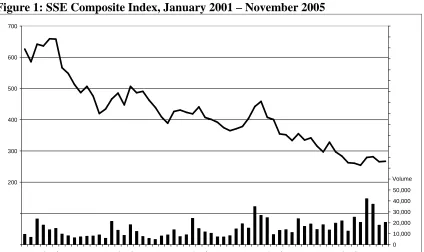
Figure 1: SSE Composite Index, January 2001 – November 2005 0 100 200 300 400 500 600 700 2001 /01 2001 /03 2001 /05 2001 /07 2001 /09 2001 /11 2002 /01 2002 /03 2002 /05 2002 /07 2002 /09 2002 /11 2003 /01 2003 /03 2003 /05 2003 /07 2003 /09 2003 /11 2004 /01 2004 /03 2004 /05 2004 /07 2004 /09 2004 /11 2005 /01 2005 /03 2005 /05 2005 /07 2005 /09 2005 /11 0 10,000 20,000 30,000 40,000 50,000 60,000 70,000 80,000 90,000 100,000 110,000 120,000 130,000 140,000 150,000 160,000 170,000 180,000 190,000 200,000 Volume
Data Source: TEJ (2005)
An analysis of IPOs and rights issues data from the Taiwan Economic Journal (TEJ) Great China Database reveals that the number of new issues reduced to a trickle in recent years. This is in stark contrast to the active program of listing of SOE’s in the 1990’s. This indicates that the state has divested just a small amount of its holdings in recent years, despite the 2001 announcement. In October 2001, the authorities
temporarily stopped the plan to reduce state holdings and it was abandoned in June 2002.
The decision facing the authorities is no doubt a complex balancing of the various agendas and aspects as to the direction that should be taken. These appear to revolve primarily around issues, such as:
• the traditional power and influence of the Party;
• social issues such as social wellbeing, unemployment and pension schemes;
• equitable distribution of state held assets;
• investment opportunities for domestic investors provided by well performing listed firms;
• the overall economic benefit that is achieved when SOEs cease being a burden on the economy.
Notwithstanding the market response and critics’ comments and objections to the 2001 sell-off attempt, the authorities in China have once again announced that they intend to reduce the holdings of the state. The Chinese market becomes nervous at the prospect of a flood of new share offerings decreasing the value (dilution) of the current listed
equity, which is buoyed by the demand created because of the limited investment choices available in China.
The Chinese Securities Regulatory Commission (CSRC) announced in April 2005 that it would once again embark on a strategy to reduce state holdings. Initially this is to be achieved by changing the status of state holdings from non-tradable to tradable. Listed firms were encouraged to prepare plans to implement this policy. These would be subject to regulatory and shareholder authorization (Economist, 2005). Previously, non-tradable shares must be held for at least one year and thereafter may only be sold at a rate of 5% per annum.
Initially four firms were given permission to convert state holdings to tradable shares. They were: Tsinghua Tongfang, Hebei Jinniu Energy Resources, Shanghai Zijiang Enterprise Group and Sany Heavy Industry. This is a cautious approach as none are large and likely to have significant impact (Economist, 2005).
The second group to be given permission later in the year is comprised of 42 firms (28 from Shanghai, and 14 from Shenzhen Stock Exchanges). This group includes some large firms and comprises around 10% of market capitalization. It includes, Baosteel, China’s biggest steel manufacturer, and Yangtze Power, a financier of the Three Georges Hydropower (Economist, 2005). By late 2005, authorities appeared satisfied with progress and indicated that the reform program was to be extended to all remaining listed firms.
2. Empirical Evidence
The findings in the literature show that ownership structure does significantly influence the performance and value of Chinese firms (Xu & Wang, 1999; Chen & Gong, 2000; Gul & Zhao, 2001; Sun, Tong, & Tong, 2002; Hovey, Li, & Naughton, 2003; Hovey, 2005b). The emphasis in these studies has been on the primary forms of state holdings, along with other ownership types in China.
2.1 State Ownership
A number of empirical studies have found state ownership per se to be negatively correlated with performance. Hovey (2005b) applied year-by-year analysis, as well as a pooled dataset of 3,835 observations, from 1997 to 2001 and found a negative
relationship of state ownership with performance. Sun and Tong (2003) studied 634 listed SOEs for the period 1994-1998 and also found that the state had a negative impact on listed firm performance. Wei and Varela (2003) and Hovey, Li and Naughton (2003) similarly found state ownership had a negative effect on firm value. Similar results were reported by Chen (2001) Gul and Zhao (2001), Gul (1999), Wei, Xie and Zhang (2005) and Xu and Wang (1999). Wang (2005), concludes that state ownership does not influence the performance of IPO firms. Is it that non-state investors choose better performing firms to invest in? The findings of the study by Hovey (2005a) suggest that this is not the case. Private sector investors have little choice as the vast majority of firms have substantial state holdings and look favorably on reductions in state involvement. Hovey (2005a), employing event study methodology, found that the market reacts favorably to changes in block ownership involving a decrease in state ownership.
2.2 Legal Person Holdings
In China, Legal Person’s (henceforth LP) are technically autonomously managed investment organizations, which are also primarily state-owned government agencies. Thus, LP holdings are autonomous domestic intuitional holdings by the state through various holding companies. LP ownership is equity held by these domestic institutions or holding firms.
LP holdings have been analyzed in a number of empirical studies and are found to have a positive influence on firm performance or value. For example, Sun and Tong (2003) found that LP ownership positively impacts on listed firm performance, as does Wong, Opper and Hu (2004). Hovey (2005b) along with Chen (2001) and Xu and Wang (1999) also found a similar positive relationship. Gul and Zhao (2001) and Gul (1999) found a stronger correlation for firms with LP dominance than for state dominance.
Moreover, Hovey (2005b) extended the study of LP ownership further and found a non-linear relationship to performance. In this study, portfolios were created based on low, medium and high levels of LP holdings. The findings suggest that LP ownership averaging between 3.8 to 32.1% of share capital provides the clearest positive relationship to firm performance. The average of this range is 15.2%. It is concluded that this may provide an approximation of the optimal level of LP holdings in China. Thus overall, these studies suggest that LP’s are the most respected shareholders by the market in China, and that relationship is non-linear. Accordingly, it appears that in the present circumstances, the market considers that LP ownership provides the necessary monitoring which results in improved performance of listed firms in China.
The basis of the argument rests on large institutional shareholders’ ability to monitor the firm and its management, and to be able to make the necessary changes whenever performance is unsatisfactory. Shareholdings at low levels may have little impact, whilst shareholdings at high levels may result in entrenchment that adversely affect firm performance, although, how this entrenchment is achieved is unclear at this point. Nonetheless, following the general principal of entrenchment, greater LP ownership increases the power of their influence and agenda, but decreases the power of the external constituency to influence corporate performance. Though LPs have a
independent institutions may monitor management more effectively than LPs at high levels of ownership, because LP institutions may lack the same level of expertise or may ally with management strategically, as LP representatives and SOE management are both effectively state employees.
On the other hand, LP representatives are not as likely to regard the political agenda a primary consideration as would direct state representatives. Thus, it can be assumed they are less politically motivated and have objectives and incentives with a greater focus on the performance of the firm. Significantly, LPs have representatives elected to the board of directors and the supervisory committee and are thus privy to inside information. In so doing, they also have greater power, proficiency and incentive to monitor and control the performance of management. Furthermore, LP appointed directors are selected more carefully, in addition to having better focused business and performance objectives (Xu & Wang, 1999; Gul & Zhao, 2001).
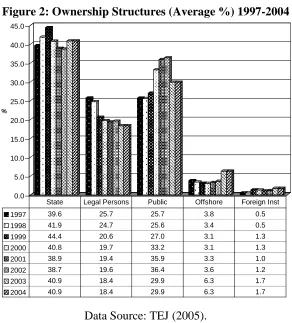
[image:8.595.152.444.416.739.2]Despite this, LP ownership is declining in China. It fell from an average of 25.7% in 1997, to 19.6% in 2002 (Figure 2), whereas direct state ownership has only fallen marginally from an average of 39.6% to 38.7%.
Figure 2: Ownership Structures (Average %) 1997-2004
0.0 5.0 10.0 15.0 20.0 25.0 30.0 35.0 40.0 45.0
%
1997 39.6 25.7 25.7 3.8 0.5
1998 41.9 24.7 25.6 3.4 0.5
1999 44.4 20.6 27.0 3.1 1.3
2000 40.8 19.7 33.2 3.1 1.3
2001 38.9 19.4 35.9 3.3 1.0
2002 38.7 19.6 36.4 3.6 1.2
2003 40.9 18.4 29.9 6.3 1.7
2004 40.9 18.4 29.9 6.3 1.7
State Legal Persons Public Offshore Foreign Inst
Data Source: TEJ (2005).
The increase has been in individual private investors, which has seen the average rise from 25.7% in 1997 to 36.4% in 2002. The findings noted above provide strong evidence that LP ownership has the propensity to enhance the performance of publicly listed firms in China. Therefore, this suggests that the decline in LP ownership should be halted and be held at its current rate for the present in order to maintain or improve the performance of publicly listed firms in China whereas direct state ownership should be substantially reduced.
2.3 Tradable A-Shares
The empirical evidence with regard to tradable A-shares, that is ordinary shares held principally by domestic individuals, provides some mixed results. However, the
majority of studies reveal that the greater the proportion of tradable A-shares, the higher the performance of the firm. This is especially so for studies using post 1997 data. Hovey (2005b) found a positive relationship between tradable A-Shares and firm
performance, though the relationship is not as strong as would be expected. On the other hand, Xu and Wang (1999) using 1993 to 1995 data did not find a positive relationship and thus suggest that private ownership should be reconsidered. However, as the data was gathered soon after the markets opened, the findings should be interpreted in the light of an immature market with supermajority state holdings (as illustrated in Figure 2 above), poor transparency (Lin, 2001), weak protection of minority shareholders (Lin, 2001) and considerable manipulation of prices (Guo, 2001; Tam, 2002). In addition, most private holdings are very small with very few being greater than one percent (see Wang, Xu, & Zhu, 2004)
tradable A-shares. Thus, the matters of concern raised above should be addressed and A-share ownership encouraged.
2.4 Offshore Ownership
Continuing the theme of individual structure, offshore ownership, as applied in this analysis, relates to B-Shares, plus cross-listings in Hong Kong, New York and other foreign exchanges (H-Shares, N-Shares and the like). The empirical analysis of Hovey (2005b) found that generally offshore ownership has a positive influence on
performance, although the results were not as compelling as might have been intuitively expected. According to theory (Merton, 1987; Coffee, 2002; Faff, Hodgson, &
Saudagaran, 2002; Lang et. al., 2003; Moffett, Stonehill, & Eiteman, 2003), it is expected that firms that cross-list on Hong Kong or New York stock exchanges, would have superior performance due to improved disclosure and monitoring, and ultimately enhanced value. However, as the empirical findings are not convincing, there remains a potential for further research to investigate why this is not the case in China.
The B-share market was opened up for trading by domestic individual investors in February 2001, providing funds used for the trade are from offshore accounts. Chiu, Lee, and Chen (2005) studied the impact of this change on the markets and find that A-share and B-A-share markets are “lead/lag markets with each other and the volatility relationship became closer after 19 February 2001” (Chiu et al. 2005, p 280). A conclusion drawn with regard to the B-share market is that the authorities should consider reviewing the market and its operation. As one of the objectives of the B-share market is to attract international capital, a more efficient and better performing market that produces good returns and reduces variability and risk, would attract more
international players. Perhaps the amalgamation of the market with the A-Share market and the opening of that market to foreign investors would provide greater benefit to the economic development of China.
2.5 Foreign Institutional Ownership
foreign institutional holders tend to monitor firms more closely, leading to improved firm performance. Accordingly, the findings support the notion that foreign institutional ownership on average leads to superior performance of publicly listed firms in China. Supporting this, conventional theory would hold that foreign institutional holders would tend to monitor firms they invest in more closely and thus performance should improve and select only these firms that have excellent records and potential (Sarkar & Sarkar, 2000; Chung, Firth, & Kim, 2002). Accordingly, the findings presented here support the notion that foreign institutional ownership on average leads to superior performance of publicly listed firms in China. It is concluded that the positive impact of foreign
institutions, LP holdings, as well as the increasing role of pension and mutual funds and domestic investors, have potential to strengthen the market. Thus, they should be encouraged in China.
China has begun to open its A-share market to large foreign institutional investors. As of December 2002, qualified foreign institutional investors (QFII) have been able to invest in the A-share market. It is aimed at substantial, established institutions. For example, foreign institutions are required to have at least $10 billion under management or be a top 100 financial institution. They are required to be fully committed to the market, thus, entry and funds repatriation conditions are restricted. A similar effective scheme, introduced in Taiwan in the early 1990s, was the model on which QFII is based (Loong, 2002).
Observers report that the introduction of QFIIs has brought greater sophistication to the market and to investment practices (Gray, 2005), including increased emphasis on fundamentals and better financial reporting (Yuen, 2006). However, it is reported that a large part of the funds is being kept in cash in the hope of gaining from favorable currency movements, rather than invested in equities (Gray, 2005). Currently, the total QFII investment quota is US$10 billion, having been raised from US$6 billion in the last quarter of 2005 (Asia Pulse, 2005). Shirai (2004), concludes that funds raised through the equity markets in China, including QFII investment, is used “for
3. The Way Forward
The findings discussed above, suggest that, in the prevailing corporate environment in China, a significant strategy shift is needed which involves moving away from wholly or substantially state-owned, and/or state-controlled enterprises. Under the policy of maintaining state ownership, it would be beneficial to the economy if the state did not have direct ownership through A-share holdings, or involvement to the extent that the political agenda influences the direction or decisions of the firm. Thus, when a firm is listed, they should be listed under the sponsorship of LPs solely. The findings strongly suggest that the ideal firm ownership structure involves medium levels of LP holdings, a percentage of foreign institutional and individual shareholdings and minimal direct state holdings. Some B-shares and crosslistings also appear to be worthwhile,
particularly in the case of large-scale internationally competitive firms. However, the present system needs to be examined to establish why B-shares and crosslisting do not appear to have such a positive impact as might be expected. For example, areas such as timely reporting and open disclosure should be addressed. Strengthening the legal system and the protection of investors should also be given priority. The supermajority holdings of the state offer little incentive to serve the interests of the minority
shareholders at all. Thus, the reduction of these supermajority state holdings will enhance minority rights and private investors will be more likely to invest in the stock market.
3.1 Which Corporate Governance Model
The corporate governance structures that presently exist in China are not generally considered an effective governance system (see Tam, 2000; Gul & Zhao, 2001). The insider-dominated system of corporate governance, and the pervasiveness of the state and party, has created a lack of truly independent directors, which has not facilitated the establishment of good corporate governance. A strong influence on the model of
corporate governance that evolves is the country’s legal system (La Porta, López de Silanes, & Shleifer, 1999). No doubt, this has had a major bearing in the direction taken by China. Currently, the system of corporate governance is a combination of the
2000; Harvie & Naughton, 2000). This is within the context of the legal system of China, which is based on a tradition of judicial process in which civil order has been the responsibility of the family, neighborhood or local government and thus differs
considerably from civil or common-law traditions. The Anglo-US, German and Japanese models of corporate governance are cited by Shleifer and Vishny (1997) as being some of the best corporate governance systems and are thus worthwhile contributors to the corporate governance system of China.
The Anglo-US model is dependent on free, transparent, open and liquid markets, which reduces the cost of capital, increases market efficiency and hence allocational efficiency (Perotti & von Thadden, 2003). The system depends on active shareholders and upon their rights being well protected. However, the main drawback is the agency problem, which stems from the separation of ownership and control (Jensen & Meckling, 1976). A further criticism is the lack of credence placed on the claims of other stakeholders and environmental concerns.
The German model of corporate governance is an insider system resulting in a lesser number of listed firms, concentrated share ownership, largely in the hands of other firms and to a lesser extent families, and comparatively low levels of takeover activity (Franks & Mayer, 2001). Bank influence and control, through both ownership and elaborate voting rights, is widespread (Franks & Mayer, 2001). A mandatory two-tiered board structure is a characteristic. Some of the advantages of the German model are long-term, informed, patient investors that influence management and support distressed firms (Porter, 1992; Kaplan, 1995; Edwards & Nibler, 2000; Gorton & Schmid, 2000). There are fewer mergers, takeovers and corporate scandals, which builds stability (Charkham, 1995). However, this comes at a price, as the system has been criticized as not being subject to the discipline of the market, as being less efficient (Stengel & Steven, 1998) and innovation being stifled or restricted (Lehrer, 1997; Franks & Mayer, 2001).
The South Korean model of corporate governance used in the early stages of developing the economy was relatively successful and a core catalyst in the growth of the economy. A notable and remarkable achievement is that poverty has been almost eliminated (Solomon, Solomon, & Park, 2002). It was also an insider system, but in this case dominated by state supported business groups, the chaebol. They were primarily
unmanageable and monopolistic conglomerates, which draw on the state for benefits and preferential policy. They have been highly leveraged, lacking transparency and pursued market share and empire building at the expense of performance (Hwang & Seo, 2000). In addition, the rights of minority shareholders were largely overlooked. The weakness of the system was brought to the fore as a result of the Asian financial crisis in 1997/98 in which South Korea suffered a severe shock to both its financial system and real economy. As a consequence, the system is in a reform stage, which suggests that the chaebol model lacks long-term sustainability. It is estimated that by mid-2005 almost half of the large chaebols have disappeared and foreign investors now hold 42% of South Korean listed firms (Economist, 2005b). China could therefore consider adopting aspects of the model as an interim strategy, if it were adapted to avoid some of the negative aspects.
Firms in Germany are typically characterized by strong bank relationships while Japanese firms traditionally had a main-bank as their primary financier. These bank relationships often function to perform an important role in corporate governance and in the monitoring of firms. Elements of a bank-dominated model do exist in China, though the firm-bank relationship is not strong. Inhibiting the relationship are factors such as firms relating with more than one financial institution, non-performing loans, directed lending and the soft budget problem. Thus, as firms in China do not typically have a strong main-bank relationship, banks are not involved in corporate governance to any great extent and their monitoring function is weak (Gul & Zhao, 2001).
The State plays a strong role in corporate governance in China. It is one of the highest levels of control globally and in East Asia1 with 83.8% of listed firms being deemed to be state controlled, using a minimum of 25% of capital to represent control (Hovey, 2005a). The state held in total an average of 58.25% ownership of listed firms. Claessens et al. (2000) report that Singapore has the highest level of state control of listed firms in East Asian (their study excluded China) with about 50% of firms being controlled by the state. Malaysia also has a high level of state control. Thus, some quite successful Asian economies have high levels of state ownership. This suggests that state ownership in itself is not necessarily a negative factor. Nonetheless, the privatization literature generally finds that privatized firms have improved performance with consequent benefits to the economy (see Kikeri, Nellis, & Shirley, 1994; Boycko,
Shleifer, & Vishny, 1996; Jensen, 2000; Ding & Motwani, 2001; Megginson & Netter, 2001). Furthermore, the evidence reviewed in this paper reveal that direct state
ownership in China is negatively correlated to performance. Hence, it is not a recommended strategy for China for the long-term.
Djankov and Murrell (2002) conducted a comprehensive review of the empirical evidence as to whether state or private ownership more efficiently foster economic progress. They found that investment funds, foreigners and blockholders were the most effective in facilitating restructures (see also Boycko et. al., 1996). The least effective were found to be workers, diffuse individual investors and the state. However, in partially privatized firms, banks, managers and state control produced relatively effective restructuring, whereas workers, diffuse individual owners and insiders, in the main do not. They find that management turnover and introducing new human capital had a significant effect in improving firm performance and that an increase of
managerial incentives promotes restructures.
Accordingly, China should not focus its strategy entirely on a myriad of small individual investors with very small stakes. This is not the ideal solution, as Djankov and Murrell (2002) found that diverse small investors do not afford significant reform or performance enhancement to SOEs. It would be difficult to sell significant ownership stakes of the great number of large SOEs to private entrepreneurs or individual
investors, without resulting in an ownership structure that is too dispersed, resulting in poor corporate governance (Lin & Zhu, 2001). Large non-management private
In summary, China has the opportunity to draw on the experiences of other countries. However, given the assumption that the present political regime and its tenets and ideals will continue, we cannot lose sight of the issue of social equity that is likely to be an overriding feature of the reform agenda in China. Consequently, in the absence of mass distribution of shareholdings to the populace, institutional arrangements should be such as to protect “social” ownership.
4. Policy Recommendations
The policy recommendations made in this section are derived from the assumption that the present political regime will continue in China. Based on the above review of the empirical findings and discussion, the fundamental recommendations are to ensure that the ownership structures of firms in China are performance enhancing and lead to best practice corporate governance. Future privatization should be accomplished by first winding back state ownership and control in a timely manner. It is also important that state ownership be divested as it has the propensity to affect China’s international credit rating. Standard & Poor’s August 2002 report states that, “The delay in selling the two-thirds of the shares of listed companies that are not traded but held by the government or by government-controlled institutions illustrates some of the weaknesses constraining China’s triple-B/Stable/A-3 foreign currency sovereign credit rating” (Loong, 2002, p.36).
To support this strategy requires the strengthening of the legal system in order to protect the rights of shareholders, especially minority shareholders. A robust regulatory system governing all aspects of corporate governance and the corporate sector should be established urgently, although it is recognized that such change will take some time. The institutional setting needs strengthening to protect shareholder rights, provide open disclosure, address poor accounting practices, halt stock market manipulation and overcome poor practices associated with insider control. The system should provide regulatory oversight, the required formal and informal institutions, the financial and capital market structure and infrastructure to ensure that the systems work effectively. Much of this is well known and is documented in the literature. However, despite the efforts of authorities, in particular the considerable endeavor of the China Securities Regulatory Commission, the Ministry of Finance, and the State-owned Assets Supervision and Administration Commission (SASAC) there is some way to go. Concerns still revolve around poor corporate governance practices, market
manipulation, backroom deals between brokers and other players in the market, brokers misappropriating investors funds, falsified accounts and members of the accounting profession and auditors that abet falsifying the accounts (Gilley, 2001; Lin, 2001; Loong, 2002; Bezlova, 2005). Hence improving the quality of institutions and audits is a further key aspect of the reform process.
Furthermore, under new regulations, firms were expected to have one-third or at least two independent directors on their boards by the end of 2002 (Gilley, 2001). However, many are not truly independent directors (Economist, 2000) as it is the “keyman”2 who dictates and dominates decisions of the board. Whilst firms do have independent directors, they are seldom expected to contribute to board discussions (Economist, 2001). Thus, there remains considerable insider control in Chinese firms (Chen, Dietrich, & Feng, 2000; Li, 2000; Lin, 2001).
Firms that have been privatized frequently retain a communist party committee, who preserve political influences that in turn have a degree of influence on management, which can impede micro-level economic efficiency. Significant change in management is important in the reversal of poor performance (Claessens & Djankov, 1999; Djankov & Murrell, 2002), and a managerial labor market needs to develop quickly. Within this
2
context, the selection, appointment and training of senior personnel should be addressed so that more efficient management systems are implemented. Furthermore,
remuneration systems that reward best practice and align management with a performance orientation should be instigated.
Chinese firms also need to be more aligned with a market focus when it comes to the production and marketing of goods and services. The encouragement of both domestic and international competition in the product market has been identified as being a very important aspect to facilitate the reforms of China’s SOEs (World Bank, 1996; Lizal, Singer, & Svejnar, 2001).
4.1 A suggested Approach to Divesting State Ownership
Based on the above review, and assuming that the present political environment will continue, this section makes further suggestions as to a possible approach to divesting state ownership. The research findings and the literature review and institutionalanalysis have identified a number of issues and limitations in the corporate and financial sectors in China that should be attended to for the economy to progress further. In this way, the discussion is based on the deliberations and findings of this paper. The models proposed should consequently be considered as tentative proposals that bring together the research findings with the broader range of challenges that China faces.
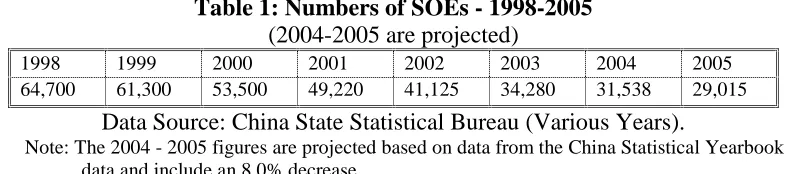
[image:18.595.101.501.579.666.2]The discussion is directed toward both the firms that are presently listed and the larger SOEs that are yet to be privatized. Small to medium enterprises will not be addressed in this discussion. Medium and Large SOEs, with more than Rmb 5 million in sales revenue, have been privatized at the rate of about 8% per year in recent times (Hovey, 2004). The projected numbers based on this are shown in Table 1 below.
Table 1: Numbers of SOEs - 1998-2005 (2004-2005 are projected)
1998 1999 2000 2001 2002 2003 2004 2005 64,700 61,300 53,500 49,220 41,125 34,280 31,538 29,015
Data Source: China State Statistical Bureau (Various Years).
Note: The 2004 - 2005 figures are projected based on data from the China Statistical Yearbook data and include an 8.0% decrease.
approximately 23,290 medium SOEs and 5,725 large SOEs would remain at the end of 2005.
China has the option of drawing on its own experience and that of the Czech, Russian and other models as a background to its pragmatic and measured approach to reforms. As there is a concern that the market would be flooded if the state were to divest too much of its holdings over a short time, the state could transfer its holdings to institutions and conduct a phased sell-off over a strategically determined period. As previously discussed, any retained state ownership should be held by LP institutions, preferably at medium levels of ownership. However, this needs to be interpreted with caution as medium levels of LP ownership appear optimum in the current regime, but may not be when radical divestment takes place.
The balance of state holdings could be divested and sold to private investors. The proposed strategy revolves around large non-management blockholders as Lins (2003) and Filatotchev et al. (2003) found that they were significant in facilitating reform.
4.2 Divesting State Ownership of Unlisted SOEs
The Fifteenth Congress of the Chinese Communist Party (CCP), held in September 1997, endorsed a major policy shift. It involved a commitment to an immense privatization program made under the slogan zhuada fangxiao, – “protect the large, release the small” (Ho, Bowles, & Dong, 2003; Smyth, 1998). A significant part of this policy change was to allow smaller enterprises to determine their own path (Ho et al., 2003). It is directed toward the “privatization” of numerous small and certain medium SOEs, including township and village enterprises. The primary basis of these reforms is restructuring of the ownership by means of arranged sale, auction, merge into
partnerships, joint venture arrangements, leasing, bankruptcy or closing down (Broadman, 2002; Hu, 2000; Lin & Zhu, 2001; Rongxia, 1998).
large listed firms or unlisted SOEs, other than in an experimental context (Hui 2005). The concept of an MBO remains controversial in China as well as lacking financial infrastructure in the form of specialized investment banks or investment funds that finance large-scale management acquisitions of their firms.
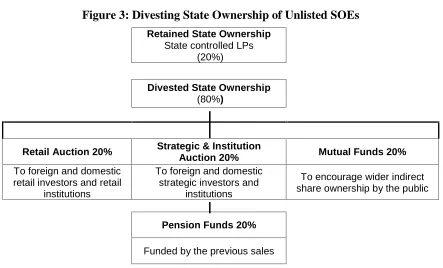
[image:20.595.77.520.441.709.2]The first strategy is aimed at divesting state ownership of unlisted SOEs. In this case, the balance of state holdings could be distributed over four tranches in the following manner (see Figure 3). The first two tranches of 20% each, entails an auction to both domestic and foreign retail investors and institutions and strategic investors and institutions. The third tranche of 20% involves an auction to the populace through mutual funds. Finally, the balance of roughly 20% could be transferred to nationwide pension funds to support the pension schemes and be funded by the previous sales. It is recognized that this would have a major initial impact on liquidity, and the present stockbroking industry would be affected. Therefore, this offer should be conducted in such a way as to minimize the impact. As one of the objectives is the development of the various markets, the state equity that is divested should ultimately be fully tradable. Thus, a significant part of the strategy is that state shares will ultimately become tradable as part of the program outlined.
Figure 3: Divesting State Ownership of Unlisted SOEs
Retained State Ownership
State controlled LPs (20%)
Divested State Ownership
(80%)
Retail Auction 20% Strategic & Institution
Auction 20% Mutual Funds 20%
To foreign and domestic retail investors and retail
institutions
To foreign and domestic strategic investors and
institutions
To encourage wider indirect share ownership by the public
Pension Funds 20%
Funded by the previous sales
3). Similarly, a further 20% could be auctioned to domestic and foreign strategic investors and institutions. The target market should be strategic investors and institutions both domestic and international. Given that individual transaction agreements are vulnerable to price fixing, shams and pay-offs, an open auction is proposed. For example, open tender offers may be a good alternative. However, there is limited capital available to take up the offers. Thus, this will need to be managed
carefully over time.
Non-listed larger SOEs should be listed on the stock exchanges. Smaller SOEs could be divested to private investors directly through auctions. Once again, the availability of capital and the lack of maturity of the market will require careful management. A percentage of state ownership could also be offered to domestic and foreign
institutions (see Figure 3). The advantage is that funds under management will tend to curb the volatility of the markets (Siegel, 1998; Huo, 2003) and enhance economic development (Mallin, 1998; Gillan & Starks, 2000). It is also assumed that funds would be motivated to monitor firms relatively closely, and should be given the incentive to do so. This has been demonstrated in the literature in that LP institutional ownership is shown to enhance performance. A primary concern of this model, that expands the institutional funds management sector, would be the affect on the market and its overall long-term impact on value, efficiency and liquidity. However, the impact was found not to be significant in the Hungarian market (Dezelan, 2002). Gompers and Metrick (2001) found that in the U.S. institutional investors focused primarily on acquisitions of large firms, which has overall pushed their value up.
The development of mutual funds is widely recognized as a priority area in financial development in China. In effect, to achieve elements of social equity, there needs to be a shift in savings patterns throughout Chinese society away from traditional bank and credit cooperative savings, towards funds that invest in securities. These institutions could initially be state sponsored but with foreign fund management, with the view to becoming private sector funds in due course. The ultimate objective would be to develop a fully functioning modern system and market. If applied correctly the fund managers’ duty of care will ensure that unit-holders interests are protected. Under this arrangement, the misappropriation of unit-holders funds would be constrained.
The next approach envisaged is proposed in preference to a direct voucher system, as applied in the Czech Republic. It is suggested that approximately 20% of state
ownership of larger SOEs be transferred to mutual funds (see Figure 3). In this model, the transferred state ownership would become units held in mutual funds. These units could then be auctioned as coupons to domestic citizens of China. The objective would especially focus on encouraging those not involved in the stock market to get involved through the funds management sector. The distributed coupons would hold rights to the units held in the mutual funds managed by the funds management institutions. It is an alternative to a voucher system. However, in this case, the vouchers are issued through the funds management institutions and are rights to units in the funds. This would tend to protect the firms from falling into the hands of management as happened in Russia, or into the hands of Banks as happened in the Czech Republic. Similar advantages are envisaged as outlined above.
It is proposed that the remaining 20% of shares of SOEs should be sold to pension funds. This proposal is to be funded by the proceeds of previous tranches. The principal behind this tranche is to achieve a more equitable distribution that would benefit a high proportion of the populace quickly, efficiently and cost effectively. The pension funds could provide benefits for the working population and thereby be a relatively equitable means of distributing state assets. The present pension funds provide a service to certain urban areas only and would need to be expanded to be on a national scale in order to provide benefits to all workers in China.
4.3 Divesting State Ownership of Listed SOEs
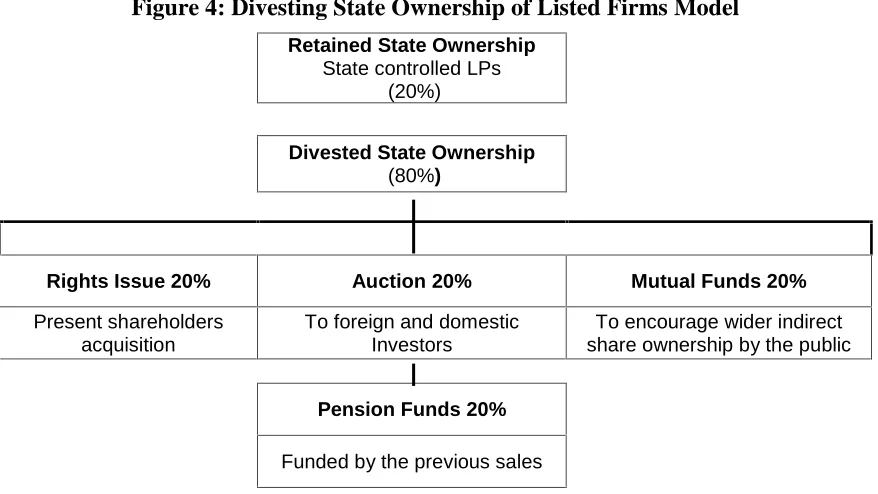
In consideration of the presently listed firms, a second proposed privatization strategy would involve divesting state ownership of SOEs that are presently listed and already partially privatized. In this strategy, the balance of state holdings could be distributed over four tranches similar to the approach suggested above, but with an additional tranche involving a rights offering to current shareholders, but excluding state
capital through a secondary offer is likely to strain the liquidity of the market and dilute minority shareholder interests. Hence, a rights issue is proposed as it would avoid the dilution of present holdings and maintain the price for the investors who are currently in the market.
The strategy would involve the state divesting ownership through the three tranches as outlined above, plus a rights offering for currently listed firms. Firstly, the rights offering involving a tranche of 20% would be offered to current tradable
A-shareholders, but not to state holders. The second tranche of 20% would be an auction to domestic and foreign investors. The third proposed tranche is an auction of 20% to the broad populace through mutual funds. Finally, the balance of 20% could be
[image:23.595.80.519.335.582.2]distributed to nationwide pension funds to support the pension schemes, and be funded by the previous tranches.
Figure 4: Divesting State Ownership of Listed Firms Model
Retained State Ownership
State controlled LPs (20%)
Divested State Ownership
(80%)
Rights Issue 20% Auction 20% Mutual Funds 20%
Present shareholders acquisition
To foreign and domestic Investors
To encourage wider indirect share ownership by the public
Pension Funds 20%
Funded by the previous sales
5. Conclusion
The strategic importance of the state owned enterprises (SOE) sector to the Chinese economy cannot be underestimated. Accordingly, the success of SOE reform is a
significant factor in China’s future economic prosperity. Whilst experiencing significant improvement, issues remain to be contended with and resolved in order for SOEs in China to become effective free market corporations and for them to have the ability to contend with unemployment and social justice issues.
References
Asia Pulse (2005), Chinese Body yet to Allocate US$6 Bln of Investment Quotas. Asia
in Focus, Asia Pulse Pte Limited, 4 August.
Bezlova, A. (2005) China to Sell State-Owned Stocks to Boost an Ailing Market. (May 31) Inter Press Service/Global Information Network.
Boycko, M., A. Shleifer, and R. W. Vishny. (1996) A Theory of Privatization.
Economic Journal, 106 (435): 309-319.
Broadman, H.G. (2002), China’s Membership in the WTO and Enterprise Reform: The Challenges for Accession and Beyond. In A.S. Alexandroff, S. Ostry and R. Gomez (Eds.), China and the Long March to Global Trade: The Accession of
China to the World Trade Organization. Routledge Studies in the Growth
Economies of Asia, No. 34. London; New York: Routledge.
Business Daily Update. (2003) Fund Managers Urge China Merchants Bank on Rights Issue. China Daily Information Company (September 26).
Charkham, J. P. (1995) Keeping Good Company: A Study of Corporate Governance in
Five Countries. Oxford and New York: Oxford University Press.
Chen, B., J. K. Dietrich, and Y. Feng (Eds.). (2000) Financial Market Reform in China:
Progress, Problems, and Prospects. Boulder and Oxford: Westview Press.
Chen, J. (2001) Ownership Structure as Corporate Governance Mechanism: Evidence from Chinese Listed Companies. Economics of Planning, 34 (1-2): 53-72. Chen, K. C. W. and H. Yuan. (2004) Earnings Management and Capital Resource
Allocation: Evidence from China’s Accounting-Based Regulation of Rights Issues. Accounting Review, 79 (3): 645-665.
Chen, Y.-M. and S.-C. Gong. (2000) Ownership Structure and Corporate Performance - Some Chinese Evidence. In T. A. Fetherston (Ed.), Advances in Pacific Basin
Financial Markets., Vol. 6: 177-193. Stamford, Conn.: JAI Press.
China State Statistical Bureau. (Various Years) China Statistical Yearbook. Sanlihe Beijing: China Statistical Publishing House.
ChinaOnline. (Various Issues). China Online Inc. (www.chinaonline.com).
Chung, R., M. Firth, and J.-B. Kim. (2002) Institutional Monitoring and Opportunistic Earnings Management. Journal of Corporate Finance, 8 (1): 29-48.
Claessens, S. and S. Djankov. (1999) Enterprise Performance and Management Turnover in the Czech Republic. European Economic Review, 43 (4-6): 1115-1124.
Claessens, S., S. Djankov, and L. H. P. Lang. (2000) The Separation of Ownership and Control in East Asian Corporations. Journal of Financial Economics, 58 (1-2): 81-112.
Coffee, J. C., Jr. (2002) Racing to the Top?: The Impact of Cross-Listings and Stock-Market Competition on Corporate Governance. Columbia Law Review, 102 (7): 1757-1833.
Dezelan, S. (2002) The Impact of Domestic Mutual Funds on the Liquidity of the Hungarian Equity Market. Economic and Business Review, 4 (1): 43-74. Ding, J. Z. and J. Motwani. (2001) Transfer of Technology: A Critical Element in
China’s Privatization Process. International Journal of Technology
Management, 21 (5-6): 453-462.
Economist. (1997) China Adopts the Chaebol. The Economist Newspaper Ltd. (US), London; New York: 343 (June 7): 61-63.
Economist. (2000) China - Getting Their Skates On. Economist Newspaper Limited, London; New York: 355 (June 3): 72-75.
Economist. (2001) China’s Securities Regulator Cracks Down on Murky Practices. The
Economist Newspaper Ltd., London; New York: (March 3): 17-18.
Economist. (2005a) Securities Markets: Overview. Economist Intelligence Unit - Country Finance, China, The Economist Newspaper Ltd., London; New York (August 22).
Economist. (2005b) Emerging-market indicators: South Korea. The Economist
Newspaper Ltd., London; New York: (October 15).
Edwards, J. and M. Nibler. (2000) Corporate Governance in Germany: The Role of Banks and Ownership Concentration. Economic Policy: A European Forum, 0 (31): 237-260.
Faff, R. W., A. Hodgson, and S. Saudagaran. (2002) International Cross-Listings Towards More Liquid Markets: The Impact on Domestic Firms. Journal of
Multinational Financial Management, 12 (4-5): 365-390.
Filatotchev, I., M. Wright, K. Uhlenbruck, L. Tihanyi, and R. E. Hoskisson. (2003) Governance, Organizational Capabilities, and Restructuring in Transition Economies. Journal of World Business, 38 (4): 331-347.
Franks, J. and C. Mayer. (2001) Ownership and Control of German Corporations.
Review of Financial Studies, 14 (4): 943-977.
Gillan, S. L. and L. T. Starks. (2000) Corporate Governance Proposals and Shareholder Activism: The Role of Institutional Investors. Journal of Financial Economics, 57 (2): 275-305.
Gilley, B. (2001) Let 1,000 Casinos Wither. Far Eastern Economic Review, 164 (41): 42-44.
Gompers, P. A. and A. Metrick. (2001) Institutional Investors and Equity Prices.
Quarterly Journal of Economics, 116 (1): 229-259.
Gorton, G. and F. A. Schmid. (2000) Universal Banking and the Performance of German Firms. Journal of Financial Economics, 58 (1-2): 29-80.
Gray, J. (2005), Cash-Heavy QFII. Asiamoney, 16 (3): 10.
Gul, F. A. (1999) Government Share Ownership, Investment Opportunity Set and Corporate Policy Choices in China. Pacific Basin Finance Journal, 7 (2): 157-172.
Gul, F. A. and R. Zhao. (2001). Corporate Governance and Performance in Chinese
Listed Companies. Paper presented at the AAA International Accounting
Section, Phoenix, AZ. (January).
Guo, X. (2001) Firms Fined for Stock Manipulation. (April 27) China Daily.
Habib, M. A. and A. P. Ljungqvist. (1998) Underpricing and IPO Proceeds: A Note.
Economics Letters, 61 (3): 381-383.
Harvie, C. and T. Naughton. (2000) Corporate Governance and State Owned Enterprise Reform. In C. Harvie (Ed.), Contemporary Developments and Issues in China’s
Economic Transition: Chapter 3. London: Macmillan/St. Martin’s Press.
Ho, S.P.S., P. Bowles, and X. Dong (2003), ‘Letting Go of the Small’: An Analysis of the Privatization of Rural Enterprises in Jiangsu and Shandong. The Journal of
Development Studies, 39 (4): 1-26.
Hovey, M. (2005a) Corporate Governance in China: An Analysis of Ownership
Hovey, M. (2005b) Do Ownership Structures Stimulate the Performance of Listed Firms in China? 10th AIBF Banking and Finance Conference Proceedings, September 30.
Hovey, M. (2006), Corporate Governance in China: An Empirical Study of the
Ownership Structures of Listed Firms. (SSRN Working Paper, No. 904261).
Hovey, M. and T. Naughton. (2000) Financial Market Reform. In C. Harvie (Ed.),
Contemporary Developments and Issues in China’s Economic Transition (Chapter 5): 101-136. London: Macmillan/St. Martin’s Press.
Hovey, M., L. Li, and T. Naughton. (2003) The Relationship between Valuation and Ownership of Listed Firms in China. Corporate Governance: An International
Review, 11 (2): 112-123.
Hu, X. (2000), The State, Enterprises, and Society in Post-Deng China: Impact of the New Round of SOE Reform. Asian Survey, 40 (4): 641-657.
Hui, Q. (2005), "MBOs," Yes; "Year of the MBO," No. Chinese Economy, 38 (5): 55-66.
Huo, Y. (2003) Umbrella Funds Reign Supreme in Market. Business Weekly. (April 1). Hwang, I. and J.-H. Seo. (2000) Corporate Governance and Chaebol Reform in Korea.
Seoul Journal of Economics, 13 (3): 361-389.
Jensen, M. C. (2000) A Theory of the Firm: Governance, Residual Claims, and
Organizational Forms. Cambridge, MA: Harvard University Press.
Jensen, M. C. and W. H. Meckling. (1976) Theory of the Firm: Managerial Behavior, Agency Costs, and Ownership Structure. Journal of Financial Economics, 3 (4): 305-360.
Kaplan, S. N. (1995) Corporate Governance in Germany, Japan, and the United States: A Comparison. In J. Doukas and L. Lang (Eds.), Research in International
Business and Finance, Vol. 12. Greenwich, Conn. and London: JAI Press.
Kikeri, S., J. Nellis, and M. Shirley. (1994) Privatization: Lessons from Market Economies. World Bank Research Observer, 9 (2): 241-272.
La Porta, R., F. López de Silanes, and A. Shleifer. (1999) Corporate Ownership around the World. Journal of Finance, 54 (2): 471-517.
Lang, M. H., K. V. Lins, D. P. Miller, and C. Leuz. (2003) ADRs, Analyzts, and
Accuracy: Does Cross Listing in the United States Improve a Firm’s Information Environment and Increase Market Value? Journal of Accounting Research, 41 (2): 317- 362.
Leggett, K. (2000) Under Pressure, China Blesses Private Sector. Wall Street Journal. (March 13).
Lehrer, M. (1997) German Industrial Strategy in Turbulence: Corporate Governance and Managerial Hierarchies in Lufthansa. Industry and Innovation, 4 (1): 115-140.
Li, D. D. (2000) Insider Control, Corporate Governance, and the Soft Budget Constraint: Theory, Evidence, and Policy Implications. In B. Chen, J. K. Dietrich and Y. Feng (Eds.), Financial Market Reform in China: Progress,
Problems, and Prospects. Political Economy of Global Interdependence Series.
Westview Press, Boulder and Oxford.
Li, L., J. Fowler, and T. Naughton. (2004) Short Term Equity Returns of Chinese IPOs
1998 - 2001: Excess Demand, Social Policies, and Wealth Effects. (Unpublished
Working Paper) RMIT University.
Lin, Y. and T. Zhu. (2001) Ownership Restructuring in Chinese State Industry: An Analysis of Evidence on Initial Organizational Changes. China Quarterly, 0 (166): 305-341.
Lins, K. (2003) Equity Ownership and Firm Value in Emerging Markets. Journal of
Financial and Quantitative Analysis, 38 (1): 159-184.
Lizal, L., M. Singer, and J. Svejnar. (2001) Enterprise Breakups and Performance During the Transition from Plan to Market. Review of Economics and Statistics, 83 (1): 92-99.
Loong, P. (2002) Sell-Down on Hold, but for How Long? Asiamoney, 13 (8): 31-36. Mallin, C. (1998) The Role of Institutional Investors in the Corporate Governance of
Financial Institutions: The UK Case. In M. Balling, E. Hennessy and R. O’brien (Eds.), Corporate Governance, Financial Markets and Global Convergence.
Financial and Monetary Policy Studies, Vol. 33: 216-233. Dordrecht; Boston
and London: Kluwer Academic.
McGuinness, P. (2001) Ex-Day Effects for Rights Issues in Hong Kong. Applied
Economics Letters, 8 (1): 5-7.
Megginson, W. L. and J. M. Netter. (2001) From State to Market: A Survey of
Empirical Studies on Privatization. Journal of Economic Literature, 39 (2): 321-389.
Merton, R. C. (1987) A Simple Model of Capital Market Equilibrium with Incomplete Information. Journal of Finance, 42 (3): 483-510.
Moffett, M. H., A. I. Stonehill, and D. K. Eiteman. (2003) Fundamentals of
Multinational Finance. Boston: Addison-Wesley.
Naughton, T. and M. Hovey. (2002a) Markets Governing Corporations. In Economic Analytical Unit (Ed.), Changing Corporate Asia: What Business Needs to Know: 13-34. Canberra: Economic Analytical Unit, Department of Foreign Affairs & Trade.
Park, A. and M. Shen (2003), Joint Liability Lending and the Rise and Fall of China’s Township and Village Enterprises. Journal of Development Economics, 71 (2): 497-531.
Perotti, E. C. and E.-L. von Thadden. (2003) Strategic Transparency and Informed Trading: Will Capital Market Integration Force Convergence of Corporate Governance? Journal of Financial and Quantitative Analysis, 38 (1): 61-85. Porter, M. E. (1992) Capital Disadvantage: America’s Failing Capital Investment
System. Harvard Business Review, 70 (5): 65-82.
Rongxia, L. (1998), Haicheng Reforms Property Right System. Beijing Review 41 (28): 14-16.
Sarkar, J. and S. Sarkar. (2000) Large Shareholder Activism in Corporate Governance in Developing Countries: Evidence from India. International Review of Finance, 1 (3): 161-194.
Shirai, S. (2004), Testing the Three Roles of Equity Markets in Developing Countries: The Case of China. World Development, 32 (9): 1467-1486.
Shleifer, A. and R. W. Vishny. (1997) A Survey of Corporate Governance. Journal of
Finance, 52 (2): 737-783.
Siegel, J. J. (1998) Stocks for the Long Run: The Definitive Guide to Financial Market
Returns and Long-Term Investment Strategies (2nd ed.). New York:
McGraw-Hill.
Smyth, R. (1998), Toward "The Modern Corporation": Recent Developments in the Institutional Reform of State-Owned Enterprises in Mainland China. Issues &
Solomon, J., A. Solomon, and C. Park. (2002) A Conceptual Framework for Corporate Governance Reform in South Korea. Corporate Governance An International
Review, 10 (1): 29-46.
Stengel, A and C Steven. (1998) Germany. International Financial Law Review, Issue: Corporate Governance, Supplement: 23-27.
Sun, Q. and W. H. S. Tong. (2003) China Share Issue Privatization: The Extent of Its Success. Journal of Financial Economics, 70 (2): 183-222.
Sun, Q., W. H. S. Tong, and J. Tong. (2002) How Does Government Ownership Affect Firm Performance? Evidence from China’s Privatization Experience. Journal of
Business Finance and Accounting, 29 (1-2): 1-27.
Tam, O. -K. (2002) Ethical Issues in the Evolution of Corporate Governance in China.
Journal of Business Ethics, 37 (3; 2): 303-320.
Tam, O.-K. (2000) Models of Corporate Governance for Chinese Companies.
Corporate Governance: an International Review, 8 (1): 52-64.
Tan, R. S. K., P. L. Chng, and Y. H. Tong. (2002) Private Placements and Rights Issues in Singapore. Pacific-Basin Finance Journal, 10 (1): 29-54.
TEJ. (Various) Taiwan Economic Journal, Greater China Database. Taiwan Economic
Journal. (www.finasia.biz/tejonline/tejonline.htm).
Tong, T. (2005a) Chinese Business: Revamping China’s Stock Markets. The Edge
Singapore, (June 27).
Tong, T. (2005b) Behind the Great Chinese Stock Sale. Business Times Singapore, (May 17).
Wang, C. (2005), Ownership and Operating Performance of Chinese IPOs. Journal of
Banking and Finance, 29 (7): 1835-1856.
Wang, X., L. C. Xu, and T. Zhu. (2004) State-Owned Enterprises Going Public: The Case of China. Economics of Transition, 12 (3): 467-487.
Wei, Y. (2002), Corporatization and Privatization: A Chinese Perspective. Northwestern
Journal of International Law and Business, 22 (2): 219-234.
Wei, Z. and O. Varela. (2003) State Equity Ownership and Firm Market Performance: Evidence from China’s Newly Privatized Firms. Global Finance Journal, 14 (1): 65-82.
Wei, Z., F. Xie, and S. Zhang (2005), Ownership Structure and Firm Value in China’s Privatized Firms: 1991-2001. Journal of Financial and Quantitative Analysis, 40 (1): 87-108.
Wong, S. M. L., S. Opper, and R. Hu. (2004) Shareholding Structure, Depoliticization and Firm Performance: Lessons from China’s Listed Firms. Economics of
Transition, 12 (1): 29-66.
World Bank. (1996) From Plan to Market: World Bank Development Report. Oxford: Oxford University Press.
Xinhua Financial Network. (2003) China’s Hafei Aviation to Make 1.875-for-10 Rights Offer. Xinhua Financial Network Ltd. (September 2).
Xu, X. and Y. Wang. (1999) Ownership Structure and Corporate Governance in Chinese Stock Companies. China Economic Review, 10 (1): 75-98. Yuen, N. (2006), Question & Answer/Keen to Feed the A-share Artery. China
Economic Review, (May 2006). (www.chinaeconomicreview.com/ subscriber/