This is a repository copy of
Information systems evaluation methodologies
.
White Rose Research Online URL for this paper:
http://eprints.whiterose.ac.uk/74740/
Proceedings Paper:
Chen, S., Osman, N.M., Nunes, J.M.B. et al. (1 more author) (2011) Information systems
evaluation methodologies. In: Proceedings of the IADIS International Workshop on
Information Systems Research Trends, Approaches and Methodologies. IADIS
International Workshop on Information Systems Research Trends, Approaches and
Methodologies 2011, 20 July 2011, Rome, Italy. .
[email protected] https://eprints.whiterose.ac.uk/
Reuse
Unless indicated otherwise, fulltext items are protected by copyright with all rights reserved. The copyright exception in section 29 of the Copyright, Designs and Patents Act 1988 allows the making of a single copy solely for the purpose of non-commercial research or private study within the limits of fair dealing. The publisher or other rights-holder may allow further reproduction and re-use of this version - refer to the White Rose Research Online record for this item. Where records identify the publisher as the copyright holder, users can verify any specific terms of use on the publisher’s website.
Takedown
If you consider content in White Rose Research Online to be in breach of UK law, please notify us by
promoting access to White Rose research papers
White Rose Research Online
[email protected]
Universities of Leeds, Sheffield and York
http://eprints.whiterose.ac.uk/
This is an author produced version of a paper published in Proceedings of the
IADIS International Workshop on Information Systems Research Trends,
Approaches and Methodologies.
White Rose Research Online URL for this paper:
Published paper
Chen, S., Osman, M., Nunes, J.M.B. and Peng, G.C. (2011). Information
systems evaluation methodologies. In; Proceedings of the IADIS International
Workshop on Information Systems Research Trends, Approaches and
INFORMATION SYSTEMS EVALUATION
METHODOLOGIES
Si Chen
Information School, The University of Sheffield,
Regent court, 211 Portobello, Sheffield, S1 4DP, UK
Nor Mardziah Osman
Information School, The University of Sheffield,
Regent court, 211 Portobello, Sheffield, S1 4DP, UK
Miguel Baptista Nunes
Information School, The University of Sheffield,Regent court, 211 Portobello, Sheffield, S1 4DP, UK
Guo Chao Peng
Information School, The University of Sheffield,
Regent court, 211 Portobello, Sheffield, S1 4DP, UK
ABSTRACT
Due to the prevalent use of Information Systems (IS) in modern organisations nowadays, evaluation research in this field is becoming more and more important. In light of this, a set of rigorous methodologies were developed and used by IS researchers and practitioners to evaluate the increasingly complex IS implementation used. Moreover, different types of IS and different focusing perspectives of the evaluation require the selection and use of different evaluation approaches and methodologies. This paper aims to identify, explore, investigate and discuss the various key methodologies that can be used in IS evaluation from different perspectives, namely in nature (e.g. summative vs. formative evaluation) and in strategy (e.g. goal-based, goal-free and criteria-based evaluation). The paper concludes that evaluation methodologies should be selected depending on the nature of the IS and the specific goals and objectives of the evaluation. Nonetheless, it is also proposed that formative criteria-based evaluation and summative criteria-based evaluation are currently among the most and more widely used in IS research. The authors suggest that the combines used of one or more of these approaches can be applied at different stages of the IS life cycle in order to generate more rigorous and reliable evaluation outcomes.
KEY WORDS
Information systems evaluation, methodology, formative, summative, criteria-based evaluation, goal-based evaluation
1.
INTRODUCTION
important to note that the primary purpose or objective of evaluation research is not to explore new knowledge as other forms of research do (Clarke, 1999: 2). Rather, it aims at using current knowledge to assess and study the effects, effectiveness and outcomes of “some innovation, intervention, policy, practice or service” (Robson, 2002: 202), and then to inform decision making to guide practical actions (Clarke, 1999: 2; Lagsten and Goldkuhl, 2008).
This type of research started receiving substantial attention from academics since the 1960s (Robson, 2002: 203). Specifically, in the 1960s the US government invested a large amount of money in developing various new social programmes in education, income maintenance, housing, and health (Dart et al., 1998). These vast investments raised the issue and need of evaluating the outcomes and impact of the developed social programmes, which subsequently turned into an interest in evaluation in Social Sciences research (Robson 2002:203; Dart et al., 1998). In other words, evaluation research has its root in the field of Social Sciences.
In terms of Information Systems (IS) research, evaluation is particularly important. In fact, and according to the International Data Corporation 2007 report (IDC, 2008), the global software market reached US$229,946 million in 2007. This figure clearly indicates the prevalence and heavy investments of IS in modern organisations. However, and despite this apparent success in the IS market, failure rates of IS implementation and exploitation have been continuously high (Chen et al., 2011; Peng and Nunes, 2009; Lycett 2000). For example, and according to a recent Standish Group Chaos Report (Standish Group, 2009), 44% of IS projects were considered as challenged and 24% were identified as a complete failure in 2008. Giving the large investment and high failure rate of IS implementation, evaluation is now recognised as an increasingly important task that can directly contribute to IS success (Ammenwerth et al., 2003; Lycett and Giaglis, 2000).
In particular, Lycett and Giaglis (2000) argue that evaluation is very useful in predicting and assessing potential costs, benefits and risks associated with the development, implementation and use of IS, as well as assisting decision makers to take proper actions to mitigate the identified risks. Moreover, other IS researchers reinforce that in order to inform decision making and increase the possibility of IS success, evaluation should be carried out at different phases throughout the entire system’s lifecycle, from feasibility study, to system development, implementation, post-implementation and even system replacement (Willcocks and Lester, 1996; Smithson and Hirschheim, 1998; Seddon et al., 2002).
However, and despite its importance in guaranteeing IS success, evaluation is never an easy and straightforward task (Cronholm and Goldkuhl, 2003a). In particular, there is a range of IS evaluation methodologies, each one having its own strengths and limitations. Moreover, different stages of the IS lifecycle are associated with different goals, changes and outcomes. As a result, the aims and focuses of evaluation at different stages will also vary. Faced with this diversity and complexity, practitioners and evaluators may often find it difficult to select which methodology is the most suitable one for evaluating a particular IS project or a particular stage of the project.
This paper provides a comprehensive summary and an in-depth discussion on the various key methodologies that can be used in IS evaluation, namely in terms of the nature of the evaluation (summative vs. formative) and the strategy to be adopted in the evaluation (goal-based, goal-free and criteria-based). It aims to provide rich insights and practical guidelines in helping practitioners and evaluators to choose and apply a suitable evaluation methodology in their IS development projects.
2.
FORMATIVE AND SUMMATIVE EVALUATION IN IS RESEARCH
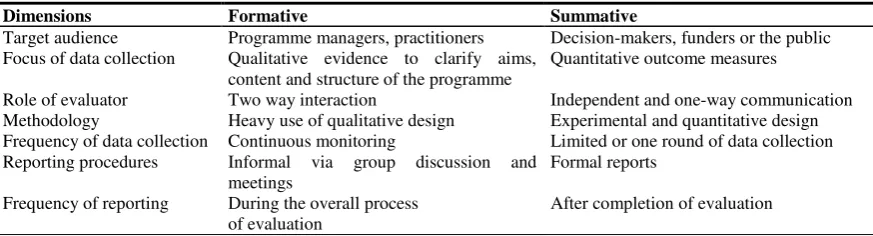
gather information and feedback to assess the effects, effectiveness, impacts and outcomes of the developed IS (Clarke, 1999:7; Bennett, 2003:10). A further comparison on the key features and differences between formative and summative evaluation is provided in Table 1.
Table 1. A comparison of key differences between summative and formative evaluation
Dimensions Formative Summative
Target audience Programme managers, practitioners Decision-makers, funders or the public Focus of data collection Qualitative evidence to clarify aims,
content and structure of the programme
Quantitative outcome measures
Role of evaluator Two way interaction Independent and one-way communication
Methodology Heavy use of qualitative design Experimental and quantitative design Frequency of data collection Continuous monitoring Limited or one round of data collection Reporting procedures Informal via group discussion and
meetings
Formal reports
Frequency of reporting During the overall process of evaluation
After completion of evaluation
Source: adapted from Herman et al. (1987: 26) and Clarke (1999: 8-10)
Since their emergence, the approaches of formative and summative evaluation have been continuously and widely used in many other fields, especially in IS evaluation (Hamilton and Chervany, 1981; Kumar 1990; Kushniruk et al., 1997; Cronholm and Goldkuhl, 2003a; Karoulis et al., 2006). Specifically, and in light of the discussion above, formative evaluation is typically used throughout the IS design, development and implementation process, with the aim to provide systematic feedback and suggestions to system designers and implementers during the project (Hamilton and Chervany, 1981; Cronholm and Goldkuhl, 2003a). In contrast, summative evaluation is normally carried out at the end of the IS project or at the post-implementation stage, in order to inform CEOs or managers about the quality, adequacy and impact of the implemented IS and the overall effectiveness and outcomes of the project (Hamilton and Chervany, 1981; Kumar 1990; Cronholm and Goldkuhl, 2003a).
It clearly emerges from the above discussion that in order to improve the quality of the system and enhance the possibility of success, both formative and summative evaluation should be carried out in IS projects. Nonetheless, it should be highlighted that the selection of the use of either approach is related to actual stages of the IS lifecycle. That is, the use of formative or summative evaluation is closely related to
when evaluation is conducted in the IS project.
3.
GOAL-BASED, GOAL-FREE AND CRITERIA-BASED EVALUATION
IN IS RESEARCH
Although formative and summative approaches provide clear indication about when assessment should be
carried out, these two methodologies do not contain sufficient guidelines on how evaluation can be done (e.g.
what strategy to adopt in the evaluation? what methods to use? should any measurement criteria be set up prior to evaluation? If so, how can these criteria be set up, and more importantly, how can they be applied in the evaluation process?). In response to these limitations, this paper proposes to use an alternative set of evaluation methodologies, as proposed by Cronholm and Goldkuhl (2003a), in conjunction with formative
and summative approaches, namely goal-based evaluation, goal-free evaluation, and criteria-based
evaluation.
3.1 Goal-based evaluation
evaluation (Cronholm and Goldkuhl, 2003a; Patton, 2005). The evaluators will then need to measure to which extent these predefined goals are achieved in the program or intervention (Gregory 1992; Cronholm and Goldkuhl, 2003a).
Quantitative data collection methods are traditionally adopted in goal-based evaluation (Patton, 1990: 117; Cronholm and Goldkuhl, 2003a). Nonetheless, it has been extensively criticised (Hirschheim and Smithson, 1988; Cronholm and Goldkuhl, 2003a) since if only quantitative methods are used, goal-based evaluation often mainly focuses on technical and economical aspects, rather than on human and social dimensions. As a consequence, the result of the evaluation may over-emphasise on the quantitative value of the innovation (e.g. a newly implemented IS, but neglect important social, organisational and human effects (Hirschheim and Smithson, 1988). Therefore, Cronholm and Goldkuhl (2003a) suggest that when quantitative methods can be used to assess hard measurable goals, qualitative methods should actually also be adopted in goal-based evaluation in order to examine goals of more social or human nature.
3.2 Goal-free evaluation
In contrast with the traditional goal-based approach, some researchers argue that evaluators may come up with more interesting and unbiased results by “undertaking fieldwork in a programme without knowing the goals of the programme or at least without designing the [evaluation] study with goal attainment as the primary focus” (Patton, 1990: 115-116). A very similar line of thought has led Scriven (1972) to propose much earlier on an alternative evaluation methodology, namely goal-free evaluation.
Goal-free evaluation is an inductive methodology, which aims at gathering data on a large amount of actual effects and then assessing the importance of these effects in meeting demonstrated needs of the socio-technical environment in which the IS is to produce change or innovation (Scriven, 1972; Patton, 1990: 116; Cronholm and Goldkuhl, 2003a). Both quantitative and qualitative methods can be used in this evaluation approach (Patton, 1987: 36). Scriven (1972) and Patton (1990: 116) highlight a number of reasons and advantages for doing goal-free evaluation, such as avoiding the risk of narrowly studying the pre-specified goals and thus missing unanticipated aspects, eliminating evaluation biases introduced potentially by knowledge of goals, and maintaining evaluator objectivity and independence through goal-free conditions.
3.3 Criteria-based evaluation
Criteria-based evaluation means the evaluation is conducted according to predefined checklists, heuristics, or principles. These criteria mainly stem from some specific theories as well as sets of guidelines, standards or even legal requirements. The selected criteria for evaluation indicate that evaluators emphasize and focus on certain characteristics more than others. Therefore the criteria used for evaluation determine the types of outcomes that can be acquired (Cronholm 2003).
From reviewing previous studies, criteria-based evaluation emerges as one of the most frequently used evaluation approach in the field of IS, namely in usability, accessibility and standard verification studies. Usability usually refers to the assessment of how users react to and interact with the IS (Bertot et al., 2006). On the other hand, accessibility evaluates how well systems allow users with disabilities to have equal or equivalent use of information and services (Jaeger, 2002). Standards emerge from national, international and professional accrediting boards and are usually available in the form of very purposefully structured documents. Evaluation based on one or more of these three types of criteria are increasingly common in the IS field.
3.4 Summary of IS evaluation approaches
In summary, IS evaluation research processes may vary in the nature of the process, that is, evaluation may be formative or summative. This distinction results from a difference in the implementation of the evaluation in terms of the point in time in relation to the design and development cycle of the IS: formative during the process of design and development; summative at the end of this process. Nonetheless, each of these types of evaluation can in turn use different strategies, namely goal-free evaluation, goal-based evaluation and criteria-based evaluation depending on the motivation for evaluation. Therefore, this results in six basic types of evaluation methodologies: free summative methodology, free formative methodology, goal-based summative methodology, goal-goal-based formative methodology, criteria-goal-based summative methodology and criteria-based formative methodology.
4.
DISCUSSION OF THE BASIC TYPES OF IS EVALUATION
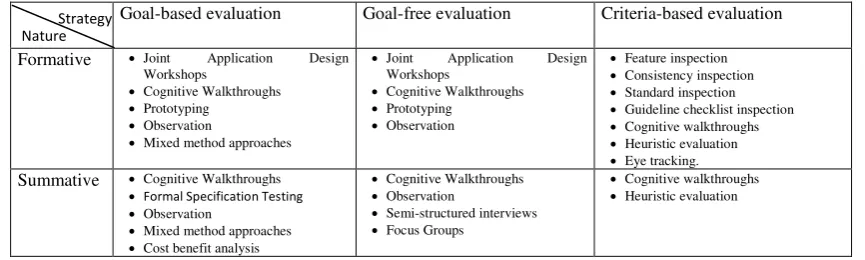
[image:7.595.89.522.354.484.2]As has mentioned before, the field of IS has recently experienced and unprecedented rapid development. Therefore, the study of IS socio-technical environments requires the consideration of increasingly complicated factors that need to be embedded in the evaluation processes. This section of the paper aims to discuss the six basic types of evaluation methodologies mentioned above and presented in Table 2.
Table 2. A comparison of key differences between summative and formative evaluation
Goal-based evaluation Goal-free evaluation Criteria-based evaluation
Formative •Joint Application Design Workshops
•Cognitive Walkthroughs •Prototyping
•Observation
•Mixed method approaches
• Joint Application Design Workshops
• Cognitive Walkthroughs • Prototyping
• Observation
• Feature inspection • Consistency inspection • Standard inspection • Guideline checklist inspection • Cognitive walkthroughs • Heuristic evaluation • Eye tracking.
Summative •Cognitive Walkthroughs •Formal Specification Testing •Observation
•Mixed method approaches •Cost benefit analysis
• Cognitive Walkthroughs • Observation
• Semi-structured interviews • Focus Groups
• Cognitive walkthroughs • Heuristic evaluation
We will discuss each of these methodologies in detail in the following sections by describing its basic structure and criticising its use and applicability.
4.1 Goal-free formative evaluation
This type of evaluation methodology emerges from combining goal-free evaluation and formative evaluation. It means the evaluation is undertaken without clear goals during the development of information systems. Theoretically, IS can be evaluated using goal-free formative evaluation methods, but this is actually seldom used in practice. When it is used, it is with an exploratory attitude in mind, that is, to detect, identify and explore the possibility of the occurrence of unpredicted events that may have an undesirable impact in the IS under development.
Usually, external evaluators are asked to become involved in goal-free formative evaluation in order to avoid internal evaluators biases, preconceived ideas and even acquired prejudices about the IS under development (Scriven 1991). This type of evaluation can be performed using joint application design workshops, cognitive walkthroughs, prototyping or even interpretive observation.
Joint application design workshops (JAD) involve users and technical developers that work together on a variety of activities related with system design, such as requirements definition, test specification design, and user interface design (Davidson, 1999). The traditional methods of interviewing individual users and writing text specification have been identified as less efficient in understanding user requirements in a complicated
socio-technical environment (Martin, 1991:156). Therefore, JAD workshops are generally carried out in the form of focus group discussion, which is facilitated by a well-trained session leader/moderator (Davidson, 1999). This approach aims to encourage user participation, expedite system development, and lead to better quality of specifications (Davidson, 1999).
Cognitive walkthroughs are traditionally used as usability evaluation methods, with special attention to how well the interface supports "exploratory learning," i.e., first-time use without formal training (Rieman et al., 1995). It focuses on evaluating user interfaces of a system as to attribute ease of learning, particularly by exploration, i.e. guessing what to do using the signals provided by the system. Based on early propositions by Wharton et al. (1994), cognitive walkthrough simulates users performing navigation tasks on a website by assuming that users perform goal-driven exploration (Blackmon, 2002).
Prototyping is an iterative process of design and development that aims to evaluate the design of the IS through asking users’ actually trying rather than evaluating according to description (Lycett, 2000). A prototype can serve as a communication vehicle that allows users to get a feeling about what the new IS would be like , as well as to review how users can interact with the system (Martin, 1991:172). It is particular useful in exploring the functions and design of IS, especially when the detailed design of the system is not fully understood and developed (Martin, 1991:172). However, applying this type of empirical testing is expensive in formative evaluation because it requires a number of users involved in the evaluation at different important points in development (Nielsen 1994).
Observation is a naturalistic approach in which activities and interactions with systems are monitored or recorded, using audio or video (Kushniruk, 2002). In the case of goal free evaluation the observation process is designed to be as unobtrusive as possible, with little or no experimental control. Usually this type of evaluation is either performed by free roaming and use of the system or through the use of simulation, that is, the evaluation is conducted through observing the simulative operation by potential users (Lycett, 2000).
4.2 Goal-free summative evaluation
This type of evaluation methodology is a result of the combination of goal-free evaluation and summative evaluation. By adopting this methodology, evaluation is undertaken without clear goals after the IS development process is finished. Summative evaluations are increasingly becoming goal-free in many social sciences project evaluations (Scriven 1991). However, and similar to goal-free formative evaluation, a literature review of the IS field revealed that this type evaluation is scarcely applied.
Methods used in this type of evaluation may be very similar to the ones used in goal-free formative evaluation, that is, cognitive walkthroughs and observation. However, due to the summative nature of this approach methods such as interviews and focus groups are also often used.
Interviews can be defined in very general terms as “conversations with a purpose” (Dexter, 1970:136). They are a very powerful tool for information gathering within organizational human activity environments (Warner, 1996: 183). Interviews used in goal free summative evaluation are usually semi-structured in nature, that is, the questions emerge from lists of themes to be covered in an open conversation, rather using the very closed structured interview script.
A focus group is, in fact, a group semi-structured interview in which a moderator keeps the direction of discussions under control by utilizing a predefined set of questions or script (McPherson and Nunes, 2008). Focus groups are particularly useful in goal-free summative evaluation, since this method offers a unique and comprehensive form of discussion in which IS stakeholders could use the full range of their sensibilities, knowledge and experiences to discuss and negotiate the different understanding and aspects of the implemented IS
4.3 Goal-based formative evaluation
(Kueng, 1996) and is necessary before engaging with goal-based evaluation. Therefore this goal-based evaluation is a deductive research approach as discussed above.
In practice, during the development process, a number of information systems development techniques are used to ensure the match of software functionality and business goals. Thus, goal-based formative evaluation is mainly used during the design and development of organizational IS and it provides a crucial contribution to ensure quality, usefulness and acceptance of the IS. This type of evaluation is often connotated with IT and SW centred evaluation processes.
The most useful goal-based formative evaluation methods are prototyping and simulation (Lycett 2000). However, the above mentioned joint application design workshops, observation and interviews are also often used. Cronholm and Goldkuhl (2003b) propose that some of these methods can actually be combined in order to perform the evaluation. By way of an example, observation and interviews could be used, where the evaluator observes users actions and contrasts these with their perceptions in order to evaluate if goals and business actions defined in requirement specifications have been attained. Monk et al. (1993) propose that the “think aloud” observation method would be particularly adequate in this case.
4.4. Goal-based summative evaluation
This type of evaluation results from the combination of goal-based evaluation and summative evaluation. This means the main aim of the evaluation is to assess if the implemented IS fulfils the business goals. A part form evaluating a the attainment of business goals and systems requirements, this type of evaluation is often also used to assess the costs and benefits of implementing the IS in order to assist decision making. Irani (2008) summarises, that in this case, the costs and benefits should be considered including financial and non-financial measures as well as tangible and intangible factors:
• Financial measures: Evaluations with financial measures are carried out in terms of cost-benefit
assessment based on the traditional capital investment measure analysis.
• Non-financial measures: Information systems investments contribution can also evaluated in
non-financial aspects. It is indicated that decision-makers should consider non-financial costs and benefits of information system implementation along with the rapid development of information systems. Not only the information technology, but also the interaction between users and information systems should be considered in evaluation such as the opinions from the users.
• Tangibles: the tangible performance measures are usually from operation or tactical levels of
information systems such as sales in a period, cycle producing time and so on.
• Intangibles: when evaluating organizational information systems, the intangible measures such
as the reputation of the company, the technological factors are also need to be considered.
Lycett (2000) mentions various methods for evaluating different types of costs and benefits. The classical financial methods include net present values (NPV), return on investment (ROI) and internal rate of return (IRR). These methods are widely used for investment evaluation through comparing the estimations of cash flow costs and benefits. But, very difficult to perform in the IS field. However, some cost benefit analysis methods have been developed bearing IS specifically in mind, such the index “return on management”.
In any case, goal-based summative evaluation methodology mainly depends on the characteristics of the stated business goals (Cronholm and Goldkuhl, 2003). Irani (2008) provides a characterization of the main types of business goals for the implementation of IS as follows:
• Strategic significance: In this aspect, research mainly concerns the evaluation of the contribution
of information systems to business strategy in organizations. For example, Wagner (2002) assesses the support of strategic information systems to organization performance and also indicates the new requirements for strategic information systems.
• Tactical impact: IS are evaluated at a tactical level in organizations to help their selection or
implementation at tactical and decision making levels. This perspective of evaluations has a positive impact on innovative changes.
• Operational consideration: Evaluations may be carried out on the IS itself from a technological
assessments emphasize on how the information systems are implemented or the contribution of the operational information systems in functional areas, such as sales or human resource areas.
4.5 Criteria-based formative evaluation
This type of evaluation is the combination of criteria-based evaluation and a formative approach. After reviewing the previous studies, the main criteria-based formative evaluation approaches are usability, accessibility and standard verification studies. The criteria standards for evaluation stem from the theories as well as precise guidelines or standards.
Usually, this type of evaluation is better performed by expert evaluators, who in are much more efficient than users with less experience. Experts are much more adept at assessing possibilities, judging problems and proposing solutions (Karoulis, 2006). Moreover, experts in usability, accessibility and specific standards are bound to improve acceptance and quality assurance of the development process. Therefore, rapid and efficient interventions by experts in a formative stage are ideal.
Another advantage of expert-based evaluation is that it can be applied in very early stages of the systems design life cycle. Experts are able to evaluate the systems that are being constructed even if only very basic prototypes are available. Methods used in criteria based formative evaluation include feature inspection, consistency inspection, standard inspection and guideline checklist inspection. All of these are usually performed against very detailed and precisely stated documented criteria using methods such cognitive walkthroughs, heuristic evaluation or eye tracking.
4.6 Criteria-based summative evaluation
This type of evaluation research combines criteria-based principles with a summative approach. Similarly with the previous summative approaches described it is usually carried out after the development of the IS is completed. Similarly to its formative counter-part, this type of criteria-based evaluation also focuses on usability, accessibility and standard verification studies. The summative nature however, gives it a very different character. This type of evaluation usually aims at certification with accrediting bodies, acceptance testing and quality assurance. It is an exercise also mostly undertaken by experts, but with a much less constructive purpose than in the formative stages of the IS design and development. Methods used here are usually methods such cognitive walkthroughs and heuristic evaluation.
5 Conclusions
This paper provides an overview of the main IS evaluation research methodologies. As the result of an extensive literature review and a survey of studies, the paper proposes a classification of these methods divided by their nature - formative evaluation and summative - and the strategy followed - goal-free evaluation, goal-based evaluation and criteria-based evaluation. Consequently, this resulted in the six type classification discussed above. The paper also identified potential methods to be used with each of the types of evaluation. This aimed at providing the reader with the knowledge on how to apply each type of evaluation and of methods that can be used.
REFERENCES
Agerfalk, P., Sjorfrom, J., Eliasion, E., Cronholm, S. and Goaldkuhl, G., 2002. Setting the Scene for Actability Evaluation: Understanding Information Systems in Context. In Proceedings of European Conference of IT Evaluation, Paris, France.
Angrist, S. S., 1975. Evaluation Research: Possibilities and Limitations. Journal of Applied Behavioral Science, Vol. 11, No.75, pp. 75-91.
Anton, A.I. 1996. Goal-based requirements analysis. In Proceedings of the 2nd International Conference on Requirements Engineering, Colorado, USA, pp. 136-144.
Baker, K., Greenberg, S. and Gutwin, C. 2002. Empirical development of a heuristic evaluation methodology for shared workspace groupware. In Proceedings of the 2002 ACM conference on Computer supported cooperative work, LA, USA, pp. 96-105.
Bates, M., S. Boisen, and Makhoul, J., 1990. Developing an evaluation methodolgy for spoken language systems. In Proceedings of Third DARPA Speech and Natural Language Workshop, Hidden Valley, Pennsylvania, June 24-27, pp. 102-105.
Bennett, J., 2003. Evaluation method in research, New York: Continuum.
Bertot, J. C., J. T. S, 2006. Functionality, usability, and accessibility: Iterative user-centered evaluation strategies for digital libraries. Performance Measurement and Metrics, Vol. 7, No. 1, pp. 17-28.
Blackburn, S. M., K. S. McKinley, 2008. Wake up and smell the coffee: Evaluation methodology for the 21st century.
Communications of the ACM, pp. 83-89.
Broadbent, R. E., G. S. Saunders, Joseph J. 2006. An infrastructure for the evaluation and comparison of information retrieval systems. In Proceedings of the 7th conference on Information technology education. Minneapolis, Minnesota, USA, pp. 123-127.
Chen, H., M. B. Nunes, Zhou, L. and Peng, G. 2011. Expanding the concept of requirements traceability: The role of electronic records management in gathering evidence of crucial communications and negotiations. Aslib Proceedings, Vol. 63, No. 2/3, pp. 168-187.
Clarke, A. H. 1999. Evaluation research: an introduction to principles, methods and practice, SAGE, California. Cronholm, S. and G. Goldkuhl, 2003a. Strategies for information systems evaluation: six generic types. Electronic
Journal of Information Systems Evaluation, Vol.6, No. 2, pp 65-74.
Cronholm, S. and G. Goldkuhl 2003b. Strategies for information systems evaluation: six generic types. In Proceedings of the Tenth European conference on information technology evaluation, Madrid, Spain, pp. 65-74.
Dart, J., R. J. Petheram and Straw, W., 1998. Review of evaluation in Agricultural Extension. Available
a
Davidson, E. J. 1999. Joint application design (JAD) in practice. The Journal of Systems and Software, Vol. 45, pp 215-223.
Delutis, T. G., K. B. Johnston, Rush,J.E and Wong,P.M.K., 1979. A simulation model for information system design, evaluation and planning. In Proceedings of the 12th annual symposium on Simulation, New Jersey, USA, pp. 175-199.
Dexter, L. A., 1970. Elite and specialized interviewing. London, Colchester
Dominick, W. D. and W. D. Penniman, 1979. Automated Monitoring to Support the Analysis and Evaluation of Information Systems. In Proceedings of the 2nd annual international ACM SIGIR conference on Information storage and retrieval: information implications into the eighties, New York, USA, pp. 2-9.
Granic, A., V. Glavinic, 2004. Usability evaluation methodology for webbased educational systems. In Proceedings of the 8th ERCIM Workshop “User Interfaces for All”. Vienna, Austria.
Hazlewood, W. R., K. Connelly, 2008. Exploring evaluation methods for ambient information systems. In Proceedings of the CHI '08 extended abstracts on Human factors in computing systems, Florence, Italy, pp. 2973-2978.
House, E. R. 1978. Assumptions Underlying Evaluation Models. Educational Researcher, Vol.7, No.3, pp 4-12. Ishii, K., C. F. Eubanks, and Marks, M., 1993. Evaluation methodology for post-manufacturing issues in life-cycle
design. International Journal of Concurrent Engineering: Research and Applications, Vol. 1, No. 1, pp 61-68. Jiang, J. J. and G. Klein 1996. User Perceptions of Evaluation Criteria for Three System Types. The DATA BASE for
Advances in Information Systems, Vol. 27, No.3, pp 63-69.
Jong, M. D. and P. J. Schellens 2000. Toward a document evaluation methodology: what does research tell us about the validity and reliability of methods? IEEE Transactions on Professional Communication, Vol. 43, No. 3, pp 242-263. Karoulis, A., S. Demetriadis, and Pombortsis, 2006. Comparison of expert-based and empirical evaluation methodologies
Krathwohl, D. R. 1980. The Myth of Value-Free Evaluation. Educational Evaluation and Policy Analysis, Vol. 2, No. 1, pp. 37-45.
Kueng, P. and P. Kawalek 1996. Goal-based business process models: creation and evaluation. Business Process Management Journal, Vol. 3 No. 1, pp. 17-28.
Kumar, K. 1990. Post Implementation Evaluation of Computer-Based Information Systems: Current Practices. Computing Practices, Communications of the ACM, Vol. 33, No.2, pp. 203-212.
Kushniruk, A.W., Patel, V.L. and Cimiho, J.J. 1997. Usability testing in medical informatics: cognitive approaches to evaluation of information systems and user interfaces. In Proceedings of AMIA Annual Fall Symposium, Montreal, Quebec, Canada.
Langsten, J. and G. Goldkuhl 2008. Interpretive IS Evaluation: Results and Uses. The Electronic Journal Information Systems Evaluation, Vol. 11, No. 2, pp 97-108.
Lavelli, A., M. E. Califf, et al. 2004. A critical survey of the methodology for information extraction evaluation. In Proceedings of the 4th International Conference on Language Resources and Evaluation, Lisbon, Portugal.
Leake, D. B. 1991. Goal-Based Explanation Evaluation. Cognitive Science, Vol. 15, pp. 509-545.
Mankoff, J., A. K. Dey, 2003. Heuristic evaluation of ambient displays. In Proceedings of the ACM Conference on Human Factors in Computing Systems, New York, USA.
Martin, J. 1991. Rapid Application Development, Macmillan Publishing Company, New York, USA.
McPherson, M. A. and J. M. Nunes 2008. Critical issues for e-learning delivery: what may seem obvious is not always put into practice. Journal of Computer Assisted Learning, Vol. 24, No. 5, pp. 433-445.
Monk, A., P. Wright, 1993. Improving Your Human-Computer Interface. Englewood Cliffs, NJ, Prentice Hall Publishing. Oroviogoicoechea, C., Watson, R 2009. A quantitative analysis of the impact of a computerised information system on nurses' clinical practice using a realistic evaluation framework. International Journal of Medical Informatics, Vol. 78, No. 12, pp 839-849.
Patton, M. Q. 2005. Goal-based vs. Goal-free Evaluation. Encyclopedia of Social Measurement, Vol. 2, pp141-144. Peng, G. C. and M. B. Nunes 2009. Identification and assessment of risks associated with ERP post-implementation in
China. Journal of Enterprise Information Management, Vol. 22, No. 5, pp 587-614.
Reid, J. 2000. A task-oriented non-interactive evaluation methodology for information retrieval systems. Information Retrieval. Vol. 2, No. 1, pp 113-127.
Robson, C. 2002. Real world research: a resource for social scientists and practitioner-researchers, Blackwell, Oxford. Rossi, P.H. and Williams, W. 1972. Evaluating Social Programs: Theory, Practice, and Politics. New York, Seminar
Press.
Saunders, M., P. Lewis, and Thornhill, A. 2009. Research methods for business students, New York, Prentice Hall. Scriven, M., 1991. Prose and Cons about Goal-Free Evaluation. American Journal of Evaluation, Evaluation Practices,
Vol. 12, No.1, pp. 55-62.
Seddon, P. B. 2002. Measuring Organizational IS Effectiveness: An Overview and Update of Senior Management Perpectives. Advances in Information Systems, Vol. 33, No. 2, pp 11-28.
Smithson, S. and R. Hirschheim, 1998. Analysing information systems evaluation: another look at an old problem.
Europen Journal of Information systems,Vol. 7, pp 158-174.
Tague, J. and R. Schultz ,1988. Some Measures and Procedures for Evaluation of the Ilser Interface in an Information Retrieval System,. In Proceedings of the 11th International Conference on Research and Development, in Information Retrieval (SIGIR 88), Grenoble, France.
Tyler, R. W. ,1942. General statement on evaluation. Journal Education Research, Vol. 35, pp 492-501 Warner, T. ,1996. Communication skills for information systems, Pitman Publishing, London.
Weiss, C. H. 1972. Evaluation Research: Methods for Assessing Program Effectiveness. Prentice Hall, Englewood Cliffs, NJ.