
This is a repository copy of
The use of electrospray mass spectrometry to determine
speciation in a dynamic combinatorial library for anion recognition
.
White Rose Research Online URL for this paper:
http://eprints.whiterose.ac.uk/83112/
Version: Published Version
Article:
Phillips, HIA, Chernikov, AV, Fletcher, NC et al. (4 more authors) (2012) The use of
electrospray mass spectrometry to determine speciation in a dynamic combinatorial library
for anion recognition. Chemistry - A European Journal, 18 (43). 13733 - 13742. ISSN
0947-6539
https://doi.org/10.1002/chem.201201302
[email protected]
Reuse
Unless indicated otherwise, fulltext items are protected by copyright with all rights reserved. The copyright
exception in section 29 of the Copyright, Designs and Patents Act 1988 allows the making of a single copy
solely for the purpose of non-commercial research or private study within the limits of fair dealing. The
publisher or other rights-holder may allow further reproduction and re-use of this version - refer to the White
Rose Research Online record for this item. Where records identify the publisher as the copyright holder,
users can verify any specific terms of use on the publisher’s website.
Takedown
If you consider content in White Rose Research Online to be in breach of UK law, please notify us by
DOI: 10.1002/chem.201201302
The Use of Electrospray Mass Spectrometry to Determine Speciation in a
Dynamic Combinatorial Library for Anion Recognition
Hazel I. A. Phillips,
[a]Aleksey V. Chernikov,
[a]Nicholas C. Fletcher,*
[a]Alison E. Ashcroft,
[b]James R. Ault,
[b]Maria H. Filby,
[c]and Andrew J. Wilson
[b, c]Introduction
Over the last 40 years, the polypyridine complexes of ruthe-nium(II) have attracted considerable interest as recognition
units for a vast array of small molecules,[1]the structural
rec-ognition of DNA,[2] and more recently, proteins.[3, 4] Their
evaluation in the specific detection of anions has spawned a wealth of new complexes with varying degrees of selectivi-ty.[1, 5] Importantly, Uppadine et al. have highlighted that a
C3-symmetric cavity, formed by arranging three 5,5’
-func-tionalized-2,2’-bipyridine ligands around a ruthenium(II)
metal centre, could be used to selectively recognize a range
of small inorganic anions by hydrogen bonding to the amide
groups,[6]whereas more recently, Wu and Janiak have
illus-trated that a ruthenium(II) complex, with two carbamate
groups on each 2,2’-bipyridine ligand has a good selectivity
for sulfate.[7]Similarly, by using asymmetric ligands, we have
explored the influence of the relative position of the three
amide groups in two comparable mer- andfac isomers and
the resulting effect on anion recognition.[8]
The synthesis of compounds for anion specific recognition is not trivial. In the case of complexes based on late transi-tion metals, such as ruthenium(II), it can also be prohibitive-ly expensive, both in the cost of the materials and the labour required, making it almost impossible to screen a large number of similar complexes to optimize for selectivi-ty. To overcome this, there has been interest in the use of
dynamic combinatorial chemistry (DCC).[9–13] This creates a
library of compounds that can readily adjust to the optimal conditions within a controlled environment. Such “target
in-duced adaptation and selection”[13]for the optimal
comple-mentarity between a host and a guest has been demonstrat-ed in a variety of systems, with recent examples including species that template around simple cations such as
lithi-um,[14]calcium[15] and barium,[16]polymer-bound ammonium
salts[17] and even carbon dioxide.[18] The identification of
suitable candidates to selectively recognize anionic species
such as dihydrogen phosphate[19] and sulfate[20, 21] have also
been reported.
DCC is reliant upon a readily reversible reaction that can adjust the composition of the library by the introduction of
an external stimulus.[11]Labile divalent cations, such as those
Abstract:The composition of a
dynam-ic mixture of similar 2,2’-bipyridine
complexes of iron(II) bearing either an
amide (5-benzylamido-2,2’-bipyridine
and 5-(2-methoxyethane)amido-2,2’
-bi-pyridine) or an ester (2,2’
-bipyridine-5-carboxylic acid benzylester and 2,2’
-bi-pyridine-5-carboxylic acid 2-methoxy-ethane ester) side chain have been evaluated by electrospray mass spec-troscopy in acetonitrile. The time taken for the complexes to come to equilibri-um appears to be dependent on the counteranion, with chloride causing a
rapid redistribution of two preformed heteroleptic complexes (of the order of 1 hour), whereas the time it takes in the presence of tetrafluoroborate salts is in excess of 24 h. Similarly the final distribution of products is dependent on the anion present, with the presence of chloride, and to a lesser extent bro-mide, preferring three
amide-function-alized ligands, and a slight preference for an appended benzyl over a
meth-ACHTUNGTRENNUNG
oxyACHTUNGTRENNUNGethyl group. Furthermore, for the first time, this study shows that the dis-tribution of a dynamic library of metal complexes monitored by ESI-MS can adapt following the introduction of a different anion, in this case
tetrabut-ACHTUNGTRENNUNG
ylammonium chloride to give the most favoured heteroleptic complex despite the increasing ionic strength of the sol-ution.
Keywords: 2,2’-bipyridine · anion
recognition · combinatorial
chemis-try·iron·mass spectrometry
[a] Dr. H. I. A. Phillips, Dr. A. V. Chernikov, Dr. N. C. Fletcher School of Chemistry and Chemical Engineering
Queens University Belfast
Stranmillis Road, Belfast BT9 5AG (UK) Fax: (+44) 28-9097-6524
E-mail: [email protected]
[b] Prof. Dr. A. E. Ashcroft, Dr. J. R. Ault, Dr. A. J. Wilson Astbury Centre for Structural Molecular Biology University of Leeds Institution
Woodhouse Lane, Leeds LS2 9JT (UK) [c] Dr. M. H. Filby, Dr. A. J. Wilson
School of Chemistry
University of Leeds Institution Woodhouse Lane, Leeds LS2 9JT (UK)
Supporting information for this article is available on the WWW under http://dx.doi.org/10.1002/chem.201201302.
Re-use of this article is permitted in accordance with the Terms and Conditions set out at http://onlinelibrary.wiley.com/journal/10.1002/
ACHTUNG-TRENNUNG
(ISSN)1521-3765/homepage/2111_onlineopen.html.
from the first transition series, have been widely considered in this respect, notably with chelating di- and triimine ligand
systems. The pioneering work of Lehn[22]demonstrated that
the structural composition within a library of cyclic
heli-cates[23]and grids[24]can be strongly influenced by the
pres-ence of certain anions, and the metal ions used. Further, the recent work of Barboiu and co-workers has extended these
ideas to self-optimization in networks and lattices.[10, 25] In a
similar vein, Constable and co-workers have shown that a
fac isomer of a cobalt(II) tris-chelate can be amplified over
the statistically favouredmerform by the reversible
interac-tion with a triamine,[26]and Sasaki et al. have shown that the
concentration of a L-mer iron(II) complex with appended
galactose groups is amplified by the addition of lectin.[27]
Furthermore, a library of copper(II) salicylimides has been shown to adjust concentration in the presence of a RNA
olignucleotide.[28]Anions have also been shown to direct the
observed distribution within a family of metal complexes composed of a mixture of ligands, with examples including
both terpyridine[29]and bipyridine[30, 31]systems.
However, the issue of identifying the relative abundance of the various components within a dynamic combinatorial
library (DCL) remains problematic.[11]In the case of metal
ion-based systems, a variety of techniques have been
em-ployed, ranging from reverse-phase HPLC,[28]size exclusion
chromatography,[32]CD spectroscopy,[27]extraction studies,[33]
and 1H NMR spectroscopy,[30] although in the case of
iron(II) complexes this is often problematic,[31] and for
co-balt(II) the use of paramagnetic NMR spectroscopy is
re-quired.[26, 34]Even then, in the case of ion paired species, the
spectroscopic studies can be misleading.[35]To overcome this,
interrogation of dynamic systems has been attempted using
electrospray mass spectrometry (ESI-MS).[12, 14, 22–24, 32, 36] In
general the speciation of mixtures of metal complexes by mass spectrometry has been shown to provide reliable
data,[37]even in dynamic systems.[38]However, it is not
with-out significant drawbacks, such as the necessity to assume that the relative composition of the solution and the gas phases are comparable. The ionization process, which by ne-cessity, separates an ion pair and strips off the solvation sphere, could potentially give a misleading result. It is also assumed that each of the species analysed give a similar de-tectable response in the instrument. As a result the data can at best only be considered qualitative without making a number of assumptions and careful consideration of the
ligand systems involved.[37]Nevertheless, it has been shown
to provide some very informative data. For example, Schrçder and co-workers have recently evaluated the
com-position of a DMF solution of the late 3d metal ions[39]and
significantly demonstrated size selective anion binding by
using ESI-MS.[40]
In constructing an adaptive DCL for the recognition of anions, it is worth considering structures in which the anion has already been shown to provide a template for the
struc-ture. In particular, examples ofC3-symmetric structures with
labile metal centres including zinc(II), iron(II) and
co-ACHTUNGTRENNUNG
balt(II) and diimine ligands providing suitable cavities to
en-close small inorganic anions are prevalent in the
litera-ture.[7, 21, 31, 41] Of these, iron(II) complexes of 2,2
’-bipyridine
have previously been shown to be appropriate to dynamic
studies,[27]with complexes having been shown to selectivity
adapt and recognize heparin.[42] Similarly, the electrospray
detection of a variety of iron(II) bipyridine complexes has
been reported[43]providing a robust platform from which we
can construct a DCL to investigate whether it is possible to discern an appropriate assembly to selectively recognize a specific anion.
In the following account, we wish to validate the use of a DCL by using an iron(II) bipyridine system, monitored by routine ESI-MS, and then, for the first time, use it to in-struct the observer of the appropriate ligand combination for anion binding. This can be then compared with our pre-viously reported findings using inert ruthenium(II) com-plexes, but without the necessity to separate, isolate or
syn-thesize the target complex.[8]
Results and Discussion
Identification of appropriate ligand systems: The primary
objective of this study was to demonstrate that a combinato-rial library of products can first be appropriately speciated by using routine electrospray spectroscopy, and then demon-strate that the library can be perturbed by the introduction of an external stimulus. Having selected labile iron(II)
com-plexes of 2,2’-bipyridine and armed with the understanding
that substitution at the 5-position of the ligands with amidic functions is known to give a relatively strong interaction
with electronegative anions,[6–8] we selected chloride as a
suitable component to add to the combinatorial library, given its benign nature under normal electrospray condi-tions assuming that it does not cause either a significant per-turbation in the ionic strength or precipitation. The problem
with many 2,2’-bipyridine amide-functionalized ligand
sys-tems reported for the recognition of anions[44]using the
tris-chelating ruthenium(II) centre is their solubility.[6, 45] To
overcome this problem, and the possibility that inter-ligand steric interactions can dominate larger ligand systems
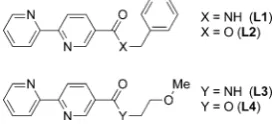
around the iron(II) centre, 5-benzylamido-2,2’-pyridine (L1,
Figure 1) was selected with the aromatic group separated from the amide by a flexible methylene spacer, and only one functional group per ligand. This ligand system has pre-viously been shown to have a good response to the
introduc-tion of anions in the complexmer-andfac-[Ru(L1)3]2
+.[8]
[image:3.595.359.496.660.722.2]Initial ESI-MS experiments indicated that a relatively straight forward spectrum, typical of the ionization of
[Fe(L1)3]Cl2, could be obtained by taking a 10mL solution
of a 10 mm stock solution of anhydrous FeCl2 in methanol
and mixing it with 60mL of a 10 mmstock solution in
aceto-nitrile of L1 and diluting the sample to 50mmwith
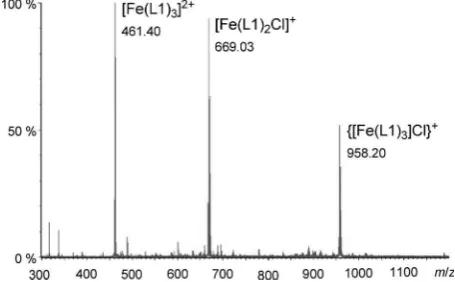
acetoni-trile (see the Experimental Section: Method A). Initially it was hoped to use only acetonitrile, however the solubility of the iron salt dictated that a small quantity of methanol was required to permit the initial dissolution. The detected spec-trum (Figure 2) proved to be diagnostic, with signals for
both [Fe(L1)3]2
+ at
m/z 461 and {[Fe(L1)3]Cl}
+ at
m/z 958 being particularly clear, in addition to peaks representing
[L1H]+
atm/z290, and {[Fe(L1)2]Cl}
+
atm/z669.
To ensure the iron(II) complex could be formed and de-tected in situ with structurally similar ligands to L1, the cor-responding ester ligand L2 was prepared by using a similar synthetic procedure to that previously reported for the
isola-tion of L1.[8]The resulting mass spectrum proved to be
com-parable under the same conditions (see the Supporting In-formation, Figure S1) with the observation of the doubly
charged complex [Fe(L2)3]2 + atm/z463 and [Fe(L2)2Cl]+ at
m/z 671 in addition to peaks representing [L2H]+ at m/z
291. However, to demonstrate speciation between the
lig-ACHTUNGTRENNUNG
ands, an appropriate soluble 2,2’-bipyridine ligand was
re-quired. The criteria were that the ligands should not have significantly different steric or electronic behaviour and no-ticeably different masses so that the respective molecular ions could be readily realized from the mass spectrum.
Ini-tial investigations with 2,2’-bipyridine, 5-methyl-2,2’
-bipyri-dine and 2,2’-bipyridine-4,4’-di(carboxylic acid methyl ester)
proved to be unsatisfactory, either due to ligand insolubility,
or the dominance of a species attributed to [Fe(L)2Cl]+ in
the resulting spectra. To overcome these problems, the read-ily soluble amide and ester ligands L3 and L4 were pre-pared. The mass spectrometry data on these two samples were recorded using an identical procedure as before (Method A, the Supporting Information Figures S2 and S3). For the amide-containing ligand, L3 peaks attributed to the
complexes [Fe(L3)3]
2 + at
m/z413, {[Fe(L3)2]Cl}
+ at
m/z605,
{[Fe(L3)3]Cl}+ atm/z862 and the free ligand [L3H]+ atm/z
258 were observed, whereas the corresponding ester L4
gave indicative peaks for [L4H]+ at
m/z259, [Fe(L4)3]
2 + at
m/z 415 and [Fe(L4)2Cl]+ at m/z607. Interestingly, neither
of the ester ligands L2 and L4 resulted in an assignable
signal attributed to {[Fe(L)3]Cl}+ giving an indication that
there is a much higher affinity for the chloride ion with ligand possessing an amide group over the analogous ester functionality.
Equilibria in mixed ligand systems: The two
amide-contain-ing ligands L1 and L3 were selected for the initial studies on the composition of heteroleptic solutions given that the indi-vidual homoleptic metal complexes gave clean and inter-pretable mass spectra for the iron(II) complexes. The first step of the investigation was to establish whether the metal complexes were at equilibrium (Scheme 1) under the condi-tions required to provide interpretable spectra, and
signifi-cantly whether the species being detected were representa-tive of the solution composition. The two complexes
[Fe(L1)3]Cl2and [Fe(L3)3]Cl2were prepared separately, and
then mixed in a 1:1 ratio following the protocol outlined in preparation method A. An excess of both ligands was used (in this case, 6 equivalents) to each metal ion to minimize
the presence of the bischelate species [Fe(L)2Cl]
+. The
spec-tra of the resulting pink solutions were then recorded over a period of 24 h establishing the time taken for the complexes
to reach equilibrium at 298 K. With anhydrous FeCl2, using
a little methanol to encourage solubility of the iron salt, the resulting mass spectra recorded after 30 min of mixing the two solutions demonstrated that the key regions of interest could be readily identified with peaks indicative of both bis-and tris-bipyridine species (Figure 3). Clusters of peaks are
observed for the exchange complex species for [FeACHTUNGTRENNUNG(L1/
L3)3]
2 + at
m/z413–461, [FeACHTUNGTRENNUNG(L1/L3)2Cl]
+at
m/z606–669, and
{[FeACHTUNGTRENNUNG(L1/L3)3]Cl}+ at m/z 862–958 ({[FeACHTUNGTRENNUNG(L1/L3)3]Cl}+. Over the course of the experiment, the relative intensities for
both the [Fe(L1)/(L3)3]2 + (m/z 413, 429, 445, 461) and
{[Fe(L1)/(L3)3]Cl}+ (m/z 862, 894, 926, 958) species were
normalized and their relative change over time plotted (Figure 4). This simple system appears to follow first order
kinetics (kCl=(1.70.1 10
[image:4.595.53.281.227.368.2]4) s 1), with the system reaching
Figure 2. ESI-MS spectrum of ligand L1 with FeCl2in acetonitrile (metal
ion concentration=50mm).
Scheme 1. The equilibrium identified within a combination of [Fe(L1)3]Cl2and [Fe(L3)3]Cl2in acetonitrile.
equilibrium in the order of four hours demonstrating the an-ticipated speciation in the final products. Importantly the
two species investigated, the divalent ion [Fe(L)3]2 + and the
monovalent ion {[Fe(L)3]Cl}
+, gave similar time plots
de-spite having different relative intensities in the spectra ana-lysed. Interestingly, the com-plexes formed from ligand L1 appears to be the more domi-nant over those composed of L3. Initially it was considered if this observation arose from the two different complexes having dissimilar ionization be-haviour, resulting in lower de-tection of the species contain-ing ligand L3, however the ion
count for the complexes
[Fe(L1)3]2 + and [Fe(L3)3]2 +
under similar conditions were comparable indicating that the observed speciation in the het-eroleptic system is probably representative of the
composi-tion of the solution, with
ligand L1 having a greater thermodynamic stability on the metal centre than L3. One would have expected the more sterically demanding ligand to have shown the weaker rela-tive binding but that does not appear to be the case.
The length of time taken for the system to achieve equili-brium was a surprising observation; in our preliminary stud-ies it was assumed that in acetonitrile a mixture of an iron(II) salt and bipyridine ligands rapidly reached equilibri-um given the instantaneous development of the characteris-tic dark pink colour upon mixing. This is consistent with a relatively quick formation of the kinetic product with the free metal ions. The subsequent ligand substitution, necessi-tating the displacement of a chelating bipyridine, to arrive at the thermodynamic distribution is much slower. This latter kinetic process determines the distribution of the dy-namic library and so needs to be taken into consideration when exploring the subsequent perturbation of an observed mixture of complexes.
The study was extended to a range of other iron(II) salts to investigate the effect that the counteranion has on the time taken for the system to reach equilibrium. The use of
FeBr2 as the iron source resulted in very similar behaviour
to that observed for FeCl2(the Supporting Information,
Fig-ure S4;kBr=(1.60.1 10 4) s 1) with a slightly longer time
to come to equilibrium (approx. five hours). In moving to iron(II) sources with anions that have a lower affinity to
metal coordination, namely FeACHTUNGTRENNUNG(ClO4)2 and FeACHTUNGTRENNUNG(BF4)2, the
time required to come to equilibrium was considerably longer (the Supporting Information, Figures S5 and S6; rate
constants of kClO4=(0.820.05 10
4) s 1 and k
BF4=(0.54
0.05 10 4) s 1 respectively), and was only fully complete
after 24 h in the latter case. This indicates that the nature of the counterion is extremely important in the process, with anions that readily coordinate to the metal ions making the exchange process occur more rapidly. Studies were also
at-Figure 3. ESI-MS spectrum of ligands L1 and L3 with FeCl2in acetonitrile 30 min after mixing (metal ion
[image:5.595.55.399.68.289.2]con-centration=50mm)
Figure 4. Time course graphs of normalized intensity obtained for FeCl2:L1:L3, determined for (a) {[FeACHTUNGTRENNUNG(L1/L3)3]Cl}
+ (
m/z 862, 894, 926, 958) species and (b) [FeACHTUNGTRENNUNG(L1/L3)3]2
+
(m/z413, 429, 445, 461). [Fe(L1)3]
(blue), [Fe(L1)2(L3)] (orange), [Fe(L1)(L3)2] (green) and [Fe(L3)3] (red).
[image:5.595.53.284.327.622.2]tempted using FeSO4, but precipitation of the induced com-plexes were observed approximately ten minutes after sample preparation and so no further investigation was un-dertaken with this system.
Comparison of the final distribution of the four complexes observed in the mass spectrum with the four salts tested
after 24 h indicates that for the divalent species [Fe(L)3]2
+
, the counteranion does not significantly affect the speciation (Figure 5), which approaches the expected statistical
polyno-mial distribution (1:3:3:1) of the four species (with a slight preference for ligand L1 over L3 as previously observed). A remarkably similar distribution was also observed in the monovalent species containing either perchlorate or tetra-fluoroborates ions. However, in the presence of simple halide ions, the preference for L1 over L3 in the complex
{[Fe(L1)3]X}
2+ (in which X is Cl or Br) is further
exaggerat-ed giving an indication that a bound anion can determine the product distribution. Hence, the anion is not only
in-volved in the rate at which the system reaches equilibrium, but significantly, it is also involved in determining the equili-brium, as would be anticipated if these anions are “binding” to the amide ligand systems.
The speciation of the mixtures resulting from pairs of both the two ester ligands (L2 and L4) and then with the amides (L1 and L3), using pre-prepared homoleptic samples
(method A) in the presence of FeCl2, FeBr2, FeACHTUNGTRENNUNG(ClO4)2and
FeACHTUNGTRENNUNG(BF4)2, were also considered both shortly after mixing, and then 24 h later. In each case, the iron(II) halide salts re-sulted in a mixture that was evidently a combination of all four possible components shortly after mixing the two com-ponents, but there were significant differences with the spec-tra taken after 24 h (Figure S7–S9). The perchlorate and tet-rafluoroborates salts were again observed to take considera-bly longer to reach equilibrium than the halide salts
follow-ing the order: Cl (shortest)<Br<ClO4<BF4(longest).
The final distribution of the divalent cations [Fe(L)3]
2+
developed from the ligand combinations L2 and L4, L2 and L3, and L1 and L4 after 24 h of equilibration also provided informative data (Figure 6). In the majority of ligand combi-nations with the counter tetrafluoroborates and perchlorate salts, the distribution of products proved to be similar to that seen with L1 and L3, which is consistent with equilibri-um having been achieved in all but one case; the
distribu-tion for the ester combinadistribu-tion of L2 and L4 with FeACHTUNGTRENNUNG(BF4)2
was still dominated by peaks assigned to [Fe(L2)3]2
+
and
[Fe(L4)3]
2+. The ligand combination L2 with L3 in the
pres-ence of FeCl2does not follow the expected 1:3:3:1
distribu-tion of [Fe(L2)3]2
+, [Fe(L2)
2(L3)]2
+, [Fe(L2)(L3)
2]2
+, and
[Fe(L3)3]2
+
, with the observed dominance of [Fe(L2)3]2
+
al-though it would appear that in this case the distribution of products has come to equilibrium given the depletion of
[Fe(L3)3]2
+
[image:6.595.71.264.192.314.2]from the system. This is further exaggerated with ligands L1 and L4, with complexation of the amide L1
Figure 5. Normalized intensities obtained for FeX2/L1 L3, determined
after 24 h for {[FeACHTUNGTRENNUNG(L1/L3)3]X}+ and [FeACHTUNGTRENNUNG(L1/L3)3]2 +. [Fe(L1)3] (blue),
[Fe(L1)2(L3)] (orange), [Fe(L1)(L3)2] (green) and [Fe(L3)3] (red).
Figure 6. Normalized intensities of obtained complexes determined after 24 h for [FeACHTUNGTRENNUNG(LA/LB) 3]2
+after mixing two solutions of the iron(II) source in the
presence of three ligands of (a) L1 and L3, (b) L2 and L4, (c) L2 and L3 and (d) L1 and L4 (metal ion concentration 50mm). [Fe(LA) 3] (blue),
[Fe(LA)
2(LB)] (orange), [Fe(LA)(LB)2] (green) and [Fe(LB)3] (red).
[image:6.595.96.502.509.701.2]dominating the coordination of the metal centre, with the inference being that the chloride anion “templates” the for-mation of the homoleptic amide species, presumably through the hydrogen bonding interactions of the amidic protons with the chloride in keeping with the findings of the
previously reported ruthenium(II) complexes.[8] This affect
is also observed with the iron(II) complexes formed from
FeBr2 and the L1 and L4 ligand system, but to a lesser
extent.
Given the observations, by mixing preformed complexes and letting them come to equilibrium, there is strong evi-dence that ESI-MS can be used to both understand the time to reach equilibrium, and the eventual speciation with rea-sonable certainty as to the identity of the dominant species, with the data being consistent with the results we have
pre-viously obtained for analogous ruthenium(II) complexes.[8]
Speciation in mixed ligand systems: To see if the relative
ratios of the complexes following electrospray ionization are typical of those that would be anticipated in solution, and in the absence of any other technique available to us to deter-mine the nature of the solution composition, the interaction of ligands L1 and L3 with the iron(II) salts was also studied by premixing the two ligands prior to the addition of the metal cations. A total of 10 molar equivalents of the ligands were used rather than 6 (see the Experimental Section: Method B) so that depletion of one of the ligands would not significantly affect the overall speciation, but without be-coming sufficiently large that the ligands themselves domi-nate the spectra. The ligand ratio was systematically varied from 100 % L1 to 100 % L3 in 10 % incremental steps using
a traditional Job plot analysis. Using FeCl2, FeClO4 and
FeBF4 as the iron(II) sources, there was good evidence of
the formation of the four possible tris-chelate bipyridine complexes whose overall concentration is dependent on the ligand ratio used (sample spectra available in the Supporting Information, Figure S10). The relative intensities of the peaks corresponding to the four tris-chelate species record-ed after one hour following the addition of the iron salt for
both {[FeACHTUNGTRENNUNG(L1/L3)3]X}
+ and [FeACHTUNGTRENNUNG(L1/L3)
3]
2 species as
deter-mined (Figure 7). The mass spectra were also recorded again after 24 h following the initial sample preparation, and comparison of this spectra with the spectra recorded after 1 hour revealed that the relative composition was invariant over this period. It would appear that under these condi-tions, the anion itself does not significantly affect the overall equilibrium, although the evidence indicates that, as with the previously discussed experiments, there is a slight prefer-ence for complexes containing ligand L1 over L3, which is marginally exaggerated in the presence of a chloride anion (see the Supporting Information, Figure S11). Using a pre-mixed ligand system seems to ensure that the thermodynam-ic mixture of products is isolated in a relatively short time given that the initial kinetic mixture is close to the final thermodynamic distribution.
The combination of the ester containing ligands L2 and L4 was also studied by premixing the ligands prior to
addi-tion of the iron source again using FeCl2, FeBr2, FeACHTUNGTRENNUNG(ClO4)2
and FeACHTUNGTRENNUNG(BF4)2as the iron sources. Again there is evidence of
the formation of the four possible metal complexes with the relative ratio of the species dependent on the ligand ratio used and again similar mass spectra were obtained with all iron(II) sources (the Supporting Information, Figure S12). It would appear that under these conditions, once again the anion present from the iron salt does not appear to greatly affect the overall equilibrium with no significant preference for either of the two ligands.
The interaction of the ester/amide ligand combinations
L2/L3, and L4/L1 with Fe2+
was also studied using a
pseudo-Job plot analysis using FeACHTUNGTRENNUNG(BF4)2as the iron(II) salt.
Problems were encountered using FeCl2as the source of the
metal cation with these ligand systems, disappointingly re-sulting in very low total ion counts and correspondingly un-usable spectra. This could have arisen either from the pres-ence of a slight precipitation, or due to the possible interac-tion of the amide ligands with the chloride anions which sig-nificantly disturbed the equilibrium. In considering the L2/
L3 system with FeACHTUNGTRENNUNG(BF4)2, there is evidence of the formation
[image:7.595.311.547.70.395.2]of the four possible interchanged tris-chelate bipyridine complexes whose concentrations are generally proportional
Figure 7. Speciation plots of [FeACHTUNGTRENNUNG(L1/L3)3]2
+ determined from the mass
spectroscopy data with varying concentrations of ligands L1 and L3 in the presence of (a) FeCl2, (b) FeACHTUNGTRENNUNG(ClO4)2 and (c) FeACHTUNGTRENNUNG(BF4)2. [Fe(L1)3]
(blue), [Fe(L1)2(L3)] (orange), [Fe(L1)(L3)2] (green) and [Fe(L3)3] (red).
to the ligand ratio used. The relative intensities again were
calculated and a distribution plot for both the [Fe(L)3]2
+
and {[Fe(L)3]ACHTUNGTRENNUNG(BF4)}
+were considered (the Supporting
Infor-mation, Figure S13). In this case, there is a slight preferen-tial binding for the amidic ligand L3 over the ester
contain-ing L2, particularly in the 2+ charge species. The
corre-sponding L4/L1 system was not particularly easy to analyse, with what appears to be poor data for the 9:1 and 3:7 ratios (the Supporting Information, Figure S14), but despite this, it would appear that the amide ligand (L1) would also be mar-ginally preferred over L4.
On the evidence available from these speciation plots, the relative peak intensities of the four species present in the spectra are representative of the anticipated speciation in the solution, with a preference for the amide ligands systems over those of the ester functions, presumably due to the op-portunities for additional hydrogen bonding, whereas the
benzyl-containing species are preferred over the methACHTUNGTRENNUNG
oxy-ACHTUNGTRENNUNG
ethyl group. These results, using premixed species (in a 5:5 ratio), replicate the equilibrium achieved after mixing the individual complexes and as a consequence, it is a reasona-ble assumption that the observed relative intensities deter-mined by ESI-MS do appear to be directly related to the an-ticipated solution composition.
Perturbation of the equilibrium: Having established that the
distribution of the complexes in solution could be deter-mined by ESI-MS, and that the ligand systems under investi-gation were under a dynamic equilibrium, the next consider-ation was whether introducing an external stimuli could cause a shift in the distribution. The above results have demonstrated that the equilibrium, particularly that of the
{[Fe(L)3](X)}
+ species, is dependent on the anion present.
Similarly, our preceding studies have also shown that the ki-netically inert species containing ligand L1 on ruthenium(II) have a degree of selectivity for dihydrogen phosphate and
chloride over a range of other anions.[8]The introduction of
phosphate ions is problematic given the propensity for com-plexes of this type to precipitate and for phosphate to hinder ionisation. As a result, the addition of chloride ions was considered to the iron(II) salts of the complexes formed
from a 5:5 ratio of pairs of ligand systems using FeACHTUNGTRENNUNG(BF4)2as
the metal cation source, making the assumption that the BF4
anion has a negligible coordination to either the ligands or metal ions involved. Ammonium chloride was initially se-lected as the salt of choice, with the ammonium cation being far from the mass region of interest; however, it also proved to be problematic because it gave an unidentified precipi-tate. The corresponding tetrabutylammonium (TBA) salt however proved to give reasonable spectra of the regions of interest with the addition of up to ten equivalents of the anions concerned, although slight problems were encoun-tered arising from the increased ion count.
On addition of TBACl to a distribution arising from
equi-molar ligand combinations and FeACHTUNGTRENNUNG(BF4)2 there were clear
differences observed depending on the ligand combination used. In case of the amide ligand system (L1/L3), a slight
change in the distribution of the species present was ob-served; with increasing amounts chloride present, there is an
increased quantity of [Fe(L1)3]2
+ and a corresponding
de-crease in [Fe(L1)(L3)2]2+ and [Fe(L3)3]2+ giving an
indica-tion that the complexes formed using L1 have a marginally greater preference for chloride than those composed from ligand L3 (Figure 8 a). Similar behaviour was shown by the ester ligand system (L2/L4), with a slight preference for the stabilization of metal complexes containing ligand L2 bear-ing the benzylester group (Figure 8 b) on the addition of chloride. It can be assumed therefore that the anions must be weakly associated with the aromatic functionality present in both L1 and L2. However for both of these systems, these effects are small, and could potentially be dismissed as being insignificant.
For the mixed amide/ester ligand systems, the titrations demonstrated very different behaviour and clearly illustrate the preference for amidic functionality in the metal com-plexes in the presence of large quantities of halide ions (Fig-ure 8 c and d). The spectra for the L2/L3 system (the Sup-porting Information, Figure S15 a) shows that upon addition
of TBACl, the peak corresponding to [Fe(L3)3]2
+
(m/z415)
has increased considerably at the expense of higher weight species containing the benzyl ester L2, whereas the amide containing complexes are formed preferentially over the cor-responding esters (as discussed previously). The introduction of chloride clearly drives this equilibrium further as
demon-strated by the depletion of [Fe(L2)(L3)2]
2+. This is evident
to an even greater extent in the L1/L4 mixture, with the
peak corresponding to [Fe(L1)3]2
+ (
m/z 461) increasing at
the expense of complexes containing L4 (the Supporting In-formation, Figure S15 b). In addition to the dominance of the amide containing species, the affect of the benzyl group further enhances the observed preference.
Given the titration data, the evidence shows that the ben-zylamide derivative (L1) does appear to be the overall pre-ferred ligand for use in the formation of complexes to bind to chloride, with ESI-MS demonstrating the suppression of similar species. On the addition of chloride to the mixtures, a colour change was also observed with the solutions becom-ing darker (more purple). This observation is readily moni-tored by UV/Vis spectroscopy with a systematic change being observed on the sequential addition of TBA chloride
to a mixture of FeACHTUNGTRENNUNG(BF4)2 and five equivalents of both L1
and L4 (the Supporting Information, Figure S17). However, given that four complexes are contributing to the observed metal-to-ligand-change-transfer band (not including species with metal bound chloride ions), multivariable modeling to obtain meaningful speciation data would be required even for this simple two ligand system. Attempts were also made to determine if a similar change in speciation could be
deter-mined by 1H NMR spectroscopy. However, severe
difficul-ties were observed; very broad peaks were encountered, either due to the presence of a small percentage of para-magnetic iron salts, and/or the dynamic nature of the system. Given the complexity of the large number of
over-lapping signals in the 1H NMR spectra, integration of
acteristic regions was not possible. The use of ESI-MS does however give direct access to the species present, where it would appear that both the gas and liquid phase studies are sufficiently similar to permit determination of the dominant species.
Conclusion
In the course of this work, an ESI-MS protocol has been es-tablished making it possible to evaluate the equilibrium of different bipyridine derivatives around an iron(II) centre, through the premixing of ligands followed by the introduc-tion of an iron(II) salt. The resulting dynamic equilibrium has then been shown to be perturbed by the addition of an external stimulus, in this case chloride. As indicated in the introduction, the design of anion receptors has over the years required considerable synthesis to create a suite of compounds to be directly compared to optimize for a degree of selectivity, certainly in our experience with ruthe-nium(II) complexes this has proved to be a considerable challenge. The use of a dynamic combinatorial library cen-tred on iron(II) and directly interrogated by ESI-MS has been shown here to have opportunities to identify potential candidates for a particular target analyte without undertak-ing considerable and potentially redundant synthetic work. However it is acknowledged that there are certain consider-ations that need to be made in creating a working model
system. In this paper we have demonstrated that using com-ponents that are sufficiently similar having analogous ioniza-tion potentials, that “fly” in the instrument together, and with comparable detection responses, these concerns can be mitigated. We have also confirmed that the resulting distri-bution of the iron complexes in the gas phase corresponds to that anticipated in the liquid phase.
Given the evidence outlined in this report, we conclude that the experimental protocol described herein has the po-tential to be an extremely powerful tool in the identification of synthetic target structures for the recognition of a wide variety of analytes. Given the continuing widespread consid-eration of ruthenium(II) polypyridyl complexes in the
detec-tion of DNA,[2] protein,[3, 46] and small molecules,[1]and the
difficulty in the synthetic procedures of these inert com-plexes, the initial screening using an iron(II) dynamic library monitored by ESI-MS will remove the requirement for a considerable amount of protracted and difficult synthesis. At the current time, the groups involved in this study are ex-tending the ideas shown to the design of recognition units for protein surfaces and key structural features in DNA.
Experimental Section
Instrumentation:1H and13C NMR spectra were recorded on a Bruker
[image:9.595.68.532.67.354.2]AV300, microanalyses and E.I. mass spectrometry were performed by A.S.E.P., The School of Chemistry, The Queens University of Belfast. Figure 8. Speciation plots of [FeACHTUNGTRENNUNG(LA/LB)
3]2 +using premixed equimolar quantities of (a) L1 and L3, (b) L2 and L4, (c) L3 and L2 and (d) L1 and L4, with
FeACHTUNGTRENNUNG(BF4)2in the presence of increasing equivalents of tetrabutylammonium chloride after 1 hour equilibrium (acetonitrile as solvent), metal ion
concen-tration 50mm. [Fe(LA)
3] (blue), [Fe(LA)2(LB)] (orange), [Fe(LA)(LB)2] (green) and [Fe(LB)3] (red).
Electrospray mass spectra were recorded on a LCT Premier electrospray mass spectrometer (Waters) fitted with a Nanomate injection system (Advion). Analysis was completed by using 10mL samples with an ac-quisition time of 1 min. The calibration of the spectrometer was checked using SULPHA prior to each acquisition set, with the capillary voltage set at 4229 V, cone voltage at 100 V and the source temperature at 1208C, respectively. Data analysis was completed using Mass Lynx v4.1, using both isotope modeling and elemental composition to confirm the proposed species where possible. Samples were analysed in positive mode using standard ESI+acquisition parameters whilst checking the total ion count (typically between 104–106). If the ion count value
exceed-ed 106, the solution was diluted with acetonitrile and re-run.
Materials: Anhydrous FeCl2, FeACHTUNGTRENNUNG(ClO4)2·xH2O and FeACHTUNGTRENNUNG(BF4)2·6H2O were
purchased from Sigma Aldrich, 2,2’-bipyridine was purchased from Alfa Aesar. HPLC grade methanol and acetonitrile were used throughout. THF was dried by distillation from sodium under nitrogen. 2,2’ -Bipyri-dine-5-carboxylic acid[47]and 5-benzylamido-2,2
’-bipyridine (L1)[8] were
prepared following literature procedures.
Synthesis: All ligands were prepared by a similar route (see below).
2,2’-Bipyridine-5-carboxylic acid benzylester (L2): Dry 2,2’ -bipyridine-5-carboxylic acid (1.00 g, 5.00 mmol) was refluxed in thionyl chloride (25 cm3) under nitrogen for 3 h, giving a clear yellow solution. The
thion-yl chloride was removed in vacuo and the residual solid dried under vacuum for 1 h. The acyl chloride was dissolved in dry THF under nitro-gen (50 mL) and brought to reflux. To this, a solution of benzyl alcohol (0.52 mL; 5.00 mmol) dissolved in dry THF (5 mL) and triethylamine (2 mL) was added dropwise over 1 h, and the resulting mixture cooled and stirred for 16 h at room temperature. This was poured into water (50 mL) and extracted using CH2Cl2(2 50 mL). The organic layer was
dried over anhydrous MgSO4, filtered and the solvent removed under
re-duced pressure leaving a light brown solid. The crude product was dis-solved in diethyl ether (50 mL), washed with water (2 50 mL) and dried over anhydrous MgSO4 to afford the product as a pale yellow/brown
solid (0.507 g, 35 %).1H NMR (300MHz, CDCl
3):d=5.42 (s, 2 H; CH2),
7.32–7.51 (m, 6 H; Har+ Hbpy5’), 7.85 (dd, J=7.5 Hz and 8.1 Hz, 1 H;
Hbpy4’), 8.43 (d,J=8.3 Hz, 1 H; Hbpy4), 8.48 (d,J=8.1 Hz, 1 H; Hbpy3’), 8.50
(d, J=8.3 Hz, 1 H; Hbpy3), 8.71 (d,J=4.8 Hz, 1 H; Hbpy6’), 9.31 ppm (s,
1 H; Hbpy6);13C NMR (75.47MHz, CDCl
3):d=67.1, 120.5, 121.9, 124.5,
125.6 (q), 128.3, 128.4, 128.7 135.6 (q) 137.0, 138.1, 149.4, 150.6, 155.5 (q), 158.9 (q), 165.2 ppm (q); EI-MSm/zcalcd for C18H14N2O2: 290.1055 [M]+
; found: 290.1060; elemental analysis calcd (%) for C18H14N2O2: C, 74.47,
H, 4.81, N, 9.65; found: C, 74.43, H, 4.71, N, 9.46.
5-(2-Methoxyethane)amido-2,2’-bipyridine (L3): Prepared using the same
procedure used to isolate L2 with the addition of 2-methoxyethylamine rather than benzylalcohol (0.76 g, 56 %). 1H NMR (300MHz, CDCl
3):
d=3.39 (3 H, s, CH3), 3.58 (2 H, t,J=5.0 Hz, CH2), 3.68 (dt, J=5.0 Hz
and 5.0 Hz, 2 H; CH2), 6.80 (br, 1 H; NH), 7.33 (dd, J=4.8 Hz and
7.5 Hz, 1 H; Hbpy5’), 7.82 (dd,J=7.5 and 7.8 Hz, 1 H; Hbpy4’), 8.19 (d,J=
8.3 Hz, 1 H; Hbpy4), 8.44 (d, J=7.8 Hz, 1 H; Hbpy3’), 8.47 (d, J=8.3 Hz,
1 H; Hbpy3), 8.68 (d, J=4.8 Hz, 1 H; Hbpy6’), 9.06 ppm (s, 1 H; Hbpy6); 13C NMR (75.47MHz, CDCl
3): d=40.2, 59.2, 71.4, 121.0, 122.0, 124.7,
130.1 (q), 136.2, 137.4, 148.2, 149.7, 155.5 (q), 158.9 (q), 166.0 ppm (q); EI-MS:m/z: calcd for C14H15N3O2: 257.1164 [M]+; found: 257.1169;
ele-mental analysis calcd (%) for C14H15N3O2: C, 65.36, H, 5.88, N, 16.33;
found: C, 65.20 H, 5.74 N, 16.36.
2,2’-Bipyridine-5-carboxylic acid 2-methoxyethane ester (L4): prepared using the same procedure used to isolate L2 with the addition of 2-ACHTUNGTRENNUNG
meth-ACHTUNGTRENNUNG
oxyethanol rather than benzylalcohol (0.465 g, 36 %). 1H NMR
(300MHz, CDCl3):d=3.44 (s, 3 H; CH3), 3.75 (t,J=4.6 Hz, 2 H; CH2),
3.68 (d,J=4.6 Hz, 2 H; CH2), 7.35 (dd,J=4.9 Hz and 7.4 Hz, 1 H; Hbpy5’),
7.84 (dd,J=7.4 and 7.9 Hz, 1 H; Hbpy4’), 8.42 (d,J=8.3 Hz, 1 H; Hbpy4),
8.47 (d,J=7.9 Hz, 1 H; Hbpy3’), 8.50 (d,J=8.3 Hz, 1 H; Hbpy3), 8.70 (d,J=
4.9 Hz, 1 H; Hbpy6’), 9.29 ppm (s, 1 H; Hbpy6); 13C NMR (75.47MHz,
CDCl3): d=59.1, 64.4, 70.4, 120.4, 121.9, 124.5, 125.5 (q), 137.0, 138.1,
149.3, 150.6 155.0 (q), 159.5 (q), 165.3 ppm (q); EI-MS:m/z: calcd for C14H14N2O3: 258.1004 [M]+; found: ) 258.1003 ; elemental analysis calcd
(%) for C14H14N2O3: C, 65.11, H, 5.46, N, 10. 85; found: C, 65.22 H, 5.30,
N, 11.05.
ESI-MS sample preparation: 10 mmstock solutions of the ligands and the iron salts were prepared in acetonitrile, with the exception of FeCl2,
which was prepared in methanol.
Method A: In an Eppendorf tube, the ligand (60mL) and the appropriate iron salt stock solution (10mL) were mixed. The solution was diluted to an overall concentration of 50mmby taking 70.4mL of this solution and diluting it to 200mL with acetonitrile). In mixed ligand systems, a 1:1 ratio mixture was obtained by taking 30mL of each of the diluted iron(II) solutions in a separate Eppendorf tube.
Method B: Using 10mL as being one equivalent, the appropriate number of equivalents required giving an overall total volume of 100mL of the mixed ligand system (i.e., 10 equivalents) were placed in an Eppendorf tube. A series of 11 samples ranging from 0:10 to 10:0 ligand ratios were typically prepared. Then 10mL of the iron salt stock solution was added and the sample left for 1 h to come to equilibrium, before recording the spectra, which was then re-recorded after 24 h to ensure consistency.
Addition of TBACl to the MS samples: 10 mmand 100 mmstock solutions of tetrabutylammonium chloride (TBACl) were prepared in acetonitrile. The appropriate volume of the TBACl stock solutions were used to add 0 to 10 equivalents to 50mL of the stock solutions of the two ligand sys-tems under investigation, followed by 10mL of the FeACHTUNGTRENNUNG(BF4)2stock
solu-tion. The solution was diluted to reach an overall concentration of ap-proximately 50mmwith respect to the iron salt by taking 11mL of this sol-ution and diluting it to 200mL with acetonitrile.
ESI-MS data normalization: ESI-MS data for systems containing more than one ligand by summation of the peak heights for the four possible components and then reporting the relative intensities of each of the components as a fraction of the total intensity.
Acknowledgements
This work was supported by the Leverhulme Trust, (F/00 203/P), the EPSRC (EP/F039069 and EP/F038712), and the European Research Council (ERC-StG-240324). The LCT Premier used to perform MS anal-yses at the University of Leeds was purchased with funds from the Well-come Trust (075099/Z/04/Z). Dr B. J. Duncombe (University of Edin-burgh) is kindly thanked for undertaking some preliminary studies that validated the data presented in this paper. The authors wish to thank Mr. Conor McGrann for assisting in the experimentation and maintaining the QUB Instrumentation primarily used in this study.
[1] M. H. Keefe, K. D. Benkstein, J. T. Hupp,Coord. Chem. Rev.2000,
205, 201 – 228.
[2] K. E. Erkkila, D. T. Odom, J. K. Barton,Chem. Rev.1999,99, 2777 – 2795; C. Metcalfe, J. A. Thomas,Chem. Soc. Rev.2003,32, 215 – 224. [3] M. H. Filby, J. Muldoon, S. Dabb, N. Fletcher, A. E. Ashcroft,
Chem. Commun.2011,47, 559 – 561; K. K. W. Lo, K. H. K. Tsang, K. S. Sze, C. K. Chung, T. K. M. Lee, K. Y. Zhang, W. K. Hui, C. K. Li, J. S. Y. Lau, D. C. M. Ng, N. Y. Zhu, Coord. Chem. Rev.2007,
251, 2292 – 2310; J. Muldoon, A. E. Ashcroft, A. J. Wilson, Chem. Eur. J.2010,16, 100 – 103.
[4] H. Takashima, S. Shinkai, I. Hamachi,Chem. Commun.1999, 2345 – 2346.
[5] V. Amendola, L. Fabbrizzi,Chem. Commun.2009, 513 – 531; D. J. Mercer, S. J. Loeb, Chem. Soc. Rev. 2010, 39, 3612 – 3620; M. E. Moragues, R. Martinez-Manez, F. Sancenon,Chem. Soc. Rev.2011,
40, 2593 – 2643; J. W. Steed,Chem. Soc. Rev.2009,38, 506 – 519. [6] L. H. Uppadine, M. G. B. Drew, P. D. Beer,Chem. Commun.2001,
291 – 292.
[7] B. Wu, J. Yang, X. Huang, S. Li, C. Jia, X.-J. Yang, N. Tang, C. Janiak,Dalton Trans.2011,40, 5687 – 5696.
[8] N. C. A. Baker, N. McGaughey, N. C. Fletcher, A. V. Chernikov, P. N. Horton, M. B. Hursthouse,Dalton Trans.2009, 965 – 972. [9] M. Albrecht, J. Inclusion Phenom. Macrocyclic Chem. 2000, 36,
127 – 151; J. G. de Vries, L. Lefort,Chem. Eur. J. 2006, 12, 4722 –
4734; A. Herrmann, Org. Biomol. Chem. 2009, 7, 3195 – 3204; R. A. R. Hunt, S. Otto, Chem. Commun.2011,47, 847 – 858; J. M. Lehn,Chem. Eur. J.1999,5, 2455 – 2463; J. R. Nitschke,Acc. Chem. Res.2007,40, 103 – 112; S. J. Rowan, S. J. Cantrill, G. R. L. Cousins, J. K. M. Sanders, J. F. Stoddart, Angew. Chem.2002,114, 938 – 993;
Angew. Chem. Int. Ed.2002,41, 898 – 952. [10] M. Barboiu,Chem. Commun.2010,46, 7466 – 7476.
[11] P. T. Corbett, J. Leclaire, L. Vial, K. R. West, J. L. Wietor, J. K. M. Sanders, S. Otto,Chem. Rev.2006,106, 3652 – 3711.
[12] G. R. L. Cousins, S. A. Poulsen, J. K. M. Sanders,Chem. Commun. 1999, 1575 – 1576.
[13] K. Severin,Chem. Eur. J.2004,10, 2565 – 2580.
[14] B. Saur, R. Scopelliti, K. Severin, Chem. Eur. J.2006,12, 1058 – 1066.
[15] F. Schleef, U. Luening,Euro. J. Org. Chem.2011,2011, 2062 – 2065. [16] J. M. Klein, V. Saggiomo, L. Reck, M. McPartlin, G. D. Pantos, U. Luening, J. K. M. Sanders, Chem. Commun. 2011, 47, 3371 – 3373; J. M. Klein, V. Saggiomo, L. Reck, U. Luning, J. K. M. Sanders,Org. Biomol. Chem.2012,10, 60 – 66.
[17] P. Besenius, P. A. G. Cormack, R. F. Ludlow, S. Otto, D. C. Sherring-ton,Org. Biomol. Chem.2010,8, 2414 – 2418.
[18] J. Leclaire, G. Husson, N. Devaux, V. Delorme, L. Charles, F. Ziarel-li, P. Desbois, A. Chaumonnot, M. Jacquin, F. Fotiadu, G. Buono,J. Am. Chem. Soc.2010,132, 3582 – 3593.
[19] S. R. Beeren, M. Pittelkow, J. K. M. Sanders,Chem. Commun.2011,
47, 7359 – 7361.
[20] Z. Rodriguez-Docampo, E. Eugenieva-Ilieva, C. Reyheller, A. M. Belenguer, S. Kubik, S. Otto,Chem. Commun.2011,47, 9798 – 9800; R. Custelcean, P. Remy, P. V. Bonnesen, D.-E. Jiang, B. A. Moyer,
Angew. Chem.2008,120, 1892 – 1896;Angew. Chem. Int. Ed.2008,
47, 1866 – 1870; R. Custelcean, A. Bock, B. A. Moyer,J. Am. Chem. Soc.2010,132, 7177 – 7185.
[21] R. Custelcean, J. Bosano, P. V. Bonnesen, V. Kertesz, B. P. Hay,
Angew. Chem.2009,121, 4085 – 4089;Angew. Chem. Int. Ed.2009,
48, 4025 – 4029.
[22] V. Goral, M. I. Nelen, A. V. Eliseev, J. M. Lehn,Proc. Natl. Acad. Sci. USA2001,98, 1347 – 1352.
[23] B. Hasenknopf, J.-M. Lehn, B. O. Kneisel, G. Baum, D. Fenske,
Angew. Chem.1996,108, 1987 – 1990;Angew. Chem. Int. Ed. Engl. 1996,35, 1838 – 1840; B. Hasenknopf, J.-M. Lehn, N. Boumediene, A. Dupont-Gervais, A. Van Dorsselaer, B. Kneisel, D. Fenske, J. Am. Chem. Soc.1997,119, 10956 – 10962.
[24] N. Giuseppone, J. L. Schmitt, J. M. Lehn,J. Am. Chem. Soc.2006,
128, 16748 – 16763; P. N. W. Baxter, R. G. Khoury, J. M. Lehn, G. Baum, D. Fenske,Chem. Eur. J.2000,6, 4140 – 4148.
[25] M. Barboiu, F. Dumitru, Y.-M. Legrand, E. Petit, A. van der Lee,
Chem. Commun.2009, 2192 – 2194; M. Barboiu, E. Petit, A. van der Lee, G. Vaughan,Inorg. Chem.2006,45, 484 – 486; F. Dumitru, Y.-M. Legrand, A. Van der Lee, Y.-M. Barboiu, Chem. Commun.2009, 2667 – 2669; Y.-M. Legrand, A. van der Lee, M. Barboiu, Inorg. Chem.2007,46, 9540 – 9547.
[26] B. Brisig, E. C. Constable, C. E. Housecroft,New J. Chem.2007,31, 1437 – 1447.
[27] S. Sakai, Y. Shigemasa, T. Sasaki,Bull. Chem. Soc. Jpn.1999,72, 1313 – 1319.
[28] C. Karan, B. L. Miller,J. Am. Chem. Soc.2001,123, 7455 – 7456.
[29] M. S. Goodman, V. Jubian, B. Linton, A. D. Hamilton,J. Am. Chem. Soc.1995,117, 11610 – 11611.
[30] I. Huc, M. J. Krische, D. P. Funeriu, J. M. Lehn,Eur. J. Inorg. Chem. 1999, 1415 – 1420.
[31] S. G. Telfer, X. J. Yang, A. F. Williams,Dalton Trans.2004, 699 – 705. [32] M. A. Case, G. L. McLendon,J. Am. Chem. Soc.2000,122, 8089 –
8090.
[33] D. M. Epstein, S. Choudhary, M. R. Churchill, K. M. Keil, A. V. Eli-seev, J. R. Morrow,Inorg. Chem.2001,40, 1591 – 1596.
[34] E. C. Constable, C. E. Housecroft, T. Kulke, C. Lazzarini, E. R. Schofield, Y. Zimmermann,J. Chem. Soc. Dalton Trans.2001, 2864 – 2871.
[35] G. Hefter,Pure Appl. Chem.2006,78, 1571 – 1586.
[36] L. F. Bornaghi, B. L. Wilkinson, M. J. Kiefel, S. A. Poulsen, Tetrahe-dron Lett.2004,45, 9281 – 9284; F. Dumitru, E. Petit, A. van der Lee, M. Barboiu,Eur. J. Inorg. Chem. 2005, 4255 – 4262; T. Hotchkiss, H. B. Kramer, K. J. Doores, D. P. Gamblin, N. J. Oldham, B. G. Davis,Chem. Commun.2005, 4264 – 4266; S.-A. Poulsen,J. Am. Soc. Mass Spectrom.2006,17, 1074 – 1080; S. A. Poulsen, L. F. Bornaghi,
Bioorg. Med. Chem.2006,14, 3275 – 3284; S. A. Poulsen, P. J. Gates, G. R. L. Cousins, J. K. M. Sanders,Rapid Commun. Mass Spectrom. 2000,14, 44 – 48; H. Schiltz, M.-K. Chung, S. J. Lee, M. R. Gagne,
Org. Biomol. Chem.2008,6, 3597 – 3600.
[37] V. B. Di Marco, G. G. Bombi,Mass Spectrom. Rev.2006,25, 347 – 379; M. J. Keith-Roach,Anal. Chim. Acta2011,684-708, 140 – 148. [38] E. Leize, A. Jaffrezic, A. VanDorsselaer,J. Mass Spectrom.1996,31,
537 – 544.
[39] L. Duchackova, J. Roithova, P. Milko, J. Zabka, N. Tslerkezos, D. Schroeder,Inorg. Chem.2011,50, 771 – 782.
[40] A. Rvsz, D. Schroeder, J. Svec, M. Wimmerova, V. Sindelar, J. Phys. Chem. A2011,115, 11378 – 11386.
[41] S. Goetz, P. E. Kruger,Dalton Trans. 2006, 1277 – 1284; L. P. Har-ding, J. C. Jeffery, T. Riis-Johannessen, C. R. Rice, Z. T. Zeng,
Chem. Commun.2004, 654 – 655; L. P. Harding, J. C. Jeffery, T. Riis-Johannessen, C. R. Rice, Z. T. Zeng,Dalton Trans.2004, 2396 – 2397; S. G. Telfer, G. Bernardinelli, A. F. Williams,Chem. Commun.2001, 1498 – 1499; B. Wu, X. J. Yang, C. Janiak, P. G. Lassahn, Chem. Commun.2003, 902 – 903.
[42] P.-K. Mller-Graff, H. Szelke, K. Severin, R. Kraemer,Org. Biomol. Chem.2010,8, 2327 – 2331.
[43] C. L. Gatlin, F. Turecek,Anal. Chem.1994,66, 712 – 718. [44] P. D. Beer, E. J. Hayes,Coord. Chem. Rev.2003,240, 167 – 189. [45] P. D. Beer, N. C. Fletcher, T. Wear,Polyhedron1996,15, 1339 – 1347;
P. D. Beer, S. W. Dent, T. J. Wear,J. Chem. Soc. Dalton Trans.1996, 2341 – 2346; P. D. Beer, S. W. Dent, G. S. Hobbs, T. J. Wear,Chem. Commun.1997, 99 – 100; L. H. Uppadine, F. R. Keene, P. D. Beer,J. Chem. Soc. Dalton Trans. 2001, 2188 – 2198; P. D. Beer, C. A. P. Dickson, N. Fletcher, A. J. Goulden, A. Grieve, J. Hodacova, T. Wear,J. Chem. Soc. Chem. Commun.1993, 1240.
[46] J. Ohkanda, R. Satoh, N. Kato,Chem. Commun.2009, 6949 – 6951. [47] N. C. Fletcher, M. Nieuwenhuyzen, S. Rainey,J. Chem. Soc. Dalton
Trans.2001, 2641 – 2648.
Received: April 17, 2012 Revised: July 26, 2012 Published online: September 20, 2012

![Figure 6. Normalized intensities of obtained complexes determined after 24 h for [FeACHTUNGTRENUNG(LA/LB)3]2+ after mixing two solutions of the iron(II) source in thepresence of three ligands of (a) L1 and L3, (b) L2 and L4, (c) L2 and L3 and (d) L1 and L4](https://thumb-us.123doks.com/thumbv2/123dok_us/7992065.205866/6.595.71.264.192.314/normalized-intensities-obtained-complexes-determined-feachtungtrenung-solutions-thepresence.webp)
![Figure 7. Speciation plots of [FeACHTUNGTRENUNG(L1/L3)3]2+ determined from the massspectroscopy data with varying concentrations of ligands L1 and L3 inthe presence of (a) FeCl2, (b) FeACHTUNGTRENUNG(ClO4)2 and (c) FeACHTUNGTRENUNG(BF4)2](https://thumb-us.123doks.com/thumbv2/123dok_us/7992065.205866/7.595.311.547.70.395/speciation-feachtungtrenung-determined-massspectroscopy-concentrations-presence-feachtungtrenung-feachtungtrenung.webp)
![Figure 8. Speciation plots of [FeACHTUNGTRENUNG(LA/LB)3]2+ using premixed equimolar quantities of (a) L1 and L3, (b) L2 and L4, (c) L3 and L2 and (d) L1 and L4, withFeACHTUNGTRENUNG(BF4)2 in the presence of increasing equivalents of tetrabutylammonium chlo](https://thumb-us.123doks.com/thumbv2/123dok_us/7992065.205866/9.595.68.532.67.354/speciation-feachtungtrenung-equimolar-quantities-withfeachtungtrenung-increasing-equivalents-tetrabutylammonium.webp)
