This is a repository copy of
Biomimetic robots as scientific models: a view from the
whisker tip
.
White Rose Research Online URL for this paper:
http://eprints.whiterose.ac.uk/107024/
Version: Accepted Version
Book Section:
Prescott, A.J., Mitchinson, B., Pearson, M.J. et al. (1 more author) (2011) Biomimetic
robots as scientific models: a view from the whisker tip. In: Krichmar, J. and Wagatsuma,
H., (eds.) Neuromorphic and Brain-Based Robots. Cambridge University Press , pp. 23-57.
ISBN 9780521768788
[email protected] https://eprints.whiterose.ac.uk/ Reuse
Unless indicated otherwise, fulltext items are protected by copyright with all rights reserved. The copyright exception in section 29 of the Copyright, Designs and Patents Act 1988 allows the making of a single copy solely for the purpose of non-commercial research or private study within the limits of fair dealing. The publisher or other rights-holder may allow further reproduction and re-use of this version - refer to the White Rose Research Online record for this item. Where records identify the publisher as the copyright holder, users can verify any specific terms of use on the publisher’s website.
Takedown
If you consider content in White Rose Research Online to be in breach of UK law, please notify us by
Biomimetic robots as scientific models: A
view from the whisker tip
0.1 Introduction 3
Abstract
Why build robot models of animals and their nervous systems? One an-swer is that in building a robot model of a target organism, that mimics sufficiently some aspects of that animal’s body, brain and behaviour, we can expect to learn a good deal about the original creature. Synthesis (engineering) is quite different from analysis (reverse-engineering), often easier, and teaches fascinating lessons (Braitenberg, 1986). Another an-swer is that a robot model should allow us to conduct experiments, that will help us better understand the biological system, and that would be impossible or at least much more difficult to perform in the original ani-mal (Rosenblueth and Wiener, 1945). In this chapter our target organism is the rat and our specific focus is on the sophisticated tactile sensory sys-tem provided by that animal’s facial whiskers (vibrissae). Neurobiology shows us that the brain nuclei and circuits that process vibrissal touch signals, and that control the positioning and movement of the whiskers, form a neural architecture that is a good model of how the mammalian brain, in general, co-ordinates sensing with action. Thus, by building a robot whisker system, we can take a significant step towards building the first robot ‘mammal’. Following a short review of relevant rat biology, this chapter will describe the design and development of two whiskered robot platforms—Whiskerbot and SCRATCHbot—that we have con-structed in order to better understand the rat whisker system, and to test hypotheses about whisker control and vibrissal sensing in a physical brain-based device. We provide a description of each platform, including mechanical, electronic and software components, discussing, in relation to each component, the design constraints we sought to meet and the trade-offs made between biomimetic ideals and engineering practicali-ties. Some results obtained using each platform are described together with a brief outline of future development plans. Finally, we discuss the use of biomimetic robots as scientific models and consider, using the ex-ample of whiskered robots, what contribution robotics can make to the brain and behavioural sciences.
0.1 Introduction
Figure 0.1 Macro- and microvibrissae. Left inset shows a close-up of the microvibrissal region centered around the upper lip (see outlined region on main image), the right inset shows the microvibrissae being used to investigate a coin lying on the floor. Note the regular grid-like organisation of the actuated macrovibrissae.
is primary in primates—to the untrained eye the behaviour of blind rats can appear indistinguishable from that of sighted animals.
0.1 Introduction 5
The whisker system has become very popular as a model sensory sys-tem in neuroscience owing to its discrete organisation from the sen-sory apparatus (the whisker shaft) all the way to the sensen-sory cortex (Petersen, 2007), its ease of manipulation and, not least, its presence in the laboratory rat. Our approach to this system begins with neu-roethology, wherein we study neural systems holistically, including the observation of natural behaviour as well as comparative and evolution-ary data, and leading to computational models. We then expose these models to the complexities of real-world operation, and the demands of functional robotics, revealing shortcomings that do not manifest in sim-ulation. This engineering process feeds back, raising questions that are not raised (or addressed) by current biological data, and guiding us in the design of future biological experiments. Along the way, we hope to show that whiskers can be a useful robotic sensory system.
Below, we briefly review the neuroethology of the rat whisker system, including results from behavioural experiments conducted in our own laboratory. We then go on to describe two robotic platforms that we have developed, ‘Whiskerbot’ and ‘SCRATCHbot’. Whiskerbot was our first attempt to develop a biomimetic model of the rat whisker system and was, consequently, the more primitive mechanically. Investigations focussed on embedded models of neural processing as well as our first efforts to build and control artificial whiskers. SCRATCHbot1
is our latest platform and still a work-in-progress. Compared to Whiskerbot, the new robot is more refined mechanically and electrically and has more degrees of freedom. The sensor transduction and whisker actuation mechanisms have been redesigned based on insights drawn from our earlier attempt. SCRATCHbot’s control system uses a mixture of neural-like and arithmetic computation with a focus on modelling motor control and sensory processing at a relatively abstract level. Its whisker system is also much closer to being a practical artificial sensory system, with possible applications in autonomous robotics.
Our work builds on, and was inspired by, a large number of previ-ous research efforts in robotic tactile sensing systems, including, but not limited to, other whiskered robots that have been developed (Rus-sell and Wijaya, 2005; Fend et al., 2004; Kim and M¨oller, 2004; Seth et al., 2004a; Solomon and Hartmann, 2006). We have recently provided an extensive review of artificial whisker systems (Prescott et al., 2009) therefore related projects are mentioned below only where they are of
direct relevance to the design decisions that we made in developing our own robot platforms. Our wider goal, through this review, is to describe the development of a research programme in neuromorphic robots, in-cluding the trade-offs made between accurate biomimicry and the need to engineer functioning systems at reasonable cost. We aim to show that, despite these constraints, the robotics provides insights to the biology; we will illustrate this using examples, and discuss the matter at the end of the chapter.
0.2 Neuroethology of the rat vibrissal system
0.2.1 Morphology, sensory transduction, and whisker
actuation
Rat macrovibrissae are made of keratin, are tapered from base to tip, are curved (Figure 0.1), and are typically between 20 and 50 mm long (length varying regularly with location on the face) (Brecht et al., 1997). Their frequency response and other mechanical characteristics have been quantified both in vivo and ex vivo (Hartmann et al., 2003; Neimark et al., 2003), and mechanical response seems to play a key role in signal transduction (Lottem and Azouz, 2009).
0.2 Neuroethology of the rat vibrissal system 7
identified (that is, a typical ‘whisk’ is reminiscent of a ‘rowing’ action), as has a torsional rotation of the shaft during the whisk cycle (Knutsen et al., 2008). Furthermore, the whisker columns move at somewhat dif-ferent speeds with the net effect that the angular separation, or spread, between the whiskers varies significantly within each whisk cycle (Grant et al., 2009). Finally, the whiskers do not always move in concert on the two sides of the face (Sachdev et al., 2003; Mitchinson et al., 2007), and the mystacial pad moves substantially during whisking (Hill et al., 2008). Nonetheless, AP motion of all whiskers together describes a large proportion of overall whisker motion (Grant et al., 2009).
The ‘intrinsic’ muscles are found under the skin of the pad, wrap around each follicle, and are anchored to the skin and/or to neighbouring follicles (D¨orfl, 1982), These drive ‘protraction’ (forward angular motion) of whiskers individually, by rotating the follicle around a lower pivot point beneath the skin (D¨orfl, 1982; Wineski, 1985). Whisker ‘retraction’ (rearward angular motion) is partly passive, due to the elastic properties of the skin, and partly active, driven by the ‘extrinsic’ muscles to the rear of the pad (Carvell et al., 1991). These muscles pull the pad backward, causing all the follicles to rotate around an upper pivot point (Berg and Kleinfeld, 2003). A more recent study reports a contribution to protraction from another set of extrinsic muscles forward of the pad (Hill et al., 2008).
0.2.2 Whisker motion and active sensing behaviour
Rats generally whisk when they are exploring an environment or at-tempting most forms of tactile discrimination. Studies of neural re-sponses to ‘passive’ whisker deflection (deflecting the whiskers of an anaesthetised rat) are therefore beginning to give way to studies of more natural ‘active’ deflection where moving whiskers encounter stationary obstacles. These studies show that whisker motion plays a key role in signal formation. There is no evidence of proprioception in the whisker musculature but angle cells may provide equivalent information (Szwed et al., 2003). Either these cells, or the temporal relationship between whisker motion and whisker deflection, are thought to provide the in-formation necessary to transform deflections of moving whiskers into an appropriate head-centered reference frame (Szwed et al., 2003; Ahissar and Arieli, 2001).
6-10Hz interspersed by periods of inactivity, are typical. Whisk frequency tends to be relatively constant within a bout (Hill et al., 2008) but other kinematic parameters can vary substantially driven, apparently, by both internal and external variables. The strongest observed external influence is whisker-environment contact, which rarely fails to modu-late whisking (Grant et al., 2009; Mitchinson et al., 2007). For instance, a unilateral unexpected whisker-environment contact generally leads to suppression of protraction ipsilaterally (i.e. on the side the contact was made) and to increased protraction amplitude contralaterally (see fig-ure 0.2). We hypothesise that this is the outcome of a control policy we term ‘Minimal Impingement, Maximal Contact’ (MIMC), which tends to maximise the count of whisker-environment contacts, whilst keeping the depth of those contacts within a managed range to maintain signal quality. A further observation (Grant et al., 2009) that spread between whisker columns is reduced during environmental contact is consistent with this policy, with rearward, non-contacting, whiskers brought for-ward to meet an ipsilateral obstruction. Another, internal, modulatory influence is head-rotation, whereby the animal appears to preempt up-coming head rotations by moving its whiskers backward (forward) on the side to which (away from which) the head will turn (Towal and Hartmann, 2006). In addition to these asymmetries, a temporary loss of bilateral synchrony in whisker movements is often observed following a unilateral contact (Mitchinson et al., 2007), whilst repeated contacts with the environment can lead to longer periods of desynchronization (unpublished results from our laboratory).
Psychophysical and behavioural experiments (see (Prescott et al., In press) for review) show that, using only the data gathered by their macrovibrissae, rats can locate objects accurately in space (Knutsen et al., 2006), perform fine textural discriminations (Carvell and Simons, 1990), and judge gap widths (Krupa et al., 2001), and that both macro-and micro- vibrissae are required for effective prey capture (Anjum et al., 2006). However, a reasonable hypothesis is that macrovibrissae are pri-marily used for locating objects, and then microvibrissae are brought to bear for close investigation (Brecht et al., 1997). For instance, the microvibrissae seem to be used preferentially in a shape-discrimination task (Brecht et al., 1997; Fox et al., 2009), and in our own laboratory, where we do not constrain the animal’s behaviour, we consistently see the microvibrissae used for close investigation of surfaces and objects.
0.2 Neuroethology of the rat vibrissal system 9
Figure 0.2 Whisking asymmetry induced by contact with a surface. Frames from two example high-speed video sequences recorded in our laboratory, showing exploring rats with whiskers at the maximum protraction phase of the whisk cycle, but with the whiskers ipsilat-eral to an object of interest held back towards the cheek, whilst the contralateral whisker field pushes forward towards the surface. Elec-tomyograph recordings from the whisking muscles confirm that the contralateral whiskers are driven significantly harder than the ipsi-lateral ones (Mitchinson et al., 2007). We interpret behaviour such as this as evidence for a ‘Minimal Impingement, Maximal Contact’ (MIMC) active sensing control strategy.
to as a series of orients to immediately-sensed features, are also seen. In such conditions, where locomotion is not motivated by sensing, we might expect different whisking behaviour, attuned more to supporting locomotion (e.g. to ensure a sound footing and avoid collisions) rather than to maximising the gain of new sensory information. Experiments to establish whether rat whisking behaviour is noticeably different in these circumstances are currently in progress in our laboratory.
Orients are generally observed to occur on the timescale of one or two whisking periods (Prescott et al., 2009). Contact usually occurs dur-ing whisker protraction, and repositiondur-ing of the snout may complete quickly enough such that the battery of contacts due to the subsequent protraction sample the neighbourhood of the attended object. Supple-mentary video 1 shows an example orient that completes in about one whisking period. In this clip, the orient has begun by 40ms following contact, and completes around 160ms after contact (with the peak of the subsequent protraction occurring about 120ms after contact). Some orients may take two (perhaps, more) whisks to complete—for instance supplementary video 2 shows an orient completed in the space of two whisks.
After orienting, the animal will often keep its snout near to an at-tended object for a few whisks in order to investigate it more closely using the sensory equipment around the snout. This activity can be com-plex, and is thus less easy to describe, but we often see an investigative behaviour we refer to as ‘dabbing’, whereby the microvibrissae are lightly touched or brushed against the object in synchrony with macrovibrissal protractions (Hartmann, 2001; Prescott et al., 2005). The result is that tactile information is obtained at high spatial density towards the center of the dab, through the microvibrissal array, whilst, within the same nar-row time window, surrounding surfaces are sampled in a sparser fashion by the macrovibrissae. Supplementary video 1 shows the animal, im-mediately following the orient, performing five ‘dabs’ at the attended feature (the corner of a block) before appearing to move on, whisking and dabbing across the wider extent of the object. The whole operation, from contact through orient and dabbing to moving on, is completed within three quarters of a second.
0.2.3 Neurobiology of the rat vibrissal system
0.2 Neuroethology of the rat vibrissal system 11
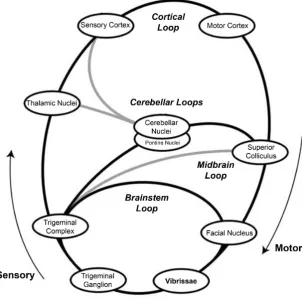
Figure 0.3 Neuroanatomical loops in the whisker system of the rat (modified from Kleinfeld et al. (2006)). Loops through non-whisker musculature (neck, shoulders, etc.) are not shown. Whisker sensory signals pass up from the vibrissae via the trigeminal nerves to the trigeminal sensory complex. From here, they pass along multiple loop paths, including: directly to the facial nucleus and back to the muscles driving the vibrissae; through superior colliculus; through cerebellar nuclei; through sensory and motor cortex via the thalamic nuclei.
(Krupa et al., 2001). However, it is important not to over-emphasise the role of this feedforward pathway to the cortex. As is clear from the dia-gram, the more general character of the system is that it consists of a set of nested closed loops which likely have different, though overlapping, functional roles. Each of these loops connects sensation to actuation at relatively short latencies, particularly at the lower levels of the neuraxis.
For instance, the pathway via the trigeminal complex to the facial nucleus, which contains the motoneurons that drive the intrinsic and extrinsic whisking musculature, provides a fast and direct, brainstem-only pathway through which contact information could affect the on-going movement of the whiskers (Nguyen and Kleinfeld, 2005; Mitchin-son et al., 2007). A midbrain loop through the superior colliculus (SC) (Drager and Hubel, 1976) is likely to underlie whisker-initiated orient-ing and avoidance responses (Sahibzada et al., 1986). The latency for whisker deflection signals to reach the SC may be as short as 5 mil-liseconds (Cohen et al., 2008) thus providing the capacity for very rapid orients as might be required, for instance, when the source of the stimu-lus is a moving prey animal. From the S1 cortex signals pass to the motor cortex (MCx) which has a substantial area devoted to the whisker sys-tem (Haiss and Schwarz, 2005). Although it is known that MCx sends a large projection to the brain areas involved in whisking pattern genera-tion (Kleinfeld et al., 1999), its precise role in modulating or initiating whisking is poorly understood. Areas such as the trigeminal complex, SC, and S1 also project to two brain sub-systems that perform more general purpose roles within the brain architecture, the cerebellum and basal ganglia (BG). The cerebellum is thought to function as an adaptive filter (Dean et al., 2010) that could, for instance, use current state to predict future sensory signals. In contrast, the role of BG seems to be to provide action selection (Redgrave et al., 1999), that is, to decide which of the many possible behaviours available to the animal are engaged at any one time.
0.3 Whiskerbot 13
0.3 Whiskerbot
Our first foray into whiskered robotics was Whiskerbot (2003-2007) (Pearson et al., 2007b), which ran simultaneously with an effort to model neural components of the rat whisker sensory system. Computational models were developed of transduction in the whisker follicle (Mitchin-son et al., 2004, 2008), processing in the trigeminal nucleus (Pear(Mitchin-son et al., 2007a), transformation of whisker signals into a head-centered reference frame, orienting to whisker contacts (Mitchinson et al., 2006), and whisking pattern generation and its modulation by contact signals (Mitchinson et al., 2007). A number of these models used arrays of arti-ficial ‘leaky-integrate-and-fire’ (LIF) neurons and were designed run on embedded onboard digital hardware in real-time (Pearson et al., 2006b, 2007a). The robot, including deployment of these models, is discussed in this section.
0.3.1 Robot
Whiskers and transducers
Since our control models are based on the neural systems of the rat, we expect them to work with signals of the type used by the rat. Where those systems are not fully understood, we cannot assume that they will work with signals with different characteristics. Our approach, therefore, is to engineer our whiskers to match those of the animal as closely as possible. Biological whiskers display an enviable combination of stiffness and damping, and even light contacts on the tip can elicit orienting, indicating that they effectively propagate mechanical deformation. Our hope was to design artificial whiskers for our robot with similar physical characteristics to their natural counterparts so that our robotic sensors would share these beneficial properties. Inevitably, however, since we were designing an engineered system composed of non-biological mate-rials, the desire to accurately mimic the properties of natural whiskers and of the tissues that support them was balanced against engineering practicalities, necessitating some compromises, described below.
arti-ficial whiskers and configured to measure strain in two axes, which we denote x(AP) andy (DV) (Pearson et al., 2007b). The advantages of this approach were two-dimensional measurement, high sensitivity, and large bandwidth (limited only by sampling speed). The disadvantage of strain gauges is that high strains can reduce bond integrity, leading to calibration drift. Similar gauges have also been used recently configured, as in Whiskerbot, to measure two-dimensional strain at the whisker base (Quist and Hartmann, 2008).
Given this gauge technology, manufacturing constraints (particularly, attaching the gauges securely) forced us to build our whiskers physically scaled-up by a factor of four. Moreover, a complex robot of similar size to a rat would generate significant engineering challenges that we are not currently equipped to face. To mitigate the effect of this change on whisker dynamics, we adopted a temporal scaling-down by a factor of two (that is, our neural models ran at half wall-clock speed when deployed on the robot). This temporal scaling means that we match the animal’s behaviour by whisking at a more leisurely pace of around 3-4Hz.
We tested a variety of materials for the whisker shaft. A major finding was that, to generate a strain at the base of the whisker that was well clear of the noise floor, we were forced to build from materials much stiffer than those of real whiskers. This compromise did not prevent useful modelling—indeed, experiments described later in this chapter demonstrate effective contact detection and texture discrimination using these whiskers. What remains to be discovered is whether additional, or higher quality, sensory information might be recovered from whiskers that are a closer physical match to biology. An active line of research in our own and other laboratories is mechanical modelling of whiskers, in an attempt to gain insight into this question (Birdwell et al., 2007; Fox et al., 2008).
Whisking
0.3 Whiskerbot 15
moved together (Fend et al., 2004; Kim and M¨oller, 2007). Physical whisking mechanics as complex as that found in the biology (Hill et al., 2008) would be very challenging to implement. However, we noted above that AP angular motion is sufficient to reproduce a substantial part of the whisker motion observed in the animal (Grant et al., 2009). Our current robot platforms therefore reproduce just this degree of freedom for whisker motion, although unlike previous whisking robots we do allow for independent AP movement of individual whiskers (Whiskerbot) or whisker columns (SCRATCHbot). Shaft encoders provide sensory data encoding the angle of each whisker carrier (denoted θ), in analogy to biological angle cells.
The Whiskerbot platform was designed to have nine whiskers on each side. Shape-memory alloy wire was used to independently actuate each whisker to minimise weight and power consumption. Passing current through this material generates heat, causing a linear muscle-like con-traction, which generated whisker protraction. Springs played the role of tissue elasticity, providing passive retraction (D¨orfl, 1982). This system was able to whisk at up to 5Hz when fans were used to cool the actuating wires; however, operating in this region limited the lifetime of the wires significantly. Most experiments, therefore, were performed in the 1-2Hz range.
Platform
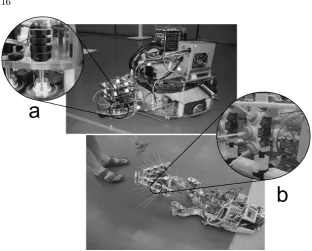
Figure 0.4 Photographs of whisking actuation technology used fora)
Whiskerbot, shape memory wire (protraction) and springs (passive retraction), andb)SCRATCHbot, motor and gearbox driving each column
this approach is that interactions between the plant mechanics and the mechanics of the environment are only indirectly modelled. Since these interactions could be a contributor to whisker transduction, we may seek to move away from artificial closed-loop control as our physical models of whiskers and whisking mature.
Computing
0.3 Whiskerbot 17
this way, we were able to run detailed spiking neural network models yet maintain strict adherence to the real-time constraint (Pearson et al., 2007a, 2006a). Coordination of this processing architecture, incorporat-ing both hardware and software components, was left to BRAHMS a framework for integrated heterogeneous computing that we have devel-oped in-house (Mitchinson et al., 2010). The main control resource of the platform was a re-configurable computing platform called a ‘Bennuey’ PC-104+ motherboard (Nallatech, 2007). This consists of a PC-104 Sin-gle Board Computer (SBC) and a number of expansion slots for FPGA modules. One FPGA was used as a bridge between hardware commu-nications systems and the PCI bus of the PC. Other FPGAs were con-figured for hardware acceleration of spiking neural models in a ‘neural coprocessor’ and a ‘follicle coprocessor’ (Pearson et al., 2005, 2006b) (see Section 0.3.2).
0.3.2 Control Architecture
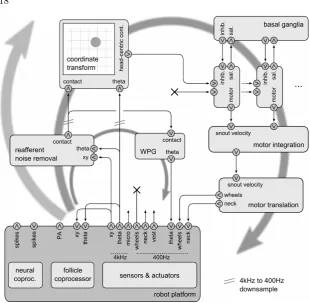
An overview of the robot control architecture is illustrated in Figure 0.5, which we map loosely onto parts of the biological architecture of Figure 0.3; the figure shows the SCRATCHbot configuration. At the bottom left is the interface to the robot platform; this consists of the neural and follicle coprocessors (Whiskerbot) as well as the sensors (x, y, θ) and ac-tuators (whiskers, wheels, neck). The remainder of the architecture can be described as an inner loop (small circular arrow) mediating whisking pattern modulation, and a middle loop (large circular arrow) mediating behaviour. Higher loops (curved arrow to left) modelling cortical and hippocampal systems, for such competences as object discrimination and spatial mapping, are the subject of current work in our laboratory (Fox et al., 2009) (see also Discussion); the current architecture exhibits only immediate responses, and has no long-term memory. The Whiskerbot configuration is similar, but uses the spiking output of the follicle copro-cessor to drive the coordinate transform (and does not perform reafferent noise removal) and implements the Whisker Pattern Generator (WPG) as a spiking neuron model in the neural coprocessor, with modulation from the follicle coprocessor output.
Whisker pattern generation
Figure 0.5 Overview diagram of control architecture of SCRATCH-bot/Whiskerbot, SCRATCHbot configuration shown (see text for de-tails). Straight arrowed lines represent numeric data streams at 400Hz or 4kHz.xy andtheta are raw sensor data. Reafferent noise is re-moved fromxyto generate contact, the clean per-whisker contact strength signal, which modulates the WPG.contactis transformed into head-centric space using the instantaneous values oftheta, and is passed to the actions. Competition between actions for the mo-tors is mediated by the Basal Ganglia. Finally, the selected action sends snout velocity to the motor translation layer, which generates platform-specific control signals for the actuators.
0.3 Whiskerbot 19
movements have been observed, but this has yet to be quantified or explained. Rather than address the issue of multiple coupled WPGs at the outset of our study, for Whiskerbot we chose to use a single WPG to generate the base whisking signal, and derive movement patterns for each whisker from this signal.
Typical whisking, as described above, can be broadly described as modulated periodic oscillations. Therefore, our model is based around modulation of periodic oscillators. The simplest possible model is a sin-gle oscillator generating the angular position of each individual whisker through a gain. In this model, the whiskers are constrained to move synchronously (all whiskers in phase), symmetrically (whisking on the two sides having the same profile), and periodically (each whisking cy-cle is identical). Each of these constraints is relaxed in a long-enough series of rat whisking, as described above; in the robot, we can relax these constraints to test the impact of different modulation strategies. Although not enough is known about the rat WPG to constrain a de-tailed model we nevertheless chose to implement our model WPG in a neurally-inspired manner. For this purpose a base oscillator was formed from two, alternately active, spiking neuron populations, one population acting as the integrator and the other as the reset signal. An additional pair of populations, one on each side, relayed the oscillator activity to the actuator control board (and could be modulated, see below), where each of the signals is used to drive all whiskers on that side of the face. The WPG model was implemented in the neural coprocessor.
Sensory transduction through a model of the whisker follicle and trigeminal ganglion
model was a conventional noisy LIF cell model that was used to simu-late the sensory cells within the trigeminal ganglion (these cells do not merely transmit the response of the mechanoreceptors, but play a key role in signal formation). The parameters of this second model, along with remaining parameters of the mechanical part, were chosen to bal-ance plausibility (e.g. smoothness) with reproduction of the results of biological experiments (Lichtenstein et al., 1990; Shoykhet et al., 2000; Szwed et al., 2003). Two distinct classes of deflection cell were mod-elled, ‘slowly adapting’ (SA) and ‘rapidly adapting’ (RA), reflecting a dichotomy widely described in the literature. These classes are defined by their responses to prolonged deflections: SA cells fire throughout these deflections, whilst RA cells fire only during their onset and offset. Both classes of cell are directionally sensitive, so information on the direc-tion of whisker deflecdirec-tion is encoded. This model was computed on the Whiskerbot ‘follicle coprocessor’, in FPGA (see Figure 0.5).
Our control architecture also included a population of model whisker angle cells (Mitchinson et al., 2006) similar to those described in the animal by (Szwed et al., 2003). For this purpose, angular position, as measured by each shaft encoder, was used to drive a bank of cells as-sociated with each whisker. Each cell responded strongly only when the measured angle was near to its preferred angle, with some overlap be-tween cells. Thus, the identity and response of the active cells implies the whisker angle, consistent with biological data.
Coincidence detection
0.3 Whiskerbot 21
to determine the distance along the whisker at which contact occurred (although extensions to allow this are possible e.g. (Birdwell et al., 2007; Evans et al., 2008)), it is instead assumed that contact occurred close to the tip of the whisker. in practice, this assumption has proved adequate for the robotic experiments performed using the Whiskerbot platform, allowing us to defer the problem of computing radial distance to contact for later.
Action selection
non-selected actions. Note that we were not concerned with learning, here—the BG model has fixed weights and mediates between bids by actions, the salience of each of which is a pre-programmed function of current sensory inputs.
0.3.3 Whiskerbot Experiments
The Whiskerbot platform was used to validate the embedded compu-tational neuroscience models (i.e. to demonstrate that they could ade-quately perform their intended role), to evaluate active control strategies for vibrissal sensing, and to develop and test classification methods for texture discrimination using whisker signals.
An example of the type of experiment performed, was our investigation of the likely consequences of a Minimal Impingement (MI) control strat-egy on the whisker deflection signals processed in the brain. As noted previously, our own behavioural observations in animals had indicated that whiskers rapidly cease to protract following contact with an object during exploration. We hypothesized that this result implied a control strategy that sought to minimize the extent to which whiskers were al-lowed to bend against surfaces. To implement MI in our robot control architecture the total activity across all whisker deflection cells on one side of the face was fed back to suppress activity in the ipsilateral WPG relay. This has the desired effect that protraction ceased rapidly after contact, as seen in the animal (Mitchinson et al., 2007). Figure 0.6 shows how MI affects WPG output, the signals consequently generated in the strain gauges, and the response of the simulated deflection cells, during whisking against a stationary obstacle (examples of whisker movement and deflection with MI off and on are shown in supplementary videos 3 and 4, respectively). With MI enabled, the signals are cleaner and more closely match those observed in the animal (Mitchinson et al., 2006; Pearson et al., 2007b). This result is in line with our predictions for the effect of this control strategy on signal quality in the animal (Mitchin-son et al., 2007), and suggests that the whisker signals being relayed to the sensory cortex (and elsewhere) in awake, exploring animals will be quite different from those generated in the same animals in the absence of feedback control (as for instance, in whisker deflection experiments performed under aneasthesia).
0.3 Whiskerbot 23
Figure 0.6 Signals recorded during two whisks where the rostral whiskers contact a stationary obstacle; left/right column of panels is without/with MI control. Top panels show rostral whisker column angles (solid line); dotted line is the same in both panels, and shows the output of the pattern generator (i.e. the requested column angle) for the unmodulated case. In the unmodulated case (top left), the whisker presses hard against the obstacle, and the column is physi-cally prevented from moving further forward. In the modulated case (top right), the whisker briefly touches the obstacle, and the column is retracted by the MI policy. Other panels show strain gauge output (middle) and simulated rapidly adapting (RA) deflection cells (bot-tom, with each dot representing a spike). All panels reproduced from figures in (Mitchinson et al., 2006).
cylinders). Initially, the robot control architecture selects the default
explore behaviour and the robot proceeds in a random walk, whisk-ing as it goes. On detectwhisk-ing one of the obstacles, the robot switches to
orient, and turns its snout to the obstacle before pausing—that is, it expresses an ‘orient’. With no ability to ‘dab’ on this platform,orient
concludes with the robot backing off and heading in another direction. An example, using a version of the platform equipped with only two whiskers, is shown in supplementary video 5.
whiskers ‘whip’ around when they are moved. This generates a rela-tively high power noise signal in thexdata stream, leading to spurious spiking in contact cells. These ‘ghost orients’ were traced to this noise source (Pearson et al., 2007b) and are considered further in the section below describing SCRATCHbot.
In addition to providing an embodied test-bed for neural models an important goal for Whiskerbot was to investigate tactile feature extrac-tion from artificial whiskers signals. To that end, we have shown that sim-ple Gaussian classifiers, together with either hand-picked or biomimetic features derived from whisker contact signals, can be used as the ba-sis for effective robotic texture classification (Fox et al., 2009). These results serve to further demonstrate the potential of vibrissal tactile sensing for applications in autonomous robotics such as navigation and spatial-mapping in darkness.
0.4 SCRATCHbot
SCRATCHBOT constituted a fundamental redesign of many of the physical and mechanical aspects of our whiskered robot, and a more high-level approach to the development of the embedded brain-based control system. The following sub-sections summarise and explain the main changes and extensions.
0.4.1 Changes to the Robot Design
Signal transduction
0.4 SCRATCHbot 25
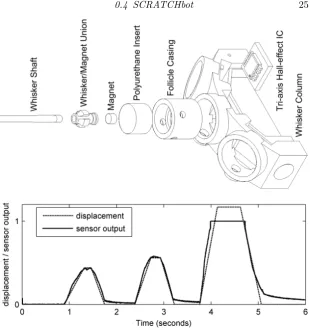
Figure 0.7 Exploded view of the Hall effect based macro-vibrissae sensor assembly and an example output voltage plot taken from the sensor during 3 ramp-hold-release displacement profiles of varying magnitude. The voltage and displacement data has been normalised to the the maximum output voltage (5V), calibrated for a 40mm deflection of the whisker applied at a point 60% along the length from the base. Note that the magnitude of the third displacement profile exceeds the calibrated range resulting in the output voltage saturating.
(deflection outside the programmed range results in saturation). Impor-tantly, these sensory modules remain undamaged under large deflections. Where such deflections cause a whisker to break, a new whisker is sim-ply inserted into the old module, and the HS recalibrated, to return to normal operation.
A secondary consequence of this change was the freedom to explore alternative, less stiff, materials for the whisker shaft. Nonetheless, it has still proved difficult to match the simultaneous high sensitivity and high damping displayed by rat whiskers. Partly, this is an issue of materials: biological whiskers are highly composited, and achieve good energy ab-sorption simultaneously with good signal transmission; reproducing such a material will require substantial further development. Partly, it is an issue of scale: the smaller the whisker, the less prone to prolonged oscil-lation; a substantially smaller (factor four) whisker/whisking assembly is currently under development in our laboratory—this will be a close match to the size of a rat’s larger whiskers, and we expect to achieve a better sensitivity/damping trade-off as a result.
Microvibrissae
An important enhancement over Whiskerbot is the addition of an ar-ray of microvibrissae, mounted at the center of the snout between the two actuated macrovibrissal arrays. The central array consists of nine short (80mm) plastic whiskers, mounted at their base into a common polyurethane sheet, and again instrumented with magnets and Hall-effect sensors to measure deflections in 2-dimensions. These microvibris-sae are able to initiate orienting in the same manner as the macrovibris-sae if an obstacle is encountered snout-first. In addition, they are able to sample the object at a relatively high spatial resolution once the robot has oriented. The classifier systems originally developed for dis-criminating texture using Whiskerbot macrovibrissae are currently being adapted and extended for use with both the macro- and micro- vibrissal arrays (Evans et al., 2009), and to distinguish other object properties such orientation, distance, and velocity relative to the snout.
Whisker array geometry and actuation
0.4 SCRATCHbot 27
Figure 0.8 Photograph of the SCRATCHbot platform with detailed view of the front right motor drive unit (top left panel) and the three degree of freedom neck assembly (lower left panel).
motors required, three whisker carriers were mounted on either side of a light-weight plastic ‘head’, with each carrier carrying three whiskers in a column. The geometry of the head was such that all the whiskers would point directly ahead of the robot when fully protracted. Each column can rotate (AP) through 1200
, which is similar to the maximum angular range available to the rat. A second actuated axis of rotation (DV) was implemented on the SCRATCHbot platform, though this was limited to a single actuator for each side (three columns) and constrained to±150
of rotation about the vertical.
Head and body design and actuation
three wheels can be turned through 1800
, approximating a holonomic platform.
Computing
Finally, whilst demonstrating embedded onboard processing for neural models was a key goal in the development of Whiskerbot, this was less of a core objective in the design of SCRATCHbot. Onboard FPGA co-processors have been retained to allow for the possibility of computationally-intensive onboard processing, however we have also added a wireless signal link allowing the inclusion into the control architecture of asyn-chronous heavy-duty off-board processing. Three levels of computation are thus available on the new platform: short-latency, relatively inflex-ible (onboard FPGA); medium-latency, limited computational power, synchronous (in the PC-104); high latency, high computational power, asynchronous (off-board PC). This gives a range of computing options that are well suited to implement aspects of the lower, middle and upper loops of the neural architecture.
0.4.2 Changes and Additions to the Control
Architecture
0.4 SCRATCHbot 29
robot platform that are more directly comparable with rat whisking be-haviour.
Naturally, we have an extensive list of additions that we hope to make to the SCRATCHbot control architecture. The following sub-sections summarise some changes that have already been implemented, and also provide a brief outline of where we expect this work to go in the near future.
Using MIMC to control whisker spread
Predictable variation in whisker spread (the angular separation between the whiskers) was noted previously as a characteristic of animals that are exploring surfaces (Grant et al., 2009). To investigate the possi-ble causes of this variability we extended the modulation options of SCRATCHbot’s WPG by implementing a separate relay for each column (rather than having just one for each side of the head, as in Whiskerbot). Whisker-environment contact excites all of these relays, whilst suppress-ing only those relays drivsuppress-ing the whiskers that contacted the environ-ment. The result is that, in addition to the per-side MIMC elicited in Whiskerbot, more rearward whiskers move more rapidly than they would otherwise, and are thus brought forward to meet a contacted obstacle. The net result is a reduction in inter-column spread following contact, as seen in the animal. Another way of putting this, is that, by implement-ing MIMC at the per-column level, ‘control’ of whisker spread appears as an automatic consequence of this general active sensing strategy -the whiskers are brought forward to meet -the environment wherever possible, whilst being restrained from bending too far against it.
Head and body movement
(Sahibzada et al., 1986), and more massy central nodes tend to be moved less than lightweight peripheral nodes. This algorithm results in motion that appears quite natural to the human observer. Furthermore, nodes are moved no more than necessary to achieve the target velocity of con-trolled nodes, and the computations for each node are local to that node and cheap, all of which are bio-plausible characteristics. The algorithm can be inferior to explicit motion planning under some conditions; for instance, the trajectory of the overall plant may pass through illegal configurations, or uncontrolled nodes may intersect obstacles. We hy-pothesise that, in biology, failures of this class are easier to deal with (reactively) than is computationally-heavy proactive global motion plan-ning. In SCRATCHbot, usually only the snout node is controlled (snout location being the hypothesised goal), and the joints and base of the neck follow as if the robot was being led by a ring through its nose.
Predicting and cancelling sensory signals due to self-movement
Other than the increased complexity of the motor translation layer (due to the increased degrees of freedom in the head and neck), and the abstraction away from the spiking neuron level, SCRATCHbot initially employed similar algorithms for generating orienting responses to those used in Whiskerbot. The robot therefore displayed ‘ghost orients’, just as Whiskerbot did, for the same reason that movements of the robot body, head, or whiskers, can induce large transients in the transduced whisker signals.
To mitigate this problem, we took inspiration from a hypothesis of motor-reafferent noise removal in cerebellum (Anderson et al., 2009; Dean et al., 2010), and used a bank of linear adaptive filters, one for each whisker, to attempt to predict this noise signal based on the whisker an-gle signal measured from the shaft encoder attached to each column. Af-ter learning the parameAf-ters of the filAf-ters independently for each whisker from example data, this noise removal proved to be very effective. The nature of the motor-reafferent noise generated at the transducers de-pends both on the whisker material and length, so it would appear that both the animal and the robot would benefit from mechanisms, such as efficient damping, that can act to minimise this noise at source.
Work in progress
(mod-0.4 SCRATCHbot 31
elled on the rat hippocampus), for feature detection (modelled on S1 cortex), and for improved decision-making by BG. Longer-term we also plan to explore the role whisker motor cortex (MCx) in initiating and modulating whisking bouts, and of further cortical areas involved in so-matosensory processing such as the S2 cortex. The cerebellum is known to be involved in a number of distinct loops with the vibrissal system that may each implement a similar computation (adaptive filtering) but in a context that fulfills a quite different role with respect to the be-haviour of the animal. For instance, one hypothesis that we wish to explore is that the cerebellum may be involved in predictive tracking of a moving target that would allow a whiskered predator to track rapidly moving prey using only their vibrissae. Another is that cerebellum may be involved in the tuning of open-loop motor control operations, such as the orient action implemented on the robot.
0.4.3 Scratchbot Experiments
Observing general SCRATCHbot behaviour (locate and orient), we typ-ically use 30-60 second runs in a featureless flat arena, with one or more obstacles, or an experimenter’s hand. On startup, a behaviour called
unparkbids strongly to the BG, and is given control of the robot, whilst
other actions (and whisking) are suppressed. The neck axes are driven such that the head is moved from its ‘park’ position to an unstable point we call the ‘unpark’ position. On arrival,unparkstops bidding, the de-fault explore behaviour is given control, and whisking begins. At the preset end time, software control ceases, and the low-level controllers automatically return the neck to the park position.
the orient itself. Whenorientcompletes, it stops bidding for the plant,
exploreis again selected, and the robot straightens up as it resumes its exploration. The removal of motor reafferent noise is very effective, and SCRATCHbot does not express ghost orients.
Currently, as described (and shown in supplementary video 5 for WhiskerBot, supplementary video 6 for SCRATCHbot), locomotion dur-ing robot exploration results from switchdur-ing betweenexploreandorient. As described in Section 0.2.2, we hypothesise that rat locomotion in sim-ilar circumstances might be viewed as a series of orients, with the focus of attention being constantly shifted, often ahead of the animal. In future, we will test this hypothesised approach to locomotion using SCRATCH-bot, removing explore and generalising orient, such that the robot
can ‘attend to’ (thus, orient to) a more general target, which may not be something immediately detected as interesting, but rather a location about which it intends to gather sensory information.
0.5 Discussion 33
0.5 Discussion
0.5.1 Why build robot models of animals and their
nervous systems?
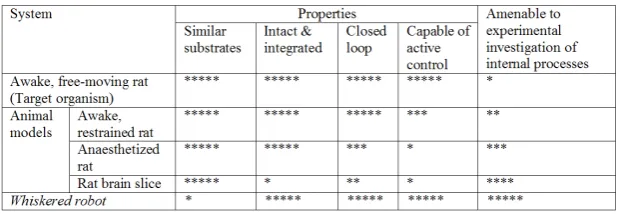
[image:34.595.121.433.336.443.2]When neuroscientists think of model systems they usually think, not of robots, but of using one animal as a model of another (e.g. the rat as a model of a human); of an animal in an altered condition (e.g. under anaesthesia, or awake but immobilized) as a model of the awake, behav-ing one; or of an isolated part, such as a brain slice or a muscle, as a model of that component within the intact, functioning system. How-ever, consider the task that our research group is attempting which is to understand the whisker system of the rat. Some of the biological models that are available to us, the properties that they share with our tar-get system, and their amenability to experimental investigation of their internal processes are summarized in Table 0.1.
Table 0.1 Comparison of material model of the awake, free moving rat.
understand—how the free-moving animal controls its head and body so as to optimize sensing; how sensorimotor loops are closed through the environment; and how the component parts operate within an integrated and intact system. The more restricted animal preparations can still be useful, of course, but insight concerning these properties will need to be inferred where they cannot be obtained directly. As a consequence we may then ask how the compromises made to create a particular model (e.g. treatment with anaesthesia) have impacted on the results and on the inferences drawn.
Now, examine the bottom line of table 0.1. All of the interesting prop-erties just listed are, or could be, exhibited in a robot model of the be-having animal in a system that is highly amenable to investigation of its internal processes, indeed, far more so than any of the available an-imal models. The snag, and of course it’s a big one, is that the robot’s physical and computational substrates—its body and its brain—may not approximate the target animal in an adequate way. Thus the results obtained from experiments with the robot may not be valid when trans-lated back to the animal. But note that this is not too different from the situation with the animal models—in both cases, animal and robot, we have had to compromise and allow some aspects of the model to differ significantly from our target. What we have with robotics, at least, is the possibility that we can continue to refine the model, so that if we are worried that some aspect is substantially wrong we can fix it and re-run the experiment to see if the result changes. As the biomimicry improves, we can expect richer and more convincing insights into the properties of the biological system we are trying to understand.
0.5 Discussion 35
into a domain we understand better, and it should allow us to conduct experiments with relative ease. We contend that—for exploring the re-lationships between brain, body, and behaviour—robotics, which trans-lates problems in biology into problems in computing and engineering, meets these requirements well.
0.5.2 Insights from whiskered robots into the biology of
the rat vibrissal system
We would like to conclude by reviewing some of the contributions that we believe robotics can make to neuroethology, illustrating each with an example from our research on whiskered robots.
Discovering important questions
Thus began a programme of experimental work that showed that, dur-ing exploratory whiskdur-ing, protraction ceases rapidly followdur-ing contact, leading to our hypothesis of the ‘minimal impingement’ whisker control strategy (Mitchinson et al., 2007).
Testing the sufficiency of theories
Many good reasons for building models, in simulation or in robots, have been nicely summarized by Epstein (Epstein, 2008). One of the most important of these is that a model allows us determine whether our the-ories are adequate to account for the behaviour we are trying to explain. If the robot can replicate the behaviour of the animal then there is no longer any question of whether the theory is sufficient (although we can still ask whether it does the task as well as the animal or in the same way). As it turns out, some of the tasks that look easy are harder to repli-cate than you would expect, and some apparently hard tasks turn out to be relatively easy. For instance, orienting to a whisker contact sounds easy, but when we implemented it we found that the robot was easily distracted by ghost contacts generated by its own movement. Resolving this problem using an adaptive filter was non-trivial and suggested a new theory about the role of vibrissal loops through the cerebellum. A theory of vibrissal orienting without noise cancellation was an insuffi-cient theory, but this was not apparent until we built the robot model and tried it out.
Suggesting new hypotheses
0.5 Discussion 37
must take place either in SC itself, or on the way to it (i.e. in the trigem-inal nuclei). Whisker representations in SC in the anaesthetized animal are very broad (Drager and Hubel, 1976), particularly in the AP direc-tion, with individual whiskers having representations almost as large as the whisker rows to which they belong. From our modeling work we con-tend that these broad, AP-biased, fields are to be expected. Specifically, if accurate integration is to be performed between visual and vibrissal stimuli, then since whiskers move relative to the head as the result of whisking, their representations must also move around with respect to the head-centered map in SC, leading to broad overall fields. Record-ing from multiple cells in an animal whilst the whiskers move, it should be possible to show that the strongest response to individual whiskers moves around in SC in a manner consistent with this hypothesis. Whilst we can only be confident of this prediction in the awake animal, it might also be observed in a lightly anaesthetised animal, with whisking invoked electrically.
Investigating the role of embodiment
It is increasingly recognized that behaviour is the consequence of the in-teraction between the brain, the body, and the environment (Chiel and Beer, 1997; Chiel et al., 2009) and that robotics may be one of the most cost-effective ways of studying this interaction. Current simulations of real-world physics are not up to the task of adequately capturing all of the dynamical properties (e.g. collision elasticity, surface friction) of the interaction between two objects such as a whisker shaft and a moving or irregular surface (Fox et al., 2008), thus the world remains its own best model for this aspect of our work. As noted above, our recent efforts to build artificial vibrissae fall short of producing artefacts with all the desirable mechanical properties of the rat whisker-shaft/follicle. There-fore, our current approach combines simulation, to better understand the biomechanics of natural whiskers, with robotic experiments to de-termine what properties of surfaces can be effectively discerned through artificial vibrissal sensing. Through this combined approach we hope to be able to better identify the contribution of the morphology to the task of tactile sensing for this system.
Investigating ‘What if ?’ scenarios
of whiskers that do not taper or do not curve with those that do, in order to better understand why natural whiskers have evolved to do both. Likewise, we can investigate ways of controlling the movement of the whiskers that are either natural or unnatural and observe the consequences of these different movement strategies for the type, quality and quantity of tactile information obtained by the robot (animal).
Doing the experiments that cannot be done
One of the most important uses of a physical model is that it can allow experiments to be performed that could not be done on the animal, or at least would be very difficult to doin vivogiven our current knowledge and available methods. For example, what impact does minimal impinge-ment (MI) control of vibrissal moveimpinge-ment (Mitchinson et al., 2007) have on the sensory signals ascending from the whiskers to higher process-ing centers such as the S1 cortex? This question is important because much of the research conducted on cortex is performed in anaesthetized animals, or even in brain slices, using input signals that are intended to mimic the effects of natural contacts. Unfortunately we cannot per-form a straightforward experiment in the animal where we turn-off MI control and see the difference that this makes to signals (in the anaes-thetized preparation we can replace natural whisker motion with a form of fictive whisking (Szwed et al., 2003), however, there are differences here from the awake, behaving animal that could make interpretation of the findings problematic). In contrast, in the robot model, the required experiment is trivial to perform (see 0.6), and we can exactly compare the contacts resulting from movement, with and without MI, and the spike trains that these contacts generate in the simulated trigeminal nerve (which, in the animal, is just two synapses away from the sig-nals arriving at the S1 cortex). These robot experiments can therefore help neuroscientists to select more plausible signal trains with which to stimulate animal models duringin vivoorin vitroexperiments.
Evaluating the usefulness of biological solutions to problems in robotics
0.5 Discussion 39
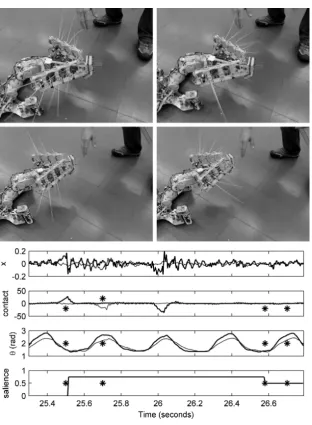
Figure 0.9 Data from SCRATCHbot during an orient to a whisker contact. Upper three plots show data from 5th whisker (middle row/column, thick line) and 7th whisker (top row, rear column, thin line) on the left. Upper: raw x-component of whisker sensory signal; Second: re-afferent noise removed, greatly improving the signal-to-noise ratio; Third: angular position (θ) of middle/rear columns (π radians indicates straight ahead); Lower: saliency oforient. Frame
timing is indicated in plots by star symbol. Contact on whisker 5 during retraction (Frame 1) is followed by increase inorientsalience
and action selection. Additional contacts on whisker 7 (Frame 2) and 5 during the orient are ignored. Snout arrives at the point of initial whisker contact (Frame 3), completing the orient; saliency is reduced. The second phase oforient(Frame 4) is a placeholder, during which
0.5 Discussion 41
References
Ahissar, E., and Arieli, A. 2001. Figuring Space by Time. Neuron, 32(2), 185–201.
Anderson, S. R., Porrill, J., Pearson, M. J., Pipe, A. G., Prescott, T. J., and Dean, P. 2009. Cerebellar-inspired forward model of whisking enhances contact detection by vibrissae of robot rat. Society For Neuroscience, Chicago IL, Poster 77.2.
Anjum, F., Turni, H., Mulder, P. G., van der Burg, J., and Brecht, M. 2006. Tactile guidance of prey capture in Etruscan shrews. Pages 16544–16549 of:Proc Natl Acad Sci USA, vol. 103.
Berg, R. W., and Kleinfeld, D. 2003. Rhythmic Whisking by Rat: Retraction as Well as Protraction of the Vibrissae Is Under Active Muscular Control.
J Neurophysiol,89(1), 104–117.
Bermejo, R., Vyas, A., and Zeigler, H. P. 2002. Topography of Rodent Whisking–I. Two-dimensional Monitoring of Whisker Movements. So-matosens Mot Res,19(4), 341–346.
Birdwell, J. A., Solomon, J. H., Thajchayapong, M., Taylor, M. A., Cheely, M., Towal, R. B., Conradt, J., and Hartmann, M. J. Z. 2007. Biomechanical Models for Radial Distance Determination by the Rat Vibrissal System.
J Neurophysiol,98, 2439–2455.
Braitenberg, Valentino. 1986. Vehicles: Experiments in synthetic psychology. The MIT Press.
Brecht, M., Preilowski, B., and Merzenich, M. M. 1997. Functional Architec-ture of the Mystacial Vibrissae. Behavioural Brain Research,84, 81–97. Carvell, G. E., and Simons, D. J. 1990. Biometric Analyses of Vibrissal Tactile
Discrimination in the Rat. J Neurosci,10(8), 2638–2648.
Carvell, G. E., Simons, D. J., Lichtenstein, S. H., and Bryant, P. 1991. Elec-tromyographic Activity of Mystacial Pad Musculature During Whisking Behavior in the Rat. Somatosens Mot Res,8(2), 159–164.
Chiel, H J, and Beer, R D. 1997. The brain has a body: adaptive behav-ior emerges from interactions of nervous system, body and environment.
Trends in Neurosciences,20(12), 553–7.
References 43
2009. The brain in its body: motor control and sensing in a biomechanical context. J Neurosci,29(41), 12807–14.
Cohen, J. D., Hirata, A., and Castro-Alamancos, M. A. 2008. Vibrissa Sensa-tion in Superior Colliculus: Wide-Field Sensitivity and State-Dependent Cortical Feedback. J Neurosci,28(44), 11205–11220.
Cramer, N. P., Li, Y., and Keller, A. 2007. The Whisking Rhythm Genera-tor: A Novel Mammalian Network for the Generation of Movement. J Neurophys,97, 2148–2158.
Dean, P, Redgrave, P, and Westby, G W. 1989. Event or emergency? Two response systems in the mammalian superior colliculus. Trends in Neu-rosciences,12(4), 137–47.
Dean, P., Porrill, J., Ekerot, C. F., and J¨orntell, H. 2010. The cerebellar micro-circuit as an adaptive filter: experimental and computational evidence.
Nat Rev Neurosci,11(1), 30–43.
D¨orfl, J. 1982. The Musculature of the Mystacial Vibrissae of the White Mouse.J Anat,135(Pt 1), 147–154.
Drager, U. C., and Hubel, D. H. 1976. Topography of visual and somatosensory projections to mouse superior colliculus. J Neurophys,39(1), 91–101. Ebara, S., Kumamoto, K., Matsuura, T., Mazurkiewicz, J. E., and Rice, F. L.
2002. Similarities and Differences in the Innervation of Mystacial Vib-rissal Follicle-sinus Complexes in the Rat and Cat: A Confocal Micro-scopic Study. J Comp Neurol,449(2), 103–119.
Elumotion. 2009. Biologically inspired robotic devices (website). http://www.elumotion.com.
Epstein, JM. 2008. Why Model? Journal of Artificial Societies and Social Simulation,11(4), 12.
Etienne, A. S., Maurer, R., and S´eguinot, V. 1996. Path integration in mam-mals and its interaction with visual landmarks. J Exp Biol, 199(1), 201–9.
Evans, M., Fox, C. W., Pearson, M., and Prescott, T. J. 2008.Radial distance to contact estimation from dynamic robot whisker information. Barrels XX (Society For Neuroscience Satellite Meeting).
Evans, M., Fox, C. W., Pearson, M. J., and Prescott, T. J. 2009. Spectral template based classification of robotic whisker sensor signals in a floor texture discrimination task. Pages 19–24 of:Proceedings of Towards Au-tonomous Robotic Systems (TAROS).
Fend, M., Bovet, S., and Hafner, V. 2004. The Artificial Mouse - A Robot with Whiskers and Vision. In:Proceedings of the 35th International Sym-posium on Robotics.
Fox, C., Evans, M., Stone, J., and Prescott, T. 2008. Towards temporal in-ference for shape recognition from whiskers. In:Proceedings of Towards Autonomous Robotic Systems (TAROS).
Gao, P., Bermejo, R., and Zeigler, H. P. 2001. Whisker Deafferentation and Rodent Whisking Patterns: Behavioral Evidence for a Central Pattern Generator.J Neurosci,21(14), 5374–5380.
Gopal, V., and Hartmann, M. J. Z. 2007. Using hardware models to quantify sensory data acquisition across the rat vibrissal array. Bioinsp Biomim,
2, S135–145.
Grant, Robyn A., Mitchinson, Ben, Fox, Charles W., and Prescott, Tony J. 2009. Active touch sensing in the rat: Anticipatory and regulatory control of whisker movements during surface exploration.Journal of Neurophys-iology,101, 862–874.
Gurney, K. N., Humphries, M., Wood, R., Prescott, T. J., and Redgrave, P. 2004. Testing computational hypotheses of brain systems function: a case study with the basal ganglia.Network,15(4), 263–90.
Haiss, F., and Schwarz, C. 2005. Spatial Segregation of Different Modes of Movement Control in the Whisker Representation of Rat Primary Motor Cortex. J Neurosci,25(6), 1579–1587.
Hartmann, M. J. 2001. Active Sensing Capabilities of the Rat Whisker System.
Autonomous Robots,11, 249–254.
Hartmann, M. J., Johnson, N. J., Towal, R. B., and Assad, C. 2003. Mechani-cal Characteristics of Rat Vibrissae: Resonant Frequencies and Damping in Isolated Whiskers and in the Awake Behaving Animal. J Neurosci,
23(16), 6510–6519.
Hill, D. N., Bermejo, R., Zeigler, H. P., and Kleinfeld, D. 2008. Biomechan-ics of the Vibrissa Motor Plant in Rat: Rhythmic Whisking Consists of Triphasic Neuromuscular Activity.J Neurosci,28(13), 3438–3455. Jung, D., and Zelinsky, A. 1996. Whisker-based mobile robot navigation.
Pages 497–504 of:Proceedings of the IEEE/RSJ International Conference on Intelligent Robots and Systems (IROS), vol. 2.
Kim, D., and M¨oller, R. 2004. A Biomimetic Whisker for Texture Discrimi-nation and Distance Estimation. In:Proc of the Int Conf on the Sim of Adap Behav (SAB).
Kim, D., and M¨oller, R. 2007. Biomimetic whiskers for shape recognition.
Robot Autonom Syst,55(3), 229–243.
Kleinfeld, D., Berg, R. W., and O’Connor, S. M. 1999. Anatomical Loops and Their Electrical Dynamics in Relation to Whisking by Rat. Somatosens Mot Res,16(2), 69–88.
Kleinfeld, D., Ahissar, E., and Diamond, M. E. 2006. Active Sensation: In-sights from the Rodent Vibrissa Sensorimotor System. Curr Opin Neu-robiol,16(4), 435–44.
Knutsen, P., Biess, A., and Ahissar, E. 2008. Vibrissal Kinematics in 3D: Tight Coupling of Azimuth, Elevation, and Torsion. Neuron,59(1), 35–42. Knutsen, P. M., Pietr, M., and Ahissar, E. 2006. Haptic Object Localization
in the Vibrissal System: Behavior and Performance. J Neurosci,26(33), 8451–8464.
References 45
Rats Performing Whisker-dependent Tactile Discriminations.J Neurosci,
21(15), 5752–5763.
Lichtenstein, S. H., Carvell, G. E., and Simons, D. J. 1990. Responses of Rat Trigeminal Ganglion Neurons to Movements of Vibrissae in Different Directions. Somatosens Mot Res,7(1), 47–65.
Lottem, E., and Azouz, R. 2009. Mechanisms of Tactile Information Trans-mission through Whisker Vibrations. J Neurosci,29(37), 11686–11697. Mitchinson, B., Gurney, K. N., Redgrave, P., Melhuish, C., Pipe, A. G.,
Pear-son, M., Gilhespy, I., and Prescott, T. J. 2004. Empirically Inspired Simulated Electro-mechanical Model of the Rat Mystacial Follicle-sinus Complex. Proc R Soc Lond B Biol Sci,271(1556), 2509–2516.
Mitchinson, Ben, Pearson, Martin, Melhuish, Chris, and Prescott, Tony J. 2006. A model of sensorimotor co-ordination in the rat whisker system. Pages 77–88 of:From Animals to Animats 9: Proceedings of the Ninth International Conference on Simulation of Adaptive Behaviour.
Mitchinson, Ben, Martin, Chris J., Grant, Robyn A., and Prescott, Tony J. 2007. Feedback control in active sensing: rat exploratory whisking is modulated by environmental contact. Royal Society Proceedings B,
274(1613), 1035–1041.
Mitchinson, Ben, Arabzadeh, Ehsan, Diamond, Mathew E., and Prescott, Tony J. 2008. Spike-timing in primary sensory neurons: A model of somatosensory transduction in the rat. Biological Cybernetics, 98(3), 185–194.
Mitchinson, Ben, Chan, Tak-Shing, Chambers, Jon, Pearson, Martin, Humphries, Mark, Fox, Charles, Gurney, Kevin, and Prescott, Tony J. 2010. BRAHMS: Novel middleware for integrated systems computation.
Advanced Engineering Informatics,24(1), 49–61.
Nallatech. 2007. PCI-104 Series: COTS PCI-104 FPGA computing stacks product brief (NT190-0331 Version 1.0). available on-line: http://www.nallatech.com/mediaLibrary/images/english/6406.pdf. Neimark, M. A., Andermann, M. L., Hopfield, J. J., and Moore, C. I. 2003.
Vibrissa Resonance as a Transduction Mechanism for Tactile Encoding.
J Neurosci,23(16), 6499–6509.
Nguyen, Q. T., and Kleinfeld, D. 2005. Positive Feedback in a Brainstem Tactile Sensorimotor Loop. Neuron,45(3), 447–457.
Pearson, M., Nibouche, M., Pipe, A. G., Melhuish, C., Gilhespy, I., Mitchin-son, B., Gurney, K., Prescott, T., and Redgrave, P. 2006a. A Biologically Inspired FPGA Based Implementation of a Tactile Sensory System for Object Recognition and Texture Discrimination. Pages 1–4 of: Proceed-ings of the International Conference on Field Programmable Logic and Applications (FPL).
Pearson, M. J., Melhuish, C., Pipe, A. G., Nibouche, M., Gilhespy, I., Gurney, K., and Mitchinson, B. 2005. Design and FPGA implementation of an embedded real-time biologically plausible spiking neural network proces-sor. Pages 582–585 of:International Conference on Field Programmable Logic and Applications.
Pearson, M. J., Pipe, A. G., Mitchinson, B., Gurney, K., Melhuish, C., Gilh-espy, I., and Nibouche, M. 2007a. Implementing spiking neural net-works for real-time signal-processing and control applications: A model-validated FPGA approach. IEEE Trans on Neural Networks, 18(5), 1472–1487.
Pearson, M. J., Pipe, A. G., Melhuish, C., Mitchinson, B., and Prescott, T. J. 2007b. Whiskerbot: A Robotic Active Touch System Modeled on the Rat Whisker Sensory System.Adaptive Behaviour,15(3), 223–240.
Petersen, C. C. H. 2007. The Functional Organization of the Barrel Cortex.
Neuron,56, 339–355.
Prescott, T. J., Mitchinson, B., Redgrave, P., Melhuish, C., and Dean, P. 2005.
Three-dimensional reconstruction of whisking patterns in freely moving rats. Society For Neuroscience, November 12-16, Poster 625.3.
Prescott, T. J., Gonzalez, F. M. Montes, Gurney, K., Humphries, M. D., and Redgrave, P. 2006. A Robot Model of the Basal Ganglia: Behavior and Intrinsic Processing. Neural Netw,19(1), 31–61.
Prescott, T. J., Bryson, J. J., and Seth, A. K. 2007. Introduction. Modelling natural action selection.Philos Trans R Soc Lond B Biol Sci,362(1485), 1521–9.
Prescott, T. J., Pearson, M. J., Mitchinson, B., Sullivan, J. C. W., and Pipe, A. G. 2009. Whisking with robots: from rat vibrissae to biomimetic technology for active touch. IEEE Robotics and Automation Magazine,
16(3), 42–50.
Prescott, T J, Grant, R A, and Mitchinson, B. In press. Vibrissal function and behavior.Scholarpedia.
Quist, B. W., and Hartmann, M. J. 2008. A two-dimensional force sensor in the millinewton range for measuring vibrissal contacts. J Neurosci Methods,172(2), 158–167.
Redgrave, P., Prescott, T. J., and Gurney, K. 1999. The Basal Ganglia: a Vertebrate Solution To the Selection Problem?. Neuroscience, 89(4), 1009–1023.
Rice, F. L., Mance, A., and Munger, B. L. 1986. A Comparative Light Micro-scopic Analysis of the Sensory Innervation of the Mystacial Pad. I. In-nervation of Vibrissal Follicle-sinus Complexes. J Comp Neurol,252(2), 154–174.
Rosenblueth, A, and Wiener, N. 1945. The role of models in science. Philos-ophy of Science,12(4).
Russell, R. A. 1992. Using tactile whiskers to measure surface contours. Pages 1295–1299 of: Proceedings of the IEEE International Conference on Robotics and Automation, vol. 2.