This is a repository copy of Splitting attention across the two visual fields in visual
short-term memory.
White Rose Research Online URL for this paper:
http://eprints.whiterose.ac.uk/82481/
Version: Accepted Version
Article:
Delvenne, JFCM and Holt, JL (2012) Splitting attention across the two visual fields in
visual short-term memory. Cognition, 122 (2). 258 - 263. ISSN 0010-0277
https://doi.org/10.1016/j.cognition.2011.10.015
[email protected] https://eprints.whiterose.ac.uk/
Reuse
Unless indicated otherwise, fulltext items are protected by copyright with all rights reserved. The copyright exception in section 29 of the Copyright, Designs and Patents Act 1988 allows the making of a single copy solely for the purpose of non-commercial research or private study within the limits of fair dealing. The publisher or other rights-holder may allow further reproduction and re-use of this version - refer to the White Rose Research Online record for this item. Where records identify the publisher as the copyright holder, users can verify any specific terms of use on the publisher’s website.
Takedown
If you consider content in White Rose Research Online to be in breach of UK law, please notify us by
1 Running Head: Splitting attention in VSTM
Cognition 122 (2012) 258–263
Splitting attention across the two visual fields in visual short-term
memory
Jean-Francois Delvenne and Jessica L. Holt
University of Leeds, UK
Word count: Abstract + Main text + Footnotes: 2996 words
Keywords: visual short-term memory; visual working memory; bilateral advantage; attention
Corresponding author: Jean-Francois Delvenne Institute of Psychological Sciences
University of Leeds, Leeds, LS2 9JT United Kingdom
2 Abstract
Humans have the ability to attentionally select the most relevant visual information from their
extrapersonal world and to retain it in a temporary buffer, known as visual short-term memory
(VSTM). Research suggests that at least two non-contiguous items can be selected simultaneously
when they are distributed across the two visual hemifields. In two experiments, we show that
attention can also be split between the left and right sides of internal representations held in VSTM.
Participants were asked to remember several colors, while cues presented during the delay
instructed them to orient their attention to a subset of memorized colors. Experiment 1 revealed
that orienting attention to one or two colors strengthened equally partic
colors, but only when they were from separate hemifields. Experiment 2 showed that in the absence
of attentional cues the distribution of the items in the visual field per se had no effect on memory.
These findings strongly suggest the existence of independent attentional resources in the two
3
The ability to maintain visual information in an accessible state is a critical aspect of our
cognitive capacities as it allows us to interact successfully in the visuo-spatial world. Because our
visual short-term retention system (i.e., visual short-term memory - VSTM) is extremely limited in
storage capacity (Luck & Vogel, 1997), only a subset of information from our extrapersonal world
can be transferred into this limited memory space at any one time. The selection of this subset of
information is made by attentional mechanisms that can be voluntarily or involuntarily oriented to
particular locations or objects. For example, when spatial attention is cued to a particular location of
the visual field, the object that occurs at that location will be more likely transferred into VSTM as
compared to the other objects (Makovski & Jiang, 2007; Schmidt, Vogel, Woodman, & Luck, 2002).
During the last 10 years, an increasing number of studies have revealed that once transferred
into VSTM, the internal representations remain highly flexible and can be selectively accessed and
consolidated by attentional mechanisms (e.g., Delvenne, Cleeremans, & Laloyaux, 2010; Griffin &
Nobre, 2003; Landman, Spekreijse, & Lamme, 2003; Makovski & Jiang, 2007; Makovski, Sussman, &
Jiang, 2008; Matsukura, Luck, & Vecera, 2007; Nobre, Coull, Maquet, Frith, Vandenberghe, &
Mesulam, 2004). Those studies use the retro-cuing paradigm, in which an attentional orienting cue
was presented during the retention interval of a memory task and pointed to the location of one of
the items held in VSTM. Memory for the cued item is found to be better as compared to memory for
the uncued items. This finding is crucial as it suggests that it is possible to orient spatial attention
onto a subset of internal representations beyond the phase of perceptual encoding. Because spatial
location plays a central role in the maintenance of objects in memory (e.g., Jiang, Olson, & Chun,
2000), directing attention to one location previously occupied by an object helps solidify and/or
retrieve that object from memory. However, this ability to attentionally select locations already held
in VSTM appears to be more constrained than orienting attention in perception. In a recent study,
Makovski and Jiang (2007) directly compared the effect of orienting attention to multiple locations
before (pre-cuing) and after (retro-cuing) the appearance of a memory array. They found that while
4
only a single cue was advantageous for memory performance when presented after the offset of the
memory array. Although this, along with previous studies (Awh & Pashler, 2000; Kraft, Müller,
Hagendorf, Schira, Dick, Fendrich, & Brandt, 2004; Kramer & Haln, 1995), indicates that spatial
attention can be oriented onto multiple locations at once in perception M J
suggests that orienting attention in memory may be restricted to a single location.
Here, we report an exception to this restriction. We show that attention can be split in VSTM
between the left and right visual fields. Specifically, the present study reveals that two
non-contiguous locations can be selected from VSTM at no extra cost as compared to a single location,
but only if they are from separate hemifields. Past work has demonstrated that attention can be split
in perceptual space between the two hemifields at a lower cost as compared to within the same
hemifield. This has been observed in a number of visual tasks, such as tracking objects (Alvarez &
Cavanagh, 2005), remembering spatial locations (Delvenne, 2005) and orientations (Umemoto,
Drew, Ester, & Awh, 2010), matching stimuli (Kraft et al., 2004; Sereno & Kosslyn, 1991),
enumerating objects (Delvenne, Castronovo, Demeyere, & Humphreys, 2011), and identifying
targets (Awh & Pashler, 2000), amongst others. In particular, performance at those tasks was better
when the to-be-attended items were distributed across the left and right visual fields as when they
were all displayed within the same hemifield. Here, we provide the first evidence that attention can
also be split beyond perception, namely between the left and right sides of internal representations.
Experiment 1
Method
Sixteen volunteers took part in this experiment (9 women; mean age = 21.4, range 20 24
years). In all experiments, the participants had normal (self-reported) or corrected-to-normal visual
5
Visual stimuli were generated by a GH PC T was
generated by E-Prime programming software (Psychology Software Tools, Inc., www.pstnet.com)
and responses were collected using the computer keyboard. Six highly discriminative colored
squares (blue, green, pink, red, turquoise, and yellow), produced by permutation of the presence or
absence of red, green and blue phosphors, were used as stimuli. At a viewing distance of
approximately 60 cm, each square subtended a visual angle of 0.76° x 0.76°. The stimuli were
randomly located equidistantly at eight different possible positions on an imaginary circle (7.12° in
diameter) centered at fixation. The eight locations were 12:45, 2:15, 3:45, 5:15, 6:45, 8:15, 9:45, and
11: The colors were selected at random with the constraint that two contiguous
colors could not repeat. A gray background was used to reduce afterimages.
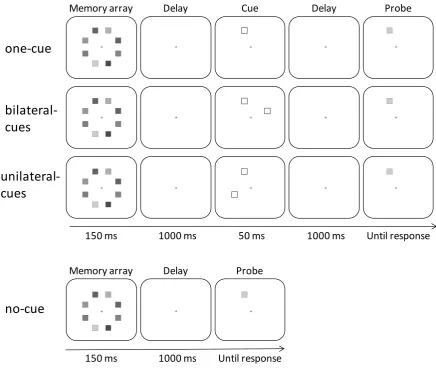
On each trial, participants were first presented with an initial central fixation cross that they had
to fixate throughout the entire trial. After 800 ms, the memory array was presented for 150 ms,
followed by a 1,000 ms blank interval, then by a cue array for 50 ms, followed by another 1,000 ms
blank interval and finally by the probe that remained present until a response key was pressed.
There were three retro-cue conditions. In the one-cue condition, the cue array consisted of a single
cue (i.e., a white outlined square subtending 0.76° x 0.76°) randomly positioned at one of the eight
locations. In the bilateral-cues condition, the cue array consisted of two non-contiguous cues located
in opposite hemifields. In the unilateral-cues condition, the two non-contiguous cues were located
within the same hemifield. The distance between the cues was kept constant in both the bilateral-
and unilateral-cues conditions and they were always separated by an uncued location. The cue(s)
indicated the location of the test probe (validity = 100%). To measure the effect of retro-cuing on
memory capacity, a fourth condition was used in which no cue was presented. In this no-cue
condition, the memory array was presented for 150 ms, followed by a 1,000 ms blank interval and
then immediately by the probe. Figure 1 illustrates the four conditions. Participants were instructed
6
same position on the memory array (with 50% probability). The next trial was automatically initiated
500 ms later.
150 ms 1000 ms Until response
Cue
Memory array Delay Delay Probe
50 ms 1000 ms
Probe
Memory array Delay
150 ms 1000 ms Until response
one-cue
bilateral-cues
unilateral-cues
[image:7.595.80.517.140.510.2]no-cue
Fig. 1. Illustrations of the four conditions and the sequence of events in Experiment 1. The different gray levels represent different colors.
The conditions were randomly mixed during the experiment and there were a total of 48 trials in
each condition. The whole experiment consisted of 192 experimental trials, evenly divided into six
32-trial blocks. Each block began with the presentation of three digits that participants were
required to repeat aloud as quickly as they could throughout the block. This concurrent articulatory
suppression task was used to discouraged participants from verbally recoding the visual information
7 Results and discussion
We computed A nal detection theory (Aaronson & Watts, 1987; Grier, 1971; Pollack &
Norman, 1964) to assess the accuracy of the memory performance for each condition and for each
participant. To obtain a second representation of the results, we also measured C s K (Cowan,
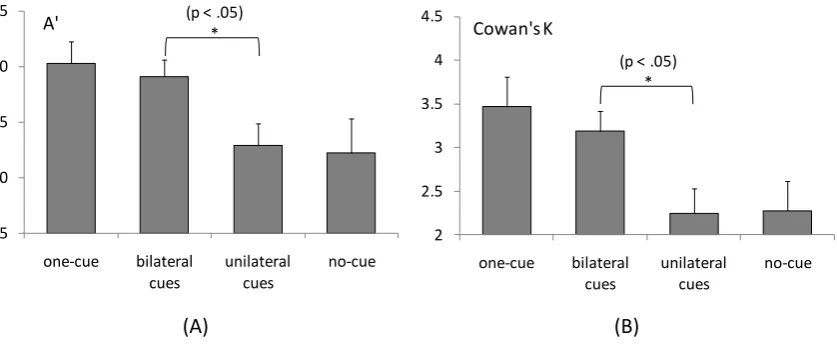
2001), an estimation of memory capacity. Figures 2a and 2b show A K respectively,
in each condition. Because the analyses on K produced the same pattern of statistical significance as
A, we report only the statistical results on the A alues. The ANOVA (repeated measures) on
A a main effect of condition, F(3, 45) = 4.25, MSE = 0.007, p < .01. Pairwise
comparisons showed no difference between the one-cue and bilateral-cues conditions (p = .60) and
no difference between the unilateral-cues and no-cue conditions (p = .84). However, both the
one-cue and bilateral-one-cues conditions were significantly better performed (p < .05) than the
unilateral-cues and no-cue conditions. In addition, no difference was found between the left and right visual
fields (p = .30) and between the upper and lower visual fields (p = .60). Finally, we compared change
detection performance between items near the vertical meridian (i.e., the 12:45, 5:15, 6:45, and
and items farther away
The paired t-test revealed no effect of distance of the items relative to the vertical meridian (p =
.11).
Those results show that two items can be attentionally selected from, and/or consolidated in
VSTM at no extra cost compared to a single memory item, provided that the two items were
bilaterally presented in the memory array. In contrast, when the two memory items came from the
same single hemifield, the retro-cuing effect disappeared. This finding strongly suggests that
attention can be split in VSTM between the left and right sides of internal representations1.
1
8 65 70 75 80 85 one-cue bilateral cues unilateral cues no-cue
A' (p < .05)
* 2 2.5 3 3.5 4 4.5 one-cue bilateral cues unilateral cues no-cue Cowan's K
(p < .05) *
[image:9.595.92.511.77.249.2](A) (B)
Fig. 2.R A C K E E
values.
Experiment 2
Previous research has shown that short-term memory for spatial information, such as locations
(Delvenne, 2005) and orientations (Umemoto et al., 2010) is better across hemifields than within a
single one. Given that VSTM is contralaterally organized (Eimer & Kiss, 2009; Gratton et al., 1997),
remembering visual items that occur in separate hemifields may indeed be easier as compared to
within the same hemifield because they are registered in different hemispheres. Although this
bilateral advantage has never been found in memory for non-spatial features such as colors
(Delvenne, 2005; Delvenne, Kaddour, & Castronovo, 2011; see also Umemoto et al., 2010, p. 78), the
possibility remains that the retro-cues in Experiment 1 were simply facilitating a natural advantage
when items are distributed in the two hemifields. In experiment 2, we examined whether the
beneficial effect of the bilateral presentation of the retro-cues might be explained by a general
cross-hemifield advantage in VSTM.
9 Method
Sixteen new participants (11 women), aged between 19 and 37 years (mean = 24.5) took part in
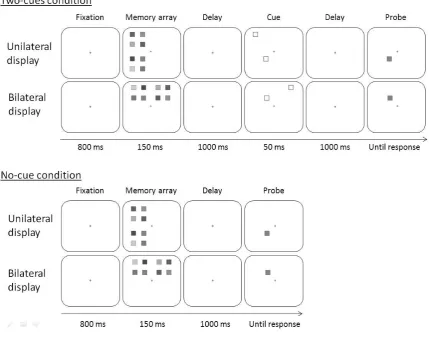
this experiment, which replicated Experiment 1 with the following changes: (i) the display consisted
of four invisible quadrants (subtending 3.8° x 3.8° each) placed around the central fixation cross and
separated vertically and horizontally (centre-to-centre) by 4°; (ii) as shown in Figure 3, eight colors
were located at each corner of two of the four quadrants, either from the same hemifield (unilateral
display upper-left/lower left or upper-right/lower-right) or from different hemifields (bilateral
display upper-left/upper-right or lower-left/lower-right); (iii) the colors within one quadrant could
not repeat; (iv) there were two conditions: in the two-cues condition, the cue array consisted of two
non-contiguous cues located equidistantly in distinct quadrants, while in the no-cue condition, the
probe immediately followed the first blank interval. The experiment consisted of 256 trials (i.e., 2
conditions X 2 displays X 64 trials), divided into eight 32-trial blocks.
Results and discussion
The 2 (conditions: no-cue/two-cues) x 2 (displays: unilateral/bilateral) ANOVA (repeated
measures) A no effect of condition (p = .148) and no effect of display (p =
.104). However, there was a significant interaction between those factors, F(1, 15) = 6.35, MSE =
0.024, p < .03 (see Figure 4). The interaction revealed a bilateral advantage in the two-cue condition
only (p < .014). Finally, no difference was found between the left and right visual fields (p = .51) and
between the upper and lower visual fields (p = .32). The absence of a bilateral advantage in the
no-cue condition suggests that the retro-no-cues effect cannot be accounted for by a general
cross-hemifield advantage in VSTM. Rather, these findings indicate an advantage of splitting attention
10
Fig. 3. Illustrations of the different conditions and the sequence of events in Experiment 2. The different gray levels represent different colors.
65 70 75 80 85
no cue two cues
A' Unilateral
Bilateral
(p < .02) *
[image:11.595.200.415.515.682.2]11 General Discussion
In this study, we used the retro-cuing paradigm to test whether attention can be divided over
two non-contiguous items held in VSTM beyond the phase of perceptual encoding. Recent studies
have shown that attention can be selectively oriented to a particular item in VSTM (e.g., Delvenne et
al., 2010; Griffin & Nobre, 2003; Landman et al., 2003; Makovski & Jiang, 2007; Makovski et al.,
2008; Matsukura et al., 2007; Nobre et al., 2004). Here, we show that attention can be oriented to
two items in VSTM at no extra cost compared to a single item. Furthermore, although attention may
have multiple foci within VSTM, the efficiency of these foci depends on their distribution in the
visual field. When two retro-cues were distributed in separate hemifields, they provided the same
benefit on memory performance as a single retro-cue. In contrast, no performance benefit was
found when the two retro-cues occurred within the same single hemifield. This bilateral advantage
cannot be explained by a general cross-hemifield advantage in VSTM (Experiment 2). Rather, these
findings suggest that attention can be split in VSTM between the left and right sides of internal
representations.
Several explanations can be proposed to account for the ability to split attention across
hemifields in VSTM. One possibility is that the items selected from VSTM by the retro-cues are
integrated to form a global shape. One must then assume that grouping multiple items together is
easier when the items are located in separate hemifields than when they are from the same
hemifield. However, our view is that this is unlikely to be the case in the present study. Firstly, the
nature of the stimuli used here (i.e., colors) would make such a grouping process difficult: (i) no
gestalt principles, such as similarities or symmetries for instance, that would encourage grouping,
can be found in the displays that were used; (ii) previous studies have demonstrated that grouping
features that belong to the same dimension, like colors, has no effect on memory for those features
(e.g., Delvenne & Bruyer, 2004; Delvenne & Dent, 2008; Xu, 2002; Wheeler & Treisman, 2002).
12
than across-hemifield integration (Humphreys, Cinel, Wolfe, Olson, & Klempen, 2000; Large, Culham,
Kuchinad, Aldcroft, & Volis, 2008; Pillow & Rubin, 2002). Thus, even if the cued colors were
somewhat grouped together in VSTM, this cannot explain the bilateral advantage observed here.
Another possibility is that attention can only be oriented to one location at a time in VSTM and
cycles rapidly through the other locations. According to this account, a bilateral advantage would be
observed if reorienting attention across hemifields in VSTM is easier or faster than reorienting
attention within the same hemifield. However, this is not compatible with past evidence showing
that it actually takes more time to shift attention from one hemifield to the other than within the
same hemifield (Hughes & Zimba, 1987; Ibos, Duhamel, & Ben Hamed, 2009). In addition, Griffin and
Nobre (2003) have shown that when attention is focused on one memory item, memory for the
other unattended items deteriorates. Therefore, if attention shifts from one location to another in
VSTM, memory performance should decline as a function of the number of shifts required. Against
this, we observed that orienting attention to either one or two bilateral items consolidated evenly
The more plausible account for the present data appears therefore to be the existence of
somewhat independent attentional resources in the left and right hemispheres for selecting and/or
consolidating information in VSTM. Previous studies on healthy and brain-damaged patients have
suggested that each hemisphere has its own independent attentional resources (Alvarez &
Cavanagh, 2005; Kinsbourne, 1987; LaBerge & Brown, 1989; Luck, Hillyard, Mangun, & Gazzaniga,
1989). Given that the selection of information in memory may be based on similar mechanisms, and
may recruit similar cortical regions as the selection of information in perceptual space (Griffin &
Nobre, 2003; Nobre et al., 2004), we propose that each hemisphere-specific pool of attentional
resources can still operate independently on the representations stored in VSTM beyond the phase
of perceptual encoding. Splitting attention between the left and right sides of internal
13 Acknowledgments
We would like to thank Lauren Took, Rebecca Winstanley and Camilla Greenwood for their
assistance with the data collection.
References
1. A D W B E G formulas for A´ and B to
below-chance performance. Psychological Bulletin, 102, 439 442.
2. Alvarez, G. A., & Cavanagh, P. (2005). Independent resources for attentional tracking in the left
and right visual fields. Psychological Science, 16(8), 637 643.
3. Awh, E., & Pashler, H. (2000). Evidence for split attentional foci. Journal of Experimental
Psychology: Human Perception & Performance, 26(2), 834-846.
4. Baddeley, A. D. (1986). Working Memory. Oxford: Oxford University Press.
5. Cowan, N. (2001). The magical number 4 in short-term memory: A reconsideration of mental
storage capacity. Behavioral Brain Sciences, 24, 87 114.
6. Delvenne, J.-F. (2005). The capacity of visual short-term memory within and between hemifields.
Cognition, 96, B79-B88.
7. Delvenne, J.-F., & Bruyer, R. (2004). Does visual short-term memory store bound features? Visual
Cognition, 11, 1-27.
8. Delvenne, J.-F., Castronovo, J., Demeyere, N., & Humphreys, G.W. (2011a). Bilateral field
advantage in visual enumeration. PLoSONE, 6(3): e17743.
9. Delvenne, J.-F., Cleeremans, A., & Laloyaux, C. (2010). Feature bindings are maintained in visual
short-term memory without sustained focused attention. Experimental Psychology, 57(2),
108-116.
10. Delvenne, J.-F. & Dent, K. (2008). Distinctive shapes benefit short-term memory for color
14
11. Delvenne, J.-F., Kaddour, L., & Castronovo, J. (2011b). An electrophysiological measure of visual
short-term memory capacity within and across hemispheres. Psychophysiology, 48, 333-336.
12. Eimer, M. & Kiss, M. (2009). An electrophysiological measure of access to representations in
visual working memory. Psychophysiology, 46, 1-4.
13. Gratton, G., Corballis, P. M., & Jain, S. (1997). Hemispheric organization of visual memories.
Journal of Cognitive Neuroscience, 9, 92-104.
14. Grier, J. B. (1971). Nonparametric indexes for sensitivity and bias: Computing formulas.
Psychological Bulletin, 75, 424-429.
15. Griffin, I. C. & Nobre, A. C. (2003). Orienting attention to locations in internal representations.
Journal of Cognitive Neuroscience, 15, 1176-1194.
16. Hughes, H. C., & Zimba, L. D. (1987). Natural boundaries for the spatial spread of directed visual
attention. Neuropsychologia, 25, 5-18.
17. Humphreys, G. W., Cinel, C., Wolfe, J., Olson, A., & Klempen, N. (2000). Fractionating the binding
process: neuropsychological evidence distinguishing binding of form from binding of surface
features. Vision Research, 40, 1569-1596.
18. Ibos, G., Duhamel, J.-R., & Ben Hamed, S. (2009). The Spatial and Temporal Deployment of
Voluntary Attention across the Visual Field. PLoS ONE 4(8): e6716.
19. Landman, R., Spekreijse, H., & Lamme, V. A. F. (2003). Large capacity of storage of integrated
objects before change blindness. Vision Research, 43, 149-164.
20. Jiang, Y., Olson, I. R., & Chun, M. M. (2000). Organization of visual short-term memory. Journal of
Experimental Psychology: Learning Memory and Cognition, 26, 683-702.
21. Kinsbourne, M. (1987). Mechanisms of unilateral neglect. In M. Jeannerod (Ed.),
Neurophysiological and neuropsychological aspects of spatial neglect (pp. 69-86). Amsterdam:
15
22. Kraft, A., Müller, N. G., Hagendorf, H., Schira, M. M., Dick, S., Fendrich, R. M., & Brandt, S. A.
(2004). Interactions between task difficulty and hemispheric distribution of attended locations:
Implications for the splitting attention debate. Cognitive Brain Research, 24(1), 19 32.
23. Kramer, A. F., & Hahn, S. (1995). Splitting the beam: Distribution of attention over
non-contiguous regions of the visual field. Psychological Science, 6, 381-386.
24. LaBerge, D., & Brown, V. (1989). Theory of attentional operations in shape identification.
Psychological Review, 96, 101-124.
25. Large, M. E., Culham, J., Kuchinad, A., Aldcroft, A., & Vilis, T. (2008). fMRI reveals greater within-
than between-hemifield integration in the human lateral occipital cortex. European Journal of
Neuroscience, 27, 3299-3309.
26. Luck, S. J., Hillyard, S. A., Mangun, G. R., & Gazzaniga, M. S. (1989). Independent hemispheric
attentional systems mediate visual search in split-brain patients. Nature, 342, 543-545.
27. Luck, S. J., & Vogel, E. K. (1997). The capacity of visual working memory for features and
conjunctions. Nature, 309, 279-281.
28. Makovski, T., & Jiang Y. V. (2007). Distributing versus focusing attention in visual short-term
memory. Psychonomic Bulletin & Review, 14(6), 1072-1078.
29. Makovski T, Sussman R, & Jiang YV (2008). Orienting attention in visual working memory reduces
interference from memory probes. Journal of Experimental Psychology: Learning, Memory, &
Cognition, 34(2), 369-380.
30. Matsukura, M., Luck, S. J., & Vecera, S. P. (2007). Attention effects during visual short-term
memory maintenance: Protection or prioritization? Perception & Psychophysics, 69, 1422-1434.
31. Nobre, A. C., Coull, J.T., Maquet, P., Frith, C. D., Vandenberghe, R. & Mesulam, M. M. (2004).
Orienting Attention to Locations in Perceptual Versus Mental Representations. Journal of
Cognitive Neuroscience, 16, 363-373.
32. Pillow, J. & Rubin, N. (2002). Perceptual completion across the vertical meridian and the role of
16
33. Pollack, I., & Norman, D. A. (1964). A nonparametric analysis of recognition experiments.
Psychonomic Science, 1, 125 126.
34. Schmidt, B. K., Vogel, E. K., Woodman, G. F., & Luck, S. J. (2002). Voluntary and automatic
attentional control of visual working memory. Perception & Psychophysics, 64, 754-763.
35. Sereno, A. B., & Kosslyn, S. M. (1991). Discrimination within and between hemifields: A new
constraint on theories of attention. Neuropsychologia, 29, 659-675.
36. Umemoto, A., Drew, T., Ester, E. F., & Awh, E. (2010). A bilateral advantage for storage in visual
working memory. Cognition, 117, 69-79.
37. Wheeler, M. E., & Treisman, A. M. (2002). Binding in short-term visual memory. Journal of
Experimental Psychology: General, 131(1), 48-64.
38. Xu, Y. (2002). Limitations of object-based feature encoding in visual short-term memory. Journal