White Rose Research Online URL for this paper: http://eprints.whiterose.ac.uk/80079/
Version: Accepted Version
Article:
Pan, JS, Coats, RO and Bingham, GP (2014) Calibration is action specific but perturbation of perceptual units is not. Journal of Experimental Psychology: Human Perception and Performance, 40 (1). 404 - 415. ISSN 0096-1523
https://doi.org/10.1037/a0033795
[email protected] https://eprints.whiterose.ac.uk/ Reuse
Unless indicated otherwise, fulltext items are protected by copyright with all rights reserved. The copyright exception in section 29 of the Copyright, Designs and Patents Act 1988 allows the making of a single copy solely for the purpose of non-commercial research or private study within the limits of fair dealing. The publisher or other rights-holder may allow further reproduction and re-use of this version - refer to the White Rose Research Online record for this item. Where records identify the publisher as the copyright holder, users can verify any specific terms of use on the publisher’s website.
Takedown
If you consider content in White Rose Research Online to be in breach of UK law, please notify us by
CALIBRATION IS ACTION SPECIFIC
BUT PERTURBATION OF PERCEPTUAL UNITS IS NOT
Jing S. Pan
Department of Psychological and Brain Sciences Indiana University,
Bloomington, IN 47405, USA e-mail: [email protected]
Rachel O. Coats
Center for Sport and Exercise Sciences University of Leeds
Leeds LS2 9JT UK e-mail: [email protected]
Geoffrey P. Bingham
Department of Psychological and Brain Sciences Indiana University
Bloomington, IN 47405 USA e-mail: [email protected]
Running head: Mapping Embodied Units Theory-Action Specificity or Generality?
Please send all correspondence to:
Geoffrey P. Bingham
Department of Psychological and Brain Sciences Indiana University,
ABSTRACT
Bingham and Pagano (1998) argued that metric space perception should be investigated using
relevant action measures because calibration is an intrinsic component of perception/action that yields
accurate targeted actions. They described calibration as a mapping from embodied units of perception
to embodied units of action. This mapping theory yields a number of predictions. We tested two of
them. The first prediction is that calibration should be action specific because what is calibrated is a
mapping from perceptual units to a unit of action. Thus, calibration does not generalize to other actions.
This prediction is consistent with the ‘action specificity approach’ to calibration (Proffitt, 2008). The
second prediction is that a change in perceptual units should generalize to all relevant actions that are
guided using that perceptual information. The same perceptual units can be mapped to different actions.
Change in the unit affects all relevant actions. This prediction is consistent with the ‘general purpose
perception approach’ (Loomis & Philbeck, 2008). In Experiment 1, two targeted actions, throwing and
extended reaching were tested to determine if they were comparable in precision and in response to
distorted calibration. They were. Comparing these actions, the first prediction was tested in Experiment
2 and confirmed. The second prediction was tested in Experiment 3 and confirmed. The ‘action
specificity’ and ‘general purpose perception’ approaches each fail to predict the alternative results
predicted by the other. Both sets of results were predicted by the ‘mapping among embodied units’
theory of calibration.
INTRODUCTION
In the mid-1990’s, perception researchers studying space perception confronted a puzzling situation.
Most of the large number of studies investigating perception of metric distance, size and/or shape were
finding performance that was inaccurate and imprecise. These results were puzzling because space
perception is used to guide actions and, as a rule, actions are reasonably effective and accurate. Baseball
and (American) football players reliably perform accurate targeted throws. Tennis and badminton
players reliably target strategic locations on the court. One can usually reach to grab one object (e.g. the
phone or one’s coffee) while looking at another (e.g. a computer screen). How are these and countless
other accurate (open loop) actions possible if the space perception that must support and enable them is
so poor?
Bingham and Pagano (1998) addressed this situation (see also Bingham, Coats and Mon-Williams,
2007) by arguing as follows.
(1) If action is what perception is for, then space perception should be tested in the context of
relevant action.
(2) Perception/action entails an intrinsic component that had been missing in previous judgment
studies, namely, calibration. Calibration is required to yield metrically accurate responses.
(3) Optical information is angular so the linear dimension in perceived distance or size is provided
by embodied perceptual units that are intrinsically associated with specific optical variables (for
instance, Inter-Pupillary Distance (IPD) scales vergence angles in binocular vision and Eye
Height (EH) scales the angle of elevation–see extended explanation of what these units are and
how they work in the introductory section of Experiment 3).
a) because perception drifts without calibration as shown, for instance, by Bingham and Pagano
(1998) and Vindras and Viviani (1998) and
b) because embodied units of perceptual information must be mapped to embodied units of
action. See also Bingham and Romack (1999) and discussion by Fajen (2007).
The Mapping Among Embodied Units Theory of Calibration that was developed by Bingham
and Pagano (1998) entailed a number of predictions that followed from the essential premise of the
theory, namely, that what is calibrated is a mapping from embodied units of perception to embodied
units of action. The goal of the current study was to test two of these predictions as follows:
(1) Calibration of one action does not generalize to another action involving a different unit of
action. It is the mapping from units of perception to units of action that is calibrated. Change of
action (and the associated unit) renders the calibration ineffective.
(2) Perturbation of embodied units of perception should generalize, on the other hand, to different
actions. Different actions are performed using the same perceptual information (and thus,
perceptual units). If those units are perturbed, then all of the relevant actions would similarly be
perturbed.
A recent book on embodied approaches to perception and action (Klatzky, MacWhinney &
Behrmann, 2008) featured two competing and contradictory approaches to calibration. The ‘action
specific approach’ hypothesizes that perception (including calibration) is specific to action (Proffitt,
2008; Witt, Proffitt & Epstein, 2010). The alternative ‘general purpose perception approach’
embodied units theory’ is a third approach that makes predictions consistent with aspects of both of the
other approaches.
First, the ‘action specific approach’ predicts that calibration will be action specific. This means
that if an action (e.g. targeted throwing), guided using distance perception, is calibrated, then that
calibration will not generalize to other actions (e.g. targeted walking) that are also guided using distance
perception. The reason is that the perception itself is assumed to be specific to the action. What is
perceived is assumed to be, not just distance as such, but instead ‘distance for reaching’ or ‘distance for
throwing’, where the perceived property is assumed by the theory to be different in each case and thus,
independent. The ‘mapping theory of calibration’ also predicts that calibration will be specific to the
calibrated action. The reason, however, is that the specific mapping is assumed to be calibrated. This is
important because the ‘mapping theory of calibration’ entails perceptual units that are assumed to be
used in common to guide different actions. The use, however, requires that the perceptual units be
mapped to the relevant action units and, it is that mapping that is assumed to be calibrated.
Nevertheless, the theory predicts action specificity of calibration just as does the ‘action specificity
approach’.
Second, the ‘general purpose perception approach’ predicts that perception generalizes across
actions that are guided in common by that perception, for instance, perceived distance. So, a change in
the perception is predicted to affect all the relevant actions, that is, to generalize across actions. The
‘mapping theory of calibration’ also predicts that a change in the relevant unit of perception will
generalize to affect all actions employing that unit of perception. The reason is that the same perceptual
unit can be mapped to different units of action. While it is the mapping that is calibrated, according to
specific to a particular action. Thus, a perturbation to the perceptual unit is predicted to affect the
different actions to which the perceptual unit is mapped.
Previous studies have found evidence to support the hypothesis that calibration is specific to
calibrated actions, however, that evidence is problematic. First, studies that have employed verbal
judgments to provide such evidence (e.g. Witt, et al., 2010) confound hypotheses about calibration with
the two visual system hypothesis. In the early 1990’s, Milner and Goodale advanced the two visual
systems theory with the suggestion that one visual system (namely, the object recognition or ventral
stream) might be relatively insensitive to metric properties of space while the other (the
perception/action or dorsal stream) should be sensitive to metric properties and thus, potentially more
accurate (Goodale & Milner, 1992; Milner & Goodale, 1995). Because they also hypothesized that only
the ventral stream would entail awareness, visual judgments were assumed to invoke the ventral stream.
In the space perception literature, verbal judgments have been contrasted frequently with appropriate
action measures. In the context of the two visual system theory, many studies have found dissociations
between verbal judgments and action measures and these results have been used to support the
hypothesis of two distinct visual systems. (See e.g. Norman (2002) for review.) For instance, Pagano
and Bingham (1998) simultaneously tested both verbal judgment of target distance and a reach to the
same target in each trial. Each reach yielded haptic feedback about both the actual target distance and
errors in perceived distance that could be used to calibrate responses in subsequent trials. Lag 1, 2 and 3
correlations between errors in reaching and in verbal judgments were computed with the finding of no
correlation between the two types of responses. Nevertheless, errors decreased over trials and
performance improved in both accuracy and precision. Still, the pattern of errors was consistently
different for the two response types. Clearly, the verbal judgments and the action response measure
specificity of perception is inappropriate because it confounds issues of calibration with the two visual
system hypothesis. Pagano and Bingham (1998) discussed this confluence of issues at length.
Second, earlier studies (e.g. Rieser, Pick, Ashmead & Garing, 1995) had used action measures
(not verbal judgments) to demonstrate a failure of calibration to generalize from one action to another.
However, this and other similar studies employed targeted locomotion as one of two actions that failed
to share calibration. The problem with this, as pointed out by Bingham and Pagano (1998), is that
targeted locomotion is a special case. It exhibits a symmetry that is not characteristic of most other
actions. In targeted locomotion, the units of perception are the same as the units of action. This
difference is evident in the methodology of studies that either did or did not involve targeted
locomotion. Most calibration studies employing targeted locomotion do not include explicit terminal
feedback (or “Knowledge of Results” (KR)) whereas studies employing, for instance, targeted reaching
(e.g. Mon-Williams & Bingham, 2007; the current studies), braking (Fajen, 2005a; b; c), catching
(Jacobs & Michaels, 2006), or throwing (van der Kamp, Bennett, Savelsbergh & Davids, 1999) do.
Fajen (2007) showed explicitly that terminal feedback is not required for recalibration of targeted
locomotion. To recalibrate visually guided locomotion, a relation between speed of locomotion and
speed of resulting optic flow is manipulated. Rieser et al manipulated this relation by putting a
treadmill, on which participants walked, on a trailer and pulling it with a tractor at speeds either slower
or faster than the speed of walking on the treadmill. (The fast tractor speed is similar in effect to that
experienced on the moving sidewalks commonly found in airports.) Another way to achieve the same
effect was used in a recent study by White, Shockley and Riley (in press) who manipulated the optic
flow using computer graphic displays viewed by participants in a Head Mounted Display while walking
on a treadmill. Participants viewed (virtual) target cones at two distances, near and far, on the floor of a
cones. When they reached the nearer set, the far set disappeared. They then walked the distance
perceived between the cones and hit a button once they judged they had reached the farther set of cones.
Targeting trials were preceded by calibration trials during which participants walked with, for instance,
speeded optic flow.
Targeted locomotion is a special case because the units of perception are the same as the units of
action. Bingham and Pagano (1998) suggested that stride length was both the embodied perceptual unit,
intrinsically coupled with optic flow, and the embodied unit of targeted walking. White et al have now
shown that the relevant unit in each case is not stride length, but instead metabolic energy. They used a
Douglas airbag to measure energy usage as they manipulated either speed of optic flow, speed of
locomotion (that is, step frequency), or the slope of the treadmill. (Walking up a slope increases energy
usage per unit distance traversed.) Targeted walking distances in all cases were invariant with the
energy. This result provides support for the action specificity approach. However, it also shows the
symmetry between units of perception and units of action in targeted locomotion. The units are the
same which is not true of other actions like reaching or throwing, where the units of perception are
different from the units of action and terminal feedback is required to recalibrate the mapping between
these different units. The difference in symmetry is thus confounded with the difference in action in
studies purporting to show that calibration fails to generalize between targeted locomotion and other
targeted actions. Thus, in the current study, we used targeted reaching and targeted throwing (and not
targeted locomotion) to investigate whether calibration would generalize between actions, or not. Both
of these actions required terminal feedback to calibrate subsequent performance.
The key element of the ‘mapping theory of calibration’ is its focus on various embodied units of
perception and their inter-relations as well as the required mapping to embodied units of action. In this
specific to the unit of action involved in the mapping, and thus, to the relevant action. However,
different mappings can relate the same unit of perception to different actions. If that perceptual unit is
perturbed, then logically the perturbation must affect all relevant mappings, and thus, actions. We will
test the first prediction in Experiment 2 where we compare two actions, targeted throwing and an
extended type of targeted reaching. In Experiment 1, we perform baseline testing of the two actions to
determine whether they are comparable in precision and in their respective responses to distorted
feedback during calibration. Having found that the two actions are comparable as required, we then
predict, in Experiment 2, that calibration of throwing will not generalize to extended reaching and that
calibration of extended reaching will not generalize to throwing. In Experiment 3, we will test the
second prediction. Two different sources of visual distance information will be made available to
participants to be used to perceive target distances. Each source will entail a different perceptual unit,
namely, Inter-Pupillary Distance (or IPD) for binocular vergence and Eye Height (or EH) for
(monocular) elevation information. The size of both units will be perturbed in the same way with the
prediction that this perturbation will generalize to both actions, that is, both extended reaching and
throwing. The results of Experiment 2 are consistent with the ‘action specificity approach’, but not the
‘general purpose perception approach’. The results of Experiment 3 are consistent with the ‘general
purpose perception approach’, but not the ‘action specificity approach’. Both sets of results are
consistent with the ‘mapping among embodied units theory of calibration’.
EXPERIMENT 1: COMPARING ACTIONS – THROWING AND EXTENDED REACHING
The goal of this experiment was to test if the two actions we selected, namely extended
reaching and throwing, were suitable to be used as response measures. For throwing, a 5 cm diameter
reaching, a marker on a cord extended between two pulleys was moved to the perceived distance of a
visible target by repeated reaching to pull the cord through the pulleys. There are several intrinsic
differences between the two actions. Extended reaching was a one-dimensional action, that is, it only
varied along the horizontal distance in depth, because the other two dimensions were fixed by the
pulleys. In contrast, throwing required three-dimensional control, that is, although only distance along
the depth-dimension was measured, when a participant was throwing, he or she needed to control the
release angle, which affected distance along the depth as well as other dimensions. Additionally, in
extended reaching, a participant was able to make fine adjustments of positioning. However, in
throwing, once the ball was released, the thrower was no longer able to adjust the action. Last, because
the extended reaching was a novel but potentially easier task (requiring only one-dimensional control),
whereas throwing was a natural action at which participants were more experienced but was potentially
more difficult to control, it was necessary to test how well participants were able to perform these
actions and whether the actions exhibited the same levels of precision and finally, whether they
responded comparably to distorted feedback used during calibration.
To test the two actions we provided the participants with full visual information in a lit
environment in which the extended surface of support, on which targets were placed, was well specified
by bright texture elements. Both extended reaching and throwing were tested before calibration, during
calibration with veridical feedback and post calibration. In addition, we gave participants distorted or
false feedback that mis-represented the actual target distance by +15 cm or –15 cm. After this, we tested
them again post calibration. If the two actions were comparably responsive to calibration, then with
accurate calibration, participants should be able to perform throws and extended reaches accurately,
approximately +/–15 cm in each action. We required the actions to be comparable in these respects to
be suitable for testing generalization of calibration and changes in perceptual units.
METHODS
Participants. Eight participants (half male) took part in the experiment and were remunerated at a rate
of $10/hour for their time. All participants had normal or corrected to normal vision and had adequate
stereovision, as tested using the Stereo Fly (Stereo Optical Co., Inc).
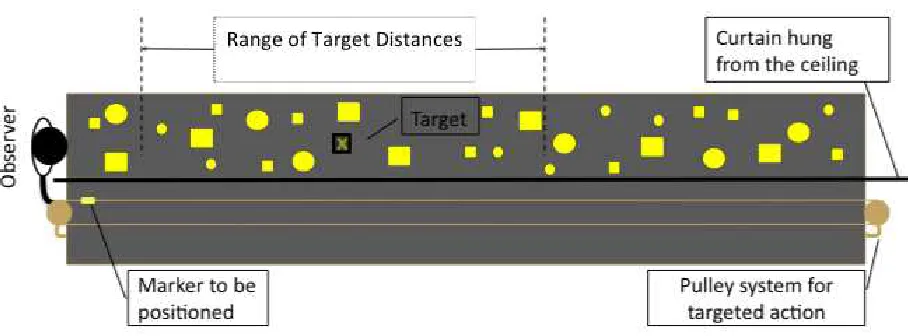
Apparatus. Participants sat at the end of a 5 m long, 1 m wide table that was covered in black felt.
They sat on the left side of the end. They were seated in an adjustable height chair and asked to rest
their chin on the chin rest that was attached to the table. This was used to keep eye-height at 53 cm
above the viewing surface throughout the experiment. A large black curtain was hung from the ceiling
along the centre of the table and extending along the 5 m length. This allowed participants to see targets
positioned along the visible textured surface on the left “perception” side where they sat, but not to be
able to see the right “action” half of the table along which they made their responses, either by throwing
or by positioning the marker on the pulley. The visible support surface was black with phosphorescent
1” and 2” square and circular texture elements that were distributed randomly along a long board (400
cm long and 30 cm wide) placed on the tabletop. On each trial, a target was placed at a distance from the
observer on this surface. The target was a phosphorescent X mounted on a black square wooden block
with sides of 5.5 cm. The range of distances that the target was placed throughout the experiment was
The “action” side of the table was occluded by the curtain so that participants were unable to see
the result of their actions. Thus, actions were performed open-loop. A tape measure was attached along
each side of the table running the entire length. See Figure 1 for an illustration of the setup.
---
INSERT FIGURE 1 ABOUT HERE
---
Two actions were tested in this experiment: extended reaching and throwing. To test extended
reaching, two identical pulleys (7cm radii) were attached to the two ends of the table, with a cord
running around them, on the right “action” side of the table directly to the right of the participant with
the cord just below shoulder height. Attached to the cord was a marker, which could be moved smoothly
by pulling the cord. The participant was unable to see this marker and could only feel it with the hand at
the beginning of a trial. Thus, positioning of the marker was performed open loop. During extended
reaching, a participant would first place his or her hand around the curtain to grasp the cord and marker
and then send the marker towards the target distance by reaching to pull the cord. The participant
repeated this action, grabbing only the cord, as many times as needed to place the marker at the distance
of the target on the “perception” side of the table. We removed the pulleys to test throwing. A small
plastic ball (5 cm in diameter) was handed to the participant each trial. The participants were told to
throw the ball to land at the distance of the target viewed on the “perception” side of the table. This ball
was covered in black Velcro so that it would stick to the felt-covered tabletop upon contact without
rolling. The surface of the table on the “action” side was also padded so that the ball made little sound
on contact with the surface. Hence, participants were unable to see or hear the result of their throwing.
Procedure. After the participant had read and signed consent forms approved by the IRB at IU,
participants were seated in a chair that was adjusted in height so that they could comfortably place their
chin on the chin rest at the end of the “perception” side of the table. The participant was then asked to
close his or her eyes while the target was placed at a distance by one of the experimenters using the tape
measure attached to the edge of the table. Distances within the range tested were selected randomly.
During the extended reaching task, participants were asked to reach around the curtain to grasp the cord
and marker with their right hand. The participant’s task was to send the marker out by repeatedly
reaching and pulling the cord until the marker matched the distance of the target viewed on the
“perception” side of the curtain. Once the participant had finished adjusting the marker, he or she closed
their eyes and alerted a second experimenter standing next to the pulleys on the “action” side of the
table, who then measured and recorded the distance of the marker using the tape measure attached to the
edge of the table. In the throwing task, a participant first closed his or her eyes and held out his or her
right hand so the experimenter could place the Velcro-wrapped ball in the palm. After the experimenter
on the “perception” side placed a target on the visible surface, the participant opened his or her eyes and
threw the ball to land on the “action” side of the table at the distance of the target on the “perception”
side. Then, the participant closed his or her eyes while the experimenter on the “action” side measured
and recorded the throwing distance and handed the ball back to the participant for the next trial.
Sometimes participants felt, immediately after releasing the ball, that the throw was inaccurate. In this
case, they were allowed to perform the throw again. This happened in approximately 5% of throwing
trials. During the experiment, participants only opened their eyes when they were viewing the targets
and performing the actions. Experimenters reminded them when they should have their eyes open or
Of key importance in this experiment was calibration. During calibration trials, the experimenter
on the ‘action’ side of the curtain extended a visible rod under the curtain to show the participant the
distance to which he or she had placed the ball or marker to provide visual feedback to the participant
for calibration. The rod could be seen on the “perception” side relative to the target to reveal positioning
error. Target distances were uniformly, but randomly, chosen to cover the range of distances (50 cm
-350 cm) for each participant.
All participants first were given accurate calibration of both extended reaching and throwing.
Trials were blocked by action. The order of extended reaching and throwing blocks was
counterbalanced across participants. Then participants were given false calibration. For half of them,
the feedback was always 15 cm shorter than their actual responses, that is, under-calibration (which
should have led participants to overshoot by 15 cm during post-calibration trials). For the other half, the
feedback was always 15 cm farther than their actual responses, that is, over-calibration. False
calibration was applied to both actions in blocked trials with order counterbalanced across participants.
Participants were randomly assigned to receive over- or under- calibration treatment. Specifically, for
each action, the conditions were: pre-calibration (6 trials), accurate calibration (10 trials), post (accurate)
calibration (15 trials), all for one action, then the other, then over/under-calibration (10 trials), post
(over/under) calibration (15 trials), again all for one action, then the other. All participants completed
the first three conditions, then half were over-calibrated and the other half under-calibrated.
Data analysis. Performance error was calculated by subtracting target distance from response distance
for each trial. Using performance error as the dependent variable, independent-sample t-tests were used
different from zero. Paired-sample t-tests were used to compare performance post (accurate) calibration
and post false calibration (using absolute error to combine data from participants treated to either over or
under calibration).
RESULTS
The goal of this experiment was to test, under full viewing conditions, whether the two selected actions,
namely, throwing and extended reaching, were comparable. Our results showed that this was indeed true
and that both actions responded alike to calibration.
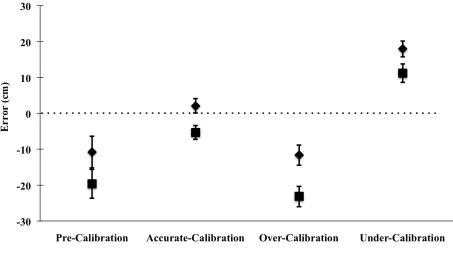
Before calibration, response distances were shorter than target distances for both actions.
Specifically, in extended reaching, the mean error (defined as response distance minus target distance)
was –10.8 cm (SD = 29.2 cm) and for throwing, it was –19.7 cm (SD = 27.2 cm). After calibration with
veridical visual feedback, both actions became more accurate and precise, with mean throwing error
reduced to –5.4 cm (SD = 20.6 cm) and mean extended reaching error reduced to + 2.1 cm (SD = 21.0).
For both actions, participants’ average performance errors after accurate calibration were not
significantly different from zero (t reaching (7) = 0.6, p = 0.6, t throwing (7) = -1.4, p = 0.2, two-tailed). This
showed that both actions could be calibrated effectively with visual feedback.
Additionally, the two actions responded alike in direct proportion to distorted calibration. In this
experiment, the visual feedback was either 15 cm farther (over-calibration) or 15 cm shorter
(under-calibration) than the actual response distance during false calibration. Mean errors are plotted in Figure 2
for throwing and extended reaching with accurate-calibration, over-calibration and under-calibration.
Compared to post (accurate) calibration errors for each action, errors for under-calibration exhibited
exhibited undershoot by approximately 14cm in extended reaching and 18cm in throwing. Ignoring the
direction of error, the magnitude of error introduced by false calibration was significantly larger than the
magnitude of error after accurate calibration for extended reaching (t(7) = - 3.0, p < 0.04, one-tailed) and
for throwing (t(7) = - 3.6, p < 0.02, one-tailed). There was also no change in precision for either
reaching or throwing, with SD’s for both actions of approximately 21 cm. Therefore, both actions were
responsive to calibration in like manner and were hence appropriate to be used as experimental tasks in
Experiments 2 and 3.
---
INSERT FIGURE 2 ABOUT HERE
---
EXPERIMENT 2: DOES CALIBRATION GENERALIZE BETWEEN ACTIONS?
In Experiment 1, we found that both extended reaching and throwing respond to calibration in
the same way. Next we tested whether calibrating one action affects the performance of another action.
To do this, we first tested baseline performance of extended reaching and throwing without feedback.
We tested both actions pre-calibration. We then calibrated one of the actions by providing false
feedback to induce a constant overshoot of approximately 15cm. Finally, post-calibration responses for
both actions were measured. If calibration generalized between actions, falsely calibrating one action
should show an effect of overshooting in both actions; if calibration does not generalize between actions,
falsely calibrating one action should not affect the other action, that is, the constant error should only be
METHODS
Participants. Sixteen participants (half male) took part in the experiment and were remunerated at a
rate of $10/hour for their time. All participants had normal or corrected to normal vision and adequate
stereovision, as tested by the Stereo Test (Stereo Optical Co., Inc.).
Apparatus. The apparatus was the same as that in Experiment 1, except that in this experiment, three
perceptual targets of different sizes were used. The perceptual targets were phosphorescent X’s mounted
on three black wooden squares, with sides equal 5.5 cm, 9 cm and 11 cm. On each trial, one of these
targets was randomly selected to control for the effect of image size.
Procedure. The procedure was similar to that in Experiment 1 with some modifications. First, the
perceptual targets were placed between 50 and 250cm from the participant on the “perception” side. In
Experiment 1 responses became more variable as target distance increased. We reduced the range of
target distances to obtain more consistent responses. Second, in this experiment, participants completed
five different conditions. All participants completed 20 pre-calibration trials: 10 extended reaching and
10 throwing trials. Then eight participants completed 20 calibration trials of extended reaching and the
other eight completed 20 calibration trials of throwing. During these trials, all participants were given
false feedback. A rod was pushed under the curtain by the experimenter on the action side 15cm closer
to the participant than the actual response distance. All participants then completed a further 20 post-
calibration trials: 10 reaching and 10 throwing. During pre- and post- calibration trials, the order of
actions (tested in blocked trials) was counterbalanced. As in Experiment 1, participants had their eyes
the textured surface of support was rotated 180° (that is, end to end) so the participants could not use the
pattern of texture elements as landmarks to aid their perception of distance. During calibration they
were advised not to try to use the texture elements to aid performance.
Data analysis. Performance error was calculated by subtracting target distance from response distance
for each trial. All analyses were performed on error scores. Using performance error as the dependent
variable, we first performed two mixed-design ANOVAs comparing the two actions in respect to the
actions that were calibrated, one analysis on pre-calibration responses and a second analysis on
post-calibration responses.
Second, we examined the levels of variability as measured by standard deviations. We computed
a standard deviation for each participant’s error scores post-calibration and performed a
repeated-measures ANOVA to compare performance of calibrated and non-calibrated actions. We also report
between-subject variability as the standard deviation in each condition of the mean error scores for
participants.
Finally, we used false feedback that should yield a consistent 15 cm overshoot so that we could
clearly recognize effective calibration. We tested each condition (that is, each action as a function of the
calibrated action both pre or post calibration) using an independent or group t-test (2-tailed) to test
difference from 15 cm. Strictly, all that can be predicted of un-calibrated performance is that it should
be variable. However, it is consistent with this expectation that un-calibrated performance should not
reliably exhibit a 15 cm overshoot. Therefore, we expected all effectively un-calibrated conditions to
yield a statistically significant difference from +15 cm, while the two calibrated conditions should not.
here we also expect the conditions that fail to reach significance to exhibit lower variance as we will
have also tested.
RESULTS
This experiment was designed to determine whether calibration is action-specific. To achieve
this, we provided false calibration (that is, visual feedback that was always 15 cm shorter than the actual
response distance) to one of the actions; and compared performance in each action before and after
calibration. Our results showed that the effect of the false calibration was only reflected in performance
of the calibrated action and not in that of the action that had not been calibrated.
We used mixed-design ANOVA to test pre-calibration and post-calibration errors, separately,
with action-calibrated as a between-subjects factor and action-performed as a repeated measures factor
in each of the two analyses. No factors were expected to be significant in the first analysis. The
interaction was predicted to be significant in the second analysis. In the ANOVA on pre-calibration
errors, the action-calibrated was significant (F(1, 158)=6.2, p < 0.02, effect size of 0.04). The means for
the two groups of participants (that is, those for whom extended reaching or throwing would be
calibrated) were -3.2 and –12.8, respectively. Essentially, these represented individual differences in
the un-calibrated pre-calibration performance. The means for throwing and extended reaching errors
were -8.4 and -7.6, respectively, and thus, essentially the same. In the ANOVA on post-calibration
errors, neither main effect was significant (p > 0.2), but the interaction was significant (F(1,158)=23.3, p
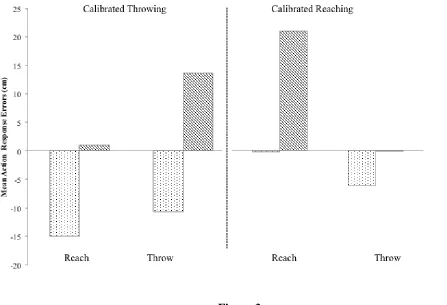
< 0.001, effect size of 0.15). As shown in Figure 3, post-calibration means for the two actions calibrated
For participants whose extended reaching was calibrated, we performed a paired-t test to compare
post-calibration throwing and extended reaching errors. (The latter had been calibrated and the former not.)
The result was significant (t(79)=3.8, p < 0.001). Likewise, for participants whose throwing was
calibrated, the result was significant (t(79)=-3.0, p < 0.005).
---
INSERT FIGURE 3 ABOUT HERE
---
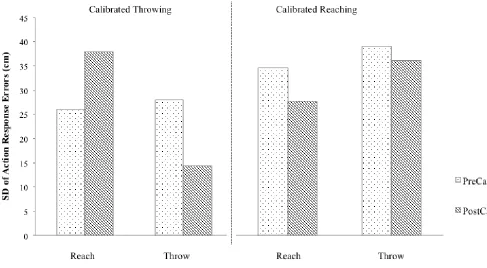
As shown in Figure 4, the post-calibration variability was less for the calibrated actions than the
other non-calibrated actions and the variability for those other actions was comparable to the variability
for all actions pre-calibration. We computed a standard deviation for each participant’s error scores
post-calibration and performed a repeated-measures ANOVA to compare performance of calibrated and
non-calibrated actions. The result was significant (F(1,15)=5.0, p < 0.05, effect size of 0.25). The mean
SD was 21.1 for non-calibrated actions and 16.0 for calibrated actions. The same analysis, performed on
pre-calibration errors, was not significant (p > 0.8). The mean SD was 22.7 for actions that were not to
be calibrated and 21.8 for actions that were to be calibrated, that is, both the same as for the
non-calibrated actions post-calibration. Next, we also evaluated between-subjects variability by computing
the standard deviation in each condition of the mean error scores for participants. For the conditions, the
standard deviations were as follows in pre to post-calibration. When throwing was calibrated, extended
reaching was 26.0 and then 37.9 (variability increased), while throwing was 28.0 and then 14.4
(variability decreased). When extended reaching was calibrated, extended reaching was 34.5 and then
27.7 (variability decreased) and throwing was 39.1 and then 36.1 (variability decreased slightly, but was
---
INSERT FIGURE 4 ABOUT HERE
---
Finally, we used an independent or group t-test (2-tailed) to test difference from +15 cm in each
condition. We predicted that all conditions that were un-calibrated (or where calibration was
ineffective) would yield a significant difference. Only the calibrated conditions should fail to yield a
significant difference in this case, because the false feedback should have yielded overshoot by +15 cm.
All conditions, except two, yielded significant results, p < 0.002 or better. The two that failed to reach
significance (and therefore, were p > 0.05) were both post-calibration, namely, extended reaching when
extended reaching was calibrated and throwing when throwing was calibrated. When this result was
combined with the finding that the reliability of the performance only increased in the same two
calibrated conditions that failed to reach significance in the group t-test, we concluded that only those
two conditions exhibit the effect of calibration.
In short, calibration only affected the calibrated actions and did not generalize to other actions.
Calibration is action specific.
EXPERIMENT 3:
The goal of this experiment was to determine whether the effect of a change in units of
perceptual information about distance generalizes across actions. We first calibrated each of two actions,
extended reaching and throwing, using accurate feedback. Each of the two actions was tested
post-calibration. Then, the perceptual units were altered without recalibrating the actions. Instead, each
action was simply tested again with the expectation of a change in response distances caused by the
change in perceptual units. We predicted that the change in perceptual units would generalize across
actions.
We manipulated two perceptual units, each coupled with one of two different sources of visual
information about distance: Eye Height (EH) units scale the angle of elevation and Inter-Pupillary
Distance (IPD) units scale the vergence angle. The EH unit is defined as the perpendicular distance
between the eyes and the surface of support. The IPD unit is defined as the distance between the two
eyes. Purely optical information is angular. The linear dimension required to specify metric distance is
missing. However, the geometry of viewing couples a linear scaler with optical angular values to yield
metric visual information about linear extents (that is for instance, distance or size). For instance,
elevation angle, , specifies distance, D, in EH units:
D/EH = 1/tan
If D and EH are measured (by an experimenter) in centimeters, for instance, then D/EH is a pure number
and this is what the optical information variable returns to the visual system. Nevertheless, the measure
is in EH units. The problem for the perceiver is that he or she, in principle, does not know the size of the
EH unit until that unit is calibrated. When = 45°, that information will specify the distance as equal to
1 EH. If the EH for a seated observer is 40 cm, then once that unit is calibrated for reaching, then the
is then increased by 25% to 50 cm (by lowering the table) without recalibrating reaching, then that same
target at 40 cm will return an optical value of 0.8 EH. Without recalibration, this would be interpreted in
the original calibrated EH unit of 40 cm and thus, the observer should reach to 0.8 x 40 cm ≈ 32 cm,
instead of 40 cm. The observer should undershoot. The same type of analysis applies to information
specified in binocular vergence angles.
In this experiment, we first calibrated both extended reaching and throwing with both
sources of information available, and then tested performance of each action post-calibration.
Next, we increased the EH and the IPD, each by 25%. Without recalibration, we again tested
extended reaching and throwing and response distances were expected to be systematically
shorter than responses immediately preceding the change in the size of the perceptual units.
METHOD
Participants. Twelve participants (4 females and 8 males) completed this experiment and were
remunerated at a rate of $10 per hour for their time. All of them had normal or corrected to normal
vision and adequate stereovision, as tested by the Stereo Test (Stereo Optical Co., Inc.).
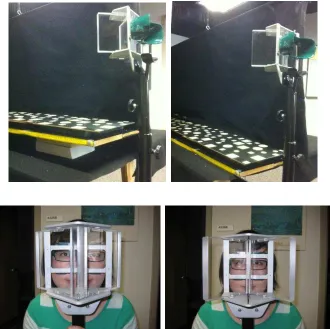
Apparatus. The experimental setup was similar to that in Experiment 1, except that participants rested
their heads on the chin and forehead rest of a telestereoscope, which was used to adjust the IPD
optically. See Anderson and Bingham (2010) for description and explanation of this new type of
attached to the table top on the “perception” side of the table was adjustable and could be easily raised
or lowered to produce changes of the EH. See Figure 5 for illustration. Targets used in this experiment
were the same as those in Experiment 2.
---
INSERT FIGURE 5 ABOUT HERE
---
Procedure. This experiment was conducted in the dark. The telesteroscope was first set to decrease the
IPD by 8mm (relative to the normal IPD) and the adjustable surface of support was positioned to fix the
EH at 40 cm. All participants were calibrated and tested performing each of the two actions. They first
performed 20 trials of extended reaching or 20 trials of throwing with veridical visual feedback provided
by the experimenter pushing a glow-in-the-dark rod through the curtain indicating where the marker or
ball had been placed relative to the visual target. Immediately after calibrating one of the two actions, in
the next ten trials, participants performed that calibrated action under the same viewing conditions, but
post-calibration (that is, without feedback). These trials were always conducted immediately after the
calibrations trials for the same action. Order of testing reaching or throwing was counterbalanced across
participants. Then the experimenters reset the telestereoscope to increase the IPD by 16 mm (that is, to 8
mm larger than normal) and lowered the textured surface to an EH of 50 cm. This yielded comparable
amounts of change in the IPD and the EH. Given that the average IPD in adults was 65 mm, a 16 mm
change from the calibrated condition to the perturbed condition yielded a 25% increase. Also, as
compared to the calibrated condition with an EH of 40 cm, the new EH of 50cm was again a 25%
the perceptual units quickly and surreptitiously and participants were asked to keep their eyes closed in
between trials such that participants were unaware of this manipulation. Without further calibration,
participants performed extended reaching and throwing with the new set of perceptual units, 10 trials of
each action with order again counterbalanced across participants.
Data analysis. For each action, response errors (defined as response distance minus target distance)
before and after the change of perceptual units were compared using a paired-samples t-test. Response
errors were also analysed using a repeated measures ANOVA with the following factors (and levels):
action (reaching, throwing) and perceptual unit (original-calibrated, enlarged-uncalibrated..
RESULTS
To determine how action responses were affected by the increase in the size of perceptual units without
recalibration, we compared throwing and extended reaching responses performed with the original,
calibrated perceptual units to those performed with enlarged units, both cases having followed a single
block of calibration trials for each action with the originally sized units. Trials with response errors more
than 2 standard deviations away from the mean in each condition were considered outliers
(approximately 6%) and removed from the analysis.
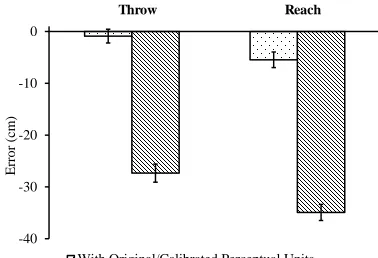
Our results showed that calibrating perceptual units to action responses produced accurate
responses. Specifically, after calibrating the first set of perceptual units (EH = 40cm and IPD = - 8mm),
the mean error for throwing was -0.9 cm (SD = 14.2 cm) and for extended reaching, it was -5.5 cm (SD
expected: the mean error for throwing was -27.3 cm (SD = 18.56 cm) and for extended reaching, it was
–34.9 cm (SD = 16.4 cm). See Figure 6. Paired-sample t-tests showed that the decrease in response
distances for both actions was significant, with t (11) = 9.7, p < .001 for throwing, and t (11) = 11.4, p <
.001 for extended reaching.
A repeated-measures ANOVA showed that response error was significantly affected only by the
change in perceptual units (F (1, 11) = 318.8, p < 0.001, effect size was 0.6). Neither the action nor the
interaction were significant (action: F (1, 11) = 1.6, p > 0.3; action by perceptual units interaction: F (1,
11) = 0.4, p > 0.6). Figure 6 shows mean response errors in throwing and extended reaching with both
original and changed perceptual units. These results show that a change in perceptual units generalized
in its effect across actions.
---
INSERT FIGURE 6 ABOUT HERE
---
GENERAL DISCUSSION
The goal of these experiments was to test two predictions of the ‘mapping among embodied
units’ theory of calibration. To test these predictions, we used targeted feedforward actions that required
terminal feedback for calibration. In Experiment 1, we tested both actions in response to the same
distorted feedback to ensure that the actions were comparable in precision and in response to the
another action. To test this, two groups of participants in Experiment 2 each performed both actions
before calibration. Then, one action was calibrated for one group and the other action for the other
group, using the same distorted feedback in both cases, namely, 15 cm under-calibration. This was
expected to produce 15 cm overshoot in performance of the calibrated actions post-calibration. It did.
The central question was whether this effect would generalize for each group to the action that was not
calibrated (when tested after the other action had been calibrated). The result was that it did not.
Calibration did not generalize to other actions beyond the action calibrated. In addition to having been
predicted by the mapping theory, this result was consistent with expectations of the ‘action specificity
approach’, but not the ‘general purpose perception approach’.
However, a second prediction of the mapping theory was that a change in the size of the relevant
units of perception would generalize to different actions (in which that information is used). This
prediction of the mapping theory was also consistent with the ‘general purpose perception approach’,
but not the ‘action specificity approach’. We tested this prediction in Experiment 3 by providing
participants with two sources of visual information about target distance, each involving a different
perceptual unit. Elevation angles are scaled by EH and vergence angles are scaled by IPD. Performance
of both throwing and extended reaching was calibrated, with given sizes of each of the two perceptual
units. Accurate feedback was provided for calibration. Performance was tested post-calibration and was
found to be accurate as expected for each of the two actions. Then both of the perceptual units were
increased in size by 25% and both actions were tested again without additional calibration. The result
was that targeted throws and targeted extended reaches both reliably undershot the targets, as expected
given the increase in the size of the perceptual units. The effect generalized across relevant actions.
Thus, two predictions of the ‘mapping theory of calibration’ were confirmed. The key aspect of
perception and the dynamics of their relations to one another and to embodied units of action is new and
important. This focus allows us to resolve current debates in the calibration literature while bringing
new problems to the attention of researchers. Is perception action specific or general? The answer is
necessarily both. On the one hand, it is specific because a mapping is required from embodied units of
perception to embodied units of action. Calibration tunes this mapping and the mapping is specific to
the action that returns feedback information used for calibration. On the other hand, embodied units of
perception are general to the different actions to which they are mapped. A change in a unit naturally
affects all the relevant actions. Indeed, the fact that units of perception are embodied means that they
can and do change. In Experiment 3, two different perceptual units, EH and IPD, were changed in the
same way after the relevant actions had been calibrated. Both were increased by 25%. What would
happen if they were changed in different ways, for instance, one increased and the other decreased, or
one changed and the other not? Would calibration remain stable? Would one perceptual unit dominate
to determine targeting responses or would responses instead reflect some weighted average as suggested
by ‘cue combination theories’? Surprisingly, these possibilities have not been previously considered or
investigated, although Coats, Pan and Bingham (submitted) have now ventured to do so following the
work herein reported. The role of dynamics in interactions among sources of perceptual information has
not previously been featured, but it naturally is when the questions are raised in the context of
calibration. A substantial literature exists of investigations revealing the dynamical properties of
calibration, for instance, the lag in response to terminal feedback or the stability of calibration once
terminal feedback is made unavailable. See, for instance, Bingham (2005), Bingham, Bradley, Bailey
and Vinner (2001), Bingham, Coats and Mon-Williams (2007), Bingham, Pan and Mon-Williams
(submitted), Bingham and Pagano (1998), Bingham and Romack (1999), Coats, Bingham and
Mon-Williams and Bingham (2007), Vindras and Viviani (1998). Calibration is akin to learning and as such,
it naturally involves dynamics. However, dynamics has not been featured in the long standing debates
among proponents of different ‘cue combination’ theories. Once interactions among embodied units of
perception is considered in the larger context of the calibration of perceptually guided actions, dynamics
naturally becomes an intrinsic part of the problem domain. Much future work will be required to pursue
REFERENCES
Bingham, G.P. (2005). Calibration of distance and size does not calibrate shape information:
Comparison of dynamic monocular and static and dynamic binocular vision. Ecological
Psychology, 17(2), 55-74. .
Bingham, G.P., Bradley, A., Bailey, M., Vinner, R. (2001). Accommodation, occlusion and disparity
matching are used to guide reaching: A comparison of actual versus virtual environments.
Journal of Experimental Psychology: Human Perception and Performance, 27(6), 1314-
1344.
Bingham, G.P., Coats, R. & Mon-Williams, M. (2007). Unnatural prehension to virtual objects is not
inevitable if calibration is allowed. Neuropsychologia, 45, 288-294.
Bingham, G.P., Crowell, J.A. & Todd, J.T. (2004). Distortions of distance and shape are not produced
by a single continuous transformation of reach space. Perception & Psychophysics, 66(1), 152-
169.
Bingham, G.P., Pan, J.S. & Mon-Williams, M.A. (submitted). Calibration is both functional and
anatomical.
Bingham, G.P. & Pagano, C.C. (1998). The necessity of a perception/action approach to definite
Psychology: Human Perception and Performance, 24, 145-168.
Bingham, G.P. & Romack, J.L. (1999). The rate of adaptation to displacement prisms remains constant
despite acquisition of rapid calibration. Journal of Experimental Psychology: Human
Perception and Performance, 25(5), 1331-1346.
Bingham, G.P., Zaal, F., Robin, D. & Shull, J.A. (2000). Distortions in definite distance and shape
perception as measured by reaching without and with haptic feedback. Journal of Experimental
Psychology: Human Perception and Performance, 26(4), 1436-1460.
Bruggeman, H. & Warren, W.H. (2010). The direction of walking – but not throwing or kicking – is
adapted by optic flow. Psychological Science, 21, 1006-1013.
Coats, R., Bingham, G.P. & Mon-Williams, M. (2008). Calibrating grasp size and reach distance:
Interactions reveal integral organization in reaching-to-grasp movements. Experimental Brain
Research, 189, 211-220.
Coats, R.O., Pan, J.S. & Bingham, G.P. (submitted). Perturbation of perceptual units reveals dominance
hierarchy in cross calibration.
Durgin, F. H., Fox, L. F., & Kim, D. H. (2003). Not letting the left leg know what the right leg is doing:
Limb-specific locomotor adaptation to sensory-cue conflict. Psychological Science, 14, 567–572.
Fajen, B.R. (2005a). Calibration, information, and control strategies for braking to avoid collision.
Fajen B.R. (2005b). Perceiving possibilities for action: on the sufficiency of perceptual learning and
calibration for the visual guidance of action, Perception, 34, 741–755.
Fajen B.R. (2005c). The scaling of information to action in visually guided braking. Journal
of Experimental Psychology: Human Perception and Performance, 31, 1107– 1123.
Fajen, B.R. (2007). Rapid calibration based on optic flow in visually guided action. Experimental Brain
Research, 183, 61-74.
Goodale, M. A., Jakobsen, L. S.,&Keillor, J.M. (1994). Differences in the visual control of pantomimed
and natural grasping movements. Neuropsychologia, 32, 1159–1178.
Hu Y, Eagleson R, Goodale MA (1999) The effects of delay on the kinematics of grasping.
Experimental Brain Research, 126, 109–116.
Jacobs, D.M. & Michaels, C.F. (2006). Lateral interception I: operative optical variables, attunement,
and calibration. Journal of Experimental Psychology: Human Perception and Performance, 32,
443–458.
Lee, Y.L., Crabtree, Norman, F., & Bingham, G.P. (2008). Poor shape perception is the reason that
reaches-to-grasp are visually guided online. Perception & Psychophysics, 70, 1032-1046.
Loomis, J.M. & Philbeck, J.W. (2008). Measuring spatial perception with spatial updating and action.
(Chptr 1, pp. 1-43), Psychology Press, New York, NY.
Mon-Williams, M. & Bingham, G.P. (2007). Calibrating reach distance to visual targets. Journal of
Experimental Psychology: Human Perception and Performance, 33(3), 645-656.
Norman, J. (2002). Two visual systems and two theories of cognition. Behavioral and Brain Sciences,
25, 73-96.
Pagano, C.C. & Bingham, G.P. (1998). Comparing measures of monocular distance perception: Verbal
and reaching errors are not correlated. Journal of Experimental Psychology: Human
Perception and Performance, 24 (4), 1037-1051.
Proffitt, D.R. (2008). An action specific approach to spatial perception. In R.L. Klatzky, B.
MacWhinney, & M. Behrmann (eds.) Embodiment, Ego-Space and Action, (pp. 179-202),
Psychology Press, New York, NY.
Rieser, J.J., Pick, H.L., Ashmead, D.H. & Garing, A.E. (1995). Calibration of human locomotion and
models of perceptual-motor organization. Journal of Experimental Psychology: Human
Perception and Performance, 21, 480-479.
Van der Kamp, J., Bennett, S.J., Savelsbergh, G.J.P. & Davids, K. (1999). Timing a one-handed catch
II. Adaptation to telestereoscopic viewing. Experimental Brain Research, 129, 369-377.
Multimodally specified effort and distance perception. Journal of Experimental Psychology:
Human Perception and Performance.
Wickelgren, E.A., McConnell, D. & Bingham, G.P. (2000). Reaching measures of monocular distance
perception: Forward vs side-to-side head movements and haptic feedback. Perception &
Psychophysics, 62(5), 1051-1059.
Witt, J.K., Proffitt, D.R. & Epstein, W. (2010). When and how are spatial perceptions scaled? Journal
FIGURE CAPTIONS
Figure 1. Apparatus used in the experiments. The observer sat at the end of the table on the
“perception” side to the left of a curtain that extended along the length of the table. Responses were
made on the “action” side to the right of the observer. Extended reaching responses were performed
using the pulley system on the “action” side to move a marker to the distance of the target seen on the
“perception” side. Throwing responses were performed by tossing a Velcro covered ball on the “action”
side to land at the distance of the target on the “perception” side. The curtain occluded the observer’s
view of the action responses that, therefore, were performed open loop. Terminal feedback was
provided during calibration trials by an experimenter on the “action” side who extended a visible rod
under the curtain to appear on the “perception” side relative to the target. The range was 50 cm- 350 cm
in Experiment 1 and 50 cm – 250 cm in Experiments 2 and 3. In Experiments 1 and 2, the observer
placed his or her head on a chin rest attached to the table. In Experiment 3, a new type of
telestereoscope, that included chin and forehead rests, replaced the chin rest. The telestereoscope was
used in Experiment 3 to change the observer’s Inter-Pupillary Distance (IPD). Finally, the surface on
the “perception” side could be rapidly raised or lowered to change the observer’s eye height (EH). This
was used in Experiment 3. The texture was more dense than shown. See Figure 5.
Figure 2. Response errors in extended reaching (diamonds) and throwing (squares) before calibration,
after accurate calibration, after over calibration by 15 cm and after under calibration by 15 cm. Error
bars represent +/- 1 standard errors.
Figure 3: Mean errors for extended reaching and throwing both pre-calibration (light bars) and post-
calibration (dark bars). The left panel shows results when extended reaching was calibrated. The right
Figure 4: Standard Deviations for extended reaching and throwing both pre- calibration (light bars) and
post- calibration (dark bars). The left panel shows results when extended reaching was calibrated. The
right panel shows results when throwing was calibrated.
Figure 5. The top two pictures illustrate the change in EH by raising or lowering the textured support
surface. The new telestereoscope is also shown. The bottom two pictures illustrate change in IPD both
greater than and less than normal produced using the new telestereoscope. See Anderson and Bingham
(2010) for full description and explanation.
Figure 6. Error means for throwing and extended reaching before and after a 25% increase in the size
Figure 6.