This is a repository copy of
Exploring critical risks associated with enterprise cloud
computing
.
White Rose Research Online URL for this paper:
http://eprints.whiterose.ac.uk/79126/
Version: Accepted Version
Proceedings Paper:
Peng, G.C., Dutta, A. and Choudhary, A. (2014) Exploring critical risks associated with
enterprise cloud computing. In: Leung, V.C.M. and Chen, M., (eds.) Cloud Computing. 4th
International Conference on Cloud Computing, 17th - 19th October 2013, Wuhan, China.
Lecture Notes of the Institute for Computer Sciences, Social Informatics and
Telecommunications Engineering, 133 . Springer International Publishing , 132 - 141.
https://doi.org/10.1007/978-3-319-05506-0_13
[email protected] https://eprints.whiterose.ac.uk/ Reuse
Unless indicated otherwise, fulltext items are protected by copyright with all rights reserved. The copyright exception in section 29 of the Copyright, Designs and Patents Act 1988 allows the making of a single copy solely for the purpose of non-commercial research or private study within the limits of fair dealing. The publisher or other rights-holder may allow further reproduction and re-use of this version - refer to the White Rose Research Online record for this item. Where records identify the publisher as the copyright holder, users can verify any specific terms of use on the publisher’s website.
Takedown
If you consider content in White Rose Research Online to be in breach of UK law, please notify us by
promoting access to White Rose research papers
White Rose Research Online
[email protected]
Universities of Leeds, Sheffield and York
http://eprints.whiterose.ac.uk/
This is an author produced version of a paper published in Cloud Computing.
White Rose Research Online URL for this paper:
http://eprints.whiterose.ac.uk/79126
Published paper
Peng, G.C., Dutta, A. and Choudhary, A. (2014) Exploring critical risks
associated with enterprise cloud computing. In: Leung, V.C.M. and Chen, M.,
(eds.) Cloud Computing. 4th International Conference on Cloud Computing, 17th
- 19th October 2013, Wuhan, China. Lecture Notes of the Institute for Computer
Sciences, Social Informatics and Telecommunications Engineering, 133 .
Springer International Publishing , 132 - 141.
Exploring Critical Risks Associated with Enterprise
Cloud Computing
Guo Chao Alex Peng1*, Arnab Dutta1, and Alok Choudhary2
1
Information School, University of Sheffield, Regent Court, Sheffield, S1 4DP, UK 2
Management School, University of Sheffield, IWP Building, Sheffield, S10 2TN, UK
{g.c.peng, ADutta2, a.choudhary}@sheffield.ac.uk
Abstract. While cloud computing has become an increasingly hot topic in the
industry, risks associated with the adoption of cloud services have also received growing attention from researchers and practitioners. This paper reports the results of a study that aimed to identify and explore potential risks that organisations may encounter when adopting cloud computing, as well as to assess and prioritise the identified risks. The study adopted a deductive research method based on a cross-sectional questionnaire survey. The questionnaire was distributed to a group of 295 carefully selected and highly experienced IT professionals, of which 39 (13.2%) responses were collected and analysed. The research findings identified a set of 39 cloud computing risks, which concentrated around diverse operational, organisational, technical, and legal areas. It was identified that the most critical risks were caused by current legal and technical complexity and deficiencies associated with cloud computing, as well as by a lack of preparation and planning of user companies.
Keywords: Cloud computing, Risks, Legal, Organisational, Operational,
Technical.
1 Introduction and Background of Study
integration and access to real-time data. Cloud computing provides the facility to access shared resources and common infrastructure, offering services on demand over the network to meet changing business needs [1]. It also promises to deliver high-quality and advanced IT services to organisations with substantially reduced costs [2], such as reduced hardware investments, less maintenance fees, and lower electricity consumption associated with IT usage. In this context, cloud computing can also be perceived as one of the green technologies that enables environmentally sustainable use of IT in modern organisations in the long term.
However, despite these very attractive facts, migrating the hitherto internal IT resources and sensitive business data to a third-party cloud vendor is never an easy decision to be made by CEOs, CIOs and IT managers. In fact, the adoption of cloud computing is associated with a wide range of potential risks and challenges. For instance, the inherent features of cloud computing determine that IT operation within a third-party cloud provider will be by no means transparent to user companies, who also have limited control on the subscribed cloud services [3]. Such lack of transparency and control may raise potential risks related to the security and privacy of business and customer data stored in the cloud [1]. Moreover, user companies need to make a range of internal changes (e.g. designing new business processes, refining IT roles, and downsizing IT department) to prepare themselves to the new cloud environment [4]. This however may potentially lead to job dissatisfaction of in-house IT and business staff. Consequently, fully exploring and understanding these cloud risks and challenges is fundamental for organisations to decide strategically whether or not cloud computing is the right tool for them, as well as to better prepare them to deal with the potential cloud problems and thus avoid severe technical failure and business disasters.
This paper reports a study that aimed to identify, explore and assess a comprehensive list of risks associated with cloud computing. A systematic literature review was carried out at the early stage of the research. As a result of this extensive review, the researchers established a theoretical risk ontology that contains 39 potential risks that organisations may encounter during cloud computing adoption and usage. A questionnaire was constructed based on this theoretical risk ontology and it was used to seek IT professionals’ perceptions of the established cloud risks. This paper is organized in the following manner. The next section of the paper presents the research methodology including a discussion of the theoretical risk ontology and the research questionnaire design. Section 3 presents the analysis and results derived from the questionnaire survey. Finally, section 4 concluded this study with a note of its research and practical implications.
2 Research methodology
2.1 The theoretical risk ontology
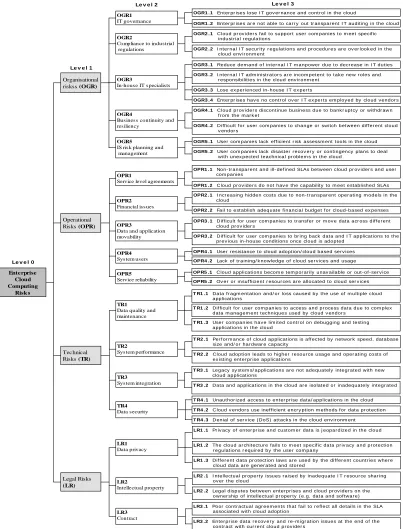
of the study identified that current research on cloud computing risks has been very limited and focused mainly on security and privacy aspects. Faced with this scarcity of studies on the topic, a more extensive literature review was conducted. This critical review followed the systematic approach proposed by Peng and Nunes [5, 6]. Specifically, apart from reviewing studies that directly address cloud computing risks, this systematic review also covers general IT and computing journal papers, conference proceedings, books, industrial white papers, and technical reports. The purpose here was “to identify broadly any possible factors and issues that might lead to potential” cloud computing failure [5]. This endeavour resulted in the identification of a large amount of valuable literature, which addressed various IT, cloud computing, legal, and business issues. Subsequently, these retrieved articles and materials were “systematically and critically analysed, compared and synthesised, and then used as raw materials to construct arguments and standpoints for risk identification” [5]. Consequently, through this extensive and critical literature review, the researchers established and proposed a set of 39 potential cloud computing risks. A risk ontology is then developed to organise and present these identified cloud risks (Figure 1 below).
As shown in Figure 1, the established cloud risks were organised into 4 main categories and 12 sub-categories in the risk ontology. The 4 main risk categories include:
• Organisational risks (OGR). Cloud adoption can lead to significant impacts on
diverse organisational aspects, such as IT governance, compliance to industrial regulations, in-house IT experts, and IT planning. Risks related to these organisational and managerial aspects are categorised as organisational risks.
• Operational risks (OPR). The adoption of cloud computing significantly changes
the hitherto internal IT and business operations in user companies. Risks affecting daily business and IT operations are thus categorised as operational risks.
• Technical risks (TR). The complicated cloud infrastructure and inherent IT
deficiencies existed in the company can raise a set of technical risks during cloud computing adoption.
• Legal risks (LR). The nature and inherent features of cloud computing can lead to
Operational Risks (OPR) Legal Risks (LR) Enterprise Cloud Computing Risk s Organisational riskss (OGR)
OGR1 . 1 Enter pr ises lose I T gov er nance and contr ol in the cloud
OGR3 . 2 I nter nal I T adm inistr ator s ar e incom petent to tak e new r oles and r esponsibilities in the cloud env ir onm ent
OGR2
Compliance to industrial regulations
OGR3
In-house IT specialists OGR1
IT governance
OGR4
Business continuity and resiliency LR3 Contract LR1 Data privacy LR2 Intellectual property
OGR1 . 2 Enter pr ises ar e not able to car r y out tr anspar ent I T auditing in the cloud
OGR2 . 1 C loud pr ov ider s fail to suppor t user com panies to m eet specific industr ial r egulations
OGR2 . 2 I nter nal I T secur ity r egulations and pr ocedur es ar e ov er look ed in the cloud env ir onm ent
OGR3 . 1 Reduce dem and of inter nal I T m anpower due to decr ease in I T duties
OGR3 . 3 Lose ex per ienced in- house I T ex per ts
OGR4 . 1 C loud pr ov ider s discontinue business due to bank r uptcy or withdr aw n fr om the m ar k et
OGR4 . 2 D ifficult for user com panies to change or switch between differ ent cloud v endor s
OPR1 . 1 Non- tr anspar ent and ill- defined SLAs betw een cloud pr ov ider s and user com panies
OPR3 . 1 Difficult for user com panies to tr ansfer or m ov e data acr oss differ ent cloud pr ov ider s
OPR2 Financial iss ues
OPR3
Data and application movability OPR1
Service level agreements
OPR4 System users
OPR1 . 2 Cloud pr ov ider s do not hav e the capability to m eet established SLAs
OPR2 . 1 I ncr easing hidden costs due to non- tr anspar ent oper ating m odels in the cloud
OPR2 . 2 Fail to establish adequate financial budget for cloud- based ex penses
OPR3 . 2 Difficult for user com panies to br ing back data and I T applications to the pr ev ious in- house conditions once cloud is adopted
OPR4 . 1 User r esistance to cloud adoption/ cloud based ser v ices
LR1 . 1 Pr iv acy of enter pr ise and custom er data is j eopar dized in the cloud
LR1 . 2 The cloud ar chitectur e fails to m eet specific data pr iv acy and pr otection r egulations r equir ed by the user com pany
LR2 . 1 I ntellectual pr oper ty issues r aised by inadequate I T r esour ce shar ing ov er the cloud
LR2 . 2 Legal disputes between enter pr ises and cloud pr ov ider s on the owner ship of intellectual pr oper ty ( e.g. data and softwar e)
LR3 .2 Enter pr ise data r ecov er y and r e- m igr ation issues at the end of the contr act with cur r ent cloud pr ov ider s
LR3 .1 Poor contr actual agr eem ents that fail to r eflect all details in the SLA associated with cloud adoption
Le v e l 0
Le v e l 1
Le v e l 2 Le v e l 3
OGR3 . 4 Enter pr ises hav e no contr ol ov er I T ex per ts em ploy ed by cloud v endor s
OGR5 IS risk planning and management
OGR5 . 1 User com panies lack efficient r isk assessm ent tools in the cloud
OGR5 . 2 User com panies lack disaster r ecov er y or contingency plans to deal with unex pected teachnical pr oblem s in the cloud
OPR4 . 2 Lack of tr aining/ k nowledge of cloud ser v ices and usage
OPR5 Service reliability
OPR5 .1 Cloud applications becom e tem por ar ily unav ailable or out- of- ser v ice
OPR5 .2 Ov er or insufficient r esour ces ar e allocated to cloud ser v ices
Technical Risks (TR)
TR2
System performance TR1
Data quality and maintenance
TR3 System integration
T R1 . 1 Data fr agm entation and/ or loss caused by the use of m ultiple cloud applications
T R1 . 2 Difficult for user com panies to access and pr ocess data due to com plex data m anagem ent techniques used by cloud v endor s
T R1 . 3 User com panies hav e lim ited contr ol on debugging and testing applications in the cloud
T R2 .1 Per for m ance of cloud applications is affected by networ k speed, database size and/ or har dwar e capacity
T R2 .2 Cloud adoption leads to higher r esour ce usage and oper ating costs of ex isting enter pr ise applications
T R3 . 1 Legacy sy stem s/ applications ar e not adequately integr ated with new cloud applications
T R3 . 2 Data and applications in the cloud ar e isolated or inadequately integr ated
LR1 . 3 Differ ent data pr otection laws ar e used by the differ ent countr ies wher e cloud data ar e gener ated and stor ed
TR4
[image:6.595.102.505.149.678.2]Data security T R4 . 2 C loud v endor s use inefficient encr y ption m ethods for data pr otection T R4 . 3 D enial of ser v ice ( DoS) attack s in the cloud env ir onm ent T R4 . 1 Unauthor ized access to enter pr ise data/ applications in the cloud
2.2 The questionnaire design
The questionnaire began by asking general questions related to respondents’ previous experience of IT, cloud computing, and risk assessment. Subsequently, the main part of the questionnaire was designed by using the cloud risk ontology as the theoretical basis. In detail, the researchers attempted to identify which of the 39 established events would be perceived by respondents as risks for cloud adoption, and to explore respondents’ perceptions on the importance of each identified risk based on its probability of occurrence, level of impact, and frequency of occurrence. In order to achieve these purposes, each predefined risk event was examined in the questionnaire through four questions:
1) Whether this event can be perceived as a risk to cloud adoption (1 = yes, 2= no). 2) What the perceived probability of occurrence of this risk event will be
(measured on a 3-point Likert scale, ranging from high [3] to low [1]).
3) What level of impact this risk is perceived to result in (measured on a 3-point Likert scale, ranging from high [3] to low [1]).
4) What the perceived frequency of occurrence of this risk event will be (measured
on a 5-point Likert scale, ranging from very often [5] to very rarely [1]).
Moreover, it was expected that stakeholders, who are interested in cloud computing and have the necessary cloud knowledge to answer the questionnaire, should have good computer literate skills. These potential respondents of the questionnaire thus may prefer filling in the questionnaire electronically, rather than in the traditional paper-based format. Therefore, this questionnaire was developed and conducted electronically.
2.3 Target respondents
It was considered that cloud computing as a relatively new concept may not currently be fully understood by business managers and users, who thus may not have sufficient insights on the cloud computing risks explored in this study. In contrast, IT consultants and experts working in the frontier areas of the IT industry were expected to hold more in-depth knowledge on cloud computing issues. These considerations led the researchers to select IT professionals and consultants as the prospective respondents of the designed questionnaire. Moreover, Linkedin as a social networking site has been increasingly used by professionals to establish and maintain personal and specialist networks. This networking site was thus used as a valuable resource to identify and select potential IT specialists to get involved in the survey. In order to identify and choose suitable IT professionals registered on Linkedin to be involved in the survey, a set of selection criteria were established and used. In particular, the prospective respondents should:
• Have at least 3 years of professional IT experience;
• Have experience and/or knowledge of cloud computing;
• Have experience in IT risk assessment and management.
An invitation email, which contained 1) a covering letter to explain the purpose of the study, and 2) the URL to the online questionnaire, was sent to these 295 IT professionals. Three weeks after the original email, a reminder was sent out. With these efforts, a total of 39 valid and usable responses were received, representing a response rate of 13.2%.
3 Data Analysis and Findings
3.1 Overall risk findings
The questionnaire findings show that all of the 39 events contained in the risk ontology were perceived by the majority (86%) of the respondents as risk events to cloud computing adoption. Nonetheless, these risks were perceived to have different levels of importance. In particular, the questionnaire asked respondents to assess the importance of each risk item from three dimensions, namely perceived probability of occurrence, level of impact, and frequency of occurrence. The need for all this information lies in the fact that from a risk management perspective, a risk event that has a high probability of occurrence may not have a high impact, and vice versa. Moreover, while probability refers to ‘how likely’ a risk event may occur, frequency refers to ‘how often’ this event may happen. Therefore, when evaluating the importance of a risk event, it is necessary and vital to take into account all these three risk aspects [7]. Consequently, and in order to facilitate risk assessment, the following formula was developed:
Risk score of each cloud computing risk = Σ [W *(Probability + Impact + Frequency)]
This formula was initially established and proposed by Peng and Nunes [7] and then further improved by Pan et al [8], which aimed to identified and assessed ERP post-implementation risks. Because the structure of this formula is consistent with and clearly reflects the questionnaire design of this research, it is adopted as a suitable method to assess cloud computing risks in this study. Based on this formula, the calculation of the risk score for each identified risk event should go through the following 3 steps:
Step 1 (Probability + Impact + Frequency): sum up the values given by each
respondent for the three independent dimensions of a risk event, namely perceived probability of occurrence (i.e. high = “2”, medium = “1”, low = “0.5”), perceived level of impact (i.e. high = “2”, medium = “1”, low = “0.5”), and perceived frequency of occurrence (i.e. 5 values from very often to very rarely = “2”, “1.5”, “1”, “0.75” and “0.5”).
Step 2 W*(Probability + Impact + Frequency): ‘W’ refers to whether or not the
Step 1 and 2 thus generate the individual score that each respondent gave for a specific risk event.
Step 3 Σ [W*(Probability + Impact + Frequency)]: sum up the individual score that
each of the 39 respondents of the survey gave for a particular risk event, and thus generate the total risk score that this risk event received.
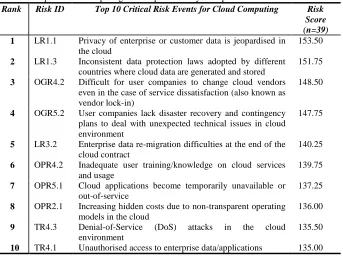
[image:9.595.126.469.289.545.2]By using this formula, the researchers calculated the risk scores for all of the 39 cloud computing risks identified, and then prioritised these risks based on their risk scores. The top 10 cloud risks ranked by their risk scores are shown in Table 1. These top 10 risks were identified as the most critical to current cloud computing practice.
Table 1. Top 10 cloud computing risks as perceived by IT experts
Rank Risk ID Top 10 Critical Risk Events for Cloud Computing Risk Score (n=39) 1 LR1.1 Privacy of enterprise or customer data is jeopardised in
the cloud
153.50
2 LR1.3 Inconsistent data protection laws adopted by different countries where cloud data are generated and stored
151.75
3 OGR4.2 Difficult for user companies to change cloud vendors even in the case of service dissatisfaction (also known as vendor lock-in)
148.50
4 OGR5.2 User companies lack disaster recovery and contingency plans to deal with unexpected technical issues in cloud environment
147.75
5 LR3.2 Enterprise data re-migration difficulties at the end of the cloud contract
140.25
6 OPR4.2 Inadequate user training/knowledge on cloud services and usage
139.75
7 OPR5.1 Cloud applications become temporarily unavailable or out-of-service
137.25
8 OPR2.1 Increasing hidden costs due to non-transparent operating models in the cloud
136.00
9 TR4.3 Denial-of-Service (DoS) attacks in the cloud environment
135.50
10 TR4.1 Unauthorised access to enterprise data/applications 135.00
of cloud computing adoption may not just be simply attributed to privacy and security risks, but may also be triggered by various operational, organisational, and managerial problems related to both cloud vendors and user companies. In order to validate this conclusion, a further bivariate analysis was carried out to explore potential casual relationships between the cloud computing risks identified, as presented below.
3.2 Correlations between the identified cloud computing risks
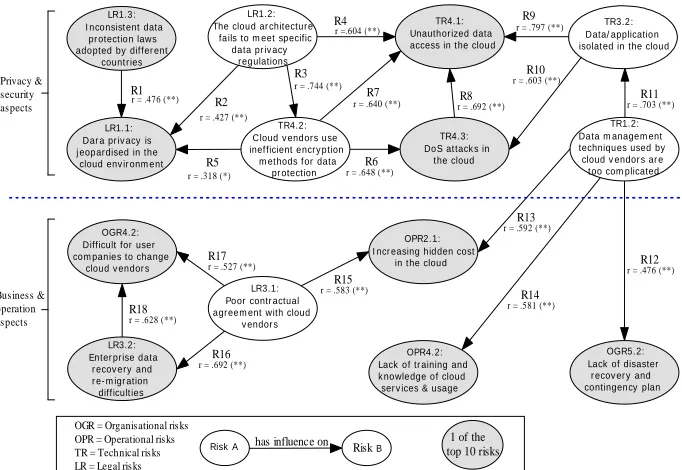
A bivariate analysis is a statistical technique that aims at identifying the correlation between two variables. In this study, the researchers used bivariate analysis to explore potential relationships between the identified cloud computing risks. Specifically, we aimed to explore that when the probability of occurrence of Risk A (e.g. inconsistent data protection laws adopted by different countries where cloud data are stored) was perceived to be high/low in practice, whether the probability of occurrence of Risk B (e.g. data privacy is jeopardised) would be correspondingly perceived as high/low. If so, then we interpret that Risk A is likely to have influence on Risk B. As illustrated earlier, Likert scales were used in the survey to examine the perceived probability of occurrence of each identified risk, data variables generated were therefore ordinal data sets. According to Field [13] and Bryman and Cramer [14], Spearman’s rho (rs) is the most common and appropriate approach to use to measure bivariate correlations between ordinal variables. As a consequence, Spearman’s rho was adopted for this study. Moreover, one-tailed test was used to test further the statistical significance (P value) of each correlation identified. By following this approach, the researchers identified 18 statistically significant correlations between all the 39 identified risks. Figure 2 presents a conceptual map to summarise and represent these correlations.
By scanning this conceptual map, it becomes immediately apparent that in the perceptions of IT professionals, the identified cloud computing risks, especially the top 10 critical risks (as highlighted with grey colour in the map), are interwoven and closely related with each other. Therefore, the occurrence of these critical risks proves to be very difficult for user companies to manage, mitigate and contain. Moreover, by further investigating the conceptual map, it emerges that about half of the identified correlations was related with privacy and security risks (e.g. LR1.1, TR4.1 and TR4.3). These findings thus confirm the importance of privacy and security issues in cloud computing adoption. More importantly, the findings also identified that these critical privacy and security risks can be originated by current legal and technical complexity and difficulties in the cloud (e.g. LR1.2, LR1.3 and TR1.2). On the other hand, the second half of the correlations shown in the conceptual map was found between various organisational and operational risks (e.g. OGR5.2, OPR4.2, OGR4.2 and LR3.2). These business-related risks were also triggered by legitimate deficiencies (e.g. LR3.1) and IT infrastructure complexity (e.g. TR1.2) in the cloud.
in not just privacy and security aspects but also across different IT operation and business areas.
LR1.3: I nconsistent data pr otection laws adopted by differ ent count ries
TR3.2: Data/ application isolated in the cloud
LR1.1: Dar a pr iv acy is j eopardised in the cloud env ir onm ent
LR1.2: The cloud ar chitecture fails to m eet specific data pr iv acy regulations
TR4.1: Unauthorized data access in the cloud
TR1.2: Data m anagem ent techniques used by cloud v endor s ar e too com plicated
OGR5.2: Lack of disaster r ecov er y and contingency plan OPR2.1:
I ncr easing hidden cost in the cloud
OPR4.2: Lack of tr aining and k nowledge of cloud ser v ices & usage LR3.2:
Enter prise data r ecov ery and r e- m igr ation difficulties
LR3.1: Poor contr actual agreem ent with cloud v endor s OGR4.2:
Difficult for user com panies to change cloud v endor s
R1 R2 R3 R4 R5 R6 R7 R8 R9 R10
Risk A has influence on Risk B r = .476 (**)
r = .427 (**)
r = .744 (**) r =.604 (**)
r = .318 (*) r = .648 (**)
r = .640 (**) r = .692 (**) r = .797 (**)
r = .603 (**)
TR4.3: DoS attack s in the cloud TR4.2:
Cloud v endors use inefficient encry ption m ethods for data pr otection
OGR = Organisational risks OPR = Operational risks TR = Technical risks LR = Legal risks
R11
r = .703 (**)
R12
r = .476 (**)
R13
r = .592 (**)
R14
r = .581 (**)
R15
r = .583 (**)
R16
r = .692 (**)
R17
r = .527 (**)
R18
r = .628 (**) Privacy & security aspects Business & operation aspects
[image:11.595.129.470.182.417.2]1 of the top 10 risks
Fig. 2. Conceptual map of correlations between identified cloud computing risks
4. Conclusions
across all levels of the organisation, are essential to prevent potential cloud computing failure and business disasters.
The results of this study have important practical and research implications. In practical terms, the identified cloud risks in general and the top 10 critical risks in particular, can be used by business managers and IT experts, as a checklist for risk identification, management and prevention in cloud adoption. The findings of this study also provide useful and valuable insights to support CEOs, CIOs and IT managers in the process of strategic planning and decision making towards successful cloud adoption. In research terms, the comprehensive risk ontology established in this study does not just fill the current knowledge gap in cloud computing risk, but can also serve as a starting point and theoretical foundation for IS researchers to carry out further investigation in this increasingly important research area.
Reference
1. Voorsluys, W., Brober, J. and Buyya, R.: Introduction to cloud computing. In: Buyya, R., Broberg, J. and Goscinski, A. (eds.), Cloud Computing Principles and Paradigms, pp. 1-41. New Jersey: John Wiley & Sons Inc. (2011)
2. Marston, S., Li, Z., Bandyopadhyay, S., Zhang, J. and Ghalsasi, A.: Cloud computing - the business perspective. Decision Support Systems. 51 (1), 176-189 (2011)
3. Chow, R., Golle, P., Jakobsson, M., Shi, E., Staddon, J., Masuoka, R. and Molina, J.: Controlling data in the cloud: outsourcing computation without outsourcing control. In: Proceedings of the 2009 ACM workshop on Cloud computing security, pp. 85-90, Chicago, Illinois, USA. (2009)
4. Ali, K.H.: Cloud migration: a case study of migrating an enterprise IT system to IaaS. In Proceedings of the 3rd IEEE International Conference on Cloud Computing, pp. 450-457, Miami, Florida. (2010)
5. Peng, G.C. and Nunes, J.M.B.: Surfacing ERP exploitation risks through a risk ontology. Industrial Management & Data Systems. 109 (7), 926-942 (2009)
6. Peng, G.C. and Nunes, J.M.B.: Establishing and verifying a risk ontology for surfacing ERP post-implementation. In Ahmad, M., Colomb, R.M. and Abdullah, M.S. (eds.), Ontology-based applications for enterprise systems and knowledge management, pp. 43-67, Hershey, USA: IGI Global (2012)
7. Peng, G.C. and Nunes, J.M.B.: Identification and assessment of risks associated with ERP post-implementation in China. Journal of Enterprise Information Management. 22 (5), 587-614 (2009)
8. Pan, K., Nunes, J.M.B. and Peng, G.C.: Risks affecting ERP post-implementation: insights from a large Chinese manufacturing group. Journal of Manufacturing Technology Management. 22 (1), 107-130 (2011)
9. Heiser, J. and Nicolett, M.: Assessing the security risks of cloud computing. Available at: http://www.globalcloudbusiness.com/SharedFiles/Download.aspx?pageid=138&mid=220&f ileid=12 (2008). [accessed Mar 2012]
10. Mather, T., Kumaraswamy, S. and Latif, S.: Cloud security and privacy: an enterprise perspective on risks and compliance. Sebastopol: O'Reilly (2009).
12. Bisong, A. and Rahman, S.S.M.: An overview of the security concerns in enterprise cloud computing. International Journal of Network Security & Its Applications. 3(1), 30-45 (2011) 13. Field, A.: Discovering statistics using SPSS: and sex, drugs and rock'n'roll, 2nd ed. London:
SAGE Publication (2005)