Rochester Institute of Technology
RIT Scholar Works
Theses
Thesis/Dissertation Collections
8-1-1970
Single Element Fiber Forms
Carolyn Thomas
Follow this and additional works at:
http://scholarworks.rit.edu/theses
This Thesis is brought to you for free and open access by the Thesis/Dissertation Collections at RIT Scholar Works. It has been accepted for inclusion
in Theses by an authorized administrator of RIT Scholar Works. For more information, please contact
.
Recommended Citation
Single
Element
Fiber
Forms
by
Carolyn
B.
Thomas
Candidate
for
the
Master
ofFine
Arts
in
tbe
College
ofFine
andApplied
Arts
of
the
Rochester
Institute
ofTechnology
August
1,
1970
ii
DEDICATION
This
thesis
is
dedicated
to
thosa
ofmy fellow
students who over
the
pasttwo
yearshave
unselfishly
and not without sacrifice made a sincere attempt
to
bring
forth
both quality
andequality
In
the
textile
iii
ACKNOWLEDGEMENT
My
mostimmediate
wish ofthanks
must goto
my
advisor,
Prof.
Williams,
whoIn
avery
shorttime
wasable
to
help
meto
recognizemy
direction
and obtaina
better
understanding
ofmy
goals.To him I
amgenuinly
indebted,
for
withouthis
guidencethe
best
pieces ofmy
thesis
work would nothave
been
accomplished.A
specialthanks
must goto
Prof.
Walter
Nottingham
of
Wisconsin State
University
whoturned
me on andtuned
mein to
whatfiber
artis
about.And
whois
really
responsiblefor
giving
methe
initial
impetus
for
this
thesis.
But
of all ofthe
people whohave
given mehelp,
guidence,
impetus,
etc.I
must acknowledgemy
husband,
Prof.
James
E.
Thomas,
for
withouthim
none ofthis
would exist.
At
times
it has
been HELL
but
somehowhe
has
survived andthere
is
nothing
that
I
cansay
that
wouldfully
expressthe
depth
orbreadth
ofmy
iv
TA^LE
OF
CONTENTS
page
Title
Page
i
Dedication
ii
Acknowledgement
iii
Table
ofContents
iv
Index
ofIllustrations & Plates
vIntroduction
vlI
Enter
(stage left)
1
Landscape
Pillow
6
Se
aForm
in
Orange
8
The
Footed
Folly
12
The
Bulging
Bump
15
The
Knitted
Kniffty
17
From Now Forward
20
(conclusion)
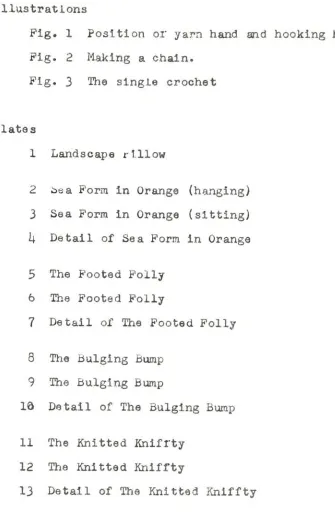
INDEX OF
ILLUSTRATIONS
AND
PLATES
Illustrations
pageFig.
1
Position
or yarnhand
andhooking
hand.
3
Fig.
2
Making
a chain.1|
Fig.
3
The
single crocheti|
Plates
1
Landscape
rillow2
beaForm
in Orange
(hanging)
3
Sea Form in Orange
(sitting)
4
Detail
ofSea Form in Orange
5
The
Footed
Folly
6
The
Footed
Folly
7
Detail
ofThe
Footed
Folly
8
The
Bulging Bump
9
The
Bulging Bump
Id
Detail
ofThe
Bulging Bump
11
The
Knitted
Knifrty
12
The
Knitted
Kniffty
[image:6.539.75.410.110.625.2]"Art
is
not a pleasure, a solape or an amusement*Art
is
a matter of primeimportance.
Art
is
anorgan of
human
life..."Tolstoy
vi
"To
the
craftsmenhis
first
and mostimportant
tool
'the
hands'1
Greek
philosopherAnaxagoras
saidthat
manis
the most
intelligent
or all creaturesbecause
he
has
hands.
Aristotle,
commenting
onthis
remark,
thought
that
moreprobably
man was endowed with handsbecause
he
is
the
mostintelligent
being.
The
same observationoccurs,
perhapsindependently,
morethan
two
thousand
years
later,
in
the
Anthropology
ofIramanuel
Kant,
he
wrote:"The
characterization of man as a rationalanimal
is
found
evenin
the
shape and organizationof
his
hand,
his
fingers
andthe
tips
ofhis
fingers.
It
is
through
theirbuild
andtender
sensitivity
that
nature
has
equippedhim,
notfor
just
one manner ofhandling
things,
but
unspecifically
for
all ofthem,
which
is
to
say,
naturehas
equippedhim
lor theemployment of reason and
thereby
designated
the
technical
capacity
of his species asthat
of a rational animal.wThus,
thehand
produced objectis
the
reminderand promise of
inexhaustible
and unpredictablevariety;
and
to
makethings
by
hand
is
almostindispensable
for
a personin
orderto
contemplatethe
image
ofhis
own
individuality,
without whichhe
loses his
placein
the
world of thehumans.
1
"With
These
Hands"ABC
Television
Documentary
Today
we are accustomedto
ourfunctional
problemsbeing
solvedel'ficiently
andeconomically
by
mechanicalmeans;
yet we areacutely
aware or our particularneed
for
the
selr-created productin
satisfying
estheticand psycnological urgencies.
The
artist-craftsmenhas
begun
to
engage1'unctlon
in
a challenge as aformal
and objective
determinant.
He
now subjectsdesign
to
the
plasticdynamics
orinteraction
ofform
and colorand avoids
immediate
functional
associations-the
valueby
which machine-made products are defined- a valuewhich can
impede
free
sensory
discovery
ofthe
objectjust
asits
limitations
canimpede
his
creative act.And
so,
the
value of usebecomes
asecondary
or evenarbitrary
attribute.Fiber
like
all areas of crafttoday
is
nowgroping
for
a new estheticto
meetthe
needs of ourtime,
orperhaps
it
is
a new anti-estheticto
break
the
decorative-functional
patternsthat
nolonger
suffice.The
mostpowerful
forces
of our environment-electronics and
atomic,
Inner
and outerspace,
speed - areinvisible
to
the
naked eye.Craft's
esthetictradition,
involved
as
it
has
been
withdecorative
-functionalexperience,
does
notsatisfy
the
extension and growth ofreality
in
today's
world.All
this,
then,
has
made artist-craftsmen mostsusceptible and responsive
to
the
startling
achievementsFor
better
or worsetoday's
craftsmen arebrandishing
a new weapon
in
the
technological
society;
creativity
without
the
functional
restrictions.He
has
alliedhimself
withthe
plastic expressionsthat
comefrom
his
own culture andhis
owntime,
andfrom
an attitudetoward
his
work andits
processes with whichhe
canIdentify.
Even
the
mosttraditional
ofcraftsmen,
Anni
Albers,
who's
background
wastotally
saturated withthe
Idea
of
f
unctionalismfirst has
said:"Today
it
is
the
artist whoin
many
instances
is
continuing
thedirect
work with amaterial,
with a
challenging
material,
andit
is
here,
I
believe,
that
the
true
craftsmenis
found
-inventive,
ingenious,
intuitive,
skillful,
worthy
oflinking
us with
the
past.His
workis
concerned withmeaningful
form,
finding
significantterras
for
newly
unfolding
areas of awareness.And
dealing
with visual matter
-the stuff
the
worldis
madeof -
the
Inherent
discipline
of matter acts as a
regulative
force;
noteverything
"goes".
To
circumvent
the
'no1 ofthe
material with
the
'yes'of an
inventive
solution -that
is
the
way
newthings
comeabout,
in
a contest withthe
material..0As
Mrs.
Albers
pointsout,
the
craftsmen who arep
Anni
Albers
-A.C.C.
contributing
the
mostto
their
fields
arethe
craftsmenwho are
bringing
things
like
imagination,
invention
and
ingenuity
into
every
piece of workthey do;
nolonger
Is
decoratlve-functionalism
enough.The
creative raind must
play
the
important
role withthe
I
enter(
stageleft
)
My
work goes whereI
go -It
lives
in ray
body,
my
hands
giveit
birth.
This
thesis
is
not astudy
of atechnique
noris
it
ahistorical
rehash.It
is
the
documentary,
writtenand visual of
my
ideas
aboutfiber
craft andray
useof
fibers
as a mediumfor
3-diraensional
expression.I
cameto
my
thesis
with oneprimary
goal,
that
wasto
try
to
createform ideas.
Along
withit
I
undertookto
learn
atechnique
which wascompletely
foreign
to
me.The
workthat
I
produceIs
a combination of personalgive and
take,
the
constant compromise oflife,
but
life
Is
the
force
that
demands
I
produce.To
meIt
is
the
product ofIdeas,
digital
dexterity
and physical material.
The
form
concepts arewholly
my
own;
they
arepersonal,
no one cansay
sheis
doing
things
like
so and so'sbut
nature must receive creditfor
inspiration.
My
workis
ofthings
that
arealive,
things
that
look
asIf
they
can move and grow.My
products are oftotal
things,
notfragments.
They
are completeforms.
Craft
as well as art canbe
aform
of communication.I
feel
that
if
oneIs
ableto
project oneselfthrough
his
workit
becomes
a unique andextremely
Interesting
way
ofexpressing
oneself.Look,
see,
feel,
this
is
who
I
am.it's
idea.
Without
a concept your artbecomes
meredecoration.
It
seemsto
methat
there
aretwo
ways ofworking
In
fiber
craft.One,
youhave
anIdea
andthen
youproceed
to
find
atechnique
to
expressIt
ortwo,
youknow
atechnique
andtry
to
find
anidea
that
willfit
it.
The
latter
way
seemsto be
the
greatest pitfall
andhelps
to
contributeto
the
classification ofcraft as a
lower
form
of art.I
vehemently
agree withDorian
Zachai
when she said:"I
considertechniques
to be
'tricks'that
are
absolutely
necessary
to
learn,
but
oncelearned,
better
forgotten.
No
technique
ormaterial
is
a solution or endIn
itself.
What
is
vitalis
to
live
a concept andthis
concept must overpower
the
materials,
the
techniques,
andthe
composer..." JFor
the
technique
best
suitedto
my
ideas,
I
have
chosen
to
returnto
abasic
and primitive one.I
employ
the
use ofmy
hands
and a small rod with ahook
onoone end.
This
technique
is
known
by
the
French
wordfor
hook;
crochet.Long
before
recordedhistory,
Pima
Indian
womenIn
America
did
the
first
crocheting
weknow.
They
weremaking
akind
of clothby
pounding
theinner
bark
oftrees,
but
somebark,
pounded,
crumbledto
dust
and-*
fibers.
Fingers
pulledloops
through
loops
ofthese
fibers,
and some womanthought
ofmaking
abowl
like
form.
The
loops
made a sort ofbasket;
she plasteredIt
thickly
withclay
inside
and out.Sure
enough,
it
held
water.I
have
borrowed
this
simple consecutiveloop
technique
to
produce not waterbowls
but
sculpturalforms.
In
realizing
the
potentiality
ofthis
simpletechnique
my
feelings
mustbe
similarto
those
ofMary
Walker
Phillips
when shefirst
began experimenting
withknitting.
She
wrote:"I
cameto
seethe
technique
in
anentirely
new
way,
for
it
was afamiliar
discipline
rediscovered
in
another context withtotally
new
freedom.
"^
One
stitchknown
asthe
single crochethas
providedme with
the
ability
to
produce avariety
offorms.
The
simple process ofincreasing
anddecreasing
stitchesprovides me with
the
meansto
expand and reducethe
form.
[image:15.539.69.461.400.755.2]Insert
thread
between
ring
finger
andlittle
finger
ofleft
hand.
Then
weavethread
toward
back,
underlittle
and
ring
fingers,
over middlefinger,
and underforefinger
toward
you.Next
grasp hook
which ashad
loop
knot
attached
to
it,
withthumb
andforefinger
of righthand.
Fig.
2
Making
a chain.With
the
first
loop
onhook,
passthe
hook
underthe
thread
onleft
hand
and pullthrough
aloop
(making
another
stitch.)
This
operationis
repeated until
the
chainhas
the
number of stitches
necessary
to
achievethe
desired
length.
Fig.
3
The
single crochet.Adding
a second row of stitchesis
accomplishedby inserting
hook
into
the
nextto
last
stitch on chainthen catching
wool with
hook
andpulling
it
through
original chain.This
processis
repeated untildesired
form is
completed.The
variation of shapeis
obtainedby
the
increase
or [image:16.539.51.478.187.738.2]As
the
fibers
runthrough
my
hands
I
feel
every
particle of material
that
goesinto
my
finished
piece.This
processhas
made meacutely
aware ofthe
varieddimensionality
andthe
tactility
offibers.
Formerly
my
eyes weremy
mainsensory
receptorsfor
fibers but
now
ray
fingers
play
animportant
part.This
has helped
to
expandmy
awarness ofthe
form.
For
methe
act ofmaking
canbe
&rewarding
asthe
fulfillment
onederives
from
the
finished
piece.To know
your materialin
allit's
potentiality
and
to
be
ableto
invent
a solutionfor
it's
limitations;
it
is
this
challengethat keeps
meInterested.
Since
my
materialdoes
notnecessarily
dictate
aform
idea,
such as wood
might,
I
amfree
to
conceiveany
possibleform Idea.
My
approachto
the
medium offibers
has
been
apersonal preference of
three
dimensionality.
It
is
the
way
in
whichI
would approachany material,
for
it
is
my
inherent way
of communicating.(refer
page3
)
Mary
Walker
Phillips
by
Alice
Adams
"Landscape
Pillow"Formulation
ofmy
first
form
concept wasbased
on
learning
the
elementary
techniques
of crochet.The
idea
wasto
make alarge
pillow with a relief surface.I
made a number of rough sketches of aflat
design,
much
like
those
usedfor
atapestry
cartoon.The
final
design
waslater
transfered
into
full
size paperpattern pieces.
Each
pattern piece wasthen
reproducedin
crochet.When
the
flat
crochetforms
werefinished
a
backing
was sewnto
them
andthey
were stul'fed withdacron
quilting.One
form
was nothandled
in
this
manner andit
was a
very
large
flat
piecethat
wouldbe
used as abackground.
It
wasto
serve as aform
onto which thesmaller
forms
couldbe
sewn andit
was also aunifying
edge aroundthe
whole work.When
I
began
to
assemblethe pieces on
this
background
it
became
apparentthat
the
scale ofthe
stitch onthe
larger
crochetedform
was
drastically
out of proportion withthe
smallerstitches of
the
other partsthat
wereto
be
attachedto
it.
Instead
ofunifying
the
forms,
the
large
piece producedthe
opposite effect soit
had
to
be
abandoned.Now
that
onevery
important
member wasmissing
my
design
neededto
be
reworked.I
approachedit's
a
total design
picture.One
more smallerform
wasdiscarded
andfinally
asemi-satisfactory
inner
andouter shape was arrived at.
The
forms
werethen
sewntogether,
backed
withgrey
woolfelt
and a corded edgewas added.
The
materials were single anddouble
ply
wool ofwhite,
medium anddark
grey
andblack
wool cording.If
this
piece canboast
ofany
accomplishmentsthey
would
be
ofshowing
a certain amount ofability
witha
previously
unknowntechnique
andthat
it
does
serveas a
functional
object.But
these
alone nolonger
satisfy,
if
they
everdid.
I
had
notinstilled
this
piece with a
life.
It
is
not atotality
asyet,
it
is
lacking;
it
is
apple pie without a crust.I
do
notknow
exactly
whatis
necessary
to
saveit
from
anunresolved existence.
Somewhere
withinthat
form
the
solution
is
hidden
and untilthe
time
that
it
becomes
8
"Sea-Form
In
Orange"I
cameaway
from my first
experimenthaving
learned
the
basic
technique
thatI
would usefor
the
rest ofmy
work and alsothe
realization ofhow
notto
go aboutdesigning
athree-dimensional
idea.
I had
tried
to
take
what wasessentially
aflat
design
andtransform
it
into
something
of an opposite nature.In
otherwords,
I
had
usedthe
'typical
textile
approacn',
one of aninherent
tendency
toward
flatness
or atwo
dimensionality
but
obviously
this
was whatI
wasstriving
to
overcome.Now
that
I
had
conquered or maybehaving
been
conqueredby
the
crochetidea,
I
began
experimenting
with acompletely
dimensional
crochetedform.
I
discovered
I
could create pod-like structures whichhelped
lead
me
to
my
nextform
concept.I
wantedto
make agrouping
ofdifferent
podforms.
The
size,
color,
texture
and shape would producethe
variety
in
tnem.Again,
unity
of partsbecame
my
mainform
objective.This
time
unity
woulddevelope
arelationship
through
many
conflicting
colors andtexture,
while
the
podforms
would remainfairly
similarin
structure.
Tne
piece wasto
encompassboth
conformity
and
individuality.
I
wanted a surprizeawaiting
the
viewer as
the
pieceturned
before
him;
a newsize,
coloror
textural
Idea,
slightly
different
from
the
immediate
previous visual experience
but
not sodifferent
asto
was similar
to
afamily
gathering,
lots
of visualresemblances
but
notwo
exactly
alike.since
this
pod-shapedform
had
given airto
asea-like
creation.I
continuedthis
conceptby
the
addition of sea-moss-likehanging
forms
atthe
bottom
ofthe
pod groupings.
The
choice of color wasderived
from
two
things;
One,
because
I
had
anidea
aboutjuxtaposing
color withform.
It
seemedto
methat
the
warm colorrange,
orange,
yellow,
redcombination,
should alsobe
part ofmy
visual surprise
because
whenI
thlnic
of sealife
acool,
blue-green
paletteimmediately
popsinto my
mind's eye.Secondly,
I
had
a specialfeeling
for
one ofthe
yarns andI
wanted todo
something
withIt.
Materials
weregreatly
varied;
mohair,
one,
two andthree
ply wool,
raw silkthat
I
had
dyed
and evensome wood excelsior which was used
to
stuffthe
podforms.
From
this
pieceI
was ableto
gain a certain amount of satisfactionthat had
been
denied
meIn my
earlier piece.Technically
I
had
learned more andI
wasbeginning
to
see new possibilitiesfor
crochet.The
piecehad
flow
andrhythm^
it
had
alife
of its' own.Definitely
the
podgrouping
seemedto
containinterludes
that
mightbe
lab
led
confusing but
somehowthat
was overcomeby
a certainfeeling
of naturalness.I
muchperferred
this
overpopulatedfeeling
to
a'designi-decoratlve
'quality
somany
hangings seemto
try
to
10
Upon
completion ofthis
pieceI
felt
that
I
had
made a
firm
step
forward andthat
whatI
had
learned
from
both
works couldonly
be
considered a constructiveexperience.
As
dawn
began
to
appear overmy
horizon
of understanding,
I
suddenly
began
to
seehow
I
wasdealing
with
my
ideas
in
relationship
to
that
old'typical
textile
approach'.
I
waslimiting
myself,
I
wastrying
tosay
something
but
with avocabulary
that
didn't
containthe
right words.I
was'hung
up' with wordslike
function
and
hangings.
They
weretwo
valid modes of expressionbut
they
belonged
to
someone else'sway
of coramuni eating.I
decided
that
nolonger
wouldI
usefunction
asa
factor
in
determining
the worth of anidea.
I
wouldstop
thinking
sculptural pillow and startmaking
sculpture.If
it
couldbe
used as a pillowfine,
if
not,
ok.I
also
tried
to
breakaway
from
that
hanging
syndrome.Wall
hangings
themselves,
those
one sided excusesfor
an
Inability
to
think
beyond
the
two-dimensional world,
contain some sort of
logic,
I
suppose.For
if
you areuse
to working
onthe
loom
whereonly
one side of yourwork
is
visibleduring
the
wholemaking
process,
it
is
then
only
naturalthat
the
weaver,
liberated
from function
and
wanting
to
create pureaesthetics,
should returnto
the
loom
stillcarrying
withhim
the
two dimensional
Idea.
For
this
is
the
way
he
has
approachedthings
11
the
use ofhanging
threads,
be
they
originalwarp
orhanging
additions,
have
become
a cliche andfor
something
to
avoid.Since
the
technique
that
I
employ does
notlimit
the
possibilities ofself-supporting
pieces,
I
tmWmWtW*'
&
4'^
v *Btr*
_*
V^
12
"The
Footed
Folly"1
emergedfrom ray
previouslearning
experienceto
begin
to
develope
a second sea animalform.
It
wasto
be
a sort ofspiny
sponge-like creature.After
afew
sketchesI began
to
test
my
ability
atproducing
a
spiny
projection-likeform
in
crochet.I
made oneafter
the
other,
seeing how
they
changed andperfecting
the
control ofthat
change.As
I
experimentedI
became
aware of
how
the
projection-likeform began
to
take
on a
life
of its' own.They
were a statementin
them
selves with obvious relationships
to
man,
not animaland
this
idea
began
to
interest
me.When
other membersof
my
class comeby
asI
worked,
their
reaction tothe
form
fascinated
me.Some
wererepulsed,
others giggledand
blushed
while still others couldn'tkeep
their
hands
off
them.
The
form
wasactually
causing
a pBiyehhlogielalreaction.
It
provoked an emotional responsein
almosteveryone.
Whether
it
be
dislike
orpleasure,
anidea
was
being
communicatedto
agroup
of people.It
wasthen
that
I
began
to
fully
understandthat
this
thing
called expression of
ideas
wasonly
as communicativeas
the
form
concepts.The
nextstep
wasto
develope
a superstructure towhich
my
projections wouldbe
attached.Keeping
in
mindthe
form's
relationship
to
human
anatomy
I
chose anamorphic organic shape
that
wouldbe
nottoo
distracting
13
Keeping
in
mindray
earlierthoughts
aboutusing
a
base
instead
ofthe
hanging idea,
it
seemedonly
natural
to
employ
afooted
conceptbecause
of therelationship
to
the
figure.
It
was a combination ofhands
andfeet,
not a strictanatomy
lesson
for
it
wouldnot
have
workedhere.
The
essence was what waswanted,
something
that
wouldleave
alittle
to
the
viewer'simagination.
Of
course,
getting
what was wanteddidn't
come until after
my
friend
had
been
fitted
withthree
pairs of
toes,
but
atleast
a good combination was arrivedat.
They
containedboth
afeeling
offantasy
andthe
quality
of movement and growth.The
form
was stuffed and metal supports wereInserted
to
giveit
stability.The
color selection was another considerationthat
had
to
be
dealt
with carefully.I
choseto
use a quietmixture
in
the green-blue range.Why?
For
three
goodreasons:
One,
I
wasplaying
aform
gamehere.
The
shape of
the
forms
wassomething I
wantedin
centerstage.
Of
course that's notsaying
color wasn'timportant,
it
is
just
that
the
emphasis wasto
be
onthe
form.
Two,
I
hoped
by
notusing
more exuberant colorsthe
decorative
quality
orits
cuteness wouldbe
playeddown.
Thirdly,
I
believe
the
colorsthat
were usedhelped
to
create a moodfor
the
piece.That
mood mightbe
called
slightly melancholy,
atone
that
would matchthe
Ill
reinforce
the
form idea.
The
yarn,
wool and a cowhair and woolblend,
wasalso of a rather muted
personality
so as notto
interfere
with
ray
main concept.In
this
pieceI
felt
I
have
succeededin making
the
forms
aconvincing
totality,
technically
I
had
mastered
the
joining
of parts withoutleaving
a visibleseam,
I
used colorto
its'best
advantage andI
had
been
ableto
find
aform
conceptthat
communicatedthe
visual expression of an
idea.
In
a singleMcLuhanesque
sounding
sentence;
I
had
transcended
the
medium andthe
method and metthe
mind.What
I
had
accomplished sounded greatbut
I
mustadmit,
instead
ofgiving
me confidenceIt
scared me.Why?
Simply
because my
work nolonger
fit
into
any
presently existing
textile
approach.Although
I had
done
whatI
set outto
do;
createmy
ownfiber
language
with its' visual
counterparts,
I
had
notfully
realizedwhat effect alienation would
have
on me.Surely
I
had
no wish
to
be
anotherDominic
Di
Mare,
Claire
Zeisler
or
Dorian
Zachai,
for
even withthe
great respect andadmiration
in
whichI
hold
their
work,
I
can notduplicate
their
Ideas.
I
mustdo
asthey
had
done
whichis
to
develope
my
own pathto
follow.
My
strangevictory
overwhelmed me sothat
I
returnedto
my
crochethook to
producesomething
that
could relate__---_--__f
15
"The
Bulging
Bump"It's
not abad
piece,
infact
in
some waysIt
is
quite acceptable.
The
technique
andthe
yarn choicehas
givenIt
anextremely handsome
textural
quality.There
are areas whereheavy
yarn createslarge
stitchesand places where a soft fur-
like
quality
was achievedby
the
use of mohairyaen,
whilein
other areas cowhairor
double
ply
wool was employed.The
non-hanging idea
was successful and
interesting
andthe
actual exteriorshapes work
from
most angles.The
basic
colorIs
earthy
and
in
combination withthe
red protrusionsit
createsa powerful effect.
The
idea for
this
form
camefrom
the
technical
knowledge
I
had
gainedfrom
its'immediate
predecessor.The
ability
to
createsomething
that
looked whole,
asif
produced all at once was whatI
wanted.Basically
it
was a matter ofexperimenting
to
find
outhow
muchform
couldbe
created withjust
anincrease
anddecrease
of
the
amount of stitches used.My
form
objective was similarto
that
of alarge
potato.
I
wantedit
to
be
soft andsquishy
aspossible,
but
to
still retain afeeling
of a once apparent structure.An
overripe growth with slitsthat
had
been
createdin
it's
sidesby
the
bursting
forth
ofthe
inner
contents.They
wouldhave
to
lfcok
strong
enoughto
break
through
the
skin,
something
with a powerful visual nature.Hence,
16
push out
from
a punctured surface.If
my
goal wastechnical
it
wassatisfied,
if
it
was
to
producesomething
that
couldbe
bracketed
asa
typical
fiber
idea
then
I
accomplishedthat
also,
but
if
one considers its'lack
of magicthen
I
canonly
feel
neglectIn
this
area.But
asAnni
Albers has
said:"All
progress,
soit
seems,
is
coupledto
regression elsewhere."
<5
Anni
Albers
On
Weaving
Wesleyan Univ.
Press
\
w
,;_H *
S
"' ^.i/*:13
1
i
17
"The
Knitted
Kniffty"My
step
back
enabled meto
take
two
forward
onray
next work.I
wasinvolved
on somedesigns
for
aflat
pattern
repeat,
whenI
realizedthat
one ofthem
evokeda
very
sculpturalquality
andhad
the
potentialto become
a
three
dimensional
form.
It
wasthe
simplestform
concept
that
I
had worked onduring
my
thesis.
A
seriesof plain crocheted
tubes
which wouldintertwine
andcreate a
free
standing
structure.Originally
it
wasto
be
about a yard squarebut
asI
began
the
task
ofcrocheting
the
tubes
I
realizedthat
such atime
consuming
processwas
pretty
silly.For
if
the
concept of a pieceis
its' most
important
consideration,
why
not spendthe
time
onthe
concept and notthe
technique,
sinceto
complete
the
crochetedtubes
wouldhave
taken
about sixweeks.
A
local
knitting
mill waskind
enoughto
supply
me with
thirty
yards oftubing
in
abouttwo
and ahalf
hours
which notonly
saved metime
but
it
also allowedme more material
to
work with.I have
no argumentswith whether
using
machine produced material is valid.It
is
for
me,
but
I
must admitI
did
missthe
actualact of
producing
my
Idea.
My
hands
stillplay
anecessary
part
in
the
mental enjoymentI
receivefrom
the
work.After
cutting
the
tubes
into
predeterminedlengths
and
sewing
one endclosed,
I
stuffedthem
with cotton18
coated aluminum wire.
The
wire was usedto
providerigidity
and supportto
the
finished
structure.Then
the
other end was sewn andthe
task
ofassembling
them
had
to
be
faced.
I had
constructed a small model ofpipe cleaners which was used
for
the
generalpositioning
of
the
pieces.The
colordispersment
alsohad
to be
considered
in
the
arrangement ofthings.
The
actualcolor choice was not as wide a range as
I
wouldhave
liked
because
ofthe
sizelimitations
imposed
by
the
knitting
machine,
therefore
my
yarnhad
to be
chosenfrom the
manufacture'sleftover
stock.Finally
the
configuration wasdecided
upon andthe
joints
andjunctions
wherethe
forms
meet were sewntogether.
When
the
piece wasfinished
andstanding,
the
pure plastic elements ofart,
form
andmovement,
were
obviously
present.It
containedthe
qualities ofa
growing
living
thing.
The
form
was capable ofexpressing
itself,
it
was ableto
sendthat
visual message.The
rhythmic,
lyrical
movement, compoundsthe
feeling
that
Nature,
whether with elements or wind or watercurrent,
has
acted upon theform
to
produce acompletely
non-staticquality
in
it.
This
work stands as a visualhomage
to
the
idea
of
using
a onceexclusively
functional
mediumin
apurely
aesthetic application.
It
is
an attempt atbroadening
the
field
offiber
art; away
to
let
fresh
airinto
that
19
This
piecehad
taken
me along
way
from
my
first
attempts at
finding
my
own means of communicating.It
represents a move
toward
a sculptural concept andaway
from that
'typical
textile
appraach.'This
trip
hasn't
been
abad
experience,
I
feel
I
can commit myself now.20
From Now Forward
(conclusion)
By
standard practice or "tradition"this
part ofmy
thesis
shouldbe
devoted
to
asumming
up,
a restatement of
important
facts
or afinal
analysis andmaybe even
something
called and "ending."But,
what abore
to
go overthings
oncesaid,
for
ir
youdidn't
understandthe
first
time
aroundthe
*
rehash
is
notgoing
to
raake muchdifference.
As
for
an analysis
I
leave
that
to
someone who seesthe
workwithout
the
emotionalinvolvement
that
I
wouldobviously
harbor.
Now
for
that
word"ending",
whichif
usedto
describe
any
part ofmy
thesis
it
wouldbe
only
of apurely
physical nature.
For
this
thesis
is
just
the
beginning.
So,
instead
ofdiscussing
whatI
have
already
discussed,
I
willtake
astep
forward
andtell
you wheremy
thesis
work
has
led
me.At
the
presenttime
I
have
found
asuitable
way
ofconstructing
my form
ideas;
atechnique.
The
form
concepts andtheir
mentalcounterparts,
ideas,
seem
to
be
always present.What
is
nowbehind be
has
given me
the
raw materials with whichI
mustdovelope
my
future
concepts.And
so,
I
have
chosento
exploreIn depth
two
varied andinteresting
areasfrom
my
thesis
work.
My
previousdealings had
been
on a onetime
basis
21
First,
I
wantto
conceive more piecesthat
deal
w!th
the
plasticideas
similarto
those
found
in my
knitted
form.
Idea:
An
enclosed walkin
spacecontaining
anenvironmental
statement.A forest
ofbending
andtwisting
tubes
would greetthe
participant.The
tubes
would grow
up
from
the
floor
andhang
down from
the
ceiling
In
an attemptto
create a spacial encroachmenton visual perception.
Light
woulddefinitely
play
anextremely important
part.I
seeit
usedto
intensify
the
break
up
ofform
placement and also as away
ofcreating
shadow effectto
multiply
the
actual numberof
forms.
My
second area ofinvestigation
wouldbe
to
workwith similar concepts as
those
found
in my
"Footed
Folly."I
amconsidering
the
possibilities of satire and socialcomment.
A
caricature,
non-portraittype,
oftoday's
way
oflife
orthe
symbolsthat
evoke recognitionin
our
daily
existence.Idea:
A
pinktorso
with pregnantbelly,
long
sticklike
legs
asits
support.No
head,
but
onthe
top
ofthe
neck asunken,
puckeredform
- cerebral cave-In.An
umbilical cord extends about sixfeet
from
the
navelwith an electrical
plug
attachedto
its
end.Yes,
the
two
proposed concepts aredifferent
but
22
in
search of a clearer perceptionthrough
personalgrowth and
to
further
my
abilitiesto
communicatemy
ideas.
The
most essential andImportant
factors
ofthis
thesis
projecthave
been
my
mental expansion andthe
learning
experiences with whichit
coincides.Upon
occasionI have
the
feeling
that
I
am a personwith a
huge
assortment of puzzlepieces,
enough piecesfor
ahundred
puzzles.I
sittrying
to
find
just
enough pieces of one
kind
sothat I
can complete onepuzzle.
To
meit
seemsthat
everything
that
Is
necessary
for
satisfactory
results are athand,
but
that
it
takes
a sincere and
truly
conscious searchto
obtain one'sgoal.
23
BIBLIOGRAPHY
Adams,
Alice;
Mary
Walker
Phillips,
CRAFT HORIZONS
Vol.
XXV
No.
1
:24
1965
Jan.
/Feb.
Albers,
Anni;
A..C.C.
Forum,
CRAFT HORIZONS
Vol.
XXI
No.
k
:52
1961
July/August
ON
WEAVING,
Wesley
anUniv.
Press
Middle
town,
Conn.
1965
ON
DESIGNING,
Wesley
anUniv.
Press
Miadletown,
Conn.
1961
CRAFT
HORIZONS;
All
issues
in
Vol.
XIX
No.l
andVol.
XXX
No.l
Jan.
/Feb.
1959
to
Jan.
/Feb.
1970
De
Dillmont,
Therese;
AN
ENCYCLOPEDIA
OF
NEEDLEWORK
D.M.C.
Library
Mulhouse,
France
Dugdale,
Kathleen;
A MANUAL OF FORM FOR
THESES
AND
TERM
REPORTS,
Indiana Univ.
Press
Bloomington,
Ind.
1955
Hamilton-Hunt, Margaret;
KNITTING DICTIONARY
Crown
Publishers,
Inc.
New
York,
1963
Kaufman,
Ruth;
THE
NEW
AMERICAN
TAPESTRY,
Reinhold
Book
Corp.
New
York,
196b*Lane,
Rose
W.;
WOMAN'S
DAY
BOOK OF
AMERICAN
NEEDLEWORK
Simon
andSchuster
New
York,
1963
Slivka,
Rose;
The
New
Tapestry,
CRAFT HORIZONS
Vol.
XXIII
No.
2
:12
March/
April
Films;
"WITH
THESE
HANDS",
A.
B.C.
Television
Documentary
onAmerican
Craftsmen,