SCREENCASTS
IN
MEDIA
STUDIES
DR PAUL REILLY
DEPARTMENT OF MEDIA AND COMMUNICATION [email protected]
KEYWORDS: SCREENCASTS, LECTURE CAPTURE, INTERNATIONAL
STUDENTS
Funding allocated: £1336.40
Recent studies show that students are broadly in favour of lecture capture, the process whereby lectures and other classroom activities are recorded and made available online for revision purposes (Andrews et al, 2010; Karnad, 2013; Fang & Pursel, 2012). Students felt they were able to learn at their own pace through the ability to pause and rewind recorded lectures, and used these resources to help prepare for their assignments and catch up on classes they had missed during the semester (see Karnad, 2013 for an overview of student perspectives on lecture capture). The provision of such resources has been found to have virtually no impact upon student attendance in classes (Holbrook and Dupont, 2009). Nevertheless, there remains only limited evidence to suggest that the frequent use of these materials is linked to increased student performance (Philips et al, 2011), with high achieving students still the most likely to benefit from these resources (Von Konsky et al, 2009). Hence academics continue to express skepticism about the pedagogical benefits of using lecture capture in Higher Education. Educational technologists have suggested that it is “the worst educational technology” due to its reproduction of the passive learning experience of the traditional lecture and its inability to engage students with its content (Smithers, 2013). This is emblematic of the broader critique of ‘blended learning’ that has emerged over the past decade, which suggests that it places too much focus on the creation of resources rather than the ways in which they contribute to student learning (Oliver and Trigwell, 2005).
in problem-‐solving exercises and discussion during class time, and which provides more personalised forms of feedback on assignments (Lancaster and Read, 2013; O’Malley 2011; Stannard, 2007). However, like lecture capture, students also reported that they missed the opportunity to interact with their tutors while viewing such content (Winterbottom, 2007). Nevertheless, early indications are that the use of such resources is positively correlated with course performance (see Pinder-‐ Grove et al, 2011 for example) albeit that it may be difficult to generalise based on such studies. Furthermore, very little is known about lecturer perspectives on whether the regular use of screencasts has enhanced their own teaching practices (or not).
Much of the above evidence has been drawn from the ‘physical sciences’ of Chemistry and Physics, where the combination of visual information and narration provided by the lecturer has been said to produce deeper forms of student learning (Lancaster and Read, 2013; Williams & Davies, 2012). Thus far, there has been relatively little research focusing on how such resources might facilitate new forms of student engagement within media education. Despite the emergence of social media as both an object of study and a potential vehicle for disseminating the findings of such research, media lecturers have appeared reluctant to experiment with this form of ‘digital’ scholarship (Procter et al, 2010; Weller, 2011). This paper sets out to provide empirical data on the potential role of screencasts in media education through a focus group study of lecturers and students based within the Department of Media and Communication, which was conducted between July 2012 and July 2013. It examines student perspectives on how their engaged with this content while preparing for assignments, with a specific focus on whether it enhanced their learning experiences during the classes. Lecturers were asked to reflect on the process of creating screencasts and if they felt it had enhanced the learning experiences of their students. They were also asked to consider the impact of using screencasts upon their own teaching practice. Results indicate that screencasts did appear to help deepen student learning about key issues covered in the lectures. Home/EU students suggested that these resources were particularly useful in their preparations for summative assessments, such as essays and exams. International students reported that they re-‐viewed this content several times in order to improve their English language listening skills, thus suggesting that there may be additional pedagogic benefits that emerge from the delivery of lecture content in this way. Although some of the student participants felt that the provision of these resources might negatively impact upon student attendance, the vast majority reported that these tools had helped with note-‐taking and enabled them to learn at their own pace. Such sentiments were shared by the lecturers, who reported that they had received very positive feedback from students in relation to their use of screencasts. Academics also felt that the process of recording screencasts had helped them focus on what were the important points from each class and that this had led to improvements in the delivery of their lectures.
This Teaching Enhancement project focused on how screencasts could help address the learning needs of an increasingly international student cohort at both undergraduate and postgraduate levels, the majority of whom have English as a second language. First identified as an issue in the Department of Media and Communication during a Teaching Away Day in June 2011, these students often make audio recordings of lectures because they find it difficult to follow what the lecturer says in real-‐time. Hence academics in the Department of Media and Communication agreed to explore the possibility of using more innovative methods of delivering teaching resources in order to address the learning needs of such students. One such innovation was the development of a Twitter hashtag, #actandprotest, which was used to curate online resources that helped undergraduate students with their assignments. The convenor of the same module also piloted the use of screencasts to provide five-‐minute summaries of each lecture.i At the postgraduate level a range of educational resources, such as e-‐tivities, quizzes and screencasts, were also created to support students as they worked on their independent research projects. A focus group and questionnaire-‐based study was conducted between February and September 2012 in order to explore how students used such resources. Results indicated that most students (79.6%) felt that the screencasts in particular had made the link between the methods modules and their dissertations much more clear. The participants also suggested that these resources had deepened their learning about key issues such as research ethics (Reilly, in press). Although it was difficult to verify such claims, it was notable that traffic through the MS7012 (Dissertation) Blackboard site was significantly higher than in the previous academic year (38096 hits compared to 4,178 for the same period). Student performance indicators also improved, with 7.81% failing the module in 2011-‐12 compared to 8.31% in 2010-‐11.
The initial objective for this project was to explore one of the unanticipated pedagogic benefits of using screencasts that was identified in this pilot study, namely that international students might use these resources to improve their English language proficiency. However, the review of the literature in the field generated a number of other questions. Did students believe that the availability of screencasts would have a negative impact upon lecture attendance? What did they think was the optimum length for a screencast? When were they most likely to use these resources? Such questions in relation to student perspectives on screencasts were addressed in this study. In addition, it also explored the views of academics on the educational value of using screencasts to supplement their lecture materials. Previous research has suggested that while many academics are willing to try innovative teaching methods, they often opt not to do so again due to a perception that it unnecessarily increases their workloads and does not improve the learning experiences of their students (Seery, 2013). Therefore, a particular focus of the study was the extent to which lecturers felt that the process of creating screencasts had enhanced their own pedagogy and whether they planned to do so again in the future.
2. PROJECT AIMS AND OBJECTIVES
Specifically, there were two research questions in the study:
RQ1: To what extent did students believe that the provision of screencasts had enhanced their learning experiences?
The first phase of the project involved training four academics from the Department of Media and Communication how to create their own screencasts. Although this was a self-‐selected sample, there were few systematic differences between those who volunteered and those who did not. Two of the lecturers had over ten years experience in Higher Education with the other two being early career researchers who had taught in HEIs for less than five years. The pedagogical benefits of using screencasts were outlined in a bespoke workshop held in February 2013. The four lecturers were given access to the in-‐browser recording package Screenr (www.screenr.com) and invited to make their own five-‐minute lecture summaries during the session. Feedback was given on these by the Primary Investigator and the participants were encouraged to integrate screencasts into their teaching in Semester 2 of the 2012-‐13 academic year. Training materials used during the workshop and some examples of screencasts created for the MS7012 Dissertation module were shared with these participants on a purpose-‐built project blog, www.screencastsinmedistudies.wordpress.com. These lecturers created screencasts for a range of modules in the second and third year of the two undergraduate programmes offered by the Department that year, namely the BA Communications, Media & Society and BA Media & Sociology. In addition, they also created screencasts for several optional modules that were offered at the postgraduate level, which enabled a comparison of both undergraduate and postgraduate student perceptions of the educational value of these resources. Following the granting of ethics approval from the University of Leicester, a total of four focus groups (two postgraduate and two undergraduate) were held between July 2013 and May 2014. The interview schedule, which was subject to a reliability check by a colleague with extensive experience in qualitative research design, was designed to explore how participants used screencasts. Additional questions were also asked in order to explore the views of these participants on whether these resources would have a negative impact upon student attendance in lectures, as well as their suggestions as to how they might be used to support student learning in the Department of Media and Communication. The four lecturers who had participated in the workshops were primarily responsible for the recruitment of these participants. An email was sent via Blackboard to their respective classes asking for volunteers to participate in the focus groups, with a £10 book token being offered as an incentive. A total of seven undergraduate and eight postgraduate students were recruited. The former were split into two small focus groups (consisting of four and three members respectively) and the latter formed two groups of four. Although this was a self-‐selected sample, the participants appeared to share similar characteristics to those of their classmates on the respective courses. Most of the postgraduate participants were female (six out of eight participants) and reported that they were from China, whereas the undergraduate students were predominantly British (with the exception of one participant who was from Romania) and female (six out of seven participants). Postgraduate participants had each studied in the United Kingdom for a minimum of nine months with the undergraduate students being at the end of the second year of their undergraduate programme. It should be noted that all of the participants had watched at least one screencast with several having seen four of them during the academic year.
with the process of creating screencasts and whether they planned to use them again in the future. Such questions were asked in order to explore the extent to which screencasts might provide a viable alternative for academics who have expressed concerns about the implications of using full lecture capture in Higher Education. Like the student focus groups, this session lasted approximately 90 minutes and participants agreed that the session could be recorded for later transcription and analysis.
A critical thematic analysis of the focus group data was conducted in August 2014. The six phases of analysis proposed by Braun and Clarke (2006), beginning with the initial reading of the transcripts and ending with the definition of themes that emerged from the datasets, were instigated in this study. This process involved the identification of the words and phrases most frequently used by participants to discuss the educational value of screencasts. Forceful comments were also noted in order to explore the extent to which staff and students felt that these resources had enhanced their respective teaching practices and learning experiences. The final step in Braun and Clarke’s model was the reporting of findings. In light of the relatively high number of participants who did not wish to be identified in the research, it was decided that their names would not be disclosed in order to protect their anonymity. Therefore, key themes are conveyed via the use of verbatim quotes and the use of word clouds. The latter has recently been identified as an ‘ethically sound’ way to illustrate themes from qualitative datasets without breaching the privacy of individual participants (Trevisan and Reilly, 2014). The transcriptions from each focus group were entered into the open-‐source tool Tagul (www.tagul.com) in order to create word clouds conveying the key themes from undergraduate, postgraduate and lecturer focus groups respectively.
3. PROJECT OUTCOMES AND ACHIEVEMENTS
FOCUS GROUP RESULTS1) Postgraduate students preferred using supplemental screencasts to deepen their learning rather than watching recorded lectures
There appeared to be a consensus amongst the postgraduate participants in favour of the use of supplementary screencasts to help students learn more about complex theories discussed during the lectures. One participant went as far as to suggest that when they were unclear about certain topics they would automatically look to see if there was a relevant screencast available on Blackboard. Congruent with previous research in the field (see Reilly, in press), these students reported that screencasts had enhanced their learning experiences through the ability to stop, pause, and replay content from their classes. These resources were said to have helped several of the participants prepare for written assignments, catch-‐up on missed classes, and learn at their own pace. Screencasts were also said to have helped international students ‘solve problems’ that emerged from the difficulties of following lectures in real-‐time:
Most of us, our first language is not English so we may not catch what the Professor said and we look for the screencasts to find out some key points
If the diction [of the lecturer] is too hard for us to follow […] we could just watch again and then you watch it several times to understand it
(Postgraduate Focus Group 2, Participant 1)
Despite the relatively short duration of many of the screencasts created during this project, participants typically accessed this content on their laptops while sitting in designated study spaces within the University or at home. None reported that they viewed screencasts on tablets and mobile devices, with several suggesting that this was due to the devices’ small screen size.
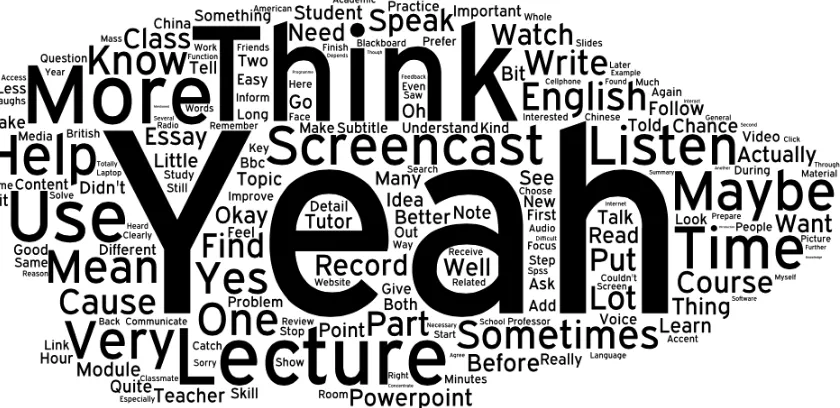
A recurring theme in both focus groups was that the integration of screencasts into the teaching of media and communication studies would lead to an improvement in the English language skills of students. While the verification of such claims is beyond the scope of this study, it was clear that these participants felt that their English language proficiency, and in particular their listening skills, had been enhanced through the repeated viewing of such content. One participant argued that the combination of visuals and narration was more ‘vivid’ than the powerpoint slides that students would bring with them to classes to help them follow what the lecturer was saying. Another said that screencasts had helped them understand the regional accents of their lecturers and made it easier to follow the verbal delivery of these members of staff in subsequent lectures (see Figure 1).
Figure 1: Words most frequently used by postgraduate focus group participants
[image:6.595.92.512.511.715.2]
Screencasts were also considered to be more practical and accessible than recorded lectures. This was perhaps a counter-‐intuitive finding given that several of the participants stated that they already engaged in a form of lecture capture through the use of mobile devices such as smartphones to record their classes. It was also felt by all but one of the participants that recorded lectures would have no negative impact upon student attendance in classes. Nevertheless, none of those that participated in the focus groups expressed a preference for full lectures to be recorded and made available on Blackboard. The consensus amongst these participants was that the optimum length of a screencast should be between 10 and 20 minutes. This was primarily due to a perception that students would find it difficult to concentrate on the screen for longer than 30 minutes.
About 15 minutes to 20 minutes, I think. It’s not, not so long […] it could feel a little bit boring to repeat the entire lecture again
(Focus Group 1, Participant 2). I think one of the advantages is […] the screencast only takes, approximately 10 or 15 minutes, so…we use a little time and we recap something or…in some degree, expand our knowledge about a specific concept
(Postgraduate Focus Group 2, Participant 4)
However, there were two caveats that should be applied to this finding. First, none of these participants were familiar with lecture capture software packages, such as Echo360, which allow students to skip to relevant sections in recorded lectures. For most, their interaction with screencasts was limited to those created by the lecturers involved in this project, as well as the library tutorials on how to use software packages such as SPSS.ii Second, the perceived English language skills of the participants might have influenced their views on how likely students were to watch recordings lasting longer than 20 minutes. During the first focus group several admitted to having problems expressing themselves in English and found it difficult to follow lectures in real-‐time as a result of their limited listening skills. Such language difficulties were evident in the suggested improvements to screencast provision within the Department of Media and Communication. For example, one participant believed that student comprehension of content delivered through screencasts could be further improved through the inclusion of video footage of the lecturer, which would allow students to see their mouths as they spoke. It was also suggested that subtitles might be added so that students could see exactly what the lecturer was saying in their narration of the slides.
2) Undergraduate students use screencasts strategically for revision purposes and to help with their assignments
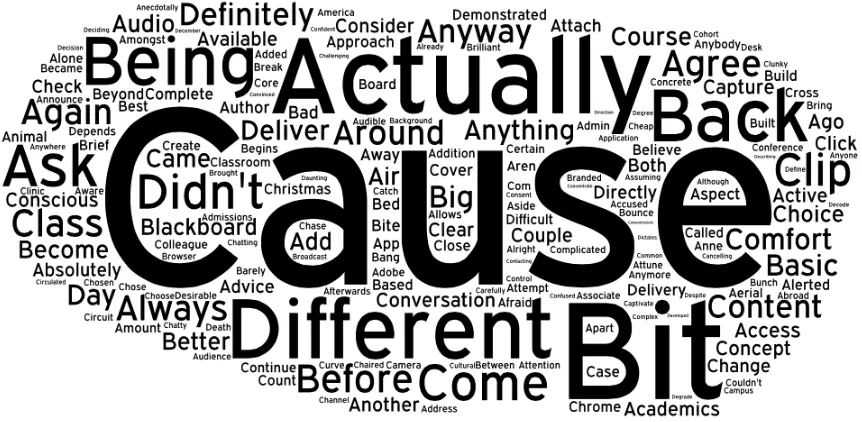
screencast had caused the participants to reflect upon the key issues discussed during class time (see Figure 2)
Figure 2: Words most frequently used by undergraduate focus group participants
Both instructional and supplemental screencasts appeared to have enhanced the learning experiences of these participants. The former included a video that showed students how to use a particular tool for the television production module whereas the latter were screencasts summarizing key concepts that had been provided by the lecturer for the purposes of exam revision. The ability to play, pause and rewind such content was said to have made it easier for students to take notes and understand the complexities of these topics:
Using that tool was a bit complicated and no one could get it just like attending one class. So people needed to watch that video to understand what goes where, why there were sometimes why they were doing some things..[…] so we needed that
(Undergraduate Focus Group 1, Participant 2) I find it a lot easier though, going to revise and stuff, and I can just see what they’re saying again cause I nearly forgot what’s in a lecture. It’s just easier when it’s at home, it’s like accessible
[image:8.595.86.514.199.413.2]seminars and lectures. On the other hand, some participants queried the role of screencasts within the teaching of campus-‐based courses. One argued that such content was better suited towards distance learners and that contact hours between staff and students should be given greater priority by both. This was illustrated by the fact that students were unable to ask questions while viewing screencasts and would often have to send such queries via email to their lecturers afterwards. The majority of the participants in both focus groups also raised concerns about the impact of such content upon attendance in lectures. Unlike their postgraduate counterparts, they believed that undergraduate students would be less likely to turn up to classes if the screencasts were made available before class. Several participants in both focus groups suggested that truancy might be a problem if these practices were rolled out across the Department. There was much speculation over whether screencasts would make students ‘lazy’ with some ‘pretending to be ill’ in order to miss lecture content that they could watch online. One participant event went as far as to admit that they would be:
“less likely to go to the lecture if I know it’s gonna be up.”
(Undergraduate Focus Group 2, Participant 3).
Although there remains little robust empirical evidence to suggest that recorded lectures negatively impacts upon student attendance, such testimony would appear to illustrate some of the problems raised by academics about the widespread use of these approaches in Higher Education.
The undergraduate participants suggested a number of ways in which such issues might be addressed. It was suggested that such content should not be released until after lectures had taken place in order to encourage students to attend the classes. Full lecture capture was also ruled out as it was considered highly unlikely that students would watch such content. Similar to the postgraduate focus groups, the consensus was that screencasts should be much shorter than conventional lectures and provide summaries of key concepts for revision purposes. The undergraduate participants also believed that screencasts should last between 10 and 30 minutes, the latter being the optimum time for content provided in place of a lecture. However, they tended to believe that the content might influence how long the screencast should be:
I’d keep them short because if they’re too long I’m not gonna use much of my own time to just sit and watch them
(Undergraduate Focus Group 2, Participant 3) I mean personally I’d like things to be kept short and sweet […] if they’re talking about a concept, they say what the concept is and explain briefly what that concept means I’m fine with that but I think it really depends on the content
for an overview), as opposed to deeper forms of engagement, merits further research. What was clear from the undergraduate focus group results was that participants reported learning practices congruent with the former and outcomes consistent with the latter.
3) Screencasts enhanced the learning and teaching experiences of lecturers too
A prominent theme in the lecturer focus group was that the process of creating screencasts had been a ‘positive experience’ for both academics and students (see Figure 3). The lecturers reported that it was ‘easy to get the hang of’ screencasts and that they had found the process ‘less daunting’ they had thought it would be:
I found that when I recorded it. Um I found the recording process quite straightforward actually, and I expected it to be more complicated.
(Lecturer Focus Group, Participant 2) that was one of the things about the screencast that I thought that when I had a go at it that it was actually easier than I thought and this is actually not bad. I could play around with this and see how it works anyway
(Lecturer Focus Group, Participant 3) This was perhaps an unexpected finding in light of previous research that has suggested that academics are reluctant to engage in new forms of ‘digital’ scholarship (see Pearce et al, 2010). Furthermore, only one of the three participants had previously recorded audio-‐visual content, such as podcasts, for teaching purposes. While the other two had used YouTube to show video clips to their students during lectures, they did not feel comfortable creating content and sharing it on ‘public’ sites such as Twitter.
Figure 3: Words most frequently used by participants during lecturer focus group
[image:10.595.83.514.535.746.2]These participants not only used screencasts to preview and summarise lecture content, but also to address frequently asked questions that had accumulated during the term. One of the lecturers had even went as far as to record a two hour screencast, which included some singing, for a lecture on a music module that they had been unable to present in person. Such content was signposted during the lectures and on Blackboard, with links provided to the host website. All of the lecturers agreed that the process of creating this content became even easier with practice and had recorded at least two screencasts during the semester.
Recording screencasts was said to have had a positive impact upon the pedagogy of these lecturers. They felt that the challenge of adopting a ‘conversational tone’ and identifying the most salient points from lectures had improved their lecturing skills. For example, one participant stated that this process had made them pay more attention to their diction and the importance of staying on-‐topic: So it’s helped me a little bit with that. Seeing actually, what do I really want to say here? A lot of this is probably waffle and it’s not really helpful,[…]So I found it helpful in that sense, in thinking what is it actually that I want to say and then backing that up.
(Lecturer Focus Group, Participant 3) There were also similarities between student and staff perspectives on the optimum length of a screencast. The consensus amongst the former was that 10-‐15 minutes should be sufficient time to provide either instructional content or summaries of key concepts from the lectures. Like the undergraduate students, the lecturers perceived that students were unlikely to sit through an entire recorded lecture and expressed concerns about the impact of full lecture capture upon attendance in classes. Furthermore, the lecturers acknowledged that screencasts were a poor substitute for lectures. As one interviewee stated:
I mean you slow down, or you speed up. If you see them getting a little bit impatient, then you speed up. Delivering a lecture, it’s a performance. It’s a one-way performance, and it would be shorter for starters I think. Um it’s a different animal, you know. It’s the same content, but a different animal.
(Lecturer Focus Group, Participant 2)
The participants also expressed concerns about the inability of students to ask questions while viewing this content. That is not to say that they felt that screencasts had no role in the teaching of media and communication studies. Rather, all of the participants characterised screencasts as a viable alternative to full lecture capture, which they feared would be imposed upon academics by University management without prior consultation. Indeed, the empowerment of creating screencasts was contrasted with the top-down imposition of lecture capture in Higher Education. Hence, the lecturer who had received positive feedback for their use of screencasts, in the form of emails from students, expressed a preference for their normalisation within UK HE institutions. However, it was perhaps more revealing that the other two participants stated that they would continue to create this content despite the lack of qualitative feedback on its perceived value to students:
I’m convinced it’s a really useful addition and tool. And it’s one of those things that it’s value added with a relatively small amount of effort, and so it’s worth doing. You know, it’s worth doing even if you’re not getting a lot of qualitative feedback.
These resources were seen as a potential solution to the language issues frequently reported by international students at both undergraduate and postgraduate levels. This was congruent with a previous study within the Department of Media and Communication, which suggested that students used such content to improve their understanding of the regional accents of their lectures (Reilly, in press). Thus each of the participants stated that they planned to create more of these resources to support their teaching in the following academic year. There were also suggestions about how screencasts might be used to provide more practical information on admissions and the University regulations. Overall, the consensus amongst these lecturers was that screencasts should be more widely deployed in order to improve the teaching resources within the Department.
4. CONTINUATION OF THE PROJECT
The study provided further evidence of the educational value of using screencasts to address the learning needs of both undergraduate and postgraduate students. Both staff and students suggested that these resources not only helped international students develop their English language skills, but also encouraged deeper forms of engagement with key concepts in media and communication studies. The convenience of learning at their own pace was said to have improved note-‐taking and helped students prepare for their assignments. Screencasts of no more than 30 minutes were preferred to recorded lectures on the basis that they were less likely to have a negative impact upon student attendance in lectures. Lecturers also appeared to be empowered by the process of creating this content and this contrasted this with the top-‐down imposition of lecture capture in Higher Education. Screencasts helped them focus on what were the most important points in their lectures and several suggested that it had led to improvements in their teaching delivery. However, it should be noted that none of the participants in this study believed that screencasts were an adequate substitute for lectures, especially given that students would not be able to ask the lecturer questions while watching this content. Indeed, the student participants felt that screencasts were an additional but not equivalent mode of teaching delivery compared to the traditional lecture.
Since the project finished the lecturers have continued to use screencasts in their respective modules. Two of the participants have used sites such as Screenr and Screencast-‐o-‐matic to record content for flipped lectures and there are provisional plans for further screencast workshops to be held in the Department in the forthcoming academic year. The training materials created during the project have not only been shared with colleagues in the College of Social Science, but also with academics based in countries such as Kazahkstan and the United States. The evidence so far suggests that academics are open to experimenting with screencasts in their teaching. However, it is perhaps too early to tell whether such resources will be fully integrated into the teaching of media and communication studies. Hence, a longitudinal study of how these lecturers have used screencasts should be conducted in order to provide further evidence of educational outcomes that emerge from their utilisation in Higher Education.
comparison between the grades of those who did and did not use screencasts to support their learning. The proposed project should also explore how these resources interact with the learning styles of individual students and, in particular, focus on whether they promote surface or strategic learning approaches. What was clear from this study was that students felt that screencasts deepened their knowledge about certain topics even though they reported practices that were congruent with these learning approaches. Thus, further empirical data is needed to explore whether students are only likely to use these resources to help prepare for their assignments. Clearly this would also inform the type of content created by lecturers and enable the further integration of screencasts into their teaching.
ACKNOWLEDGEMENTS
This report focuses on the findings from my 2013 University of Leicester Teaching Enhancement Fund project. Thanks to Palitha Edirisingha, Caitlin Jones, and Miruna Virtopeanu for their assistance with this project.
REFERENCES
ReferencesAndrews, C. J., Brown, C. B., Harrison, C. K. W., Read, D. And Roach, P. L. (2010) Lecture Capture: Early Lessons Learned and Experiences Shared, New Directions in the Teaching of Physical Sciences, 6, 56-‐60.
Biggs,, J. (1987) Student Approaches to learning and Studying, Hawthorn, Vic: Australian Council for Educational Research.
Braun, V. and Clarke, V. (2006) Using thematic analysis in psychology. Qualitative Research in Psychology, 3 (2). pp. 77-‐101. ISSN 1478-‐0887, Available at:
http://eprints.uwe.ac.uk/11735/2/thematic_analysis_revised_-‐_final.pdf [accessed 10 September 2014] Fang, HN., & Pursel, B. (n.d). Lecture Capture: Current Research and Future Directions. retrieved November 13 2012, from Pennsylvania State University Web Site:
http://www.psu.edu/dept/site/pursel_lecture_capture_2012v1.pdf
Holbrook, J & Dupont, C. (2009) Profcasts and Class Attendance-‐Does Year in Program Matter? Bioscience Education, 13, 2. Available at: www.bioscience.heacademy.ac.uk/journal/vol13/beej-‐13-‐ c2.pdf.
Karnad, A. (2013) Student use of recorded lectures: a report reviewing recent research into the use of lecture capture technology in higher education, and its impact on teaching methods and attendance. London School of Economics and Political Science, London, UK. Available online:
http://eprints.lse.ac.uk/50929/ [Accessed 28 June, 2013]
Lancaster, S.J and Read, D. (2013) Flipping lectures and inverting classrooms, Education in Chemistry, 50 (5): 14-‐17.
O’Malley, P. J. (2010). Combining a tablet personal computer and screencasting for chemistry teaching. New Directions in the Teaching of Physical Sciences, 6, 64-‐67.
Oliver, M. and Trigwell, K. (2005). Can 'Blended Learning' Be Redeemed?, E-‐Learning and Digital Media, 2(1),pp. 17-‐26. Available at: http://dx.doi.org/10.2304/elea.2005.2.1.17
Pearce, N., Weller, M., Scanlon, E., Kinsley, S. (2010) Digital Scholarship Considered: How New Technologies Could Transform Academic Work. In Education 16, 1. Available at: http://www.ineducation.ca/article/ -‐scholarship-‐considered-‐how-‐new-‐technologies-‐ could-‐ transform-‐academic-‐work
Pinder-‐Grover, T., Green, K. & Millunchick, J.M. (2011) The efficacy of screencasts to address the diverse academic needs of students in a large lecture course, Advances in Engineering Education, Winter 2011, pp.1-‐28.
Procter, R., Williams R., & Stewart, J. (2010). If you build it, will they come? How researchers perceive and use web 2.0. London: Research Information Network.
Seery,M.K. (2013) Harnessing Technology in Chemistry Education, New Directions, 9 (1): 77-‐86. Smithers, M. (2013) Is Lecture capture the worst educational technology?, Retrieved from: http://www.masmithers.com/2011/03/11/is-‐lecture-‐capture-‐the-‐worst-‐educational-‐technology/ Stannard, R. (2007) Using screen capture software in student feedback. Higher Education Academy
English Subject Centre Case Study. Retrieved from:
http://www.english.heacademy.ac.uk/explore/publications/casestudies/technology/camtasia.php
Trevisan, F and Reilly, P. (2014) Ethical Dilemmas in Researching Social Media Campaigns on Sensitive Personal Issues: Lessons from the Study of British Disability Dissent Networks,
Information, Communication & Society, 17:9, 1131-1146.
Von Konsky, B.R., Ivins, J. & Gribble, S.J., (2009) Lecture attendance and web based lecture technologies : A comparison of student perceptions and usage patterns. Australasian Journal of Educational Technology, 25(4), pp.581–595.
Weller, M. (2011). The Digital Scholar: How Technology Is Transforming Scholarly Practice. Basingstoke: Bloomsbury Academic.
Williams, D & Davies, D.L. (2012) Multimedia resources for teaching problem solving in Chemistry, Journal of Excellence in Teaching and Learning.
Winterbottom, S. (2007). Virtual lecturing: Delivering lectures using screencasting and podcasting technology. Planet, 18, 6-‐8.
i
For more on the use of Twitter in the module ‘Activism and Protest in the Information Age’
see
http://pauljreillydot.com/actandprotest/
ii