City, University of London Institutional Repository
Citation:
Marinova, D., de Ruyter, K., Huang, M., Meuter, M. and Challagalla, G. (2017). Getting Smart: Learning From Technology-Empowered Frontline Interactions. Journal of Service Research, 20(1), pp. 29-42. doi: 10.1177/1094670516679273This is the accepted version of the paper.
This version of the publication may differ from the final published
version.
Permanent repository link:
http://openaccess.city.ac.uk/16048/Link to published version:
http://dx.doi.org/10.1177/1094670516679273Copyright and reuse: City Research Online aims to make research
outputs of City, University of London available to a wider audience.
Copyright and Moral Rights remain with the author(s) and/or copyright
holders. URLs from City Research Online may be freely distributed and
linked to.
1
GETTING SMART: LEARNING FROM TECHNOLOGY-
EMPOWERED FRONTLINE INTERACTIONS
Detelina Marinova, Ko de Ruyter, Ming-Hui Huang, Matthew Meuter, and Goutam Challagalla
JSR Special Issue on “Organizational Frontline Research”
2
GETTING SMART: LEARNING FROM TECHNOLOGY
EMPOWERED FRONTLINE INTERACTIONS
Abstract
Smart technologies are rapidly transforming frontline employee–customer interactions. However, little academic research has tackled urgent, relevant questions regarding such
technology-empowered frontline interactions. The current study conceptualizes: (1) smart technology use in frontline employee–customer interactions, (2) smart technology–mediated learning mechanisms that elevate service effectiveness and efficiency performance to empower frontline interactions, and (3) stakeholder interaction goals as antecedents of smart technology–mediated learning. We propose that emerging smart technologies, which can substitute for or complement frontline employees’ efforts to deliver customized service over time, may help resolve the long-standing tension between service efficiency and effectiveness, because they can learn or enable learning from and across customers, frontline employees, and interactions. Drawing from pragmatic and deliberate learning theories, the authors conceptualize stakeholder learning mechanisms that mediate the effects of frontline interaction goals on frontline employees’ and customers’ effectiveness and efficiency outcomes. This study concludes with implications for research and practice.
3
New, rapidly emerging technologies are transforming frontline employee–customer
interactions. For example, imagine a medical device that tracks heart rate activity continuously for each individual patient, across a vast number of patients. Using signals from patients and
heart attack incidences over time, the device may gain the ability to predict, in real time, when a patient is about to have a heart attack. Much like Amazon.com recommends products to
customers by using the collective purchase histories it has collected, the medical device could
send a message to an individual patient, suggesting “Please take your blood pressure medicine now, because your blood pressure is above your target level.” These improved diagnostics hold the promise of improving efficient, effective health care services, with fewer redundant checkups
and faster problem identification. In turn, health care professionals can make better decisions, and patients can learn how to combat illness and manage their personal health.
Such data-rich, customized analyses require an infinite array of smart, connected devices that can combine data from electronic medical records, diagnostic information, and personal
monitoring—that is, the “Internet of things.” As the cost of connecting devices continues to drop, such smart technology innovations are quickly making their ways into customers’ business and personal lives, with far-reaching potential for applications at the service frontline. We define
smart technologies as tools (comprising information, software and hardware) that can enable customer and frontline employee learning from frontline interactions that co-produce value.
Over time, these smart technologies begin to adapt and offer customized, desirable service to customers.
Customized service delivery, whether focused on effectiveness, efficiency, or both, also
4
customers, organizations place higher demands on their frontline employees (FLEs) to meet customers’ functional goals by leveraging deep and broad knowledge about the service and the
customer. In many industries, companies are scoping up (re-tooling and training) and scaling down FLEs, in efforts to increase both efficiency and effectiveness. Using smart technology is
one such method. For example, in retail bank branches in Japan, collaborative robots work side-by-side with bank tellers to serve customers. These multilingual robots can answer customer queries in various languages and have real-time access to data about each customer’s contact
history and stock portfolio. Both customers and FLEs thus must learn how to co-create service delivery with such advanced forms of customer-facing technology (Simpson 2015).
We conceptualize that both the smart technology as well as the humans involved in the
co-production activity can learn and get smarter. The co-production activity, when enhanced with a smart technology, allows the customer and FLE to retain knowledge across interactions
and enhance those interactions real time. Hence both the customer and FLE become more effective in their respective roles and the interactions produce more value for both parties. In some cases the smart technology might be used by the customer only, the smart technology could
be used by a FLE only, or the smart technology could be used jointly by both parties.
However, we have few insights into how leveraging smart technology at the
organizational frontline shapes customer interactions and their outcomes. Academic research is just beginning to tackle urgent, relevant questions in relation to technology-empowered frontline
interactions, prompting Yadav and Pavlou (2014, p. 35) to call for research on “how technology actually mediates interactions in computer-mediated environments” rather than adopt a “black box” approach to the issue. Responding to this recent call for research, we propose that emerging
5
customized service over time, offer the potential to address the long-standing tension between service efficiency and effectiveness. This is because smart technologies can learn and enable
learning from and across customers, FLEs, and their interactions. For example, substituting
FLEs, geofencing-enabled apps on smartphones can track the customer’s behavior over time and
then offer personalized, real-time product suggestions or promotional offers while the customer is in a store, which increases both the effectiveness and the efficiency of the interaction (Danaher et al. 2015; Fong, Fang, and Luo 2015). In complementing human FLEs, virtual socialization
agents can help new customers adjust more effectively to different service environments such that both the interaction style and content of the virtual agents impact customer learning and
firm-level performance (Kohler, Rohm, de Ruyter and Wetzels, 2011).
To address the research gap related to how technology-mediated stakeholder learning takes place and can be leveraged and managed for superior service outcomes, we identify
different patterns of smart technology–mediated learning, as a function of stakeholders’ (FLEs’ and customers’) interaction goals. In so doing, we make several contributions to frontline management literature. We conceptualize smart technology use in FLE–customer interactions,
explain how smart technology–mediated learning mechanisms can elevate service effectiveness and efficiency performance to empower interactions, and identify stakeholder interaction goals
as antecedents of smart technology–mediated learning. Without a clear understanding and appropriate management of stakeholder learning, the use of smart technology during frontline
interactions likely will underwhelm customers and fail to deliver performance outcomes, regardless of its benefits. This is because customer goals evolve over time resulting in faster customer disengagement, boredom and eventual service or product use termination. Moreover,
6
customers suggests that FLEs might struggle to extract and apply new, uniquely embedded product, service, or consumption knowledge continuously and within and across customer
interactions. While the required FLE and organizational knowledge barrier evolves and becomes higher, smart-technology investments are increasingly more accessible for organizations,
resulting in likely competitive imitation which over time erodes competitive advantage.
In the next section, we review literature on technology-mediated frontline interactions to conceptualize the use of smart technology. Then we propose smart technology–mediated
learning mechanisms that can lead to smart performance, featuring simultaneous effectiveness and efficiency outcomes for FLEs and customers. We also present stakeholder (FLE and
customer) interaction goals as motivators and antecedents of smart technology–mediated
learning. Finally, we identify directions for research and discuss the implications of our proposed framework for frontline research and management.
Smart Technology Use in Frontline Interactions
Early explorations of the role of technology in customer–firm interfaces focus mainly on
consumers’ willingness to use the technology (Curran, Meuter, and Suprenant 2003; Dabholkar 1996; Meuter et al. 2005; Parasuraman 2000). A common theme underpinning early research though—and even continuing today—is the overemphasis on the use of technology to save costs
(Bendapudi and Leone 2003; Lusch, Vargo, and O’Brien 2007; Prahalad and Ramaswamy 2000; Shamdasani, Mukherjee, and Malhotra 2008). These Technology – Based Self Service Tools
7
A common thread for many of these technologies was the replacement of repetitive interactions with a machine that could do those tasks more accurately, quickly and efficiently.
Parallel to the literature on customer use of technology is a growing literature on
salesperson’s use of technology. Much of this research has focused on the drivers of salesperson
use and adoption of these technologies (e.g. Ahearne, Hughes and Schillewaert 2007, Weinstein and Mullins 2007), similar to research that focuses on drivers of customer uses of technology (Kleijnen, de Ruyter, and Wetzels 2007; Meuter et al. 2000). The cost savings and benefits to the
firm cannot materialize if most customers and salespeople remain unwilling to use the new technologies.
However, as technological tools and their capabilities have expanded and evolved, we also recognize a shift away from technologies that replace humans in repetitive encounters and toward those that FLEs can use to facilitate service or sales, often in collaboration with
customers, as well as to create more enjoyable, customized, and valued service interactions. If leveraged and managed effectively, technology-based interactions produce more value, such that
both customers and FLEs should be more likely to embrace and welcome the technology into their interactions.
Modern technologies can expand service or sales by deepening customer relationships (Rust
and Huang 2014), as well as serve as knowledge repositories that streamline sales processes (Ahearne and Rapp 2010). This is very evident in the interaction between customers and the
organizational frontlines. For example, Ahearne, Jones, Rapp and Mathieu (2008) show that the use of IT by salespeople can improve customer service, the salesperson’s adaptability, and sales performance. Hunter and Perreault (2007) also show that even if sales technology can hinder
8
A recent development is the arrival of technological tools that can learn or enable learning by customers and employees, such that they are “smart” rather than limited to performing
repetitive tasks quickly and efficiently. These tools can deliver customized service over time, reflecting their learning from all previous interactions (Rust and Huang 2014). Such
technological advancements arise from cognitive computing, a form of self-learning artificial intelligence that blends the best of human and machine learning (Fingar, 2014). To do so, it engages in deep learning, involving high-level data abstraction and nonlinear processes based on
input data, adaptation, and learning.
Continuum of Smart Technology in Frontline Interactions
We propose that smart technologies also fall along a continuum, from those that fully and completely replace FLEs to those used in tandem with FLEs to provide service (Figure 1). For our purposes, FLEs include any firm employees who regularly interact with customers. Although
we note the many available back-office applications, we focus on employees who have contact with customers as a central part of their job. For example, the left end of the spectrum in Figure
1, smart technologies that substitute for FLEs, might be manifested by the Garmin Connect that enables consumers to interactively track and analyze their fitness activities in real time. The detailed, real-time data about time spent, distance, elevation, heart rate, and calories burned help
users identify their strengths and weaknesses. They also can receive live feedback and encouragement from friends through a social support function, as well as see their friends’
activities. Another example, in a business-to-business context, is the Financial Services
Information Sharing and Analysis Center (FS-ISAC), which provides cyber- and physical threat analysis to the global financial industry through the use of machine learning. It continuously
9
all levels of government agencies, law enforcement, and other trusted resources, then quickly disseminates any alerts and other critical information to business customers through smart
technology.
** Insert Figure 1 here**
The numerous examples of smart technologies that complement FLEs (right side of Figure 1) include smart glass (e.g., Google, Vuzix M100, Wrist Keyboard) customer relationship management systems that present customer data on wearable devices and thus grant FLEs an
immediate, 360º view of customers that produce up- and cross-selling opportunities and increased conversion rates (Bhat, Badri, and Reddi 2014). Smart technologies can help FLEs
plan customer calls, remind them to provide timely follow-up, generate quotes, update customer accounts in real time as well as access products and pricelists on the spot to close deals faster and increase the size of the deal. In a B-to-B high-tech engineering context, field service agents
(FSA) today can wear smart glasses that bring up scheduled work orders and customer locations on Google Maps (Bhat, Badri, and Reddi 2014). While onsite, the FSA can access
product/service information to solve problems, conduct live-streaming conversations with back-office support personnel, and place replacement orders through external apps. Therefore, the technology enables faster interactive service delivery and also enhances the FSA’s productivity.
All along the continuum, smart technologies provide value and our focus is on how such technologies can be leveraged and integrated at the customer–firm interface. Smart technologies
offer more sustainable advantages and create more switching barriers than automated
technologies, which are common in most industries and easily replicable. The customization and learning provided by smart technology platforms draw the customer in by providing rich user
10
with another firm. In this sense, learning and adaptation by the technology to the environment and human desires is a key attribute of a smart technology, as Kohler, Rohm, de Ruyter and
Wetzels (2011) show in their examination of the role of socialization agents (virtual FLEs) in helping new customers adjust to different service environments. They find that both the
interaction style and content of virtual agents affect customer learning and firm-level performance.
The drivers of success in this environment therefore differ from those that are pertinent to
automated technologies. Although high levels of penetration and adoption are important, other metrics, such as customer retention, satisfaction, increased purchase behavior, and enhanced
relationships, are more indicative of success. First-mover advantages are also clearly important, because customers who enter into “learning” situations with firms are less likely to switch to competitors unless the learning-based outcomes from competitive offerings are substantial. For
example, General Electric’s Predix cloud-based platform can create innovative Internet apps, by giving FLEs real-time operational data and analysis results, which support better, faster decision
making (https://www.gesoftware.com/predix). Smart technology–mediated FLE learning and the related effectiveness and efficacy outcomes thus can constitute significant barriers to switching.
Smart Technology–Empowered FLE and Customer Learning in Frontline Interactions
We focus on frontline interactions as the context of smart technology mediated learning and
define frontline interactions to also include interactions between a customer and an artificial
intelligence-powered machine which connects the customer with the organization by substituting or
complementing FLEs to co-produce value. Smart technology–mediated FLE or customer learning involves a process of knowledge acquisition about products, services, consumption, and self that
11
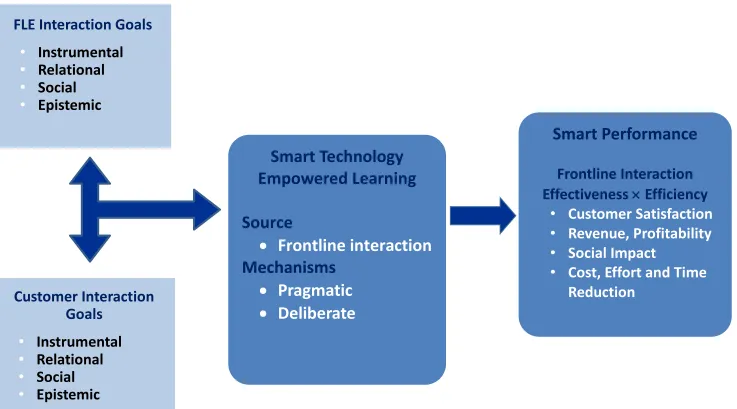
mediating mechanism through which technology use in frontline customer interactions can elevate both interaction effectiveness and efficiency over time. In particular, we argue that smart
technology can empower frontline interactions by uniquely enabling both pragmatic and deliberate learning of FLEs and customers over time, as we show in the conceptual framework
(Figure 2). In these frontline interactions, smart technology can either substitute for or complement FLEs.
** Insert Figure 2 here**
Pragmatic Learning Empowered by Smart Technology
Pragmatic learning theory addresses the transformation of individual experiences into
experiential knowledge (Jayanti and Singh 2010). Experience pertains to “the thoughts,
emotions, activities and appraisals that occur during or as a result of an event” (Hirschman and Holbrook 1982)—or in our study terminology, smart technology–mediated frontline interactions.
Actors, such as customers (Chartrand and Bargh 1999) and FLEs (Ye, Marinova, and Singh 2012), often falter in their efforts to obtain knowledge from their experiences. The process is
effortful, resource- and capability-intensive, and time consuming, because it requires both “inquiry” and “action” mechanisms. An inquiry entails interpreting, understanding, and
explaining the experiences and generating hypotheses. Customers or FLEs may ask “what if” or “why” questions about the product, service, or consumption situation to solve a problem or else
seek interaction-oriented answers and goals. In turn, actions result from the inquiry process,
12
The resultant knowledge, acquired by the customer or FLE, is specific to the customer, experience, or interaction (rather than general or generalizable).
Smart technology that substitutes for or complements FLEs’ efforts can effectively and efficiently convert customers’ experiences into processed data through machine learning
algorithms that enable customers to understand their experience or automatically tap into the knowledge of other customers or FLEs. Thus, such smart technology can grant customers and FLEs the capability for ad hoc inquiry and action in real time, such that they can interpret and
explain experiences as they occur, while also experimenting dynamically over time. For example, as we described in the opening lines to this article, a smart wearable sensor with a "skin-friendly" adhesive could continuously track heart rate activity for an individual customer
but also across a large number of customers (https://www.wearable-technologies.com). Using the real-time signals, as well as data about heart attack incidences over time, the device can even
predict high-threat heart attacks using machine learning routines. The customer and his health care provider may receive a visual, audible or haptic signal (through an app on a connected device) that prompts the customer to take medication and his health care provider to take actions
in real time. This richer real time-feedback can enable learning experiments that effectively and efficiently improve customers’ health status over time. Specifically, a customer’s “inquiry” can
focus on dynamic medication dosing as a function of customer’s real-time physical activity. Feedback derived from smart-technology enabled data processing from this customer and across
13
When smart technology substitutes for the FLE, the inquiry mechanism may be
continuous, dynamic, and conducted by the smart technology on behalf of the customer, because
it automatically processes customers’ evolving behavior and information, while also tapping in to the experiences of others (available in the processed data stored in dynamic, smart databases).
An array of data-driven options for action, such as taking different medications or changing current activities also can be generated by the smart technology, resulting in a customized solution and then learning from the particular experiences of that customer. When smart
technology complements the FLE, it means that the actors can engage in joint decision making, such that the FLE’s (e.g., health care provider) and customer’s inquiry and action enter dynamic
cycles of immediate interactions. The FLE gains instantaneous access to customer-specific behavioral data from the inquiries initiated by the smart technology, so the real-time input that drives the FLE’s actions during the interaction is both efficient and accurate.
In the absence of smart technology–mediated frontline interactions, customers or FLEs may lack the ability and means to engage in productive inquiry and action, which requires tracking behavior (e.g., physiological activity), reflecting on it to understand it, refining
knowledge by integrating outside perspectives, and exploring various options (or experimenting) iteratively until the right solution emerges. Furthermore, FLEs are limited in their ability to
derive knowledge-in-action (Ye, Marinova, and Singh 2012) that is specific to each customer interaction. This burdensome process requires resources, time, and effectiveness–efficiency
trade-offs, which often create FLE role stress (Singh 2000; Zablah et al. 2012). Smart technology provides rapid, on-the-spot access to processed, readily available, accurate, customer-specific insights, derived from the customer’s evolving behaviors and experiences, as well as the
14
customer or FLE thus diminishes, even as it empowers pragmatic learning and accelerates emergent actions by the customer or FLE that aim to reach interaction goals. Overall, smart
technology–mediated pragmatic learning produces fast, accurate, customized solutions in FLE– customer interactions.
Deliberate Learning Empowered by Smart Technology
In addition to pragmatic learning, we propose that smart technology can empower FLEs’ and customers’ deliberate learning, by converting experiential (customer- or interaction-specific)
knowledge into generalizable knowledge across experiences (for customers) or interactions (for FLEs). Then it can induce deliberate practice, which refers to focused actions that get repeated
over time, by customers or FLEs. Theoretically, deliberate learning refers to a process for capturing implicit knowledge or knowledge in action, as is generated through ongoing customer interactions, and then transforming it into explicit, updated routines for use across organizational
frontlines (Arthur and Huntley 2006; Ye, Marinova, and Singh 2012; Zollo and Winter 2002). Frontline customer interactions contain rich, unique data that give rise to FLE know-how or
knowledge-in-action, which cannot be possessed readily as a set of hard facts. The resulting frontline knowledge is characterized by complexity, fragility, and tacitness, because it is unprocessed, variable, unclear (i.e., ambiguous action–outcome links), and thus unusable in its
original form (Ye, Marinova, and Singh 2012). In a consistent view, Dewey (1938) and James (1963) present knowledge as inherent to individual actions when people interact with their
environment. Transforming everyday knowledge into usable (explicit) knowledge is a deliberate process that requires time, energy, and resources. Frontline, deliberate learning thus has been conceptualized as an effortful, time-consuming, multistep process that involves generating,
15
across various frontline interactions. We reason that when smart technology gets deployed at the FLE–customer interface, it helps deal with this challenge by performing many of the process
steps and empowering FLEs to execute the remainder.
To generate and articulate knowledge, smart technology can track customers’ behaviors
and actions (e.g., with wearable smart monitors) and integrate this information over time to derive patterns and insights. The insights then can be shared in real time with both the customer and FLE, through connected apps and devices. Our heart activity smart monitor example might
be linked to a caregiver’s app, and a smart database can produce explicit reports that effectively articulate knowledge, without consuming this FLE’s time, effort, or resources, enhancing the co-produced interaction value. In addition to tracking behavior and converting the information into
actionable insights and experiential knowledge (pragmatic learning), smart technology can provide objective feedback about an ideal or desired performance model, by processing and
integrating behavioral data acrossfrontline interactions or customers over time. Such outcomes rely on advances in unsupervised (i.e., performed by the machine automatically, with no human intervention), supervised (performed by the machine using input from humans), and
semi-supervised machine learning procedures, as well as advances in artificial intelligence fueled by connected devices, supported by faster but cheaper computing resources (Fingar 2014).
Feedback supports problem solving and accurate solutions (e.g., right medicine at the right time), by cross-checking smart databases and tapping into the generalizable knowledge (e.g., clinical
16
patterns using analyses across FLE–customer interactions and generalized knowledge that gets continuously updated.
Equipping FLEs with such customized knowledge in real time is empowering, especially if they deal with knowledgeable, technology-empowered customers who expect effective,
efficient, customized solutions. Smart technology can reduce the time, energy, and resources associated with deliberate learning activities, thus enabling FLEs to focus on other functions and tasks. For example, it can free up FLEs’ resources, so that they can devote those resources to
implementing solutions for the customer (e.g., ensure the customer takes prescribed medication), focus on relationship building (e.g., extend customer lifetime value), cross-sell (e.g., discuss
other health care services, such as home visits), and extract and record additional interaction information that may be useful for improving the effectiveness and efficiency of future interactions with this customer in the smart database.
A parallel research stream on individual learning and expert performance (e.g., Baron and Henry 2010; Ericsson 2006; Ericsson and Charness 1994; Ericsson, Krampe, and Tesch-Romer
1993) similarly conceptualizes deliberate practice as intense, concentrated, repeated
performance, compared against an ideal or “correct” model of performance (Kolb and Kolb 2011). It requires feedback to evaluate the actual performance relative to the ideal and identify “errors” that can be corrected in subsequent performances. For example, an app (that substitutes
the FLE) might enable customers to choose, customize, and manage energy solutions for their
house by linking them with energy solution providers and customer communities they can tap in to, in an interactive sense. Customers use this app to manage energy use and monthly energy bills, with the functional goal of reducing energy consumption and cost. Typically, reducing
17
sustained effort and resources over time. These impediments to deliberating learning and practice can be overcome by a smart technology energy app that:
1. Eliminates ambiguity and clearly links customer actions to outcomes by analyzing and charting energy consumption, including its source, timing, and impact on costs
and efficiencies.
2. Providing prompts for action in real time (e.g., “switch off your screens rights now”), rather than retrospectively when motivation is more difficult to induce.
3. Enabling automated performance of some tasks to reduce customer effort.
4. Motivating customers by providing information about similar others (e.g., neighbors) who have achieved similar goals (e.g., cost savings).
Soneter (smartflowh2o.com) uses advanced ultrasonic sensors to measure water flow in pipes and sends real-time usage and alerts, together with historical reports, to customers’ mobile
devices, laptops, or smart phones so they can monitor water usage and check for leaks. It also enables customers to create customer communities.
Thus, smart technology–empowered deliberate learning helps customers gain customized knowledge about their specific experiences by automatically and efficiently tapping generalized knowledge or the dynamically assembled knowledge of others, which otherwise would be
difficult to access. A customer motivated to pursue a consumption goal through deliberate practice can be empowered to do so through either input and knowledge generated automatically
by smart technology (smart technology substitutes FLEs) or joint decision making with an FLE that has been facilitated by smart technology (smart technology complements FLEs).
18
Both learning mechanism share common elements as they directly address the process of generating explicit knowledge about co-producing value in frontline interactions from on-going
experiences or from ‘knowledge in action.” Knowledge “generation” and “articulation” in deliberating learning are similar in function to the “inquiry and action” iterative process in
pragmatic learning. Pragmatic learning theory goes into greater detail to delineate this process by specifying that it should optimally include a continuous cycle of inquiry and action. For example, Resmed, a medical device company that specializes in treating sleep disorders such as
sleep apnea, has connected its devices to assess sleep patterns. It has analyzed the sleep patterns of over 2,000,000 users. Each individual user can analyze his/her sleep pattern over time through “inquiry” and “action” against benchmarks across Resmed’s large user base, generating
knowledge unique to their own sleep behavior. In addition, the data are available to home health nurses, who in this case are FLEs. Nurses can provide suggestions, similarly derived from a
continuous cycle of “inquiry” and “action” to patients to reduce sleep fatalities and also improve sleep quality. These data, the generated and articulated knowledge, are also available to
organizational researchers or employees who can improve device effectiveness. Finally, both learning mechanisms function similarly, regardless of whether smart technology tends to substitute or complement FLEs as we move along the continuum depicted in Figure 1. When
smart technology complements (substitutes) FLEs, co-produced value in the interaction is propelled in real-time by customer and FLEs’ (customer and organizational) learning.
Differences between Smart-Technology Empowered Pragmatic and Deliberate Learning
While deliberate learning has the goal of “knowledge codification,” i.e. long-term storage and retrieval of knowledge generalizable across interactions/experiences (for customers) or
19
does not explicitly identify a mechanism for knowledge long-term storage and retrieval (“codification”). Pragmatic learning in its goal, can thus be more unplanned, situational, and
task-specific relative to deliberating learning. Consequently, the resultant knowledge from pragmatic learning is more experience (interaction) specific for customers or customer
(interaction) specific for FLE. In contrast, knowledge obtained through deliberating learning is generalizable across experiences/ interactions for customers or across customers/interactions for FLEs. For example, in the case of Resmed, on a typical day an individual patient may engage in an ‘inquiry” to look at his/her data from the previous night to make some immediate adjustments (take “action”). These data may not be coded for long-term storage or use. On the other hand, a
nurse may analyze the same data and view it from a patient’s holistic history for long-term usage for this patient and across patients.
Interrelationship between Smart-Technology Empowered Pragmatic and Deliberate Learning
Pragmatic learning and deliberating learning can take place simultaneously and evidence an interplay. First, an iterative or continuous process of “inquiry” and “action” (based on
pragmatic learning) can be used to achieve knowledge generation and articulation (in deliberating learning). Second, though knowledge codification (for long-term storage and
retrieval of generalizable knowledge) posited by deliberating learning is not explicitly considered
in pragmatic learning, it can be achieved by deploying and directing a pragmatic learning-based “inquiry” and “action” process towards codifying knowledge that is generalizable across
interactions or customers. Such a process has to be intentional and initiated by the customer, FLE or both during the frontline interaction. It can also be a function of interaction goals (discussed in propositions P3 and P4). For instance, Resmed’s home care specialists can provide immediate
20
environment. Such information may be provided to encourage pragmatic learning based on one’s context. However, as the patient’s condition improves, his/her health goals may evolve and s/he
may direct his/her “inquiry” and “action” towards developing a new personalized plan to be codified for a future daily routine use. The company may codify data generated through routine
patient and FLE’s “inquiry” and “action” across thousands of patients and provide to FLEs generalized advice on dealing with a broader set of customer contexts.
P1. Smart technology empowers (a) FLEs’ and (b) customers’ pragmatic and deliberate learning over time from frontline interactions that co-produce value.
Smart Technology–Empowered FLE and Customer Learning Trajectory
Real-time, smart technology–enabled customization of frontline interactions and the consumption experience has the potential to engage customers, at least at first. However,
impediments to learning arise over time, because consumers likely fall into routine uses of the product or service, allowing skill-based habits to form. Skill-based product use habits tend to involve goal-activated, automated behaviors (Murray and Haubl 2007), which suggests the
notable role of goal activation as a determinant of consumer preferences for a product (along with increased ease of use through repeated experience). As skill-based habits of product use
develop, consumers become more locked in to the product or service, due to the interplay of the amount of experience consumers have with the product, usage errors they made while learning to use the product, and the goal activated at the time of product choice. Although habits of use can
create substantial advantages for a specific product or service, this advantage is limited to the achievement of a particular interaction goal (e.g., functional goal of reducing energy use). In
21
smart technology–mediated or other interactions with the energy company, and thus experiences slower or reduced learning. Pragmatic learning theory then predicts a degenerative learning
mode, in which inquiry or action fail to take place iteratively or are disrupted. Over time, if customers do not encounter new, self-relevant information, they become bored and find nothing
new, which Dewey (1916, p. 78) describes as “narrowing the field of further experience.” The process and evolution of goals might be gradual or incremental, rather than rapid and disruptive, yet a corresponding evolution or adjustment to the value offered by the company is necessary to
maintain a competitive advantage (as we discuss subsequently).
Furthermore, FLE learning is a function of cumulative customer uses of a product or service. Over time, the quantity and quality of these cumulative data, obtained from consumers’
smart technology–mediated product use, likely increase and then level off, unless consumers find some new goal to pursue. Smart technology–enabled processing, such as machine learning
algorithms that rely on the accumulated quantity and quality of consumption and interaction data across customers, is likely to increase (nonlinearly) the magnitude of FLEs’ smart technology– mediated learning. Even slower customer learning can be used as an input to FLE learning. This
represents what Day (2011) refers to as the “signal from the periphery” in presenting his vigilant learning theory to deal with changing customer needs or goals. For example, customer learning
about how to reduce energy use (functional goal) might slow down, but the customer’s goals also might evolve to include a social goal, such that the customer taps into a social community to
learn about energy use in the neighborhood. This change in behavior can be detected by the customer’s use of the app and then prompt scoping up of FLEs by providing them with real-time,
22
offer new value. Thus, if the magnitude of learning represents the current level of knowledge relative to a reference level, we propose that:
P2a.The magnitude of customer smart technology–mediated learning from smart technology empowered frontline interactions decreases nonlinearly over time.
P2b. The magnitude of FLE smart technology–mediated learning from smart technology empowered frontline interactions increases nonlinearly over time.
FLE–Customer Interaction Goal Alignment and Learning
The achievement goal framework (Locke and Latham 1990) provides a well-established theoretical lens for studying cognitive structures that seek to account for how FLEs and
customers approach the specific challenges associated with using smart technology on the frontline (e.g., learning about the use of smart meters). These cognitive frames guide actors in
the service encounter to devote attention, time, and effort to attaining desired end states and hence will impact learning. In the achievement goal framework, mastery and performance goals are discerned. Regarding the impact of goals on learning, mastery or learning goals drive people
to focus on developing their competence; acquiring new knowledge, including social and relational skills; and evaluating and experimenting with new opportunities. This is in contrast
with performance goals that refer to a desire to demonstrate competence and gain positive evaluations. On the other hand, approach and avoidance structures refer more to social reinforcement. Approach frames focus on the pursuit of gains (e.g., instrumental and social
benefits attained by learning how to use a collective smart grid in a neighborhood); avoidance frames are oriented toward avoiding losses.
23
in service encounters also may attempt to achieve both relational and social goals (e.g., receiving social support from peers). In learning about technology, people often work to establish
satisfying social relationships and want to feel appreciated in a peer group, which provides a basis for learning. Therefore, the characterization of goals developed in achievement theory
needs to be supplemented by a goal taxonomy that also includes instrumental, relational, social, and epistemic goals. Adopting multiple goals requires a coordinated prioritization effort, depending on the nature of the learning context and the specific technology used.
Goal setting literature offers ample evidence of a relationship between goal types and learning. For example, mastery goals are associated with in-depth processing of information or skills; performance goals emphasize outcomes, so the resulting information processing takes
place more on the surface level. In goal achievement research, most studies focus on individuals attempting to accomplish a specific task, such as using technology to acquire information,
browse a database more efficiently, or manage energy use more effectively. Yet goal
achievement increasingly takes place online and in the presence of others, including FLEs and other customers on social platforms. It remains unclear whether the impact of goals on learning
also is influenced by the interactive nature of the environment (e.g., social presence may be more conducive to performance goals, as a result of social comparison). In particular, does goal
alignment between the FLE and customer foster learning, due to increased mutual adjustment and identification, or is it possible that such goal alignment actually leads to decreased learning?
The goals for FLE–customer interactions evolve over time and are interdependent, such that they may become aligned or misaligned over time, within and across interactions. When instrumental, relational, social, or epistemic goals are more closely aligned between the FLEs
24
more open to each other’s ideas and share feedback. They gain learning opportunities, because
they exchange their viewpoints more frequently during the unfolding of the service delivery
process (Moran 2005). In this sense, the pragmatic learning process might be fueled by
successive, productive cycles of customer and FLE inquiry and action. This driver is especially
important when FLEs and customers share the experience of working with new technologies that require both of them to contribute resources (e.g., insights added to a decision support system for financial services). Finally, goal alignment should inspire trust, leading the actors to be more
receptive to learning from each other and broadening their horizons with respect to learning about the adoption and use of new technology. This emergent, iterative process should evolve
over time. Therefore,
P3: Alignment between evolving customer and FLE interaction goals increases the magnitude of (a) customer and (b) FLE smart technology–mediated learning from smart technology empowered frontline interactions over time.
However, shared agreement about common goals actually may decrease actors’
willingness to invest time and effort in exploring new or alternative opportunities or consider information that lies outside the scope of this common goal (Kiesler and Sproull 1992). Divergent goals instead lead cooperating actors to develop more innovative solutions, because
they need to take a broader set of issues into consideration (Oinonen and Jalkala 2015). A shared, myopic approach to the potential of new technological solutions can be detrimental to successful
implementation. For example, way-finding technology integrated with smartphone software helps customers find their way to a particular product in a retail store. This smart technology simultaneously transmits customers’ location to the company, which can send real-time offers
25
any deviation, thus might limit opportunities to sell broader solutions (from the FLE’s perspective) or keep the customer from considering an expanded array of options that might
better address their needs or resolve the problem. By limiting the perspective to just goals that are shared, firms (and customers) may forego the implementation of smart functionalities that
present interaction opportunities that can lead to a high value add of the interaction, developing a hardware store app that meets both the customer goal of convenience and the firm’s goal of
optimal routing and interaction opportunities. Conceptual and behavioral conformity even could
produce shared norms, suggesting that thinking or experimenting beyond the specific goal is a waste of resources (Edelman et al. 2004). When FLE and customer goals are very strongly
aligned, their goal setting becomes less autonomous, which may produce cognitive inertia (e.g., prevent creative thinking, stick to tried ways of doing things), hinder the development of new competencies, and negatively influence the magnitude of learning by FLEs and customers. It can
be argued that a similar negative impact of goal alignment on learning occurs when smart technology substitutes FLEs. Recent studies on robots that are used on the service frontline in
hospitals show that current machine learning takes place largely on the basis of mimicking human behavior (Shah 2016). Rather than creatively suggesting innovative or emotionally appealing solutions to a customer problem, smart technology still requires sequences of explicit
instruction as to how to achieve a goal that creativity averts. As this is detrimental to out-of-the-box thinking which is often crucial to higher-value activities, goal alignment based on machine
26
P4: The alignment of evolving customer and FLE interaction goals decreases the
magnitude of (a) customer and (b) FLE smart technology–mediated learning from smart technology empowered frontline interactions over time.
Achieving Smart Performance: Simultaneous Effectiveness and Efficiency
Smart technologies in frontline interactions can undergird service productivity and/or
customer satisfaction by facilitating deliberate and pragmatic learning mechanisms, depending on the intelligence level of smart technologies and their appropriate uses in frontline interactions.
Productivity-Satisfaction Tension
Previous generation automated technologies that sought service productivity often came at the cost of lower customer satisfaction, especially if the frontline interactions required active
participation by both FLEs and customers. Anderson, Fornell, and Rust (1997) illustrate this productivity–satisfaction tension by an example: If a restaurant improves productivity by
downsizing, it may achieve productivity gains but only at the cost of customer satisfaction, because this satisfaction depends on the efforts of sufficient personnel. Rust, Moorman, and Dickson (2002) also find that a dual emphasis (revenue/satisfaction simultaneously with
cost/productivity) is less profitable. Singh’s (2000) empirical results suggest that in facing such
tensions, FLEs tend to pursue the productivity level, rather than meeting quality performance
goals, because productivity is visible and linked to their pay and incentives more closely than is quality performance. Marinova, Ye, and Singh (2008) further find that with dual productivity– quality orientations, both efficiency and customer satisfaction suffer. In explicitly considering
the role of technology, Rust and Huang (2012) find that lower labor intensity in service settings decreases customer satisfaction, implying a tension between service productivity and customer
satisfaction.
27
With smart technologies, frontline interactions can be empowered by learning to relieve this tension. Mithas and Rust (2016) find that high levels of IT investment make the dual emphasis
more profitable, such that the intelligent use of IT can overcome the productivity–satisfaction tension. We use the term “smart performance” to refer to the full spectrum of outcomes when
smart technologies substitute for and complement FLEs to achieve better productivity, customer satisfaction, or both. That is, a performance outcome is smart if it achieves its intended goal. If achieving productivity is the firm’s goal, as well as a means to enhance customer satisfaction,
then automated technologies can enhance both service productivity and customer satisfaction. In a similar vein, routinely striving for both productivity and customer satisfaction may not be
smart if it only results in a productivity–satisfaction tension that impairs firm performance. Smart technologies also help FLEs move from improving productivity to enhancing
customer satisfaction. Therefore, Rust and Huang (2012) and Huang and Rust (2014) predict that
technological advances will result in increasing levels of service productivity, thus giving firms more room in which to find the right combination of technology and labor profitably.
Smart performance entails achieving the optimal ratio of customer satisfaction and service productivity. In terms of firm profitability, the service productivity of FLEs, defined as the ratio of labor outputs (FLE quality, quantity, labor cost), and the intelligence level of technologies,
both can be enhanced by smart technology. The less labor used and the smarter the technologies, the more productive the FLEs are. Such technology-enhanced productivity provides augmented
input into the firm profitability equation, with customer satisfaction as the output; together, they determine firm profitability. Equation 1 illustrates this smart performance ratio:
Customer Satisfaction (+), Labor Inputs (-), Intelligence of Technology (+) Profitability (1)
28
which affects service productivity and may have a negative impact on customer satisfaction and thus firm profitability. Using smart technology to augment FLEs’ service of customers
complements them, which is tied to customer satisfaction and should improve profitability, if it is sufficiently cost effective. The use of technology to either substitute for or complement FLEs is a
managerial decision, depending on whether productivity and/or customer satisfaction is a desirable goal.
Smart Learning Mediated Performance
Smart technology-mediated learning can empower frontline interactions from the backend and the frontend for simultaneous service productivity and customer satisfaction. The learning is
more likely to be deliberate when smart technologies empower FLEs from the backend, whereas the learning is more likely to be pragmatic when such empowerment occurs at the frontend. However, it is worth noting that pragmatic learning can be nested within deliberate learning and
can take place simultaneously.
In the backend, for example, call centers use real-time big data analytics to match service agents and tailor services to customers’ preferences to achieve higher levels of customer satisfaction and revenues (D’Emidio, Dorton, and Duncan 2015). Data mining helps prepare
FLEs to serve customers by summarizing information that indicates customers’ preferences upon
their arrival. Text mining helps firms analyze open-ended customer comments or Internet blogs to detect patterns in customer sentiment for insights on frontline service (Magnini and Uysal
2011). Learning in these scenarios is more likely to be deliberate because smart technologies such as big data analytics have codified customer knowledge across interactions/experiences that then can be used by FLEs to handle customer issues more effectively. As a result, the tension
29
smart enough to provide updated routines for use by FLEs to produce the desired performance outcomes.
Smart technologies also can better facilitate frontline interactions and meet customer needs through frontend learning-based empowerment. Such use of technology would focus on
enhancing interaction experiences. This use of smart technologies for learning is more likely to be pragmatic, for example, using virtual or augmented reality to enhance sales experiences. Even with the assistance of backend smart technologies such as big data analytics, knowledge learned
from specific frontend interactions is more experience/customer specific. Such pragmatic learning is more difficult to plan beforehand like the backend scenario, is more spontaneous and
situational, but it is critical for the customer experience right on the spot and subsequently the customer satisfaction. The difficulty of smart technologies to empower frontline experience is the reason that Giebelhausen, Robinson, Sirianni, and Brady (2014) conclude from their study
that current technologies are still insufficient for high-touch service encounters.
The Smart Win–Win
Several issues are pertinent when leveraging smart technologies to empower learning from frontline interactions. First, extant frontline studies appear largely optimistic about using smart technologies for high-tech interactions and backend knowledge codification, but less so for their
frontend use in high-touch interactions. Rust and Huang (2014) recognize that better, more personalized service is a characteristic of the service revolution, enabled by the use of
computationally intensive data processing and big data, while Giebelhausen, Robinson, Sirianni, and Brady (2014) are concerned about whether technologies facilitate or hinder high-touch service encounters. The need to leverage technology for high-touch service delivery thus
30
grow smarter, research is needed to investigate how to use them to empower and enable high-touch frontline interactions, especially the interrelation between frontline deliberate and
pragmatic learning mechanisms.
Second, studies of the use and deployment of frontline technologies tend to center on the firm or employee, ignoring customers’ uses of their own smart technologies. In this view,
customers are passive accepters of technologies deployed by firms, and research focuses on how the technologies enhance or hinder the firm’s or FLE’s performance. However, modern
customers are active users of their own smart technologies. They possess a variety of smart devices and can download countless apps to empower themselves to achieve their own
interaction goals. Customers can use smart technologies either to reduce their time, effort, and cost or to enhance their interaction experience. For example, many customers now use their mobile devices for showrooming purposes, researching products before they buy online at a
lower price, which is a form of deliberate learning by customers. The Internet of Things makes customers’ daily lives virtually effortless, and virtual or augmented reality enrich their service
experiences, which is a form of pragmatic learning. Whether such trends will replace or augment the role of FLEs needs further research attention. Both FLEs and customers are becoming
smarter, through their use of smart technologies that often have been designed to optimize firm
profitability or customer utility. In this value co-production process, we need to explore the conditions in which technology-mediated learning from frontline interactions and lead to benefits
for both sides.
P5. Smart technology-mediated learning from frontline interactions increases smart performance, in the form of simultaneous frontline interaction (FLE and customer), effectiveness and efficiency.
31
At a fundamental level, most organizations recognize that their industry is being
transformed by technology. As Ford’s CEO Mark Fields has noted repeatedly, Ford is no longer
just an automobile company; it is as much an IT and mobility company. The number of
technology employees in banks is now about 25% of the overall employee base. These shifts, or
investments, are guided not just by cost or efficiency considerations (as previously argued) but also by effectiveness considerations, including a goal of enhancing the customer experience during interactions with a firm. Accordingly, we propose a framework to outline smart
technology–mediated mechanisms that empower frontline interactions, with implications for how organizations or customers learn in real time about frontline services, experiences and goals,
both within and across frontline interactions, so that they can deliver or derive corresponding value, in anticipation of the changes. By combining smart technology–mediated frontline interactions with learning theories and frontline research, our framework implies several
directions for theory development and empirical research.
Further research could explore conditions in which pragmatic or deliberate learning
threatens to backfire against an organization – i.e., explore the “dark side” of smart technologies.
For several years, Target has been able to predict whether a female customer is pregnant, according to her buying patterns (e.g., vitamins, supplements). But suggesting a basket of
products relevant to pregnant women, an interaction designed to assist the shopper (and increase sales), also could prove problematic if customers believe the company knows too much and is
leveraging personal information for commercial purposes. Similarly, insurance companies can use continuously monitored customer data to raise insurance rates because they believe a customer is prone to certain chronic health conditions. Investigating the conditions in which
32
privacy beliefs, the sensitivity of the product category, or individual variables make some customers more suspicious of a firm’s motives?
Another concern regarding the “dark side” of smart technologies is whether companies will rely excessively on them and diminish the role of FLEs. With the Internet of Things rapidly
becoming a reality, the data gathered from connected devices will be too enormous for human intervention. Companies will have to rely on sophisticated algorithms to analyze the terabytes of data and make automated recommendations to their customers. However, many a times
customers may desire human interaction and guidance from FLEs rather than machines. For example, a patient in pain may receive all the advice via a smart phone, but may crave for an empathetic hand holding or soothing voice of a well-trained nurse (see also Van Doorn et al
2017) . Exploring the tradeoffs that customers are willing to make will be critical for implementing smart technologies.
While examining the role of smart technologies creates new opportunities for research, there are also some challenges in studying their impact. For instance, we argue that smart
technology–empowered learning is nonlinear and can increase or decrease over time. Many smart technologies initially are exciting for customers, because of the novel information they provide, which enhances pragmatic and, potentially, deliberate learning. Wearable technologies
provide information about exercise and activity, including heart rate, speed, and calories burned. This information helps customers learn about their activity patterns. However, the “surprise”
element of this information decreases over time, thus diminishing the magnitude of learning. This raises important questions regarding the type of data for examining the impact of smart technologies. Much research that explores consumer behavior tends to be cross-sectional in
33
examining phenomenon such as impact of smart technologies on degree of learning over time or customer engagement during life-cycle usage will require development of new scales and
interventions over multiple points of time (see also Lam et al. 2017). Future researchers will have to be innovative in designing such studies.
Firms also need to identify the frequency with which to introduce new features to keep increasing the trajectory of customer learning. Introducing new features alone is insufficient if those features do not create sufficient pragmatic learning among customers. Thus, firms also
need to determine when feature fatigue (i.e., information overload) occurs among customers. The role of customer education in this process is another issue worthy of future study (cf. Eisingerich and Bell 2006).
On a related note, firms should investigate whether features that help customers meet instrumental goals are more or less important than those that help them meet social goals. A
narrow focus on product features often drives business and technology firms to focus on meeting instrumental goals but ignore the social contexts in which all consumers live. An interesting
research avenue thus might investigate whether any particular sequence arises for meeting instrumental and social goals. Perhaps for some product categories (e.g., wearables),
instrumental goals are important initially, but over time, meeting social goals becomes more
critical. In that case, firms could begin by focusing on product features but then complement those efforts by building networks that enable like-minded customers to meet broad social goals.
In the past, marketing scholars have had difficulty exploring such phenomenon because of the challenges in obtaining data. However, connected devices and apps will make it more feasible to obtain such data in the future. Thus, marketing scholars will be in a position to help
34
Another interesting research direction would be to examine the factors that might reduce (enhance) negative (positive) impacts of interaction goal misalignment (alignment) on smart
technology–empowered learning. Most research focuses on goal alignment, yet misalignment, as long as it is complementary, could be desirable. The degree of this desirability likely depends on
the confidence or efficacy of the FLE dealing with a customer. If FLEs have high self-efficacy, they likely can identify relevant elements of pragmatic or deliberate learning that should resonate with customers and enable them meet their goals. Similarly, they likely can use
relevant lessons and direct them toward their own learning (or meeting their own goals).
In this case, which FLEs are most suitable for service and sales roles when smart
technology complements them? Conventional wisdom suggests that extraverted people make the
best FLEs. But when technology complements FLEs, this conventional wisdom might not hold. If technology interfaces are prominent, FLEs also may have less opportunity to influence
customers through their tone of voice, courteousness, or empathy—all of which are critical in face-to-face interactions. This begs the question: How can firms use smart technologies
intelligently to avoid diminishing the richness of an interaction? The answer will have massive
implications for hiring and training FLEs, as well as the design of technologies.
Furthermore, in which conditions can technology interfaces best be integrated with
human interfaces to improve service quality and efficiency? In our framework, we propose that customer and FLE smart technology–enabled learning mediates the impact of customer/FLE
interaction goals on simultaneous FLE/customer effectiveness and efficiency. To address this question, researchers therefore should investigate the distinct roles of FLE and customer learning magnitude for generating performance outcomes, under both aligned and misaligned FLE and
35
magnitude of smart technology–mediated customer learning from the FLE/firm likely decreases over time. In the absence of new goals or value offered, customers might fall into routine uses of
the product or service and form skill-based habits, which eventually spur a cycle of gradual disengagement with the technology-empowered product or service. Examining the functional
form (e.g., linear or nonlinear) and boundary conditions for this relationship will be a fruitful direction for research.
If we consider disruptors of consumer skill-based habits, as identified in prior research
(Murray and Haubl, 2007), we also might reason that updating the goal or enhancing the quality of the customer value sought over time can increase the magnitude of smart technology–
mediated customer learning from the FLE. That is, when is it more effective and efficient for
organizations to focus on the type of goal, versus the quality of value sought, in their efforts to dynamically deepen and manage customer learning? An answer could represent an initial step
toward clarifying the mechanisms for fostering consumer learning to preempt or disrupt customer disengagement patterns.
Overall, managing smart technology–mediated learning at the frontline suggests a
sustainable pathway for “win–win” frontline and consumer solutions, so it warrants further study
by both researchers and practitioners. It also opens the door for a broad range of potential FLE
and consumer benefits. For example, it can free up FLEs’ temporal, physical, and cognitive resources so that they might engage in unstructured innovation, conduct in-depth studies of their
communities of practice, or pursue epistemic value for professional growth. Similarly, it can enhance consumers’ well-being by availing them of more time and capacity to attain deeper knowledge of themselves or consumption experiences, as well as opening possibilities for the
36
empowered interactions. We hope continued research and practice respond by engaging in these promising opportunities for discovery and performance.
Figure 1. Smart Technology Continuum in Frontline Interactions
Substitutes FLEs
SMART
37
Figure 2. Conceptual Framework: Smart-Technology Empowered Learning from Frontline Interactions.
Mechanism Attributes
Magnitude
Propensity
Reversal
Customer Interaction
Goals
•
Instrumental
•
Relational
•
Social
•
Epistemic
Smart Technology
Empowered Learning
Source
Frontline interaction
Mechanisms
Pragmatic
Deliberate
•
Revenue, Profitability
•
Social Impact
•
Cost, Effort and Time
Reduction
FLE Interaction Goals
•
Instrumental
•
Relational
•
Social
•
Epistemic
•
Revenue, Profitability
•
Social Impact
•
Cost, Effort and Time
Reduction
Smart Performance
Frontline Interaction
Effectiveness
Efficiency
•
Customer Satisfaction
•
Revenue, Profitability
•
Social Impact
•
Cost, Effort and Time
38
References
Ahearne, Michael, Douglas E. Hughes, and Niels Schillewaert (2007),"Why sales reps should
welcome information technology: Measuring the impact of CRM-based IT on sales effectiveness." International Journal of Research in Marketing 24 (4), 336-349.
Ahearne, Michael, Eli Jones, Adam Rapp, and John Mathieu (2008), "High Touch through High Tech: The Impact of Salesperson Technology Usage on Sales Performance via Mediating Mechanisms," Management Science, 54 (4), 671-685.
Ahearne, Michael, and Adam Rapp (2010), "The Role of Technology at the Interface Between Salespeople and Consumers," Journal of Personal Selling & Sales Management, 30(2),
111-120.
Anderson, Eugene W., Claes Fornell, and Roland T. Rust. (1997), “Customer Satisfaction,
Productivity, and Profitability: Differences between Goods and Services,” Marketing
Science, 16 (2), 129–145.
Arthur, Jeffrey B. and Christopher L. Huntley (2005), “Ramping Up the Organizational Learning
Curve: Assessing the Impact of Deliberate Learning on Organizational Performance under Gainsharing,” Academy of Management Journal, 48 (December), 1159-1170.
Baron, Robert A., and Rebecca A. Henry (2010),"How entrepreneurs acquire the capacity to excel: Insights from research on expert performance." Strategic Entrepreneurship Journal, 4(1), 49-65.
Bendapudi, Neeli and Robert P. Leone (2003), “Psychological Implications of Customer
39
Bhat, Avinash, Priya Badri, and Uday Shankar Reddi (2014), “Wearable Devices: The Next Big Thing in CRM,” Cognizant 20-20 Insights, Teaneck, NJ.
Chartrand, Tanya L., and John A. Bargh (1999), "The Chameleon Effect: The Perception– Behavior Link and Social Interaction." Journal of Personality and Social
Psychology 76(6), 893.
CBT News (2015), August 31 [ http://cbtnews.com/how-one-dealership-is-using-tech-savvy-teens-to-help-customers/], accessed on October 8, 2015.
Curran, James M., Matthew L. Meuter, and Carol F. Suprenant (2003), “Intentions to Use Self-Service Technologies: A Confluence of Multiple Attitudes,” Journal of Service Research, 5
(3), 209-224.
Dabholkar, Pratibha A. (1996), “Consumer Evaluations of New Technology-Based Self-Service Options: An Investigation of Alternative Models of Service Quality,” International Journal
of Research in Marketing, 13, 29-51.
Danaher, Peter J., Michael S. Smith, Kulan Ranasinghe, and Tracey S. Danaher (2015), “Where,
When, and How Long: Factors that Influence the Redemption of Mobile Phone Coupons,”
Journal of Marketing Research, 52 (October), 710-725.
Day, George S. (2011), “Closing the Marketing Capabilities Gap,” Journal of Marketing, 75
(July), 183-195.
D’Emidio, Tony, David Dorton, and Ewan Duncan (2015), “Service Innovation in A Digital