
City, University of London Institutional Repository
Citation
:
Fealy, N., Aitken, L. M., du Toit, E., Bailey, M. & Baldwin, I. (2018). Evaluation of
Urea and Creatinine change during Continuous Renal Replacement Therapy: Effect of blood
flow rate. Critical Care and Resuscitation, 20(1), pp. 41-47.
This is the published version of the paper.
This version of the publication may differ from the final published
version.
Permanent repository link:
http://openaccess.city.ac.uk/20160/
Link to published version
:
Copyright and reuse:
City Research Online aims to make research
outputs of City, University of London available to a wider audience.
Copyright and Moral Rights remain with the author(s) and/or copyright
holders. URLs from City Research Online may be freely distributed and
linked to.
City Research Online: http://openaccess.city.ac.uk/ [email protected]
Acute kidney injury (AKI) is a complication of critical illness that affects up to 50% of intensive care patients.1-3 The use of renal replacement therapy has evolved as the treatment for severe AKI, and is required in up to 5–6% of all critically ill patients in intensive care units (ICUs).4 Continuous renal replacement therapy (CRRT) is the most common dialytic therapy used to treat AKI worldwide.5 CRRT techniques are instituted by clinicians with the aim of achieving homeostasis of water, electrolytes, acid base and removal of waste products in this group of patients.6 Solute control and maintenance have long been key priorities in the provision of CRRT and has been an area of research and focus since the fi rst Acute Dialysis Quality Initiative consensus meeting.7,8 Subsequently, two large multicentre randomised controlled trials defi nitively showed that there was no survival benefi t in increasing the dose of CRRT from the common dose of 25 mL/kg/h.9,10
While a greater CRRT dose does not lead to improved patient outcomes, solute removal (particularly small solutes, such as urea and creatinine) remains an important aim of the therapy. For prescribing CRRT, clinicians continue to target a prescription dose and best settings to achieve solute removal for each 24-hour period, to remove excessive toxins and maintain solute balance for each individual patient.8In addition to a prescribed effl uent rate, other clinical variables may contribute to solute clearance in CRRT, including “down time”, membrane composition, membrane fouling and frequent circuit clotting.11 The Acute Dialysis Quality Initiative has recently recommended research objectives aimed at identifying optimal techniques and practical prescriptions for solute removal.8 Blood fl ow rate (BFR) and a modality of CRRT — that is, continuous venovenous haemofi ltration (CVVH), continuous venovenous haemodialysis (CVVHD) or continuous venovenous haemodiafi ltration (CVVHDF) — are two common bedside prescriptions that may have a direct impact on solute removal, but have not been assessed in any randomised controlled study. An increase in BFR in convective modes, such as CVVH, may directly assist solute removal by increasing transmembrane pressure, exposing additional plasma water to the dialyser per effl uent dose and assisting solvent drag across the membrane. Indirectly, a faster BFR may decrease blood viscosity in the membrane,
Evaluation of urea and creatinine change during
continuous renal replacement therapy: effect of blood
fl ow rate
Nigel Fealy, Leanne Aitken, Eugene du Toit, Michael Bailey and Ian Baldwin
ABSTRACT
Objective: To determine if faster blood fl ow rate (BFR) has an effect on solute maintenance in continuous renal replacement therapy.
Design: Prospective randomised controlled trial.
Setting: 24-bed, single centre, tertiary level intensive care unit.
Participants: Critically ill adults requiring continuous renal replacement therapy (CRRT).
Interventions: Patients were randomised to receive one of two BFRs: 150 mL/min or 250 mL/min.
Main outcome measures: Changes in urea and creatinine concentrations (percentage change from baseline) and delivered treatment for each 12-hour period were used to assess solute maintenance.
Results: 100 patients were randomised, with 96 completing the study (49 patients, 150 mL/min; 47 patients, 250 mL/min). There were a total of 854 12-hour periods (421 periods, 150 mL/min; 433 periods, 250 mL/ min). Mean hours of treatment per 12 hours was 6.3 hours (standard deviation [SD], 3.7) in the 150 mL/min group, and 6.7 hours (SD, 3.9) in the 250 mL/min group (P = 0.6). There was no difference between the two BFR groups for change in mean urea concentration (150 mL/min group, –0.06%; SD, 0.015; v 250 mL/min group, –0.07%; SD, 0.01; P = 0.42) or change in mean creatinine concentration (150 mL/min, –0.05%; SD, 0.01; v 250 mL/min, –0.08%; SD, 0.01; P = 0.18). Independent variables associated with a reduced percentage change in mean serum urea and creatinine concentrations were low haemoglobin levels (–0.01%; SD, 0.005; P = 0.002; and 0.01%; SD, 0.005;
P = 0.006, respectively) and less hours treated (–0.023%; SD, 0.001; P = 0.000; and –0.02%; SD, 0.002; P = 0.001, respectively). No effect for bodyweight was found.
Conclusions: Faster BFR did not affect solute control in patients receiving CRRT; however, differences in urea and creatinine concentrations were infl uenced by serum haemoglobin and hours of treatment.
increase fi ltration fraction and decrease membrane fouling with eventual clotting. In diffusive modes, such as CVVHD and CVVHDF, faster BFR may assist with solute removal by maximising concentration gradients between blood (plasma) fl ow and dialysate fl ow rates, decreasing dwell time and sustaining diffusive movement of solutes across the membrane.12
We aimed to test our hypothesis that faster BFR increases small solute removal (eg, urea and creatinine) in critically ill patients receiving CRRT. To address this question, we report additional fi ndings from our recently published randomised controlled trial comparing two BFRs and the effect on circuit life in patients treated with CRRT.13
Methods
Trial design and setting
This study was a prospective, parallel group randomised controlled trial conducted in a 24-bed, adult, tertiary referral ICU in Melbourne, Victoria, Australia. The study was registered at the Australian New Zealand Clinical Trials Registry (ACTRN: 12615001353583) and approved by Austin Health Human Research Ethics Committee (HREC project no. H2012/04772). Written informed consent from the patient or their next of kin was obtained before or soon after enrolment.
Eligibility criteria
Critically ill patients in ICU were eligible for the study if they fulfi lled the following criteria:
• age ≥ 18 years; and
• AKI (RIFLE [risk of renal dysfunction, injury to the kidney, failure of kidney function, loss of kidney function, and end-stage kidney disease] classifi cation = F)14 requiring CRRT.
• Patients were considered ineligible for the study if they fulfi lled any exclusion criterion:
• required citrate anticoagulation (citrate protocol requires a set BFR of 150 mL/min); or
• expected to stay in the ICU for < 24 hours.
Interventions
The study compared two BFR settings and the effect on small solute control in CRRT. BFR was either 250 mL/min or 150 mL/min using CVVH and CVVHDF modes. Vascular access was either Niagara 13.5 Fr catheter (24 cm) (Bard, Murray Hill, NJ, USA) or GamCath Dolphin Protect 13.0 Fr catheter (25 cm) (Gambro, Hechingen, Germany) dual lumen catheters. Machines used were Prismafl ex with AN69 ST (ST100) 1.0 m2 membrane (Gambro Nephral TM, Lund,
Sweden) or Infomed HF440 with DF140 Polyethersulfone 1.4 m2 membrane(Infomed, Geneva, Switzerland) for all
treatments respectively. We used bicarbonate buffered replacement and dialysis fl uid (Baxter, Castlebar, Co. Mayo, Ireland). In CVVH, the replacement fl uid was delivered into the extracorporeal circuit before and after the fi lter (pre- and post-dilution), with a ratio of 50% pre-dilution and 50% post-dilution. The dose in CVVH was standardised at 2000 mL/h. In CVVHDF, the replacement fl uid was delivered 100% post-dilution. The dose in CVVHDF was standardised at 1000 mL/h replacement and 1000 mL/h dialysate. CRRT was prescribed by the treating intensivist and provided by ICU nurses.
Data collection
We collected baseline data regarding age, gender, weight, body mass index (BMI), source of admission, severity of illness (APACHE [Acute Physiology and Chronic Health Evaluation] II and III score; SAPS [Simplifi ed Acute Physiology Score] II), diagnostic group, presence of sepsis, mechanical ventilation, inotropes and vasopressors, and basic laboratory variables pertaining to renal function.
Outcome measurements
For all patients, twice-daily (0500 and 1700 hours) measurement of haemoglobin and biochemistry (serum creatinine and urea) was performed. The primary outcome was small solute maintenance estimated by the change in urea and creatinine concentrations over these two predefi ned 12-hour periods each day (percentage of change in serum levels over time). Circuit life was documented for each CRRT circuit as cumulative hours, so that delivered treatment hours could be calculated for each 12-hour period (T1, 0500–1700 hours; and T2, 1700–0500 hours).
Randomisation
Data analysis
Linear regression analysis was performed to identify independent variables that may be associated with change in small solute serum levels. Independent variables included modality of CRRT, gender, BMI, weight, haemoglobin level and number of hours treated in each 12-hr period. Repeated measures analysis of variance (ANOVA) was used on the independent variables showing signifi cance. The advantage of this model is that it considers within-subject measures over multiple time points. In this study, patients contributed multiple 12-hour periods measuring solute percentage change over these periods. Data lacking normality of distribution are presented as median with interquartile range (IQR) (25% and 75%), using the Wilcoxon rank sum test or mean with standard deviation (SD) when normally distributed, and using the Student t test, 2 test and the Fisher exact test. A P < 0.5
was considered signifi cant. SPSS Statistics 21.0 (IBM, Chicago IL, USA) software was used for all data analysis.
Results
Participants and recruitment
[image:4.595.44.550.68.381.2]All patients receiving CRRT in the study ICU (n = 135) were screened for eligibility between June 2013 and August, 2014. From this screening, 100 patients were considered Figure 1. CONSORT diagram for patient enrolment
CONSORT = Consolidated Standards of Reporting Trials. CRRT = continuous renal replacement therapy. CVVH = continuous venovenous haemofi ltration. CVVHDF = continuous venovenous
haemodiafi ltration.
eligible and randomised to the study; and two patients from each group were randomised but did not receive CRRT. Figure 1 shows the CONSORT diagram for patient enrolment. Overall, 96 patients (49 in the 150 mL/min group, and 47 in the 250 mL/min group) contributed a total of 854 12-hour treatment interval periods (421 in the 150 mL/min group, and 433 in the 250 mL/min group). Of the patients studied, 50 received CVVH compared with 46 treated with CVVHDF.
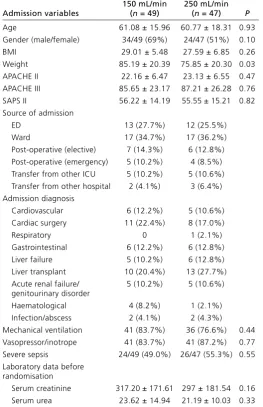
At randomisation, patients were similar with respect to age, sex, severity of illness scores (APACHE II and III; SAPS II), admission source and diagnosis (Table 1). There was a slight weight difference, with patients in the 150 mL/min group being heavier (P = 0.03); however, BMI was similar for both groups. Pre-randomisation renal function was also similar for both groups.
Primary outcomes: solute maintenance
Table 1. Baseline demographic and clinical characteristics*
Admission variables
150 mL/min
(n = 49)
250 mL/min
(n = 47) P
Age 61.08 ± 15.96 60.77 ± 18.31 0.93
Gender (male/female) 34/49 (69%) 24/47 (51%) 0.10
BMI 29.01 ± 5.48 27.59 ± 6.85 0.26
Weight 85.19 ± 20.39 75.85 ± 20.30 0.03
APACHE II 22.16 ± 6.47 23.13 ± 6.55 0.47
APACHE III 85.65 ± 23.17 87.21 ± 26.28 0.76
SAPS II 56.22 ± 14.19 55.55 ± 15.21 0.82
Source of admission
ED 13 (27.7%) 12 (25.5%)
Ward 17 (34.7%) 17 (36.2%)
Post-operative (elective) 7 (14.3%) 6 (12.8%) Post-operative (emergency) 5 (10.2%) 4 (8.5%) Transfer from other ICU 5 (10.2%) 5 (10.6%) Transfer from other hospital 2 (4.1%) 3 (6.4%) Admission diagnosis
Cardiovascular 6 (12.2%) 5 (10.6%) Cardiac surgery 11 (22.4%) 8 (17.0%)
Respiratory 0 1 (2.1%)
Gastrointestinal 6 (12.2%) 6 (12.8%)
Liver failure 5 (10.2%) 6 (12.8%)
Liver transplant 10 (20.4%) 13 (27.7%) Acute renal failure/
genitourinary disorder
5 (10.2%) 5 (10.6%)
Haematological 4 (8.2%) 1 (2.1%)
Infection/abscess 2 (4.1%) 2 (4.3%) Mechanical ventilation 41 (83.7%) 36 (76.6%) 0.44 Vasopressor/inotrope 41 (83.7%) 41 (87.2%) 0.77 Severe sepsis 24/49 (49.0%) 26/47 (55.3%) 0.55 Laboratory data before
randomisation
Serum creatinine 317.20 ± 171.61 297 ± 181.54 0.16 Serum urea 23.62 ± 14.94 21.19 ± 10.03 0.33
APACHE = Acute Physiology and Chronic Health Evaluation. BMI = body mass index. ED = emergency department. ICU = intensive care unit. SAPS = Simplifi ed Acute Physiology Score. * Independent t test and 2 test.
Table 2. Continuous renal replacement therapy treatment times and solute levels
150 mL/min 250 mL/min
CVVH CVVHDF CVVH CVVHDF
12-hour time periods 169 252 261 172
Total treatment time (hours) 1527.7 2313 2331.3 1573.5
Hours of treatment (12-hour periods); mean (SD) 6.3 (3.7) 6.7 (3.9)
Urea level, mmol/L
T1 (0500–1700); mean (SD) 15.7 (7.6) 16.7 (8.7) 13.2 (5.9) 13.1 (6.2)
T2 (1700–0500); mean (SD) 15.2 (7.5) 16.4 (7.7) 12.7 (5.2) 13.4 (6.1)
Creatinine level, µmol/L
T1 (0500–1700); mean (SD) 217.0 (127.3) 226.7 (152.7) 167.8 (82.8) 209.1 (126.2)
T2 (1700–0500); mean (SD) 218.3 (144.9) 216.6 (118.8) 165.0 (87.1) 202.3 (102.9)
CVVH = continuous venovenous haemofi ltration. CVVHDF = continuous venovenous haemodiafi ltration. min = minute. SD = standard deviation
2). The median number of 12-hour periods per patient was also similar for both groups (150 mL/min; 6; IQR, 4–12; v 250 mL/min; 7; IQR, 4.5–12; P = 0.4).
Blood plasma concentrations of urea and creatinine were similar for time interval (T1 and T2), BFR and modality (Table 2). Linear regression analysis showed no difference in the change in urea and creatinine concentrations for BFR groups, modality of CRRT, gender, BMI and weight. Repeated measures analysis of variance (ANOVA) revealed no difference between the two BFR groups for change in mean urea concentration (150 mL/min; –0.06%; SD, 0.015; v 250 mL/min; –0.07%; SD, 0.01; P = 0 .42) (Figure 2) or change in mean creatinine concentration (150 mL/ min; –0.05%; SD, 0.01; v 250 mL/min; –0.08%; SD, 0.01; P = 0.18) (Figure 3) There was a signifi cant correlation between the 12-hourly percentage change in the serum concentration of these two small solutes, with decreased haemoglobin levels (150 mL/min; –0.01%; SD, 0.005; P = 0.002; v 250 mL/min; 0.01%; SD, 0.005; P = 0.006) and less hours of CRRT during the 12-hour period (eg, more down time) (150 mL/ min; –0.023%; SD, 0.001; P = 0.000; v 250 mL/min; –0.02%; SD, 0.002; P = 0.001).
Discussion
Key fi ndings
[image:5.595.52.555.557.710.2]Relationship to previous studies
The effi ciency of solute removal in CRRT has been a key focus since it started to be used for treating critically ill patients with AKI.15,16 Foundation studies for small solute removal in CRRT were often unable to report BFR, as this was determined by arterial blood pressure in continuous arteriovenous circuits or as a low fi xed rate (100 mL/min) determined by primitive blood pumps in the fi rst venovenous circuits. These early reports identifi ed that effl uent rates (dialysate or ultrafi ltration rates) were the most important determinants of small solute removal, as the volume of effl uent would approximate the clearance.15,16 Today, despite signifi cant advances in CRRT technology, dosing or solute clearance in CRRT is still expressed as total effl uent volume per weight and unit of time (mL/kg/h),11indicating that other factors may be less important in the clearance of solutes across the semi-permeable membrane.
One aspect of CRRT technology that has changed over time is clinicians prescribing a faster BFR. A recent survey of Australian and New Zealand ICUs indicated a BFR of 150–200 mL/min was the dominant setting; however, faster rates of 200–250 mL/min were now commonplace in the ICUs surveyed.17Observational studies and recent worldwide practice surveys of CRRT also show great variability in practice, from 80 mL/min18 to 350 mL/min.19,20 The prescription of BFR in intermittent haemodialysis (IHD) has long been seen as integral to therapy prescription for dosing (solute removal) in direct relation to dialysate fl ow rates, and is well established and standardised for the treatment of chronic kidney disease with dialysis.21Blood fl ow rates of ≥ 300 mL/min are prescribed typically with matching or higher dialysate fl ow rates (300–500 mL/min) to achieve azotemic control in this group of patients.22,23 One key important difference between IHD and CRRT is the ability to achieve higher BFR during IHD with the use of long term large bore vascular access catheters and arteriovenous
shunts, which both allow high BFR prescriptions aimed at targeted dosing regimens accordingly.
Historically, the prescription of BFR in CRRT has been based on the experience gained from IHD therapies, and a BFR of 200 mL/min has been common without any evidence for this.24,25 However, limiting factors for blood fl ow in CRRT have been the use of short term small bore catheters in haemodynamically unstable patients26 and the machine technology used to pump venous blood through the extracorporeal circuit. Unlike IHD, the setting of BFR in CRRT has been focused towards extracorporeal circuit patency and prevention of premature clotting (eg, < 6 hours) of the circuit.13,19,27 The prescription of faster BFR in recent times may be attributed to improvements in vascular access catheters and machine capability rather than concern for solute clearance.
One retrospective review of 15 patients has examined any association with blood fl ow rates and clearances of urea and creatinine concentrations in CVVHDF.28 Four BFR groupings were audited, with a mean rate of 125 mL/min that ranged between 35 mL/min and 175 mL/min. A comparative fi nding was that a BFR of 135–145 mL/min showed a difference in urea and creatinine concentrations compared with lower BFR ranges in this mode of CRRT. Consistent with our fi ndings, Gilbert and colleagues28 report that differences in change in urea and creatinine concentrations were best predicted by number of hours treated.
[image:6.595.45.286.61.266.2]The acronym CRRT suggests that therapy is continuous and without interruption; however, down time and failure occurs frequently.29 Reasons for interruptions to treatment are clotting, or when the patient requires procedures outside the ICU, or when native assessment of kidney function is trialled.30 In this study, we identifi ed an effective treatment time approximating 50% (6.3 hours and 6.7 hours/12 hours). The delivery therapy time is similar, with previously reported prescription versus delivery data.24-33
Figure 2. Urea change by grouping (repeated measures analysis of variance [ANOVA])
[image:6.595.310.549.63.265.2]Similar to this study, it has also been shown that there is a direct correlation between reduction in hours of treatment and loss of small solute control in critically ill patients.11,29,31 While there has been comparative prescribed versus actual delivered dose and therapy reports, it remains unclear which is the optimal number of CRRT hours per day to maintain small solute control in this group of patients. However, there is recent acknowledgement that clinicians who prescribe CRRT should be aware of the effect of delivery time in comparison to prescribed treatment, and should form an integral quality indicator measure in process reassessment, monitoring, reporting and benchmarking for CRRT.34
Based on the results identifi ed in this study, we suggest that the number of hours of active treatment should be routinely reviewed as a component of practice. This information should be reviewed twice daily and then be considered in the context of solute levels and planned activities that might lead to down time, with CRRT prescriptions altered accordingly.
In this study, we report that low serum haemoglobin levels are an independent variable that affects small solute removal. Patients with lower serum haemoglobin count showed a smaller reduction in serum urea and creatinine levels over a 12-hour period. To our knowledge, this is the fi rst study to report such fi nding.
Strengths and limitations
This randomised controlled trial of 100 patients presents, for the fi rst time, an investigation into the effect of BFR on solute maintenance in two commonly used modes of CRRT. The analysis is based on 7745 hours (> 300 days) of treatment time. This number of patients and treatment time is representative of a tertiary level ICU and provides important fi ndings for current CRRT practice. The study has some limitations. Solute clearance was reported as the percentage change in serum level over time. A direct measurement of serum solute levels and effl uent solute levels would provide a more precise indication of control and represent a closer assessment for clearance. However, we did not measure effl uent biochemistry.
The study was conducted in a single tertiary level ICU, where training and expertise among nurses for their ability to troubleshoot alarm conditions may infl uence delivered time (12 hours) compared with other centres, where circuits may terminate prematurely due to low skill level, or where the delays in reinstitution of therapy may be due to poor training. One further limitation may be the defi ned BFR used in this study. We chose 150 mL/min and 250 mL/min as a result of current intensive care practices. BFRs < 150 mL/ min or > 250 mL/min may have yielded a different fi nding.
Conclusions
A BFR of 250 mL/min does not improve solute clearance compared with a BFR of 150 mL/min in CVVH or CVVHDF. Independent factors that affect solute removal include hours of effective treatment and haemoglobin levels.
Competing interests
None declared.
Author details
Nigel Fealy1,2,3
Leanne Aitken2,4,5,6
Eugene du Toit7
Michael Bailey8
Ian Baldwin1,3
1 Department of Intensive Care Medicine, Austin Hospital, Melbourne, Australia.
2 School of Nursing and Midwifery, Griffith University, Brisbane, Australia.
3 School of Nursing and Midwifery, Deakin University, Melbourne, Australia.
4 Menzies Health Institute Queensland, Griffith University, Brisbane, Australia.
5 Intensive Care Unit, Princess Alexandra Hospital, Brisbane, Australia.
6 School of Health Sciences, City, University of London, London, United Kingdom.
7 School of Medical Science, Griffith University, Gold Coast, Australia.
8 Australian and New Zealand Intensive Care Research Centre, Department of Epidemiology and Preventative Medicine, Melbourne, Australia.
Correspondence: [email protected]
References
1 Hoste EA, Bagshaw SM, Bellomo R, et al. Epidemiology of acute kidney injury in critically ill patients: the multinational
AKI-EPI study. Intensive Care Med 2015; 41: 1411-23.
2 Ostermann M, Chang RW. Acute kidney injury in the intensive
care unit according to RIFLE. Crit Care Med 2007; 35:
1837-43.
3 Uchino S, Kellum JA, Bellomo R, et al. Acute renal failure in critically ill patients: a multinational multicentre study. JAMA
2005; 294: 813-8.
4 Dennen P, Douglas IS, Anderson R. Acute kidney injury in the intensive care unit: an update and primer for the intensivist.
Critical Care Med 2010; 38: 261-75.
5 Prowle JR, Bellomo R. Continuous renal replacement therapy:
recent advance and future research. Nat Rev Nephrol 2010;
6 Bellomo R, Mårtensson J, Lo S, et al. Femoral access and
delivery of continuous renal replacement therapy dose. Blood
Purif 2016; 41: 11-7.
7 Kellum JA, Mehta RL, Angus DC, et al. ADQI workshop: the first international consensus conference on continuous renal
replacement therapy. Kidney Int 2002; 62: 1855-63.
8 Bagshaw SM, Chakravarthi MR, Ricci Z, et al, ADQI Consensus Group. Precision continuous renal replacement therapy and solute control. Blood Purif 2016; 42: 238-47.
9 RENAL Replacement Therapy Study Investigators, Bellomo R, Cass A, Cole L, et al. Intensity of continuous renal replacement therapy in critically ill patients. N Engl J Med 2009; 361: 1627-38.
10 VA/NIH Acute Renal Failure Trial Network, Palevsky PM, Zhang JH, O’Connor TZ, et al. Intensity of renal support in critically ill patients with acute kidney injury. N Engl J Med 2008; 359: 7-20.
11 Lyndon WD, KM, Tolwani AJ. Solute clearance in CRRT:
prescribed dose versus actual delivered dose. Nephrol Dial
Transplant 2012; 27: 952-6.
12 Baldwin I, Baldwin M, Fealy N, et al. Con-current versus counter-current dialysate flow in CVVHD. A comparative study for creatinine and urea removal. Blood Purif 2016; 41: 171-6.
13 Fealy N, Aitken L, du Toit E, et al. Faster blood flow rate does not improve circuit life in continuous renal replacement
therapy: a randomised controlled trial. Crit Care Med 2017;
45: e1018-25.
14 Bellomo R, Ronco C, Kellum JA, et al, Acute Dialysis Quality Initiative workgroup. Acute renal failure — definition, outcome measures, animal models, fluid therapy and information technology needs: the Second International Consensus Conference of the Acute Dialysis Quality Initiative (ADQI) Group. Crit Care 2004; 8: R204-12.
15 Sigler MH, Teehan BP. Solute transport in continuous
hemodialysis: a new treatment for acute renal failure. Kidney
Int 1987; 32: 562-71.
16 Ifediora OC, Teehan BP, Sigler MH. Solute clearance in continuous hemodialysis. A comparison of cuprophane,
polyacrylonitrile, and polysulfone membranes. ASAIO J 1992;
38: M697-701.
17 Fealy N, Aitken L, du Toit E, Baldwin I. Continuous renal replacement therapy: current practice in Australian and New Zealand intensive care units. Crit Care Resusc 2015; 17: 83-91.
18 Uchino S, Toki N, Ohnuma T, et al, Japanese Society for Physicians and Trainees in Intensive Care (JSEPTIC) Clinical Trial Group. Validity of low intensity continuous renal replacement
therapy. Crit Care Med 2013; 41: 2584-91.
19 Dunn WJ, Sriram S. Filter lifespan in critically ill adults receiving continuous renal replacement therapy: the effect of patient
and treatment related variables. Crit Care Resusc 2014; 16:
225-31.
20 Jones SL, Devonald MAJ. How acute kidney injury is investigated and managed in UK intensive care units — a survey of current practice. Nephrol Dial Transplant 2013; 28: 1186-90.
21 National Kidney Foundation. KDOQI clinical practice guideline
for hemodialysis adequacy: 2015 update. Am J Kidney Dis
2015; 66: 885-930.
22 Rocco MV. Chronic hemodialysis therapy in the West. Kidney
Dis (Basel) 2015; 1: 178-86.
23 Albalate M, Pérez-García R, de Sequera P, et al. Is it useful to
increase dialysate flow rate to improve the delivered Kt. BMC
Nephrol 2015; 16: 20.
24 Kox WJ, Rohr U, Waurer H. Practical aspects of renal replacement therapy. Int J Artif Organs 1996; 19: 100-5.
25 Davies H, Leslie G. Maintaining the CRRT circuit: non-anticoagulant alternatives. Australian Crit Care 2006; 19: 133-8.
26 Kim IB, Fealy N, Baldwin I, Bellomo R. Premature circuit clotting due to likely mechanical failure during continuous
renal replacement therapy. Blood Purif 2010; 30: 79-83.
27 Huriaux L, Costille P, Quintard H, et al. Haemodialysis catheters
in the intensive care unit. Anaesth Crit Care Pain Med 2017;
36: 313-9.
28 Gilbert RW. Blood flow effects in continuous venovenous haemodiafiltration on blood urea nitrogen and creatinine reduction. Nephrol Nurs J 2000; 27: 503-6.
29 Uchino S, Fealy N, Baldwin IC et al. Continuous is not continuous: the incidence and impact of circuit “down– time” on uraemic control during continuous veno-venous
haemofiltration. Intensive Care Med 2003; 29: 575-8.
30 Fealy N, Baldwin I, Bellomo R. The effect of circuit “down-time” on uraemic control during continuous veno-venous haemofiltration. Crit Care Resus 2002; 4: 266-70.
31 Ventkataraman R, Kellum JA, Palevsky P. Dosing patterns for continuous renal replacement therapy at a large academic
medical centre in the United States. J Crit Care 2002; 17:
246-50.
32 Ronco C, Bellomo R, Homel P, et al. Effects of different doses in continuous veno-venous haemofiltration on outcomes of
acute renal failure: a prospective randomised trial. Lancet
2000; 356: 26-30.
33 Davies H, Leslie GD, Morgan D. A retrospective review of fluid
balance control in CRRT. Aust Crit Care 2016; http://dx.doi.
org/10.1016/j.aucc.2016.05.004 [Epub ahead of print]
34 Rewa O, Villeneuve PM, Eurich DT, et al. Quality indicators in continuous renal replacement therapy (CRRT) care in critically ill patients: protocol for a systematic review. Syst Rev 2015;

![Figure 2. Urea change by grouping (repeated measures analysis of variance [ANOVA])](https://thumb-us.123doks.com/thumbv2/123dok_us/1372050.90542/6.595.310.549.63.265/figure-change-grouping-repeated-measures-analysis-variance-anova.webp)
