Theses
Thesis/Dissertation Collections
1984
Optimization of a Photographic Shutter by
Minimization of Closing Time Variability
Steven D. Daniels
Follow this and additional works at:
http://scholarworks.rit.edu/theses
This Thesis is brought to you for free and open access by the Thesis/Dissertation Collections at RIT Scholar Works. It has been accepted for inclusion in Theses by an authorized administrator of RIT Scholar Works. For more information, please [email protected].
Recommended Citation
Approved by:
CLOSING
TIM~VARIABILITY
by
Steven D. Daniels
A Thesis Submitted
in
partial Fulfillment
of the
Requirements for the Degree of
MASTER OF SCIENCE
in
MECHANICAL ENGINEERING
Pro f •
Ray C. Johnson
---:(-==T:-:-"h
e
s i
'3.1\d v i
so r)
Prof.
-Prof.
Prof.
-~---,-(Department Head)
D~PARTM~NT
OF MECHANICAL ENGINEERING
COLLEGE OF ENGINEERING
ROCHESTER INSTITUTE OF TECHNOLOGY
ROCHESTER, NEW YORK
CLOSING TIME VARIABILITY
[
______ ---_________________________________ hereby (grant,
jeny) permission to the Wallace Memorial Library, of R.I.T., to
~eproduce my thesis in whole or in part. Any reproduction will
mechanically
driven,
pivoted opening blade and a springdriven,
pivoted closing blade which is releasedby
a magneticholding
coil through an armature lever. The magnitude of theviscous
drag
of air on the closing blade is approximated, and its effect on the travel time(lag
time) of the blade isdetermined to be
insignificant.
A set of equations is derived representing the dynamic performance of thecombination of the closing blade and the armature lever.
These equations are used to
develop
a mathematicalrepresentation of the variation in
lag
time due tomanufacturing tolerances of the parts involved. Then an optimization computer program is devised and utilized which uses an "exhaustive" search technique to locate the minimum
for the variation in
lag
time as a function of fiveindependent variables. A previously written "gradient based" optimization computer program is also employed to minimize variation in
lag
time. The exhaustive program yields a reduction in variation oflag
time of 6 percent while thegradient based program yields a reduction of 2 percent.
The author would like to express his deepest gratitude
to his wife,
Nancy,
and his children, Nicole and Tyler fortheir support and the sacrifices
they
made in order tohelp
complete this work. Without their participation in this
endeavor, this project would not have been completed on time.
A debt is also owed to John 7. Breen for the competetive
stimulus he provided. He was instrumental in the arrangement
of the word processing equipment used, and was generous
enough to provide a much needed quiet place to work when the
going got tough.
Thanks also go out to
Ray
C. Johnson for his guidanceand support as advisor on this project. He helped in the
definition of a manageable thesis objective and provided a
valuable sounding board for ideas. He also was instrumental
in
helping
diagnose last minute problems with comouterprograms.
We are all products of what we aspire to
be,
what weare able to
be,
and what other peoplehelp
us to be.LIST OF FIGURES vi
LIST OF SYMBOLS vii
1. INTRODUCTION 1
2. DESCRIPTION OF SYSTEM 4
3. ANALYTICAL APPROACH TO DYNAMICS
3.1 Calculation of Skin Friction
on
Closing
Blade Due to Air 113.2 Equation
Relating
the Angular Displacementof
Closing
Blade and Armature Lever 173.3 Determination of Disengagement Point 21
3.4 Approximation for
Coupling
of Armature Leverand
Closing
Blade 253.5 Equation of Motion for First Part of Travel.... 23
3.6 Equation of Motion for Second Part of Travel... 33
3.7 Calculation of Moments of Inertia ^4
3.8 Example Calculation of
Closing
Time 384. APPROACHES TO OPTIMIZATION
4.1 The Optimization Problem 42
4.2 Description of Exhaustive Search Method 46
4.3 Description of Gradient Based Search Method.... 51
5. APPLICATION OF OPTIMIZATION PROGRAMS 55
6. RESULTS 58
7. CONCLUSIONS AND RECOMMENDATIONS 59
BIBLIOGRAPHY 62
APPENDIX A: A Program "for
Calculating
the AngularDisplacement of the Armature Lever
Assembly
6**APPENDIX B: A Program for
Calculating
the ApproximatePolar Moment of Inertia of an Irregular
Planar Shape 64
APPENDIX C: A Program for the Minimization of the
Variability
of a Photographic ShutterThrough the Use of an Exhaustive Search
Technique 65
APPENDIX D: Modser Algorithm Program, P519RE 85
APPENDIX E: Special
Programming
for Use with ModserAlgorithm Program 1^4
APPENDIX F: Output from Exhaustive Search Program. Ill
APPENDIX G: Output from Gradient Based Search
Program 112
2.1 Shutter System 5
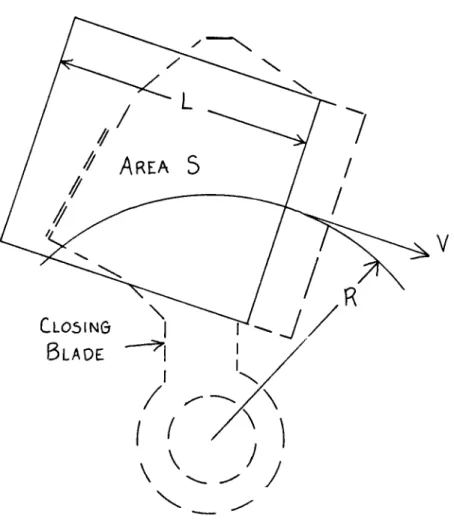
3.1 Approximation Used for Skin Friction Calculation.... 12
3.2
Drag
of Smooth Flat Plate-Skin Friction 13
3.3
Geometry
of Shutter System 193.4 Comparison of Calculated vs. Graphical Values of
Disengagement Angle of
Closing
Bla^e 253.5 Angular Displacement of Armature Lever vs. Angular
Displacement of
Closing
Blade for Various Cam Angles ">J3.5 Method for
Calculating
Polar Moment of Inertia ofIrregular Shapes 36
4.1 Illustration of Scan Se?rch Technique 48
D = Total
skin friction
Cf
=Drag
coefficientS =
Wetted area of plate
p
=Density
V =
Velocity
Re = Reynolds'
Number
L = Length
^
= Dynamicviscosity
Wav = Average angular
velocity
A = Displacement
angle
t = Time
Wmx = Maximum angular
velocity
Vmx = Maximum linear
velocity
R = Radius
V =
Velocity
T = Torque
Tmx = Maximum torque
0
= Angular displacement of the armature lever assembly^
= Angular displacement of theclosing biaH
y = ^iifj
of the cam edge of the closing blade
xo = X dimension of the contact point between the closing
blade and the armature lever
yo = Y dimension of the contact point betwen the closing
blade and the armature lever
Xo = X dimension of the
(xo,
yo) contact point as theclosing blade rotates
X dimension of the closing blade pivot
Y dimension of the closing blade pivot
Angle between the vertical and the line connecting
(xp,
yp) with (xo, yo)Radius between
(xp,
yp) and(xo,
yo)Slope of a straight line
Y axis intercept of a straight line
X dimension of the contact point between the closing
blade and the armature lever
Y dimension of the contact point between the closing
blade and the armature lever
Angle of rotation of the armature lever at which it disengages from the closing blade
Angle of rotation of the closing blade at which it disengages from the armature lever
Mass
Displacement
Damping
coefficientTorsional spring constant
Moment of inertia
Angular displacement of the closing blade
Natural
frequency
Angular displacement of the closing blade and shutter spring as a function of time
Angular displacement of the shutter spring when it is
being
held backby
the armature leverAngular displacement of the shutter spring when the closing blade disengages from the armature lever
IA = Moment of inertia of gear A xp
yp
P
r
M
B
xf
yf
<P
dt
dm
X
b
k
I
6
U)
d(t)
6(0)
6(d)
pdB = Pitch diameter
of gear B
&A
= Angular displacementof gear A.
Ieq
= Equivalentmoment of inertia
Icb = Moment
of inertia of the closing blade
Ial = Moment of inertia of the armature lever
fl(t)=
Angular velocity of theclosing blade as a function of
time
i7(d)
= Angularvelocity of the closing blade when it
disengages from the armature lever
0(h)= Angular displacement of the shutter spring when the
closing blade is covering half of the aperture
In the design of a photographic system, one of the most important considerations is the shutter, the device
by
whichcontrol is exercised on the amount of light energy which reaches the film. When an exposure is made, the shutter is
required to open, allowing light to reach the
film,
and thenclose at the proper time to achieve the desired exposure.
The shutter must close in such a way that it prevents any
light from reaching the
film,
for even a small amount oflight can cause an exposure over
long
periods of time whilethe camera is not in use.
The shutter has taken on many forms throughout the
history
of photography. Some of the earliest camerasrequired the operator to remove a lens cover to begin the
exposure and to replace it when he judged that the exposure
was completed. In contrast,
today
military pilots areequipped with electronic shutters built into their helmet
visors which protect them from
being
blindedby
the flashfrom a nuclear explosion. These shutters are made from
lanthanum-modified lead zircoate titanate crystals, and can
go from translucent to opaque in 85 microseconds. The
familiar amateur cameras available to the consumer
today
usevarying
curtains. Impact shutters consist of a single pivoted
shutter blade which covers a small aperture near the lens.
The blade is driven to an open position
by
the impact ofanother part, and it is returned to the closed position
by
aspring. This type is usually found in inexpensive cameras
and has a fixed shutter speed.
The cameras that use the impact type of shutter are
still able to produce acceptable photographs because the film
they
use is able to record an image at a wide range of lightlevels. With the introduction in recent years of new films
which require a much more precise exposure, it has become
necessary to produce inexpensive cameras which control
shutter speeds accurately. One of the ways this has been
accomplished is with a shutter design of the type considered
in this paper. It consists of two shutter blades, called an
"opening
blade" and a"closing blade",
which rotate about thesame pivot and are held in contact edge-to-edge
by
a torsionspring.
Normally
the opening blade covers a small aperturenear the camera lens. When an exposure is made, an
electromagnetic
"holding
coil"
is energized, which holds back
the closing
blade,
while the opening blade is mechanicallydriven to an open position and trapped there. At the same
time,
an electronic sensor isintegrating
the light from theThe exposure times for this type of system are often
shorter than the
lag
time of the closing blade.Lag
time isdefined as the time required for the closing blade to move
from rest to the half closed position. Because the
lag
timeis actually longer than some of the exposure
times,
theelectronic sensor must anticipate the
lag
time and include itwhen making a decision about when to close.
Consequently,
variations in
lag
time from that designed into theelectronics will cause errors in exposure. This necessitates
an adjustment to the camera
during
manufacturing. Thelag
time is measured and, if
incorrect,
the shutter spring, thatis the torsion spring which holds the blades
together,
ismoved to a different anchor position. Then the
lag
time mustbe remeasured to confirm performance. If the variations in
lag
time could be reduced, the costly process of adjustmentand remeasuring would also be reduced. The optimization
objective of this study is to minimize the variation in
lag
The shutter system to be considered consists of an
opening
blade,
a closingblade,
a shutter spring, an armaturelever assembly, and a magnetic
holding
coil. Figure 2.1ashows the system in the initial covered aperture position.
The opening blade covers the aperture and the shutter spring
is only
lightly
loaded. In Figure 2.1b the opening blade hasbeen driven to its open position
by
the upward movement of anopening lever which protrudes through a slot in the plane
supporting the shutter blades. Before the opening lever
moves upward, the magnetic
holding
coil is energized andprevents the armature lever assembly from rotating
counterclockwise. This in turn prevents the closing blade
from rotating clockwise
by
creating an interference betweenthe follower on the armature lever and the cam edge on the
closing blade. With the blades in this position, the shutter
spring is
fully
loaded,
and is urging the closing bladeclockwise. When the exposure is complete, the magnetic
holding
coil is deenergized and the closing blade is allowedto rotate clockwise to the position shown in Figure
2.1c,
covering the aperture. To complete the cycle, the opening
lever moves downward, rotating the two blades back to the
normal positon.
Armature
Magnetic
Holding
Coil
Openimg
LEVEf?
H
Armatuhe lever
OLUOWER
Cam
Edoe
Opening-"Blade
2.
Id
Covered
Aperture
Position
Before
Exposure:
Armature*
magnetic
Holding
Coil
sOpening
Lever
Armature
Lever
Follower
Cam
Eqqe
2.1b
Opem
Aperature
P05ITION
Armature Lever
MAGNETIC
HOLDiMG
COil_\
Armatures
Open
ikgLever
Closinc-Blade
2.
1
c
Covered
Aperture
Position After
opening
progressive punch-and-die from 0.008 inch thick cold rolled,
hard
tempered,
type 301 stainless steel. The thickness andthe hardness of the material are necessary to withstand
repeated impacts with the opening lever and the closing
blade. The closing blade is also a punch-press part, but it
is made of cold rolled, half hard
tempered,
301 stainlesssteel, and is 0.005 inches thick. The softer material is
required to produce a number of forms in the part with sharp
bend radii. Both blades are required to complete their
travel in 4 to 5 milliseconds, so their moments of inertia
must be minimized. The opening blade is moved
by
the openinglever,
which is propelledby
a strong spring, and which has arelatively high momentum when it strikes the blade. The
closing blade is moved
by
a relatively weak shutter spring,so its moment of inertia must be lower than that of the
opening blade to achieve the necessary travel times. Hence,
it is made of thinner material than the opening blade.
The shutter spring is a one-turn torsion spring made
from a 0.012 inch diameter hardened stainless steel wire.
The single turn is dictated
by
space limitations in thecamera, and the wire size is a result of design optimization
to produce the torques needed, the angular displacements of
the parts, and the lowest spring rate possible. The armature
glass fill for rigidity and the PTFE for lubricity. Attached
to the armature lever is the armature. It consists of a
50 percent nickel and 50 percent iron alloy in a powdered
form which has been pressed in a mold and sintered. This
material was chosen for its high magnetic permeability,
attaining a maximum
holding
force from the magnetic coil witha minimum mass armature.
There are a number of parameters which will influence
lag
time ifthey
are varied. Some of these parameters aresubject to control through design or through the
manufacturing process and some are not. Control cannot be
effectively exercised over the frictional forces.
Hence,
materials, processes, and coatings are used which will
minimize the coefficient of friction between contacting
surfaces. Both of the shutter blades slide on a surface
consisting of glass-filled polystyrene. To reduce friction
at this interface the blades are painted with a low friction
paint. The follower on the armature lever assembly slides on
the cam edge of the closing blade as the blade is
being
released. The PTFE fill in the plastic armature lever
reduces friction at this point. Friction at the pivot for
the shutter blades is minimized
by
molding the pivot fromacetal copolymer, a thermoplastic with high
lubricity
andmanufacturing process. The moment of inertia of the closing
blade will vary
directly
with the variation in the thicknessof the metal it is made from. The thickness of the paint on
the blade is assumed to be insignificant because its
density
is much less than that of the metal. Variations in the
densities of the metal and the paint are also assumed to be
insignificant. Because of the punch-press process
by
whichit is made, changes in moment of inertia due to changes in
the other two dimensions of the blade will be very small and
are assumed insignificant.
The moment of inertia of the armature lever assembly is
a combination of the properties of the armature lever and the
armature. The armature lever is injection molded from
polycarbonate, and therefore has excellent repeatability in
its
dimensions,
as does the sintered armature. Variations inthe
density
of the polycarbonate are assumed small enough tobe ignored. The
density
of the sintered part is known tovary considerably and it is located far from the pivot,
making it the only significant influence on the moment of
inertia of the armature lever assembly.
The torsional spring constant and the windup angle of
the shutter spring are also parameters that will vary
significantly. Both of these will change due to variations
the spring wire used. Variations will also result from the
set-up of the spring winding machines and from the stress
relief treatment the springs receive.
A parameter which does not vary significantly
during
themanufacturing process but which is available for design
changes is the angle of the cam edge of the closing blade
where it contacts the follower on the armature lever.
Because the part is made on a progressive punch-and-die, the
angle of the cam edge is assumed not to vary. However,
design changes made to this angle will have a significant
effect on
lag
time,
because it affects the relationshipbetween the angular acceleration of the armature lever and
the angular acceleration of the closing blade.
In summary, variations in the
following
five designrelated parameters are considered most significant for
affecting the variation of
lag
time for the closing blade.1. Thickness of the closing blade.
2.
Density
of the sintered armature.3. Torsional spring constant of the shutter spring.
4.
Windup
angle of the shutter spring.5. Angle of the cam edge on the closing blade.
The effect of variations in these parameters will be
considered in what
follows,
as related to variation inlag
CHAPTER 3
ANALYTICAL APPROACH TO DYNAMICS
3. 1 Calculation of Skin Friction on
Closing
Blade Due to AirOne item of interest in the study of the variability in
lag
time is whether there is a significant friction forcefrom the viscous
drag
of air on the closing blade. In aneffort to gauge the order of magnitude of such forces in this
system, a worst-case approximate calculation is carried out.
The analysis will be made on the approximate geometry of
figure 3.1.
Reference
1,
pp137,
gives equations and charts whichrepresent the
drag
forces on a rectangular plate as it ismoved edgewise through a viscous medium. The
drag
force isgiven
by
equation 3.1.1.D =
Cf
Sp
V*/2(3.1.1)
In this equation, D is the total skin friction
drag
inlbf,
C. is the
drag
coefficient, which is unitless, S is thewetted area of the plate in sq-ft,
p
is thedensity
of thefluid in slugs/cu-ft, and V is the velocity of the plate in
ft/sec. The
drag
coefficient is givenby
the chart shown infigure
3.2,
taken from reference1,
pp 137. It is shown as afunction of
Reynolds'
Number, which is given
by
equation3.1.2.
Re =
p
V L/
/a.(3.1.2)
In this equation, Re is the
Reynolds'
Figure
3.
1
Approximations
used
for
Skin
Friction
Calculation
Figure
3.2
Drag-
ofSmooth
Flat
Plate
-5kin
Friction
Reference
1,
pp
137.
0.009
0.008
0.007
0.006
0.005
0.004
0.003
0.002
0.001
0
\ 1
7TT ;i
i
! :X
! \
|
'i.i, . . .',\
1
:i
_ -. ..
1
~ :
-";>-
&</
I
\v<
&Kj>
DECREASING^vr.
\f$\RM$h
1
1 57"-^
EXTERNAL TURBULENCE
I
_Ill
104 105 106 107
REYNOLDS'
NUMBER=
unitless, L is the total length of the plate in the direction
of flow in
ft,
and ^i is the dynamic viscosity of the fluidin slug/ft-sec.
To calculate the
drag
force,
some assumptions had to bemade to determine a worst-case approximation for velocity V.
Assuming
that there is information available about the timerequired for the closing blade to complete its travel, from
elementary mechanics we have equation 3.1.3 for the average
angular velocity of the closing blade.
Wav = A
/
t(3.1.3)
In this equation, Wav is the average angular velocity in
degrees/sec,
A is the displacement angle indegrees,
and t isthe elapsed time for that displacement in seconds.
Assuming
that the angular acceleration of the closing blade is
constant, so that the angular velocity changes
linearly,
andthat the closing blade starts from rest, we have equation
3.1.4 from elementary mechanics.
Wmx = 2 Wav
(3.1.4)
In this equation, Wmx is the maximum angular velocity reached
in deg/sec. To convert from angular velocity to linear
velocity we have equation 3.1.5 from elementary mechanics.
Vmx = Wmx R
(TT/180)
(3.1.5)
In this equation, Vmx is the maximum instantaneous linear
velocity in the tangential direction in ft/sec of a point
located a radius R ft from the center of rotation.
Combining
for the worst-case velocity V to use in
determining
drag
forces.
V =
A R rr
/
90 t(3.1.6)
Assuming
that the closing blade travels 64 degrees froma rest position in a time of 0.004 seconds, we can calculate
a worst-case velocity from the above equation. (The
analytical justification for this assumption can be found in
section
3.8)
The earlier assumption of constant angularacceleration is conservative because the closing blade is
driven
by
a torsion spring with alinearly decreasing
torque.A constant angular acceleration would require a constant
torque,
so the actual maximum angular velocity reachedby
theclosing blade will be lower than the approximation. The
radius to be used is that of a point
halfway
along theleading
edge of the large section of the shutter blade whichcovers the aperture, as shown in figure 3.1. This radius is
chosen to represent the average speed of the large section,
and its value is R = 3.724 E-2 ft.
Substituting
the abovevalues for A, t, and V into equation 3.1.6 we get velocity V
= 20.80 ft/sec.
Reference
1,
pp65,
was used to find that fordry
air at59F and 14.7 psi the
density
f> is 2.378 E-3 slugs/cu-ft andthe dynamic viscosity ju is 3.73 E-7 slugs/ft-sec. An
approximate value for L was determined
by
using the largestdimension of the closing blade in a direction approximately
:or
dimension occurs at
approximately
the radius used above fcthe velocity V.
Substituting
the values from above forp
,V,
L,
and juinto equation 3.1.2 we obtain a Reynolds' Number of
Re = 5.526
E3.
Using
this number on the graph in figure 3.2we see that it is below the range of values given for
Reynolds'
Number.
Looking
at the range of values given inthe graph for the
drag
coefficientCf
, it is assumed thatthe choice of a
drag
coefficient of .50 would be reasonablyconservative, since it is 50 times as large as the largest
drag
coefficient on the graph.A value for
S,
the wetted area, is approximatedby
multiplying together the two largest dimensions of the
section of the closing blade that covers the aperture, and
multiplying
by
two for the two sides. The value obtained forwetted area S = 3.20 E-3 sq-ft.
Using
the above values forC, , p ,
V,
and S in equation 3.1.1 gives a value fordrag
force of D = 8.255 E-4 lbf.
Assuming
this force is appliedat the radius R, from elementary mechanics the torque exerted
on the closing blade would be given
by
equation 3.1.7.T = D R
(3.1.7)
In this equation T is the torque in ft-lbf.
Substituting
thevalues for D and R into equation 3.1.7 gives a torque of
T = 3.063 E-5 ft-lbf. The shutter spring that drives the
closing blade has a maximum torque of Tmx
= 2.465 E-3 ft-lbf.
value of 1.2 percent. Since all the approximations that went
into the analysis were conservative of the
drag
forces,
andsince the
resulting
torque is so low compared to the othertorque
driving
the closingblade,
it is concluded that thefriction due to the viscous
drag
of air can be ignored in thestudy of variations in
lag
time.3. 2 Equation
Relating
the Angular Displacement ofClosing
Blade and Armature Lever
In order to write the dynamic equations for the system,
the travel of the closing blade in figure 2.1 is divided into
two parts.
During
the first part of travel the closing bladecam edge is pushing on the follower from the armature lever
to rotate it counterclockwise. The shutter spring is
accelerating both the closing blade and the armature lever
assembly
during
this period. The second part of travelbegins when the armature lever has disengaged from the
closing blade. The shutter spring now accelerates only the
closing blade.
To analyze the first part of travel, it is necessary to
derive an equation which describes the angular displacement
of the armature lever as a function of the angular
displacement of the closing blade. Since the angle of the
cam edge on the closing blade was identified earlier as a
useful parameter for adjusting the closing
time,
this angleobjective of this section is to derive an equation in the
form of equation 3.2.1.
<fi = f
( T
,Y)
(3.2.1)
In this equation, <j> is the angular displacement of the
armature lever assembly in the counterclockwise
direction,
F
is the angular displacement of the closing blade in theclockwise
direction,
andY
is the angle between thehorizontal and the cam edge of the closing blade when it is
being
held backby
the armature lever.In figure
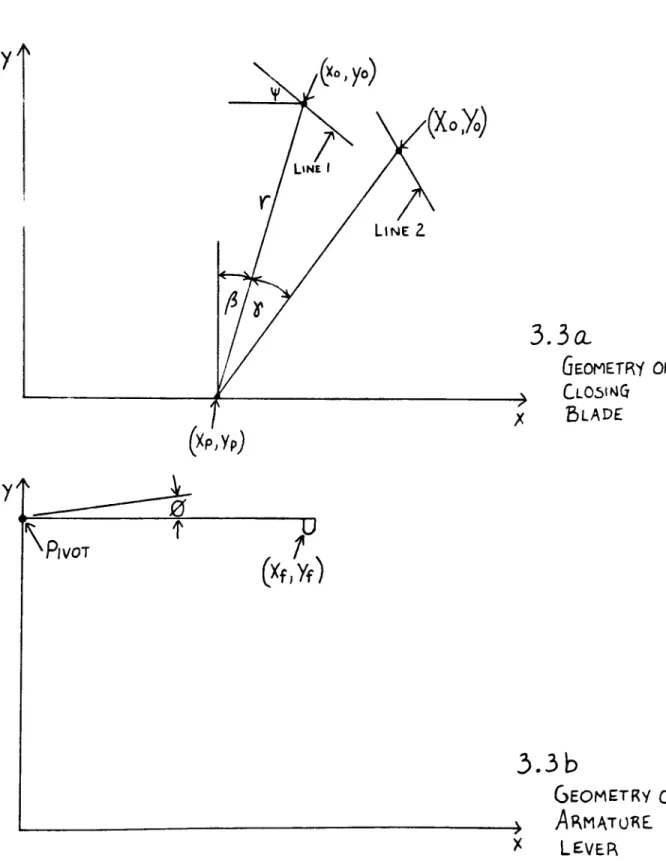
3.3a,
line 1 represents the cam edge of theshutter blade when it is
being
held backby
the armaturelever. Line 2 represents the cam edge of the shutter blade
as it rotates clockwise
by
an angle^
. The point ofcontact between the closing blade cam and the follower on the
armature lever is represented
by
the coordinates(xo,
yo) . Asthe blade rotates, that point moves and becomes
(Xo,
Yo)
online 2. Changes in angle
Y
cause line 1 to rotate aboutthe point
(xo,
yo) and line 2 to rotate about the point(Xo,
Yo)
. It is assumed that the actual changes in the pointof contact on the follower due to its circular shape are
small enough to be ignored. Coordinates
(xp,
yp) representthe location of the shutter blade pivot, and it is assumed
that yp = 0. The angle
fi
represents the angle between thevertical and the line connecting
(xp,
yp) with(xo,
yo) , andis given
by
equation 3.2.2 from elementarygeometry-ft
= arctan|(xo
Figure
3.3
Geometry
of
Shutter System
3.3a.
Geometry
ofClosing
x
Blade
3.3b
Geometry
of_>
Mmature
The radius from
(xp,
yp) to(xo,
yo) is representedby
r, andis given
by
equation 3.2.3 from the Pythagorean theorem.r =
y(xo
- xp)2+ yo2
(3.2.3)
Coordinate Xo is given
by
xp plus the product of r and thesine of the sum of angles
ft
and <T , given in equation3.2.4.
Xo =
xp + r sin(
fi
+ <T)
(3.2.4)
Coordinate Yo is given
by
the product of r and the cosine ofthe sum of angles j3 and
^
, given in equation 3.2.5.Yo =
r cos
(
fi
+t
)
(3.2.5)
The slope M of line 2 is given
by
the negative of the tangentof the sum of angles
Y
and <T in equation 3.2.6.M = -tan
( Y
+T
)
(3.2.6)
To find the equation for
B,
the y-axis intercept ofline
2,
the line equation is rearranged and the coordinates(Xo. Yo) are subsituted
in,
to give equation 3.2.7.B=Yo-MXo
(3.2.7)
Substituting
in the values of Yo, M, and Xo from equations3.2.5,
3.2.6,
and 3.2.4 we get equation 3.2.8 for B as afunction of
T
andY
.B = r cos(y+^) + tan(r +
n(xp
+ r sin(/3 +^))
(3.2.8)
where:
/$
= arctan((xo
-xp)
/
yo]
(3.2.2)
r =
/(xo
-xp)2
+ yo2
(3.2.3)
Using
the form y = M x + B and substituting equations 3.2.7and 3.2.8 for B and M gives equation 3.2.9 for line 2 as a
where:
y =
x tan(-(f +
JT))
+ r cos(/S+<T) +tan( f
+ JT)
(xp
+ r sin(/5 + JP ))
(3.2.9)
/* = arctan
[(xo
-xp)
/
yo]
(3.2.2)
r =
/(xo
-xp)2
+ yo2
(3.2.3)
In order to reduce equation 3.2.9 to a more manageable
form,
dimensions from the shutter mechanism will now besubstituted into it. These dimensions are in millimeters,
but since the final equation will be strictly a relationship
between angles, the linear units will
drop
out. Thefollowing
dimensions are to be substituted in.= 15.62
mm yo = 16.49 mm
xp = 10.7 mm
yp = 0.0 mm
Substituting
these values into equation 3.2.9 gives equation3.2.10 for line 2 as a function of
P
andY
.y = x tan(-( V+
J1)
+ 17.21 cos(
^
+16.61)
+tan( Y +
IT)
(10.7 + 17.21 sin (* +15.95) )(3.2.10)
Since we now have an equation for y as a function of
angles
T
andY
, we need an expression for <p as afunction of x and y. Figure 3.3b illustrates the geometric
relationship between the pivot and the follower on the
armature lever. The coordinate axes are located in the
same place relative to the shutter mechanism as
they
werein figure
3.3a,
so the dimensions are compatible. The factthat the contact point
(xf,
yf) of the follower is verynearly at the same y dimension as the pivot, coupled with the
disengages from the
closing
blade,
leads to somesimplifications. The path of the contact point
(xf,
yf) ofthe follower is approximated
by
assuming that it follows a
straight vertical line for the 6 degree
travel we are
interested
in.
The equation for this line is givenby
equation 3.2.11.
x = xf
(3.2.11)
It is also assumed that the pivot has exactly the same y
dimension as the contact point. The displacement angle of
the armature lever then is given
by
equation 3.2.12.jzi = arctan
(y
-yf)
/
xf(3.2.12)
To simplify this expression, the
following
dimensions fromthe shutter mechanism will be substituted.
xf= 15.62 mm yf =16. 49 mm
These values are the same as the previous xo and yo because
these points are in contact when the closing blade is
being
held back
by
the armature lever.Substituting
these valuesinto equation 3.2.12 gives equation 3.2.13 for the rotation
angle of the armature lever as a function of y.
0
= arctan(y
-16.49)
/
15.62(3.2.13)
Equation 3.2.11 can now be substituted for x into equation
3.2.9. Then equation 3.2.9 can be substituted into equation 3.2.13 to give equation 3.2.14.
0
= arctan[(1/15.
62)
{l
5. 62 tan(-(
P
+Y )
)+17.21 cos(^+16.61)
+
[tan
(6 +Y)]
[id.
1+11.21 sin(
t
+16.6.1)]
-16.49}
]
(3.2.14)
armature lever as a function of the angular displacement of
the closing blade and the cam angle of the closing blade.
This equation will be used in later sections in the
derivation of the dynamic equations for the closing blade.
3. 3 Determination of Disengagement Point
In the dynamic equations for the closing blade travel,
it is necessary to know the angle of closing blade travel at
which the armature lever disengages from the closing blade.
The effective moment of inertia of the closing blade and
armature lever together is much greater than that of the
closing blade alone, so there will be a significant change in
the angular acceleration at this point. The angle of
rotation of the armature lever 0d at which it disengages
will remain fixed because it is limited
by
the geometry ofother parts. As the cam angle
Y
is changed, the angle ofrotation of the closing blade required to reach the
disengagement point will change. As the cam angle
increases,
the armature lever follower will be pushed upward more
rapidly, so the disengagement angle
^d
will decrease. Theconverse is also true.
In order to determine the disengagement angle for any
value of cam angle
Y
, equation 3.2.14 must be solved forthe closing blade travel
<5.
Upon inspection of theequation it was concluded that putting it in an explicit form
Therefore,
aroot-finding
method was used in all subsequentcalculations.
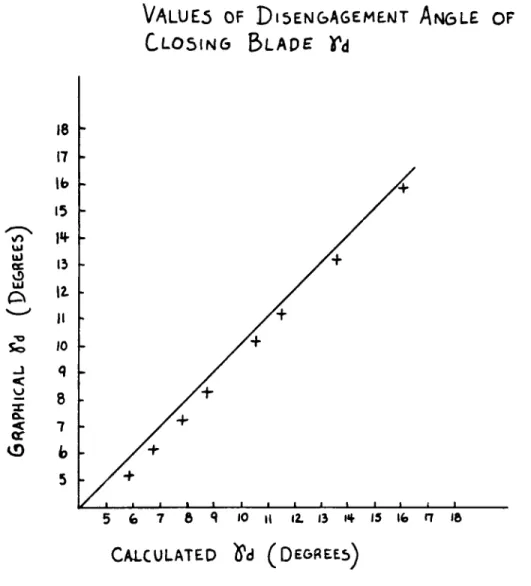
A program was written for an HP-41CV calculator and the
disengagement
angle)fd
was determined for 0d = 6 degreesand for several different values of cam angle
Y
. A flowchart of the program can be found in Appendix A. The same
cases were done
by laying
out the parts on adrawing
boardand
finding
a graphical solution. The comparison of thecalculated values with the graphical values for disengagement
angle <^d are shown in figure 3.4. There is a consistent
disagreement between the two methods of about 0.5
degrees,
which is assumed to be due to the inherent
inaccuracy
of alayout and the bias of the
drafting
machine used.3.4 Approximation for
Coupling
of Armature Lever andClosing
Blade
During
the first part of shutter bladetravel,
theangular displacements of the closing blade and armature lever
assembly are coupled together. For the purposes of later
calculations, it is desirable that there be a direct ratio
between the angular displacements of these two parts. If,
for example, the angular displacement of the armature lever
is always one half that of the closing
blade,
then theangular velocity of the armature lever will always be one
half that of the closing blade.
Similarly,
the angularFigure 3.
M-Comparison
of
Calculated
vs.Graphical
VALUE5
OFDi5ENGA6EMENIT
AN6LE
OFClosing
Blade
Yd
UJ oc
UJ
So
<
a.
<
or
5 6 7 8 9 10 n 12. 13 1* IS It a 18
that of the
closing
blade.
Thisonly holds true if the
relationship between
the angular displacements of the twoparts is
linear.
A good example is that of two gears ofdifferent pitch
diameter
meshed together. Their angulardisplacements,
angular velocities, and angular accelerationsare all linked
by
the sameratio.
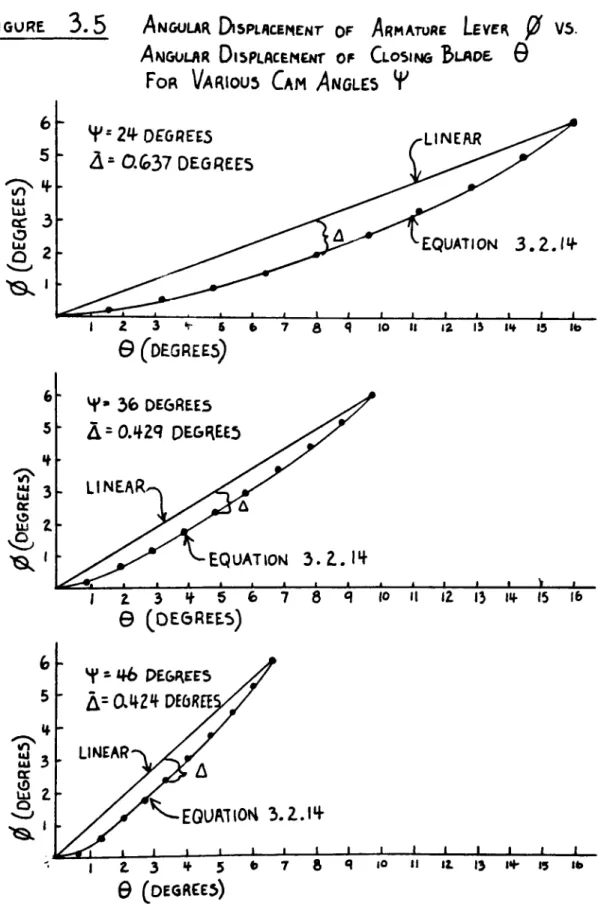
Figure 3.5 shows the angular displacement of the closing
blade versus that of the armature lever assembly for three
values of cam angle Y . The cam angles of 24 degrees and
46 degrees represent the lower and upper extremes possible
based on the geometry of the system. The 36 degree cam angle
is approximately the middle value. It can be seen that the
relationship between the angular displacements of the closing
blade and the armature lever calculated
by
equation 3.2.14are not linear. The straight lines on each graph represent a
linear approximation to the relationship between the angular
displacements. The ratio used for the straight lines is the
ratio between the total angular displacements of the two
parts at the disengagement point.
In order to evaluate the error that would be introduced
by
using the linear approximation, the error in armaturelever angular displacement <j) was calculated at each of ten
equally spaced locations along the curves. These errors were
then averaged for each case, and the averages were divided
by
the mean value for </> , which is 3 degrees. The relative
Figure
3.5
6
5
-^*
1X1
LU ,
a:
3
o
Q 2
^-^
^
in"
2
zo
^
5
?
ui 3
or
^Sl
/ANGULAR
DlSPLflCENENT
OFARMATURE
LeVC*
^
VS.Angular
Displacement
ofClosing
Blade
9
For
Various Cam Angles V
y--2f
degrees
A
=0.637
DEGREES
8 q 10 II 12 13 <<f 13 lb
0
(degrees)
36
DEGREESA
=0.429D&&R&E5
LINEAR
EQUATION
3.2.IYJ 3*56781
9
(DEGREES)
^
s46DEGREES
&=
CX42f DE6KE
j i L
to il IZ 13 if 15 16
LINEAR
EQUATION,
3.2.IM-j i 1 u J I I L J L
I t 3 io n it 13
if-15 lb
21.2 percent for cam angle
Y
=24degrees,
14.3 percent forY
= 36degrees,
and 14.1 percent forY
= 46 degrees.The
following
observations aremade regarding the use of the
linear approximation to the
angular displacement.
1. The errors in angular
displacement,
and thereforeangular acceleration, occur over a small percentage of
the total travel.
2. The linear approximation used agrees exactly with the
actual angular displacement at the disengagement
point, which is a critical point for later
calculations.
3. The objective of the study is to model the variation
in
lag
time,
rather than the absolutelag
time.These facts constitute a reasonable
justification
for theuse of the linear approximation in later calculations.
3.5 Equation of Motion for First Part of Travel
The first part of travel of the closing blade is defined
as the travel from the position where it is
being
held backby
the armature lever to the position where it disengagesfrom the armature lever.
During
this travel the shutterspring is accelerating both the closing blade and the
armature lever assembly. Since friction forces are not known
and are relatively small,
they
will be assumed to benegligible.
for a mass, spring, and damper
system with linear travel and
no
driving
function
is givenby
equation 3.5.1.m d*_x +bdx+kx=0
(3.5.1)
dt* dt
In this equation, m is the mass, x is the
displacement,
t isthe
time,
b is thedamping
coefficient, and k is the springconstant. Each term represents a
force,
and the sum of theforces equals zero.
To use this equation for shutter blade travel, the term
for
damping
forces is assumed to be relatively small, and theequation is rewritten in terms of rotary motion, giving
equation 3.5.2.
I
d^0_
+ kO = 0(3.5.2)
dt*
In this equation, I is the moment of
inertia,
6
is theangular
displacement,
t is the time, and k is the torsionalspring constant. Each term represents a torque, and the sum
of the torques equals zero.
To solve this differential equation we first rearrange
it,
giving equation 3.5.3.d*0 + k6 = 0
(3.5.3)
dt2 I
Letting
= k/I we get equation 3.5.4.d26 +u26 = 0 (3.5.4)
dt*
The characteristic equation for this is given
by
equationr2
+ W*
=0
(3.5.5)
In this equation r is a
dummy
variable.By
inspection thei -
Z"1*
The solution to equation 3.5.4 is therefore given
by
equation3.5.6.
0(t)
=c,
exp(iwt) + c2 exp(-i^t)(3.5.6)
In order to convert this expression from complex form to real
form we use Euler's relations from reference
2,
pp 64.exp(ibx) =
cos bx + i sin bx (3.5.7)
exp(-ibx) = cos bx - i
sin bx
(3.5.8)
Applying
equations 3.5.7 and 3.5.8 to equation 3.5.5 givesequation 3.5.9.
0(t)=ct
(coswt + i sinwt) + c2(coswt - isinut)
(3.5.9)
Rearranging
this equation we get equation 3.5.10.0(t)
=(c,+c2)
cos uj t + i (c,-c2) sinwt(3.5.10)
If we let
C,
=c, + c2 and
C2
= i(c,
-c2 ) , we can write
the solution to equation 3.5.4 in the form of equation
3.5.11.
@(t)
=C,
coswt + C2sina;t(3.5.11)
The initial conditions on this problem are that the
angular velocity equals zero and the angular displacement is
known,
and is designated0(0).
If we write equation 3.5.11at time t = 0
, we get equation 3.5.12.
0(0)
=C,
cosw0 +C2
sinw0 (3.5.12^Solving
this forC,
we get C =0(0)
.Differentiating equation 3.5.11 and writing it for time t = 0
gives equation 3.5.13.
0 = -
0(0)
WsinW0 +Cz
wcosy0(3.5.13)
The angular
displacement
as a functionof time for the
closing blade is given
by
the complete solution, equation3.5.14.
0(t)
=0(0)
coso/t(3.5.14)
Turning
our attention to w , we recall from equation3.5.4 that we set u)1
= k/I
. The moment of inertia in effect
during
the first part of travel is the moment of inertia ofthe closing blade combined with that of the armature lever
assembly. It was stated in section 3.4 that the angular
acceleration of the closing blade and the angular
acceleration of the armature lever assembly would be assumed
to be related
by
a ratio. The first term in equation 3.5.2is the product of the moment if inertia and the angular
acceleration. Since that term is
linear,
the ratio betweenthe angular accelerations can be applied to the moment of
inertia of the armature lever assembly and achieve the same
result.
For example, gear A and gear B are meshed together and
gear A has a larger pitch diameter and a larger moment of
inertia than gear B. For the purpose of writing the dynamic
equation, gear B may be treated as if it has the same pitch
diameter,
and therefore the same angular acceleration, asgear A if the moment of inertia of gear B is multiplied
by
the ratio of the pitch diameters, pdB/pdA. The equation for
undamped motion for the two gears can be written as shown in
[iA
+ IB(pdB/pdA)]
d2
(
6
A)
+k(
0A)
= 0(3.5.15)
Jt*In this equation, IA is the moment of inertia of gear
A,
IBis the moment of
inertia
of gearB,
pdA is the pitch diameterof gear
A,
pdB is the pitch diameter of gear B, and0A
isthe angular displacement of gear A. The term in square
brackets in equation 3.5.15 will be called the "equivalent
moment of
interia",
Ieq.In a similar manner, an equation may be written for an
equivalent moment of inertia for the closing blade and
armature lever assembly. The moments of inertia of the
closing blade and the armature lever assembly are equated to
the moments of inertia of gears A and B. The ratio of
angular displacements of the closing blade and the armature
lever
(
^
d/
^d)
is equated to the ratio of pitch diameters ofgears A and B
(pdB/pdA)
, giving equation 3.5.16 for theequivalent moment of inertia.
Ieq
= Icb + lal(*d//d)(3.5.16)
In this equation, Icb is the moment of inertia of the closing
blade,
Ial is the moment of inertia of the armature leverassembly, <f> d is the angular displacement of the armature
lever assembly at disengagement, and
^d
is the angulardisplacement of the closing blade at disengagement.
In equation 3.5.14 we set
uj2
= k/I. It follows that
t is given
by
equation 3.5.17.oj t =
/k
ta/I(3.5.17)
gives equation 3.5.1R for the angular displacement of the
closing blade as a function of time and as a function of the
parameters to be varied.
6(t)
=(0)
cos^k t*/(Icb + Ial
( 0
d/3M)
)(3.5.1^)
In ordar to determine the travel time for the second
part of closing blade
travel,
it will be necessary to knowthe angular velocity of the closing blade at disengagement.
Equation 3.5.19 for the angular velocity of the closing blade
is obtained
by differentiating
equation 3.5.18 with respectto time. (3.5. 19
below)
J7(t)=-(9(0)/k/(Icb+Ial( 0
d/^d)
) sin/kt2/(Icb+Ial($
d/**d)
)
In this equation, _/7(t) is the angular velocity of the
closing blade
during
the first part of travel.3. 6 Equation of Motion for Second Part of Travel
The second part of travel of the closing blade is
defined as the angular displacement from the disengagement
point to the position where the closing blade is covering
half of the aperture. The applicable differential equation
is again the rotary version of the mass, spring, and damper
equation with the
damping
term removed, shown below asequation 3.5.1.
I d20 + k0 =0
(3.5.1)
dt2
The general solution to this equation, which was developed in
section
3.5,
is given in equation 3.5.2.This problem has
initial
conditions of a known displacement0(d)
and a known angular velocityfl
(d)
at time t = 0, whichis at the
disengagement
point.Writing
equation 3.5.2 for t= 0 gives
equation 3.5.3.
0(d)
=C,
coswfl +C2
sincj0(3.6.3)
Solving
this forC,
givesC,
=0(d)
.
Differentiating
equation 3.6.2 to get the angular velocityequation and writing that equation for time t = 0
gives
equation 3.5.4.
fl
(d) =-0(d)
wsinyd +Cz
wcoso/0(3.6./1)
Solving
this forC2
givesC2
=fl
(d) /co
.
Substituting
thetwo constants back into equation 3.5.2 gives the final
solution, equation 3.6.5.
0(t)
=0(d)
coswt + (fl
(d)
sincJtWuJ(3.5.5)
From section 3.5 we recall that w = k/I. In this
case
I is
Icb,
the moment of inertia of the closing blade.Writing
equation 3.5.5 in terms of parameters that can bevaried to change closing time we get equation ^.6.6.
0(t)
=0(d)
cos/kt2/Icb + _(l(d)/lcb/ksin/kt2/Icb(3.6.6)
This equation, together with equation 3.5.18 can be used to
determine the total time required for the closing blade to
move from the latched position to the half-closed position.
3. 7 Calculation of Moments of Inertia
The purpose of this section is to illustrate the
blade and the armature lever assembly. No recent
measurements of these moments were available, so
they
had tobe calculated.
The shape of the closing blade does not lend itself to
being
broken up into simple geometric shapes with polarmoments of inertia that can be readily calculated and then
combined to determine the total moment of inertia. A method
was therefore devised for calculating polar moment of inertia
for any planar irregular shape. A calculator program is
shown in appendix B which is written for the HP-41CV and
which calculates polar moment of inertia for a planar part
by
the
following
method.An accurate layout of the part is required with as large
a scale as practical. A line is drawn which passes through
the point about which the polar moment of inertia is
required. This is shown as "first line"
on figure 3.6. For
convenience the line should pass approximately through the
center of the shape to be considered. Lines are then drawn
at regular intervals perpendicular to the first line and
extending past the edges of the part in both directions.
Judgement must be used in
deciding
the size of the intervalbetween the
lines,
with a smaller interval providing greateraccuracy. Three measurements are then made for each cross
line,
the distance along the first line from the point ofinterest to the cross line, and the distance along the cross
First
Line
Cross Lines
passes the edges of the part to the right and to the
left,
asshown in figure 3.6. The calculator program prompts the user
for the interval between cross
lines, and then prompts
repeatedly for the three measurements for each cross
line,
displaying
a progressive sum of the polar moment of inertiafor each cycle. The program calculates the moment of inertia
of each narrow strip, shown in the figure
by
a dashed line,about the first line and about a second line perpendicular to
the first line and passing through the point of interest.
The polar moment of inertia of each strip is determined
by
adding these two moments together. The polar moments of the
strips are then progressively summed. The method is
straightforward, and the accuracy can be adjusted
by
the useras he deems necessary.
The polar moment of inertia of the irregular part of the
closing blade was determined using the calculator program and
this was added to the polar moment of the annular ring
obtained through standard formulas. The result of 3.2R5 E-6
oz-in-sec2
compared
favorably
with physical, measurements ofpolar moment of inertia made on obsolete versions of this
pa rt.
The polar moment of inertia of the armature lever was
calculated
by
treating it as two rectangular solids, eachwith the same length and approximately the same
cross-sectional area as one of the arms of the part. The
pivot was calculated and found to account for 57 percent of
the moment of inertia of the assembly- The moment of inertia
calculated was 1.151 E-5 oz-in-sec , which is 3.5 times as
large as that of the closing
blade,
showing that the armaturelever will have a significant effect on the first part of
travel of the closing blade.
3. 8 Example Calculation of
Closing
TimeThe objective of this section is to go through the
process of calculating closing time with parameter values
from a known case and to compare the results with known
values. In the last section the moments of inertia of the
closing blade and the armature lever assembly were
calculated. The other values needed for the calculations are
the torsional spring constant
k,
which is 0.314 oz-in/radian,the windup angle of the spring
0(0),
which is -1.507radians, and the cam angle of the closing blade Y , which is
0.663 radians. These values come from measurements of
manufactured parts.
First the disengagement angle of the closing blade must
be determined using equation 3.2.14 which is shown below as
equation 3.8.1.
0
= arctan[(1/15.62)
{l
5. 6? tan(
-(
V + Y) )
+1"?. 21 cos(
V +16.61)
+
[tan(f+r')]
[l0
. 7+17. 21 sin (Y
+16.51)]
-16.49}]
(3.8.1)
In this equation,
#
is the angular displacement of thearmature lever assembly,
X
is the angular displacement of theIt can be seen
by
examinationof this equation that it would
be
extremely
difficult
to write it explicitly for
the angular
displacement
of theclosing blade
Y
. It istherefore
n-cessary
to use aroot-finding
technique to solvefor
Y
as afunction
of0
,-mdY
. The technique chosenwas
bisection,
as described inreference
3,
pp21,
because itwill always converge to a solution. A calculator program for
the HP-41CV was written to do
this,
and is shown in appendixA.
The angular displacement of the armature lever at the
disengagement point jzf d , is 6 degrees (.105 radians) and is
limited to this value
by
the geometry of other parts.Using
this program, the angular displacement of the closing blade
at the disengagement point
Td
was determined to be .153radian
The next equation needed is equation 3.5.18 for the
first part of shutter blade travel, which is rewritten
explicitly for time t as equation 3.8.2.
t =
/(1/k)
[icb
+IaM^d/fd)]
[arccos
(0(d)/0(H)]
(3.8.2)In this equation, t is in seconds, k is the torsional spring
constant of the shutter spring in oz-in/rad, Icb is the
moment of inertia of the closing blade in oz-in-sec , Ial is
the moment of inertia of the armature lever assembly in
oz-in-sec , and
0(0)
is the angular displacement of theshutter spring from no load to the latched position. The
the disengagement point,
0(d)
-an be foundby
addingY
d to0(0).
n4nce0(T)
is a negative angle and^d
is a positiveangle,
0(d)
will be a smaller negative angle.Substituting
in the parameters gives 2. ^2 E-3 seconds as the time for tha
first part of closing blade travel.
To get the time for the second part of shutter blade
travel it is first necessary to use eguation 3.5.19,
rewritten as equation
3.8.3,
to determine the angularvelocity of the closing blade at the disengagement point.
flit)
= -0(0)/k/(Icb+Ial
(
0
d/
/d)
)
sin /kt2 /(Icb+lai (
0
d/ <T d) ) (3.8.3)Substituting
into this equation the parameters determinedabove gives an angular velocity
il(d)
at the disengagementpoint of 114.18 rad/sec.
The next equation needed is equation 3.6. s for the
second part of closing blade travel as a function of time,
rewritten as equation 3.8.4.
0(h)-
0(d)
cos/kt2/Icb + J?(d)/lcb/k sin/kt2/Icb(3.3.4)
For substitution into this equation
0(h)
is the angulardisplacement of the shutter spring from no load to the half
closed point, and has a value of -1.083 radians.
Upon inspection of this equation, no way was found to
rearrange it to give "t" explicitly. Therefore, a
root-finding method was used to find a solution. The
function is a sinusoid, and the root of interest is the
risk that the
initial
interval
chosen will contain more thanone root and that the method will not converge to the
smallest root. A method was therefore
devised,
for theoptimization problem to
follow,
to choose the initialinterval. This is done
by
stepping along the positive axisfrom zero until a change is detected in the sign of the
function,
indicating
that a root had been passed. Tha1: stepis then taken as the right
boundary
for the initial intervaland two steps are taken backwards to establish the left
boundary. The bisection method is then applied normally to
this interval .
Using
this method on equation 3.3.4 for the parametersof this example gave a time for the second part of closing
blade travel of 1.35 E-3 seconds.
Adding
this to the timecalculated for the first part of travel of 2.72 E-3 seconds
gives a total closing time of 4.07 E-3 seconds. The time
measured for mechanisms with these parameters is 4.3 E-3
seconds, giving an error of 5 percent. This small error
indicates that friction does not have much effect on the
closing time and that the other assumptions and
approximations that were used in the derivation of the
CHAPTER 4
APPROACHES TO OPTIMIZATION
4. 1 The Optimization Problem
The most common perception of an optimization problem is
one in which some specific measureable performance parameter
is to be maximized or minimized. For this problem one might
initially
expect that the time required for closing bladetravel should be minimized, or that the force required from
the opening lever or the magnetic
holding
coil should beminimized. Even though a fast shutter time is desirable for
accurate exposures, in this case there are synchronizations
to be considered with other
functions,
such as thefiring
ofthe electronic
flash,
which are dependent on a specificclosing time for proper performance.
If the system as it exists
today
is modified slightlyin one of its parameters it is possible to compensate
by
changing another parameter and achieve the same closing
time-For example, if the moment of inertia of the closing blade is
increased
by
making it from a thicker metal the closing timeswould increase. However, the windup angle of the shutter
spring might be increased to provide more torque to drive
the
blade,
bringing
the closing time back to its originalvalue- Since any pair of the five relevant parameters could
be adjusted in this manner it can be seen that there are an
would provide the proper
closing
time.Each of the five parameters described in Chapter 2 is
subject to tolerances in the manufacturing process. The cam
angle on the closing blade is subject to very little change,
because it is made on a progressive punch and die. The