City, University of London Institutional Repository
Citation
:
Tedeschi, S., Mehnen, J., Tapoglou, N. and Roy, R. ORCID:
0000-0001-5491-7437 (2017). Secure IoT Devices for the Maintenance of Machine Tools. Procedia CIRP, 59,
pp. 150-155. doi: 10.1016/j.procir.2016.10.002
This is the published version of the paper.
This version of the publication may differ from the final published
version.
Permanent repository link:
http://openaccess.city.ac.uk/22027/
Link to published version
:
http://dx.doi.org/10.1016/j.procir.2016.10.002
Copyright and reuse:
City Research Online aims to make research
outputs of City, University of London available to a wider audience.
Copyright and Moral Rights remain with the author(s) and/or copyright
holders. URLs from City Research Online may be freely distributed and
linked to.
City Research Online:
http://openaccess.city.ac.uk/
[email protected]
2212-8271 © 2016 The Authors. Published by Elsevier B.V. This is an open access article under the CC BY-NC-ND license
(http://creativecommons.org/licenses/by-nc-nd/4.0/).
Peer-review under responsibility of the scientific committee of the The 5th International Conference on Through-life Engineering Services (TESConf 2016)
doi: 10.1016/j.procir.2016.10.002
Procedia CIRP 59 ( 2017 ) 150 – 155
ScienceDirect
The Fifth International Through-life Engineering Services Conference
Secure IoT Devices for the Maintenance of Machine Tools
Stefano
Tedeschi
a*, Jörn Mehnen
a, Nikolaos Tapoglou
a, Rajkumar Roy
aaEPSRC Centre for Innovative Manufacturing in Through-life Engineering Services
Manufacturing Department, Cranfield University, MK43 0AL, UK
* Corresponding author. E-mail address: {s.tedeschi, j.mehnen, n.tapoglou, r.roy } @cranfield.ac.uk
Abstract
Through the Internet of Things (IoT) interaction between objects becomes possible in a way we have never seen before. With the advent of IoT and its introduction into almost all aspects of life, safety and security of IoT devices has to be considered for their whole life cycle. This concerns not only the large amounts of data that needs to be exchanged securely but also the design of the hardware of the devices themselves. Security has to be designed right from the start into IoT devices rather than added on later.
This paper will introduce a global strategy for secure Design for IoT which includes:
¾ Safe solutions for environments with rich information
¾ Guarantee that the devices are functioning as intended by the manufacturer and are not damaged
¾ Life cycle security across devices, networks and data centers
¾ Support for industry standards and interoperability of devices
¾ Ability to solve the challenges of the information link
¾ Secure Clouds for traditional systems.
This paper lays the foundation for the creation of a safe remote monitoring system for machine tools through IoT devices and analyses the critical issues focusing on the manufacturing environment.
© 2015 The Authors. Published by Elsevier B.V.
Peer-review under responsibility of the Programme Chair of the Fourth International Conference on Through-life Engineering Services.
Keywords: Remote Maintenance; Machine Tool; Secure Communications; Remote Monitoring;IoT
1.
Introduction
Currently, the continued growth of Internet of Things (IoT)
has made remarkable progress in information technology.
This technique has become an important engine of economic
growth around the world [1, 2]. The idea of IoT goes back to
the 1998, when it was given a first description by a British
researcher and co-founder of Massachusetts Institute of
Technology (MIT). He called the IoT the set of “all things
that are connected with Internet through sensors, such Radio
Frequency Identification (RFID), to achieve intelligent
i
dentification and management” [3
]. Many different
definitions have since followed and each geared to highlight
the main possible scope of IoT application. In this sense, the
Internet of Things can be considered "a family of technologies
whose aim is to make any type of object or device connected
to the Internet, able to enjoy all the features that the objects
created to use the network” [4
].
Nowadays, the properties related to the IoT systems are
essentially two: monitoring and control. With monitoring, we
intend the capability of the object to behave as a sensor or to
be able to produce information about itself or the
encompassing environment. Instead, the control means that
objects can be remotely controlled with no particular
technologies but through the Internet. In the industrial sector,
the Internet of Things (IoT) thing is associated with the
concept that intelligent machines, devices and people are
connected through them. This connection leads to the
possibility of making better decisions with large databases
and advanced analytics. This aspect is of high important for
factories that will be increasingly intelligent. There will be a
significant improvement in the ability to collect, analyse and
distribute data converted into important information. This
could help factories in maintenance operations through the
sharing of data with the service assistance. In this paper it will
be explored what enterprises can do to manage the security
© 2016 The Authors. Published by Elsevier B.V. This is an open access article under the CC BY-NC-ND license (http://creativecommons.org/licenses/by-nc-nd/4.0/).
151
Stefano Tedeschi et al. / Procedia CIRP 59 ( 2017 ) 150 – 155
risks associated with IoT devices. The paper presents the main
cause of potential data loss in remote maintenance
architectures. A practical example demonstrates a new
approach to increase the level of safe remote monitoring
system for machine tools through IoT devices.
2. Research problem
One of the aims of manufacturing enterprises is to produce
high-quality products characterized by no defects. It is also
requested that the machine tool can maintain high overall
equipment efficiency (OEE), without compromising the
company’s profit because of prolonged shutdowns.
A part of the research aim is to provide support to
companies that do not have a remote maintenance system for
machine tools. The occurrence of a machine downtime is
transformed into a loss of competitiveness on the market, loss
of money and time. A company is required to immediately
contact servicing, to reduce machine downtime. However, in
many cases, there could be a significant delay before
returning the machinery to operational status. During this
time, the service engineer will perform an initial diagnosis to
understand the underlying problem, extending the machine
downtime.
Ideally, a company is configured with a remote
maintenance system for machine tools. In this case, the major
problems arise to ensure long life to the maintenance system,
evaluating the reliability of all the connected devices. Remote
maintenance, however, is linked with the issue of the
protection of machine data over public or private networks.
Another problem involves the secure communications with
the assistance service on the public networks.
This paper addresses this challenge through providing
guidance to companies that consider remote maintenance as a
solution to higher productivity, involving the protection of
machine data from threats which would entail a leak of
information knowledge.
3. Related work
Currently, many research projects have been proposed to
develop remote monitoring and maintenance systems
(RMMS). Yang et al. [5] developed an Internet-based remote
maintenance system for process control. Feldmann and
Göhringer [6] have developed an Internet-based diagnosis of a
monitoring system for maintenance. Lung et al. [7] developed
a maintenance tool to facilitate remote decision making.
Cunha et al. [8] developed a service module as input for
production planning. Mori et al. [9] proposed a practical way
to improve the efficiency of maintenance by monitoring and
analysing the state of operation of 8000 machine tools
simultaneously worldwide.
With respect to remote monitoring and maintenance
systems through IoT devices, Yonggang et al. [10]
developed a wall-mounted boiler remote monitoring and
control system based on IoT cloud platform. Wang et al. [11]
developed an IoT application for fault diagnosis and
prediction. Sharma and Suryakanthi [12] developed a system
called IoT for University. Lee at al. [13] developed a smart
home web of object architecture. Alexandru et al. [14]
develop a smart web-based maintenance system for a smart
manufacturing environment.
With regards to system data protection through IoT devices
Tiburski et al. [15] developed a security architecture for
SOA-based IoT middleware. As a threat analysis for embedded
devices, and monitoring systems, Shahri and Ismail [16]
developed a model for identification of threats as the first
stage of risk assessment in Health Information System (HIS).
Di and Smith [17] developed a hardware threat modelling
concept for trustable integrated circuits. Di-Battista et al. [18]
analysed side-channel attack methods. Kim et al. [19]
developed an extensive analysis of side-channel attacks on
cryptographic module. Nakai et al. [20] studied the cause of
memory-dependent EM geometric leaks.
These developments published in literature present
different remote monitoring and maintenance systems and
strategies useful to evaluate the health status of industrial
machines. Moreover, a collection of the papers focused
particularly on the IoT applications within the home,
university, and industry field. Shahri and Ismail reviews
common threats in the industrial environment such as human,
technical and physical threats.
Throughout most of these examples from literature,
particularly those focused on IoT and monitoring systems, the
reader is confronted with a situation in which many do not
focus on security related issues of these remote technologies,
which will be a significant concern for industries looking to
utilize and exploit these technologies. This paper introduces a
strategy to analyze and design a safe solution for
environments with rich information.
4. Identified threats
[image:3.595.317.525.481.610.2]The identification of threats is a fundamental stage in risk
management and the social science has long had privacy and
security issues as a major subject. In literature a lack of a
systematic investigation for the identification and
categorization of threats related to information security and
privacy can be observed [21].
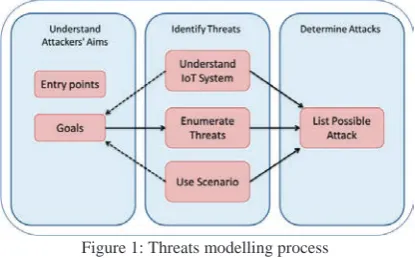
Figure 1: Threats modelling process
Understanding Attackers’ Aims
The purpose of this level is the understanding of what the
attackers want. It represents a critical aspect considering that
the threat modeling aims to prevent the satisfaction of the
attackers’ goals which, then, must be
well understood.
Entry points
–
are the entrances where the attackers can
interface with the target. Unlike in software/network systems,
where the entry points are usually difficult to enumerate and
subject to change, entry points for hardware are much fewer
and relatively fixed.
Goals
–
Usually, the hardware attackers’ goals are linked
to the integrated circuits. They can determine:
9
Information leakage
–
attackers manage to directly
extract information from an integrated circuit,
passively or actively, as an individual component or
as an element of an integrated system. Information to
be protected includes the IP associated with a chipset
and its design, data with both the hardware and
deployed software, and data embedded [22].
9
Tampering
–
attackers eavesdrop on or modify the
data associated with the integrated circuit by
prolonged inspection and monitoring.
9
Denial of service
–
attackers manage to modify the
structure of the internal circuit of an integrated
system to cause its malfunction or shutting down
under operating conditions.
Identify threats
The scope of this level is the identification of all possible
threats to the IoT system for the attackers aiming to reach
their goals. An attacker could be interested in acquiring of the
cryptographic key stored in an integrated circuit from IoT
system, and then the corresponding threat would be the access
to the RAM chip and controlling the internal bus.
Understand IoT structure
–
The goal of this sub step is to
understand the integrated circuits functionality and its internal
circuit structure, which will help identify the threats.
Use scenarios
–
This sub step aim is to determine the
potential applications of the target IoT.
By so doing will expand the threats modelling process with
human and physical factors.
Enumerate threats
–
It is possible to enumerate all potential
threats in an IoT system because once configured, the IoT
structure will be fixed. All threats will be enumerated based
on the understanding of attackers’ goals, IoT structure, and
external scenarios.
Determine attacks
The purpose of this level is to individuate how the attackers
could reach their objective by enumerating and listing all
possible attacks associated with each threat individuated in
the previous level. This process will take into account both the
internal circuit structure and the external scenarios.
5.
Classification of threats
An important part of this research is to analyse the most
common causes for data loss in industrial applications. This
served as a starting point for analysing the remote monitoring
system and to find some mitigation useful to develop robust
remote monitoring system architectures. To furnish this
analysis, a literature review [16-20], survey and interview
have been undertaken. Table 1 shows an overview of threats
considered in this research work. The threat research is
categorized into three main groups: Human, Physical and
Technical. Categories depend on the work environment. In the
case of this paper, remote monitoring of a 24-hour
manufacturing environment is considered.
Table 2 shows an overview of threat examples that
contributes to the development of a more secure remote
monitoring system through secure IoT device.
Human Threats
Threats
Descriptions
Inadvertent Acts or Carelessness
Are unintentional acts that could cause system performance degradation or system loss.
Data entry errors or omissions
Are non-malicious threats that could affect system resources and the safeguards that are protecting other system resources.
Physical Intrusions Are deliberate malicious acts that could cause damage, destruction, or loss of system assets. Such an act could also enable other threats, such as compromise of interconnected systems.
User Abuse Addresses authorized users who abuse their assigned access privileges or rights to gain additional information or privileges.
Unauthorised use of remote maintenance accesses
Are continuous acts that could cause damage of system assets. Such an act could also enable other threats, such as the insertion of virus, collect sensitive information.
Introduction of malicious code via removable media and external hardware
Access to external ports for the introduction of viruses into the system, or new settings.
Physical Threats
Threats
Descriptions
Electromagnetic interference
Is the impact of signal transmitters and receivers operating in proximity integrated system, which could cause an interruption in the electronic operation of the system.
Physical cable cuts Could be an intentional or unintentional event that affects the system’s ability to perform its intended function.
Power fluctuation Is a disruption in the primary power source (power spike, surge, brownout, and blackout) that results in either insufficient or excessive power.
Voltage spikes Refers to a rapid variation of voltage, more specifically to a voltage peak and short duration, may cause damage system assets.
Technical Threats
Threats
Descriptions
Dangerous emanations
Are the unintentional data-related or intelligence-bearing signals, which, if intercepted and analyzed, could disclose sensitive information being transmitted and/or processed.
Data/system contaminations
Is the intermixing of data of different sensitivity levels, which could lead to an accidental or intentional violation of data integrity.
Hardware Is the unexpected loss of operational functionality of any system hardware asset.
Software Is the malicious intent to change a system’s configuration without authorization by the addition or modification of code, software, database records, or information.
153
Stefano Tedeschi et al. / Procedia CIRP 59 ( 2017 ) 150 – 155
Tampering Is an unauthorized modification that alters the proper functioning of equipment in a manner that degrades the security functionality the asset provides.
Takeover of authorized session
Is gaining control of an authorized session, and assuming the access rights of the authorized party. Online attacks via
office
Is an unauthorized modification takes place within the local network that alters the proper functioning of equipment.
Reading and messages in the integrated system
[image:5.595.68.523.56.681.2]Access to communications equipment that allows the free leakage of sensitive information.
Table 1: A summary threat analysis descriptions, condensed
from [16]
Human Threats
Threats
Examples
Inadvertent Acts or Carelessness
-Programming and development errors result in software vulnerabilities.
-Incorrect operations of database synchronization procedures could result in data errors and deletion. -Improper upgrades to database management software.
-Programming and development errors could cause a buffer overflow.
-Installation, upgrade, and maintenance errors could leave data unprotected.
Data entry errors or omissions
-Failure to disable or delete unnecessary accounts (network, Internet), could provide unauthorized access to system resources.
-If the system administrator fails to perform some function essential to security, it could place a system and its data at risk of compromise. Physical Intrusions -Disgruntled employees could create both mischief
and sabotage of system data.
-Sensitive data could be captured through application vulnerabilities, and held hostage. -Disgruntled employees could sabotage a computer system by installation of software that could damage the system or the data.
-Destruction of hardware or facilities could destroy data that might not be recovered.
-Computer abuse such as intentional and improper use, alteration and disruption could result in loss of system assets.
-Cleaning staffs/vendors or contractors could steal unsecured sensitive information
User Abuse -Use of information (password) as an indirect aid for subsequent misuse
-The opening of an unprotected port on a firewall could provide unauthorized access to information Unauthorised use of
remote maintenance accesses
-Unauthorised personnel could change passwords, account and system assets
-Modify maintenance parameters
Introduction of malicious code via removable media and external hardware
-Trojan -New system assets
Physical Threats
Threats
Examples
Electromagnetic
interference -Malfunctioning equipment
-An extended power surge, over-stress power supplies and lead to computer equipment damage. -A power failure, disrupting network operation, computer screens to go blank, and servers to crash. Physical cable cuts -A disgruntled employee could sabotage
transmission media
-Animals could cause damages to cables resulting in broken cables.
-Lightning strikes could cause a structural fire, which could, in turn, burn out circuits resulting in a
power failure.
-Lightning strikes could cause severe damage resulting in broken cables.
Power fluctuation -Malfunction or failure of Central Processing Unit (CPU) or hardware could impact the timeliness and quality of the delivered services.
Voltage spikes -Malfunction of CPU or hardware equipment. -Internal power disturbances could result in loss of system data.
Technical Threats
Threats
Examples
Dangerous emanations
-Radiation or signals that emanate from a communications circuit could disclose to unauthorized persons or equipment the sensitive or proprietary information that is being transmitted via the circuit.
Data/system
contaminations -Anomalies and multiple numbers for the same entity could allow unauthorized access to data.
-Corrupted system files could contain strings of sensitive information.
-File fragments containing sensitive information could be scattered throughout a drive instead of in an encrypted sector to protect them from compromise.
Hardware -Malfunction or failure of Central Processing Unit
(CPU)
-Faulty network components such as hosts, routers and firewalls could result in interruption of
communications between the connected stations. -Improper hardware maintenance could allow a system crash to occur.
-Timing Attack
Software -Modification, insertion, or deletion of data or lines
of code could compromise data and/or system.
-Unauthorized modification of database records could compromise data integrity and availability.
-Trojan Horse applications could be installed through code and software modifications. -Logic bombs could be placed within authorized software and perform malicious system actions on a given trigger event.
Installation errors -Poor installation procedures could leave data
unprotected, e.g. built-in security features of
software packages are not implemented.
-Incorrect installation or a conflict with another
device that is competing for the same resources within the computer system could impact system data and resource availability.
Tampering -Web hacks could deface a web site, or disable the
web server functionality.
-Domain Name Service hacks could prevent authorized users from properly accessing network or Internet resources.
Takeover of authorized session
-When a user leaves the immediate work area and a session remains open, unauthorized use could occur.
Online attacks via office
-Unauthorized staffs could have access to sensitive information.
Reading and messages in the integrated system
-Sharing of badges, key cards, and passwords could
[image:5.595.68.529.66.687.2]provide unauthorized access to private information. -Forged email messages could reveal sensitive information.
6. Develop a global design strategy for securing IoT
devices
The process of configuring secure IoT devices launches the
bases as a new approach. This approach may not only be used
in the manufacturing environmental but with the right changes
also in other working environments.
Figure 2 shows a global strategy for securing IoT devices.
The process is divided into four main categories.
Define requirements
–
includes the threats analysis and the
signals to be measured to make maintenance.
[image:6.595.310.518.150.433.2]Prototype concept
–
this category involve the physical
construction of the device, paying attention to the choice of
modules.
Figure 2: Configuration process
Evaluate concept -it concerns the concept of evaluation
through the selection of threats mitigations. By so doing will
develop best technical solution for remote monitoring. Verify
requirements -
it’s
the evaluation phase of the prototype
through experiments and comparisons with other devices.
Only by so doing we will understand if our monitoring system
appears to be safer than those on the market.
7. Design of a safe remote system for machine tools
through IoT devices
An IT scenario can be greatly influenced by IoT
technology, determining a competitive advantage for
business. Also, it has to be considered that the companies are
subject to several new threats with the use of new technology.
Figure 3 shows the architecture of a data protection and
secure communication system that has been developed for this
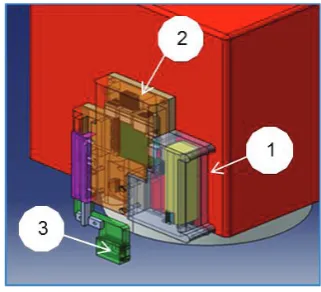
paper. From the hardware point of view, the proposed system
provides a Data Acquisition Unit (DAQ), made from
Raspberry Pi model B, a Wi-Fi module, the accelerometer
MPU 6050, a FLIR lepton thermal imaging module for
temperature monitoring, and a power bank of 3350 mAh that
provides sufficient battery life for the unit.
The system is able to collect acceleration and temperature
data at 1 kHz with 100 kbps baud rate in a single 14 byte read
and over I2C running at 400 kbps baud rate. The thermal
camera module captures infrared radiation within the
wavelength band from 8 to 14 microns.
All the collected data is not stored within the
microcontroller but is transferred to storage and sharing units
accessible only to accredited persons via cloud storage.
Inside the system are a combined iteration of the HTTP
protocol through a mechanism of encryption such as Secure
Sockets Layer (SSL), the acquired data are then transferred to
the Cloud system. The SSL protocol provides connection
security guarantees [23]:
9
Authentication (security identity of the subjects that
communicate)
9
Data confidentiality (protection of data from
unauthorized observers)
9
Data integrity (security that the data received is equal
to the datum sent).
Figure 3: System data protection and secure
communication
[image:6.595.80.288.225.385.2]This system architecture allows for the mitigation of some
possible threats that occur on the communication network that
were highlighted in Table 1 and Table 2.
Figure 4: Data Acquisition Unit (DAQ)
[image:6.595.333.494.483.629.2]155
Stefano Tedeschi et al. / Procedia CIRP 59 ( 2017 ) 150 – 155
power bank is to avoid power fluctuation and voltage spikes,
and the lack of external cables avoids direct physical
interfacing and tampering. The protective cover does not
allow access to the unit for unauthorized persons. The system
is assembled together on the DMG machine tool spindle and
used during machining operations. On the board, all external
ports are disabled except a USB port for the Wi-Fi connection
and Micro USB for power bank. To collect vibration signals
and temperature data, you must have an account and password
to access the executable file that launches the remote
program. The monitoring system is equipped with 256-bit
AES encryption [24]. An increase of data security is achieved
sby the microcontroller on board which collects the data and
writes an encrypted text file that will be sent directly to the
Cloud system. At this point, all data within the
microcontroller is deleted so as not to occupy valuable
memory and to not leave traces of data on the device. Inside
the Cloud, the data will be provided in encrypted form and
only those with keys and a valid certificate will have access.
8.
Conclusion
In this paper, the foundation for the realization of a
methodical approach for preventive maintenance through IoT
device as a data acquisition unit capable of self-learning
during the run-time of a machine tool has been presented. The
methodical approach is focused on threats that generate a loss
of data or information from the monitoring system. Future
work aims to utilize this monitoring system also as a remote
control system for different actuators.
Acknowledgements
This work is being undertaken with the EPSRC, grant
number EP/I033246/1 and collaboration with the group
Kennametal and will be conducted in the EPSRC Centre for
Innovative Manufacturing in Through-life Engineering
Services. Many thanks also to DMG Mori who made the CNC
turn-mill centre NT1000/W available for this research.
References
[1] M. Chen, (2014) “NDNC-BAN: supporting rich media healthcare
services via named data networking in cloud-assisted wireless body area networks” Information Sciences, 284: 142–156.
[2] Tedeschi, S. , Mehnen, J. , Tapoglou, N. , Rajkumar, R., (2015) “Security Aspects in Cloud Based Condition Monitoring of Machine Tools”
4th International Conference on Through-life Engineering Services, TES 2015 Procedia CIRP, 38: 47-52
[3] K. Ashton, (2009) “That ‘Internet of Things’ Thing: In the real world, things matter more than ideas,” RFID J., June 22, 2009: http://www.
rfidjournal.com/articles/view?4986#sthash.NsRaiwEl.dpuf
[4] Mark Weiser, (2014) “What is the Internet of Thighs” La Stampa,
http://www.aspeninstitute.it/system/files/inline/Internet%20of%20Things.pdf. [5] S.H. Yang, Ch. Dai, and R.P. Knott (2007) “Remote Maintenance of
Control System Performance over the Internet” Control Engineering Practice, 15(5): 533-544.
[6] K. Feldmann, J. Gohringer (2001) “Internet based Diagnosis of Assembly Systems” Annals of the CIRP, 50 (1):5–8.
[7] B. Lung, M. Veron, M.C. Suhner, A. Muller (2006) “Integration of
Maintenance Strategies into Prognosis Process to Decision-Making Aid on System Operation” Annals of the CIRP, 54(1):5–8.
[8] P.F. Cunha, J.A. Caldeira Duarte, L. Alting (2004) “Development of a Productive Service Module Based on a Life Cycle Perspective of
Maintenance Issues” Annals of the CIRP, 53(1):13–21.
[9] M. Mori, M. Fujishima, M. Komatsu, B. Zhao, Y. Liu (2008)
“Development of remote monitoring and maintenance system for machine tools” Annals of the CIRP, 57:433–436.
[10] Yonggang Gong, Aide Zhou, Yanan Xiao, (2014) “Design of wall -mounted Boiler Remote Monitoring and Control System based on the Ayla
IOT Cloud Platform” Applied Mechanics & Materials, Issue 571-572: 1047. [11] Chen Wang, Hoang Tam Vo, Peng Ni, (2015) “An IoT Application
for Fault Diagnosis and Prediction” IEEE International Conference on Data Science and Data Intensive Systems: 726-731.
[12] Kamlesh Sharma ,T. Suryakanthi, (2015) “Smart System: IoT for University” International Conference on Green Computing and Internet of
Things (ICGCloT): 1586-1593.
[13] NamKyung Lee, HyungKeuk Lee, HyunWoo Lee, Won Ryu, (2015)
“Smart home Web of Object Architecture”International Conference on Information and Communication Technology Convergence :1212-1214.
[14] Ana M. Alexandru, Alice De Mauro, Maurizio Fiasché, Francesco G. Sisca, Marco Taisch, Luca Fasanotti and Piergiorgio Grasseni, (2015) “A Smart web-based Maintenance System for a smart manufacturing
environment” IEEE 1st International Forum : 579-584.
[15] Ramão Tiago Tiburski, Leonardo Albernaz Amaral, Everton De
Matos, Fabiano Hessel, (2015) “The importance of a standard security architecture for SOA-based IoT middleware” IEEE Communications
Magazine, 53(12) :20-26.
[16] Ahmad Bakhtiyari Shahri, Zuraini Ismail, (2012) “A Tree Model for
Identification of Threats as the First Stage of Risk Assessment in HIS” Journal of Information Security, 3: 169-176.
[17] Jia Di and Scott Smith, (2007) “A Hardware Threat Modeling Concept for Trustable Integrated Circuits” IEEE Region 5 Technical
Conference, April: 65-68.
[18] Jerome Di-Battista, Jean-Christophe Courrege, Bruno Rouzeyre,
Lione Torres and Philippe Perdu, (2010) “When Failure Analysis Meets Side-Channel Attacks” Proceedings of the 12th international conference on
Cryptographic hardware and embedded systems: 188-202.
[19] HyunHo Kim , Ndibanje Bruce , Hoon-Jae Lee , YongJe Choi ,
Dooho Choi, (2015) “Side Channel Attacks on Cryptographic Module: EM and PA Attacks Accuracy Analysis” Lecture Notes in Electrical Engineering
339:509-516.
[20] Tsunato Nakai, Megumi Shibatani, Mitsuru Shiozaki, Takaya
Kubota, Takeshi Fujino, (2014) “Side-channel attack resistant AES cryptographic circuits with ROM reducing address-dependent EM leaks”
IEEE International Symposium on Circuits and Systems (ISCAS): 2547-2550.
[21] A. Appari and M. E. Johnson, (2010) “Information Security and Privacy in Healthcare: Current State of Research,” International Journal of
Internet and Enterprise Management, 6 (4): 279-314.
[22] DARPA Trust RFI, Draft Trust Program Information, URL: http://www.fbo.gov/spg/ODA/DARPA/CMO/SN06%2D25/listing. html
[23] C. Parshotam, C. Rupinder, G. Aayush, (2012) “Improving the Secure Socket Layer by Modifying the RSA Algorithm” International Journal
of Computer Science, Engineering and Applications (IJCSEA), 2(3): 79-86. [24] Merline, M.A, (2015) “Implementation of triple aes encryption and
decryption” International Journal of Applied Engineering Research, 10
![Table 1: A summary threat analysis descriptions, condensed from [16]](https://thumb-us.123doks.com/thumbv2/123dok_us/1432599.95795/5.595.68.523.56.681/table-summary-threat-analysis-descriptions-condensed.webp)