Proceedings of 7th Transport Research Arena TRA 2018, April 16-19, 2018, Vienna, Austria
Quantification of the maritime security problem onboard
passenger ships
Ioli Gypa
a,*, Evangelos Boulougouris
a, Dracos Vassalos
aaUniversity of Strathclyde, Maritime Safety Research Centre, 100 Montrose Street, G4 0LZ, Glasgow, UK
Abstract
Given the large number of recent terror attacks worldwide, there is a growing concern over the security issue in the maritime world. Aim of this paper is to address a scenario pertinent to the maritime security problem using the evacuation simulation software tool EVI. The vessel chosen for this case study is a 13-deck cruise ship. The scenario investigated deals with the evacuation of a large density populated area within the vessel, where an explosive device has been placed and assesses the potential loss of life, according to the distance of the agents relative to the explosion blast. Three different positions of the explosive device are examined in this study and for each position six different cases are examined, in which the effect of prior warning to the explosion is taken into consideration. In the first case, the explosion takes place at the beginning of the simulation (t=0) in order to replicate such a scenario in which those agents within the restaurant are un-alerted to the presence of the explosive device. In the rest of the cases the explosion takes place after warning times of 0.5, 1, 1.5, 2 and 2.5 minutes respectively in order to assess the sensitivity of the fatality rate and evacuation to prior warning time.
Keywords: evacuation analysis, cruise ship, safety, security, advanced evacuation simulation software tool, maritime security, explosion blast
* Corresponding author. Tel.: +44-141-548-3410
Nomenclature
ABM Agent-Based models
CLIA Cruise Lines International Association DHS Department of Homeland Security IMO International Maritime Organisation ISPS International Ship and Port Facility Security MSRAM Maritime Security Risk Analysis Model PLL Potential Loss of Life
SOLAS Safety of Life at Sea TNT Trinitrotoluene
USCG United States Coast Guard VLCC Very Large Crude Carrier VR Virtual Reality
1.Introduction
Over the recent past, the global cruise ship industry has witnessed a vast growth with cruise travel increasing by more than 500% since 1990, in terms of passenger carrying capacity (Brida & Zapata-Aguirre, 2009). In order to accommodate this rising demand, the industry has responded by building increasingly larger and higher capacity vessels which has raised questions regarding the ability to evacuate vessels of this type in a timely and safe manner. This increase in vessel scale and capacity also brings about another problem relating to maritime security as these vessels now represent a high value target to terrorists. It is for this reason that it is of vital importance to be able to effectively model and simulate scenarios relating to these emerging threats in order to ensure evacuation following such incidents and mitigate risk accordingly. In this paper one such security scenario is simulated using the evacuation software EVI. It relates to the evacuation of a restaurant on board a large cruise vessel following the detection of an explosive device. During the assessment, the effect of important parameters such as explosive location and prior warning time are accounted for and ultimately their impact on the evacuation of the space and number of fatalities as a result of the device’s detonation are measured.
2.Evacuation Simulations
The evacuation of a large passenger vessel is a highly complex event, presenting a series of difficulties at system, procedural and behavioural levels (IMO, 2016). The current-state-of-the-art on the evacuation of large passenger vessels is provided by advanced evacuation simulation models. These models are developed with the aid of specific modelling techniques, such as the Social Forces approach, Cellular Automata models, Agent-Based models, Lattice Gas modelling, Game Theoretical modelling and the Fluid-Dynamics models (Gypa, Boulougouris, & Vassalos, 2017). Some of the most important evacuation simulation tools are shown in Table 1.
Table 1: Evacuation simulation software tools
Evacuation simulation tool Consequence (probability of
fatality to personnel inside)
EVI Multi-Agent Models, Virtual
Reality, Mesoscopic Approach
AENEAS
maritimeEXODUS
BY-PASS
ABM
ABM
Cellular Automata Models
MonteDEM
IMEX
VELOS
Cellular Automata Models
ABM
Virtual Reality
EVI is based on multi-agent modelling techniques, which have proven to be the most suitable for passenger evacuation simulations. Each passenger and crew member is modelled as an individual agent with unique
Fig. 1: Space modelling techniques (D. Vassalos et al., 2003)
characteristics and behaviours. EVI uses a mesoscopic – hybrid approach, which is a multi-level planning structure, combining the macroscopic and microscopic models. The macroscopic model relates to the flow model, which is described by IMO in the Annex 2 of the Revised Guidelines for evacuation analysis (IMO, 2016), while the microscopic model is associated with human behaviour models (G. Vassalos, 2005).
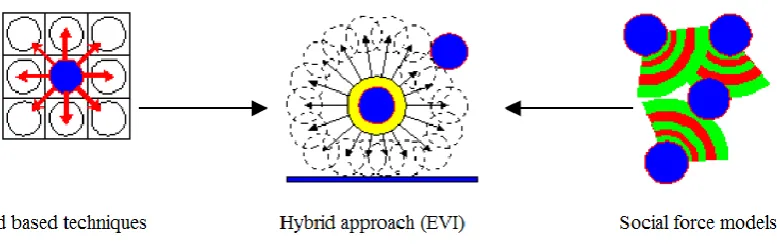
For all the evacuation simulation software tools, the path-planning process is of great importance, due to the complexity of the vessel’s layout. In EVI, when an agent has a specific location in a specific space on-board the vessel, the distance information between the agent and all the doors of the space is obtained and the agent chooses the shortest route as calculated by Dijkstra’s shortest path algorithm (Dijkstra, 1959). EVI combines grid-based techniques and social forces models, as shown in Fig. 1 so that an agent changes its direction of movement when other agents or obstacles are present or upon receiving pertinent information from other agents or the ship environment/crew.
3.Maritime Security
A growing concern over maritime security issues has given rise to a new requirement for computer-based simulations, particularly regarding the security of large passenger ships. This is a problem that has been addressed by IMO through the ISPS code and the addition of Chapter XI-2 to the 1974 SOLAS Convention (IMO, 2002). ISPS aims at the detection of security threats and implementation of security measures, the establishment of roles and responsibilities concerning maritime security for governments, local administrations, ship and port industries at the national and international level, the collection and dissemination of security-related information and the provision of a methodology for security assessments, in order to react to changing security levels. The European Union has also attempted to address this issue with the adoption of Directive 2005/65/EC (EC, 2005) on enhancing port security along with the revised Commission Regulation (EC) No. 324/2008 (EC, 2008) aimed at monitoring the implementation of the directive and Regulation EC725/2004 (EC, 2004), which describes procedures for conducting inspections aimed at monitoring the application of the directive.
The United States government has expressed a certain degree of trepidation regarding the terrorist threat to passenger vessels and in response the USCG has developed, with the assistance of the DHS, a MSRAM aimed at mitigating the risks associated with terrorist attacks on vessels operating within the United States waters (GAO, 2010). While there may not be any definitive evidence that cruise ships are being specifically targeted, maritime intelligence officials have identified the presence of terrorist groups that have the ability to carry out such attacks and thus the cause for concern. This has been reported both by USCG and RAND Corporation (Chalk, 2008). The CLIA has also reported that the greatest security concern for such ships is a waterside attack. In 2006, RAND reported that despite the implementation of security measures such as screening of passengers, crew and baggage, if militants were successful in bypassing any of these barriers, they would be able to carry out a wide range of attack scenarios.
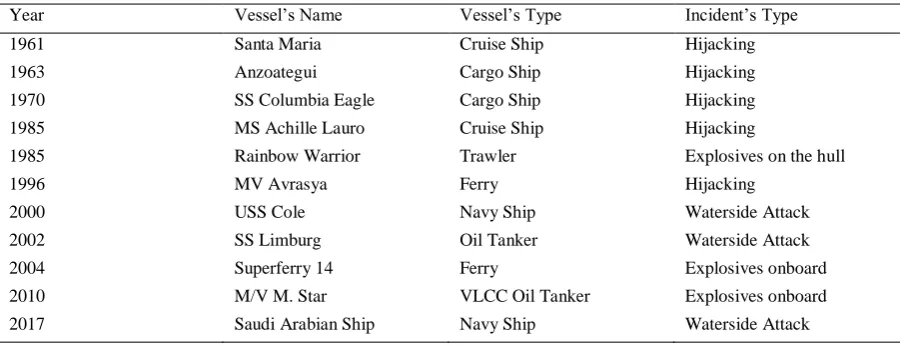
Table 2: Maritime security incidents 1960-2017 (Gypa et al., 2017)
Year Vessel’s Name Vessel’s Type Incident’s Type
1961 1963 1970 1985 1985 1996 2000 2002 2004 2010 2017 Santa Maria Anzoategui
SS Columbia Eagle
MS Achille Lauro
Rainbow Warrior
MV Avrasya
USS Cole
SS Limburg
Superferry 14
M/V M. Star
Saudi Arabian Ship
Cruise Ship Cargo Ship Cargo Ship Cruise Ship Trawler Ferry Navy Ship Oil Tanker Ferry
VLCC Oil Tanker
Navy Ship
Hijacking
Hijacking
Hijacking
Hijacking
Explosives on the hull
Hijacking Waterside Attack Waterside Attack Explosives onboard Explosives onboard Waterside Attack
4.Surface-burst explosions
During an explosion, gases and vapours expand, transforming a physical and chemical system to mechanical work and resulting in a change of the system’s potential energy (Baum, Stanyukovich, & Shekhter, 1959). There are three basic non-contact explosions: free-air bursts, air bursts and surface bursts. The explosion examined in this paper is a surface burst explosion, where the explosives are located on the ground surface. The initial wave reflects to the ground surface and a reflected reinforced wave is produced. The incident and the reflected wave are merged, forming a single wave that has a hemispherical shape (Lupoae, 2016).
During this blast wave reflection, the reflected pressure is larger than the incident pressure. This is a result of the blast wave travelling through the air and colliding with the air particles. Ideally, in a linear-elastic phenomenon, the air particles would reflect freely and the pressure would be equal to the incident pressure. As the blast wave is a non-linear phenomenon, the particles’ reflection is blocked by following air particles, resulting in a larger reflected pressure. The values of the reflected pressure depend on the structure’s and the explosives’ characteristics (Karlos & Solomos, 2013).
The characteristic parameters of a blast wave are the overpressure, the dynamic pressure, the reflected pressure, the density, the shock front velocity and the particle velocity. The estimation of the blast overpressure and the reflected pressure are the most important parameters in this study, as they inflict the most harm to the human body. Charles Kingery and Gerald Bulmash have developed the mathematical model for the estimation of the blast overpressure at range (Kingery & Bulmash, 1984). The equations used in this study, related to the hemispherical surface burst for the reflected pressure and impulse are shown below (IATG 01.80, 2015).
0 1 2 3 ... n
Y C C U C U C U C U (1)
(2)
(3)
0.240657322658 1.36637719229
U
T
(4)(5)
0.246208804814 1.33422049854
U
T
(6)2
3 4 5
6 7 8
9
3.40283217581
2.21030870597
0.218536586295
0.895319589372
0.24989009775
0.569249436807
0.11791682383
0.224131161411
0.0245620259375
0.455116002694
Y
U
U
U
U
U
U
U
U
U
0 1
U
K
K T
2
3
2.70588058103
0.949516092853
0.112136118689
0.0250659183287
Y
U
U
U
In equation (1) the Kingery and Bulmash general polynomial form is presented, where C and K are constants for a 1 kg TNT equivalent charge. Y is the common logarithm of the air blast parameter for pressure or impulse and T is the common logarithm of the distance. Equation (3) is the polynomial for reflected pressure and equation (5) is the polynomial for the reflected impulse. Equations (2), (4) and (6) are substituted into equations (1), (3) and (5). All the equations apply to a range from 0.05 to 40 metres, which cover in most cases the length of a fire zone onboard passenger ships.
Following an explosion, the consequence of the rapid compression and decompression of the blast wave on the human body is the transmission of pressure waves through the tissues. The junctions between tissues of different densities are the first to be damaged and then the lung tissue and the gastrointestinal system. The ea rdrums and lungs are the parts of the body directly susceptible to the damaging consequences of the overpressure. Table 3 shows the probability of fatality to personnel in an indoor space depending on the overpressure of the explosion (HSE, 2013).
The most important parameters for the determination of the risk from an explosion are the maximum overpressure, the time needed to reach this maximum overpressure, the indoor or outdoor exposure of people, the possibility of flying fragments and the damage resistance of the space in question. In this study, the exposure of people is indoors and the fragments and the vessel’s resistance are not taken into consideration for the estimation of the potential loss of life.
Table 3: Explosion overpressure effects
Overpressure (barg) Consequence (probability of
fatality to personnel inside)
0.210 20%
0.350 50%
0.700 100%
5.Case Study
Fig. 2: (a) 13-deck cruise ship (b) 23 assembly stations
The scenario selected for further investigation uses 520 agents (500 passengers and 20 crew members) in the simulations. The demographic characteristics have been taken into consideration, according to IMO MSC.1/Circ.1533 – Day Case. This describes the make-up of the population in terms of age, gender, physical attributes and response durations. More specifically, there are 50% female and 50% male agents onboard the vessel, the age of the agents follows a uniform random distribution, the response duration a truncated logarithmic normal distribution and the speed is modelled as a statistical uniform distribution having minimum and maximum values.
The scenario investigated deals with the evacuation of a large density populated area within the vessel. Such a scenario is of particular interest with regards to security, as it is often the case that terrorists target large crowded public spaces, where they stand to inflict the most harm. The space selected in this case is the restaurant located in Firezone 6 of Deck 4, where 500 passengers and 20 crew members are initially placed.
[image:6.595.148.466.297.478.2]An explosive device has been placed in this area with characteristics similar to those of the Superferry 14 accident (3.5 kg, TNT bomb). Three different positions of the explosive device are examined in this case study, as shown in Fig. 3, in order to assess fatality sensitivity to detonation location.
Fig. 3: Positions of the explosive devices
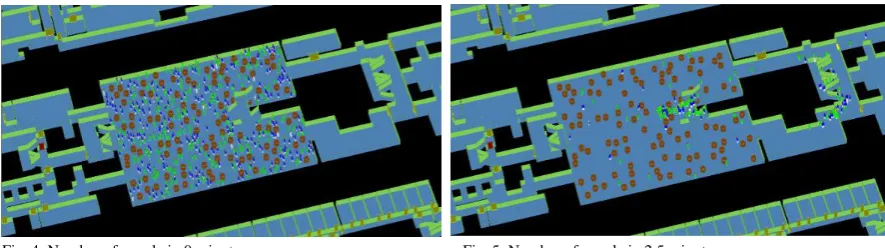
Fig. 4: Number of people in 0 minutes Fig. 5: Number of people in 2.5 minutes
Six different cases are examined, in which the effect of prior warning to the explosion is taken into consideration. The assumed prior warning times are related to cases, where the explosive device has been identified for a number of reasons. For example, there is always a security team onboard a cruise ship that is responsible for everything related to the security issue.
[image:6.595.76.519.514.638.2]the passengers are told to evacuate the space, without knowing the reason, which is something that would happen in a real scenario too. The crew members would never inform the passengers that there is a bomb onboard the vessel, as this would cause chaos. Thus, in this case study, panic-behaviour is not taken into consideration. However, as the evacuation of a space is a stressful situation, even in a drill scenario, the agents’ stress levels are considered in EVI and impact on the agents’ speed and awareness time. Furthermore, in EVI each agent is an individual with unique characteristics. The crew can be modelled in such way, so that it helps the passengers to evacuate the area, something that has been done in this case study too.
6.Results and Discussion
6.1. Space Clearance
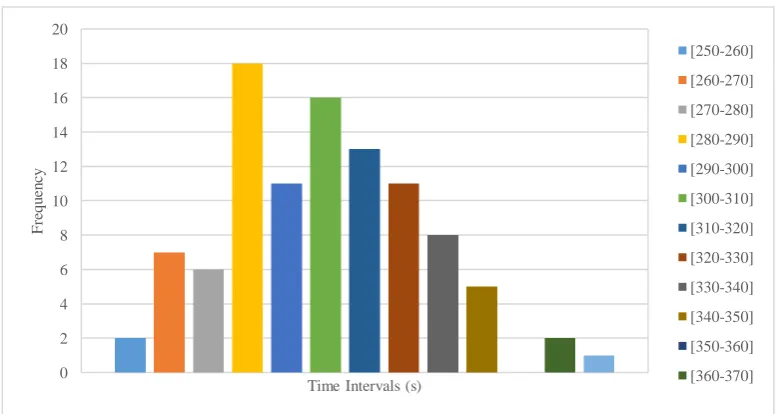
[image:7.595.103.492.383.590.2]The mean evacuation time of the space is approximately 5 minutes (304.2 seconds) with a standard deviation of 24.7 seconds, from the moment the agents initially realise the situation, until the space is completely empty. In Fig. 6, the histogram of the space clearance time is presented, where it is shown that the simulation data follows approximately a normal distribution. In Fig. 7 and Fig. 8 the agents evacuating the space versus time is shown. In Fig. 9 the number of agents evacuating the space every 10 seconds is presented. It is observed that during the first 15 seconds the space clearance is low. This is then followed by a huge rise in the timeframe spanning 20-50 seconds, as the agents have by this time become fully aware of the situation and full evacuation of the space has commenced. The rate of people evacuating the space then declines as witnessed within the timeframe spanning from 50-120 seconds as the large flow of agents leads to congestion in the emergency exits and more specifically in the stairs and corridors leading to the assembly stations. After 150 seconds the evacuation rate then continues to drop as the remaining agents exit the space unimpeded by congestion.
Fig. 6: Space clearance time histogram
0 2 4 6 8 10 12 14 16 18 20
F
re
qu
en
cy
[image:7.595.72.526.624.775.2]Time Intervals (s)
[250-260]
[260-270]
[270-280]
[280-290]
[290-300]
[300-310]
[310-320]
[320-330]
[330-340]
[340-350]
[350-360]
[360-370]
0 100 200 300 400 500 600
0 100 200 300 400
A
g
en
ts
Time (seconds)
0 100 200 300 400 500 600
0 100 200 300 400
A
g
en
ts
Fig. 7: Number of agents evacuating the space vs time (100 simulations) Fig. 8: Mean number of agents evacuating the space vs time
Fig. 9: Number of agents evacuating the space per 10 seconds
6.2. Explosion Blast
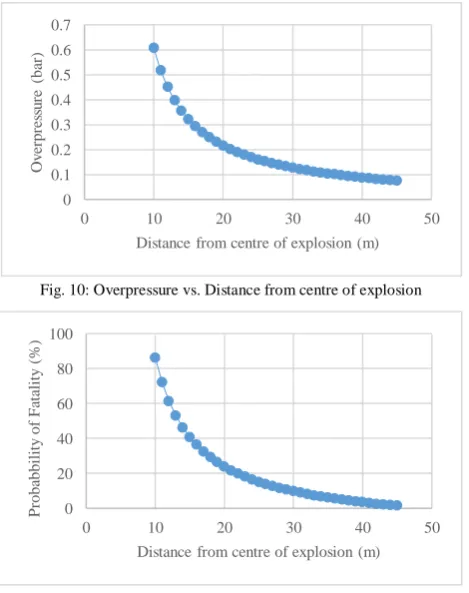
[image:8.595.182.417.446.743.2]In Fig. 10 the overpressure versus the distance from the centre of the explosion is presented, as calculated from the Kingery and Bulmash equations. According to the overpressures of Fig 10, Fig. 11 presents the probability of fatality versus the distance from the centre of the explosion, which is calculated from Table 3. The values that are not included in the table, are calculated with linear interpolation.
Fig. 10: Overpressure vs. Distance from centre of explosion
Fig. 11: Probability of Fatality vs. Distance from centre of explosion
0 10 20 30 40 50 60 A g en ts
Time Frames (seconds)
[0-10] [10-20] [20-30] [30-40] [40-50] [50-60] [60-70] [70-80] [80-90] [90-100] [100-110] [110-120] [120-130] [130-140] [140-150] [150-160] [160-170] [170-180] [180-190] [190-200] [200-210] [210-220] [220-230] [230-240] [240-250] [250-260] [260-270] [270-280] [280-290] [290-300] 0 0.1 0.2 0.3 0.4 0.5 0.6 0.7
0 10 20 30 40 50
O v er pr es su re ( ba r)
Distance from centre of explosion (m)
0 20 40 60 80 100
0 10 20 30 40 50
P rob abb il it y of F ata li ty ( % )
Fig. 12: Percentage of fatalities according to the explosive device’s position and the pre-warning
Fig. 12 represents the potential loss of life according to the position of the explosives and pre-warning. Regarding the position of the explosives, it is observed that Position No. 2 has the highest fatality rates. As shown in Fig. 3 the explosives in Position No. 2 are next to the main emergency exit (main stairs), where most of the evacuees have the tendency to go. Regarding the pre-warning, two cases are examined, the percentage of fatalities in respect to the agents inside the space and the percentage of fatalities in respect to the total number of agents (520). It is observed that for the first case and for the positions 1 and 3, the potential loss of life is almost the same in all the cases. Of course there is a slight decrease, as the time increases. In the second case, as the pre-warning time increases, there is a clear decrease in the potential loss of life in all the positions of the explosives. This is sensible, because as time passes, the number of people having already evacuated the space is high.
7.Conclusions
The aim of this paper is to address a number of scenarios pertinent to the maritime security problem, by simulating procedures in the evacuation simulation software tool EVI. The results of the case study presented herein, have proven the feasibility and the vast potential of using the EVI software in order to address security scenarios onboard. The analysis of the simulation statistics can provide very useful insight to the decision makers helping them to take well-informed, rational decisions in order to address security issues onboard passenger ships. Investigations such as the time required to evacuate a large restaurant following the detection of an explosive device represents but one of many important security scenarios which can be assessed in this way.
The results of the present investigation are very promising for additional research. Future research steps include the investigation of security scenarios onboard RoPax ships and the challenges created by the large, open RoRo spaces, the development of scenarios for the investigation of the combined impact of a waterside attack to the ship, which is berthed and the options for evacuating it given the constraints imposed by the environment, which might prohibit/limit the use of the existing life-saving appliances, the investigation of the combined flooding-evacuation-security problem with the use of time-domain flooding simulation tools such as Proteus coupled with EVI, the simulation of a moving threat onboard a passenger ship and the passengers are required to avoid different spaces as the threat changes place and the development of combined scenarios with security and hostile forces co-existing on a ship.
8.Acknowledgements
The authors wish to express their appreciation and gratitude to Luis Guarin, Yasmine Hifi and Eilidh McAdam
0 10 20 30 40 50 60 70 80 90 P er ce n ta g e of F at al it ie s (% )
0 30 60 90 120 150 Pre-Warning (seconds)
Position 1: % of agents still inside Position 1: % of total agents
Position 2: % of agents still inside Position 2: % of total agents
from BBSaS for their support and advice during the process of this investigation and for supplying the evacuation analysis software tool EVI.
References
Baum, F., Stanyukovich, K., & Shekhter, B. I. (1959). Physics of an Explosion. Fort Belvoir, Virginia: U.S. Army Engineer Research and Development Laboratories.
Brida, J., Gabriel, & Zapata-Aguirre, S. (2009). Cruise Tourism: Economic, Socio-Cultural and Environmental Impacts. International Journal of Leisure and Tourism Marketing, 1(3), 205-226.
Chalk, P. (2008). The Maritime Dimension of International Security: Terrorism, Piracy, and Challenges for the United States: RAND Corporation.
Dijkstra, E. (1959). A Note on Two Problems in Connexion with Graphs. Numerische Mathematik, 1, 269-271.
Regulation (EC) No 725/2004 of the European Parliament and of the Council of 31 March 2004 on enhancing ship and port facility security (2004).
Directive 2005/65/EC of the European Parliament and of the Council of 26 October 2005 on enhancing port security (2005).
Comission Regulation (EC) No 324/2008 of 9 April 2008 laying down revised procedures for conducting Commission inspections in the field of maritime security (2008).
GAO. (2010). Varied actions taken to enhance Cruise Ship Security, but some concerns remain.
Gypa, I., Boulougouris, E., & Vassalos, D. (2017). Decision support tool for modelling security scenarios onboard passenger ships. Paper presented at the IMAM, Lisbon, Portugal.
HSE. (2013). Methods of approximation and determination of human vulnerability for offshore major accident hazard assessment. IATG 01.80. (2015). Formulae for ammunition management: UNODA.
International Code for the Security of Ships and Port Facilities (ISPS Code) (2002).
MSC.1/Circ.1533: Revised Guidelines on Evacuation Analysis for New and Existing Passenger Ships (2016).
Karlos, V., & Solomos, G. (2013). Calculation of blast loads for application to structural components. Luxembourg: Publications Office of the European Union.
Kingery, C., & Bulmash, G. (1984). Airblast parameters from TNT spherical air burst and hemispherical surface burst: US Army Armament and Development Center, Ballistic Research Laboratory.
Lupoae, M. (2016). Prediction of blast loadings on buildings. Paper presented at the Greener and safer energetic and ballistic systerms, Bucharest, Romania.
Remennikov, A. (2003). A review of methods for predicting bomb blast effects on buildings. Journal of battlefield technology, 6(3), 5. Vassalos, D., Guarin, L., Vassalos, G., Bole, M., Kim, H., & Majumder, J. (2003). Advanced Evacuation Analysis - Testing the Ground on Ships. Paper presented at the 2nd International Conference on Pedestrian and Evacuation Dynamics (PED).
Vassalos, D., Kim, H., Christiansen, G., & Majumder, J. (2002). A mesoscopic model for passenger evacuation simulation in a virtual ship-sea environment and performance-based evaluation. Paper presented at the 1st International Conference on Pedestrian and Evacuation Dynamics.