City, University of London Institutional Repository
Citation: Borek, A. J., Abraham, C., Greaves, C. J., Gillison, F., Tarrant, M.,
Morgan-Trimmer, S., McCabe, R. ORCID: 0000-0003-2041-7383 and Smith, J. R. (2019). Identifying
change processes in group-based health behaviour-change interventions: development of
the mechanisms of action in group-based interventions (MAGI) framework. Health
Psychology Review, doi: 10.1080/17437199.2019.1625282
This is the published version of the paper.
This version of the publication may differ from the final published
version.
Permanent repository link: http://openaccess.city.ac.uk/22425/
Link to published version: http://dx.doi.org/10.1080/17437199.2019.1625282
Copyright and reuse: City Research Online aims to make research
outputs of City, University of London available to a wider audience.
Copyright and Moral Rights remain with the author(s) and/or copyright
holders. URLs from City Research Online may be freely distributed and
linked to.
Full Terms & Conditions of access and use can be found at
https://www.tandfonline.com/action/journalInformation?journalCode=rhpr20
Health Psychology Review
ISSN: 1743-7199 (Print) 1743-7202 (Online) Journal homepage: https://www.tandfonline.com/loi/rhpr20
Identifying change processes in group-based
health behaviour-change interventions:
development of the mechanisms of action in
group-based interventions (MAGI) framework
Aleksandra J. Borek, Charles Abraham, Colin J. Greaves, Fiona Gillison, Mark
Tarrant, Sarah Morgan-Trimmer, Rose McCabe & Jane R. Smith
To cite this article: Aleksandra J. Borek, Charles Abraham, Colin J. Greaves, Fiona Gillison, Mark Tarrant, Sarah Morgan-Trimmer, Rose McCabe & Jane R. Smith (2019): Identifying change processes in group-based health behaviour-change interventions: development of the mechanisms of action in group-based interventions (MAGI) framework, Health Psychology Review, DOI:
10.1080/17437199.2019.1625282
To link to this article: https://doi.org/10.1080/17437199.2019.1625282
© 2019 The Author(s). Published by Informa UK Limited, trading as Taylor & Francis Group
View supplementary material
Accepted author version posted online: 13 Jun 2019.
Published online: 13 Jun 2019.
Submit your article to this journal
Article views: 381 View Crossmark data
Identifying change processes in group-based health
behaviour-change interventions: development of the mechanisms of action
in group-based interventions (MAGI) framework
Aleksandra J. Borek a*,, Charles Abraham a†, Colin J. Greaves a‡, Fiona Gillison b, Mark Tarranta, Sarah Morgan-Trimmer a, Rose McCabe a§and Jane R. Smith a a
University of Exeter Medical School, University of Exeter, Exeter, UK;bDepartment for Health, University of Bath, Bath, UK
ABSTRACT
Group-based interventions are widely used to promote health-related behaviour change. While processes operating in groups have been extensively described, it remains unclear how behaviour change is generated in group-based health-related behaviour-change interventions. Understanding how such interventions facilitate change is important to guide intervention design and process evaluations. We employed a mixed-methods approach to identify, map and define change processes operating in group-based behaviour-change interventions. We reviewed multidisciplinary literature on group dynamics, taxonomies of change technique categories, and measures of group processes. Using weight-loss groups as an exemplar, we also reviewed qualitative studies of participants’experiences and coded transcripts of 38 group sessions from three weight-loss interventions. Finally, we consulted group participants, facilitators and researchers about our developing synthesis of findings. The resulting‘Mechanisms of Action in Group-based Interventions’(MAGI) framework comprises six overarching categories: (1) group intervention design features, (2) facilitation techniques, (3) group dynamic and development processes, (4) inter-personal change processes, (5) selective intra-personal change processes operating in groups, and (6) contextual influences. The framework provides theoretical explanations of how change occurs in group-based behaviour-change interventions and can be applied to optimise their design and delivery, and to guide evaluation, facilitator training and further research.
ARTICLE HISTORY Received 12 October 2018 Accepted 27 May 2019
KEYWORDS
Behaviour change; group dynamics; interpersonal change processes; mixed methods; review
Introduction
Understanding mechanisms by which interventions facilitate (or impede) psychological and behav-iour change are crucial to developing effective interventions. More than 80 behaviour change the-ories (Davis, Campbell, Hildon, Hobbs, & Michie,2015; Michie, West, Campbell, Brown, & Gainforth,
© 2019 The Author(s). Published by Informa UK Limited, trading as Taylor & Francis Group
This is an Open Access article distributed under the terms of the Creative Commons Attribution License (http://creativecommons.org/licenses/by/4.0/), which permits unrestricted use, distribution, and reproduction in any medium, provided the original work is properly cited.
CONTACT Aleksandra J. Borek [email protected] @BorekAleksandra
*Current affiliation: Nuffield Department of Primary Care Health Sciences, University of Oxford, Oxford, UK
†Current affiliation: School of Psychological Sciences, Faculty of Medicine, Dentistry and Health Sciences, University of Melbourne,
Melbourne, Australia
‡Current affiliation: School of Sport, Exercise & Rehabilitation Sciences, University of Birmingham, Edgbaston, UK §
Current affiliation: School of Health Sciences, City University of London, London, UK
2014) and over 100 categories of change techniques (Abraham, 2016; Abraham & Michie, 2008; Michie et al.,2013) have been identified, some for specific intervention types including those target-ing diet and physical activity (Michie, Churchill, & West,2011), weight loss (Hartmann-Boyce, Aveyard, Koshiaris, & Jebb,2016), smoking cessation (West, Walia, Hyder, Shahab, & Michie,2010), and gam-bling problems (Rodda et al.,2018). Moreover, evidence on which types of techniques are associated with improved intervention effectiveness is accumulating (e.g., Dombrowski et al.,2012; Hartmann-Boyce, Johns, Jebb, & Aveyard,2014; Michie, Abraham, Whittington, McAteer, & Gupta,2009; Tang, Abraham, & Greaves,2016). However, to date most research into change processes and change tech-niques has focused on individual-level, intra-personal change.
Group-based interventions are widely used to promote health and to support health-related behaviour change. Systematic reviews show that such interventions can be effective, for example, in increasing physical activity (Hanson & Jones,2015; Harden et al.,2015), supporting weight loss (Borek, Abraham, Greaves, & Tarrant,2018) and smoking cessation (Stead, Carroll, & Lancaster, 2017; West et al., 2010), and improving self-management of type 2 diabetes (Odgers-Jewell et al., 2017), cancer (Smith-Turchyn, Morgan, & Richardson, 2016) and other chronic conditions (Foster, Taylor, Eldridge, Ramsay, & Griffiths,2007). For example, a meta-analy-sis of 24 group-based weight-loss interventions showed a mean difference in weight loss between control and intervention groups of−3.44 kg (95% CI [−4.23,−2.85];p< .001) at 12 months (Borek et al.,2018).
Research questions
We aimed to develop an integrative framework of group features and interpersonal change pro-cesses operating in GB-BCIs by synthesising current knowledge about groups in the fields of group dynamics and behaviour change research. Our research question was: what elements related to the design, delivery, context and change processes in groups may help explain how changes in individual behaviour and health outcomes are generated by GB-BCIs? We defined a group-based intervention as an intervention partly or fully delivered in groups, that is, when at least three people are present, interact with each other and recognise their roles as group members (or group intervention participants), and at least one other person adopts the role of facil-itator and is acknowledged to hold that role. We focused on face-to-face adult groups that target health-related behaviour changes, using the example of diet and physical activity behaviour-change interventions to promote weight loss and prevention of weight-related conditions (e.g., type 2 diabetes and cardiovascular disease).
Methods
We used a mixed-method approach focusing on theoretical integration of data gathered in three steps from: (1) literature reviews, (2) qualitative content analysis of audio-recorded GB-BCI sessions and intervention manuals, and (3) expert consultations. We started with identifying and defining (based on relevant literature) key terms, such as a group and mechanisms of action, and these were refined as the study progressed (Table 1). We followed methodological guidance from Carroll et al. drawing on the ‘best fit’ approach to framework synthesis (Carroll, Booth, Leaviss, & Rick, 2013). We began with an‘a prioriframework’in the form of a parsimonious model of group operation from a previous conceptual overview (Borek & Abraham,2018). Novel, potentially relevant categories (i.e., group characteristics, change processes, technique categories or targets) were identified in the literature reviews and qualitative coding. The study team members, drawing on their experience of GB-BCI design, delivery and evaluation, and their knowledge of social psychological research on groups, discussed all candidate categories and agreed on whether to add them to the framework or incorporate them within existing ones. Through this process we also identified higher-level, over-arching categories, and defined all categories and hypothesised relationships between them. Throughout the study, we also consulted with different experts outside of the study team (including group facilitators, participants and researchers) who also made suggestions for candidate categories, helped us to describe processes and techniques already included in draft versions of the framework and provided examples of these. This was an iterative process and the framework was revised after each step, and in response to feedback from experts. Categories identified in each of these steps are listed in Supplementary Document 1. Different versions of the evolving framework, following each step of the development and expert consultations, as well as further details of the methods outlined below, are provided in the technical report (Borek et al.,In Press).
Literature reviews
We identified and reviewed the literature on change processes in groups, including (i) theoretical lit-erature on group dynamics and personal change in groups, (ii) existing taxonomies of categories of change techniques, (iii) measures of group processes, and (iv) qualitative studies of participants’ experiences of weight-loss groups.
Theoretical literature on group processes
Allan, Avenell, & Britten,2010). We began withfive overarching categories derived from Borek and Abraham’s (2018) review. These constituted our a priori framework. They were: (1) group develop-ment processes, (2) dynamic group processes and properties, (3) social change processes, (4) personal change processes, and (5) group design and operating parameters. In parallel, we tried to encompass in the framework three categories defined in the UK Medical Research Council guidance on conduct-ing process evaluation to understand the functionconduct-ing of complex interventions (Moore et al.,2014): implementation (i.e., delivery methods and techniques used), mechanisms of impact (i.e., group dynamics and processes of change), and context (i.e., facilitator and participant characteristics and wider contextual influences).
[image:6.493.47.448.57.485.2]We then reviewed reviews of group processes and individual change in groups (e.g., Association for Specialists in Group Work,2000; Brown,1993; Horne & Rosenthal,1997; Jaques & Salmon,2007; Johnson & Johnson,1991; Knowles & Knowles,1972; McGrath, Arrow, & Berdahl,2000; Smith,1980; Yalom & Leszcz, 2005) and identified change techniques and facilitation strategies (related to
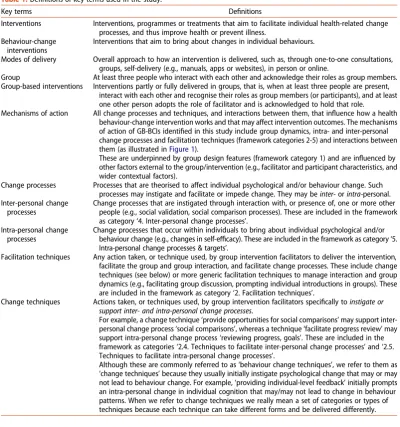
Table 1.Definitions of key terms used in the study.
Key terms Definitions
Interventions Interventions, programmes or treatments that aim to facilitate individual health-related change
processes, and thus improve health or prevent illness. Behaviour-change
interventions
Interventions that aim to bring about changes in individual behaviours.
Modes of delivery Overall approach to how an intervention is delivered, such as, through one-to-one consultations,
groups, self-delivery (e.g., manuals, apps or websites), in person or online.
Group At least three people who interact with each other and acknowledge their roles as group members.
Group-based interventions Interventions partly or fully delivered in groups, that is, when at least three people are present, interact with each other and recognise their roles as group members (or participants), and at least one other person adopts the role of facilitator and is acknowledged to hold that role.
Mechanisms of action All change processes and techniques, and interactions between them, that influence how a health
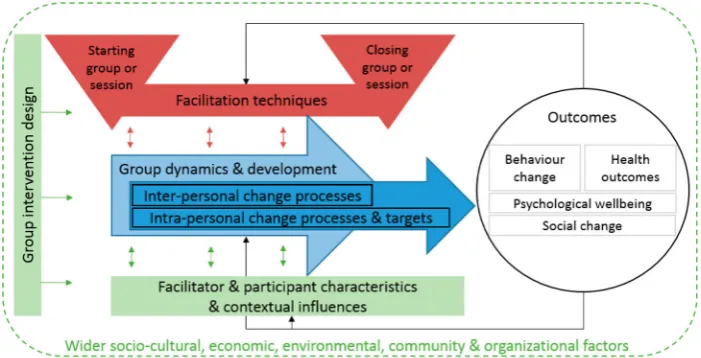
behaviour-change intervention works and that may affect intervention outcomes. The mechanisms of action of GB-BCIs identified in this study include group dynamics, intra- and inter-personal change processes and facilitation techniques (framework categories 2-5) and interactions between them (as illustrated inFigure 1).
These are underpinned by group design features (framework category 1) and are influenced by other factors external to the group/intervention (e.g., facilitator and participant characteristics, and wider contextual factors).
Change processes Processes that are theorised to affect individual psychological and/or behaviour change. Such
processes may instigate and facilitate or impede change. They may beinter-orintra-personal. Inter-personal change
processes
Change processes that are instigated through interaction with, or presence of, one or more other people (e.g., social validation, social comparison processes). These are included in the framework as category‘4. Inter-personal change processes’.
Intra-personal change processes
Change processes that occur within individuals to bring about individual psychological and/or behaviour change (e.g., changes in self-efficacy). These are included in the framework as category‘5. Intra-personal change processes & targets’.
Facilitation techniques Any action taken, or technique used, by group intervention facilitators to deliver the intervention, facilitate the group and group interaction, and facilitate change processes. These include change techniques (see below) or more generic facilitation techniques to manage interaction and group dynamics (e.g., facilitating group discussion, prompting individual introductions in groups). These are included in the framework as category‘2. Facilitation techniques’.
Change techniques Actions taken, or techniques used, by group intervention facilitators specifically toinstigate or support inter- and intra-personal change processes.
For example, a change technique‘provide opportunities for social comparisons’may support inter-personal change process‘social comparisons’, whereas a technique‘facilitate progress review’may support intra-personal change process‘reviewing progress, goals’. These are included in the framework as categories‘2.4. Techniques to facilitate inter-personal change processes’and‘2.5. Techniques to facilitate intra-personal change processes’.
implementation), change processes (or mechanisms of action), and elements of group design and contextual factors, and compared these with the categories in the a priori framework.
Taxonomies categorising change techniques
We selected and reviewed six widely-used taxonomies of categories of change techniques. We will, hereafter, use the term ‘change technique’ as shorthand for a defined category of potentially-effective actions or practices assumed to influence a specified change mechanism which may or may not be effective in prompting psychological and/or behaviour change (Abraham,2016). They were: (i) a theoretically-linked list of 23 frequently-used change techniques (Abraham & Michie, 2008), (ii) the CALO-RE taxonomy for diet and physical activity interventions (Michie et al., 2011), (iii) the Behaviour Change Technique Taxonomy v1 (BCTTv1) (Abraham et al.,2015; Michie et al., 2013), (iv) the Intervention Mapping taxonomy (Kok et al.,2015), (v) the Oxford Food and Activity Behaviors (OxFAB) taxonomy of techniques used by participants for weight loss (Hartmann-Boyce et al.,2016), and (vi) a taxonomy of group-specific techniques used in smoking cessation programmes (West et al.,2010). From these, we identified change techniques that aregroup-specific(i.e., unique to groups or particularly suitable to group delivery due to being dependent on personal inter-action) andgroup-sensitive(i.e., which operate at an intra-personal level but may be adapted to, or affected by, group delivery). Initially, the first author identified potentially relevant change tech-niques. Then, thefirst and second authors reviewed each taxonomy together and discussed all tech-niques, comparing them with, and where relevant adding novel concepts to, the mechanisms identified in the developing framework.
Measures of group processes
Through electronic searches and personal communication with other researchers working on groups, we identified three reviews of measures of intra-group processes (Cahill et al.,2008; Delucia-Waack, 1997; Orfanos,2015), and other reviews of potentially relevant measures (Bales,1950; Beck & Lewis, 2000; Chapman, Baker, Porter, Thayer, & Burlingame,2010; Estabrooks & Carron,2000; Kiesler,2004; Lee, Koopman, Hollenbeck, Wang, & Lanaj,2015; Roter & Larson,2002; Tate, Rivera, Conwill, Miller, & Puig,2013; Wilson et al.,2008; Wölfer, Faber, & Hewstone,2015).
[image:7.493.70.421.53.232.2]From these reviews four types of measures were identified: (i) screening tools to assess partici-pants’suitability for, orfit with, the group; (ii) measures to assess group facilitators’skills and beha-viours; (iii) tools to analyse and assess group interaction; and (iv) questionnaires designed for group
participants to assess perceptions of group characteristics, climate and processes. We listed measures (Supplementary Document 3) and added novel mechanisms and concepts identified therein to the developing framework.
Qualitative studies of participants’experiences of groups
We reviewed qualitative studies of participants’perceptions and experiences of group-based inter-ventions, focusing on interventions supporting weight loss in overweight or obese adults. We searched electronic databases (Medline, PsycINFO, PsycARTICLES, Embase, Social Policy and Practice accessed via Ovid platform) between 2000 and June 2016 using a detailed search strategy (Sup-plementary Document 2) and screened over 4000 identified references. Twenty-seven studies were included and uploaded to NVivo where they were thematically coded to identify categories that were compared with and, where relevant, added to the developing framework. (For details see Supplementary Document 2). Common themes included factors related to individuals (e.g., pre-vious experiences of weight loss), group design (e.g., contact time, venue), facilitators (e.g., personal and professional qualities), group context (e.g., group climate), change processes (e.g., accountability to the group, peer pressure), aspects of practical delivery, and content of group sessions (e.g., group activities and topics).
Qualitative content analysis of recorded group sessions and intervention manuals
We analysed group session recordings from three GB-BCIs targeting changes in diet and physical activity to support weight loss and its maintenance: (i) the‘Living Well Taking Control’(LWTC) pro-gramme (www.isrctn.com/ISRCTN702216700; Kok et al., 2016; Smith et al.,under review), (ii) the
‘Skills for weight loss Maintenance’(SkiM) intervention (www.isrctn.com/ISRCTN45134679), and (iii) the ‘Waste the Waist’ (WtW) intervention (www.isrctn.com/ISRCTN10707899; Gillison et al., 2012, 2015; Greaves et al., 2015). The three interventions were selected as a starting point for this work because (a) they all targeted the same behaviour change objectives; (b) they were all systematically designed employing recent psychological and behavioural science evidence and, therefore, provided examples of contemporary applications of behaviour change theory and techniques to alter specified behavioural targets; and (c) pragmatically, because the authors had access to the data from these interventions. Ethics approvals were in place for these three studies, including participant consent for audio-recording and analysis of the group sessions. All three interventions were based on avail-able intervention delivery manuals, and were delivered in small groups (up to 15 participants) in com-munity venues by trained facilitators with backgrounds in health promotion, diet or physical activity. Each involved a range of recognised change techniques delivered using a mixture of interactive group discussions, activities, provision of information about healthy diet, physical activity and weight loss, and self-monitoring diaries. For details about the interventions see Supplementary Docu-ment 4.
Session recordings were sampled using a purposeful strategy to maximise the diversity of tran-scripts (see below; for details of which sessions were sampled in each stage of analysis, see Sup-plementary Document 5). The recordings were transcribed verbatim, including audible non-verbal behaviours, such as laughter. The transcripts were checked for accuracy with recordings and uploaded to NVivo (v10/11) where they were organised to support analysis.
words, to capture what happened in the group, including examples of group activities, group pro-cesses and facilitation techniques.
In the second stage, we selected (sampling to ensure diversity of groups, session numbers and facilitators) an additional 28 transcripts from LWTC (n= 12) and SkiM (n= 16). Remaining recordings of WtW sessions were of insufficient quality and could not be included. In this stage we deductively coded the transcripts using a draft MAGI framework. To enable more reliable coding and double-coding, based on the evolving definitions of concepts included in the framework, we drafted coding instructions for all framework categories. The first author coded all the transcripts, and six transcripts were independently double-coded by four co-authors and one external researcher using the draft coding instructions. After the double-coding, the instructions and draft framework were revised to capture any new categories identified, improve the definitions and make the coding instructions more precise. Thefinal coding instructions are available in Supplementary Docu-ment 6 and more details of these qualitative analyses are provided in the technical study report (Borek et al.,In Press).
In addition to analysing transcripts of recordings of group sessions, we selected the primary inter-vention manual used to deliver group sessions from each of the three interinter-ventions and uploaded them to NVivo (v10/11). We coded the content of the manuals, identifying sections of text related to group delivery, such as instructions for group facilitation (e.g., facilitation style, group activities), and change techniques (e.g., goal setting). The codes were then compared to our developing framework.
To supplement the qualitative analyses of session transcripts and delivery manuals, thefirst author observed eight LWTC sessions from three different groups and the third author observed three SkiM sessions (all delivered around Exeter, UK). Field notes were kept and referred to but not formally ana-lysed. These observations shaped our interpretation of how participants interacted with each other and the facilitator and highlighted potentially-important GB-BCI characteristics and processes that cannot be identified in audio recordings of group sessions (e.g., room set-up, non-verbal behaviour).
Expert consultations
Throughout the research, we sought expert input and feedback on the evolving framework from other researchers working with GB-BCIs, group facilitators and group participants. In the early stages, we consulted with two group participants from the LWTC programme and with two group facilitators from the LWTC and SkiM interventions. In thefinal stage of the research, we consulted with four LWTC participants and four group facilitators (LWTC and SkiM). Throughout the research, we sought feedback from researchers and practitioners at relevant conferences, a departmental seminar and by running a workshop at a national conference. We also sought feedback from 12 researchers and practitioners external to the research team with backgrounds in health behaviour change and group interventions who had agreed to be contacted, of whom seven provided detailed written comments on the near-final version of the framework. We asked these experts how groups might facilitate or impede behaviour changes and health outcomes, what the important processes and facilitation strategies in groups might be, and about benefits and challenges of delivering inter-ventions in groups. We also asked them to comment on, and suggest improvements to, the frame-work. Feedback informed extension, revision and refinement of the developing framework.
Results
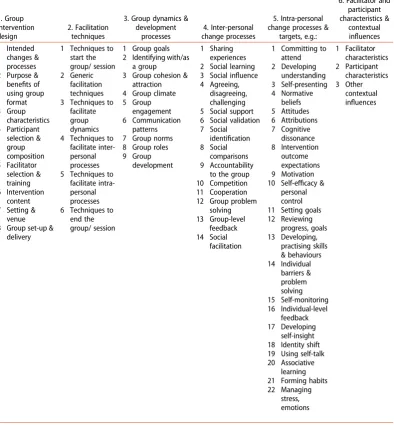
categories, are illustrated inFigure 1and specific elements in the six categories are presented inTable 2. Supplementary Document 7 includes detailed definitions and examples of the framework cat-egories, and hypothesised processes by which they may influence each other. Each of the categories, and key elements within them are described in turn below.
Group intervention design
These are features of GB-BCI design that may affect the functioning of the group and the delivery and receipt of intended change processes. Group intervention design features identified included (1.1)
[image:10.493.51.446.68.496.2]intended processesand outcomes of the intervention (as would be specified in an intervention logic model), and the (1.2)purpose and benefits of using a group format. For example, if peer support is deemed an important basis for using a group format, facilitation techniques that promote peer support processes could be planned, rather than expecting such support to occur spontaneously.
Table 2.Mechanisms of action in group-based interventions (MAGI) framework.
1. Group intervention design
2. Facilitation techniques
3. Group dynamics & development
processes
4. Inter-personal change processes
5. Intra-personal change processes &
targets, e.g.:
6. Facilitator and participant characteristics &
contextual influences 1 Intended
changes & processes 2 Purpose &
benefits of using group format 3 Group characteristics 4 Participant selection & group composition 5 Facilitator selection & training 6 Intervention content 7 Setting &
venue 8 Group set-up &
delivery
1 Techniques to start the group/ session 2 Generic
facilitation techniques 3 Techniques to
facilitate group dynamics 4 Techniques to
facilitate inter-personal processes 5 Techniques to
facilitate intra-personal processes 6 Techniques to
end the group/ session
1 Group goals 2 Identifying with/as
a group 3 Group cohesion &
attraction 4 Group climate 5 Group
engagement 6 Communication
patterns 7 Group norms 8 Group roles 9 Group
development
1 Sharing experiences 2 Social learning 3 Social influence 4 Agreeing,
disagreeing, challenging 5 Social support 6 Social validation 7 Social
identification 8 Social
comparisons 9 Accountability
to the group 10 Competition 11 Cooperation 12 Group problem
solving 13 Group-level
feedback 14 Social
facilitation
1 Committing to attend 2 Developing understanding 3 Self-presenting 4 Normative beliefs 5 Attitudes 6 Attributions 7 Cognitive dissonance 8 Intervention outcome expectations 9 Motivation 10 Self-efficacy &
personal control 11 Setting goals 12 Reviewing progress, goals 13 Developing, practising skills & behaviours 14 Individual barriers & problem solving 15 Self-monitoring 16 Individual-level feedback 17 Developing self-insight 18 Identity shift 19 Using self-talk 20 Associative
Pre-specified (1.3)group characteristics(e.g., group size) and (1.4)participant selection and group composition, including participants’ demographic (e.g., age, gender) and condition-related (e.g., risk of diabetes) characteristics and attendance of any accompanying persons (e.g., partners), may affect interactions, and so alter operating change processes. For example, group size may affect pat-terns of interaction between members, whereas sharing certain characteristics may promote social identification and social comparison processes.
(1.5)Facilitator selection, especially facilitators’professional and personal skills, and training, may affectfidelity and quality of delivery and interaction patterns in the group so determining which change processes operate. For example, facilitators whom participants consider to be credible sources, with whom they identify (e.g., peers), and who have good inter-personal skills may be more able to instigate group identification and social influence processes.
(1.6) Intervention content, including participant and facilitator materials, session content, group activities, between-session tasks and any additional resources (e.g., extra classes, access to facilities), as well as contacts outside the group (e.g., additional one-to-one counselling) were identified as part of intervention design. The (1.7)setting and venue(e.g., room size, comfort, accessibility; community versus hospital settings) are also likely to shape participants’expectations and experiences of the program. Finally, (1.8) group set-up and delivery design elements include decisions about the contact time, and the intended facilitation style that will be used to generate planned change pro-cesses. Considering and planning these elements during intervention design is likely to optimise group dynamics and development that are conducive to the pursuit of group goals, and nurture planned change processes.
Facilitation techniques
These are used by group facilitators to deliver sessions, facilitate group dynamics, and initiate planned change processes. (2.1)Setting up the groupor starting the sessions (emphasised by the tri-angles inFigure 1) may help establish an interpersonal context conducive to inducing inter- and intra-personal change processes. Starting sessions in on-going, open groups may differ to starting sessions in time-bound, closed groups, which has implications for the design of group activities and content. For example, in open groups personal introductions may be repeated at the beginning of every session, whereas in closed groups they may be completed at the start of thefirst session only.
Throughout the lifespan of the group, facilitators may have different tasks requiring different types of facilitation techniques. For example, they shape group interaction and activities, deliver interven-tion content and facilitate positive, while managing any negative, group processes. We identified a range of facilitation techniques to fulfil these tasks, which we categorised as: (2.2)generic techniques
to facilitate group interaction and engagement; (2.3)techniques to facilitate positive group dynamics and development; (2.4)techniques to facilitate inter-personal change processes; and (2.5)techniques to prompt intra-personal change processes. These facilitation techniques might change or be adapted over time depending on emerging group dynamics and change processes, the needs and character-istics of the group and participants and their progress in achieving goals and intervention outcomes (hence two-way arrows inFigure 1).
Finally, we also identified (2.6)techniques for closing the group or session. These may help reinforce participants’ commitment to change and to return to the next session. Although some of these
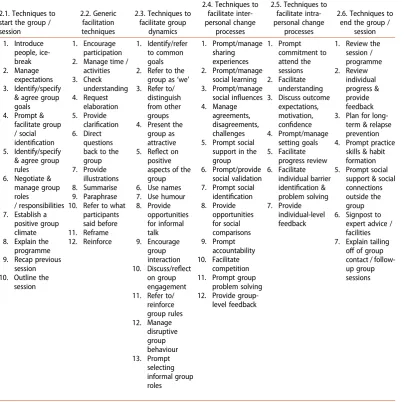
‘closing’techniques might be delivered throughout the intervention, the use of such techniques at the end of the group or session may be useful in reinforcing messages about the initiation and main-tenance of change. Examples of these different types of facilitation techniques are inTable 3.
Group dynamic and development processes
groups change over time (i.e., represented by the arrow inFigure 1). These processes are unique to a group setting and are relevant to different types of groups, regardless of whether they target per-sonal change. Successful development of positive group dynamics and progression into a cohesive, collaborative group working towards common goals may help create a social environment that pro-motes change processes. Conversely, negative group dynamics or impeded development may inhibit change processes and negatively affect participants’experiences of the group, increasing the likeli-hood of low attendance and drop out. Therefore, group dynamics and development may be concep-tualised as underpinning change processes in groups. Group dynamics can be influenced by facilitation techniques, facilitator and participant characteristics (and the relationship and interaction between them), and by contextual influences (e.g., wider social norms). These influences on group dynamics can be planned (e.g., selection of facilitation techniques) or unplanned and specific to the group (e.g., personalities of group members).
[image:12.493.49.454.64.466.2]Table 2lists the types of group dynamic processes and properties identified in this study. For a group of individuals to become a‘group’, they may need to develop or identify (3.1)group goal(s).
Table 3.Examples of different types of facilitation techniques.
2.1. Techniques to start the group / session
2.2. Generic facilitation techniques
2.3. Techniques to facilitate group
dynamics
2.4. Techniques to facilitate inter-personal change
processes
2.5. Techniques to facilitate intra-personal change
processes
2.6. Techniques to end the group /
session 1. Introduce people, ice-break 2. Manage expectations 3. Identify/specify
& agree group goals 4. Prompt &
facilitate group / social identification 5. Identify/specify
& agree group rules 6. Negotiate &
manage group roles
/ responsibilities 7. Establish a
positive group climate 8. Explain the
programme 9. Recap previous
session 10. Outline the
session
1. Encourage participation 2. Manage time /
activities 3. Check understanding 4. Request elaboration 5. Provide
clarification 6. Direct
questions back to the group 7. Provide
illustrations 8. Summarise 9. Paraphrase 10. Refer to what
participants said before 11. Reframe 12. Reinforce 1. Identify/refer to common goals 2. Refer to the
group as‘we’ 3. Refer to/
distinguish from other groups 4. Present the
group as attractive 5. Reflect on
positive aspects of the group 6. Use names 7. Use humour 8. Provide opportunities for informal talk 9. Encourage group interaction 10. Discuss/reflect
on group engagement 11. Refer to/
reinforce group rules 12. Manage disruptive group behaviour 13. Prompt selecting informal group roles 1. Prompt/manage sharing experiences 2. Prompt/manage social learning 3. Prompt/manage
social influences 4. Manage
agreements, disagreements, challenges 5. Prompt social
support in the group 6. Prompt/provide
social validation 7. Prompt social
identification 8. Provide opportunities for social comparisons 9. Prompt accountability 10. Facilitate competition 11. Prompt group
problem solving 12. Provide
group-level feedback 1. Prompt commitment to attend the sessions 2. Facilitate understanding 3. Discuss outcome
expectations, motivation, confidence 4. Prompt/manage setting goals 5. Facilitate progress review 6. Facilitate individual barrier identification & problem solving 7. Provide
individual-level feedback
1. Review the session / programme 2. Review individual progress & provide feedback 3. Plan for
long-term & relapse prevention 4. Prompt practice
skills & habit formation 5. Prompt social
support & social connections outside the group 6. Signpost to
expert advice / facilities 7. Explain tailing
This might involve a common purpose or task for the group (e.g., organising a health-related event), or individual goals that group members have in common and work towards (e.g., losing weight). (3.2)
Identification with or as a group, that is developing a perception that a number of people constitute a group and are group members (i.e., self-defining as a group), is another process that underlies forming a group. Group goals and identification may contribute to development of (3.3)group cohe-sion and attractiveness(i.e., bonds that members have with the group and each other). Stronger cohe-sion and perception of attractiveness of the group to its members (e.g., that it fulfils their needs and goals) can affect members wanting to belong to, and remain in, the group.
Moreover, group dynamics include: (3.4)group climate(i.e., a socio-emotional context or group atmosphere); (3.5)group engagement(how actively members participate in the group); (3.6) com-munication patterns(how participants communicate with each other and with the facilitators, and how co-facilitators interact); (3.7)group normswhich include explicit and implicit rules about accep-table and unaccepaccep-table behaviour in the group; (3.8)group roleswhich refer to members’formal and informal functions and responsibilities within the group (e.g., formal–a facilitator, a treasurer; infor-mal–a joker, debater). Finally, (3.9)group developmentrefers to how a group itself may change over time. Among many models and theories on how groups change, commonly groups are thought to move through the stages of forming, storming (insecurities, tensions), norming (establishing patters and relations), performing (working towards group goals) and (often) adjourning (Tuckman & Jensen,1977).
These group dynamic and development properties and processes are interactive and may have reciprocal effects. For example, identifying with the group may help identify a common group goal and create a sense of group cohesion, whereas group cohesion may be measured through a sense of identification with the group and perceptions of common group goals. Such group dynamics occur in any types of groups and they emerge regardless of the facilitator’s actions. However, facil-itators can actively promote positive group dynamics, for example, through identifying and agreeing on group rules for working together, and helping resolve any conflicts or tensions.
Inter-personal change processes
These are change processes that are instigated and operate in social contexts and through social (or group) interactions. They are unique to, or reinforced by, the group context. They can be influenced by group dynamics, such as establishment of a common goal, a sense of group identification and cohesion, and confidential and supportive group climate.
Many behaviour-change groups are interactive groups, in which participants (4.1)share experi-encesand have an opportunity to learn from each other (4.2. social learning) by exchanging infor-mation, advice and ideas (through group discussions), and by modelling or vicarious learning (e.g., through group activities). Group interaction can also be a source of (4.3)social influencewhereby par-ticipants influence each other’s beliefs or behaviours, for example, by referring to personal experi-ences and expertise, using health-promoting or ‘resistant’ talk, exerting persuasion or providing encouragement or pressure. Participants may also influence each other directly through (4.4) agree-ing or disagreeagree-ing with, or challengagree-ing, each other.
Many health-related groups offer opportunities for (4.5) social support in the group, which can involve informational (e.g., exchange of information), emotional (e.g., encouragement) or practical support (e.g., buddying up to do something together). As part of social support processes, groups may also provide opportunities for making new social connections (thus, they may help reduce iso-lation and develop a support network) and for providing support to others (thus, capitalising on benefits of reciprocity). Groups can also provide opportunities for (4.6)social validationof, or normal-ising, participants’experiences, and helping them realise that they are not alone with a problem or challenge, which can reinforce self-efficacy and self-esteem.
shared identities (from outside the group) and/or development of a new group identity among members. Change might be particularly reinforced if group member identities promote health-related social norms and behaviours. Conversely, health-impeding identities may need to be explored and re-defined in the group in ways that can bolster behaviour change. Being in a group may also create opportunities for upward and downward (4.8) social comparisons(including identifying or becoming role models) and for feeling (4.9) accountable to the group for achieving individual or group goals, which might motivate participants to take action. Similarly, (4.10)competitionmight be a source of motivation to improve performance, either compared to others in a group (intra-group competition) or to other (intra-groups (inter-(intra-group competition). Participants may equally (4.11)
cooperateby working together to achieve group or individual goals.
Change can also be instigated and reinforced by collaborative (4.12)group problem solving(i.e., involving group members discussing common‘problems’or challenges and identifying possible sol-utions), and by providing (4.13) feedback to the group on the group performance (which may reinforce common group goals and cooperation). Finally, being in a group might prompt (4.14)
social facilitation, whereby people’s performance on simple or well-trained tasks may improve, whereas the performance of less established, complex skills may be undermined, by being in the presence of others.
Intra-personal change processes and targets
Intra-personal change processes and psychological targets (e.g., beliefs) operatewithinindividuals and can be instigated without a group. When generated in a group, intra-personal change processes may be affected or prompted by inter-personal processes, or they may occur simultaneously. Both these types of change processes may be also affected by the group dynamics and development, facil-itator techniques, facilfacil-itator and participant characteristics, and the wider socio-cultural context within which the group operates (as illustrated in Figure 1). Moreover, intra-personal change pro-cesses may, and should for longer-term effects, extend beyond the group (as represented by the darker arrow extending beyond the lighter ‘group dynamics’ arrow in Figure 1). Here we report selected examples of intra-personal change processes that are particularly common in, and adaptable to, group-based delivery.
Group sessions require considerable time and effort so participants need to (5.1)commit to attend the group. In the group, participants can (5.2) develop and express understanding(or lack of under-standing), which can be facilitated by social learning processes. Interacting in a group, participants may (5.3)self-presentthemselves in an intentional way (e.g., as health-oriented) and express their health-related (5.4)normative beliefs, (5.5)attitudes, (5.6)attributions, (5.8)expectations of interventions outcomes, (5.9)motivation, or (5.10)self-efficacy andsense ofpersonal control(or lack thereof). They may express, discuss and acknowledge changes in these targets, which, in turn, can be affected by the group and others’ expressions. Moreover, if the expressed beliefs or attitudes are different from participants’behaviour patterns, the resultant (5.7)cognitive dissonancecould prompt change in motivation and behaviour to reduce the inconsistency. Group interaction and sharing can also help develop (5.17)self-insightand a better self-understanding, and might affect (5.18)changes in self-identity(e.g., becoming a‘new’, healthy person).
Many behaviour-change groups involve participants (5.11)setting goals, (5.12)reviewing goals or progress, (5.14)identifying individual barriers and solutions to them, and (5.16)feedback on individual performance. These techniques, intra-personal in nature, can be facilitated in groups collaboratively by engaging group participants, discussing their goals, progress or barriers, and thus facilitating inter-personal change processes, such as sharing experiences, social learning, or accountability. Groups can also provide a context for (5.13) developing and practising new skills and behaviours
that can prompt modelling. They can be good platforms for discussing and sharing ideas for (5.15)
(5.22)stress and emotional management. This is not an exhaustive list; many more intra-personal pro-cesses involved in behaviour change have been identified in other studies. Here we have highlighted intra-personal change processes commonly targeted in GB-BCIs and especially those that may be par-ticularly sensitive to group delivery (i.e., those that may be enhanced or impeded by group dynamics, inter-personal change processes and facilitation techniques).
Facilitator and participant characteristics, and other contextual influences
These are factors external to the group that may influence, and be influenced by, what happens in the groups (i.e., by group dynamics and inter- and intra-personal change processes). The identified (6.1)
facilitator characteristics,that may influence the group and participants, include facilitators’ personal-ity and inter-personal skills (e.g., warmth, relatedness), cognitive and emotional factors influencing their role (e.g., knowledge, experiences, passion), professional skills and experience (e.g., in presen-tation, group management), or demographic characteristics (e.g., age, gender, ethnicity, related health conditions). Similarly, we identified (6.2) participant characteristics including, for example, their personality, cognitive and emotional factors, physical or mental health issues, values and beliefs, initial motivation, personal agenda or reasons to attend, readiness to change, type of locus of control, level of knowledge, or previous experiences. These facilitator and participant character-istics are ‘brought’to the group, may influence group interaction and relationships (e.g., rapport with others in the group), and may change over time as a result of participating in, or facilitating, the groups (e.g., increased assertiveness, confidence, skills). Some of these characteristics may be controlled at the GB-BCI design stage by a selection of facilitators or members. Others might be more difficult or impractical to control but, to some extent, may be managed in the group through facilitation techniques. (6.3)Other contextual influencesmay also affect the group and indi-vidual change, including, for example, available support networks and social connectedness, positive or negative influences of other people, social situations (e.g., celebrations, eating out) or wider social norms. All of these factors may be present and affect participants outside the group but may be also brought into, and discussed in, the group, thus providing opportunities for inter-personal change processes (e.g., sharing experiences, group problem solving).
Outcomes and wider influencing factors
Outcomesof GB-BCIs include a range of intended and unintended outcomes, such as changes in psychological processes underpinning individual behaviour change, physical health outcomes tar-geted in interventions (e.g., weight loss), and changes in psychological wellbeing (e.g., self-esteem, self-efficacy, social connectedness, mental health), all of which may improve overall health-related quality of life. They may also include social change (e.g., in norms or practices) across groups of indi-viduals. Outcomes may be affected, directly or indirectly, by inter- and intra-personal change pro-cesses and the underlying group dynamics. Feedback on outcomes, or perception of progress towards them (or its lack), can affect all other elements of GB-BCIs, i.e., group dynamics, change pro-cesses, facilitation techniques used by the facilitators, and individual characteristics and contextual factors (as represented in Figure 1 by the black arrows going from Outcomes). As outcomes are specific to each intervention, they are not discussed further here.
Discussion
This research identified a range of concepts related to group design, delivery, context and change processes that together explain mechanisms of action capable of generating behaviour change in group-based behaviour-change interventions (GB-BCIs). These were integrated into a framework, comprising six overarching categories and 62 more specific sub-categories, derived from Borek and Abraham (2018), reviews of relevant literatures, qualitative coding and expert consultations. By highlighting how GB-BCIs may influence individual psychological and behaviour change, the fra-mework can be used to guide design, delivery and evaluation of GB-BCIs, and can also inform training for group facilitators.
Many of the change processes identified in the framework likely co-occur and interact dynami-cally. For example, the process of sharing experiences may prompt social learning and social vali-dation. Inter-personal change processes can occur between individuals (e.g., group members engage in group problem solving) as well aswithinindividuals (e.g., group members identify sol-utions to personal barriers in response to group interaction). To optimise effectiveness, these may need to be planned in advance and facilitatedin situduring GB-BCIs. Intra-personal change processes also occur within, and are affected by, the inter-personal, group context. For example, goal setting might be specified and refined by sharing and discussing one’s goals with the group, or impeded by not having the time or opportunity to sufficiently focus and reflect on individual needs. Moreover, for any behaviour change to occur,inter-personal change processes will need to promptintra -per-sonal change, andintra-personal change processes may need to extend outside or beyond the dur-ation of the group to lead to sustained individual behaviour change. Importantly, some of these processes may also negatively affect psychological or behaviour change; for example, identifying with stigmatised social groups (e.g., Crabtree, Haslam, Postmes, & Haslam,2010) or making social comparisons with those performing much better than oneself may decrease the motivation, self-efficacy and self-esteem (Abraham & Gardner,2009). Our framework provides a menu from which to select targeted processes that then need to be carefully designed-into GB-BCIs, actively facilitated, and checked for feasibility, acceptability and their correct functioning.
GB-BCIs vary greatly in their design, implementation, targeted change mechanisms and outcomes. The framework offers a set of categories all of which are more or less important in different GB-BCIs. Practical limitations can make it difficult to control all of these processes in intervention design and implementation. This may, in turn, curtail investigations of change processes during subsequent process evaluations. Nonetheless, the extent of specificity is likely to enhance GB-BCI design, delivery and evaluation. Striving for design precision is crucial to enable robust evaluation and to optimise intervention effectiveness. The MAGI framework provides a categorical system to facilitate design precision and specification of change processes in logic models. Not all concepts, processes and tech-niques included in the MAGI framework will be relevant to all interventions. Designers and evaluators of GB-BCIs will need to select those categories from the MAGI framework most pertinent to their intervention depending on the intended change processes, outcomes and delivery context. Use of the framework in this way would provide a structured basis for further research to empirically estab-lish the relevance and importance of the specific concepts, processes and techniques across different interventions.
Implications
of a shared social identity in the group (e.g., by ensuring homogeneous group composition and small group size) and facilitation methods (e.g., by encouraging member interactions, different types of participation and allowing breaks) (Tarrant et al., 2016). Alternatively, the design may specify changing health-related normative beliefs through changing group norms, facilitated by specific group activities, such as group discussions about relevant social norms and normative beliefs and role plays in which participants critique norms and beliefs that may lead to unhealthy behaviours or thought patterns (e.g., Cruwys, Haslam, Fox, & McMahon,2015)–or both social identifi -cation and normative belief changes may be targeted. Moreover, it is important to design and adapt GB-BCIs to take account of the specific characteristics and needs of targeted participants and wider contextual influences. This may include making relevant (e.g., cultural) adaptations, or ensuring that the selection of participants provides a degree of homogeneity in relation to health needs, socio-economic challenges and cultural commonalities. This can render group activities more relevant to participants, facilitate better group identification and cohesion, facilitate social validation between members and minimise the risk of widening health inequalities. The (highly effective) Football Fans in Training intervention is a good example of selecting participants with things in common (being male, overweight football fans) to enhance intra-group cohesion (Gray et al., 2013; Hunt et al., 2014). By providing an overview of key change processes operating in groups, the MAGI framework extends existing guidance on designing health behaviour-change interventions and we envisage that it will be used in conjunction with such guidance (e.g., Bartholomew, Parcel, Kok, Gottlieb, & Fernandez,2016; Craig et al.,2008; Hoddinott et al.,2010; Wight, Wimbush, Jepson, & Doi,2016).
Implications for GB-BCI delivery:The framework highlights the role of facilitators, their character-istics and skills in using facilitation techniques, and how these might affect the operation and main-tenance of change processes critical to intervention outcomes. Consequently, facilitator training and competencies are critical to optimising GB-BCI effectiveness (e.g., Avery, Whitehead, & Halliday,2016; Dixon & Johnston,2010; Michie et al.,2011; Reddy, Vaughan, & Dunbar,2010). This can be informed by examination of facilitators’experiences of delivering GB-BCIs (e.g., Barlow,2005; Catalano, Kendall, Vandenberg, & Hunter,2009; Hipwell, Turner, & Barlow,2008). Facilitators of GB-BCIs have three main tasks: to facilitate group dynamics, to ensure delivery of intervention content, and to promote tar-geted change processes. Identifying and using effective techniques to facilitate group dynamics, including managing counter-productive interaction, is critical, as is expertise in the targeted beha-viours and selected change techniques. The MAGI framework can be used as a resource for group facilitators, improving their understanding of the group processes that are sensitive or unique to group delivery and in designing facilitator training. It is also relevant, for example, to shared consul-tation groups in general practice for patients with long-term illnesses (Egger, Stevens, Ganora, & Morgan,2018).
Implications for GB-BCI evaluation:The framework can also be a guide to process evaluations of GB-BCIs. It could help structure group session observations, analyses of session recordings, guide partici-pant and facilitator interviews or design of questionnaires evaluating participartici-pant and/or facilitator perceptions and experiences of GB-BCIs. Investigating the role and impact of specific design elements and group processes, either pre-designed or unintended, can explain how outcomes were affected. For example, investigating characteristics of the venue and setting (e.g., organisational culture and its impact on facilitators and participants) (e.g., Hoddinott, Britten, & Pill,2010), group dynamics (e.g., group conflicts) (e.g., Nackers et al.,2015) or communication patterns (e.g., facilita-tor–participant talk ratios) (e.g., Stenov, Henriksen, Folker, Skinner, & Willaing,2016) can explain vari-ations in intervention outcomes. The MAGI study report (Borek et al.,In Press) provides examples of how the framework can be used to identify facilitation techniques and change processes from tran-scripts of group sessions, and suggestions for mixed-methods approaches to exploring links between group processes and outcomes.
processes, both in design and reporting. This could facilitate further research anddevelopment of evidenceon which of the GB-BCI design features and change processes included in the framework may improve intervention outcomes. Secondly, systematic reviews that (1) appraise evidence underpinning each framework concept to justify its inclusion in our framework or estimate its impor-tance, and (2) that synthesise qualitative studies on people’s experiences of other types of groups, could usefully extend and refine our framework. Further research needs to verify generalisability of the framework, and refine it to be applicable, to other types of groups, contexts and populations (e.g., groups for addictions, management of chronic illness, in education settings, involving partici-pants in different cultural/ethnic backgrounds, children, and delivered one-to-one or virtually/ online). Thirdly, it would be useful to formallymap available quantitative measures of group dynamics and processesto framework concepts to aid selection for use in future research and identify areas for further development. Ourqualitative methods for coding and analysing group sessions, more sophisti-cated quantitative group-level analyses and further mixed-methods and other approaches (e.g., systems-based, realist) could then be developed and applied to facilitate more detailed examination of mechanisms in GB-BCIs. Linkingfindings on mechanisms to data on engagement and outcomes in particular would help build an evidence base on what group features, facilitation techniques and group processes are important, when and for whom in GB-BCIs, and how group dynamics and processes are influenced by the participant and wider contextual characteristics. Such evidence would help validate, refute or extend aspects of our framework and be used to improve delivery or inform design. Finally, developing and evaluating facilitator training toolkits to help facilitators competently employ specific techniques for participant engagement, group dynamics and change processes, and identifying new facilitation and change techniques would further help to optimise the delivery of GB-BCIs.
Strengths and limitations
The MAGI framework is, to our knowledge, the most comprehensive theoretical synthesis of change processes operating in GB-BCIs. It bridges a gap between the extensive literature on group dynamics in social psychology and the growing literature on individual change processes and techniques in health psychology. We drew upon multiple different methods and sources to identify relevant con-cepts and processes, including literature, qualitative data, and consultations with group participants, facilitators, researchers and practitioners. By combining and triangulating results from the different steps of the study, we have created a more comprehensive and integrated review than previous studies (e.g., Davis et al.,2015; Grant, Treweek, Dreischulte, Foy, & Guthrie,2013; Pound & Campbell, 2015). We kept records of decisions involved in the framework development and its refinements and where the included concepts and processes were identified, ensuring that the framework develop-ment process was as transparent as possible (see Borek et al.,In Press).
Due to the extensiveness of the relevant research literature published over decades and across disciplines, it was not feasible to systematically search and reviewallpotentially relevant literature on each of the change processes and concepts included in the framework. We focused primarily on weight-loss interventions, and on face-to-face groups for adults. Consequently, we might have missed some characteristics, processes and techniques relevant to GB-BCIs, and generalisability of the framework to other types of GB-BCIs is yet unclear, especially in groups targeting different beha-viours, in other types of groups (e.g., online) or in other populations (e.g., children or families).
provides the most up-to-date and comprehensive synthesis available that can be further developed, revised and validated by other researchers.
We also note the limitations inherent in mapping the framework categories to the steps in which they were identified (as reported in the Supplementary Material 1). Different studies might define and operationalise concepts or processes differently, despite using similar terminology. There is also a variable quantity and quality of evidence supporting the processes and hypotheses included in our framework, some of which still need to be empirically tested. The categories included in the fra-mework are, therefore, specified and operationalised to differing extents and there is variation in the theoretical detail and empirical evidence underpinning them, which should be taken into account when using the framework to design GB-BCIs. While the framework aims to provide a ‘menu’of options, it does not provide recommendations on which change processes should be targeted or which facilitation techniques should be used and how they should be delivered in practice. All such categorisation systems evolve as empirical evidence accumulates, and the MAGI framework is likely to evolve as further research is conducted and evidence accumulates on change processes in a wider range of group interventions.
Conclusion
The mechanisms of action in group-based interventions (MAGI) framework is a synthesis of group characteristics, change processes and categories of change techniques that can explain individual behaviour change arising from group-based interventions. The framework summarises group design features, dynamics, development processes, inter- and intra-personal change processes in groups, and how they interact with each other. It identifies facilitation techniques used to instigate and facilitate behaviour change in groups, and acknowledges facilitator and participant character-istics as well as contextual influences that affect the processes and outcomes in group-based inter-ventions. It is a comprehensive resource for designers, facilitators and evaluators of GB-BCIs. It can be used to select characteristics and processes important to a particular intervention and so guide inter-vention design and facilitator selection and training.
Acknowledgements
We would like to thank all facilitators and participants in the three group-based interventions from which we used data (Waste the Waist, Skills in weight loss Maintenance, Living Well Taking Control). We thank A/Prof Matthew Jones and Dr Leon Poltawski for their helpful insights and advice, Mrs Jaine Keable from Westbank for access to their Living Well Taking Control programme, and the members of the advisory groups, including group facilitators (Miss Amy Clarke, Miss Sian Derrick, Mrs Ruby Entwistle and Mrs Anna Murch), representatives from the public and patients involvement group (Mrs Sue Sedgman, Mr Douglas Osman, Mrs Jackie Morant and Mr Andrew Wilkie) and researchers (Dr Amanda Avery, Dr Yael Bar-Zeev, Dr Enzo Di Battista, Dr Tegan Cruwys, Dr Liz Glidewell, Dr Cindy Gray, Dr Marta Moreira Marques, and Dr James Nobles) for feedback on the framework.
Disclosure statement
No potential conflict of interest was reported by the authors.
Funding
ORCID
Aleksandra J. Borek http://orcid.org/0000-0001-6029-5291
Charles Abraham http://orcid.org/0000-0002-0901-1975
Colin J. Greaves http://orcid.org/0000-0003-4425-2691
Fiona Gillison http://orcid.org/0000-0002-6461-7638
Sarah Morgan-Trimmer http://orcid.org/0000-0001-5226-9595
Rose McCabe http://orcid.org/0000-0003-2041-7383
Jane R. Smith http://orcid.org/0000-0001-5658-9334
References
Abraham, C. (2016). Charting variability to ensure conceptual and design precision: A comment on Ogden (2016).Health Psychology Review,10, 260–264.doi:10.1080/17437199.2016.1190293
Abraham, C., & Gardner, B. (2009). What psychological and behaviour changes are initiated by‘Expert Patient’training and what techniques are most helpful?Psychology & Health,24(10), 1153–1165.doi:10.1080/08870440802521110
Abraham, C., & Michie, S. (2008). A taxonomy of behaviour change techniques used in interventions.Health Psychology,27 (3), 379–387.doi:10.1037/0278-6133.27.3.379
Abraham, C., Wood, C. E., Johnston, M., Francis, J., Hardeman, W., Richardson, M., & Michie, S. (2015). Reliability of identifi -cation of behaviour change techniques in intervention descriptions.Annals of Behavioral Medicine, 1–16.doi:10.1007/ s12160-015-9727-y
Association for Specialists in Group Work. (2000). Association for specialists in group work professional standards for the training of group workers.The Journal for Specialists in Group Work,25(4), 327–342.doi:10.1080/01933920008411677
Avery, A., Whitehead, K., & Halliday, V. (2016).How to facilitate lifestyle change: Applying group education in healthcare. Chichester, UK: Wiley-Blackwell.
Bales, R. F. (1950).Interaction process analysis: A method for the study of small groups (Vol. Xi). Oxford, England: Addison-Wesley.
Barlow, J. H. (2005). Volunteer, lay tutors’experiences of the chronic disease self-management course: Being valued and adding value.Health Education Research,20(2), 128–136.doi:10.1093/her/cyg112
Bartholomew, L. K., Parcel, G. S., Kok, G., Gottlieb, N. H., & Fernandez, M. E. (2016).Planning health promotion programs: An intervention mapping approach(4th ed). San Francisco, CA: Jossey-Bass.
Beck, A. P., & Lewis, C. M. (2000).The process of group psychotherapy: Systems for analyzing change. Washington, DC: American Psychological Association.
Borek, A. J., & Abraham, C. (2018). How do small groups promote behaviour change? An integrative conceptual review of explanatory mechanisms.Applied Psychology: Health and Well-Being,10(1), 30–61.doi:10.1111/aphw.12120
Borek, A. J., Abraham, C., Greaves, C., & Tarrant, M. (2018). Group-based diet and physical activity weight-loss interven-tions: A systematic review and meta-analysis of randomised controlled trials.Applied Psychology: Health and Well-Being,10(1), 62–86.doi:10.1111/aphw.12121
Borek, A. J., Abraham, C., Smith, J. R., Greaves, C. J., & Tarrant, M. (2015). A checklist to improve reporting of group-based behaviour-change interventions.BMC Public Health,15(1), 963.doi:10.1186/s12889-015-2300-6
Borek, A. J., Smith, J. R., Greaves, C. J., Gillison, F., Tarrant, M., Morgan-Trimmer, S.,…Abraham, C. (In Press). Developing and applying a framework to identify and understand‘Mechanisms of Action in Group-based Interventions’(MAGI): A mixed-methods study. NIHR Efficacy & Mechanism Evaluation. Retrieved from www.journalslibrary.nihr.ac.uk/ programmes/eme/1420203/#
Brown, R. (1993).Group processes: Dynamics within and between groups. Cambridge: Blackwell.
Cahill, J., Barkham, M., Hardy, G., Gilbody, S., Richards, D., Bower, P.,…Connell, J. (2008). A review and critical appraisal of measures of therapist-patient interactions in mental health settings. Health Technology Assessment (Winchester, England),12(24), iii, ix–47.
Carroll, C., Booth, A., Leaviss, J., & Rick, J. (2013).‘Bestfit’framework synthesis: Refining the method.BMC Medical Research Methodology,13(1), 37.doi:10.1186/1471-2288-13-37
Cartwright, D., & Zander, A. (1968).Group dynamics: Research and theory(3rd ed). London: Tavistock.
Catalano, T., Kendall, E., Vandenberg, A., & Hunter, B. (2009). The experiences of leaders of self-management courses in Queensland: Exploring health professional and peer leaders’perceptions of working together.Health & Social Care in the Community,17(2), 105–115.doi:10.1111/j.1365-2524.2008.00801.x
Chapman, C. L., Baker, E. L., Porter, G., Thayer, S. D., & Burlingame, G. M. (2010). Rating group therapist interventions: The validation of the group psychotherapy intervention rating scale.Group Dynamics: Theory, Research, and Practice,14(1), 15.