Modelling the Self-Assembly of Silica-Based Mesoporous Materials
Miguel Jorge
1*, Andrew W. Milne
1, Olivia N. Sobek
1, Alessia Centi
1,§,
Germán Pérez-Sánchez
2, José R. B. Gomes
21) Department of Chemical and Process Engineering, University of Strathclyde, 75 Montrose Street, Glasgow G1 1XJ, United Kingdom
2) CICECO – Aveiro Institute of Materials, Department of Chemistry, University of Aveiro, Campus Universitário de Santiago, 3810-193 Aveiro, Portugal
*corresponding author email: [email protected]
§ Present address: Max Planck Institute for Polymer Research, Ackermannweg 10,
D-55128 Mainz, Germany
Abstract
Periodic Mesoporous Silicas (PMS) are one of the prime examples of templated porous materials – there is a clear connection between the porous network structure and the supramolecular assemblies formed by surfactant templates. This opens the door for a high degree of control over the material properties by tuning the synthesis conditions, and has led to their application in a wide range of fields, from gas separation and catalysis to drug delivery. However, such control has not yet come to full fruition, largely because a detailed understanding of the synthesis mechanism of these materials remains elusive. In this context, molecular modelling studies of the self-assembly of silica/surfactant mesophases have arisen at the turn of the century. In this paper, we present a comprehensive review of simulation studies devoted to the synthesis of PMS materials and their hybrid organic-inorganic counterparts. As those studies span a wide range of time and length scales, a holistic view of the field affords some interesting new insight into the synthesis mechanisms. We expect simulation studies of this complex but fascinating topic to increase significantly as computer architectures become increasingly powerful, and we present our view to the future of this field of research.
1. Introduction
In its broadest sense, Periodic Mesoporous Silicas (PMS) are materials
composed of an amorphous silicon dioxide (SiO2) scaffold that forms a porous structure
with mesoscale ordering. The ordering of the pores is brought about by the use of
supramolecular templates, usually molecular surfactants or block co-polymers, which
self-assemble in an aqueous solution containing a silica source. Depending on the
conditions of the synthesis and nature of the surfactant, different mesostructures will
form in solution, leading to porous materials with potentially controllable structural
features. PMS are therefore a flagship success case of the templated synthesis approach
for porous material production [1]. Their discovery has been almost exclusively
attributed to the work of Mobil scientists in 1992 [2, 3]. In fact, the archetypal PMS
material, and arguably the most studied member of this family, is MCM-41 (MCM
stands for Mobil Composition of Matter), which exhibits roughly cylindrical pores
organised in a hexagonal array. However, Di Renzo et al. [4] have shown that a recipe
published in a 1971 patent by Chiola et al. [5] leads to the synthesis of a PMS material
that is very similar to MCM-41. Nevertheless, Beck et al. [2] were undoubtedly the first
to recognise the importance of their discovery, and their work generated great interest in
the material science community. Their papers sparked a great number of subsequent
studies reporting new mesoporous materials obtained through similar template-based
routes, in a phenomenon perhaps not very different from the much more recent hype
surrounding Metal-Organic Frameworks [6]. Some of the most relevant advances in the
early years following the paper by Beck et al. were the extension of PMS synthesis to a
wide range of pH conditions [7], the discovery of block copolymer templated materials,
of which the most well-known example is SBA-15 [8], the synthesis of bio-inspired
incorporation of organic groups on the pore walls of the material, leading to the
discovery of Periodic Mesoporous Organosilicas (PMO) [11-13]. PMS materials and
their derivatives are now applied in a variety of fields, including gas separation and
storage, catalysis, drug delivery, sensors, energy storage, and imaging [14, 15].
This surge in the discovery of new mesoporous silica materials was closely
followed by attempts to better understand their synthesis process, mainly through
experimental means. Despite several notable advances, however, a complete
understanding of the synthesis process of even the simplest of these materials,
MCM-41, has still not been achieved. The main challenges lie in the complex nature of the
process, involving phenomena like self-assembly, chemical reactions, nucleation, and
phase separation, all taking place simultaneously within the precursor solution, as well
as in the wide range of time and length scales that are relevant to the material formation
[16]. This makes it very difficult to probe the entire synthesis mechanism in situ using a
single technique, or even a combination of experimental techniques under the same
conditions. The nature of the synthesis process, described above, also poses formidable
challenges to theoreticians, and it is perhaps not surprising that it was not until 2001 that
the first attempts to describe the formation of PMS materials through computer
simulation were published [17]. In fact, it is fair to say that our theoretical
understanding of the PMS synthesis process has significantly lagged behind (arguably
by about two decades) experimental studies into this process. However, in recent years,
due partly to the availability of increasingly powerful computational resources and to
the development of new models and simulation algorithms, there have been significant
new developments that have placed us on the verge of a complete description of the
synthesis mechanism of MCM-41, and have led to new insight into the synthesis of
simulation studies of mesoporous silica self-assembly from solution. Although it is not
our aim to review experimental studies of the PMS synthesis process (several reviews
already exist on this topic [14, 18, 19]), we will make reference to key experimental
papers throughout the discussion. Our paper is complementary, but distinct, from a
review published recently by Auerbach et al. [16] – the latter considered both all-silica
zeolites and MCM-41, while we focus on all classes of mesoporous silica and
organosilica (including, but not limited to, MCM-41). Furthermore, our paper
emphasises modelling approaches based on a statistical-mechanical description of the
self-assembly process, and thus only those quantum mechanical studies that directly
support such modelling approaches are discussed.
This paper is organised as follows. We begin by discussing the state-of-the-art
regarding the synthesis of MCM-41, as this was by far the most widely studied member
of the PMS family, as well as related materials also synthesised using quaternary
ammonium surfactants as templates, such as MCM-48 (section 2). We then cover recent
advances in modelling other silica-based materials, such as SBA-15 and bio-inspired
silica (section 3), moving on to discuss simulation studies of hybrid PMO materials
(section 4). We end the paper with some overall conclusions and an outlook to the
future of this area of research.
2. Synthesis of MCM-41 and related materials
In the synthesis of PMS materials there are at least three key components – a
solvent, a surfactant and a silica source – and the process is composed of at least three
stages: mixing of the reagents, hydrothermal reaction with phase separation of the solid
water or a mixture of water and ethanol. In the original MCM papers [2, 3], the
surfactants were quaternary alkylammonium salts (most prominently,
cetyltrimethylammonium bromide, or CTAB), which are composed of a cationic head
and a variable-length hydrophobic tail. Anionic surfactants were also used in later
studies [7], but we are not aware of any attempts to date to model the synthesis of
anionic mesoporous silica. The silica source is usually monosilicic acid (Si(OH)4),
however, since it is unstable in water, it is usually stored as tetraethylorthosilicate
(TEOS – Si(OCH2CH3)4). When mixed with water, TEOS undergoes hydrolysis
according to:
𝑆𝑖(𝑂𝐶2𝐻5)4+ 4(𝐻2𝑂) → 𝑆𝑖(𝑂𝐻)4+ 4(𝐶2𝐻5𝑂𝐻) (1)
This reaction liberates ethanol, and therefore may change the properties of the solvent.
Because the hydrolysis reaction can be acid- or base-catalysed, it is very fast at both
high and low pH values [20]. Under more neutral pH, however, several TEOS “arms”
may remain unhydrolysed long after the silica has started to polymerise [20]. Silica
polymerises according to the following polycondensation reaction:
𝑅3𝑆𝑖 − 𝑂𝐻 + 𝐻𝑂 − 𝑆𝑖𝑅3 → 𝑆𝑖2𝑅6𝑂 + 𝐻2𝑂 (2)
Where R is any functional group. Reaction (2) is also catalysed by both acid and base,
but the nature of the condensation product, even in a simple aqueous solution, depends
strongly on the synthesis pH – acid media tend to favour formation of cross-linked gels,
while high pH favours formation of small compact oligomers and nanoparticles [20].
If the chemistry of silica on its own is already quite complex, with the final
product relying on a delicate balance between the two reactions mentioned above,
aggregation of silica particles and phase separation of the solid material, and depending
molecules the complexity is multiplied. In the case of MCM-41, Beck et al. [2]
observed that the porous structure of the final material closely resembled mesostructures
formed in aqueous solutions of the template surfactant (e.g., hexagonal MCM-41, cubic
MCM-48, lamellar MCM-50), and were able to show that increasing the surfactant tail
length led to a relatively predictable increase in the pore diameter of hexagonal
MCM-41 materials. This led them to propose a liquid-crystal templating (LCT) mechanism,
whereby silica condenses around pre-formed surfactant mesostructures to produce a
rigid mesoporous scaffold. However, they also observed that several of those
mesostructures were formed at low surfactant concentrations, conditions under which an
aqueous surfactant solution would only form dispersed micelles. They therefore
suggested the possibility of a second mechanism, termed cooperative templating
mechanism (CTM), whereby it is the synergistic interaction between silicates and
surfactants that promotes the self-assembly of complex silica/surfactant mesostructures.
The two mechanisms represent two fundamentally different views of the synthesis
process – structure directing by the surfactant phase, with silica playing only a minor
role, versus templating in which silica plays a major role in directing the final structure
– but at the time, there was insufficient evidence to decouple the two mechanisms.
A series of experimental studies followed [21-34], using a multitude of
characterisation techniques including X-ray diffraction, transmission electron
microscopy, infrared and Raman spectroscopy, solid-state and solution NMR,
temperature programmed desorption, gas adsorption, polarized optical microscopy, and
fluorescence quenching. Although these studies undoubtedly shed new light on the PMS
formation, several aspects of the synthesis mechanism remained controversial. For
example, although mounting evidence in favour of the CTM has been amassed over the
conditions [27]. Within the framework of the CTM, some researchers have argued that
silicates promote a transition in the shape of surfactant micelles from small spheres to
rods and even wormlike micelles at very early stages of the synthesis process [23-25],
while others observed no evidence of such a transition [28, 29]. It is also still not
completely clear if small silicates prefer to interact with surfactant micelles, adsorbing
at their surface [23, 30, 31], or with loose surfactant monomers [7, 28, 29] in the early
stages of the synthesis. At later stages, uncertainty remains about the way in which
silica/surfactant micelles aggregate to form the liquid-crystalline mesophase, with some
researchers inferring aggregation of cylindrical micelles [21, 32] and others proposing
aggregation of spherical micelles followed by shape transformation within the micellar
aggregate [30, 33, 34]. All these questions have profound implications on the synthesis
mechanism, and on our ability to control the properties of the resulting material by
tailored design.
It was in this context of uncertainty that modelling efforts to describe the PMS
synthesis process were proposed as a valuable complement to experimental studies. In
the following subsections, we review the state-of-the-art regarding simulations of the
synthesis mechanism of MCM-41 and related materials. It is important to note that a
large number of modelling studies of PMS materials have focused on building more or
less realistic molecular models of the pore structure, for example by applying stochastic
methods [35-37] or by modifying existing silica structures [38], in order to study their
performance in gas adsorption. Those studies were mainly concerned with relating the
properties of the material (e.g., pore size, wall structure) with its performance in
particular applications. Instead, we are concerned here with studies that attempt to
elucidate the mechanism by which these materials self-assemble from an initially
and material properties. We organise this section in three more or less parallel trends; i)
attempts to describe the phase equilibrium diagrams of MCM-41 precursor solutions,
mostly based on lattice models; ii) attempts to describe the self-assembly mechanism of
silica-surfactant mesostructures, mostly based on off-lattice models; iii) attempts to
describe the silica condensation reactions in precursor solutions, mostly based on
reactive potentials and/or advanced Monte Carlo algorithms.
2.1 Phase Diagrams – Lattice Models
Possibly the first attempt to model at least part of the self-assembly pathway
with specific reference to MCM-41-type materials was the work of Siperstein and
Gubbins [17, 39]. Their focus was not on obtaining atomically detailed models of
MCM-41 adsorbents, but rather on exploring the phase diagrams of the ternary
surfactant-solvent-silica systems. They achieved this using lattice Monte Carlo (MC)
simulations in the canonical (constant NVT) ensemble, based on an earlier model of Larson et al. for surfactant self-assembly [40]. Their surfactants were comprised of head
and tail beads (HiTj); three variations thereof were investigated – H4T4, H4T6 and H2T6.
Each H or T bead occupied one lattice site, as did each solvent (S) or silica (I) bead. The
model allowed for reptation, chain regrowth and cluster MC moves on a simple cubic
lattice. Silica beads interacted strongly with the surfactant heads, while tails interacted
strongly with each other to describe hydrophobic association. Silica-solvent interactions
were varied, in order to describe different regimes of association.
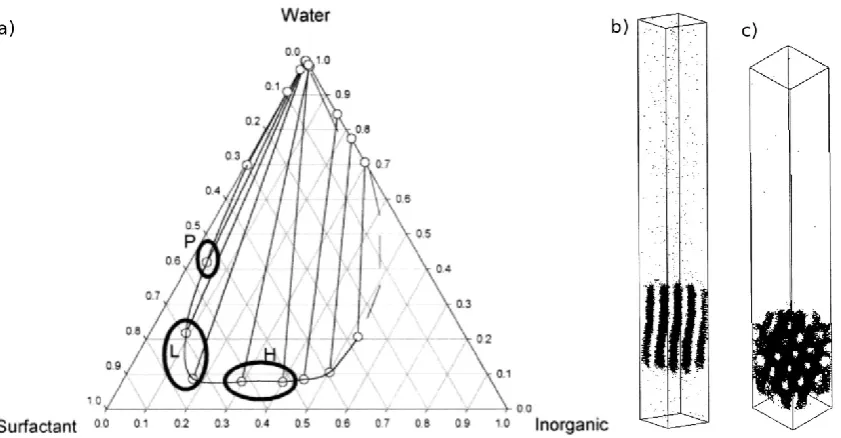
Siperstein and Gubbins [17, 39] dealt initially with the binary phase diagrams;
these were surfactant/solvent and surfactant/silica systems. They showed for the
[40], whereby the surfactant transitions from a hexagonal to a lamellar structure by
increasing the surfactant volume fraction, with a small gyroid phase region existing
between the two. For the surfactant/silica system, they observed a similar trend:
micelles were present at the lowest surfactant volume fraction, progressing through a
hexagonal phase to perforated lamellae at the highest surfactant volume fraction (Fig.
1a). They also compared the size of the aggregates in both phases, whereby the
structures in the surfactant/solvent system incorporated three times the surfactants as
those in the surfactant/silica system. This is because silica-head (I-H) interactions were
stronger than solvent-head (S-H) interactions in their model, leading to less phase
separation.
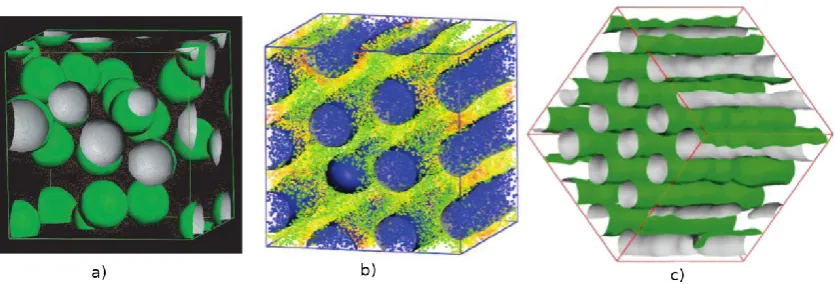
Figure 1. a) Ternary phase diagram of surfactant/water/silica obtained from lattice Monte Carlo simulations, showing the phase separation region. Circles highlight different mesostructures formed in the concentrated phase: H – hexagonal; L – lamellar; P – perforated lamellae. Simulation snapshots showing examples of the lamellar phase (b) and of the hexagonal phase (c). Only the silica beads are shown for clarity of visualisation. Adapted from Siperstein and Gubbins [39].
In the ternary systems (surfactant-solvent-silica) Siperstein and Gubbins
[image:9.595.89.510.354.573.2](zero I-S interaction energy), and in the second, it was immiscible (positive I-S
interaction). They linked these to two possible mechanisms for inducing phase
separation, respectively associative and segregative separation. In the former, the
separation is driven by strong attractions between two species, while in the latter it is
driven by a strong repulsion. They showed that, independent of the type of mechanism,
at high silica/surfactant ratios hexagonal phases (Fig. 1b) were formed, while lamellar
phases (Fig. 1c) were formed at low ratios. This corresponds to what is observed
experimentally during the synthesis of PMS materials [2, 27]. However, they were only
able to capture qualitative trends, due to the inherent simplicity of the lattice model that
restricts the number of surfactants that can interact with a silica species at any given
time.
Finally, they investigated the dependence of temperature and surfactant
composition on the phase diagrams. They noted that increased temperature led to lower
surfactant concentrations but higher silica concentrations in the surfactant-rich phase,
which promoted the formation of hexagonal as opposed to lamellar phases. This
behaviour can be seen experimentally in CTAB-silica-water systems [23]. Their analysis
of surfactant composition showed that increased head/tail ratios (i.e. shorter
hydrophobic tails) promoted hexagonal phases, whereas decreased H/T ratios favoured
lamellar phases.
The model of Siperstein and Gubbins has been subsequently extended to
describe phase equilibrium of periodic mesoporous organosilica percursors [41-44],
which is discussed in section 4, and of block copolymer-templated materials [45, 46],
which is discussed in section 3, as well as to explicitly describe silica condensation
reactions during the formation of MCM-41 by Jin et al. [47]. The model of Jin et al.
its realism: i) silicates were only allowed to occupy sites on a diamond sublattice of the
overall system, thus describing their tendency to form tetrahedral network structures; ii)
polymerisation of silica was accounted for by allowing two oxygens to occupy the same
lattice site with a very favourable interaction energy (an order of magnitude larger than
the silica-head interaction); iii) deprotonation equilibrium was explicitly modelled
through a Reactive Monte Carlo (RMC) method, thus allowing for simulations at high
pH (i.e., containing anionic silicates) to be performed. The energy scale was calibrated
by attempting to replicate the high-temperature region of the experimental phase
diagram of CTAB in water.
Jin et al. considered two different scenarios to attempt to elucidate the synthesis
process of MCM-41 [47]. The first scenario was a two-step process: in the first stage no
silica polymerisation took place and the system was allowed to self-assemble and phase
separate, while in the second stage silica was allowed to polymerise. In the first stage,
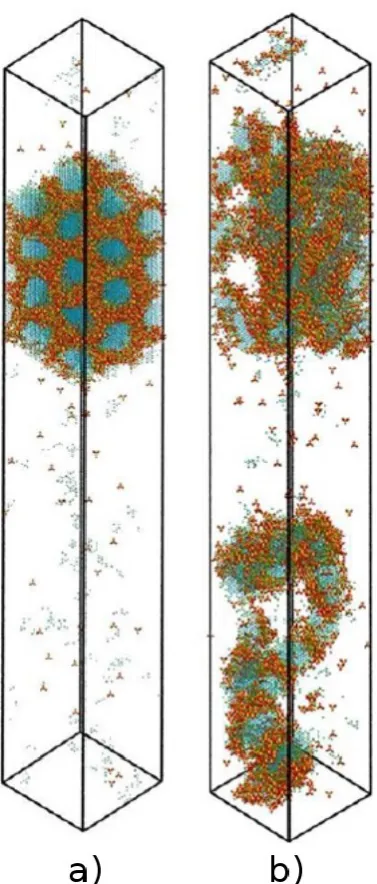
the model predicted that a binary surfactant/solvent system formed spherical micelles,
whereas adding a significant concentration of silica caused the system to form
hexagonal arrays of pores, i.e. an MCM-41 template (Fig. 2a). This is in agreement with
the theory that cooperative templating is the dominant mechanism during MCM-41
synthesis. They also showed that the initial mesophase formation process is reversible,
by cooling and heating the system to move back and forth between the lamellar and
hexagonal mesophases. However, this reversibility was only possible before extensive
silica polymerisation took place; after polymerisation (second stage), the structure
Figure 2. Snapshots of mesophases obtained from lattice Monte Carlo simulations accounting for both surfactant self-assembly and silica polymerisation: a) hexagonal phase obtained from a two-step process; b) disordered phase obtained from a one-step process. Colour code is: blue – surfactant tails; green – surfactant heads; red – neutral oxygens; purple – negatively charged oxygens; yellow – silicon. Adapted from Jin et al. [47].
The above results were compared to a second scenario in which both
mesostructure self-assembly and silica condensation were allowed to take place
simultaneously from the very start of the simulation. Interestingly, they observed that
[image:12.595.204.393.70.513.2]instead producing a glassy material (Fig. 2b). This result suggests that the mesoscale
structure of the final solid can be controlled only during the initial stages of the
synthesis, before silica condensation becomes extensive. Even though the results of this
study were very insightful, the inherent simplicity of the lattice model once again makes
it difficult to establish quantitative comparisons with experiment. For example, the
authors were not able to achieve the same degree of silica polymerisation in their
simulations as observed in experiments, a discrepancy that was attributed by the authors
to geometric restrictions of the lattice [47].
2.2 Self-Assembly – Off-Lattice Models
In 2009, Jorge et al. published the first molecular dynamics (MD) investigation
of MCM-41 synthesis using realistic atomistic models [48]. They started from a dilute
aqueous solution of surfactant, to which anionic silicic acid monomers were added, in
an attempt to mimic the initial stages of the synthesis of MCM-41 at high pH and low
surfactant concentrations (the conditions of the original experimental work [2]).
Decyltrimethylammonium bromide (DeTAB) was chosen as a surfactant instead of the
more common CTAB for the sake of computational tractability, and was modelled using
a modification of the OPLS potential [49]. Water was described by the SPC/E model
[50]. To describe silicate molecules, Jorge et al. adapted an existing model from Pereira
et al. [51], with modified geometric and electrostatic parameters obtained from quantum
calculations on a wide range of neutral and anionic silicates [52].
Their initial study [48] yielded two major insights into the early stages of the
synthesis: i) silicates were observed to interact strongly with small surfactant micelles,
micelle surface caused an increase in the size of the micelles. This was followed by a
more detailed report, in which solutions of silicate oligomers were also considered [53].
More precisely, the authors ran simulations from several starting configurations, whose
composition each corresponded to a different stage of the synthesis: reference solution
(no silicates present, describing the initial surfactant solution), monomeric solution
(with silica monomers instead of bromide counterions), and oligomeric solution (with
small silica oligomers corresponding to a distribution inferred from solution NMR
experiments at high pH [54]). From their results, they concluded that cooperative
templating does indeed occur, since the size of surfactant micelles was greater in the
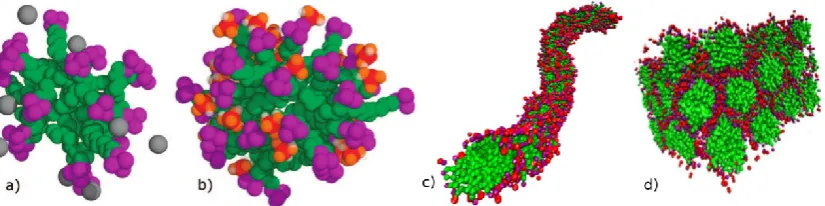
monomeric solution (Fig. 3b) than in the reference solution (Fig. 3a), and the oligomeric
solution produced even larger micelles. At the pH being modelled (11) almost all the
silica species were deprotonated, and it was thus concluded that the increase in micelle
size was due to silica species being more effective at screening the positive charge of
the surfactants than bromide ions. This was quantified by the average number of
surfactants bound to each counterion: 1.31 for bromide ions (reference solution) and
1.64 for silica monomers (monomeric solution). The oligomers were even more
effective at producing larger micelles since they can be multiply charged, increasing
their screening ability. Interestingly, the multiply charged silica oligomers were also
able to bind to multiple micelles simultaneously (1.36 on average, compared to a little
more than 1.0 for both bromide and monomeric ions), which was suggested to promote
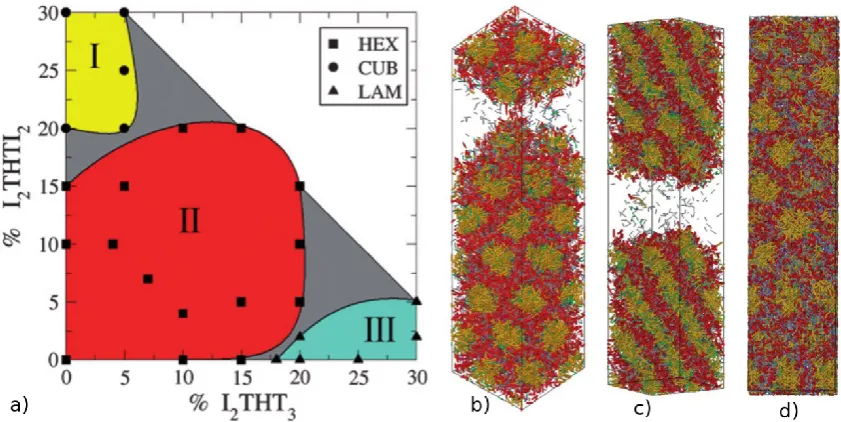
Figure 3. Snapshots showing the evolution of silica/surfactant aggregate structures during the early stages of MCM-41 synthesis, as observed from MD simulations using a multi-scale modelling approach: a) small spherical micelle in a dilute surfactant/water solution (atomistic model), adapted from Jorge et al. [53]; b) larger spherical micelle in a solution with silica monomers at short times (atomistic model), adapted from Jorge et al. [53]; c) rod-like micelle in a silica monomer solution after long equilibration times (coarse-grained model), adapted from Pérez-Sánchez et al. [55]; d) hexagonal phase in a solution with silica dimers (coarse-grained model), adapted from Pérez-Sánchez et al. [60]. Surfactant tails are shown in green, heads in purple, silica in red/orange and bromide in grey.
Jorge et al. [53] also considered an exchange solution, which was produced by
taking an equilibrated reference solution and adding silica monomers, while keeping the
initial concentration of bromide counterions. This was meant to more realistically mimic
the effects of addition of a silica source to a pre-equilibrated surfactant solution. Results
of that simulation confirmed that silica preferentially binds to the micelles, and clearly
showed ion exchange between silica and bromide at the micelle surface (the degree of
silica binding was 76% by the end of the simulation). The silica monomers tend to be
found inside the layer of the head groups, whereas the bromide ions tend to be located
outside, allowing the two to work together to more efficiently screen the electrostatic
repulsion between head groups, leading to larger micelles. Interestingly, when silica
monomers were replaced by larger silica oligomers (keeping the total charge constant),
the latter tended to migrate out of the head group layers, facilitating the binding to
multiple micelles.
The approach of Jorge and co-workers suffered from several limitations imposed
[image:15.595.94.507.72.175.2]of multiple micellar aggregates within a reasonable computational time was only
possible for the shorter DeTAB surfactant, and not for the more commonly employed
CTAB. More importantly, the authors were not able to observe significant shape
changes of the micelles (e.g., sphere-to-rod transitions) in their simulations. In an
attempt to circumvent those limitations, the same group developed a coarse-grained
(CG) model for PMS precursor solutions [55]. The model of Pérez-Sánchez et al. was
based on the popular MARTINI CG potential of Marrink and co-workers [56], but
included new parameters for neutral and anionic silicic acid monomers. The CTAB
surfactant was described by four hydrophobic tail beads and one positively charged
head bead [57], while the models for water and bromide followed the conventional
MARTINI prescription [56]. The surfactant model was validated by comparing micelle
density profiles at the CG [55] and all-atom (AA) levels [58], and was shown to
quantitatively reproduce the experimental average size and aggregation number of small
CTAB micelles [55], as well as most features of the experimental CTAB/water phase
diagram over a wide range of concentrations and temperatures [59]. The silica monomer
parameters were calibrated by matching micelle density profiles against those obtained
from AA simulations [48] under the same conditions.
Applying the CG mapping procedure allowed Pérez-Sánchez et al. to
significantly extend the length and time scales available to MD models of the MCM-41
synthesis (simulations reached the order of tens of microseconds), while maintaining a
good degree of chemical realism [55]. Simulations with silica monomers equilibrated to
form long wormlike micelles (Fig. 3c), while at the same conditions an aqueous solution
of CTAB (i.e., without silica) yielded only a distribution of small spherical micelles.
They indeed observed a sphere-to-rod transition in the silica/surfactant solution that
This transition was driven by a strong adsorption of anionic silicates on the micelle
surface, screening the repulsive interaction between cationic surfactant heads and
promoting the formation of structures with lower curvature. This is further evidence
supporting the cooperative templating mechanism for the initial stages of MCM-41
synthesis.
In a later paper, Pérez-Sánchez et al. extended the model to consider silicate
oligomers, as well as monomers, with parameters once more calibrated to match
atomistic micelle density profiles [60]. They focused their attention on low surfactant
concentration solutions corresponding to the experimental studies of Firouzi et al. [23].
Initially, they tested several compositions in order to determine the effect of different
silica species on the final mesostructure. These systems were: 1) a binary
surfactant-solvent reference solution; 2) a ternary surfactant-silica monomer-surfactant-solvent solution; 3) a
ternary surfactant-silica dimer-solvent solution. The silica/surfactant ratio was 1 in the
last two systems, i.e. there were half as many dimers in solution 3 as monomers in
solution 2; because monomers all had a charge of -1 and dimers of -2, the total silica
charge was kept constant. Their results confirmed the previous assertion [55] that the
reference system produced spherical micelles, whereas the introduction of silica altered
the geometry of the micelles, making them much more elongated. Interestingly,
however, the solutions containing monomers and dimers did not produce the same
micellar geometry; solution 2 produced wormlike micelles, whereas in solution 3 a
phase-separated hexagonal array, strongly reminiscent of MCM-41 structures, was
obtained (Fig. 3d). In order to show that these configurations were equilibrium states, as
opposed to kinetic artefacts, exchange simulations were carried out; monomers were
replaced by dimers and vice versa, while maintaining the micellar geometry and
reversible, and the obtained structures thus corresponded to equilibrium states of the
system.
The hexagonal array reached equilibrium much quicker in the exchange solution
than from a random initial configuration. This is interesting, since the exchange solution
is likely to represent a more realistic scenario; silica monomers initially produce
rod-like micelles, then dimers resulting from silica condensation subsequently promote the
formation of the hexagonal array. Further simulations with mixtures of monomers and
dimers showed that formation of the hexagonal mesophase requires the presence of
between 15-33% of silicates in the form of dimers. Their results thus not only
demonstrate that silica is necessary to promote the formation of the hexagonal structure,
but that it needs to be in the form of (at least) small oligomers. This is mainly due to the
ability of multiply charged silica oligomers to bind to more than one micelle at the same
time, thus promoting micelle aggregation and eventually phase separation of the
mesophase.
Next, Pérez-Sánchez et al. investigated larger oligomers, namely cyclic trimers,
cyclic tetramers and cubic octamers. Their simulations showed reversible hexagonal to
lamellar transitions by changing the silica charge density (either through increasing the
degree of condensation while keeping the charge constant, or through increasing the
degree of deprotonation for the same degree of condensation) or by adding a co-solvent
(e.g. benzene) to the system. In the former case, a higher charge density reduced the
effective area per head group leading to a decreased curvature and favouring lamellar
phases. In the latter case, the co-solvent was incorporated into the hydrophobic region
of the hexagonal mesophase, leading to an increase in the effective tail volume, and
hence also promoting a transition to a lamellar structure. All of the above results were in
a key achievement was the ability to reproduce, for the first time, the formation of a
hexagonal silica/surfactant mesophase under conditions that were quantitatively
equivalent to the experiments of Firouzi et al. [23].
A very recent paper by the same authors applied the CG model to precursor
solutions spanning a wide range of surfactant concentrations, in order to probe the
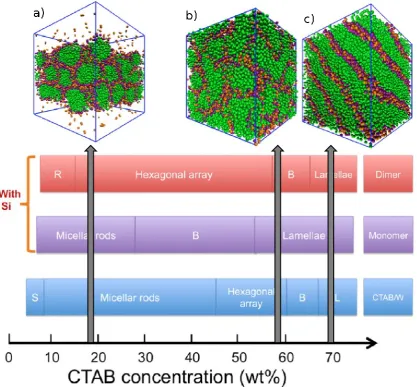
whole phase diagram of the system (Fig. 4) [59]. Once again, they compared the
behaviour of a reference CTAB solution to that of solutions containing silica monomers
and silica dimers. For the monomer-surfactant-solvent system, they found no surfactant
concentration at which a hexagonal phase could be induced – in fact, the silica
monomers appeared to hinder the formation of a hexagonal phase, instead reverting to
either wormlike micelles or lamellar phases. Replacing the monomers with dimers
produced very different results – a hexagonal phase was formed over a much larger
surfactant concentration range than in the binary surfactant-solvent system (mainly at
the expense of the micellar rods region). Interestingly, the results suggest that even
when starting from a pre-equilibrated hexagonal CTAB structure formed in concentrated
surfactant/water solutions, the original surfactant liquid-crystal is destroyed in the initial
stages of the synthesis, upon addition of silica monomers, and later reformed after some
degree of condensation produces oligomers. These results are further evidence against
the LCT mechanism, since they show that the nature of the surfactant-water and of the
silica-surfactant hexagonal phases is remarkably different – the former is driven by
micelle repulsion (week screening limit) and fills the entire space, while the latter is
driven by micelle attraction (strong screening limit) and constitutes a phase-separated
Figure 4. Map of the mesophases observed in coarse-grained simulations of different solutions at a range of initial surfactant concentrations, representative of incremental stages of PMS synthesis, from bottom to top: surfactant/water solution; silica monomer solution; silica dimer solution. S stands for spherical micelles, R for micellar rods, B for bicontinuous phase, and L for lamellar phase. The grey arrows represent possible synthesis paths leading to different PMS materials: a) 41; b) 48; c) MCM-50. Adapted from Chien et al. [59].
The phase diagrams for the three systems also allowed the authors to
hypothesise on which of the MCM-like materials might be synthesised through a LCT
mechanism. At high surfactant concentrations in the presence of silica, they observed
the formation of a bicontinuous phase reminiscent of MCM-48 and of a lamellar phase
resembling MCM-50. Although bicontinuous phases were observed in all three tested
[image:20.595.89.507.74.461.2]MCM-48 would not seem to be a candidate for the LCT mechanism. The exception,
however, is MCM-50; in all three systems, there is a region of overlap of lamellar
phases at high surfactant concentrations. Taking all these observations together, it seems
likely that the CTM is the main mechanism by which the synthesis of MCM-41 is
achieved.
2.3 Modelling Silica Condensation
The studies mentioned until this point have all focussed on the self-assembly
and phase equilibrium aspects of the PMS synthesis. To investigate those phenomena
thoroughly and efficiently, most studies have foregone investigation of the silica
polymerisation component of the synthesis – in fact, of all the studies discussed in
sections 2.1 and 2.2, only the paper of Jin et al. [47] explicitly described silica
condensation reactions, albeit with a rather simplified approach. However, in parallel
with that stream of investigation, researchers have been developing increasingly
accurate and efficient models and algorithms to describe chemical reactions involving
silicates, with several different approaches being proposed. These different approaches,
including their advantages and limitations, have been covered in recent reviews [16, 61]
so we will mention them only briefly here and focus in more detail on the few existing
studies that attempted to explicitly include silica condensation reactions in simulations
of PMS formation.
Most attempts to describe silica condensation have made use of MD simulations
with reactive potentials [62-64]. Such studies were able to provide atomic-level detail
on the formation of small amorphous silicate clusters in solution, but required
The work of Wu and Deem [65] also used a reactive potential, but the configurational
space of the system was explored through a rather complicated Monte Carlo (MC)
algorithm. Although their work yielded important insight into silica nucleation, it was
limited to small clusters due to the computationally intensive nature of the method. A
very distinct approach is kinetic Monte Carlo (KMC) [66-68], which describes chemical
reactions as independent Poisson processes and thus significantly speeds up the
sampling of reactive events. However, the method requires all reactions and rate
constants to be explicitly enumerated, which itself imposes a limitation on the size of
oligomers that can be formed (the number of possible reactions increases factorially
with cluster size). Models that describe the system energy as a function only of bond
topology, such as the Continuous Random Network (CRN) [69, 70], have also been
proposed. Finally, recent work by Malani et al. [71, 72] has put forth a reactive Monte
Carlo (RMC) model of silica polymerisation, which showed good agreement with
experimental NMR measurements of the evolution of silicate distributions under neutral
conditions. The RMC approach seems promising, as it is able to sample long time scales
while maintaining a reasonable level of atomic detail.
To our knowledge, none of the methods described above has yet been applied in
the context of simulating the synthesis of PMS materials, with one notable exception
being the work of Seaton and colleagues [73, 74]. The first model that introduced
explicit silica polymerisation during simulations of MCM-41 formation was presented
by Schumacher et al. [73]. They implemented a KMC reaction scheme, based on the
CRN model of the silica network [70] where all silicon atoms are always connected to
four oxygens, and tried to describe the entire process of MCM-41 formation. They split
their simulations into several stages: i) initial adsorption and condensation of a thin
form a hexagonal mesostructure; iii) further condensation of silica to form a highly
cross-linked network; iv) high-temperature calcination, causing further silica
condensation in the absence of template micelles. To make the scheme computationally
tractable many major assumptions were made, such as describing the surfactant micelles
as soft cylinders with no atomistic detail. Furthermore, several non-physical moves
were applied to force the reaction along the chosen path (e.g. adding an artificial
potential gradient to force the silica to the micelle in the opening stages, which is then
removed, instead of correctly describing silica diffusion to the micelle surface). Due to
all these special moves and assumptions, one cannot be completely confident that this
model produced an accurate description of the real synthesis process. However, it
achieved the authors’ main objective, which was to generate realistic models of
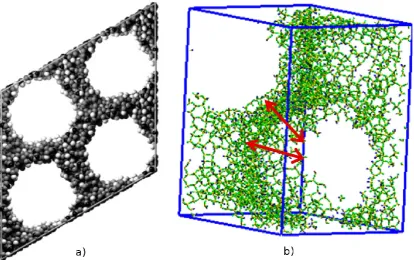
MCM-41 materials (Fig. 5a) for adsorption predictions (they reproduced gas adsorption fairly
accurately for nitrogen, ethane and carbon dioxide). More importantly from the point of
view of this review, the work of Schumacher et al. demonstrated that by applying clever
approaches, the computational modelling of the entire PMS synthesis process is not an
Figure 5. Examples of atomically detailed models of MCM-41 (a) and SBA-2 (b) materials obtained from kinetic Monte Carlo simulations of silica condensation. Only the silica framework is shown for clarity. In panel b), the red arrows highlight connecting windows between the spherical-like pores. Adapted from Schumacher et al. [73] (a) and Ferreiro-Rangel et al. [74] (b).
A later study by Ferreiro-Rangel et al. [74] proposed some improvements to the
method of Schumacher and applied it to the synthesis of two less-studied materials,
SBA-2 [75] and STAC-1 [76]. Both are synthesized with gemini quaternary ammonium
surfactants and contain connected spherical pores templated by spherical micelles, but
they differ in the way that the micelles pack together – SBA-2 shows a hexagonal close
packing of spheres, while STAC-1 micelles pack in a face-centred cubic lattice. In order
to produce realistic models of these materials, Ferreiro-Rangel et al. [74] had to
explicitly include water molecules during the reaction stages (which had been ignored
by Schumacher et al. [73]) and make the micelle-micelle interactions more repulsive so
as to generate the correct packing. The simulation results were successfully compared
against experimental data, including structural characteristics and nitrogen adsorption
[image:24.595.94.509.71.331.2]experimental isotherms were actually due to surface roughness of the pores, and also
suggested a plausible hypothesis for the origin of the connecting windows between
large spherical pores (Fig. 5b) during the synthesis [74]. Another interesting observation
pertains to the evolution of the degree of silica condensation during different stages of
the synthesis. The results of Ferreiro-Rangel et al. show that the transition between the
formation of a silica layer at the micelle surface (step 1 of their process) and the initial
aggregation of micelles to form an ordered mesostructure (step 2) involved a significant
presence of dimers and higher silica oligomers, with the concentration of silica
monomers staying below 10%. This is in qualitative agreement with the interpretation
of Pérez-Sánchez et al. [60] in their MD study of the self-assembly of silica/surfactant
mesostructures.
3. Synthesis of other mesoporous silica materials
The synthesis process of the MCM family of mesoporous materials has been the
most widely studied so far, particularly from the modelling point of view. However, as
research into periodic mesoporous silica progressed, new materials were synthesised by
varying the type of template beyond the “traditional” quaternary ammonium surfactants.
The latter have small heads with permanent net positive charge and alkyl chains of
varying length (normally between 10-18 carbon atoms). By substituting these cationic
surfactants for anionic or non-ionic surfactants and much larger block copolymers,
researchers were able to synthesise PMS materials with densities, pore geometries, and
structures differing from MCM types [7-10, 77-80]. Despite conceptual similarities,
there are important specificities in the synthesis mechanism of such materials. For
example, block copolymer templates are usually neutral, and this has implications on
ionisable, and so respond to changes in pH of the solution during the synthesis process
[9]. In this section, we review recent attempts to shed light on the synthesis process of
these fascinating materials through computational modelling.
3.1. Block copolymer templated materials
Although several early studies managed to synthesise mesoporous silica
materials using non-ionic surfactants [77, 78], it was the synthesis of hexagonally
ordered SBA-15 (SBA stands for Santa Barbara Amorphous) that represented a major
breakthrough in the field [8]. This material was synthesised using non-ionic triblock
copolymers as supramolecular templates, and achieved much larger pore sizes (up to 30
nm) than had hitherto been realized. The block copolymer templates, often referred to as
Pluronics, consist of portions of poly(ethylene oxide), PEO, and poly(propylene oxide),
PPO, arranged as PEOn-PPOm-PEOn. The extra methyl group in PPO makes these
moieties more hydrophobic than the linear PEO, and promotes self-assembly of the
polymer into large micelles and, at higher concentrations, liquid-crystal mesophases
[81]. SBA-15 in particular is synthesised by the sol-gel method in acidic medium by
mixing Pluronic P123 (PEO20-PPO70-PEO20) with a source of silica, most often TEOS
[8]. Similarly to MCM-41, this solution is heated to allow the silica to condense around
the template mesostructure, followed by template removal by calcination. Despite
similarities in the manufacturing procedure, SBA materials have several important
distinctions from MCM-type materials. Apart from possessing larger pores than their
MCM counterparts, SBA-15 materials also exhibit thicker walls and, more interestingly,
small micropores that interconnect the larger, spherical, mesopores [82]. Furthermore,
contrary to the case of ammonium surfactants, where ionic interactions dominate, the
more delicately balanced hydrophobic interactions and/or hydrogen bonds [81]. This
poses additional challenges to both experimental and theoretical approaches aiming to
describe the synthesis mechanism of block copolymer-templated materials.
Although experimentally the synthesis mechanism of SBA-15 has received
perhaps as much attention as that of MCM-41 [83], simulation studies have been much
fewer. This is not least because of the much larger size of the surfactant molecules
(Pluronic P123 has about 17 times more atoms than CTAB) and micelles, and
concomitantly slower dynamics. This puts it firmly outside the scope of detailed
atomistic models, except for analyzing local phenomena such as single-chain dynamics
[84]. As a consequence, the few existing studies on modelling the synthesis of
SBA-type materials have been carried out using highly coarse-grained models and have
almost exclusively focused on SBA-15 [45, 46, 85-88].
In 2005, Bhattacharya and Gubbins [45] modified the lattice model of Siperstein
and Gubbins [17, 39] to describe the self-assembly of triblock copolymers in the
presence of an inorganic component meant to describe silica. They considered
surfactants made up of 5 central hydrophobic (T) beads with 3 hydrophilic (H) beads on
each end, i.e. H3T5H3 instead of the original H4T4 arrangement. The size and shape of
the surfactant was selected to produce a water/surfactant phase diagram that
qualitatively agreed with experimental data for Pluronic P123. By adding silica to the
system, they once again observed phase separation between a dilute and a
surfactant-rich phase. Depending on the concentrations, the latter formed bicontinuous, hexagonal
or lamellar mesostructures. Interestingly, the hexagonal mesophases that are relevant for
the synthesis of SBA-15 were only formed at quite low silica concentrations, which was
contrary to the observations of Siperstein and Gubbins in their simulations of MCM-41
model simulations that formed hexagonal phases to produce realistic models of SBA-15
materials, taking into account the molecular scale roughness of the large cylindrical
pores and the presence of interconnecting micropores templated by the hydrophilic
corona of P123 [46]. The predicted adsorption isotherms were in qualitative, if not
necessarily quantitative, agreement with experimental data, leading the authors to
suggest that their model was perhaps too rough at the molecular scale.
Bhattacharya and Gubbins also extended their lattice model to include a fourth
component, denoted as “oil” and meant to represent the addition of a co-solvent like
trimethylbenzene (TMB) to the synthesis mixture [45]. By exploring the quaternary
phase diagram, they were able to show a gradual transition between hexagonal (i.e.,
SBA-15) mesophases and large-scale structures of disordered aggregates reminiscent of
the mesocellular foams observed experimentally by gradually adding TMB to the
solution [89]. As in the case of MCM-41, the lattice simulations of Gubbins and
co-workers were able to qualitatively explore the physics of the phase equilibrium
pertaining to block copolymer-templated materials, but it was not possible to carry out
quantitative comparisons with the experimental synthesis mechanism due to the
inherent simplifications of the model.
An alternative avenue that has been pursued to study the synthesis of SBA-15 is
based on the Mesoscopic Dynamics (MesoDyn) simulation method, which has been
widely employed to model self-assembly of polymer systems [90]. The MesoDyn
method is based on dynamic mean-field density functional theory and the time
evolution of the system is propagated through the integration of a set of functional
Langevin equations [85-87, 90]. It uses a coarse-grained implicit solvent description of
polymers that are represented by a Gaussian chain of beads, which interact with each
applied this approach in the context of SBA-15 synthesis to analyse the effect of
temperature on the material pore size. They made use of a previously determined
mapping scheme for Pluronic surfactants [90] to describe the P123 triblock copolymer,
and used values of the interaction parameters that depended on temperature. Their
simulations were able to show the formation of a distribution of spherical polymer
micelles at relatively low concentration (Fig. 6a), and posited that the micelle
self-assembly process could be divided into three stages [85]. They also observed that the
size of the micelle core, formed of hydrophobic PPO beads, increased with temperature,
and they linked this to the observed experimental increase in the pore size of SBA-15
with temperature. However, the comparison was merely qualitative, since Chen et al.
simulated a simple aqueous solution of P123 (i.e., without the presence of silica) and
were not able to observe the formation of a hexagonal phase or even cylindrical micelles
[image:29.595.90.508.434.576.2][85].
Figure 6. Examples of structures obtained from MesoDyn simulations of Pluronic 123 surfactants: a) spherical micelles obtained in quiescent copolymer/water solutions, adapted from Chen et al. [85]; b) hexagonal mesophase obtained in copolymer/water solutions with constant imposed shear and charged PEO beads, adapted from Yuan et al. [86]; c) hexagonal mesophase obtained in silica/copolymer/water solutions in the presence of shear and with charged PEO beads, adapted from Chen et al. [87].
In the same year, Yuan et al. [86] used a very similar model to study in more
range, and examined the effect of PEO charge and shear on the resulting
mesostructures. They observed the formation of several distinct mesophases, including
spherical micelles (similar to those described by Chen et al. [85]), bicontinuous and
lamellar phases. Interestingly, when a small positive charge was added to the PEO
beads (aiming to describe adsorption of H+ ions by the micellar corona under highly
acidic pH) and a constant shear rate was imposed (meant to describe agitation of the
solution in experimental SBA-15 synthesis), the authors observed a progressive
elongation of the micelles leading to formation of a hexagonal mesophase (Fig. 6b).
Interestingly, hexagonal phases seemed to require the presence of both those factors,
and were not formed when either shear or PEO charge were separately added to the
model [86]. Once again, comparisons with experimental SBA-15 materials were only
qualitative, as the authors did not consider the presence of silica in the system.
In 2012, Chen et al. extended their earlier study to include the effect of silica on
P123 self-assembly [87]. They reported having obtained the interaction parameters
between silica and the other components of the system from “estimating the cohesive
energy density of different molecules and the miscibility behavior of binary mixtures”
[87], but no additional details were provided. They considered neutral and positively
charged (at a fixed value of +1, meant to reflect protonation under highly acidic
conditions [20]) silica beads, as well as varying the charge of the PEO beads.
Confirming the observations of Yuan et al. [86], the authors only observed formation of
cylindrical micelles when shear was applied to the system. Furthermore, the ordered
hexagonal arrangement of the cylindrical micelles (Fig. 6c) was seen to be highly
sensitive to the charge values on silica and on the PEO beads – ordered hexagonal
mesophases required a charge of +1 on silica (lower or higher values led to disordered
The authors also observed that neutral silica tended to form aggregates, while a
relatively uniform distribution of silica around P123 micelles was observed when silica
was charged. They attributed this effect to the need for charge matching interactions
between silica and surfactant in SBA-15 synthesis [87].
Finally, it is worth mentioning the work of Magee and Siperstein [88], who
carried out Dissipative Particle Dynamics (DPD) of ternary systems composed of a
diblock copolymer, water, and an inorganic component meant to represent aggregating
nanoparticles. DPD is also a mesoscale modelling approach, in which particles interact
with each other through soft interactions and with an implicit solvent by way of random
(representing Brownian motion) and dissipative (representing friction) forces. Once
again, emphasis was placed on mapping the phase diagram of the system. Although the
authors were able to observe some interesting physical phenomena, such as the onset of
demixing driven by increasing interaction between nanoparticles, it is difficult to draw a
direct parallel with realistic experimental systems.
3.2. Bio-inspired silica materials
As well as being used at industrial level to produce the classes of porous solids
described in the previous sections, templating is also the key mechanism through which
many biological organisms produce their complex siliceous structures. This process,
referred as biosilicification, is mediated by polypeptides and long-chain polyamines
[91], which are believed to catalyse silica deposition while directing structure formation
[92], and has attracted particular attention because of its unique characteristics, i.e. it
takes place at mild conditions and in an aqueous environment. In fact, just a few years
silica materials was reported in the literature by Tanev and Pinnavaia [10]. The material,
named MSU-V, was obtained using diamines of variable length as templates for silica
deposition at ambient temperature and showed a hierarchical lamellar structure [10].
Following this strategy, the same group also employed monoamines to direct structure
formation, resulting in the synthesis of a new class of hexagonal mesoporous molecular
sieves referred as HMS materials [9, 93]. When compared to their non-bioinspired
counterpart (i.e. MCM-41), HMS materials showed as significantly lower degree of
order and regularity, which the authors have postulated to be a consequence of the
neutral mechanisms behind their synthesis and of the formation of relatively weak
hydrogen bonds between template molecules and silicates (as opposed to strong ionic
interactions in the case of MCM-41). A similar mechanism of formation primarily based
on hydrogen bond interactions between organic and inorganic species was also
proposed to describe the formation of MSU-V materials [10]. However, in the case of
these diamine-templated silicas the final structure is predicted to arise from silica
condensation around multilamellar vesicles, rather than around hexagonally packed
surfactant rods. Silica penetration and condensation in the inter-vesicular space gives
rise to the formation of pillars that afford structural stability to the material. The relative
simplicity of template removal, obtained in the case of bio-inspired materials by means
solvent extraction rather than calcination, was also argued to be due to a lack of strong
ionic interactions [9, 93].
Contrary to cationic ammonium surfactants, amines can be present in aqueous
solution in either neutral or protonated forms. This means that these surfactants are
pH-responsive, which adds a layer of complexity to the already challenging problem of
unravelling the synthesis mechanism of mesoporous silica materials. Recently,
molecular processes taking place during the synthesis of bio-inspired HMS and MSU-V
silica materials at varying pH [94, 95]. For each bio-inspired material and pH value
considered, two main types of simulation were performed. In a first step, a reference
system, containing only surfactant molecules (dodecylamine, DDA, for HMS and
1,12-diaminododecane, DADD, for MSU-V) in water was simulated. Subsequently, silicates
at different polymerisation degrees were added to represent the early stages of synthesis
of these materials. Simulations were carried out at both atomistic (AA) and
coarse-grained (CG) level, with results of the former being used to calibrate parameters of the
latter. Furthermore, MSU-V synthesis was investigated at ambient temperature, whereas
HMS synthesis was studied at a slightly higher temperature (50 °C) to allow comparison
with experimental values of micelle aggregation number for the latter system [96].
The multi-scale methodology adopted by Centi and Jorge has two major
advantages: it enables to explore longer time and length scales, beyond the current limit
of atomistic simulations, while allowing to maintain realism at the lower resolution
levels. This involved the development of CG models, based on the MARTINI
framework [95] by adjusting the CG parameters until satisfactory agreement between
AA and CG density profiles of micellar aggregates was obtained. At the AA level,
amine surfactants were described by the OPLS model [97], water by the SPC/E
potential [50], and silicates by the model of Jorge et al. [53]. Following the procedure
adopted by Pérez-Sánchez et al. to study PMS synthesis [60], the final set of parameters
for the systems was obtained in a progressive manner: first, the parameters for the
reference system were obtained; subsequently, more species were incrementally added
(monomers, followed by dimers) in such a way that interactions already parameterised
could be used in more complex systems. Therefore, at each stage only a limited number
that each step of the model development allows to validate the previously obtained
interactions.
CG simulations [95] of the reference systems of HMS materials at experimental
concentrations revealed that neutral amine surfactants (i.e. pH > 12) undergo rapid
precipitation, due to their limited solubility in water, which makes it unlikely that they
will be involved in the formation of the HMS material. Conversely, charged surfactants
(pH < 8) form micellar aggregates with average size in excellent agreement with
experimental data [96]. Interestingly, micelles are converted into large branched rods
when silica monomers are added to the solution. This result indicates that, contrary to
the hypothesised mechanism based on interactions between neutral species [9], charged
species are necessary to promote rod formation. Hence, the synthesis of HMS materials
was further studied including the effect of more highly condensed silica species,
showing that dimers produce a disordered packing of rods in agreement with the
“worm-like” or “worm-hole” structures reported experimentally [98], therefore
reinforcing the conclusion that charge matching interactions control the formation of
HMS materials.
The second type of bio-inspired material considered, MSU-V, was initially
studied using AA simulations [94]. Simulations at high (> 11) and intermediate (8-11)
pH, where the majority of the diamine surfactants is either neutral or singly charged,
showed formation of dry layers of surfactants for both systems. However, when silicates
were added, strong adsorption of silica monomers at the layer surface only occurred in
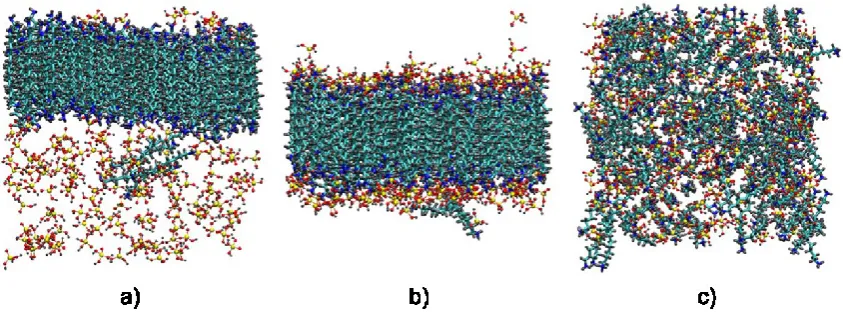
the system with singly charged surfactants (Fig. 7b), while the monomers remained
homogeneously dispersed in the solution with neutral surfactants (Fig. 7a). Conversely,
when doubly charged surfactants dominate (pH < 8), formation of small disordered
MSU-V materials is only feasible within the narrow pH range of 8-11, which agrees
with acid-base calculations based on the composition of the experimental solution.
Simulations of a more realistic speciation of amines and silicates (based on
experimental conditions), in which all three types of surfactants coexist, produced
curved layers that suggest a transition to a vesicular-like structure as observed in
experiments. Furthermore, the authors observed the spontaneous formation of a hole
defect in one of the layers, inside which a few silica monomers, together with water
molecules, migrated. It was hypothesised that, due to local excess of positive charges in
the surfactant layer, similar holes or defects could be created across template layers
allowing more silicates to penetrate and eventually condense inside. This result,
therefore, represents strong evidence for the pillaring mechanism postulated
experimentally [10]. However, similar to HMS materials, the originally hypothesised
neutral templating route does not seem to be feasible; instead, the self-assembly
mechanism seems to rely on charge-matching interactions between silicates and amine
surfactants. Preliminary CG simulations of MSU-V materials confirm this conclusion
[image:35.595.88.510.518.675.2][95].
4. Synthesis of hybrid organosilica materials
As mentioned above, one of the major breakthroughs in the manufacture of
functional mesoporous materials was the direct inclusion of organic groups on the pore
walls during the synthesis process (sometimes called “in-situ” functionalisation, in
contrast with “post-synthesis” functionalisation, which is not covered in this review),
giving rise to periodic mesoporous organosilicas (PMOs) [11-13]. The preparation of
these hybrid organic/inorganic silicas from bissilylated organic precursors (i.e.,
organo-bridged alkoxysilanes) is also based on surfactant-templated synthesis as in the case of
pure silica PMS materials [2], and thus the pore size/shape and wall thickness of the
PMO framework can be also controlled by tuning the synthesis conditions [99, 100].
However, PMOs are even more interesting materials because they combine the strength
of the inorganic silica structure with the appealing functionality of organic groups,
significantly expanding their range of potential applications [99-102]. As a
consequence, the development of these materials has continued to grow, with a
promising avenue being the incorporation of ever more complex functional
organoalkoxysilane precursors [102-104].
This high degree of variability together with the typically more flexible nature of
organic groups brings with it additional challenges from the experimental point of view;
for instance, PMO materials tend to be less ordered at the mesoscale level than their
all-silica counterparts [102]. It also makes it even more important to obtain a fundamental
understanding of the synthesis process, so as to better control the material properties. In
this context, the effect of the presence of organic precursors on the synthesis mechanism
remains largely unexplored. For example, a particularly interesting discovery was that