A Self-organized Dynamic Clustering method
and its Multiple Access Mechanism for Multiple
WBANs
Jiasong Mu, Robert Stewart, Liang Han and David Crawford
Abstract—Due to its wide application range and attractive features, Wireless Body Area Networks (WBAN) is considered as a revolutionary technology which is envisaged to change how people manage and think about their health and their life styles. In this paper, we propose a Self-organized Dynamic Clustering (SDC) method and its multiple access mechanism to mitigate the interference and improve the QoS in multiple WBANs environment. To the best of our knowledge, this is the first paper which focuses on the spectrum allocation for multiple WBANs. We borrow the concepts of cell and cluster from cellular networks to allocate the channels for different WBANs. The clustering is self-organized to improve the data transmission for intra-WBAN communication by the information exchange via inter-WBAN communication. Additionally, based on the cluster architecture, an inter-WBAN relaying (IWR) protocol for packets with low privacy or high reliability is also investigated. The simulation results show that SDC has better signal to interference ratio compared with existing framework. Besides, SDC and IWR also provide better QoS performance in terms of higher data packet delivery ratio and lower packet delay.
Key words—Clustering, Interference mitigation, Spectrum allocation, WBAN
—————————— ◆ ——————————
1
I
NTRODUCTIONHANKS to the recent advances in Information and Communication Technologies (ICTs), the design of in-telligent physiological sensor nodes is trending smaller size and more efficient in data sensing[1]. This progress fa-cilitates the development of Wireless Body Area Networks (WBAN). WBAN typically consists of a collection of low-power, miniaturized, invasive or non-invasive, light-weight devices with wireless communication capabilities placed in or on the human body for use in monitoring body vital and physiological data and immediate environment [2].
As its most attractive benefit is the capability of contin-uous functioning without obstructing user comfort in per-forming daily activities [3], WBAN is regarded as a revo-lutionary technology in various applications in health-care [4], fitness [5], smart cities [6], and many other compelling Internet of Things (IoT) applications [7], [8]. Especially, it may enhance the healthcare system significantly by reduc-ing the cost, providreduc-ing more comprehensive data and im-prove the mobility of the user [9].
Based on their roles in the networks, WBAN devices can be categorized into three types: a) Hub (aka sink, coordi-nator or gateway) organizes the network and acts as the
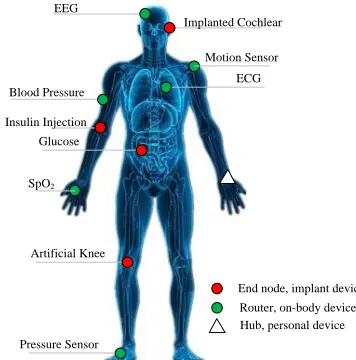
gateway to the outside world; b) Router is intermediate nodes which have a parent node and a few child nodes through which they relay messages; c) End Node is only capable of performing its sensing task and communicating with its parent (a router) [10]. A typical WBAN is shown in Fig.1. Whereas, the communication in the figure only in-cludes the intra-body communication which is the Tier 1 of a common 3-tier telemedicine system structure which cover multiple WBANs as shown in Fig.2. Tier 1 encom-passes the individual intra-body communication, tier 2 de-notes the extra-body communication between the different WBANs and the Internet which is performed by the hub and tier 3 represents the extra-body communication from the Internet to the medical server [11].
————————————————
• Jiasong Mu is with the Tianjin Key Laboratory of Wireless Mobile Commu-nications and Power Transmission, College of Electronic and Communica-tion Engineering, Tianjin Normal University, Tianjin, China. E-mail: [email protected]
• Robert Stewart is with the Dept of Electronic and Electrical Engineering, University of Strathclyde, Scotland, UK. E-mail: [email protected] • Liang Han is with the with the Tianjin Key Laboratory of Wireless Mobile
Communications and Power Transmission, College of Electronic and Com-munication Engineering, Tianjin Normal University, Tianjin, China. E-mail: [email protected].
• David Crawford is with the Dept of Electronic and Electrical Engineering, University of Strathclyde, Scotland, UK. E-mail:
T
EEG
Implanted Cochlear
ECG
Insulin Injection Blood Pressure
SpO2
Artificial Knee
Pressure Sensor
Motion Sensor
Glucose
[image:1.567.326.504.536.716.2]End node, implant device Router, on-body device Hub, personal device
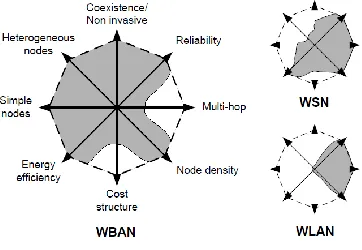
Since there are several obvious differences between WBAN and conventional wireless technologies as shown in Fig.3 [12], [13], it brings new challenges in network de-sign. WBAN technology is still in its primitive stage and needs further study [14]. As the candidates for the WBAN protocol, Bluetooth 4.0 [15], IEEE 802.15.4 [16] cannot fully satisfy the manifold WBAN application requirements [17]. Particular attention is paid to the IEEE 802.15.6, a commu-nication standard optimized for low power devices and operation on, in or around the human body to serve a va-riety of applications including medical, consumer electron-ics, personal entertainment and other [18]. However, a con-siderable part of the existing deployments and studies are not fitting in the standard [19], [20]. Based on IEEE 802.15.6, the QoS requirement for different healthcare applications is shown in Table.1. Note that the spectrum for different applications is not specified in the standard, each sensor may use an exclusive channel or a shared one with other nodes. The available frequency bands in IEEE 802.15.6 is shown in Table 2. From the viewpoint of channels, one user may be involved in networks which are working in different spectrum. However, because all these networks are managed by a common hub device, to avoid confusion, one WBAN refers to the networks related to one hub/user in the following of this paper.
To guarantee the QoS for heterogeneous nodes, the
QoS-based routing and the interference mitigation are of great importance in WBAN [22]. The existing studies on QoS-aware routing protocol mostly assume all the WBAN sensors use the same frequency to communicate [23]. it is not efficient from the view of resources efficiency, thus not
Tier 2 Tier 3
Tier 1 Tier 1
Tier 1
Tier 1
Facilities
Emergency
Docotr
[image:2.567.101.458.59.230.2]Intermediate Family
Fig. 2. Communication tiers for WBANs
TABLE1
[image:2.567.291.533.314.487.2]QOSREQUIREMENTS FOR SOME WBANAPPLICATIONS [21]
Fig. 3. Characteristics of WBAN compared Wireless Sensor Network (WSN) and Wireless Local Area Network (WLAN)
TABLE2
FREQUENCY BANDS,BANDWIDTH FOR IEEE802.15.6.
Narrowband on-body communication bands are classified into 3 groups based on the similarity of their frequencies and modulation methods, as separated by grey lines.
Application Type Bit rate Delay BER
Deep brain stimulation < 320 kbps < 250 ms < 10-10 Drug delivery < 16 kbps < 250 ms < 10-10 Capsule endoscope 1 Mbps < 250 ms < 10-10
ECG 192 kbps < 250 ms < 10-10
EEG 86.4 kbps < 250 ms < 10-10
EMG 1.536 Mbps < 250 ms < 10-10
Glucose level monitor <1 kbps < 250 ms < 10-10 Audio streaming 1 Mbps < 20 ms < 10-5 Video streaming <10 Mbps < 100 ms < 10-3
Voice 50-100 kbps < 100 ms < 10-3
Description Frequency Band Bandwidth Description 16 MHz 4 MHz Implant 27 MHz 4 MHz Implant 402 ~ 405 MHz 300 KHz Implant 420 ~ 450 MHz 300 KHz On-body 863 ~ 870 MHz 400 KHz On-body 902 ~ 928 MHz 500 KHz On-body 950 ~ 956 MHz 400 KHz On-body 2300 ~ 2400 MHz 1 MHz On-body 2400 ~ 2438.5 MHz 1 MHz On-body 3.2 ~ 4.7 GHz 499 MHz On-body 6.2 ~ 10.6 GHz 499 MHz On-body Human Body
Communication
Narrowband Communication
[image:2.567.287.533.534.649.2] [image:2.567.47.228.583.708.2]practical. Moreover, the main difficulty in WBAN QoS im-provement is the limited and changeful choices of the for-warding nodes due to the large attenuation for the electro-magnetic wave propagation in or near the human body and the postural mobility. Some data in WBAN is of high privacy (such as medical application), while some data is not (such as the entertainment application) and should be allowed to be relayed by devices from other WBANs if do-ing so may increase the network performance. Thus, the clustering mechanism for multiple WBANs is needed to enable the inter-body transmission among sensors.
On the other hand, WBANs trend to be large density due to its individual-based deployment. Based on the re-quirement specified in IEEE 802.15.6 [16], up to 10 ran-domly distributed, co-located WBANs should be sup-ported by the physical layer in a 6m3 cube. This may
pro-vide new candidates for data forwarding. However, the co-channel interference may bring unneglectable effects on QoS in such conditions. Only few works have been con-cerned with a global solution for tens or hundreds of users, who are confined to a relatively small environment [24]. The most straightforward method to minimize the interfer-ence is to distance the nodes which use the same subchan-nel away from each other, like it is done in the cellular net-work. However, the cluster in mobile communication is formed based on fixed infrastructure, the base station, which is lacking in WBAN. Hence the clustering in WBAN needs to be redesigned.
In this paper, we propose a self-organized dynamic clustering method and its multiple access mechanism for multiple WBANs. To the best of our knowledge, this is the first paper addressing the issue of spectrum and channel access allocation for multiple WBANs. The aim of our work is to mitigate the co-channel interferences and im-prove the heterogeneous QoS for the WBAN communica-tion with the coexistence of other users, especially for the large density environment. To better describe our work, we borrow the concept of cell and cluster from cellular net-works. Our work has three major contributions. Firstly, the clustering is self-organized by the hubs which have more sufficient resources and relies on the tier 2 communication. We design both the FDMA and TDMA methods to im-prove the spectrum allocation. Secondly, the clustering en-ables the inter-body packet forwarding for the data with less security or high priority. This may reduce the node en-ergy consumption and improve the QoS. However, the routing algorithm design is beyond the study in this paper. We just simply describe the principle for the next hop se-lection. Thirdly, the architecture is mainly based on the IEEE 802.15.6 for the tier 1 communication, which provides a good compatibility.
The remainder of the paper is organized as follows: Sec-tion 2 gives a brief review of the existing related work. The network architecture was discussed Section 3. In Section 4, the Self-organized Dynamic Clustering and its multiple ac-cess mechanism is proposed. The simulation results on dif-ferent scenarios are shown in Section 5. Finally, Section 6 concludes the paper with the visions of further research.
2
R
ELATEDW
ORKSExisting studies on the QoS improvement in WBAN mostly focus on the QoS-based routing improvement. In [25], a QoS-aware routing protocol for biomedical sensor networks is proposed to improve the QoS by using differ-ent routing methods based on the data priority. This pro-tocol was a proactive method, in which each node main-tained a routing table which stores the current and possible routing to the hub. The simulation result showed that the QoS for different applications was improved, especially for the one with high priority. However, as the study in the early stage, the energy efficiency for the routing table maintenance caused by the mobility of human body was not taken into consideration. Djamel and Balasingham [26] proposed a LOCALMOR protocol for biomedical applica-tion. By using diverse techniques for packets with different QoS metric level, which covered the reliability, latency and residual energy in sensor nodes and transmission power between sensor nodes, the QoS was improved in localized and distributed network networks. Nevertheless, the scalability was a serious restriction for the algorithm. In [27], a prototype of WBANs, including virtual machine (VM) and virtualized cloudlet (VC) has been proposed for large scale WBAN simulation. By designing the storage and processing infrastructure, the simulation results showed that the power cost and the latency were effec-tively reduced by increasing the number of VMs and VCs. Since the performance of the proposed method was based on the function of external device, it did not improve the WBAN communication intrinsically. The data-centric rout-ing was also studied as shown in [28], a DMQoS routrout-ing in data-centric architecture was designed to reduce the delay and improve the reliability. The traffic was categorized to provide customized QoS services by using adaptive mod-ulation method. Although it outperformed other existing routing protocol, the QoS performance and geographic lo-cation information required in the next hop selection would be a huge cost for the simple WBAN device.
for the time slots by reducing the number of transmitting LDPUs, while the scheme only focused on the communica-tion resources allocacommunica-tion in the time domain in a single WBAN. The work in [30] focused on the cooperation com-munication for multiple mobile WBANs without coordina-tion between WBANs. A decode-and-forward protocol, se-lection combing and the time-division-multiple-access schemes were used to improve the signal-to-interference-plus-noise-ratio (SINR). In the study, both the large-scale shadowing and small-scale fading were included to simu-late the realistic channel in dynamic environments. By us-ing a multi hop topology which were composed of two dual-hop links and two relays, better co-channel mitiga-tion was achieved. Whereas, the SINR was improved by lower transmission power of nodes which was capacitated by the shorter transmission distance in multi hop topology which was not allowed in IEEE 802.15.6 standard. Addi-tionally, only the TDMA techniques were considered but not the FDMA. Silva and etc [31] conduct a preliminary re-search on the impact of inter-user interference and quanti-fied its variation with different number of networks and the data rates. Then, to alleviate the co-channel interfer-ence, the authors also proposed a system model in which a fixed network infrastructure was introduced to monitor the overall communication and manage the modulation method selection for each device in several WBANs. How-ever, besides the dependency on fixed external devices and the assumption of the same band within a single WBAN, the neglect of spectrum allocation in different WBANs lim-ited the development of the architecture.
3
N
ETWORKA
RCHITECTUREIn the three-tire WBAN communication, as the tier-3 be-longs to the field of internet and big data processing, our architecture only covers the first two which refer to the in-tra and inter WBAN communication. To better describe our work, we borrow the concept of cell and cluster from cellular networks.
3.1 Device types
The WBAN nodes are classified into implant (in-body) node, body surface (on-body) node and external body node in terms of their implementations. They refer to the device implanted, placed no more than 2cm from human body and farther away, separately. In our work, the exter-nal node is not considered since it is not a typical WBAN device.
Different form conventional wireless sensors, in-body nodes have a stringent requirement on thermal control, be-cause the heat produced due to wireless communication and the power dissipation by the sensor circuitry [32], [33] may cause thermal damage to the human tissue inside the body if the communication lasts for a long time which even be life-threatening [34]. On the other hand, owing to the severe penetration loss for high frequency electromagnet wave, which is approximately 10 dB for 10mm tissue pen-etration [35], Human Body Communication which uses electrostatic field communication is always preferred for the intra-body communication. Even if the wireless method is used, a unique low frequency band is allocated
as shown in Table.2. For the reasons mentioned above, we regard the in-body nodes as end nodes in our architecture to minimize the power consumption and temperature ris-ing. We assume the implanted end node only communi-cate to a router or hub which requires the minimum trans-mitting power without interfering the on-body communi-cation between routers.
Because the batteries of on-body nodes can be easily changed, the low power level for operation is not so crucial compared with devices in other types of wireless networks [24]. We do not consider the power consumption as a met-ric in this paper, and assume the on-body devices have suf-ficient storage and the resources to run an algorithm with a certain complexity. Thus, all the on-body devices func-tion as router, which means they are capable of relaying packets received from other nodes (end node or another router). Moreover, due to the strict transmitting power re-quirements as a radio device near human body, its com-munication range is restricted to a few meters [36].
3.2 Intra-WBAN Communication
The intra-body (tier-1) communication includes the data collection and feedback from sensors or actuator to the hub and instructions backwards within a single WBAN. Since our work mainly functions in tier-2, as the basic framework, we assume that the IEEE 802.15.6 standard was used in tier-1. As a low power communication standard specially optimized for WBAN, IEEE 802.15.6 only specifies some regulations in PHY and MAC layers considering the diver-sity and flexibility of manifold applications.
IEEE 802.15.6 has specified three different physical lay-ers with different frequency bands: Human Body Commu-nication (HBC), Narrow Band (NB) and Ultra-Wide Band (UWB). Since HBC uses electrostatic field communication and UWB technology has high requirements to the hard-ware, we focus on the NB communication in this paper.
Previous studies show that the path loss near a human body tends to be huge. The path loss exponent ranges from 3 to 4 in LOS transmission and 5 to 7 in NLOS transmission [37], [38], [39]. This leads to high energy consumption for long distance transmission. Besides, due to the high mobil-ity of WBAN nodes caused by postural change and chan-nel variation, the link quality between one node and the hub may be very unstable. Above issues may degrade the performance of the network which is organized in star to-pology which is specified by IEEE 802.15.6. Meanwhile, the maximum hop counts for intra-body communication is also required to be two in the standard. Thus, the topology can be regarded as a hierarchical one whose maximum node depth is two. Because the implanted devices only communicate with their parents, the link between them is excluded from the hop counts. Since communication in dif-ferent bands may coexist in a WBAN, we assume each node generates and sends data in its own band which is defined by the application and has the capability to relay packets in all the bands of the group it belongs to as shown in Table.2. For the hub, we regard it is capable of commu-nication in all NB spectrum to collect data from different WBAN applications.
3.3 Inter-WBAN Communication
between a hub and internet and different hubs. The de-ployed protocol is usually high rate such as 802.11a/b/g. We assume the hub and mobile internet infrastructure have sufficient communication, storage and computational resources which will not be investigated in our work.
The inter-WBAN communication was seldom men-tioned in existing works because it does not suffer from the limitations in tier-1 communication and depends on some more mature communication technologies. In this paper, our goal focuses on the tier-1 communication improve-ment by exploiting the information exchange and device management among different WBANs, which is not well exploited in previous studies.
4
S
ELF-
ORGANIZEDD
YNAMICC
LUSTERING4.1. Spectrum allocation
The frequency hopping method for WBAN nodes is supported by IEEE 802.15.6. However, the effect may be limited when most of the bandwidth is occupied. Thus, we propose a self-organized dynamic clustering and its multi-ple access mechanism to mitigate the interference and im-prove the QoS.
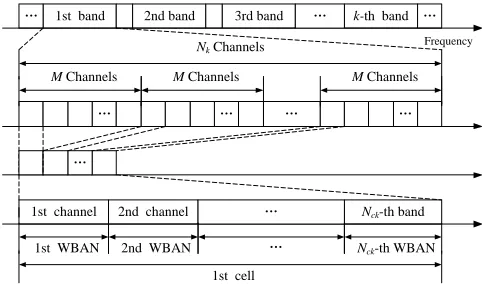
There are K frequency bands supported in the WBANs. An application will use one of them based on the require-ments. Let us focus on one band in which there are 𝑁𝑘
sub-channels, where k is integer from 1 to K. We divide them into M equal proportions; each has 𝑁𝑐𝑘 subchannels, so we have 𝑁𝑘= 𝑁𝑐𝑘× 𝑀.
The multiple WBANs are organized in clusters in our architecture. As the functionality in cellular networks, all the wireless nodes in a cluster share the whole bandwidth of the frequency band which they are working in. This means 𝑁𝑘 subchannels are to be allocated, a cluster
com-prises M cells and 𝑁𝑐𝑘 WBANs (users) in each cell. For the
n-th cell in a cluster, its allocated channels are the n-th channel and every M channels after it, as shown in Fig. 4. Here we define n as the Cell Sequential Number, Cseq.
When Cseq is given, the activating bands in the cell can be
easily determined. On the other hand, in a cell, the chan-nels are sequentially distributed since each of them is dis-tanced M channels away in the frequency domain.
When the cells and clusters are formed based on adja-cency, above spectrum allocation method may keep the de-vices using the same subchannel as far as possible. Because the central device in a cellular cell is the base station, while there are no fixed infrastructures for WBANs communica-tion. The clustering in WBANs is far more challenging. In this context, the self-organized dynamic clustering method is developed, and the FDMA is instinctively supported.
4.2. Clustering
In our work, several parameters need to be maintained by each hub:
Cluster ID. An 8-bit sequential number to identify the cluster in which the hub is working. This value is random generated by the node which initial this cluster.
Cell ID. An 8-bit sequential number to identify the cell which the hub belongs to. It is determined by its working bands, and its decimal is equal to the
Cseq mentioned above.
Hub ID. An 8-bit sequential number to identify the hub, ranges from 1 to 𝑁𝑐𝑘. Its decimal value is also
the number of nodes in the current cell.
Nnode. Number of nodes in the current cell, ranges
from 1 to 𝑁𝑐𝑘.
Tsh. Time duration for a hub runs the only WBAN
in a cell (single hub cell).
Tsh, max. Maximum allowed time duration for a hub
runs the only WBAN in a cell.
Torphan. Time duration for a hub working in orphan
mode, in which it does not belong to any cell or cluster.
Torpahn, max. Maximum allowed time duration for a
hub working in orphan mode
RQk. An indicator to describe the request QoS level
in the k-th application band. This value will be used in the TDMA method which will be discussed in next subsection.
Besides, the proposed algorithm is based on the services of each hub as follows:
All communication bands coverage. The hub is ca-pable of transmitting and receiving packets in any frequency band which its WBAN may use.
Receiving signal strength indicator (RSSI). For any packet it receives, the receiving power is measured and stored.
Link quality indicator (LQI). The link quality be-tween the sending and receiving device is esti-mated for each transmission. The link quality in WBAN covers the path loss, channel history, resid-ual energy and node temperature which relate to different techniques. Since the aim of our work is to mitigate the interference, the RSSI is only con-sidered in the LQI.
Clear channel assessment (CCA). The hub is capa-ble of identify whether a channel is idle or not for all the channels it supports.
For the self-organized dynamic clustering, a hub has the functions as follows:
Cluster initial. A hub acts as the first one in a clus-ter. It generates the Cluster ID and set its Cell ID to 1. This procedure will increase the number of clus-ters in the WBANs.
Frequency
1st band 2nd band 3rd band
…
…
k-th band …
… …
Nk Channels
M Channels
1st cell
1st channel 2nd channel Nck-th band
…
…
1st WBAN 2nd WBAN … Nck-th WBAN
…
M Channels M Channels
[image:5.567.298.539.61.203.2]…
Cell Initial. A hub acts as the first one in a cell. It inherits the Cluster ID, generates the Cell ID based on the working band and set its Hub ID to 1.
Cell Join. A hub joins a cell based on the optimal band, inherit Cluster ID and Cell ID and set Hub ID to the first empty value or Nnode +1.
Cell Leave. When a hub finds the average LQI from other cell is better than the value in current cell, it performs leave function and sends a notification. When a hub in the origin cell receives it, it notifies all the hubs in the cell and set the Hub ID of leaving device to empty, Nnode decreases by 1.
Single cell mode. When a hub acts as the only one in a cell, it works in single hub mode. The Tsh will
be timing in this mode. When a hub leaves this mode, the Tsh will set 0.
Orphan mode. When a hub fails to join adjacent cells, it works in orphan mode. The frequency hop-ping is used. The Torphan will be timing in this mode.
When a hub leaves this mode, the Torphan will set 0.
Since there is no fixed infrastructure in WBAN, the management of a cluster is implemented by all the hubs in the cluster. We call it the cluster management entity (CME) in this paper. In the CME, the information exchange is based on the mobile internet communication, and each hub implements the computation in turn. The CME is respon-sible of the function of Cell Combine. By periodically com-munication, if two adjacent clusters find they can be merged by providing enough channels for all the commu-nication in them, the two clusters will be combined to one. In that case, the hubs in the cluster with fewer WBANs will reset their related parameters and implement the Cell Join function. This procedure will decrease the number of clus-ters in the WBANs. An example of the clustering is shown in Fig.5.
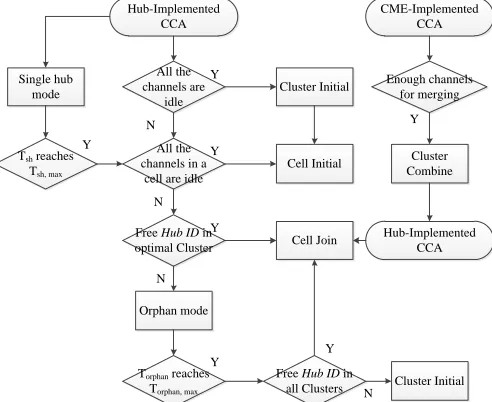
The diagram of Self-organized Dynamic Clustering based on above services and functions is shown in Fig.6. The twice entries for the Cell Join from free Hub ID search-ing are designed to maximum the efficiency of the spec-trum in clusters. The single hub mode is introduced to pre-vent the case in which an isolated node occupies the chan-nels in a cluster due to its early join, but not being able to share with other WBANs. Orphan mode may prevent the frequent new cluster initialization, which results in high communication overheads. The last issue needs to discuss is the identical Cluster ID in different clusters. It may hap-pen since the parameter is random generate. In this paper, we assume the initial device is aware of the Cluster ID in its neighborhood and generate a unique ID. This procedure can be easily realized by providing GPS information in tier-2 communication or relying on cloud-based architec-ture.
4.3. TDMA for SDC
By the SDC framework mentioned above, the hubs which use the same subchannels are separated as far as possible. However, it may be not far enough. When the density of WBANs is considerable large, a hub may still suffer from the interference from other WBAN device which cannot be ignored. Thus, we introduce a TDMA method for this case.
The superframe structure is enabled in the IEEE 802.15.6 MAC layer, while the allocation mechanism is not speci-fied. To reduce the interference, we allocate the superframe duration based on the parameter of requested QoS for the k-th band, RQk mentioned above. When there are L
appli-cations using this channel, Rl and Prl are the data rate and
priority of l-th application, where l ranges from 1 to L, the RQk is calculated as (1):
𝑅𝑄𝑘= ∑𝐿 𝑅𝑙𝑘
𝑙=1 × 𝑃𝑟𝑙𝑘 (1)
The 𝑅𝑙𝑘 is determined by the application requirement. Regarding the 𝑃𝑟𝑙𝑘, since there are four service priorities
presented in IEEE 802.15.6,which from low to high are: non-medical services, mixed-medical and non-medical vices, general health services, highest priority medical ser-vices, we set the 𝑃𝑟𝑙𝑘 to 1,2,3,4 respectively.
When finding the SIR drop to a pre-defined threshold (15dB in this paper), a hub will try to allocate the super-frame active time with all the interference clusters. Sup-pose there are I clusters interfere with each other in KI bands, the proportion of active duration for the i-th cluster,
Hub-Implemented CCA
All the channels are
idle
Cluster Initial
All the channels in a
cell are idle
Cell Initial Y
N Y
N
Free Hub ID in
optimal Cluster Cell Join Y
N
Orphan mode
Torphan reaches
Torphan, max
Free Hub ID in all Clusters
Y
N Y
Tsh reaches
Tsh, max
Single hub mode
Y
CME-Implemented CCA
Cluster Initial Enough channels
for merging
Cluster Combine
[image:6.567.290.527.62.242.2]Hub-Implemented CCA Y
Fig. 6. Diagram for Self-organized Dynamic Clustering
Cseq=1
Cseq=2
Cseq=3
Cseq=2
Cseq=3
[image:6.567.294.540.518.719.2]Cell coverage
Di, based on (2)
𝐷𝑖=
∑𝐾𝐼𝑘=1𝑅𝑄𝑘,𝑖
∑𝐼𝑖=1∑𝐾𝐼𝑘=1𝑅𝑄𝑘,𝑖 (2)
4.4. Inter-WBAN relaying
Since the multi hop method may provide better perfor-mance compared with single hop. A node forwarding tocol based on the inter-WBAN relaying (IWR) is also pro-posed. Note that the algorithm design is beyond the con-tents in this paper, we just study the principle for the selec-tion of relay node.
In our scheme, the inter-WBAN communication is al-lowed between routers from different WBANs but in the same cluster. Because the Cell ID and Hub ID are managed by each device, the channel each router uses can be ob-tained by calculating the channel sequential number, Channel ID, as (3):
𝐶ℎ𝑎𝑛𝑛𝑒𝑙 𝐼𝐷 = 𝑀 × 𝐻𝑢𝑏 𝐼𝐷 + 𝐶𝑒𝑙𝑙 𝐼𝐷 (3)
When the IWR is enabled, besides the neighbor routers in its own WBAN, the sending device may extend its next hop candidates to all the neighbor routers in its cluster. We assume each potential relay is aware of the link quality to the sending device and its optimal value to any hub. The summation of them represents the total link cost. The can-didate with minimum link cost will be chosen as the next hop node.
Considering the privacy and priority, only the packets from non-medical services and the highest priority medi-cal services are enabled for IMR. The reason is that the for-mer service contains little private information, and the lat-ter one may be life-threatening if the data fails to transmit.
5
S
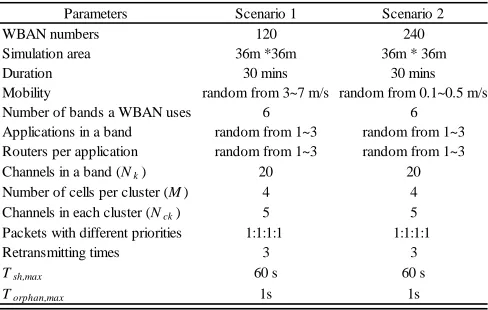
IMULATIONSThe performance of SDC was evaluated in this section. The simulation was carried out based on Opnet 14.5. To make a more convincing conclusion, we ran the simulation in two scenarios which were related to different network environments. In scenario 1, the WBANs deploy in high density with medium mobility. The typical scenes include office buildings and mall. And scenario 2 describes the case with extremely high density and low mobility, such as in a stadium or rallies.
As discussed, we assumed the implant device, as end node, was capable of sending packets to an on-body device which provided the best link quality by using in-body communication bands which would not affect the on-body transmission. Above procedure was ignored in our simu-lation. We only focused on the behaviors of on-body de-vices which acted as a router and hubs. The hub was on the wrist for each user, while the routers are random deployed as shown in Fig.1. It was impossible to build accurate chan-nel models for each link with such many devices. In this paper, we estimated the related parameters as follows. For the intra-WBAN communication, the distance between a router and hub random ranged from 200mm to 800mm. On the other hand, transmitting distance was the space be-tween two hubs which the communicating nodes belonged to adding a compensation value for height and postural differences, which ranged from 0 to 300 mm. Considering the path loss model, we assumed it might be LOS or NLOS
in even chance. The path loss exponent was random from 3 to 4 for LOS and 5 to 7 for NLOS. For a certain router, each service it provided worked in a random NB band for on-body communication listed in Table.2. In our simula-tion, since the diversity of data rate in different applicasimula-tion, we measure the data rate by the percentage of maximum data rate supported in the band it was using. The data rates ranged from 10% to 90% of the maximum rate, with inter-val of 20%. The transmit power also varied according to the application requirements. In our work, we assumed the sending device had the knowledge of the path loss and the required receiving signal strength, and then transmitted the packet in minimum power possible. Besides mentioned above, other general simulation parameters are shown in Table. 3.
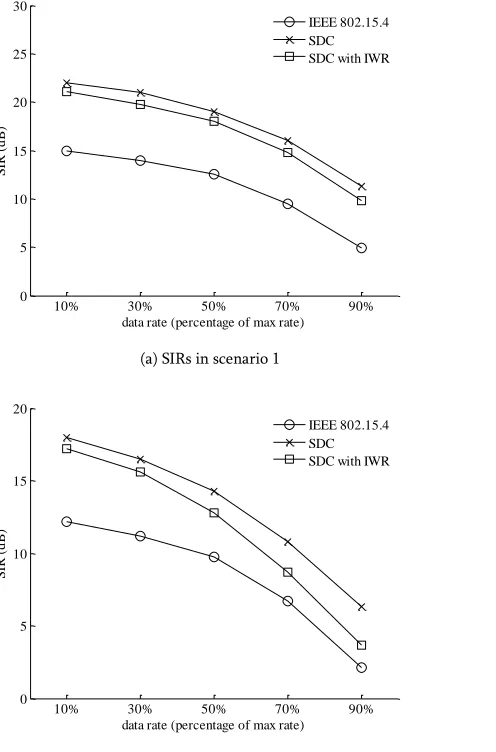
Because SDC was designed for interference mitigation, SIR was measured for performance evaluation. Besides, the QoS was also considered in terms of the packet deliv-ery ratio and packet delay. The performance was com-pared with the non cluster architecture which used IEEE 802.15.6 for tier 1 communication and the frequency hop-ping was enabled. Meanwhile, we also deployed the pro-posed IWR in SDC and tested its performance.
The SIRs for different methods in both scenarios were shown Fig.7. It could be concluded that the self-organized dynamic clustering and its multiple access mechanism were effective in the SIR mitigation. SDC had the best per-formances, with an average 5.3 dB and 3.9 dB higher than IEEE 802.15.6 in scenario 1 and 2, separately. It benefited from the longer distance between the WBAN nodes which worked in the same subchannel by clustering. We could also see that when the inter-WBAN relaying was activated, the effect on interference mitigation was counteracted a bit. The reason of this might be that the relaying node from other WBAN may locate nearer to a signal or interference source which was deployed in another cluster. The average improvement on SIR decreased to 4.0 dB and 2.3 dB on av-erage. Besides, the faster decline of all simulated methods indicated the effects of node density. On the other hand, our mechanism could make more sense in crowded situa-tion since the SIR without clustering had fallen approxi-mately to 3dB which would degenerate the network per-formance seriously.
TABLE3 SIMULATION PARAMETERS
Parameters Scenario 1 Scenario 2
WBAN numbers 120 240
Simulation area 36m *36m 36m * 36m
Duration 30 mins 30 mins
Mobility random from 3~7 m/s random from 0.1~0.5 m/s Number of bands a WBAN uses 6 6
Applications in a band random from 1~3 random from 1~3 Routers per application random from 1~3 random from 1~3 Channels in a band (Nk) 20 20 Number of cells per cluster (M) 4 4 Channels in each cluster (Nck) 5 5 Packets with different priorities 1:1:1:1 1:1:1:1
Retransmitting times 3 3
Tsh,max 60 s 60 s
[image:7.567.296.540.96.251.2]As the indicator of reliability, the packet delivery ratio was illustrated in Fig. 8. SDC improved this value for 9.3% and 7.0% on average compared with IEEE 802.15.6. On one hand, the higher SIR resulted in better Signal-to-Interfer-ence-plus-Noise-Ratio (SINR) which reduced the error rate. On the other, the determined band (based on Eq. (3)) might reduce the noise impact on frequency distortion. Moreover, it was shown that the IWR could further improve reliabil-ity, which was an instinctive advantage of multi hop com-munication. On average, SDC improved PDR by 9.2% and 9.7% in scenario 1 and 2. The value for SDC with IWR was 16.5% and 11.7%. Focusing on the slopes of PDR variation in both sub-figures, one could see that the WBAN mobility had a bigger impact on the PDR and our methods were ef-fective in both scenarios.
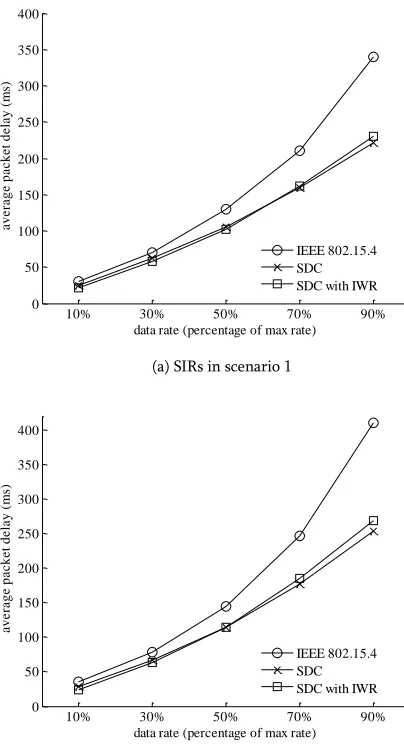
In Fig.9, because packet delay had a stronger relationship to the response time of a service or command, it was chosen rather than end-to-end delay to be studied. What happened in both scenarios seemed similar. SDC was able to reduce the latency effectively no matter whether IWR was enabled. This was partially because of the improved bit error rate which was analyzed before, at the same time, the organized
frequency and superframe allocation could reduce the chance of collision. The figures also indicated that when the data rate was low, IWR had better performance while the single SDC had less latency in high data rate case. The reason might be that the improvement was balanced by the rising channel oc-cupancy in multi hop scheme.
6
C
ONCLUSIONSThe WBAN provides continuous data sensing and gath-ering around human body without discomforting the user for various medical and non-medical applications. As it is getting more and more popular with the development of some fundamental technologies, WBAN may be ubiqui-tous in our daily life in the future. A well designed man-agement architecture is needed to reduce the influences caused by the coexistence of multiple, even massive WBANs. In this paper, we propose a Self-organized Dy-namic Clustering method and its multiple access mecha-nism to mitigate the interference and improve the commu-nication QoS for multiple WBANs environment. To the best of our knowledge, this is the first paper which focuses
(a) SIRs in scenario 1
[image:8.567.43.291.320.696.2](b) SIRs in scenario 2
Fig.7. SIRs in different scenarios
(a) Packet delivery ratios in scenario 1
[image:8.567.301.510.322.692.2](b) Packet delivery ratios in scenario 2
Fig.8. Packet delivery ratios in different scenarios
10% 30% 50% 70% 90% 0
5 10 15 20 25 30
data rate (percentage of max rate)
S
IR
(
d
B
)
IEEE 802.15.4 SDC SDC with IWR
10% 30% 50% 70% 90% 0
5 10 15 20
data rate (percentage of max rate)
S
IR
(
d
B
)
IEEE 802.15.4 SDC SDC with IWR
10% 30% 50% 70% 90% 0
0.1 0.2 0.3 0.4 0.5 0.6 0.7 0.8 0.9 1
data rate (percentage of max rate)
p
a
c
k
e
t
d
e
li
v
e
ry
r
a
ti
o
IEEE 802.15.4 SDC SDC with IWR
10% 30% 50% 70% 90% 0
0.1 0.2 0.3 0.4 0.5 0.6 0.7 0.8 0.9 1
data rate (percentage of max rate)
p
a
c
k
e
t
d
e
li
v
e
ry
r
a
ti
o
on the spectrum allocation for multiple WBANs. In SDC, the clustering is self-organized by the hubs’ operation and
communication in tier 2. FDMA is instinctively supported by cluster framework, while the TDMA is based on the su-perframe structure. Furthermore, we propose an inter-WBAN relaying protocol by allowing the inter-inter-WBAN communication in a cluster. The simulation results show that the SDC and SDC with IWR achieve better SIR, higher PDF and lower packet latency.
Since our study on the multiple WBANs is still at the beginning phase, our future work may include the im-provement on existing algorithm, protocol design on node level, cloud-based method investigation and so on.
A
CKNOWLEDGMENTThis paper is supported by the National Natural Science Foundation of China (61401310, 61501326, 61731006, and 61271411). It also supported by China Scholarship Council (201608120043), Tianjin Research Program of Application Foundation and Advanced Technology(15JCZDJC31500), and Tianjin Science Foundation(16JCYBJC16500).
R
EFERENCES[1] Nigussie, Ethiopia, Teng Xu, and Miodrag Potkonjak. "Securing wireless body sensor networks using bijective function-based hardware primi-tive." Intelligent Sensors, Sensor Networks and Information Processing (ISSNIP), 2015 IEEE Tenth International Conference on. IEEE, 2015. [2] Cavallari, Riccardo, et al. "A survey on wireless body area networks:
Technologies and design challenges." IEEE Communications Surveys & Tutorials 16.3 (2014): 1635-1657.
[3] Gravina, Raffaele, et al. "Multi-sensor fusion in body sensor networks: State-of-the-art and research challenges." Information Fusion 35 (2017): 68-80.
[4] Alrige, Mayda, and Samir Chatterjee. "Toward a taxonomy of wearable technologies in healthcare." International Conference on Design Science Research in Information Systems. Springer, Cham, 2015.
[5] Wei, Y. U., Q. I. N. G. S. O. N. G. Fei, and L. I. J. U. A. N. He. "Sports mo-tion analysis based on mobile sensing technology." Internamo-tional Confer-ence on Global Economy, Finance and Humanities Research (GEFHR 2014). 2014.
[6] Solanas, Agusti, et al. "Smart health: a context-aware health paradigm within smart cities." IEEE Communications Magazine 52.8 (2014): 74-81. [7] Hiremath, Shivayogi, Geng Yang, and Kunal Mankodiya. "Wearable In-ternet of Things: Concept, architectural components and promises for person-centered healthcare." Wireless Mobile Communication and Healthcare (Mobihealth), 2014 EAI 4th International Conference on. IEEE, 2014.
[8] Swan, Melanie. "Sensor mania! the internet of things, wearable compu-ting, objective metrics, and the quantified self 2.0." Journal of Sensor and Actuator Networks 1.3 (2012): 217-253.
[9] Chen, Min, et al. "Body area networks: A survey." Mobile networks and applications 16.2 (2011): 171-193.
[10] Movassaghigilani, S., Mehran Abolhasan, and Justin Lipman. "A review of routing protocols in wireless body area networks." Journal of Net-works (2013).
[11] Awan, Khalid, Kashif Naseer Qureshi, and Mehwish. "Wireless body area networks routing protocols: a review." Indonesian Journal of Elec-trical Engineering and Computer Science 4.3 (2016): 594-604.
[12] Wang, Yue. "Linear least squares localization in sensor networks." Eura-sip journal on wireless communications and networking 2015.1 (2015): 51.
[13] Liang, Qilian, and Qingchun Ren. "Energy and mobility aware geo-graphical multipath routing for wireless sensor networks." Wireless Communications and Networking Conference, 2005 IEEE. Vol. 3. IEEE, 2005.
[14] Movassaghi, Samaneh, et al. "Wireless body area networks: A survey." IEEE Communications Surveys & Tutorials 16.3 (2014): 1658-1686. [15] Bluetooth Core Specification, Core Version 5.0 (2016).
https://www.bluetooth.com/specifications/bluetooth-core-specifica-tion
[16] IEEE Std 802.15.4-2015 (Revision of IEEE Std 802.15.4-2011) - IEEE Stand-ard for Low-Rate Wireless Networks. https://stand-ards.ieee.org/findstds/standard/802.15.4-2015.html
[17] Lai, Xiaochen, et al. "A survey of body sensor networks." Sensors 13.5 (2013): 5406-5447.
[18] IEEE Standard for Local and metropolitan area networks - Part 15.6: Wireless Body Area Networks, 2012.
[19] Kwak, Kyung Sup, Sana Ullah, and Niamat Ullah. "An overview of IEEE 802.15. 6 standard." Applied Sciences in Biomedical and Communication Technologies (ISABEL), 2010 3rd International Symposium on. IEEE, 2010.
(a) SIRs in scenario 1
[image:9.567.36.238.325.702.2](b) SIRs in scenario 2
Fig.9. Packet delays in different scenarios
10% 30% 50% 70% 90% 0
50 100 150 200 250 300 350 400
data rate (percentage of max rate)
a
v
e
ra
g
e
p
a
c
k
e
t
d
e
la
y
(
m
s)
IEEE 802.15.4 SDC SDC with IWR
10% 30% 50% 70% 90% 0
50 100 150 200 250 300 350 400
data rate (percentage of max rate)
a
v
e
ra
g
e
p
a
c
k
e
t
d
e
la
y
(
m
s)
[20] Ullah, Sana, Manar Mohaisen, and Mohammed A. Alnuem. "A review of IEEE 802.15. 6 MAC, PHY, and security specifications." International Journal of Distributed Sensor Networks 9.4 (2013): 950704.
[21] Cordeiro, Carlos. "Use cases, applications and requirements for BANs." Doc.: IEEE802. 15-07-0564-00-0ban (2007).
[22] Yang, Wen-Bin, and Kamran Sayrafian-Pour. "Interference mitigation for body area networks." Personal Indoor and Mobile Radio Communi-cations (PIMRC), 2011 IEEE 22nd International Symposium on. IEEE, 2011.
[23] Liang, Xuedong, Ilangko Balasingham, and Sang-Seon Byun. "A rein-forcement learning based routing protocol with QoS support for bio-medical sensor networks." Applied Sciences on Biobio-medical and Com-munication Technologies, 2008. ISABEL'08. First International Sympo-sium on. IEEE, 2008.
[24] Filipe, Luis, et al. "Wireless body area networks for healthcare applica-tions: Protocol stack review." International Journal of Distributed Sensor Networks 11.10 (2015): 213705.
[25] Liang, Xuedong, and Ilangko Balasingham. "A QoS-aware routing ser-vice framework for biomedical sensor networks." Wireless Communica-tion Systems, 2007. ISWCS 2007. 4th InternaCommunica-tional Symposium on. IEEE, 2007.
[26] Djenouri, Djamel, and Ilangko Balasingham. "LOCALMOR: Localized multi-objective routing for wireless sensor networks." Personal, Indoor and Mobile Radio Communications, 2009 IEEE 20th International Sym-posium on. IEEE, 2009.
[27] Quwaider, Muhannad, and Yaser Jararweh. "Cloudlet-based efficient data collection in wireless body area networks." Simulation Modelling Practice and Theory 50 (2015): 57-71.
[28] Razzaque, Md Abdur, Choong Seon Hong, and Sungwon Lee. "Data-centric multiobjective QoS-aware routing protocol for body sensor net-works." Sensors 11.1 (2011): 917-937.
[29] Kim, Seungku, and Byung Kwon Song. "A prioritized resource alloca-tion algorithm for multiple wireless body area networks." Wireless Net-works 23.3 (2017): 727-735.
[30] Dong, Jie, and David Smith. "Cooperative body-area-communications: Enhancing coexistence without coordination between networks." Per-sonal Indoor and Mobile Radio Communications (PIMRC), 2012 IEEE 23rd International Symposium on. IEEE, 2012.
[31] de Silva, Buddhika, Anirudh Natarajan, and Mehul Motani. "Inter-user interference in body sensor networks: Preliminary investigation and an infrastructure-based solution." 2009 Body Sensor Networks. IEEE, 2009. [32] Lazzi, Gianluca. "Thermal effects of bioimplants." IEEE Engineering in
Medicine and Biology Magazine 24.5 (2005): 75-81.
[33] Tang, Qinghui, et al. "Communication scheduling to minimize thermal effects of implanted biosensor networks in homogeneous tissue." IEEE Transactions on Biomedical Engineering 52.7 (2005): 1285-1294. [34] Tang, Qinghui, et al. "TARA: thermal-aware routing algorithm for
im-planted sensor networks." International Conference on Distributed Computing in Sensor Systems. Springer, Berlin, Heidelberg, 2005. [35] Yuce, Mehmet R., et al. "A MICS band wireless body sensor network."
Wireless Communications and Networking Conference, 2007. WCNC 2007. IEEE. IEEE, 2007.
[36] C95.1-2005 - IEEE Standard for Safety Levels with Respect to Human Ex-posure to Radio Frequency Electromagnetic Fields, 3 kHz to 300 GHz, 1999.
[37] Latré, Benoît, et al. "Networking and propagation issues in body area net-works." Proceedings of the 11th Symposium on Communications and Vehicular Technology in the Benelux, SCVT 2004. 2004.
[38] Braem, Bart, et al. "The need for cooperation and relaying in short-range high path loss sensor networks." Sensor Technologies and Applications,
2007. SensorComm 2007. International Conference on. IEEE, 2007. [39] Jia, Min, et al. "Downlink Design for Spectrum Efficient IoT Network."
IEEE Internet of Things Journal PP.99(2017):1-8.
Jiasong Mu received the BS degree in electric information engineering from Harbin Institute of Technology, China, in 2005, the MS degree in signal and information processing from Tianjin University, China, in 2007, and the PhD degree in electronic circuit and system from Tianjin Univer-sity, China, in 2012. He has been an associate professor at the College of Electronic and Communication Engineering, Tianjin Normal University, China, since September, 2014. His research interests include wireless sen-sor network, body area networks, 5G, smart grid and wireless communi-cation. He is the TPC co-chair of the International Conference on Com-munications, Signal Processing, and Systems from 2015 to 2018.
Robert Stewart. is currently the Professor of Signal Processing at the Uni-versity of Strathclyde, Scotland, UK in the Dept of Electronic and Electri-cal Engineering, was previously Department Chair and Head of Depart-ment from 2014-2017. In recent years his research work has been on dig-ital communications and software defined radio, with specific interest in model-based design, spectrum sharing and TV white space and on radio standards. Bob has also worked extensively on rural communications is-sues in both UK and in Africa and is currently PI on an EPSRC funded
project (EP/P029698/1) on ‘Enabling Affordable ‘Internet Access using Dynamic Spectrum Management’. Since 1997 Bob has been engaged as a
visiting Professor at the University of California, Los Angeles (UCLA) Ex-tension School. Over his career Bob has authored many academic and technical papers, as well as 3 textbooks. In 2004 Bob was a co-founder of the startup digital communications company Steepest Ascent Ltd which was later acquired by MathWorks in 2013. Bob has a PhD from the Uni-versity of Strathclyde.
Liang Han received the M.S. and Ph.D. degree in communication and in-formation systems, both from University of Electronic Science and Tech-nology of China, Chengdu, China, in 2010 and 2013, respectively. Since 2014, he has been with the College of Electronic and Communication En-gineering, Tianjin Normal University. From 2016 to 2017, he was a visit-ing scholar in the Department of Electrical Engineervisit-ing at the University of Texas at Arlington. His current research interests include D2D commu-nications, full-duplex communications and V2X communications.