j materres technol.2019;8(5):3719–3725
w w w . j m r t . c o m . b r
Availableonlineatwww.sciencedirect.com
Original
Article
TEM
study
of
the
effect
of
high-temperature
thermal
cycles
on
the
stability
of
the
Y-Al-O
oxides
in
MA956
ODS
steel
J.R.O.
Leo
a,∗,1,
S.R.
Moturu
a,2,
M.E.
Fitzpatrick
baMaterialsEngineering,TheOpenUniversity,WaltonHall,MiltonKeynesMK76AA,UK
bFacultyofEngineering,EnvironmentandComputing,CoventryUniversity,PrioryStreet,CoventryCV15FB,UK
a
r
t
i
c
l
e
i
n
f
o
Articlehistory:
Received8January2019 Accepted18June2019 Availableonline11July2019
Keywords:
MA956 ODS
Characterization Oxides
Heattreatment TEM
a
b
s
t
r
a
c
t
MA956, a commercialferritic gradeof Oxide-Dispersion-Strengthened (ODS) steel,was investigatedusingtransmissionelectronmicroscopy(TEM)toevaluatetheinfluenceof high-temperaturethermalcyclesonthenanometricdispersedoxides.Analysesoftheoxidesize distributionwerecarriedoutonfoilsfromtheas-receivedMA956andfollowingtreatment at1285◦Cforonehour,andshowthatgrowthoftheoxideshasoccurredunderthethermal cycle.Implicationsfortheoxidestabilityinthesteelmatrixarediscussed,inthelightofthe oxidechemicalcomposition.
©2019TheAuthors.PublishedbyElsevierB.V.Thisisanopenaccessarticleunderthe CCBY-NC-NDlicense(http://creativecommons.org/licenses/by-nc-nd/4.0/).
1.
Introduction
Incoloy alloy MA956 is a commercial oxide-dispersion strengthened (ODS)steelwith aferritic matrix [1]. Itis an FeCrAlalloysystem,whosecompositionaimsathigh oxida-tionresistance.Thehighcontentofchromium(20%wt.)and aluminium(5%wt.)inthematrixcausestheformationofan adherent,slow-growingaluminascalethatprovidessuperior resistancetoaggressiveenvironmentsandhigh-temperature
∗ Correspondingauthor.
E-mail:[email protected](J.Leo).
1 PresentlyatCoventryUniversity. 2 PresentlyatStrathclydeUniversity.
oxidation[2].Thealloyexhibitsoutstandingstrengthat tem-peraturesover1000◦C,owingtothefinedispersoidsresulting fromtheformationofcomplexY-Al-Ooxides,homogeneously distributedthroughthematrix[3].
Previous investigations on a variety of ODS steels that were concerned with the size of the nanodispersoids for strengthening revealed higher stability than age-hardening precipitates,alongwithinsolubilityinthematrixat tempera-turesnearthemeltingpointofthebasealloy[4,5].Whilethe chemicalnatureoftheoxidehasnotbeenofprimary con-cern,anumberofstudiesinvestigatedtheeffectofalloying elementsontherefinementandontheformationofcomplex oxideparticles[6–8],duringprocessingofthealloys.However, nodirectinvestigationhasbeencarriedoutonthestability oftheoxidesaftermanufacturing.Thisworkconcentrateson
https://doi.org/10.1016/j.jmrt.2019.06.027
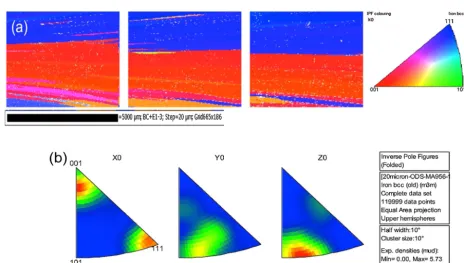
Fig.1–(a)EBSDmapsofMA956grainsinthelongitudinaldirection,and(b)thecorrespondingIPFmapsshowingthe predominantfibres,especiallyintherollingdirection(X0).
Table1–ChemicalcompositionoftheMA956steel.
Cr Al Ti Yttria C N Mn Si
19.4 4.8 0.38 0.51 0.015 0.022 0.10 0.04
Ni Cu S P Co O Fe
0.05 0.02 0.008 0.005 <0.01 0.23 Bal.
theevaluationofthestabilityoftheY-Al-Ocomplexoxidesof theMA956subjecttothermalprocessingfollowing manufac-turing.
2.
Experimental
Approach
MA956materialwassuppliedbyIncotest(aDivisionof Spe-cialMetalsWigginLTD),UK.Cylindricalsampleswith16mm diameterand100mmlengthwerecutfromtheas-received hot-extrudedbars.Chemicalcompositionwasprovidedbythe manufacturer,asshowninTable1.
Characterizationofthematerialintheas-received condi-tion wascarriedout byscanning electronmicroscopy with electronbackscatterdiffraction(SEM/EBSD)andtransmission electronmicroscopy.Sampleswere extractedfrom boththe cross-section(perpendiculartothebaraxis)andlongitudinal (alongthebaraxis)directions.
ThepreparationforEBSDinvolvedgrindingwithSiCpaper, polishingwithdiamondparticlessuspension(1mand6m); andafinalpolishingstagewithcolloidalsilicasuspension OP-S,whichconsistsofsiliconoxideparticlesofsub-micronsize range(<0.1m)inanalkalinemedium,inordertoachievethe polishedsurfacefinish.Cross-sectionalandlongitudinal sam-pleswereEBSD-scannedusingstepsizesof5mand20m, respectively.
For the TEM survey, three foils were prepared by man-ual grindingwithSiCpapersof40,15 and5m,cutintoa 3-mm-diameter diskand,then,furtherthinnedbyjet elec-tropolishing in a solution of 5% perchloric acid and 95% ethanolat–50◦C.Imagingwasconductedinbright-fieldmode (BF)inaJEOLJEM2100TEMtostudythesizedistributionofthe oxides.Atotalof449oxideparticleswerecountedand mea-suredfromeightdifferentmicrographs,obtainedbyvarying theareaofthefoilunderinvestigationaswellasthetiltangle ofthespecimenholder,inordertobestatistically representa-tive.
Initsas-receivedcondition,theMA956containshigh resid-ual stresses, and mechanical tests showed poor ductility. Based on the recrystallization temperatures ofthe MA956 foundinpreviousworks[1,9],aheattreatmentwasdevisedat 1285◦Cforonehourfollowedbyafurnacecool,atemperature suitableforasubcriticalannealing,sinceitissituatedabove 0.9Tm.Thepurposeofthetreatmentwasstressrelief.Previous
studiesontheMA956suggestedthattheonlyexpectedphase changeatthistemperatureistheformationoftheCr-rich˛’ -phase,whichtakesmorethan100hofisothermaltreatment tobeformed[10,11].Therefore,nophasetransformationwas expected forsuchashort timeinterval ofexposureto the thermalcycle.
[image:2.612.65.529.59.321.2]j mater res technol.2019;8(5):3719–3725
3721
3.
Results
3.1. Microstructureoftheas-receivedMA956
Themicroscopysurveyrevealedelongatedgrains,columnar inshapeandstronglyorientedalongthelongitudinalaxisof thebars,centimetresinlengthandseveralmillimetreswide. Thisisinagreementwiththemicrostructurereportedinthe literature[12–14].
SEM/EBSD analysis provided further insight into the microstructure. As seen from Fig. 1, the columnar grains, elongatedalongtheextrusiondirection,presentastrong pref-erentialorientation,mainlycharacterisedbythe{100}<110> system,alsoknownas˛-fibre;andthe{111}<110>system,the
-fibre.InFig.2a,threeEBSDmapsofadjacentareasofthe MA956microstructureareseenandcolour-codedbytheIPF contouring,highlightingthe fibres,whichare confirmedby theInversePoleFigures(IPF)showninFig.1b.
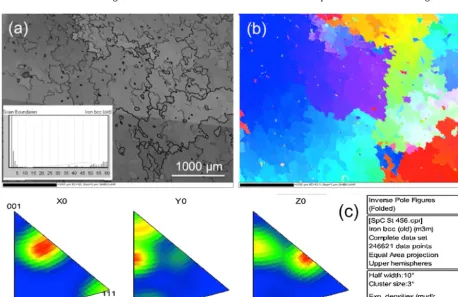
Fig.2showsthemicrostructureoftheas-received mate-rialobservedfromthecross-section.Adistributionfunction, based on the fraction ofhigh-angle grain boundaries, was obtainedfrom the EBSDand usedto estimatethe average grainsizeoverfourareas of3750m2, whichwasfoundto
be376±48m.
3.2. Oxidesizedistribution–as-receivedMA956
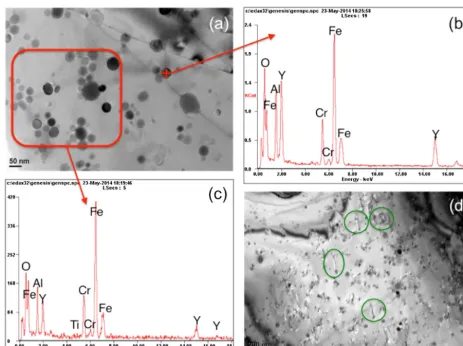
TEM images show a relatively homogeneous distribu-tion of nanoscale oxides throughout the matrix. In some
micrographs,theoxidesseemtoalignwiththegrain bound-aries,reflectingadegreeofpreferentialorientationwiththe extrusion direction of the material. Fig. 3 illustrates these findings.Someinteractionsbetweendislocationsandoxide particleswereobserved.AsFig.3dportrays,therearesome matrixdislocationsthatseemtohavebeeneffectivelypinned bythenanometricoxides.
Thehistogramforsizedistributionoftheoxidesisshown in Fig. 4. The average size determined was calculated as 34±7nm,avaluepertainingtothedesiredrange,according tosomeresearchers,forensuringeffectivenessinpinning dis-locations[15–17].
3.3. MicrostructureoftheannealedMA956
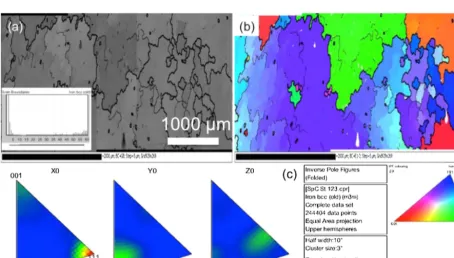
Althoughsubjectedtoaveryhightemperature,thematerial didnotpresentanychangeinitsmicrostructure,whichstill presentsthesamefeaturesastheoriginalstateoftheMA956: thatis,the˛-and-fibretexturesofthecolumn-likegrains, earlierdepicted inFigs.1and 2.Themicrostructureofthe annealedmaterialisfeaturedinFigs.5and6,inthe longitu-dinalandtransverse(cross-sectional)directions,respectively. While it is known that ferritic grains may grow easily tomillimetresizeunderheattreatmentsatrecrystallization temperatures[18],theresultsseemtoindicatemicrostructural stability, which is reasonable, considering that the manu-factured MA956 already presents columnar grains several centimetreslongandhundredsofmicrometreswide.There mayalsobeabeneficialpinningeffecttothegrainboundaries fromtheoxidedispersion.Estimatesofthegrainsizeinthe
[image:3.612.72.531.423.720.2]Fig.3–TEMmicrographsoftheas-receivedMA956.In(a),particlesandclustersalignwiththeboundary.(b)and(c)areEDS scansoftheindicatedtargets.(d)showsparticlespinningdislocations(highlighted).
Fig.4–Oxidesizedistributionoftheas-receivedMA956.
cross-sectionaldirectionmadefromthedistributionfunction averaged362±39mforthegrainsize.Thematerial,observed fromthetransversedirection,isseeninFig.6.
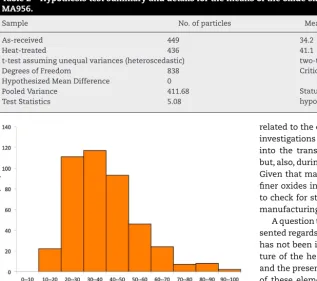
The TEM investigation on the foils extracted from the annealedmaterialshowedanaveragediameterof41±8nm fortheoxideparticles.Theresultantdistributionhistogramis
showninFig.7,whereanalmostidenticaldistributiontothat ofFig.4isnoticeable.
Given the similarities of the results from the measure-mentsoftheoxideparticlesize,aheteroscedasticstudent-t test(thatis,atestdesignedwiththeassumptionofunequal variances)wascarriedout withasignificanceprobabilityof 5%, having the null hypothesis stating that no significant difference existsbetweentheoxide sizedistributioninthe as-receivedmaterialandintheheat-treatedone.Forthe num-berofdegreesoffreedomassociatedwiththesamplesizeof the oxides, thecritical t-value oftheprobability for accep-tance ofthe null hypothesis was determined as 1.96.The t-value calculatedforthe testreached5.08,amuchhigher thanthemaximumvalueforaffirming,with95%confidence, thatthetwosizedistributionsareequivalent.Therejection ofthenullhypothesis,then,meansthat,statistically, differ-encesbetweentheoxidedistributionsintheas-receivedand theannealedMA956existandaremeasurable.Summarised detailsoftheconductedhypothesistestarefoundinTable2.
4.
Discussion
[image:4.612.65.528.63.409.2] [image:4.612.47.288.451.629.2]j mater res technol.2019;8(5):3719–3725
3723
Fig.5–EBSDmapoftheannealedMA956inthelongitudinaldirection(a);theIPFfiguresindicatethepredominanceofthe samefibreorientationsasobservedfortheas-receivedmaterial(b).
material to much higher temperatures than conventional materials,reachingtemperaturesnearthemeltingpoint,but stillretainingtheconfigurationofthedispersoids,hasbeen verifiedasafundamentalasset.Nohandco-workersreported stabilityofthe oxides indiffusionbonding cycles reaching temperaturesashighas1200◦C[19,20];Sitteletal.[21]found nodifferenceintheoxidesidedistributionofPM2000ferritic steelsubjecttodiffusionbondingcyclesat1100◦Cand1300◦C.
Otherstudiesprovidesupporttothenotionofstableoxides inharshenvironments[22,23].However,thecommonpointin alltheseinvestigationsisthefactthattheoxidesstudiedwere complexY-Ti-Ooxides.Titaniumhasbeendefinedasan effec-tiverefineroftheoxidesinthematrix[8,24,25].Aluminium, althoughalsousedforrefiningtheprimaryY2O3oxide,does
nothavethesameeffectasTi,andheattreatmentsathigh temperatures(above1100◦C)duringfabricationofthealloy
[image:5.612.67.532.66.289.2] [image:5.612.73.528.461.719.2]Table2–Hypothesistestsummaryanddetailsforthemeansoftheoxidesizedistributions—as-receivedandannealed MA956.
Sample No.ofparticles Meanparticlesize StandardDeviation
As-received 449 34.2 18.1
Heat-treated 436 41.1 22.3
t-testassumingunequalvariances(heteroscedastic) two-taileddistribution
DegreesofFreedom 838 CriticalValue(5%) 1.96
HypothesizedMeanDifference 0
PooledVariance 411.68 Statusofthenull
hypothesis
Rejected
TestStatistics 5.08
Fig.7–Oxidesizedistributionfortheheat-treated (1285◦C/1h)MA956.
renderthecomplexY-Al-Ooxidescoarserthanthoseofthe Y-Ti-Ogroup[24].Moreover,whenaluminiumispartofasteel compositioninhigheramounts,comparedtotitanium,Y-Al-O oxidesareformedoverthemorestableY-Ti-Ocomplexoxides
[26].Whilethepresentworkcannotdeterminewhetherthe oxidesintheMA956belong exclusivelytothe Y-Al-O com-plex,anumberofauthorsindicatethepredominanceofsuch oxidesinthematerial,morespecifically, yttrium-aluminium-perovskite,YAP(YAlO3)[2], yttrium-aluminium-garnet,YAG
(Y3Al5O12) [3,14]; and yttrium-aluminium-monoclinic, YAM
(Y4Al2O9)[27],owingtothehighaffinitybetweenaluminium
andoxygen.
AvisualcomparisonofFigs.4and7allowstheconclusion thattheparticlesgrewslightly.Thehypothesistestprovideda statisticalbasisforthisobservation.Theresultsofthis inves-tigation,alongwiththeconsiderationsfoundintheliterature, indicate that,evenif afurtherdegreeofrefinementofthe yttriacanbeachievedinAl-addedalloys,asaresultof,for example,amorecontrolledmanufacturingprocessinwhich particlesofthepowdersareexposedtomoreviolent fragmen-tation,theY-Al-Ooxideswillnotretaintheirsize,ifexposedto hightemperaturetreatmentsandprocesses.Thisfinds agree-mentwitharecentinvestigationbyZhangandPantleon[28], whoreportedsignificantgrowthoftheYAPoxidesfrom14nm toapproximately19nm,25nmand28nmafterannealingthe ODSFeCrAlsteelPM2000at1300◦Cfor1,10and100h, respec-tively.
Thestabilityoftheoxideparticlesunderharshconditions orhigh temperaturethermalcycles seemstobeultimately
relatedtothechemicalcompositionoftheoxides.Therefore, investigationsonthestabilityofoxidesshouldnotonlylook into the transformations duringthe manufacturing stages, but,also,duringlaterexposuretohightemperatureprocesses. Giventhatmanyelementsareaddedinanefforttoproduce fineroxidesinthematrix[6,29],furtherstudiesarerequired tocheckforstabledispersoidsathightemperaturesin post-manufacturingprocesses.
Aquestionthatmayarisefromthefindingsofthework pre-sentedregardsthemechanismsforgrowthoftheoxides.This hasnotbeeninvestigated,but,giventheveryhigh tempera-tureoftheheattreatment,thehighcontentsofaluminium andthepresenceofoxygendissolvedinthematrix,diffusion oftheseelements totheoxide, changingitsstoichiometric proportionsisplausible.Another possiblewayisattributed toOstwaldripening,thatis,adecreaseofthetotalenergyof thesystembyeliminationofinterfaces,asgrowthtakesplace atthe expenseofthevolume fractionsofsmaller particles
[30].Suchaninvestigation,however,wouldalsohavetorely onmeanparticlespacingandparticledensitymeasureinthe twoconditions.
Finally, it may well be the case that the thermal cycle affected the grain structure. A hypothesis test would be required to check the equivalence between the averages determinedfromthepopulationofgrainsineachcondition. However,thefocusoftheanalysishasbeensetontheoxides, whichconstitutethemainstrengtheningfeaturesoftheODS alloys.
5.
Conclusions
1 Heattreatmentat1285◦ContheMA956ferriticODSsteel causedthenanometricdispersedoxidestogrowslightly. Ashiftinthesizedistributionwasobserved,when com-paringthe as-receivedmaterialto the annealedversion. Ahypothesistestprovidedsupporttotheobserved differ-encesbetweentheparticles,whichgrewfromanaverageof 34nmtoanaverageof41nmwiththeheattreatment. 2 TheY-Al-Ocomplexoxidesarefoundnottobeasstableas
[image:6.612.53.371.79.360.2] [image:6.612.50.544.92.188.2]j mater res technol.2019;8(5):3719–3725
3725
Conflicts
of
interest
Theauthorsdeclarenoconflictsofinterest.
Acknowledgements
JROLwasfundedthroughtheRCUKEnergyProgramme,and we are grateful to EPSRC for funding via the PROMINENT NuclearFissionconsortiumgrant.MEFisgratefulforfunding fromtheLloyd’sRegisterFoundation,acharitablefoundation helpingtoprotectlifeandpropertybysupporting engineering-relatededucation,publicengagementandtheapplicationof research.
r
e
f
e
r
e
n
c
e
s
[1]BhadeshiaHKDH.Recrystallizationofpracticalmechanically alloyedIron-baseandNickel-baseSuperalloys.MaterSciEng A1997;223:64–77.
[2]Czyrska-FilemonowiczA,SzotK,WasilkowskaA,GilA, QuadakkersWJ.Microscopy(AFM,TEM,SEM)studiesof oxidescaleformationonFeCrAlbasedODSalloys.Solid StateIon1999;117(February(1-2)):13–20.
[3]DubielB,OsuchW,WróbelM,EnnisPJ,
Czyrska-FilemonowiczA.Correlationofthemicrostructure andthetensiledeformationofincoloyMA956.JMater ProcessTechnol1995;53:121–30.
[4]ChenJ,JungP,PouchonMA,RebacT,HoffelnerW.Irradiation creepandprecipitationinaferriticODSsteelunderhelium implantation.J.Nucl.Mater.37312008;373(1-3):
22–7.
[5]ToloczkoMB,GellesDS,GarnerFA,KurtzRJ,AbeK.
Irradiationcreepandswellingfrom400to600◦Coftheoxide dispersionstrengthenedferriticalloyMA957.J.Nucl.Mater 2004;329–333(0):352–5.
[6]OkaH,WatanabeM,OhnukiS,HashimotoN,YamashitaS, OhtsukaS.Effectsofmillingprocessandalloyingadditions onoxideparticledispersioninausteniticstainlesssteel.J. Nucl.Mater2014;447:248–53.
[7]SchafferGB,LorettoMH,SmallmanRE,BrooksJW.The stabilityoftheoxidedispersioninINCONELalloyMA6000. ActaMetall1989;37(September(9)):2551–8.
[8]ZakineC,PrioulC,Franc¸oisD.CreepbehaviourofODSsteels. MaterSciEngA1996;219(1-2):102–8.
[9]BetzW,BrunetaudR,CoutsouradisD,FischmeisterH, GibbonsTB,KvernesI,etal.Hightemperaturealloysforgas turbinesandotherapplications.D.ReidelPublishing Company;1986.
[10]ChaoJ,González-CarrascoJL,CapdevillaC.Influenceof annealingat1100◦Cand475◦Conthemechanicalproperties atroomtemperatureofanIronbaseODSalloy.ISIJInt 2007;47:1214–20.
[11]CapdevilaC,MillerMK,TodaI,ChaoJ.Influenceofthe␣–␣ phaseseparationonthetensilepropertiesofFe-baseODS PM2000alloy.MaterSciEngA2010;527(November (29-30)):7931–8.
[12]Czyrska-FilemonowiczA,WróbelM,DubielB,EnnisPJ. Transmissionelectronmicriscopystudyof
dislocation-dispersoidinteractionindeformedIncoloy MA956.ScrMetallMater1995;32(3):331–5.
[13]WasilkowskaA,BartschM,MesserschmidtU,HerzogR, Czyrska-FilemonowiczA.Creepmechanismsofferriticoxide dispersionstrengthenedalloys.JMaterProcessTechnol 2003;133(February(1-2)):218–24.
[14]DubielEL,WróbelM,EnnisPJ,Czyrska-FilemonowiczA. MicrostructureofIncoloyMA956afterlowandhigh temperaturedeformation.ScrMater1997;37(8):1215–20.
[15]WolskiK,ThévenotF,LeCozeJ.Effectofnanometricoxide dispersiononcreepresistanceofODS-FeAlpreparedby mechanicalalloying.IntermetA1996;4:299–307.
[16]RöslerJ,ArztE.Anewmodel-basedcreepequationfor dispersionstrengthenedmaterials.ActaMetallMater 1990;38(4):671–83.
[17]ArztE.Creepofoxide-dispersionstrengthenedalloys.In: Encyclopediaofmaterials:scienceandtechnology.Elsevier; 2001.p.1800–6.
[18]KluehRL,HarriesDR.High-chromiumferriticand
martensiticsteelsfornuclearapplications.AmericanSociety forTestingandMaterials;2001.
[19]NohS,KasadaR,KimuraA.Solid-statediffusionbondingof high-CrODSferriticsteel.ActaMater2011;59(8):3196–204.
[20]NohS,KimB,KasadaR,KimuraA.Diffusionbonding betweenODSferriticsteelandF82Hsteelforfusion applications.J.Nucl.Mater.4261–2012;426(1-3):208–13.
[21]SittelW,BasukiWW,AktaaJ.Diffusionbondingoftheoxide dispersionstrengthenedsteelPM2000.J.Nucl.Mater.4431– 2013;443(1-3):78–83.
[22]ChenJ,PouchonMA,KimuraA,JungP,HoffelnerW. Irradiationcreepandmicrostructuralchangesinan advancedODSferriticsteelduringheliumimplantation understress.J.Nucl.Mater2009;386–388(0):143–6.
[23]NohS,KasadaR,OonoN,IwataN,KimuraA.Evaluationof microstructureandmechanicalpropertiesofliquidphase diffusionbondedODSsteels.FusionEngDes
2010;85(7-9):1033–7.
[24]KasadaR,TodaN,YutaniK,ChoHS,KishimotoH,KimuraA. Pre-andpost-deformationmicrostructuresofoxide dispersionstrengthenedferriticsteels.J.Nucl.Mater.367–370 2007;367–370(August):222–8.
[25]RattiM,LeuvreyD,MathonMH,deCarlanY.Influenceof titaniumonnano-cluster(Y,Ti,O)stabilityinODSferritic materials.J.Nucl.Mater2009;386-388:540–3.
[26]LeeJH.Developmentofoxidedispersionstrengthened ferriticsteelswithandwithoutaluminum.FrontEnergy 2012;6(March(1)):29–34.
[27]HsiungLL,FlussMJ,TumeySJ,ChoiBW,SerruysY,Willaime F,etal.Formationmechanismandtheroleofnanoparticles inFe-CrODSsteelsdevelopedforradiationtolerance.Phys RevB2010;82(November(18)):184103.
[28]ZhangZ,PantleonW.OxidenanoparticlesinanAl-alloyed oxidedispersionstrengthenedsteel:crystallographic structureandinterfacewithferritematrix.PhilosMag (Abingdon)2017;97(21):1824–46.
[29]OkaH,WatanabeM,HashimotoN,OhnukiS,YamashitaS, OhtsukaS.MorphologyofoxideparticlesinODSaustenitic stainlesssteel.J.Nucl.Mater.4421–32013;442(November (1-3)):S164–8.
[30]KrautwasserP,Czyrska-FilemonowiczA,WideraM,Carsughi F.Thermalstabilityofdispersoidsinferritic