KENJI MAILLARD,
Inria, France and ENS, FranceDANEL AHMAN,
University of Ljubljana, SloveniaROBERT ATKEY,
University of Strathclyde, UKGUIDO MARTÍNEZ,
CIFASIS-CONICET, ArgentinaCĂTĂLIN HRIŢCU,
Inria, FranceEXEQUIEL RIVAS,
Inria, FranceÉRIC TANTER,
University of Chile, Chile and Inria, FranceThis paper proposes a general semantic framework for verifying programs with arbitrary monadic side-effects using Dijkstra monads, which we define as monad-like structures indexed by a specification monad. We prove that any monad morphism between a computational monad and a specification monad gives rise to a Dijkstra monad, which provides great flexibility for obtaining Dijkstra monads tailored to the verification task at hand. We moreover show that a large variety of specification monads can be obtained by applying monad transformers to various base specification monads, including predicate transformers and Hoare-style pre-and postconditions. For defining correct monad transformers, we propose a language inspired by Moggi’s monadic metalanguage that is parameterized by a dependent type theory. We also develop a notion of algebraic operations for Dijkstra monads, and start to investigate two ways of also accommodating effect handlers. We implement our framework in both Coq and F⋆, and illustrate that it supports a wide variety of verification styles for effects such as exceptions, nondeterminism, state, input-output, and general recursion.
CCS Concepts: •Theory of computation→Program specifications;Program verification;Program semantics;Pre- and post-conditions; Type theory.
Additional Key Words and Phrases: program verification, side-effects, monads, dependent types, foundations
ACM Reference Format:
Kenji Maillard, Danel Ahman, Robert Atkey, Guido Martínez, Cătălin Hriţcu, Exequiel Rivas, and Éric Tanter. 2019. Dijkstra Monads for All.Proc. ACM Program. Lang.3, ICFP, Article 104 (August 2019),29pages.https: //doi.org/10.1145/3341708
1 INTRODUCTION
The aim of this paper is to provide a semantic framework for specifying and verifying programs with arbitrary side-effects modeled by computational monads [Moggi 1989]. We base this frame-work on Dijkstra monads, which have already proven valuable in practice for verifying effectful code [Protzenko and Parno 2019;Swamy et al. 2016]. A Dijkstra monadDA wis a monad-like structure that classifies effectful computations returning values inAand specified byw :W A,
Authors’ addresses: Kenji Maillard, Inria, Paris, France , ENS, Paris, France; Danel Ahman, Faculty of Mathematics and Physics, University of Ljubljana, Ljubljana, Slovenia; Robert Atkey, University of Strathclyde, Glasgow, UK; Guido Martínez, CIFASIS-CONICET, Rosario, Argentina; Cătălin Hriţcu, Inria, Paris, France; Exequiel Rivas, Inria, Paris, France; Éric Tanter, Computer Science Department (DCC), University of Chile, Santiago, Chile , Inria, Paris, France.
This work is licensed under aCreative Commons Attribution 4.0 International License © 2019 Copyright held by the owner/author(s).
2475-1421/2019/8-ART104 https://doi.org/10.1145/3341708
whereW is what we call aspecification monad.1A typical specification monad contains predicate transformers mapping postconditions to preconditions. For instance, for computations in the state monad StA=S→A×S, a natural specification monad isWStA=(A×S→P) → (S →P), map-ping postconditions, which in this case are predicates on final results and states, to preconditions, which are predicates on initial states (herePstands for the internal type of propositions). However, given anarbitrarymonadic effect, how do we find such a specification monad? Is there asingle
specification monad that we can associate to each effect? If not, what are thevariousalternatives, and what are the constraints on thisassociationfor obtaining a proper Dijkstra monad?
A partial answer to this question was provided by theDijkstra Monads for Free(DM4Free) approach ofAhman et al.[2017]: from a computational monad defined as a term in a metalanguage called DM, a (single) canonical specification monad is automatically derived through a syntactic translation. Unfortunately, while this approach works for stateful and exceptional computations, it cannot handle several other effects, such as input-output (IO), due to various syntactic restrictions in DM. To better understand and overcome such limitations, we make the novel observation that a computational monad in DM is essentially a monad transformer applied to the identity monad; and that the specification monad is obtained by applying this monad transformer to the continuation monad ContPA=(A→P) →P. Returning to the example of state, the specification monadWStA can be obtained from the state monad transformer StTM A=S→M(A×S). This reinterpretation of theDM4Freeapproach sheds light on its limitations: For a start, the class of supported computational monads is restricted to those that can be decomposed as a monad transformer applied to the identity monad. However, this rules out various effects such as nondeterminism or IO, for which no proper monad transformer is known [Adámek et al. 2012;Bowler et al. 2013;Hyland et al. 2007].
Further, obtaining both the computational and specification monads from the same monad transformer introduces a very tight coupling. In particular, inDM4Freeone cannot associatedifferent
specification monads with a particular effect. For instance, the exception monad ExcA=A+Eis associated byDM4Freewith the specification monadWExcA=((A+E) →P) →P, by applying the exception monad transformer ExcTM A=M(A+E)to ContP. This specification monad requires the postcondition to account for both the success and failure cases. While this is often desirable, at times it may be more convenient to use the simpler specification monad ContPdirectly, allowing exceptions to be thrown freely, without having to explicitly allow this in specifications. Likewise, for IO, one may wish to have rich specifications that depend on thehistoryof interactions with the external world, or simplercontext-freespecifications that are as local as possible. In general, one should have the freedom to choose a specification monad that is expressive enough for the verification task at hand, but also simple enough so that verification is manageable in practice.
Moreover, even for a fixed computational monad and a fixed specification monad there can be more than one way to associate the two in a Dijkstra monad. For instance, to specify exceptional computations using ContP, we could allow all exceptions to be thrown freelyÐas explained above, which corresponds to apartial correctnessinterpretationÐbut a different choice is to prevent any exceptions from being raised at allÐwhich corresponds to atotal correctnessinterpretation. Similarly, for specifying nondeterministic computations, two interpretations are possible for ContP: ademonic one, in which the postcondition should hold forallpossible result values [Dijkstra 1975], and an
angelicone, in which the postcondition should hold forat least onepossible result [Floyd 1967].
The key idea of this paper is to decouple the computational monad and the specification monad: instead of insisting on deriving both from the same monad transformer as inDM4Free, we consider
them independently and only require that they are related by amonad morphism, i.e., a mapping between two monads that respects their monadic structure. For instance, a monad morphism from nondeterministic computations could map a finite set of possible outcomes to a predicate transformer in(A→P) →P. Given a finite setRof results inAand a postconditionpost :A→P, there are only two reasonable ways to obtain a single proposition: either take theconjunctionof post vfor everyvinR(demonic nondeterminism), or thedisjunction(angelic nondeterminism). For the case of IO, in our framework we can consider at least two monad morphisms relating the IO monad to two different specification monads,WFrandWHist, whereEis the alphabet of IO events:
WFrX =(X × E∗→P) →P ←− IO −→ WHistX =(X × E∗→P) → (E∗→P) While both specification monads take postconditions of the same type (predicates on the final value and the produced IO events), the produced precondition ofWHistX has an additional argumentE∗, which denotes the history of of interactions (i.e., IO events) with the external world.
This paper makes the followingcontributions:
▶We propose a new semantic framework for verifying programs with arbitrary monadic effects using Dijkstra monads. By decoupling the computational monad from the specification monad we remove all previous restrictions on supported computational monads. Moreover, this decoupling allows us to flexibly choose the specification monad and monad morphism most suitable for the verification task at hand. We investigate a large variety of specification monads that are obtained by applying monad transformers to various base monads, including predicate transformers (e.g., weakest preconditions and strongest postconditions) and Hoare-style pre- and postconditions. This flexibility allows a wide range of verification styles for nondeterminism, IO, and general recursionÐnone of which was possible withDM4Free.
▶We give the first general definition of Dijkstra monads as a monad-like structure indexed by a specification monad ordered by precision. We show that any monad morphism gives rise to a Dijkstra monad, and that from any such Dijkstra monad we can recover the monad morphism. More generally, we construct an adjunction between Dijkstra monads and a generalization of monad morphisms, monadic relations, which induces the above-mentioned equivalence. ▶We recastDM4Freeas a special case of our new framework. For this, we introduce SM, a principled
metalanguage for defining correct-by-construction monad transformers. The design of SM is inspired by DM and Moggi’s monadic metalanguage, but it is parameterized by an arbitrary dependent type theory instead of a set of simple types. We show that under a natural linearity condition SM terms give rise to correct-by-construction monad transformers (satisfying all the usual laws) as well as canonical monadic relations, defined from a logical relation. This allows us to reap the benefits of theDM4Freeconstruction when it works well (e.g., state, exceptions), and to explicitly provide monad morphisms when it does not (e.g., nondeterminism, IO). ▶We give an account of Plotkin and Power’s algebraic operations for Dijkstra monads. We show
that a monad morphism equips both its specification monad and the corresponding Dijkstra monad with algebraic operations. We also start to investigate two approaches to effect handlers. The first approach, in which the specification of operations is induced by the handler, allows us to both provide a uniform treatment ofDM4Free’s hand-rolled examples of exception handling, and subsume the prior work on weakest exceptional preconditions. However, this approach seems inherently limited to exceptions. The second approach, in which operations have to be given specifications upfront, enables us to also accommodate handlers for effects other than exceptions, for instance for general recursion, based on McBride’s free monad technique. ▶We illustrate the generality of our semantic framework by applying it to the verification of
Paper structure. We start by reviewing the use of monads in effectful programming and the closest related approaches for reasoning about such programs (ğ2). We then give a gentle overview of our approach through illustrative examples (ğ3). After this, we dive into the technical details: First, we show how to obtain a wide range of specification monads by applying monad transformers to base specification monads (ğ4). Then, we show the tight and natural correspondence between Dijkstra monads, and monadic relations and monad morphisms (ğ5). We also study algebraic operations and effect handlers for Dijkstra monads (ğ6). Finally, we outline our implementations of these ideas in F⋆and Coq (ğ7), before discussing related (ğ8) and future work (ğ9).
Supplementary materials include: (1) verification examples and implementation of our framework in F⋆(https://github.com/FStarLang/FStar/tree/dm4all/examples/dm4all); (2) verification examples and a formalization in Coq (https://gitlab.inria.fr/kmaillar/dijkstra-monads-for-all); (3) an online appendix with further technical details (https://arxiv.org/abs/1903.01237).
2 BACKGROUND: MONADS AND MONADIC REASONING
We start by briefly reviewing the use of monads in effectful programming, as well as the closest related approaches for verifying monadic programs.
2.1 The Monad Jungle Book
Side effects are an important part of programming. They arise in a multitude of shapes, be it imperative algorithms, nondeterministic operations, potentially diverging computations, or inter-actions with the external world. These various effects can be uniformly captured by the algebraic structure known as acomputational monad[Benton et al. 2000;Moggi 1989]. This uniform interface is provided via a typeMAof computations returning values of typeA; a functionretM :A→MA that coerces a valuev:Ato a trivial computation, for instance seeingvas a stateful computation leaving the state untouched; and a functionbindMm f that sequentially composes the monadic computationsm :MAwith f : A→ MB, for instance threading through the state. Equations specify thatretM does not have any computational effect, and thatbindM is associative.
The generic monad interface (M,retM,bindM) is, however, not enough to write programs that exploit the underlying effect. To this end, each computational monad also comes withoperations
for causing effects. We briefly recall a few examples of computational monads and their operations: Exceptions: A computation that can potentially throw exceptions of typeEcan be represented by the monad ExcA=A+E. Returning a valuevis the obvious left injection, while sequencing
mwithf is given by applying f tovifm=inlv, orinreifm=inre, i.e., whenmraised an exception. The operationthrow:E→Exc0is defined by right injection. When we take E=1, exceptions also give us a simple model of partiality (the monad being DivA=A+1).
State: A stateful computation can be modeled as a state-passing function, i.e., StA=S→A×S, whereSis the type of the state. Returning a valuevis the functionλs.⟨v, s⟩that produces the valuev and the unmodified state, whereas bindingmto f is obtained by threading through the state, i.e.λs.let ⟨v, s′⟩ =m sinf v s′. The state monad comes with operations get: StS=λs.⟨s, s⟩to retrieve the state, andput:S→St1=λs.λs′.⟨∗, s⟩to overwrite it. Nondeterminism: A nondeterministic computation can be represented by a finite set of possible
outcomes, i.e. NDetA=Pfin(A). Returning a valuevis provided by the singleton{v}, whereas
sequencingmwith f amounts to forming the unionÐ
v∈m f v. This monad comes with an operationpick: NDetB={true,false}, which nondeterministically chooses a boolean value, and an operationfail: NDet0=∅, which unconditionally fails.
input and then continue (I →Y), or output and continue (O×Y). Returningvis constructing a leaf, whereas sequencingmwithf amounts to tree grafting: replacing each leaf with value ainmwith the treef a. The operations for IO areinput: IOI andoutput:O→IO1.
2.2 Reasoning About Computational Monads
Many approaches have been proposed for reasoning about effectful programs; we review the ones closest to ours. In an imperative setting, Hoare introduced aprogram logicto reason about properties of programs [Hoare 1969]. The judgments of this logic areHoare triples{pre}c{post}. Intuitively, if the preconditionpreis satisfied, then running the programcleaves us in a situation wherepost
is satisfied, provided thatcterminates. For imperative programsÐi.e., statements changing the program’s stateÐpreandpostare predicates over states.
Hoare’s approach can be directly adapted to the monadic setting by replacing imperative pro-gramscwith monadic computationsm:M A. This approach was first proposed in Hoare Type Theory [Nanevski et al. 2008b], where aHoare monadof the formHSTpreApostaugments the state monad overAwith a preconditionpre:S→Pand postconditionpost:A×S →P. So while preconditions are still predicates over initial states, postconditions are now predicates over both final states and results. While this approach was successfully extended to a few other effects [ Del-bianco and Nanevski 2013;Nanevski et al. 2008a,2013], there is still no general story on how to define a Hoare monad or even just the shape of pre- and postconditions for an arbitrary effect.
A popular alternative to proving properties of imperative programs is Dijkstra’sweakest precon-dition calculus[Dijkstra 1975]. The main insight of this calculus is that we can typically compute a weakest precondition wp(c,post)such thatpre⇒wp(c,post)if and only if{pre}c {post}, and therefore partly automate the verification process by reducing it to a logical decision problem.
Swamy et al.[2013] observed that it is possible to adopt Dijkstra’s technique to ML programs with state and exceptions elaborated to monadic style. They propose a notion ofDijkstra monadof the formDSTA wp, wherewpis a predicate transformer that specifies the behavior of the monadic computation. These predicate transformers are represented as functions that, given a postcondition on the final state, and the result value of typeAor an exception of typeE, calculate a corresponding precondition on the initial state. Their predicate transformer type can be written as follows:
WML = ((A+E) ×S→P) | {z }
postconditions
→ (S→P) | {z }
preconditions
.
In subsequent work,Swamy et al.[2016] extend this to programs that combine multiple sub-effects. They compute more efficient weakest preconditions by using Dijkstra monads that precisely capture the actual effects of the code, instead of verifying everything usingWMLabove. For example, pure computations are verified using a Dijkstra monad whose specifications have type:
WPureA = ContPA = (A→P) → P,
while stateful (but exception-free) computations are verified using specifications of type: WStA = (A×S→P) → (S →P).
Recently,Ahman et al.’s [2017]DM4Freework shows that these originally disparate specification monads can be uniformly derived from computational monads defined in their DM metalanguage.
3 A GENTLE INTRODUCTION TO DIJKSTRA MONADS FOR ALL
In this section we introduce a few basic definitions and illustrate the main ideas of our semantic framework on various relatively simple examples. We start from the observation that the kinds of specifications most commonly used in practice formordered monads(ğ3.1). On top of this we defineeffect observations, as just monad morphisms between a computation and a specification monad (ğ3.2), and give various examples (ğ3.3). Finally, we explain how to use effect observations to obtain Dijkstra monads, and how to use Dijkstra monads for program verification (ğ3.4).
3.1 Specification Monads
The realization that predicate transformers form monads [Ahman et al. 2017;Jacobs 2014,2015;
Swamy et al. 2013,2016] is the starting point to provide a uniform notion of specifications. Gener-alizing over prior work, we show that this is true not only for weakest precondition transformers, but also for strongest postconditions, and pairs of pre- and postconditions (seeğ4.1). Intuitively, elements of a specification monad can be used to specify properties of some computation, e.g.,WPure can specify pure or nondeterministic computations, andWStcan specify stateful computations.
The specification monads we consider areordered. Formally, a monadW is ordered whenW Ais equipped with a preorder≤W Afor each typeA, andbindW is monotonic in both arguments: ∀(w1 ≤W Aw1′).∀(w2w2′:A→W B).(∀x :A.w2x ≤W Bw2′x) ⇒bindWw1w2 ≤W B bindWw1′w2′ This order allows specifications to be compared as being either more or less precise. For example, for the specification monadsWPureandWSt, the ordering is given by
w1≤w2:WPureA ⇔ ∀(p:A→P).w2p⇒w1p
w1≤w2:WStA ⇔ ∀(p:A×S→P)(s :S).w2p s ⇒w1p s
ForWPureandWStto form ordered monads, it turns out that we need to restrict our attention tomonotonicpredicate transformers, i.e., those mapping (pointwise) stronger postconditions to stronger preconditions. This technical condition, quite natural from the point of view of verification, will be assumed implicitly for all the predicate transformers, and will be studied in detail inğ4.1.
As explained inğ2.2, a powerful way to construct specification monads is to apply monad transformers to existing specification monads, e.g., applying ExcTM A=M(A+E)toWPurewe get
WExcA = ExcTWPureA = ((A+E) →P) →P (A→P) → (E→P) →P WExcis a natural specification monad for programs that can throw exceptions, transporting a
normal postcondition inA→Pand an exceptional postcondition inE→Pto a precondition inP. Further specification monads using this idea will be introduced along with the examples inğ3.3.
3.2 Effect Observations
Now that we have a presentation of specifications as elements of a monad, we can relate com-putational monads to such specifications. Since an object relating computations to specifications provides a particular insight to the potential effects of the computation, they have been calledeffect observations[Katsumata 2014]. As explained inğ1, a computational monad can have effect observa-tions into multiple specification monads, or multiple effect observaobserva-tions into a single specification monad. Using the exceptions computational monad Exc as running example, we argue thatmonad morphismsprovide a natural notion of effect observation in our setting, and we provide example monad morphisms supporting this claim. Further examples are explored inğ3.3.
The mappingθExc : Exc→WExcrelating the computational monad Exc and the specification monadWExcis parametric in the return typeA, and it verifies two important properties with respect to the monadic structures of Exc andWExc. First, a returned value is specified by itself:
θExc(retExcv)=θExc(inlv)=λp.p(inlv)=retW Exc
v and second,θpreserves the sequencing of computations:
θExc(bindExc(inlv)f)=θExc(f v)=bindWExc(retWExcv) (θExc◦f)=bindWExcθExc(inlv) (θExc◦f)
θExc(bindExc(inre)f)=θExc(inre)=bindWExcθExc(inre) (θExc◦f)
These properties together prove thatθExcis a monad morphism. More importantly, they allow us to compute specifications from computationscompositionally, e.g., the specification ofbindcan be computed from the specifications of its arguments. This leads us to the following definition:
Definition 1 (Effect observation). Aneffect observationθis a monad morphism from a compu-tational monadMto a specification monadW. More explicitly, it is a family of mapsθA:M A−→W A,
natural inAand such that for anyv:A,m:M Aandf :A→M Bthe following equations hold: θA(retMv)=retWv θB(bindMm f)=bindW (θAm) (θB◦f)
Specification monads are not canonical. When writing programs using the exception monad, we may want to write pure sub-programs that actually do not raise exceptions. In order to make sure that these sub-programs are pure, we could use the previous specification monad and restrict ourselves to postconditions that map exceptions to false (⊥): hence raising an exception would have an unsatisfiable precondition. However, as outlined inğ1, a simpler solution is possible. Taking as specification monadWPure, we can define the following effect observationθ⊥: Exc→WPureby
θ⊥(inlv)=λp.p v θ⊥(inre)=λp.⊥
This effect observation gives atotal correctnessinterpretation to exceptions, which prevents them from being raised at all. As such, we have effect observations from Exc to bothWExcandWPure.
Effect observations are not canonical. Looking closely at the effect observationθ⊥, it is clear that we made a rather arbitrary choice when mapping every exceptioninreto⊥. Mappinginre to true (⊤) instead also gives us an effect observation,θ⊤: Exc→WPure. This effect observation assigns a trivial precondition to thethrowoperation, providing apartial correctnessinterpretation: given a programm: ExcAand a postconditionp :A→P, ifθ⊤(m)(p)is satisfiable andmevaluates toinlvthenp vholds; butmmay also raise any exception instead. Thus,θ⊥,θ⊤: Exc→WPure are two natural effect observations into thesamespecification monad. Even more generally, we can vary the choice for each exception; in fact, effect observationsθ : Exc→WPureare in one-to-one correspondence with mapsE→P(seeğ4.4for a general account of this correspondence).
3.3 Examples of Effect Observations
When specifying and verifying monadic programs, there is generally a large variety of options regarding both the specification monads and the effect observations. We will now revisit more computational monads fromğ2.1, and present various natural effect observations for them.
observationθExcarises as simplyθExc = ExcT(retWPure) = λm p.p m. More generally, for any monad transformerT (e.g. StT,ExcT,StT◦ExcT,ExcT◦StT) and any specification monadW (so not justWPure, but also e.g., any basic specification monad fromğ4.1) we have a monad morphism
θT : T (Id) T(ret WPure
)
−−−−−−−−−→ T (WPure)
providing effect observations for stateful computations with exceptions, or for computations with rollback state. However, not all computational monads arise as a monad transformer applied to the identity monad. The following examples illustrate the possibilities in such cases.
Nondeterminism. The computational monad NDet admits effect observations to the specifica-tion monadWPure. Given a nondeterministic computationm: NDetArepresented as a finite set of possible outcomes, and a postconditionpost :A→P, we obtain a setPof propositions by applying post to each element ofm. There are then two natural ways to interpretP as a single proposition: ▷we can take the conjunctionÓ
p∈Pp, which corresponds to the weakest precondition such that
anyoutcome ofmsatisfiespost(demonic nondeterminism); or
▷we can take the disjunctionÔp∈Pp, which corresponds to the weakest precondition such thatat
least oneoutcome of m satisfiespost(angelic nondeterminism).
To see that both these choices lead to monad morphismsθ∀,θ∃ : NDet →WPure, it is enough to check that taking the conjunction whenP ={p}is a singleton is equivalent top, and that a conjunction of conjunctionsÓ
a∈AÓp∈Papis equivalent to a conjunction on the union of the ranges Ó
p∈Ða∈APapÐand similarly for disjunctions. Both conditions are straightforward to check.
Interactive Input-Output. Let us now consider programs in the IO monad (ğ2.1). We want to define an effect observationθ : IO→W, for some specification monadW to be determined. A first thing to note is that since no equations constrain theinputandoutputoperations, we can specify their interpretationsθ(input):W I and∀(o:O).θ(outputo):W1separately from each other.
Simple effect observations for IO can already be provided using the specification monadWPure. The interpretation of theoutputoperation in this simple case needs to provide a result inPfrom an output elemento:Oand a postconditionp:1→P. Besides returning a constant proposition (like forθ⊥,θ⊤inğ3.2), a reasonable interpretation is to forget theoutputoperation and returnp∗(where ∗is the unit value). For the definition ofθ(input):(I →P) →P, we are given a postcondition post :I →Pon the possible inputs and we need to build a proposition. Two canonical solutions are to use either the universal quantification∀(i :I).post i, requiring that the postcondition is valid for the continuation of the program for any possible input; or the existential quantification ∃(i:I).post i, meaning that there exists some input such that the program’s continuation satisfies the postcondition, analogously to the two modalities of evaluation logic [Moggi 1995;Pitts 1991]. To get more interesting effect observations accounting for inputs and outputs we can, for instance, extendWPurewithghost state[Owicki and Gries 1976] capturing the list of executed IO events.2 We can do this by applying the state monad transformer with state type listEtoWPure, obtaining the specification monadWHistSTA=(A×listE →P) →listE →P, for which we can provide interpretations ofinputandoutputthat also keep track of the history of events via ghost state:
θHistST(outputo) = λ(p :1×listE→P) (loд: listE).p⟨∗,(Outo)::loд⟩ :WHistST(1)
θHistST(input) = λ(p :I×listE→P) (loд: listE).∀i.p⟨i,(Ini)::loд⟩ :WHistST(I) This specification monad is however somewhat inconvenient in that postconditions are written over theglobalhistory of events, instead of over the events of the expression in question. Further, one can write specifications that łshrinkž the global history of events, such asλp loд.p⟨∗,[]⟩, which
noexpression satisfies. For these reasons, we introduce anupdate monad[Ahman and Uustalu
2013] variant ofWHistST, writtenWHist, which provides a more concise way to describe the events. In particular, inWHistthe postcondition specifies only the events produced by the expression, while the precondition is still free to specify any previously-produced events, allowing us to define:
θHist(outputo) = λ(p:1×listE→P) (loд: listE).p⟨∗,[Outo]⟩ :WHist(1)
θHist(input) = λ(p:I×listE→P) (loд: listE).∀i.p⟨i,[Ini]⟩ :WHist(I) WhileWHist=WHistST, the two monads differ in theirretandbindfunctions. For instance,
bindWHistSTw f = λp loд.w λ⟨x, loд′⟩.f x p loд′loд
bindWHistw f = λp loд.w λ⟨x, loд′⟩.f x λ(y,loд′′).p⟨y,loд′++loд′′⟩(loд++loд′)loд where the former overwrites the history, while the latter merely augments it with new events.
WhileWHistprovides a good way to reason about IO, some IO programs do not depend on past interactions. For these, we can provide an even more parsimonious specification monad by applying the writer transformer toWPure. The resulting specification monadWFrthen allows us to define
θFr(outputo) = λ(p:1×listE→P).p⟨∗,[Outo]⟩ : WFr(1)
θFr(input) = λ(p:I×listE→P).∀i.p⟨i,[Ini]⟩ : WFr(I)
This is in fact a special case ofWHistwhere the history is taken to be1[Ahman and Uustalu 2013]. In fact, there is even more variety possible here, e.g., it is straightforward to write specifications that speak only of output events and not input events, and vice versa. It is also easy to extend this style of reasoning to combinations of IO and other effects. For instance, we can simultaneously reason about state changes and IO events by considering computations in IOStA=S→IO(A×S), resulting from applying the state monad transformer to IO, together with the specification monad WIOStA=(A×S×listE →P) →S → listE →P. As such, we recover the style proposed by
Malecha et al.[2011], though they also cover separation logic, which we leave as future work. Being able to choose between specification monads and effect observations allows one to keep the complexity of the specifications low when the properties are simple, yet increase it if required.
3.4 Recovering Dijkstra Monads
We now return to Dijkstra monads, which provide a practical and automatable verification technique in dependent type theories like F⋆[Swamy et al. 2016], where they are a primitive notion, and Coq, where they can be embedded via dependent types. We explain how a Dijkstra monad can be obtained from a computational monad, a specification monad, and an effect observation relating them. Then we show how the obtained Dijkstra monad can be used for actual verification.
Stateful computations. Let us start with stateful computations as an illustrative example, tak-ing the computational monad St, the specification monadWSt, and the following effect observation:
θSt : St→WSt
θSt(m) = λpost s0.post(m s0)
We begin by defining the Dijkstra monad type constructor, ST : (A: Type) →WStA→ Type. The type STA wcontains all those computationsc : StAthat are correctly specified byw. We say thatciscorrectly specifiedbyw whenθSt(c) ≤w, that is, whenwis weaker than (or equal to) the specification given from the effect observation. Unfolding the definitions of≤andθSt, this intuitively says that for any initial states0and postconditionpost :A×S→P, the precondition w post s0computed bywis enough to ensure thatcreturns a valuev:Aand a final states1satisfying post⟨v, s1⟩; in other words,w post s0implies the weakest precondition ofc.
computationc:StAand a proof thatcis correctly specified byw. In F⋆, it is instead a primitive notion. In the rest of this section, we shall not delve into such representation details.
The Dijkstra monad ST is equipped with monad-like functionsretSTandbindSTwhose defini-tions come from the computational monad St, while their specificadefini-tions come from the specification monadWSt. The general shape for theretandbindof the obtained Dijkstra monad is:3
retST = retSt : (v:A) →STA(retWStv)
bindST = bindSt : (c: STA wc) → (f :(x:A) →STB(wf x)) →STB(bindW St
wcwf) which, after unfolding the state-specific definitions becomes:
retST = retSt : (v:A) →STA(λpost s0.post ⟨v, s0⟩) bindST = bindSt : (c: STA wc) → (f :(x:A) →STB(wfx))
→STB(λp s0.wc(λ⟨x, s1⟩.wf x p s1)s0)
The operations of the computational monad are also reflected into the Dijkstra monad, with their specifications are computed byθSt. GivenopSt:(x1:A1) → · · · → (xn :An) →StB, we can define
opST = opSt : (x1:A1) → · · · → (xn:An) →STB(θSt(opStx1 . . . xn)) Concretely, for state, we get the following two operations for the Dijkstra monad ST:
get : STS(λp s0.p ⟨s0, s0⟩), put : (s :S) →ST1(λp s0.p ⟨∗, s⟩). Given this refined version of the state monad, computing specifications of (non-recursive) programs becomes simply a matter of doingtype inferenceto compositionally lift the program to a specification and then unfolding the specification by (type-level) computation. For instance, given modify(f :S→S)=bindSTget(λx.put(f x)),both F⋆and Coq can infer the type
ST1(bindWSt(λp s0.p ⟨s0, s0⟩) (λs p s0.p ⟨∗, f s⟩)) = ST1(λp s0.p⟨∗, f s0⟩) which precisely describes the behavior ofmodify. Program verification then amounts to proving that, given a programmer-provided type-annotation ST1w formodifyf, the specificationwis weaker than the inferred specification.
Demonic nondeterminism. The previous construction is independent from how the compu-tational monad, the specification monad, and the effect observation were obtained. The exact same approach can be followed for the NDet monad coupled with any of its effect observations. We use the demonic one here, for which thepickandfailactions for the Dijkstra monad have types:
pickND✠ : ND
✠B(λp.ptrue∧pfalse) failND✠ : ND
✠0(λp.⊤)
With this, we can define and verify F⋆(or Coq) functions like the following: let recpickl(l:listα) :NDDα(λp→ ∀x.elem x l=⇒p x) =
matchlwith| []→fail() |x::xs→ifpick()thenxelsepickl xs
letguard(b:bool) :NDDunit(λp→b=⇒p()) =ifbthen()elsefail()
Thepicklfunction nondeterministically chooses an element from a list, guaranteeing in its specifi-cation that the chosen value belongs to it. Theguardfunction checks that a given boolean condition holds, failing otherwise. The specification ofguard bensures thatbis true in the continuation. Using these two functions, we can write and verify concise nondeterministic programs, such as the one below that computes Pythagorean triples. The specification simply says that every result (if any!) is a Pythagorean triple, while in the implementation we have some concrete bounds for the search: letpyths() :NDD(int&int&int) (λp→ ∀x y z.x∗x+y∗y=z∗z=⇒p(x,y,z)) =
letl= [1;2;3;4;5;6;7;8;9;10]in let(x,y,z) = (pickl l,pickl l,pickl l)inguard(x∗x+y∗y=z∗z); (x,y,z)
3If the representation of the Dijkstra monad is dependent pairs, then the code here does not typecheck as-is and requires
Input-Output. We illustrate Dijkstra monads for multiple effect observations fromIO. First, we consider the context-free interpretationθFr: IO→WFr, for which IO operations have the interface:
inputIOFr: IOFreeI(λp.∀(i :I).p⟨i,[Ini]⟩)
outputIOFr: (o:O) →IOFree1(λp.p⟨∗,[Outo]⟩)
We can define and specify a program that duplicates its input (assuming an implicit coercionI <:O): letduplicate() :IOFreeunit(λp→ ∀x.p((), [In x;Out x;Out x])) =letx=input()inoutput x;output x
However, with this specification monad, we cannot reason about the history ofpreviousIO events. To overcome this issue, we can switch the specification monad toWHistand obtain
inputIOHist: IOHistI(λp h.∀i.p⟨i,[Ini]⟩)
outputIOHist: (o:O) →IOHist1(λp h.p⟨∗,[Outo]⟩)
The computational part of this Dijkstra monad fully coincides with that of IOFr, but the specifications are much richer. For instance, we can define the following computation:
mustHaveOccurred = λ_.retIOHist∗ : (o:O) →IOHist1(λp h.Outo∈h∧p⟨∗,[]⟩) which has no computational effect, yet requires that a given valueowas already been outputted be-fore it is called. This isweakeningthe specification ofretIOHist∗(namely,retWHist∗=λp h.p⟨∗,[]⟩) to have a stronger precondition. By having this amount of access to the history, one can verify that certain invariants are respected. For instance, the following program will verify successfully: letprint_increasing(i:int) :IOHistunit(λp h→ ∀h'.p((),h')) =
output i;(∗ pure computation ∗)mustHaveOccurred i;(∗ another pure computation ∗)output(i+1)
The program has a łtrivialž specification: it does not guarantee anything about the trace of events, nor does it put restrictions on the previous log. However, internally, the call tomustHaveOccurred has a precondition thatiwas already output, which can be proven from the postcondition ofoutput i. If thisoutputis removed, the program will (rightfully) fail to verify.
Finally, when considering the specification monadWIOSt, we have both state and IO operations: inputIOSt: IOStI(λp s h.∀i.p⟨i,s,[Ini]⟩) getIOSt: IOStS(λp s h.p⟨s,s,[]⟩)
outputIOSt:(o:O) →IOSt1(λp s h.p⟨∗,s,[Outo]⟩) putIOSt:(s :S) →IOSt1(λp_h.p⟨∗,s,[]⟩) where(inputIOSt,outputIOSt)keep state unchanged, and(getIOSt,putIOSt)do not perform any IO. With this, we can write and verify programs that combine state and IO in non-trivial ways, e.g., letdo_io_then_rollback_state() :IOST unit(λs h p→ ∀i.p(() ,s, [In i;Out(s+i+1)])) =
letx=get()in lety=input()input(x+y);(∗ pure computation ∗)letz=get()inoutput(z+1);put x
The program mutates the state in order to compute output from input, possibly interleaved with pure computations, but eventually rolls it back to its initial value, as mandated by its specification.
Effect polymorphic functions. Even though the operations retandbindprovided by a (strong) monad can seem somewhat restrictive at first, they still allow us to write functions that are generic in the underlying computational monad. One example is the followingmapWfunction on lists, generic in the monadW(similar to themapMfunction in Haskell):
let recmapW(l:listα) (f:α→Wβ) :W(listβ) =
matchlwith[]→ret[] |x::xs→bind(f x) (λy→bind(mapW xs f) (λys→ret(y::ys)))
When working with Dijkstra monads, we can use themapWfunction as a generic specification for the same computation when expressed using an arbitrary Dijkstra monadDindexed byW:4
let recmapD(l:listα) (w:α→Wβ) (f: (a:α)→Dβ(w a)) :D(listβ) (mapW l w) = matchlwith[]→ret[] |x::xs→lety=f xin letys=mapD xs w finy::ys
wheremapDtakes the listl, the specification for what is to happen to each element of the list,w, and an implementation of that specification,f. It builds an effectful computation that produces a list, specified by the extension of the element-wise specificationwto the whole list bymapW.
Analogously, we can implement a generic iterator combinator provided we have an invariant w:Wunitfor the loopbody:nat→D unit wsuch that the invariant satisfiesbind w(λ()→w)≤w:
let recfor_in(range:list nat) (body:nat→D unit w) :D unit w= matchrangewith[]→() |i::range→body i;for_in range body
Here we use not only the monadic operations but also the possibility to weaken the specification bind w(λ()→w)computed from the second branch of thematchto the specificationwby assumption. In all the examples in this section, we used Dijkstra monads obtained via the same general recipe (seeğ5for details) from the same kinds of ingredients: a computational monad, a specification monad, and an effect observation from the former to the latter. This enables a uniform treatment of effects for verification, and opens the door for verifying rich properties of effectful programs.
4 DEFINING SPECIFICATION MONADS
To enable various verification styles, inğ3we introduced various specification monads arising from the application of monad transformers to the monad of predicate transformersWPure. In this section, we start by observing thatWPureis not the only natural basic specification monad on which to stack monad transformers (ğ4.1). We then present ourspecification metalanguageSM, as a means for defining correct-by-construction monad transformers (ğ4.2).SMis a more principled variant of theDMlanguage ofAhman et al.[2017], and similarly toDM, we giveSMa semantics based on logical relations. Observing that not allSMterms give rise to monad transformers (ğ4.3), we extract conditions under which we are guaranteed to obtain monad transformers, providing an explanation for the somewhat artificial syntactic restrictions inDM. Finally, we also discuss a principled way to derive effect observations intoWPureandWStfrom algebras of computational monads (ğ4.4).
4.1 Basic Specification Monads
givenp =⟨pre, post⟩:PrePostAand a function f =λa. ⟨pre′a,post′a⟩:A→ PrePostB, the sequential composition of two computations is naturally specified by defining
bindPrePostp f =⟨ (pre∧ ∀a.post a =⇒ pre′a) , λb.∃a.post a∧post′a b⟩:PrePostB The resulting precondition ensures that the precondition of the first computation holds and, assuming the postcondition of the first computation, the precondition of the second computation also holds. The resulting postcondition is then simply the conjunction of the postconditions of the two computations. The order onPrePost naturally combines the pointwise forward implication order on postconditions with the backward implication order on preconditions.
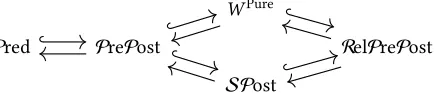
We formally show that this specification monad is more expressive than the predicate monad above: Any predicatep :PredAcan be coerced to(⊤,p):PrePostA, and in the other direction, any pair(pre,post):PrePostAcan be approximated by the predicatepost, giving rise to a Galois connection, as illustrated inFigure 1. While the monadPrePost is intuitive for humans, generating efficient verification conditions is generally easier for predicate transformers [Leino 2005].
Forward predicate transformer monad. The predicate monadPred can be extended in an alternative way. Instead of fixing a precondition as inPrePost, a specification can be a function from preconditions to postconditions, for instance producing the strongest postcondition of computation for any preconditionpre:Pgiven as argument. Intuitively, such a forward predicate transformer onAhas typeP→ (A→P). However, to obtain a monad (i.e., satisfying the expected laws), we have to consider the smaller typeSPostA= (pre:P) → (A→ P/pre)of predicate transformers
monotonic with respect topre, whereP/preis the subtype of propositions implyingpre. Return-ing a valuev : Ais specified by the predicate transformer retS Postv = λprea.pre∧a =v, and the sequential composition of two computations is specified as the predicate transformer bindS Postm f =λpreb.∃a.f a(mprea)b, form:SPostAandf :A→ SPostB.
Backward predicate transformer monad. As explained inğ2.2, backward predicate trans-formers can be described using the continuation monad with propositionsPas the answer type, namely, ContPA=(A→P) →P. Elementsw : ContPAare predicate transformers mapping a postconditionpost:A→Pto a preconditionwpost:P, for instance the weakest precondition of the computation. Pointwise implication is a natural order on ContPA:
w1≤w2: ContPA ⇔ ∀(p:A→P).w2p⇒w1p
However, ContPis not an ordered monad with respect to this order because itsbindis not monotonic. In order to obtain an ordered monad, we restrict our attention to the submonadWPureof ContP containing themonotonicpredicate transformers, that is thosew: ContPAsuch that
∀(p1p2:A→P). (∀(a:A).p1a⇒p2a) ⇒ w p1⇒w p2,
which is natural in verification: we want stronger postconditions to map to stronger preconditions. This specification monad is more expressive than the pre-/postcondition one above [Swamy et al. 2016]. Formally, a pair(pre,post):PrePostAcan be mapped to the predicate transformer
λ(p:A→P).pre∧ (∀(a:A).posta⇒p a) : WPureA, and vice versa, a predicate transformerw:WPureAcan be approximated by the pair
( w(λa.⊤) , λa.(∀p.w p⇒p a) ) : PrePostA
These two mappings define a Galois connection, as illustrated inFigure 1. Further, this Galois connection exhibitsPrePostAas the submonad ofWPureAofconjunctivepredicate transformers, i.e., predicate transformerswcommuting with non-empty conjunctions/intersections.
WPure
Pred PrePost RelPrePost
[image:14.486.137.354.92.139.2]SPost
Fig. 1. Relationships between basic specification monads (each pair forms a Gallois connection)
C ::=MA|C1×C2| (x:A) →C |C1→C2 A∈TypeL
t ::=ret |bind| ⟨t1, t2⟩ |πi t |x |λ⋄x.t |t1t2|λx.t |t u u∈TermL
Fig. 2. Syntax of SM
A⊢SMret : A→MA A,B⊢SMbind : MA→ (A→MB) →MB
Γ,x :C1⊢SMt:C2
Γ⊢SMλ⋄x.t:C1→C2
Fig. 3. Selected typing rules for SM
4.2 Defining Monad Transformers
We usemonad transformers[Liang et al. 1995] to construct more complex specification monads from the basic ones above (and in some cases also to derive effect observationsğ3.3). However, defining a monad transformer and proving that it satisfies all the expected laws requires significant effort. In this section, we introduce aSpecification Metalanguage,SM, and a translation fromSM to correct-by-construction monad transformers in a base dependent type theoryL(whereLis a parameter ofSM). More precisely, our translation takes as input a monad inSMsubject to two extra conditions,covarianceandlinearity, and produces a correct monad transformer inL.
SMis an expressive language in which many different monads can be defined in a natural way, for examplereader Rd(X : Type) = I → MX;writer Wr(X : Type) = M(X × O);exceptions Exc(X : Type) =M(X +E);stateSt(X : Type) =S →M(X × S);monotonic stateMonSt(X) =
(s0 :S) → M(X × (s1 :S) ×s0 ≼s1), where≼is some preorder on statesS; andcontinuations ContAns(X)=(X →MAns) →MAns. The symbolMstands for an arbitrary base monad, and thecovariancecondition states that it appears only in the codomain of arrows. The more involved
linearitycondition concerns thebindof these monads. With the exception of continuations (see
ğ4.3), all theseSMmonads satisfy these extra conditions and thus lead to proper monad transformers.
Definition 2 (Monad transformer). A monad transformer [Liang et al. 1995] is given by
▷a functionT mapping monadsMto monadsTM,
▷equipped with a monad morphismliftM :M→ TM,
▷assigning functorially to each monad morphismθ :M1→M2a monad morphismTθ:TM1→TM2, ▷and such that theliftM is natural inM, that is for any monad morphismθ :M1→M2,
Tθ◦liftM1=liftM2◦θ
▷moreover, they need to preserve the order structure present on the (ordered) monads as well as the monotonicity of morphisms, and the lifts themselves should also be monotonic,
i.e.,(T,lift)is a pointed endofunctor on the category of (ordered) monads [Lüth and Ghani 2002].
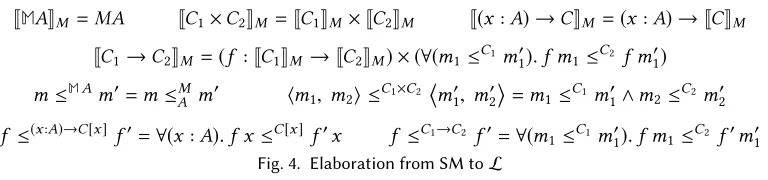
JMAKM =MA JC1×C2KM =JC1KM ×JC2KM J(x :A) →CKM =(x :A) →JCKM
JC1→C2KM =(f :JC1KM →JC2KM) × (∀(m1≤C1m′1).f m1≤C2 f m′1)
m≤MA
m′=m≤AMm′ ⟨m1, m2⟩ ≤C1×C2 m1′, m2′=m1≤C1m1′∧m2≤C2m2′
[image:15.486.53.437.83.173.2]f ≤(x:A)→C[x] f′=∀(x :A).f x ≤C[x] f′x f ≤C1→C2 f′=∀(m1≤C1m1′).f m1≤C2 f′m′1 Fig. 4. Elaboration from SM toL
inL, leading to two different type formers. We write dependent abstractions asλx.t, whereas we write the non-dependent type asλ⋄x.t. InFigure 3we present the typing rules ofM,ret, andbind, leaving the remaining standardSMtyping rules for the online appendix. To define our monad transformers, we use monadsinternal toSM, given by
▷a type constructorX : Type⊢SMC[X];
▷termsA: Type⊢SM retC :A→C[A]andA,B: Type⊢SMbindC :(A→C[B]) →C[A] →C[B]; ▷such that the monadic laws are derivable in the equational theory ofSM.
Now, given a monadCinternal toSM, we want to define the corresponding monad transformer TC evaluated at a monadMin the base languageL, essentially as the substitution ofMforM. In order to make this statement precise, we define a denotationJ−K(Mγ)inLof SMtypes (Figure 4) and terms (provided in the appendix together with the equational theory) parametrized byM. This denotation preserves the equational theory ofSM, providedLhas extensional dependent products and pairs. As such,Cinduces the following mapping from monads to monads:
TC : (M,ret,bind) 7−→ (JCKM,JretCKM,JbindCKM) For instance, takingC=St, the definition evaluates toTStM =X 7→ S →M(X× S).
To build theliftforTC, the key observation is that the denotationJCK
M of anSMtypeCinL can be endowed with anM-algebra structureαC
M :MJCKM →JCKM5. ThisM-algebra structure is defined by induction on the structure of theSMtypeC, using the free algebra whenC=MAand the pointwise defined algebra in all the other cases. ThisM-algebra structure allows us to then define a lifting function from the monadMto the monadJCKM as follows:
liftCM,X : M(X) M(ret
JCKM)
−−−−−−−−−−→MJCKM(X) αC
M,X
−−−−→JCKM(X)=TCM(X)
For instance,liftStM,X(m:M X)=λ(s:S).M(λ(x:X).⟨x,s⟩)m:S →M(X×S). The result that SMtype formers are automatically equipped with an algebra structure explains whySMfeatures products, but not sums since the latter cannot be equipped with an algebra structure in general.
ThisliftCM :M→JCKMneeds to benatural, that is, the following diagram should commute:
M A MJCKMA JCKMA
M B MJCKMB JCKMA
M(retC A)
M f
αC M,A
MJCKMf JCKMf
M(retCB) α
C M,B
⟲ ?
for anyA,Bandf :A→B. The left square commutes automatically by the naturality ofM(retC). For the right square to commute, however,JCKM f =bindJCKM(retJCKM ◦ f)should be anM -algebra homomorphism. We can ensure it by asking thatbindC maps functions toM-algebra homomorphisms, a condition that can be syntactically captured by a linearity condition in a modified type system forSMequipped with astoup, which is a distinguished variable in the context
5AnM-algebrais an objectXtogether with a mapα:M X−→X, which is required to respectretMand
such that the term is linear with respect to that variable [Egger et al. 2014;Munch-Maccagnoni 2013]. We omit this refined type system here and refer to the online appendix for the complete details. We call this condition on the monad(C,retC,bindC)internal toSMthe linearity ofbindC. Action on monad morphism. To define a monad transformer, we still need to build a functorial action mapping monad morphismθ:M1→M2between monadsM1,M2inLto a monad morphism
JCKM1→JCKM2. However, the denotation of the arrowC1→C2does not allow for such a functorial action sinceC1necessarily contains a subtermMin a contravariant position. In order to get an action on monad morphisms, we first build a (logical) relation between the denotations. Given M1,M2monads inLand a family of relationsRA ⊂M1A×M2Aindexed by typesA, we build a relation{|C|}RM1,M2 ⊂JCKM1×JCKM2as follows
m1{|MA|}m2 = m1RAm2
(m1,m1′) {|C1×C2|} (m2,m′2) = m1{|C1|}m2∧m1′{|C2|}m′2 f1{|(x :A) →C|}f2 = ∀(x:A).f1x{|C x|}f2x
f1{|C1→C2|}f2 = ∀m1m2.m1{|C1|}m2⇒ f1m1{|C2|}f2m2 Now, when a typeCinSMcomes with the data of an internal monad, the relational denotation {|C|}−
M,W maps not only families of relations to families of relations, but also preserves the following structure that we call amonadic relation:
Definition 3 (Monadic relation). A monadic relationR:M↔W between a computational monadMand a specification monadW, consists of:
▷a family of relationsRA:M A×W A→Pindexed by typeA
▷such that returned values are related(retMv) RA(retWv)for any valuev:A ▷and such that sequencing of related values is related
m1RAw1 ∀(x:A).(m2x) RB(w2x)
(bindM m1m2) RB(bindW w1w2)
The simplest example of monadic relation is the graph of a monad morphismθ : M → W. Given a monadic relation, we extend the relational translation to terms and obtain the so-called fundamental lemma of logical relations.
Theorem 1 (Fundamental lemma of logical relations). For any monadsM1,M2inL, monadic
relationR : M1 ↔ M2, term Γ ⊢SM t :C and substitutionsγ1 : JΓKM1 andγ2 : JΓKM2, if for all (x :C′) ∈Γ,γ1(x) {|C′|}R
M1,M2γ2(x)thenJtK γ1 M1 {|C|}
R M1,M2JtK
γ2 M2.
As a corollary, an internal monadCinSMpreserves monadic relations, the relational interpreta-tion ofretCandbindC providing witnesses to the preservation of the monadic structure. In partic-ular, any monad morphismθ:M1→M2defines a monadic relation{|C|}Mgraph1,M(2θ):JCKM1↔JCKM2. It turns out that ifCis moreovercovariant, meaning that it does not contain any occurrence of an arrowC1→C2whereC1is a type inSM, then the relational denotation{|C|}Mgraph1,M(2θ)with respect to any monad morphismθ :M1→M2is actually the graph of a monad morphism. To summarize:
Theorem 2 (Construction of monad transformer from SM). Given a monadCinternal to SM such thatbindC satisfies the linearity criterion, we obtain:
▷ifCis covariant, thenTC equipped withliftC
M:M→TCMis a (ordered) monad transformer; ▷ifCis not covariant,TC defines a pointed endofunctor on the category of (ordered) monads and
monadic relations.
main difference is thatSMis not parameterized on a set of simple base types but on a dependent type theoryL. As such,SMcaptures the essential elements of the metalanguageDMofAhman et al.[2017], leaving the non-necessary parts, such as sum types, to the base languageL.
4.3 The Continuation Monad Pseudo-Transformer
Crucially, the internal continuation monadContAnsdoesnot verify the conditions to define a monad transformer since it is not covariant inM. We study this (counter-)example in detail since it extends the definition ofJaskelioff and Moggi[2010] to monadic relations and clarifies the prior work ofAhman et al.[2017], where a Dijkstra monad was obtained in a similar way.
WhileSMgives us both the computational continuation monadJContAnsKId=ContAnsand the corresponding specification monadJContAnsKCont
P=ContContP(Ans), we only get a monadic
relation between the two and not a monad morphism. We write this monadic relation as follows:
JContAnsKId ←−{|ContAns|}ret
Id,ContP−→ J
ContAnsKCont
P
One probably wonders what are the elements related by this relation? Unfolding the definition, we get that a computationm:JContAnsKId(X)and a specificationw :JContAnsKCont
P(X)are related if
m{|ContAns|}ret Id,ContPw
⇔ ∀(k:X → Ans) (wk :X →ContP(Ans)).(∀(x :X).ret(k x)=wkx) ⇒ret(m k)=w wk ⇔ ∀(k:X → Ans).ret(m k)=w(λx.ret(k x))
⇔ ∀(k:X → Ans) (p:Ans→P).w(λx q.q(k x))p=p(m k)
For illustration, if we takeAns=1, the last condition reduces to∀(p:P).w(λx q.q)p=p, in par-ticular any sequencex0, . . . ,xninduces an elementw =λk p.k x0(. . .k xnp):JContAnsKContP(X)
that can be seen as a specification revealing some intensional information about the computationm at hand, namely, that the continuationkwas called with the argumentsx0, . . . ,xnin this particular order. Computationally however, in the case ofAns=1,mis extensionally equal toλk.∗: Cont1.
4.4 Effect Observations from Monad Algebras
While monad transformersT enable us to derive complex specification monads, they can only help us to automatically derive effect observations of the formθT :T (Id) −→ T (W)(seeğ3.3), which only slightly generalize theDM4Freeconstruction. In all other cases inğ3, we had to define effect observations by hand. However, when the specification monad has a specific shape, such asWPure, there is in fact a simpler way to define effect observations. For instance, inğ3.2effect observations θ⊥,θ⊤ : Exc →WPurewere used to specify the total and partial correctness of programs with exceptions, by making a global choice of allowing or disallowing exceptions. Here we observe that such hand-rolled effect observations can in fact be automatically derived fromM-algebras.
As shown byHyland et al.[2007], there is a one-to-one correspondence between monad mor-phismsM → ContRandM-algebrasM R → R. We can extend this to the ordered setting: for instance, effect observationsθ:M →WPurecorrespond one-to-one toM-algebrasα :MP→P that are monotonic with respect to the free lifting onMPof the implication order onP. Intuitively, αdescribes a global choice of how to assign a specification to computations inMin a way that is compatible withretM andbindM, e.g., such as disallowing all (or perhaps just some) exceptions. Based on this correspondence, the effect observationsθ⊥andθ⊤arise from the Exc-algebras
Importantly, this correspondence is not limited toWPure, but applies to continuation monads with any answer type. For instance, taking the answer type to beS→P, we can recover the effect observationθSt: St→WSt, whereWStAMonContS→PA=(A→ (S→P)) → (S→P), from the St-algebraαSt=λ(f :S→ (S→P) ×S) (s:S).(π1(f s)) (π2(f s)) : St(S→P) →S→P.
5 DIJKSTRA MONADS FROM EFFECT OBSERVATIONS
As illustrated inğ3.4, Dijkstra monads can be obtained from effect observationsθ : M → W between computational and specification monads. As we shall see this construction is generic and leads to a categorical equivalence between Dijkstra monads and effect observations. In this section, we introduce more formally the notion of Dijkstra monad using dependent type theory, seen as the internal language of a comprehension category [Jacobs 1993], and then build a categoryDMon of Dijkstra monads. In order to compare this notion of Dijkstra monads to effect observations, we also introduce a category of monadic relationsMonRel and show that there is an adjunction
∫ ⊣ pre : MonRel −→ DMon. (1)
Intuitively, an adjunction establishes a correspondence between objects of two categories, here MonRel andDMon. An adjunction always provides an equivalence of categories if we restrict our attention to objects that are in one-to-one correspondence, those for which the unit (resp. the counit) of the adjunction is an isomorphism. When we restrict the adjunction above, we obtain an equivalence between Dijkstra monads and effect observations. For the sake of explanation, we proceed in two steps: first, we consider Dijkstra monads and effect observations over specification monads with a discrete order (i.e., ordinary monads), describing the above adjunction in this situa-tion; later, we extend this construction to general preorders, thus obtaining the actual adjunction we are interested in. We denote categories defined over non-discrete specification monads with·≤.
Dependent type theory and comprehension categories. We work in an extensional type theory with dependent products(x :A) →B, strong sums(x :A) ×B, an identity typex =Ay forx,y:A(where the typeAis usually left implicit), a type of (proof-irrelevant) propositionsP, and quotients of equivalence relations. This syntax is the internal language of a comprehension category [Jacobs 1993] with enough structure and we will writeTypefor any such category. This interpretation of type theory allows us to call any objectΓ∈ Typea type.6
Dijkstra monads. ADijkstra monadover a (specification) monadW is given by
▷for each typeAand specificationw :W A, a typeDA wof łcomputations specified bywž ▷return and bind functions specified respectively by the return and bind ofW
retD :(x :A) → DA(retW x)
bindD :DA w1→ ((x:A) → DB w2(x)) → DB(bindW w1w2)
▷such that the following monadic equations aboutretD andbindDhold
bindDmretD =m bindD(retDx)f =f x
bindD(bindDm f)д=bindDm(λx.bindD(f x)д)
wherem:DA w,x :A,f :(x :A) → DB(w′x),д:(y:B) → DC(w′′y)forA,B,Cany types andw :W A,w′:(x :A) →W B,w′′:(y:B) →W C. Note that the typing of these equations depends on the monadic equations forW and they would not be well-typed otherwise. In order to use multiple Dijkstra monads, that is multiple effects, in a single program, we need a way to go from one to another, not only at the level of computations, but also at the level of specifications. A morphism of Dijkstra monads fromD1A(w1:W1A)toD2A(w2:W2A)provides exactly that: it is a pair(ΘW,ΘD)of a monad morphismΘW :W1→W2mapping specifications of
the source Dijkstra monad to specifications of the target Dijkstra monad, and a family of maps ΘD
A,w1 : D1A w1 −→ D2A(Θ Ww
1)
indexed by typesAand specificationsw1:W1A, satisfying the following axioms ΘD(retD1x)=retD2x, Θ(bindD1m f)=bindD2(ΘDm) (ΘD ◦f).
This gives a categoryDMon of Dijkstra monads and morphisms between them.
Monadic Relations. Given a monadic relationR:M↔W (Def. 3) between a computational monadMand a specification monadW, we construct a Dijkstra monadpreRonW as follows:
(preR)A(w:W A) = (m:M A) ×mRAw (2)
That is(preR)A wconsists of those elementsmofM Athat are related byRto the specificationw.
WhenRis the graph of a monad morphismθ(or equivalently,Ris functional),pre(R :M ↔W)
maps an elementw :W Ato its preimageθ−1(w)
={m:M A|θ(m)=w}. Conversely, any Dijkstra monadDoverW yields a monad structure on
∫ DA=(w:W A) × DA w
and the projection of the first component is a monad morphismπ1:∫ D →W.
In order to explain the relation between these two operationspreand∫ −, we introduce the
categoryMonRel of monadic relations. An object ofMonRel is a pair of monadsM,W together with a monadic relationR :M ↔W between them. A morphism betweenR1 :M1 ↔W1and R2:M2↔W2is a pair(ΘM,ΘW)whereΘM :M1−→M2andΘW :W1−→W2such that
∀(m:MA) (w :W A).mR1Aw =⇒ ΘM(m) RA2ΘW(w). (3) The constructionpreextends to a functor onMonRel by sending a pair(ΘW,ΘM)to a pair (ΘW,ΘD), whereΘD
A,wis the restriction ofΘ M
A to the appropriate domain. Conversely,∫packs up a pair(ΘW,ΘD)as(ΘW,ΘM), whereΘAM(w,m)=ΘAD,w(m). SinceΘM maps the inverse image ofw to the inverse image ofΘW(w), condition (3) holds. Moreover, this gives rise to a natural bijection
MonRel(∫ D,R) DMon(D,preR)
that establishes the adjunction (1). We can restrict (1) to an equivalence by considering only those objects for which the unit (resp. counit) of the adjunction is an isomorphism. Every Dijkstra monad Dis isomorphic to its imagepre(∫ D), whereas a monadic relationRis isomorphic to∫(preR)if
and only if it is functional, i.e., a monad morphism. This way we obtain an equivalence of categories betweenDMon and the category of effect observations on monads with discrete preorder.
The ordered setting. Recall that in the examples ofğ3.4, the Dijkstra monadsDA(w :W A) we derived from effect observationsθ :M −→W naturally made use of the order onW to compare programmer-provided specifications to type-inferred ones. This order structure onW can be naturally lifted to Dijkstra monads, by requiringDto be equipped with aweakeningstructure
weaken : w1≤Aw2× DA w1 −→ DA w2
such that the following axioms hold (where we conflate the propositionsw1≤w2and their proofs) weaken⟨w≤w,m⟩=m, weaken⟨w1≤w2≤w3,m⟩=weaken⟨w2≤w3,weaken⟨w1≤w2,m⟩⟩
bindD(weaken⟨wm≤wm′,m⟩) (λa.weaken⟨wfa≤wf′a,f a⟩)=
weaken⟨bindWwmwf≤bindWwm′ wf′,bind D
m f⟩. Such pairs of an ordered monadW and a Dijkstra monadDA(w :W A)with a weakening structure form a categoryDMon≤, whose morphisms are pairs of a monotonic monad morphism and a Dijkstra monad morphism preserving the weakening structure. Further, the definition ofpreextends
This definition coincides with (2) when the order≤AonW Ais discrete. Moreover, we can equip
preθwith a weakening structure:weaken⟨w1≤w2,⟨m,θ(m) ≤w1⟩⟩=⟨m,θ(m) ≤w1≤w2⟩. The same construction can be performed starting with anupward closed monadic relation R:M↔W, i.e., such thatMhas a discrete order and∀m.∀(w1 ≤AW w2).mRAw1 ⇒mRAw2. Doing so, we obtain a functorpre:MonRel≤−→ DMon≤from the category of upward-closed
monadic relations to the category of ordered Dijkstra monads with a weakening structure. However, when trying to build a left adjoint∫topreexactly as before, there is a small mismatch
with the expected construction on practical examples. Indeed, starting from a monad morphism θ :M→W,∫(preθ)reduces to(ΣM,W,π1)whereΣM A=(w :W A) × (m:M A) ×θA(m) ≤Aw, which is unfortunately not isomorphic toM. The problem is that we get one copy ofmfor each admissible specificationw :W A. These copies, however, are non-essential since the weakening structure ofpreθidentifies them. As such, to define∫, we need to further quotient them7, defining
∫ DA= ((w:W A) × DA w) /∼
where∼is generated by⟨w,c⟩ ∼ ⟨w′,weaken⟨w≤w′,c⟩⟩, giving us the desired adjunction∫ ⊣pre.
To summarize, we can construct Dijkstra monads with weakening out of effect observations and the other way around. Moreover, when starting from an effect observationθ:M→W, then ∫(preθ)is equivalent toθ. This result shows that we do not lose anything when moving from effect
observations to Dijkstra monads, and that we can, in practice, use either the effect observation or the Dijkstra monad presentation, picking the one that is most appropriate for the task at hand.
6 ALGEBRAIC EFFECTS AND EFFECT HANDLERS FOR DIJKSTRA MONADS
Inğ2.1, we noted that all our example computational monads come with corresponding canonical side-effect causing operations. This is an instance of a general approach to modeling computational effects algebraically using operations (specifying the sources of effects) and equations (specifying their behavior), as pioneered byPlotkin and Power[2002,2003]. From the programmer’s perspective,
algebraic effectsnaturally enable programming against an abstract interface of operations instead of a concrete implementation of a monad, with the accompanying notion ofeffect handlersenabling one to modularly define different fit-for-purpose implementations of these abstract interfaces.
6.1 Algebraic Effects for Dijkstra Monads
We begin by showing how effect observations naturally equip both the specification monad and the corresponding Dijkstra monad with algebraic operations in the sense ofPlotkin and Power
[2002,2003]. We observed several instances of this phenomenon for state, IO, and nondeterminism inğ3.4, and we can now explain it formally in terms of algebraic effects and effect observations.
Algebraic operations. For any monadM, analgebraic operationop:I {Owith input (pa-rameter) typeI and output (arity) typeOis a familyopMA :I× (O→MA) →MAthat satisfies the following coherence law for alli :I,m:O →MA, andf :A→MB[Plotkin and Power 2003]:
bindM(opAM⟨i,m⟩)f =opMB ⟨i,λo.bindM(m o)f⟩ (5) For NDet, the two operations arepick :1 { Bandfail: 1 { 0. For St, the operations are get:1{Sandput:S {1. Plotkin and Power also showed that such algebraic operations are in one-to-one correspondence withgeneric effectsgenMop:I →MO, which are often a more natural presentation for programming. For example, the generic effect corresponding to theputoperation for St has typeS→St1. They are interconvertible with algebraic operations as follows:
genMopi=opMO ⟨i,λo.retMo⟩ opAM⟨i,m⟩ =bindM(genopMi) (λo.m o) (6)
7We conjecture that an alternative and more symmetric solution would be to equip our Dijkstra monads with an additional