
0022-538X/83/060901-08$02.00/0
Copyright©1983, American Society for Microbiology
Alterations in
Substrate
Specificity
and
Physicochemical
Properties of Deoxythymidine Kinase of
a
Drug-Resistant
Herpes
Simplex Virus
Type 1 Mutant
V. VEERISETTYANDG.A.GENTRY*
Departmentof Microbiology, University of Mississippi Medical Center, Jackson, Mississippi 39216
Received 28 December1982/Accepted 18 March 1983
The deoxythymidine kinase(dTK)activity ofa
5-methoxymethyldeoxyuridine-resistantmutant(MMdUr-20) of herpes simplex virustype 1 was compared with
thatof the parental wild-type (WT) virus. The dTK activity induced by themutant
was consistently less than that induced by the WT virus, was inhibited by
antibody specific for herpes simplex virus dTK, andwas morethermostable than
theWTdTK.Further,itwasinhibitedto alesser degree than the WT dTKbythe
nucleoside analogsMMdUand arabinosylthymine(araT),whichsuggeststhatone
of the effects of the mutationwas aselective alterationinsubstraterecognition by
the dTK. The loss of ability to inhibit the mutant dTK by
E-(2)-5-bromovinyldeoxyuridinewas not as great as that seenwitharaTand MMdU.This
agreeswell with ourprevious observation that theMMdUr-20 mutant ofherpes
simplex virus is only partially resistanttothis analog,ascomparedwitharaTand
MMdU (V. Veerisetty and G. A. Gentry, Virology 114:576-579, 1981).
[2-14C]araT
was used to explore further the resistance to araT. Extracts ofcellsinfected with the
mnutant,
although producing a small amount of[14C]araTMP,
were unable to produce
[14C]araTYP,
in contrast to extracts of cellsinfectedwiththe WTvirus. Bothextracts,however,produced
[14C]dTTP
from[14C]deoxyribo-sylthymine. Finally, theability of the extracts tophosphorylate
[14C]dTMP
wasexamined. It was found that this activity was greatly reduced relative to dTK
activity in the case of the mutant. Thesefindings suggestthata mutation in the
dTKpolypeptide has affected recognitionnotonlyof nucleoside substrates but of
thenucleotide substrate dTMPaswell, whichagreeswith thesuggestion of Chen
etal. thatboth activities are located onthe samepolypeptide (M. S. Chen and
W. H.Prusoff,J. Biol. Chem.253:1325-1327, 1978; M. S. Chen, J. Walker, and
-W. H. Prusoff, J. Biol. Chem. 254:10747-10753, 1979; M. S. Chen, W. P.
Summers, J. Walker, W.C. Summers, and W. H.Prusoff, J. Virol. 30:942-945,
1979).
Since thediscoverythatherpes simplex virus
(HSV) inducesa new virus-coded
deoxythymi-dine kinase (dTK) (12), considerable attention
has beengiventothisenzymebecause itcanbe
used to enhance the selectivity of
anti-herpes-viral agents (10, 16). Unfortunately,
drug-resis-tant mudrug-resis-tantsof HSV arisereadily both in vitro
and in vivo (2, 7, 8, 15, 18, 23, 26) and may
already be present in previously untreated
pa-tients (22). Two types of mutants have been
detected, onewithamutation in the dTK gene
and the other with a mutation in the DNA
polymerase gene(7, 15, 23, 26).
We have recently isolated a number of
mu-tants of HSV type 1 (HSV-1) by using the antiviral nucleoside
5-methoxymethyldeoxyuri-dine (MMdU) (26). All mutant viruses were
cross-resistant to the other nucleoside analogs
acyclovir (ACV),
E-(2)-5-bromovinyldeoxyuri-dine(BVdU),andarabinosylthymine (araT),but
were as sensitive as the parent virus to phos-phonoacetate. Because HSV-induced dTK is
required fortheantiviralactivityofmanyofthe
known nucleoside analogs (1, 11, 13, 17), the
failure ofinduction of viral dTK would makethe
virus resistant to them. Those mutants, howev-er, thatinducedTKbutareresistant to nucleo-sides deserve further attention because they may be as virulentasthewild type (WT)virus, whereas those that lack dTK are known to be
relativelyavirulent (9, 14, 25). The majority of
ourMMdU-resistant
(MMdU)
mutantsfailedtoinduce detectable levels ofdTK activity. One,
however, MMdUr-20, induced appreciable
amountsof dTK(upto
70%o
ofWTdTK)butwasalso resistant to nucleoside analogs. Because
901
on November 10, 2019 by guest
http://jvi.asm.org/
902 VEERISETTY AND GENTRY
this virus is sensitive to phosphonoacetate, we
inferred that the mutation probably was in the dTK gene and altered the substrate specificity for nucleoside analogs. In this report we show that thisenzyme isdistinctly differentfrom the parental virus-induced enzyme. The data
sug-gest a correlation between the extent of phos-phorylation of the nucleoside and the level of resistance of the virus.
MATERIALSANDMETHODS
Cells. Baby hamster kidney (BHK-21) cells were used for virus growth and titration. Mouse cells (3T3) andL-Kit cells, both of which arenegative for host cytosol dTK(dTK-),wereused for dTKexperiments.
All were grown inEagle mediumsupplemented with 5% fetal calf serum. For routine passage of dTK-cells,30jigofbromodeoxyuridineperml wasincluded in themedium.
Buffers. Lysis buffer consisted of 0.01 M Tris-hydrochloride (pH 7.5),0.01 MKCI,1mMMgCl2, and 0.002 M dithiothreitol. Reaction buffer consisted of 0.15MTris-hydrochloride (pH7.5),2.5 mMATP, 2.5 mM MgCl2, 2.5 mM dithiothreitol, 10 mM sodium fluoride, 1 mg of bovineserumalbumin perml,3mM phosphocreatine, and1.0Uof creatinephosphokinase per ml.Reaction mixturewasreaction buffer contain-ing[2-14C]deoxyribosylthymine (dT)(1.0
IC/ml,
0.02 mM)or[2-14C]araT(17,uC/ml, 1.7mM, unless other-wise indicated) or [2-14C]dTMP (1.2 ,uC/ml, 0.024 mM). For thin-layer chromatography (TLC), a4 M sodium formate (pH3.4) buffer stockwas prepared;appropriate dilutions weremade when necessary. Nucleosides and antiviralcompounds. AraTwas pur-chased from Raylo Chemicals (Edmonton, Alberta,
Canada). MMdU, BVdU, phosphonoacetate, and ACV were giftsfrom Lorne Babiuk (Department of Veterinary Microbiology, University of Saskatche-wan, Saskatoon, Canada), Eric De Clercq, (Rega Institute for MedicalResearch, Katholeiek Universi-teit, Louvain,Belgium),Ronald Duff(Abbott Labora-tories, Chicago, Ill.), and G. B. Elion (Burroughs
WellcomeCo., ResearchTriangle Park,N.C.), respec-tively. [2-'4C]araT(specificactivity, 10mC/mM)was synthesized byRaylo Chemicals. [2-14C]dT (specific
activity, 50mC/mM)and[2-14C]dTMP(specific activi-ty, 62.2mC/mM)werepurchasedfromNewEngland
NuclearCorp., Boston, Mass. Unlabeled nucleotides werepurchased fromSigma Chemical Co., St. Louis, Mo.
Virus. HSV-1 strain 17MP (WT) and the mutant MMdUr-20werepropagatedandassayedasdescribed (26).
Preparation and assay of dTK and dTMP kinase. For theassay ofdTK,bothdTK+ (BHK) and dTK- (3T3 and L-Kit) cells were employed. dTK- cells were grown withoutbromodeoxyuridineforonegeneration toeliminatethepossibility of interference by residual bromodeoxyuridine. Cells in duplicate 5-cm plastic
petridisheswereinfected withWTvirusorthe drug-resistantmutantMMdUr-20at amultiplicity of infec-tion of5to 10PFUper cell. The cellswereharvested 18 hafter infectionby scraping and werepelletedat 1,600 x g for 5 min at 4°C. The cell pellets were suspended in0.25 to 0.5 mllysisbufferat4°Cand were disrupted by sonic treatmentfor three 30-s intervals
with a10-kHz RaytheonSonifier. The sonically treat-edmaterialwasthencentrifuged for1h at 100,000xg. The supernatant was removed and assayed as de-scribedbelow.
dTK was assayed as described by McGowan (Ph.D. thesis, University of Mississippi, Jackson, 1980) and Cheng (6). Briefly, 5 or 10 ,ul of enzyme extract was incubated with 45 or 90 ,u of reaction mixture, respec-tively, at 37°C for 1 h (unless otherwise specified). Samples were spotted on disks of Whatman DE-81 filter paper. The filter disks were air dried, washed threetimes (10 min each) with distilled water and once with 95% ethanol, air dried again, and counted in a liquidscintillation counter. [14C]araT was usedas an alternative substrate in some experiments.
Extractsfor dTMP kinase activity were assayedat 37°Cby using [14C]dTMP(1.2
RC/ml)
as asubstrate. Thereaction buffer and the assay procedure were the same as for the dTK assay, except that dTMP was removed from the Whatman DE-81 filter paper by washing three times with 0.1 M sodium formate, pH 3.4.This procedure removed about almost all dTMP butessentiallynodTDP or dTTP. TLC with polyethy-leneimine-cellulose sheets was used to verify this procedure(datanotshown). Preliminary experiments indicated that 80 to90% of the dTMP kinase activity of themock-infected (MI) cell extracts was lost when the extractswereexposedto37°C for 30 min; this did notsignificantly alter the dTK activity ofthe WT viral enzyme.Extractsof MI cells and cells infected with WT virus and MMdUr-20 were thus preincubated at 37°C for 30 min and then assayed for dTMP kinase activity.
Serum inactivation. Antiserum raised against puri-fied dTK of HSV-1 strain KOS was agenerous gift from Y.-C. Cheng (University of North Carolina, ChapelHill, N.C.). Variousamountsof antisera were thoroughly mixed with 10 ,l of crude extract and incubated at 37°C for 1 h. The extracts were then
assayed for dTKactivity asdescribed above. Lysis
bufferwasaddedto correct to aconstantvolume for the reaction mixture.
Thermalinactivation.Extracts of 3T3cells infected with WTHSV-1 andMMdUr-20 were incubated at 40 or45°C ina waterbath.Samples (10
RI)
of the enzyme extract wereremovedat0, 5, 10, and 20 min andwereimmediatelyputonice. All the samples were assayed for dTKactivityasdescribed above.
In vitro inhibition of dTK by nucleoside analogs. Nucleoside analogswereprediluted in distilled water to 10, 1, and 0.1 mM, except for BVdU, which was diluted to 1, 0.1, and 0.01 mM. Next, 10 RI of nucleoside stock,5 ,ul ofMMdUr-20-orWT-infected cellextract,and 85 ,ul ofreaction mixturecontaining
["4C]dTwereadded, mixed,and incubatedat37°Cfor 1h. Extractswithout nucleosideanalogswereusedas controls. Asamplewasassayed for dTKactivity. The percentage of residual dTKactivitywascalculated in eachcase, andthe data wereplotted.
TLC. Plastic sheets precoated with polyethylene-imine-celluloseF(0.1 mm)werepurchased from Sig-ma Chemical Co. Allsheets were prewashed by as-cending chromatography in 10% ammonium hydroxide, air dried,andstoredat -20°C.Samples (1 to 10 ,u1) of the reaction mixture were spotted, air dried,andchromatographed by ascending chromatog-raphywith0.1, 0.25, 0.5,and 2.0 Msodiumformate, J. VIROL.
on November 10, 2019 by guest
http://jvi.asm.org/
ALTERATIONS IN A DRUG-RESISTANT HSV-1 MUTANT 903
10
'3
C. 8
In
o
I
-2
cc
2 4 6 8 ' 24
TIME POST-INOCULATION (hrj
FIG. 1. Induction of dTK activity by MMdUr-20 (A) and WT virus (0). Monolayers of dTK-3T3cells
wereinfected atamultiplicity of infection of5to 10 PFU per cell, cell extracts were prepared at the indicated times, and dTK activity was measured as
described in thetext.
pH 3.4.Each solvent frontwas runtoaheightof 3cm
exceptfor the 2 Msolvent,whichusuallywasallowed torun3to5cm.After thesampleswerespotted,the
TLCplateswerewashed in 0.001 M sodiumformate, pH 3.4, to remove excess nucleoside. These plates wereair dried, sprayed with En3Hance (New England
NuclearCorp.), andagain airdried. Theywere then exposed to X-ray film at -70°C. The En3Hance al-lowed amarked reduction in the exposure time and also increasedthesensitivityof theprocedure.
RESULTS
Kinetics of induction of dTKactivity. We
re-ported earlier (26) thatextracts ofcells infected with MMdUr-20 had only 50to70% of the dTK activity of extracts of cells infected with WT virus. Thiswasobserved in bothcytosol dTK+
BHK cells and cytosol dTK- 3T3 and L-Kit cells.Tostudythisfurther, dTK- 3T3 cellswere grownin 24-wellplates in the absence of bromo-deoxyuridine and were infectedat5 to 10 PFU
per cell with either WT virus or MMdUr-20. After 2 hof infection, fresh mediumwas added,
andone setof wells was harvested, lysed, and
storedat -70°C. Similarly, after 4, 6, 8, and 24 h, replicate wells were harvested, and cell
ly-sates were prepared and stored. All samples
were assayed for dTK activity; the data are
shown in Fig. 1. The MI cell extracts (dTK) served as the base line, and the total dTK activity per 3 x 10⁵ cells was calculated. The
data show that dTK activity appeared at 2 h postinfection and continuedtoincrease for24 h.
At any given time past 6 h postinfection, the
level of dTK induced in cells infected with
MMdUr-20 was less than 60%o of that induced in
WT-infectedcells, which confirms ourprevious
observation (26). At 4h, however, there seemed to beslightly more dTK in thecellsinfected with
MMdUr-20.Wealso scored forcytopathiceffect
during the course of these studies (data not
shown) and found that cytopathic effect ap-peared in infected cells 30 min earlier in the case
ofMMdUr-20 (around 6 h postinfection),
indi-catingthat the difference in the levels of dTK
activities of WT andmutantviruses isnotdueto
differences in the timing of thegrowth cycle of the virus.
Serum inactivation of dTKactivity. The
phos-phorylating activities of extracts of 3T3 cells
infected with WT virus and MMdUr-20 were
determined. WT-infected cell extract was dilut-ed twofold with lysis buffer to equalize the
phosphorylatingactivity with that of themutant.
The activities wereagaindetermined and found
to be approximately the same. Constant
amountsofextract werethenpreincubatedwith
various quantities ofantiserum ornormalrabbit
serum at 37°C for 1 h. Reaction mixtures
con-taining
[14C]dT
werethenadded, incubated for1h, and assayed for dTK activity. The residual
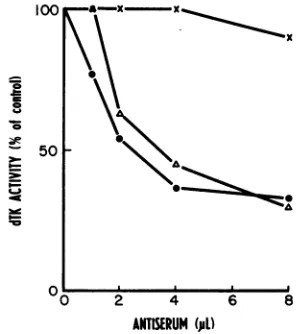
dTK activity curves (Fig. 2) of both WT and
mutant enzymes followed similar patterns of
inhibition with the antiserum. In contrast, the
dTK activity of the MI cell extract, although
slight, was insensitive to inhibition by
antiser-100K
50
0 =
0 2 4 6 8
ANTISERUM (pD)
FIG. 2. Antiserum inhibition of dTK activity. Ex-tractsofMIcells(x)and cells infected with
MMdUr-20 (A) and WT virus (0) were preincubated with
increasingamountsof antiserum (raised against puri-fied dTK of HSV-1 strain KOS) at 37°C for 1 h and thenwereassayedfor dTK activity as described in the text.Thepercentage of residualactivity was calculat-ed with dTphosphorylated in the absence of antiserum as100%.
VOL.46,1983
on November 10, 2019 by guest
http://jvi.asm.org/
[image:3.488.60.213.60.278.2] [image:3.488.268.416.428.595.2]904 VEERISETTY AND GENTRY
um. Normal rabbit serum did not affect the dTK
activity of any of the cell extracts (data not
shown). These data indicate that the enzyme
induced in cells infected with MMdUr-20 was
indeed virus specific.
Thermal inactivation of dTK activity.
dTK-3T3 cells were used to investigate the thermal
stability of the dTK induced by WT virus and
MMdUr-20. Extracts of WT-infected 3T3 cells
were diluted with lysis buffer to equalize the
phosphorylating activitywiththose of
MMdUr-20-infected cells, and theextracts were
incubat-edat40 and45°Cinawaterbath. Sampleswere
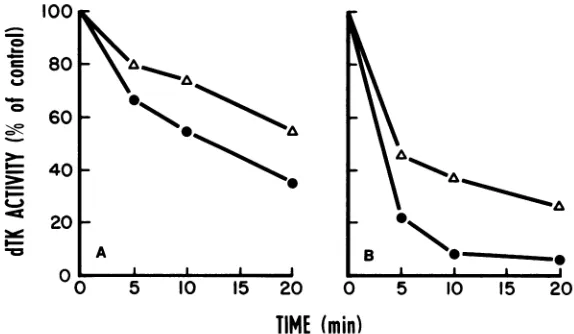
removed to 0°C at various times. All samples were assayed simultaneously in the standard assaysystem. The results are presented in Fig.
3. The enzymes followed the same pattern of
thermal inactivation, although the enzyme
in-ducedbyWTviruswasmorerapidly inactivated
than thatinduced bythe mutant.
Kinetics of phosphorylation of
[14C]dT
and[14C]araT.
In ourprevious studies (26), were-ported that MMdUr-20 was more resistant to
MMdU, ACV, andaraTthantoBVdU. Because
thismutant was as sensitive astheWTvirusto
phosphonoacetate, we suggested thatthe
alter-ationwasprobably inthe dTK ratherthaninthe
DNA polymerase. Our present studies support
this hypothesis. Although we have not directly
examined the possibility that MMdUr-20
con-tains an additional mutation in the DNA
poly-merase,the datawehave obtained donot appear
torequire suchanadditional mutationtoexplain
the pattern of resistance of MMdUr-20. This is
substantiated by the recent study by Larder et
0 =
I-40 40
>0
s-(-.
100
80
60
40
20
al. (21) ofthree mutants of HSV-1 resistant in
different degrees to ACV and BVdU. Each
mutant specified a dTK, and the patterns of
resistance correlated with the affinity of the
analog forthe dTK. The DNApolymerases of
these mutants were also studied, and it was
found that eachwassimilartothat of the
paren-tal WTstrain withrespect toaffinity for dTTP,
dGTP,ACVTP, and BVdUTP. The authors
con-cluded that the alterations in dTK substrate
specificity were sufficient to explain the
resist-ance observed, which is precisely our point in the present study.
Comparative studies on the phosphorylation of [14C]dT and
[14C]araT
were performed with extracts of MI cells and of cells infected with WT virus and with MMdUr-20. Extracts with added substrates were incubated at 37°C, andsamples were removed at various times and
assayed in the standard dTK assay systemfor
the amount of phosphorylated compound
formed. The extract of cells infected with
MMdUr-20 contained abouthalf the activity of
the extract of WT-infected cells, and the
reac-tionwaslinearto40mininbothcases (Fig. 4).
Furtherexperiments(datanotshown) confirmed
linearity for80min,whichisconsistent withthe
observations of McGowan(Ph.D. thesis).
InFig. 5,thephosphorylation of
[14C]araT
byextracts of cells infected with MMdUr-20 is
shown to be considerably less than would be
expected based on the relative amounts of
[14C]dT-phosphorylating
activity intheseand inextractsof WT-infectedcells. This suggests that resistanceof this mutantto araT was probably
TIME
(min)
FIG. 3. Effect ofheat ondTKactivity.Extracts ofdTK- 3T3 cellsinfected withMMdUr-20(A) andWTvirus (A)wereincubatedat40(A)or45°C (B) ina waterbath.Sampleswerewithdrawnatthe indicatedintervals and wereassayed for dTKactivity. The percentage of residual activity was calculated with the dT phosphorylated beforethereactionmixtureswereincubatedtaken as100%.This100% activity (incountsperminuteper 10,Jof extract)was:forWT at40°C,6.4 x 104;at45°C,8.6 x104;forMMdUr-20at40°C,7.6 x104;at45°C,8.4x 104. J. VIROL.
on November 10, 2019 by guest
http://jvi.asm.org/
[image:4.488.110.397.454.621.2]In 8
C.,
I-PC
/
6/
XE
6
La-
4-
La-22
0* ' I I I
o 10 20 30 40
TIME
OF INCUBATION
(min)
FIG. 4. Kinetics of phosphorylation of [14C]dT.Extractsof cells infected with MMdUr-20(A)andWT virus(0)(16to18 hpostinfection)wereincubatedat 37°Cwithreaction buffercontaining
[14C]dT
(1.0 uCi/ ml, 0.02 mM). Atthe indicated times, samples were withdrawn and assayedfor the amount of phosphory-latedcompound formed. O, MI cells.dueto aselective reduction in theability of the
MMdUr-20 dTKtophosphorylate araT.
Detection of mono-, di-, and triphosphates of dT and araT. We determined the kinetics of
phosphorylation of dT to dTMP, dTDP, and
dTTPusingTLC andhigh-pressure liquid
chro-matography and found detectable levels ofthe
di-and triphosphates of dTby both techniques
(manuscript in preparation). The possibility of
formation ofaraTMP, araTDP,and araTTP was
also investigated; it was necessary to increase
the incubation time because of the relatively
lowerspecific activity ofthe[14C]araT.Extracts (10 ,ul) of MI 3T3 cells and cells infected with
WT virus and MMdUr-20 were incubated at
37°C with 90 ,ul of reaction buffer containing
[14C]dT
or[14C]araT.
After60min, thereactionwas terminated (in the case of
[14C]dT)
byfreezing.Thereactionwith
[14C]araT
wastermi-nated after 8 h ofincubation, when the sample
was freeze-dried and suspended in 10 ,ul of
distilled water. A 3-,u sample of
[14C]dT-en-zymereaction mixture was spotted on a polyeth-yleneimine-cellulose F TLC plate; in the case of
[14C]araT, the total reaction mixture was
spot-ted. The plates were then processed as de-scribed.
The results (Fig. 6) show several important
features. First,bothenzyme extracts
phosphor-ylated [14C]dT to dTMP, dTDP, and dTTP, but
the amount of dTTP formed by MMdUr-20 was somewhat less than that formed by WT virus. Second, and more important, the mutant
en-zymephosphorylated [14C]araTtoaraTMPonly
to a slight extent as compared with the WT
virus,and no araTDP or araTTP could be
detect-ed. The WT enzyme extract, however, phos-phorylated araT to araTMP, araTDP, and araTTP. It therefore appears that the
muta-tion(s) in MMdUr-20 affect araTK activity.
WhetheraraTMPKactivitywasaffectedcannot
bedetermined from these data, but it remains a
possibility. No nucleotide spots were detected
with the MI cell extract. These results agree
withthedataon therelativephosphorylation of
[14C]araT (Fig. 5)and furthersupport the notion
that resistanceof the mutant to araT was due to
aloss ofphosphorylating ability.
Kinetics ofphosphorylation of
[14C]dTMP.
Toinvestigate possible differences (suggested by
thepreviousexperiments) in the dTMPK activi-ty of the WT and MMdUr-20 enzymes, [14C]dTMP was used as a substrate. Because
host dTMPK, in contrast to HSV dTMPK, is
very sensitive to heat (3, 19), we used freshly
3
I
-s- 2
= = = '
-13
o 0.
=J WT
_20 MI
SUBSTRATE SUBSTRATE
dT araT
FIG. 5. Relative phosphorylation of [14C]araT by extractsofMI cellsand cellsinfected with MMdUr-20 and WTvirus.Experimentswereperformed likethose shown inFig. 4, exceptthat[U4C]araT(17 ,uCi/ml,1.7 x lo-3 M)was used. Phosphorylation after 10min is shown.
46,1983
on November 10, 2019 by guest
http://jvi.asm.org/
[image:5.488.59.205.59.366.2] [image:5.488.277.401.427.614.2]906 VEERISETTY AND GENTRY
MONOPHOSPHATE
I B
DIPHOSPHATE
TRIPHOSPHATE @ -4I
ORIGIN > 0
WT 20 WT 20 Ml
[image:6.488.56.247.75.297.2]dT- araT
FIG. 6. Detection of di- and triphosphates of
[14C]dT and[14C]araTby TLC. Extracts of MI cells
andcells infected withMMdUr-20and WT virus were incubated at 37°C (without added dT) with reaction buffercontaining either[14C]dT(1.0,uCi/ml,0.02mM)
or[14C]araT(4.5puCi/ml,0.45 mM). The reaction was
terminated after 1 h in the case of[14C]dT(8 h in the caseof[14C]araT),and the total reactionmixture (100 pJl) wasfreeze-dried, suspended in 10 ,u1 ofdistilled water, and spotted onpolyethyleneimine-cellulose F TLC plates. A 3-,ul sample of the [14C]dT reaction mixture was spotted. TLC plates were air dried and processed asdescribed.
preparedenzymeextracts,preincubatedat37°C
for 30 min, to eliminate host dTMPK activity.
[14C]dTMP was added, and the samples were
further incubated at 37°C. At various times,
samples were removed and assayed for the
formation of dTDP and dTTP. The data(Fig. 7)
suggestthat dTMP kinaseactivitywaslinear for
atleast 20 min in the case ofthe WTenzyme.
There was, however, no significant dTMPK activitywith the extractsofMMdUr-20-infected
or MI cells. A similar experiment with the extract ofWT cells heated at 45°C for 30 min
indicated a substantial loss of dTMPK activity
(data notshown).
Inhibition of dT phosphorylation by araT,
MMdU, and BVdU. The abilities of BVdU,
MMdU,and araT toinhibitthephosphorylation
of
[14C]dT
were next compared. Extracts ofcells infected with WT and mutant virus were
incubatedwith thesenucleoside analogsat
vari-ous concentrations and with [14C]dT at a
con-stant concentration. After 1 h ofincubation at
37°C,the reaction mixture was assayed for the
phosphorylated [14C]dT product.The data(Fig. 8) complement the data obtained in the
[14C]araT phosphorylation studies (see Fig. 5
and6). AraT and MMdU significantly inhibited
the phosphorylation of [14C]dT by the WT
en-zymeonly. The reduced inhibition byaraT and
MMdU with the mutant enzyme further
indi-cates an altered substrate specificity of this
enzyme.BVdU had somewhat less effectonthe
mutant dTK than did araT and MMdU; this
agrees with our earlier observation (26) that
MMdUr-20isonly partially resistanttoBVdU.
DISCUSSION
Previous studies (26) showed that MMdUr-20
induceddTKactivityboth in dTK- (3T3 and
L-Kit) and in dTK+ (BHK) cells, but only to a
level 50to70%ashighasthat of WT virus.The present studies confirm that observation (Fig. 1).
Antiserum raised against purified dTK of
HSV strain KOS specifically inhibited both
MMdUr-20 and WT dTK activities, confirming
the viral specificityoftheinduceddTKactivities
(Fig.2).
1.0
.c
_ '3
= 0.6
CL
-V) 3'
.~3
CD cmn
L 6
J."OC 0.4
TIME
OFINCUBATION
[min)
FIG. 7. Kinetics ofphosphorylation of [4C]dTMP. Extracts of MI cells (O) and cells infected with MMdUr-20(A) and WT virus (A)werepreincubatedat 37°C for 30 min. Reaction mixtures containing
["4C]dTMP (1.2 p.Ci/ml, 0.024mM) were added and again incubated at 37°C. At the indicated intervals,
samples were withdrawn, spotted on DE 81 filter paper, and washed in 0.1 Msodium formate(pH3.4) toremovedTMP.The amountof boundnucleoside di-andtriphosphateswasdetermined byliquid scintilla-tioncounting.Results areplottedascountsperminute
of[14C]dTMPphosphorylatedagainsttime.
J. VIROL.
no
on November 10, 2019 by guest
http://jvi.asm.org/
[image:6.488.261.450.349.559.2]araT (M)
100 A-A
80 01
60
40
20 \
B 0-1)
Is 80
60
Co
a 40 o 20
.o
a. o
lo-5
BVdU (M)
[image:7.488.41.229.56.506.2]MMdU (M)
FIG. 8. Effect of araT (A), BVdU (B),and MMdU (C),onthephosphorylationof[(4C]dT.Cells infected
with MMdUr-20(A) andWTvirus(@)were lysedin buffercontaining 0.05 mM dT, and lysates were
as-sayedfor dTK in the presence ofvarious concentra-tionofnucleoside analog. Thepercentage of residual activitywascalculated with dTphosphorylatedwhen nonucleosideanalog wasaddedto thereaction mix-ture.
Thermalinactivation studies showed that the
mutant enzyme was more thermostable than the WT enzyme at both 40 and 45°C (Fig. 3). In contrast, Larder and Darby (20) recently showed that thedTKofadTK+ mutantunable
to phosphorylate ACV was more thermolabile
thanthe dTKof the WT virus.
Recent in vivo studies of MMdU' mutants
revealed differential sensitivities to various
nu-cleoside analogs (Veerisetty and Gentry,
unpub-lished results). In an earlier study, the mutant
MMdUr-20 was slightly resistant to BVdU, as
compared with all othermutants(26). The
pres-ent studies onthe phosphorylation of[14C]araT
and theinhibition of[14C]dTphosphorylation by
araT, MMdU, and BVdU suggest altered
sub-straterecognition by themutantenzyme(Fig.
4-6, 8). The WT dTK efficiently phosphorylated
both dT and araT, whereas the MMdUr-20 dTK
failed to phosphorylatearaTappreciably (Fig.5
and 6). Longerincubation periods and
alterna-tive methodsofdetection (TLC coupled with the
use of radioactive enhancer to compensate for
the reduced specific activity ofthe araT) also
showed negligible phosphorylation of araTMP
by the MMdUr-20 enzyme (Fig. 6) as wellas a
failure of formation of araTTP. In contrast,
significant amounts of araTMP, araTDP, and
araTTPwere formed by theWT enzyme. This
suggests thatthe mutant may haveacquired its
resistance to nucleoside analogs because of its
relative inability to phosphorylate them. The
resultsshowing inhibition of dTphosphorylation
by MMdU, BVdU, and araT(Fig. 8)
substanti-ate this and agree with thedifferences in levels
of resistance reported earlier (26).
Aneffortwas made toestablisharelationship
between the thermostability of the dTK and its
ability to phosphorylate dTMP because it has
been suggested (3-5) that a virus-specific
heat-resistant dTMPK activity is present in
HSV-infected cells.
Thedata inFig. 7show that thereis dTMPK
activity in extracts of WT-infected cells and,
furthermore, that this activity is relatively heat
stable. In contrast, no significant activity was
seen in extracts of cells infected with
MMdUr-20. This lack of activity suggests that either
MMdUr-20dTK doesnot havedTMPKactivity
at all, or that if itdoes, the dTMPK activity is
relatively more heatlabile thanthe
correspond-ing activity seen in the extracts of WT-infected
cells. In any case, itseemsclearthat both dTK
and dTMPKactivities arealtered in thecase of
the mutant MMdUr-20. This provides genetic
evidence to support the suggestion of Chen,
Prusoff, and co-workers (3-5) that both activi-ties arepresent on the samepolypeptide. If this istrue,and if thedTK ofMMdUr-20 differs from
thatofthe WTvirusbyasingle mutation(which seems likely because the mutant was originally
selectedbyasingle step),thenitcould beargued
further that the active sites, if not identical,
should at least be located close together. An
alternativepossibilityisthatthe mutationcould
be remotefromtheactive site and yet stillaffect
folding of the polypeptide with similar resolts.
-I
= 'a
=
=
40
= s
0.
6-=
0-0=
I-25
NO. at S=
eq
VOL.46, 1983
%O O
,,ti
on November 10, 2019 by guest
http://jvi.asm.org/
908 VEERISETTY AND GENTRY
Resolution of this question must await further
study.
Two classes of dTK mutants have been
de-scribed by Summers et al. (24), one resulting
from a nonsense mutation and the other froma
missense mutation. Theformer would be devoid
of enzyme activity, whereas the latter might
include considerable variation in the
physico-chemical properties of the enzyme. We conclude
that the mutant MMdUr-20 dTK belongs to the
missense type, as is evident from the various
altered properties thataredescribed above.
Recently, several mutantsof HSV-1 resistant
to ACV, BVdU, or both and having an altered
dTK substrate specificity with no loss in
viru-lence tomice have been isolated (9, 21). These
mutants were further shown by Darby and
co-workers to have decreased affinity for several
othernucleosides ascompared with the parental
strain (20, 21). Themutantvirusdescribed in the
present communication seems tobehave
some-what like these mutants in at least in two
re-spects: (i) it induces a virus-specific dTK, and
(ii) the dTK has altered substrate specificity for certain nucleoside analogs. The fact that dTK+
drug-resistant mutantscould beisolated in vitro
with ACV (9), BVdU (21), and MMdU (26)
suggests that similar mutants may be obtained
with othernucleoside analogs that require HSV
dTKspecificallyfor their activation. Since such
dTK+ mutantsarevirulent, greater
understand-ing of them may help us develop new and
effective drugs.
ACKNOWLEDGMENTS
This study was supported by grants from the National Institute forDental Research(PublicHealth Service grant DE-05089) and the American CancerSociety (CH-74).
Itisapleasuretoacknowledgethetechnical assistance of Nancy Lawrence,L.Devine, M.Minyard,and M. Meek. We thankY.-C.Chengfor his generousgiftof HSV-1 antiserum.
LITERATURECITED
1. Allaudeen,H.S., J.W.Kozarilch,J.R. Bertino,andE.
DeClercq.1981. On themechanismofselective inhibition of herpes virus replication by E-5-(2-bromovinyl)-2'-deoxyuridine. Proc. Natl. Acad. Sci. U.S.A. 78:2698-2702.
2. Burns,W.H.,R.Saral, G.W.Santos,0.L.Laskin,P.S. Lietman,C.McLaren,and D. W.Barry. 1982.Isolation and characterization of resistant herpes simplex virus afteracyclovir therapy. Lanceti:421-423.
3. Chen, M. S., and W. H. Prusoff. 1978. Association of thymidylatekinaseactivity withpyrimidine deoxyribonu-cleoside kinase inducedby herpessimplex virus. J. Biol. Chem.253:1325-1327.
4. Chen,M.S.,W. P.Summers, J. Walker,W.C.Summers,
and W. H.Prusoff. 1979. Characterization ofpyrimidine deoxyribonucleoside kinase(thymidine kinase) and thy-midylate kinase as a multifunctional enzyme in cells transformedby herpessimplex virus type1 and incells infected withmutantstrains ofherpessimplex virus.J.
Virol. 30:942-945.
5. Chen,M.S., J. Walker,and W. H.Prusoff.1979.Kinetic studies ofherpessimplex virus type 1-encoded thymidine
andthymidylate kinase,amultifunctional enzyme.J.Biol. Chem.254:10747-10753.
6. Cheng, Y.-C. 1976. Deoxythymidine kinase induced in Hela Tk- cells by HSV-I andII: substrate specificity and kinetic behaviour. Biochim. Biophys. Acta452:370-381. 7. Coen, D. M., and P. A. Schaffer. 1980. Two distinct loci
confer resistance to acycloguanosine in herpes simplex virus type 1. Proc.Natl. Acad. Sci. U.S.A. 77:2265-2269. 8. Crumpacker, C. S., L. E. Schnipper, S. I. Marlowe, P. N. Kowalsky,B. J.Hershey, and M. J. Levin. 1982. Resist-ance to antiviral drugs of herpes simplex virus isolated from a patient treated with acyclovir. NewEngi. J. Med. 306:343-346.
9. Darby, G., H. J. Field, and S. A.Salisbury. 1981. Altered substrate specificity of herpes simplex virus thymidine kinase confers acyclovir-resistance. Nature (London) 289:81-83.
10. DeClercq, E. 1979. New trends in antiviral chemotherapy. Arch. Int. Physiol. Biochim. 87:353-395.
11. DeClercq, E., J. Descamps, G. Verhelst, R. T. Walter, A. S. Jones, P. F.Torrence, and D.Shugar.1980. Compar-ative efficacy of antiherpes drugs against different strains of herpessimplexvirus. J. Infect. Dis. 141:563-574. 12. Dubbs, D.R., and S. Kit. 1964. Mutant strains of herpes
simplex deficient inthymidine kinase inducing activity. Virology 22:493-502.
13. Elion, G. B., P. A.Furman, J. A. Fyfe, P. deMiranda, L. Beauchamp, and H. J.Schaffer. 1977. Selectivity of action of anantiherpetic agent, 9-(2-hydroxyethoxymethyl) gua-nine. Proc. Natl. Acad. Sci. U.S.A. 74:5716-5720. 14. Field, H. J., and G. Darby.1980.Pathogenicity in mice of
strains of herpes simplex virus which are resistant to acyclovir in vitro and in vivo. Antimicrob. Agents Che-mother. 17:209-216.
15. Field, H. J., G. Darby, and P.Wildy. 1980. Isolation and characterization of acyclovir-resistant mutants of herpes simplex virus. J. Gen. Virol. 49:115-124.
16. Gentry, G. A., G. P.Allen, R. Holton, R. B. Nevins, J. J. McGowan, and V. Veerisetty. 1983. Thymine salvage, mitochondria, and the evolution of the herpesviruses. Intervirology 19:67-76.
17. Gentry, G. A., and J. F. Aswell.1975.Inhibition of herpes simplex virus replication by araT. Virology65:294-296. 18. Hirano, A., K. Yumura, T. Kurimura, T.Katsumoto, H.
Moriyama, and R. Manabe. 1979. Analysis of herpes simplex virus isolated from patients with recurrent herpes keratitis exhibiting "treatment-resistance" to 5-iodo-2'-deoxyuridine. ActaVirol. 23:226-230.
19. Ives, D. H., P. A. Morse, Jr., and V. R. Potter. 1963. Feedback inhibition of thymidine kinase by thymidine triphosphate. J. Biol.Chem. 238:1467-1474.
20. Larder, B. A., and G. Darby.1982.Properties of a novel thymidine kinase induced by anacyclovir-resistant herpes simplex virus type1mutant.J.Virol. 42:649-658. 21. Larder, B. A., D. Derse, Y.-C.Cheng, and G. Darby. 1983.
Properties ofpurified enzymes induced by pathogenic drug-resistant mutants of herpes simplex virus. J. Biol. Chem. 258:2027-2033.
22. Parris, D. S., and J. E. Harrington. 1982.Herpes simplex virusvariantsresistant to highconcentrations of acyclovir exist in clinical isolates. Antimicrob. Agents Chemother. 22:71-77.
23. Schnipper, L. E., and C. S. Crumpacker. 1980. Resistance of herpes simplex virus to acycloguanosine: role of viral thymidine kinase and DNA polymerase loci. Proc.Nati. Acad. Sci.U.S.A.77:2270-2273.
24. Summers, W. P., M. Wagner, and W. C.Summers. 1975. Possiblepeptide chain termination mutants in thymidine kinase gene of a mammalian virus, herpessimplex virus. Proc. Natl. Acad. Sci. U.S.A.72:4081-4084.
25. Tenser, R. B., R. L. Miller, and F. Rapp. 1979.Trigeminal ganglion infection by thymidine kinase-negative mutants of herpes simplex virus. Science (Wash. D.C.) 205:915-917.
26. Veerisetty, V.,and G.A.Gentry. 1981. 5-Methoxymethyl-deoxyuridine-resistant mutants of herpes simplex virus type 1. Virology 114:576-579.
J.VIROL.
on November 10, 2019 by guest
http://jvi.asm.org/
![FIG. (min)virus37°CExtractslatedml,withdrawn 4. Kinetics of phosphorylation of [14C]dT](https://thumb-us.123doks.com/thumbv2/123dok_us/1445767.96998/5.488.277.401.427.614/fig-min-virus-cextractslatedml-withdrawn-kinetics-of-phosphorylation.webp)
![FIG. 6.orTLCcasewater,incubatedprocessedandbufferterminatedmixturepJl)[14C]dT [14C]araT Detection of di- and triphosphatesof and [14C]araT by TLC](https://thumb-us.123doks.com/thumbv2/123dok_us/1445767.96998/6.488.261.450.349.559/fig-ortlccasewater-incubatedprocessedandbufferterminatedmixturepjl-arat-detection-triphosphatesof-arat-tlc.webp)
![FIG. 8.(C),activitywithbuffertionnosayed Effect of araT (A), BVdU (B), and MMdU on the phosphorylation of [(4C]dT](https://thumb-us.123doks.com/thumbv2/123dok_us/1445767.96998/7.488.41.229.56.506/fig-c-activitywithbuffertionnosayed-effect-arat-bvdu-mmdu-phosphorylation.webp)