City, University of London Institutional Repository
Citation
:
Bacinello, A. R., Millossovich, P. and Chen, A. (2018). Longevity impact on life insurers in low interest rate environment. The European Actuary, 18(2018), pp. 16-18.This is the published version of the paper.
This version of the publication may differ from the final published
version.
Permanent repository link:
http://openaccess.city.ac.uk/20654/Link to published version
:
Copyright and reuse:
City Research Online aims to make research
outputs of City, University of London available to a wider audience.
Copyright and Moral Rights remain with the author(s) and/or copyright
holders. URLs from City Research Online may be freely distributed and
linked to.
City Research Online: http://openaccess.city.ac.uk/ [email protected]
7
34
30
TRIANNUAL MAgAzINe of The AcTUARIAL AssocIATIoN of eURope
n
o18
OCt 2018
10
36
BeTTeR oUTcoMes foR Dc ReTIRees DIffeReNces IN
LoNgevITy IN eURope
cReATINg Bespoke MoRTALITy TABLes foR popULATIoN sUBseTs ReINsURANce cApTIves,
why LUxeMBoURg?
5
2
AcTUARIAL oveRsIghT
theme:
LoNgevITy
New
chAIRpeRsoN coNTRIBUTINgTo socIeTy
13
soLvINg LoNgevITy, fRoM RUssIA wITh Love
[image:2.595.25.581.20.841.2]16
FIGURE 3: HUNGARIAN LIFE EXPECTANCY AUSTRIA =100%
1950 1952 1954 1956 1958 1960 1962 1964 1966 1968 1970 1972 1974 1976 1978 1980 1982 1984 1986 1988 1990 1992 1994 1996 1998 2000 2002 2004 2006 2008 2010 2012 2014
102%
100%
98%
96%
94%
92%
90%
88%
Female Male
Source: HMDB, own calculations
19
22
LoNgevITy RIsk AND peNsIoN fUNDs
25
weLfARe chALLeNges IN ITALy
27
cUTTINg-eDge LoNgevITy ReseARch LoNgevITy IMpAcT oN LIfe INsUReRs
The eURopeAN AcTUARy No 18 - ocT 2018
The eURopeAN AcTUARy No 18 - ocT 2018 16
The eURopeAN AcTUARy No 18 - ocT 2018 16
LoNgevITy IMpAcT
on liFe insurers in low interest
rate environment
o
ver the last few decades, one of the majorsocietal challenges has been the changing
demographics due to our aging society. While birth rates remain low, life expectancy has increased continuously for many years. Apart from this, one of the main consequences of the credit crunch crisis in 2007/2008 has been the transition to a long-lasting phase of extremely low interest rate regimes in many developed countries. These two aspects have brought some trouble on life insurers all over the world, particularly on those providing long-term investment guarantees or lifelong benefits, as these have put a severe strain on life insurers’ balance sheets by perceptibly inflating the market values of the liabilities.
The adoption of fair value based accounting standards for insurers, e.g. the full implementation of the Solvency II framework in the European Union in 2016, has enhanced the transparency of their balance sheets by tying assets’ and liabilities’ values to the actual (or hypothetical) prices they could be exchanged for in a liquid market. On the other hand, the application of these accounting standards has stressed the exposure of life insurers’ balance sheets to a variety of financial and biometric factors, with a consequent effect on capital requirements. This is again particularly relevant for providers of long-term investment guarantees or lifelong benefits.
Traditional life insurance products offering fixed life contingencies have been replaced long ago by more competitive contract structures, with-profits in the UK and participating policies with guarantees in Europe and the US, where insurers share part of their returns with the policyholders. Usually, the policyholders are promised to receive
By
anna rita Bacinello,
pietro millossovich
AND
an chen
LoNgevITy IMpAcT oN LIfe INsUReRs
The european acTuary no 18 - ocT 2018 17
been emphasized as a main factor influencing life insurance portfolios only in relatively recent years. Stochastic mortality models have been developed to explicitly allow for the uncertainty surrounding future survival rates. In our stylized framework, a stochastic force of mortality is introduced that is obtained by randomly rescaling a deterministic intensity. By this simple modelling, the mortality risk can be split into two components. The first component is given by the unsystematic risk that can be diversified away through pooling. In other words, this risk component tends to disappear for large enough portfolios. The second component is instead given by a systematic part that hits all policies in the same direction. In our case, this second component can be identified in the so-called longevity risk that is the risk of an overall unanticipated decline in mortality rates. When it is present, even with a large portfolio, there is a residual part of risk that cannot be eliminated.
significant impact of longevity risk
Our thorough analysis of contract components and fair participation rates explores in detail the
interplay of guarantees, market regimes, mortality assumptions and portfolio sizes. Overall, our results stress the predominance of systematic over diversifiable risk in determining fair participation rates. The main findings can be summarized as follows: First, idiosyncratic biometric risk vanishes even in small portfolios. In other words, when homogeneous contracts are pooled together, diversification becomes fully effective with relatively small
portfolio sizes. Second, longevity risk has a very substantial impact on the market values of the participating life insurance liabilities. The relative size of this impact on the fair participation coefficients is particularly relevant when systematic biometric risk is paired with a low interest rate environment, and is preserved when the solvency capital or the pricing rule is adjusted to reflect the portfolio size. Specifically, our results are quite worrying as they show that, under low interest rate levels, yet not even close to those currently experienced, the costs of offering guarantees may be hardly sustainable. Finally, our detailed analysis provides some useful guidance on the possible actions a life insurer could take in order to mitigate the effect of longevity risk. The insurance company can either increase the volatility of the assets or decrease the magnitude of the surpluses distributed to the policyholders to maintain the fairness of the contracts. In other words, continued improvement in life expectation will make currently offered surplus participation rates unsustainable.
It is high time for life insurers to fully perceive the important role of longevity risk!
reference
“The impact of longevity and investment risk on a portfolio of life insurance liabilities” (2018) in European Actuarial Journal (ICA 2018 Best Paper Award in “Aspects of long-term savings: uncertainty in low real returns, longevity and
inflation”), link.springer.com/content/
pdf/10.1007%2Fs13385-018-0175-5.pdf
a minimum return even when market performance is poor. This minimum rate of return is set at issuance on a very conservative basis, so that the implicit value of such a guarantee is small. However, given the long-term nature of the contract, guarantees that are initially far out of the money may become highly valuable due to adverse movements in market rates of return and/or an unexpected rise in the length of life. The increasing costs of these guarantees could become unsustainable and eventually compromise the financial stability of the insurance companies. A notable example is given by Equitable Life, the world’s oldest life insurer. Therefore, an accurate contract design and careful assessment of all the risks involved, along with the interactions between them, are crucial.
longevity risk as explicit model component
Our approach aims at shedding some light on the interplay between two key risk factors affecting most life insurance products, namely the biometric and the investment risks. In our examinations, longevity risk is explicitly incorporated on a portfolio level in the stylized contingent claim model of a life insurance company issuing participating contracts and being subject to default risk. So far, most of the related literature has focused on financial risks only, as it is implicitly assumed that diversifiable biometric risk can be completely eliminated by pooling a large portfolio and systematic biometric risk, that is longevity risk, is absent. Longevity risk has
The eURopeAN AcTUARy No 18 - ocT 2018
The eURopeAN AcTUARy No 18 - ocT 2018 18
[image:5.595.127.542.107.225.2]The eURopeAN AcTUARy No 18 - ocT 2018 18
Table 1: Fair participation rate 𝛿𝛿 for different values of 𝐸𝐸[𝛥𝛥] and the case with deferred whole life annuities guaranteeing each survivor the continuous payment 𝜌𝜌 per year starting a fixed maturity date 𝑇𝑇 for a large portfolio.
𝐸𝐸 Δ = 0.4 𝐸𝐸 Δ = 0.8 𝐸𝐸 Δ = 1.2 𝜌𝜌 𝛿𝛿% 𝑉𝑉2g 𝑉𝑉2b 𝑉𝑉2d 𝛿𝛿% 𝑉𝑉2g 𝑉𝑉2b 𝑉𝑉2d 𝛿𝛿% 𝑉𝑉2g 𝑉𝑉2b 𝑉𝑉2d 5.0 90.28 43 48 3 95.69 33 57 1 97.65 28 63 1 7.5 69.16 65 33 11 85.11 50 42 5 91.33 42 49 3 10.0 32.76 87 23 22 66.14 67 31 11 79.64 56 38 7 12.5 — 108 17 36 37.33 84 24 20 61.63 70 30 13 15.0 — 130 12 52 — 100 18 30 36.41 84 24 20
𝑉𝑉2g is the initial market value of the guaranteed payments, 𝑉𝑉2b the initial market value of the bonus payment, and 𝑉𝑉2d the initial market value of the default option.
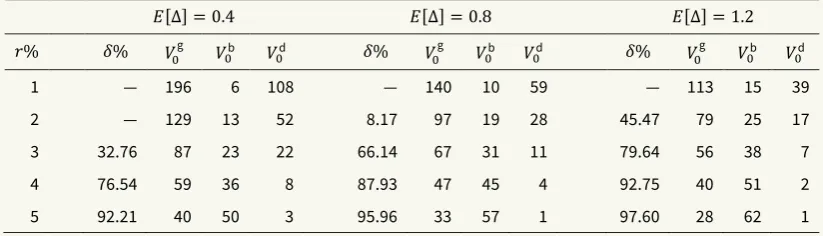
Table 2: Fair participation rate 𝛿𝛿 for different values of 𝐸𝐸[𝛥𝛥] and risk free interest rate 𝑟𝑟 for the case with deferred whole life annuities guaranteeing each survivor the continuous payment 𝜌𝜌 = 10 per year starting a fixed maturity date 𝑇𝑇 for a large portfolio.
𝐸𝐸 Δ = 0.4 𝐸𝐸 Δ = 0.8 𝐸𝐸 Δ = 1.2 𝑟𝑟% 𝛿𝛿% 𝑉𝑉2g 𝑉𝑉2b 𝑉𝑉2d 𝛿𝛿% 𝑉𝑉2g 𝑉𝑉2b 𝑉𝑉2d 𝛿𝛿% 𝑉𝑉2g 𝑉𝑉2b 𝑉𝑉2d
1 — 196 6 108 — 140 10 59 — 113 15 39 2 — 129 13 52 8.17 97 19 28 45.47 79 25 17 3 32.76 87 23 22 66.14 67 31 11 79.64 56 38 7 4 76.54 59 36 8 87.93 47 45 4 92.75 40 51 2 5 92.21 40 50 3 95.96 33 57 1 97.60 28 62 1
𝑉𝑉2g is the initial market value of the guaranteed payments, 𝑉𝑉2b the initial market value of the bonus payment, and 𝑉𝑉2d the initial market value of the default option.
For the numerical results we have used the parameters:
• 𝑚𝑚 Gompertz law of mortality, fitted to the survival probabilities 9𝑝𝑝;2∗ implied by the projected life table IPS55 currently used in the Italian annuities market
𝑚𝑚 𝑡𝑡 = 𝜆𝜆𝑐𝑐@A9 with 𝑥𝑥 = 40, 𝜆𝜆 = 2.6743 ⋅ 10HI, 𝑐𝑐 = 1.098.
• Δ Gamma distributed with VarΔ = 0.1 and the following scenarios:
o 𝐸𝐸 Δ = 0.4 extreme longevity improvement scenario
o 𝐸𝐸 Δ = 0.8 moderate longevity improvement scenario
o 𝐸𝐸 Δ = 1.2 slight mortality worsening scenario
• instantaneous assets return normally distributed with mean 𝑟𝑟 = 0.03 and 𝜎𝜎 = 0.15
• maturity 𝑇𝑇 = 25;
• initial individual assets per contract 𝑤𝑤2= 100; • initial contribution ratio 𝛼𝛼 = 0.7;
The eURopeAN AcTUARy No 18 - ocT 2018 LoNgevITy IMpAcT oN LIfe INsUReRs
anna RIta Bacinello is a full professor of mathematical methods for economics and for actuarial and financial sciences at the Department of Economics, Business, Mathematics and Statistics “Bruno de Finetti” of the University of Trieste, Italy.
pIetRo MIllossovIch is a senior
lecturer in actuarial science at the Faculty of Actuarial Science and Insurance within the Cass Business School of the City, University of London, UK. He also holds a position at the University of Trieste.
an chen is a full professor in
[image:5.595.130.542.320.438.2]