HIV Control Is Mediated in Part by CD8
T-Cell Targeting of
Specific Epitopes
Florencia Pereyra,a,bDavid Heckerman,cJonathan M. Carlson,cCarl Kadie,dDamien Z. Soghoian,aDaniel Karel,aAriel Goldenthal,a Oliver B. Davis,aCharles E. DeZiel,cTienho Lin,cJian Peng,cAlicja Piechocka,aMary Carrington,a,eBruce D. Walkera,f
Ragon Institute of MGH, MIT and Harvard, Boston, Massachusetts, USAa
; Division of Infectious Diseases, Brigham and Women’s Hospital, Boston, Massachusetts, USAb
; Microsoft Research, Los Angeles, California, USAc
; Microsoft Research, Redmond, Washington, USAd
; Cancer and Inflammation Program, Laboratory of Experimental Immunology, Leidos Biomedical Research, Inc., Frederick National Laboratory for Cancer Research, Frederick, Maryland, USAe
; Howard Hughes Medical Institute, Chevy Chase, Maryland, USAf
ABSTRACT
We investigated the hypothesis that the correlation between the class I HLA types of an individual and whether that individual
spontaneously controls HIV-1 is mediated by the targeting of specific epitopes by CD8ⴙT cells. By measuring gamma interferon
enzyme-linked immunosorbent spot (ELISPOT) assay responses to a panel of 257 optimally defined epitopes in 341 untreated HIV-infected persons, including persons who spontaneously control viremia, we found that the correlation between HLA types and control is mediated by the targeting of specific epitopes. Moreover, we performed a graphical model-based analysis that sug-gested that the targeting of specific epitopes is a cause of such control—that is, some epitopes are protective rather than merely
associated with control—and identified eight epitopes that are significantly protective. In addition, we use anin silicoanalysis to
identify protein regions where mutations are likely to affect the stability of a protein, and we found that the protective epitopes
identified by the ELISPOT analysis correspond almost perfectly to such regions. Thisin silicoanalysis thus suggests a possible
mechanism for control and could be used to identify protective epitopes that are not often targeted in natural infection but that may be potentially useful in a vaccine. Our analyses thus argue for the inclusion (and exclusion) of specific epitopes in an HIV vaccine.
IMPORTANCE
Some individuals naturally control HIV replication in the absence of antiretroviral therapy, and this ability to control is strongly correlated with the HLA class I alleles that they express. Here, in a large-scale experimental study, we provide evidence that this
correlation is mediated largely by the targeting of specific CD8ⴙT-cell epitopes, and we identify eight epitopes that are likely to
cause control. In addition, we provide anin silicoanalysis indicating that control occurs because mutations within these
epitopes change the stability of the protein structures. Thisin silicoanalysis also identified additional epitopes that are not
typi-cally targeted in natural infection but may lead to control when included in a vaccine, provided that other epitopes that would otherwise distract the immune system from targeting them are excluded from the vaccine.
C
ontrol of HIV is associated with the expression of certain“protective” HLA alleles (1–5). Although the mechanisms
mediating this effect are not fully understood, evidence points to
the induction of virus-specific CD8⫹T-lymphocyte (CTL)
re-sponses as the primary mechanism of control. In animal studies of AIDS virus infection, depletion of CTL leads to rapid loss of
con-trol (6), while in human studies,in vitro quantification of the
quality of T-cell responses is correlated with HIV control, with effective HIV-specific CTLs characterized by their ability to
rap-idly proliferate (7), avoid exhaustion (8,9), and efficiently kill
infected CD4⫹T cells (7,10,11). These observations provided the
rationale for the development of CTL vaccines, though such vac-cines expressing full-length viral proteins as antigens have failed to
induce protection or control in human trials (12,13).
While CTL responses are generally linked with natural HIV control, an important question is whether control is more likely if the CTL response is targeted against specific viral epitopes. Studies suggest that targeting predominantly the HIV Gag protein is
cor-related with control (14–17), while targeting Env (14) and Nef (16,
17) is correlated with progression, though the reasons for this
differentiation are unclear. One hypothesis is that Gag-related protection is due to the relative abundance of Gag proteins soon
after viral entry into a cell (18), suggesting that broad Gag-specific
CTL targeting should be the aim of a CTL-based vaccine. Another hypothesis is that targeting specific “protective” epitopes leads to
control (19–24) and that Gag just happens to have a high
concen-tration of such epitopes. Recent evidence for this hypothesis in-cludes the observation that targeting specific epitopes in Gag is
linked with loss of control (21), while targeting some regions
out-side Gag is linked with control (25–27). If the latter hypothesis is
Received11 April 2014Accepted19 August 2014
Published ahead of print27 August 2014
Editor:G. Silvestri
Address correspondence to Bruce D. Walker, [email protected].
F.P., D.H., and J.M.C. contributed equally to this article.
Supplemental material for this article may be found athttp://dx.doi.org/10.1128 /JVI.01004-14.
Copyright © 2014, American Society for Microbiology. All Rights Reserved.
doi:10.1128/JVI.01004-14
The authors have paid a fee to allow immediate free access to this article.
on November 7, 2019 by guest
http://jvi.asm.org/
correct, then identifying protective epitopes is an important step in the development of a vaccine.
One hypothesis that has emerged is that protective epitopes will be those that are mutationally constrained, meaning that CTL targeting of these epitopes followed by escape through mutation would weaken the virus. Perhaps the simplest way to estimate mutational constraint is to use overall sequence conservation. However, although this is an approach that is being actively
pur-sued (20,28), studies to date have shown at best very weak
corre-lations between the conservation of the sequences targeted by an
individual’s CTL response and viral control (25), though there is
some evidence that more careful definitions of sequence conser-vation that account for covariation may improve the link between
targeting conserved elements and control (22,24).
In this study, we directly tested the hypothesis that targeting of specific epitopes mediates the correlation between HLA alleles and control by comparing the responses of untreated viremic control-lers and progressors to all reported optimally defined epitopes. This approach is unbiased regarding HLA expression, an impor-tant consideration since many epitopes have been reported to be targeted in the context of more than one HLA class I allele
(re-viewed in reference 4). From these data, we identified specific
epitopes correlated with control and used statistical methods to show that targeting of specific epitopes is a likely causal mecha-nism of HLA-mediated control—that is, that these epitopes are likely protective rather than simply correlated with control. Fur-thermore, we found that although protective epitopes were not distinguished by high levels of sequence conservation, they were distinguished by the tendency of intraepitopic mutation to desta-bilize the HIV protein structures. These observations provide in-sight into the mechanisms of natural control and provide a means by which we can identify protective epitopes that are not often targeted in natural infection but may be potentially useful in a vaccine.
MATERIALS AND METHODS
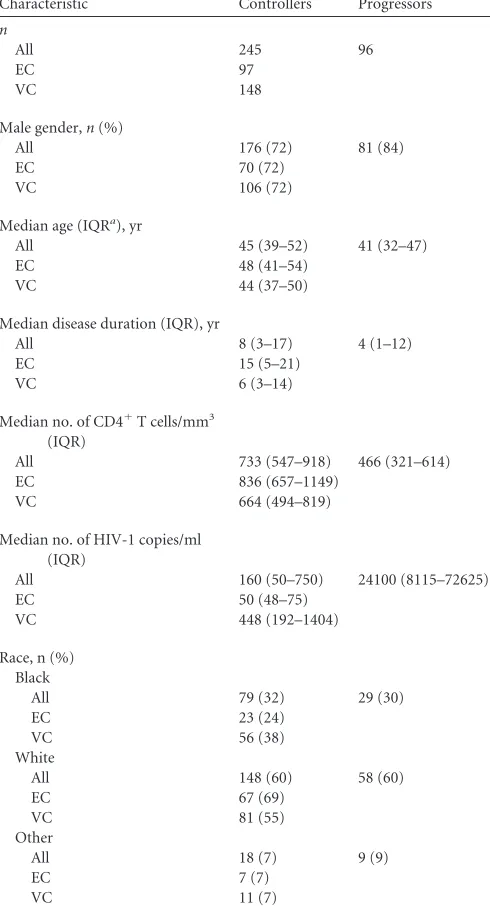
Study subjects.Subjects for the first part of the analysis were recruited from outpatient clinics at local Boston hospitals and referred from providers throughout the United States, following institutional review board approval and written informed consent. Controller status was determined based on the median HIV RNA levels over available samples prior to enrollment. Subjects were classified as elite controllers (n⫽98), viremic controllers (n⫽147), or progressors (n⫽96) if their median HIV RNA levels were below the limit of detection,ⱕ2,000 copies/ml, or⬎2,000 copies/ml, respectively (Table 1). The limit of detection was⬍75 copies/ml by branched chain DNA testing (bDNA) or⬍50 copies/ml by ultrasensitive PCR.
HLA typing.High-resolution class I HLA typing for HLA-A, -B, and -C was performed at the National Cancer Institute, National Institutes of Health, Frederick, MD, using sequence-based typing protocols developed by the 13th International Histocompatibility Workshop (29). DNA for typing was extracted from whole blood using the Puregene DNA isolation kit (Gentra Systems, Minneapolis, MN) according to the manufacturer’s instructions. HLA alleles were grouped at the 2-digit resolution level, with the exception of A*68, B*15, whose allotypes have divergent binding mo-tifs (30), and B*58, B*42, and B*35, which were previously reported to exhibit discordant associations with disease progression (31–34).
Assessment of HIV-specific CD8 T-cell responses.Gamma inter-feron (IFN-␥) enzyme-linked immunosorbent spot (ELISPOT) assays were performed with previously cryopreserved peripheral blood mono-nuclear cells (PBMC), using a panel of 257 peptides corresponding to optimal clade B cytotoxic T-lymphocyte epitopes (35). For each subject, all defined CD8 T-cell epitopes were tested irrespective of the known HLA
class I allele restriction. PBMC were plated at 100,000 cells per well with peptides at a final concentration of 14g/l in 96-well plates and pro-cessed as described previously (36). Medium alone served as a negative control and phytohemagglutinin (PHA) as a positive control. The num-bers of specific IFN-␥-secreting T cells were enumerated using an auto-mated ELISPOT reader (Cellular Technology Ltd., Shaker Heights, OH) and expressed as spot-forming cells (SFCs)/106PBMC. Responses were
considered positive if they had at least three times the mean number of SFC in the three negative-control wells and⬎50 SFC/106PBMC (36,37). Flow cytometry.Whole PBMC or expanded T-cell lines were stimu-lated with specified optimal peptides directly or with B-cell lines pulsed with the specified optimal peptides (2g/ml), as previously described (38). Briefly, stimulation was performed at 37°C for 6 h in R10 (RPMI 1640 supplemented with 10% heat-inactivated fetal bovine serum, 2 mM
L-glutamine, 10 mM HEPES, 100 U/ml penicillin, and 100g/ml
strep-TABLE 1Baseline characteristics of the cohort
Characteristic Controllers Progressors
n
All 245 96
EC 97
VC 148
Male gender,n(%)
All 176 (72) 81 (84)
EC 70 (72)
VC 106 (72)
Median age (IQRa), yr
All 45 (39–52) 41 (32–47)
EC 48 (41–54)
VC 44 (37–50)
Median disease duration (IQR), yr
All 8 (3–17) 4 (1–12)
EC 15 (5–21)
VC 6 (3–14)
Median no. of CD4⫹T cells/mm3
(IQR)
All 733 (547–918) 466 (321–614)
EC 836 (657–1149)
VC 664 (494–819)
Median no. of HIV-1 copies/ml (IQR)
All 160 (50–750) 24100 (8115–72625)
EC 50 (48–75)
VC 448 (192–1404)
Race, n (%) Black
All 79 (32) 29 (30)
EC 23 (24)
VC 56 (38)
White
All 148 (60) 58 (60)
EC 67 (69)
VC 81 (55)
Other
All 18 (7) 9 (9)
EC 7 (7)
VC 11 (7)
aIQR, interquartile range.
on November 7, 2019 by guest
http://jvi.asm.org/
[image:2.585.299.544.83.536.2]tomycin). To detect CD107a mobilization, a predetermined amount of anti-human CD107a phycoerythrin (PE)-Cy5 (clone H4A3; BD Biosci-ences) was added to the medium. An unstimulated (medium-only) sam-ple served as a negative control. At 30 min into the stimulation, the trans-port inhibitors brefeldin A (Sigma) and monensin (BD Biosciences) were added to facilitate detection of T-cell responses. Following stimulation, cells were surface stained with an amine-reactive viability dye and anti-bodies against CD3, CD4, and CD8. Cells were then washed, permeabil-ized (Cytofix/Cytoperm; BD Biosciences), and stained with antibodies against IFN-␥and/or tumor necrosis factor alpha (TNF-␣). Data were collected on a BD LSR II cytometer.
Predictive model and statistical analysis.L1-regularized logistic re-gression (39) was used to predict controller status (HIV controllers versus chronic progressors) based on class I HLA alleles alone, epitope-specific CD8⫹T-cell targeting alone, and the combination of both sets of obser-vations. The prediction accuracy of one model relative to another was determined by comparing the areas under the receiver operating charac-teristic (ROC) curves generated using 10-fold cross validation to ensure out-of-sample predictions, while the Lasso penalty for each training set was determined using nested 10-fold cross validation. Significant differ-ences in the areas under the curves (AUCs) were determined by estimating the variance of the AUC differences using a bootstrap approach (40).
To identify HLA class I restrictions for each epitope, we assessed the sig-nificance of association between the presence of targeting that epitope and the presence of an allele using Fischer’s exact test. To limit the effects of HLA linkage disequilibrium, we used a decision tree approach similar to that de-scribed previously (41): for each epitope, we identified the HLA that was most significantly associated with targeting that epitope, then removed all individ-uals who expressed that HLA, and repeated the procedure until no HLA was associated with targeting at aPvalue of⬍0.05 by Fisher’s exact test. To esti-mateqvalues, we took all contingency tables of all HLA-epitope pairs result-ing from the decision tree and computedqvalues using the exact Fisher’s exact testPvalue distributions of the tables (42).
Directed acyclic graphical models were used to investigate the direc-tion of cause and effect (43). Each node in a graphical model corresponds to a random variable, while arcs correspond to assertions of cause and effect. In a given graphical model, an L1-regularized logistic regression model was constructed for each non-HLA variable/node with regressor variables being those of the parent variables (nodes) in the graph. To measure how well a model fit the data, we determined, for each sample (individual) in the data, the out-of-sample log likelihood summed over each regression node, using 10-fold cross validation. To compare these fits for two models, we tested for differences between these summed log like-lihoods using a Wilcoxon matched-pairs signed-rank test.
In silicoanalysis of protein structural stability.To estimate the ex-pected amino acid distribution at a given site, we estimated the thermo-dynamic stability changes caused by each of the 20 amino acids using the FoldX software package (http://foldx.crg.es/) and a six-step procedure, as previously described (44). Briefly, the structures of p17 (Protein Data Bank [PDB] code2GOL) (45), p24 hexamer (PDB3H4E) (46), protease dimer (PDB3IXO) (47), reverse transcriptase (RT) (PDB1DLO) (48), integrase (PDB1BIS) (49), Tat (PDB3MI9) (50), Rev (PDB3LPH) (51), Nef (PDB1EFN) (52), and gp120 (PDB3JWD) (53) were mutated to the NL4-3 reference strain background, and the FoldX optimization proce-dure and probability-based rotamer libraries were used (54) to remove steric clashes and other estimation errors and to reconstruct missing side chain atoms. Then, the absolute change |ddG| in the Gibbs free energy was estimated using the FoldX software for each of the 20 amino acids. The expected frequencyE[fij] of amino acidjat siteiwas then estimated using
the Boltzmann distribution as the normalized negative exponential:
pij⫽E[fij]⫽
exp(⫺
ⱍ
ddGijⱍ
)兺
k20⫽1exp(⫺ⱍ
ddGikⱍ
)The expected entropy E[Hi] of site i was calculated as
E关Hi兴⫽ ⫺
兺
j⫽120
pijln共pij兲. The structural entropy of an epitope is
re-ported as the average ofE[Hi] over all sitesiin the epitope. Standard
sequence entropies were calculated in an identical manner, withE[fij]
being estimated as the observed frequency of amino acidjat siteiin a previously published alignment of full sequences sampled from approxi-mately 1,800 chronically clade B-infected, antiretroviral (ARV)-naive in-dividuals from North American and Australian cohorts (55).
RESULTS
We evaluated the relationship between epitope targeting specific-ity and viral control in 341 persons with chronic untreated HIV infection and high-resolution HLA typing, including 245 HIV
controllers (56), who maintain viremia at less than 75 RNA
cop-ies/ml (elite controllers [EC]) or 2,000 RNA copcop-ies/ml (viremic controllers [VC]) in the absence of antiretroviral therapy (median viral load of 160 RNA copies/ml), and 96 chronic progressors
(median viral load of 23,800 RNA copies/ml) (Table 1). In
partic-ular, peripheral blood mononuclear cells (PBMC) from all 341 subjects were tested for responses to HIV epitopes listed in the Los Alamos Immunology Database that are considered to be opti-mally defined in terms of epitope length and restricting class I
allele (n⫽257) (35) using an IFN-␥ELISPOT assay. Responses
were scored as either positive or negative based on predetermined
criteria (57). All individuals were tested for responses to all
epitopes. Consistent with previous work (41,58), we found many
undocumented responses to epitopes among individuals who did not express the HLA alleles reported to restrict those epitopes. Although it is possible some of these undocumented responses are
CD4⫹specific, our experimental setup was unlikely to detect such
responses, as CD4 T-cell-induced IFN-␥responses typically
re-quire longer exposure time and CD8 T-cell depletion to be
mea-surable (59,60). Nevertheless, to confirm CD8⫹specificity, we
performed intracellular cytokine secretion assays to randomly se-lected responses among five individuals with the highest number of undocumented responses (40 to 50); CD4 T-cell responses did not appear to meaningfully contribute to our findings by flow cytometry (see Fig. S1 in the supplemental material). The fre-quency of responses from all individuals is shown in Table S1 in the supplemental material.
Epitope targeting mediates the association between HLA and
control.To examine the relative contributions of HLA class I
al-leles and targeting of T-cell epitopes to viral control, we used
L1-regularized logistic regression (39) to predict viral control based
on these features. To increase power, we grouped together EC and VC and modeled the HLA alleles at the HLA type (formerly known as “two-digit level”), with the exceptions of A*68 and B*15, whose
subtypes span multiple supertypes (30), and B*35 (33), B*42 (61),
and B*58 (31), whose subtypes have differential effects on control.
Specifically, we used groups Px and PY for B*35 and modeled the remaining exceptions at the four-digit level.
Using receiver operator characteristic (ROC) curves to
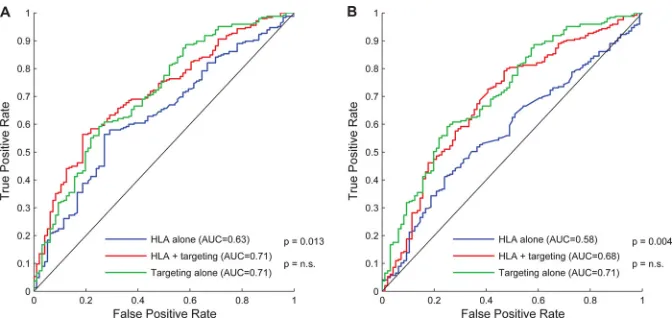
evalu-ate predictive performance (Fig. 1), we found that the
combina-tion of HLA class I alleles and targeting of T-cell epitopes better
predicted viral control than HLA class I alleles alone (P⫽0.013).
In contrast, HLA class I alleles did not improve prediction of
con-trol beyond that of epitope targeting alone (P⫽ 0.95). Thus,
within our cohort, epitope targeting mediates the correlation be-tween HLA expression and control. Similar results were observed
when we used high-resolution HLA subtype information (Fig. 1,
right), and the ROC curves were not improved when HLA ho-mozygosity, HLA frequency, total epitope breadth, or proportion
on November 7, 2019 by guest
http://jvi.asm.org/
of responses in Gag was included in the model (data not shown). Also, epitope targeting could not be used to predict EC versus VC, justifying our decision to group these individuals into a single controller group.
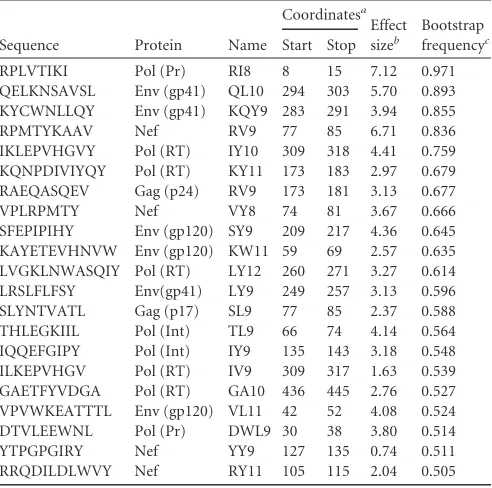
We further investigated which epitopes were individually cor-related with viral control by using L1-regularized logistic regres-sion to predict control based on HLA alleles and epitope targeting. We constructed 1,000 bootstrap replicates of the data and mea-sured the frequency with which each epitope appeared in the model. The targeting of eight epitopes was positively and
signifi-cantly associated with virus control (bootstrap frequency,⬎0.5):
Gag KF11, Gag QW11, Gag AS10, Env RR11, Env RW9, Nef HW9,
Pol GK9, and Rev SL9 (Table 2). In contrast, the targeting of 21
epitopes was significantly associated with chronic progression (Table 3). Note that while we use 0.5 for our bootstrap frequency threshold for significance, there is no general standard (see
Tables 2and3and Table S1 in the supplemental material for specific values).
When we repeated this analysis with exclusion of individuals who expressed the well-established protective B*57 and B*58:01 alleles, seven epitopes were positively and significantly associated with control, suggesting that the predictive effect of epitopes ex-tends beyond the well-characterized B*57/58:01 alleles. These in-cluded two new epitopes (Env RI10 and Gag GL8, both of which were just below the threshold of significance in the initial analy-sis), while three previously associated epitopes lost their associa-tion (Gag KF11, Nef HW9, and Rev SL9).
Protective epitope targeting causes control, while
nonpro-tective epitope targeting is the result of loss of control.One
ex-planation of the predictive ability of targeting beyond HLA alleles is that targeting is a cause of viral control. Another explanation is that increased virus load resulting from lack of control leads to the
targeting of additional epitopes (62). To explore the relative
like-lihood of these two explanations, we considered how well alterna-tive statistical models uniquely consistent with each explanation predicted the data. Specifically, we first defined two groups of epitopes: those with a positive and negative trending association with viral control, where trends were determined using a (non-regularized) univariate logistic regression model with HLA alleles as covariates. We then fit each group of epitopes to two different graphical models: model A, a model in which HLA class I alleles determine viral control and this viral control, along with HLA
restrictions, determines epitope targeting (Fig. 2A); and model B,
a model in which HLA class I alleles determine epitope targeting
and epitope targeting determines viral control (Fig. 2B). Model A
is consistent with lack of control causing targeting, whereas model B is consistent with targeting causing control (see Materials and Methods). Out-of-sample prediction accuracy using 10-fold cross validation was then measured for epitope targeting and control. For the group of positively associated epitopes, model B produced better predictions than did model A according to a Wilcoxon
matched-pairs signed-rank test (P⫽0.05). In contrast, for the
group of negatively associated epitopes, model A produced the
[image:4.585.124.460.65.224.2]FIG 1Ability of HLA types and epitope targeting to predict control. Shown are receiver operating characteristic (ROC) curves, plotting the true-positive rate versus false-positive rate of L1-regularized logistic regression models for the prediction of viral control on 341 subjects with chronic HIV infection. Models were trained using a mix of 2-digit and 4-digit resolution (left), as described in the text, and using all 4-digit types (right). The diagonal line represents uninformed predictions. The curve for predictions based on HLA restriction and epitope targeting deviates significantly from the curve for predictions based on HLA restriction alone, indicating significantly improved predictions when epitope targeting data are incorporated. Adding HLA typing information to epitope targeting does not improve predictions.Pvalues are estimated using bootstrap estimates of the standard errors of the areas under the curves (AUC) and test adjacent curves as indicated.
TABLE 2Epitope-specific CD8⫹T-cell epitopes associated with HIV control
Sequence Protein Name
Coordinatesa
Effect sizeb
Bootstrap frequencyc
Start Stop
KAFSPEVIPMF Gag (p24) KF11 30 40 2.49 0.946 RLRDLLLIVTR Env (gp41) RR11 259 269 4.06 0.754 GIPHPAGLK Pol (RT) GK9 93 101 5.26 0.746 HTQGYFPDW Nef HW9 116 124 4.86 0.743 AEAMSQVTNS Gag (p2) AS10 1 10 4.30 0.638 SAEPVPLQL Rev SL9 67 75 2.57 0.626 QAISPRTLNAW Gag (p24) QW11 13 23 1.21 0.599 RIKQIINMW Env (gp120) RW9 419 427 2.90 0.513
a
HXB2 coordinates with respect to protein domains (p24, RT, gp41, and gp120). See Table S1 in the supplemental material for coordinates with respect to polyproteins (Gag, Pol, Env).
bThe natural logarithm of the odds ratio that an individual will be a progressor or not
given that he or she targets this epitope. Parameters are estimated using a nonregularized logistic regression model including all HLAs and epitopes.
c
The fraction of bootstrap samples in which the sequence is selected for inclusion in the predictive model.
on November 7, 2019 by guest
http://jvi.asm.org/
[image:4.585.41.286.540.652.2]better predictions (P⫽0.005). These results suggest that targeting of the positively associated epitopes is a cause of viral control, whereas targeting of negatively associated epitopes is a causal ef-fect of the lack of viral control. The latter observation is further supported by our observation that individuals with higher viral load target more epitopes and at higher intensity (see Fig. S2 in the supplemental material), consistent with a model in which a higher viral load leads to a high cell surface viral peptide concentration that stimulates further responses (similar observations with re-spect to variant recognition within Gag have been reported
previ-ously [62]). Note that these results suggest but do not prove cause
and effect, as the models we examined were by no means exhaus-tive. For example, our models did not include latent variables. Furthermore, because we have sufficient statistical power to test only the positively and negatively correlated groups as a whole, our analysis does not rule out the possibility, e.g., that some neg-atively correlated epitopes cause lack of control. Here we refer to epitopes that are significantly associated with control as either protective (if the association is positive) or nonprotective (if the association is negative) epitopes.
Protective epitopes are distinguished by protein structures
that constrain immune escape.Having uncovered the possibility
of a cause-and-effect relationship between targeting specific epitopes and control, we next explored a possible mechanism to explain why some epitopes cause control and others do not. We hypothesized that a protective epitope is one where immune es-cape substantially weakens the virus. We further hypothesized
that an escape at a given position in the protein would weaken the virus if that mutation altered the stability of the viral protein, as
can be estimatedin silicothrough a physics simulation of the
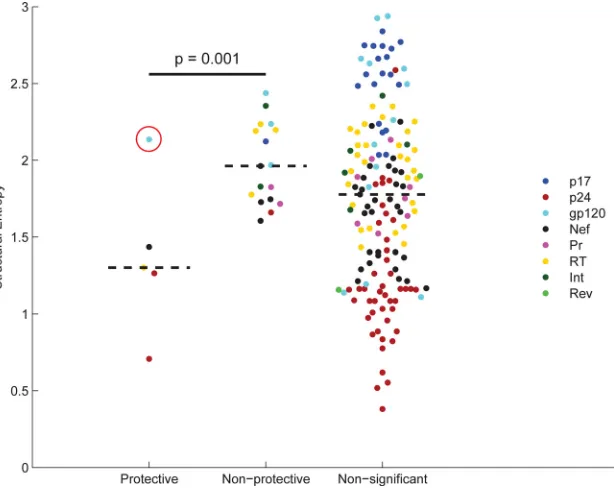
in-teractions among the atoms in the protein (see Materials and Methods). We performed these simulations for every protein with an available high-resolution crystal structural (portions of p17, p24, protease, RT, integrase, Rev, Tat, and gp41) and from these results constructed a measure of protection that we call structural entropy. In particular, for each position in the protein, we mapped the predicted change in protein stability (energy) due to an amino acid substitution to the probability that the amino acid would be observed in the population of circulating viruses: the greater the change in stability, the lower the probability. We did so for each possible amino acid substitution (including wild type) at a given position, yielding a probability distribution over the 20 amino acids. Finally, we defined the structural entropy of a site to be the Shannon entropy of this probability distribution and the struc-tural entropy of an epitope to be the average entropy over all sites in that epitope. Thus, the structural entropy of an epitope can be viewed as a hypothesized surrogate for how readily the virus can mutate in that region without harm to the virus. Note that struc-tural entropy should not be confused with classical sequence en-tropy that is based on the observed frequencies of amino acids in a given population (see Discussion).
The structural entropies completely segregated protective
from nonprotective epitopes (P⫽0.001 by logistic regression,
with covariates for each protein domain) (Fig. 3), with the
excep-tion of the protective Env RW9 epitope, which spans important protein-protein interaction interfaces that mediate coreceptor
(63), CD4 (64,65), and gp41 (63) binding. Results remained
sig-nificant at aPvalue of⬍0.02 over all data sets resulting from the
removal of one or two epitopes. Furthermore, the three protective epitopes that lay outside solved protein structures were similarly consistent with mutational constraint. In particular, gp41-RR10 lies on the N terminus of the lentiviral lytic peptide 2 (LLP-2) domain. Site-directed mutagenesis of position 1 of the epitope,
which is associated with escape from A*31 and A*74 (55), has been
[image:5.585.41.287.87.331.2]shown to dramatically reduce cell-cell fusion and associated cell
TABLE 3Epitope-specific CD8⫹T-cell targeting associated with HIV chronic progression
Sequence Protein Name
Coordinatesa
Effect sizeb
Bootstrap frequencyc
Start Stop
RPLVTIKI Pol (Pr) RI8 8 15 7.12 0.971 QELKNSAVSL Env (gp41) QL10 294 303 5.70 0.893 KYCWNLLQY Env (gp41) KQY9 283 291 3.94 0.855 RPMTYKAAV Nef RV9 77 85 6.71 0.836 IKLEPVHGVY Pol (RT) IY10 309 318 4.41 0.759 KQNPDIVIYQY Pol (RT) KY11 173 183 2.97 0.679 RAEQASQEV Gag (p24) RV9 173 181 3.13 0.677 VPLRPMTY Nef VY8 74 81 3.67 0.666 SFEPIPIHY Env (gp120) SY9 209 217 4.36 0.645 KAYETEVHNVW Env (gp120) KW11 59 69 2.57 0.635 LVGKLNWASQIY Pol (RT) LY12 260 271 3.27 0.614 LRSLFLFSY Env(gp41) LY9 249 257 3.13 0.596 SLYNTVATL Gag (p17) SL9 77 85 2.37 0.588 THLEGKIIL Pol (Int) TL9 66 74 4.14 0.564 IQQEFGIPY Pol (Int) IY9 135 143 3.18 0.548 ILKEPVHGV Pol (RT) IV9 309 317 1.63 0.539 GAETFYVDGA Pol (RT) GA10 436 445 2.76 0.527 VPVWKEATTTL Env (gp120) VL11 42 52 4.08 0.524 DTVLEEWNL Pol (Pr) DWL9 30 38 3.80 0.514 YTPGPGIRY Nef YY9 127 135 0.74 0.511 RRQDILDLWVY Nef RY11 105 115 2.04 0.505
aHXB2 coordinates with respect to protein domains (p24, RT, gp41, and gp120). See
Table S1 in the supplemental material for coordinates with respect to polyproteins (Gag, Pol, Env).
b
The natural logarithm of the odds ratio that an individual will be a progressor or not given that he or she targets this epitope. Parameters are estimated using a
nonregularized logistic regression model including all HLAs and epitopes.
cThe fraction of bootstrap samples in which the sequence is selected for inclusion in the
predictive model.
FIG 2Graphical models used to investigate the direction of cause and effect between targeting and viral control. Nodes correspond to variables, and an arc from one node to another reflects the assumption that the first node is a cause of the second. Thus, model A reflects the assumptions that HLA types are causes of control and that HLA and (lack of) control are causes of epitope targeting. (Not shown in the figure but present in the model are additional arcs from HLA nodes to epitope nodes corresponding to the known influence of HLA on epitope binding.) Model B reflects the assumptions that HLA types are causes of targeting of specific epitopes, which in turn are causes of control.
on November 7, 2019 by guest
http://jvi.asm.org/
[image:5.585.351.494.505.640.2]death of CD4⫹T cells (66). Interestingly, Rev-SL9 is immediately upstream of gp41-RR10 and also overlaps the gp41 LLP-2 domain, though in a different reading frame. Finally, Gag-AS10 lies on the proteolytic cleavage site for the capsid-spacer 1 (p24-p2) bound-ary, consisting of p2 positions 1 to 10; cleavage appears to be largely mediated by the interaction of the protease and cleavage
site structures (for a review, see reference 67), and mutations
within the AS10 epitope have been shown to disrupt p2 cleavage
and drastically reduce viral infectivity (68). These striking results
suggest that a decrease in viral fitness due to escape after targeting is a possible causal mechanism for control.
Finally, we note that many of the epitopes tested have low structural entropies but were neither significantly protective nor
nonprotective (Fig. 3). These epitopes may be protective but lower
on the immunodominance hierarchy and hence not targeted fre-quently enough to show significant protection. Indeed, 35 out of 49 of these epitopes were targeted in fewer than 10% of our sub-jects (compared to an average targeting frequency of 23% for sig-nificant protective epitopes) and thus are good candidates for pro-tective epitopes.
A majority of noncontrollers are capable of targeting
protec-tive epitopes.Although our analysis identified only eight
protec-tive epitopes with high enough targeting frequencies to be de-tected, 215 of 461 (47%) responses to these epitopes were in individuals who lacked the published restricting HLA allele, con-sistent with previous reports in which a subset of these protective epitopes were frequently targeted by controllers who did not
ex-press the published restricting allele (41). Such a high rate of
un-documented targeting suggests that a vaccine including only these
epitopes may cover a substantial proportion of the population. To further explore this possibility, we identified HLA-epitope associ-ations using an iterative Fisher exact test that corrects for linkage disequilibrium (see Table S2 in the supplemental material and
Materials and Methods), using aqvalue of⬍0.05 as a threshold to
define HLA alleles associated with each epitope. Overall, 74/96 noncontrollers (77%) expressed at least one HLA allele that was linked with the presentation of a protective epitope, suggesting that a majority of individuals have the capacity to target these epitopes. Importantly, 340/341 individuals (99.7%) in the study express alleles that were statistically linked to nonprotective epitopes, highlighting the potential importance of vaccinating for specific protective epitopes and the exclusion of nonprotective epitopes. Although precise HLA-epitope restrictions will require
furtherin vitroconfirmation, these results highlight the
poten-tially broad coverage that may be achieved by a vaccine that fo-cuses on a small number of protective epitopes.
DISCUSSION
By comprehensively analyzing the IFN-␥ELISPOT response
pro-files of 245 natural controllers, compared to those of 96 progres-sors, against all known optimally defined epitopes, we obtained compelling evidence that a primary mechanism of control associ-ated with HLA types is mediassoci-ated by the targeting of specific
epitopes, providing a broad justification for CD8⫹T-cell based
vaccines and identifying specific epitopes that are primary candi-dates for such vaccines. The set of identified protective epitopes covered multiple proteins, including the Env protein, and was characterized by a heightened tendency for intraepitopic variation
FIG 3Structural entropy for protective, nonprotective, and nonsignificant epitopes. The structural entropy of an epitope can be viewed as anin silicoestimate for how readily the virus can mutate in that region without harming the virus. Each point corresponds to a specific epitope from a protein (indicated by color). Epitopes are grouped as being protective, nonprotective, or nonsignificant based on the analysis of the ELISPOT data. There is a significant difference between the structural entropies of the protective and nonprotective epitopes (P⫽0.001 using a logistic regression test in which the dependent variable is protective versus nonprotective and the independent variables are the structural entropy and the protein domain in which the epitope resides). The circled data point corresponds to the envelope epitope RW9, which spans important protein-protein interaction interfaces that mediate coreceptor, CD4, and gp41 binding. The reportedP
value includes this point.
on November 7, 2019 by guest
http://jvi.asm.org/
[image:6.585.140.447.67.311.2]to result in altered protein stability. These observations argue for the inclusion of specific epitopes in a vaccine, rather than whole viral proteins that may result in unfocused and unhelpful target-ing, suggest that a hallmark of protective epitopes is a reduced capacity to escape the immune response through viral mutation, and provide an approach to identify additional protective epitopes.
Although the preponderance of evidence has pointed toward
CD8⫹T-cell targeting as a causal mechanism behind
HLA-medi-ated control (reviewed in reference4), it has been difficult to prove
this hypothesis. The most compelling evidence in humans has come from longitudinal studies, in which viral mutation led to loss of targeting of the immunodominant epitopes by the protective
B27 (69–72), B57 (73), or B81 (74) HLA allele and was temporally
followed by loss of control, though it is difficult to know if these results generalize to other alleles that are not characterized by such highly immunodominant targeting. In cross-sectional studies, one study provided some evidence that the targeting of a select set of epitopes in early infection improved prediction of CD4 decline
beyond HLA typing information alone (21), while another study
used a regression model that identified numerous overlapping peptide (OLP) targets as being predictive of reduced viral load in
addition to HLA typing information (25), each suggesting that
relative control among individuals expressing similar alleles can be better predicted given epitope targeting information. Here, we extended these analyses by examining all reported optimal epitopes in a large cohort of persons with chronic infection and through two formal statistical approaches. First, we showed that epitope-specific targeting mediates the correlation between HLA and control in this cohort, as epitope targeting significantly im-proves prediction of viremic control compared to HLA typing alone, while HLA type information adds no predictive value be-yond that of epitope targeting. Second, an additional analysis re-vealed that a model in which HLA control was mediated through targeting of epitopes positively associated with control was signif-icantly better at explaining the data than a model in which HLA alleles directly predicted control while targeting was a function of HLA restriction and control. Importantly, we observed the oppo-site result for epitopes negatively associated with control: targeting of such epitopes in general appeared to be the result of loss of control, while lack of control was associated with a greater breadth and higher intensity of epitope targeting. These results thus pro-vide new epro-vidence that a subset of epitopes are causally protective, including epitopes outside Gag, and are thus primary vaccine can-didates, though future longitudinal studies in early infection co-horts are warranted to confirm these results.
If certain epitopes are causally protective and not simply markers of the presence of specific allelic types or haplotypes, then certain characteristics are likely to be common among protective epitopes. A natural potential mechanism involves viral immune escape. If CTL targeting is effective at limiting viral reproduction, then there will be significant selection pres-sure that will favor viral variants that ameliorate the immune
response by, for example, disrupting epitope processing (75–
77), HLA binding (70,78), and/or TcR recognition (79–82).
The importance of such immune escape is suggested by the extent to which specific HIV polymorphisms are correlated
with the expression of specific HLA alleles (55,83–85), as well
as the observation that roughly a third of observed mutations
in early infection are consistent with escape or reversion (86).
Furthermore, protective alleles are distinguished by a tendency
to select for escapes that abrogate HLA binding (55) and by a
relatively highin vitroreplicative cost of escape (24,44),
indi-cating that selection pressure is sufficiently high—and the po-tential sites of escape are sufficiently limited—to warrant the selection of otherwise unfavorable viral variants. An attractive hypothesis has therefore emerged: protective epitopes will be those for which escape options are constrained.
It has therefore been proposed that protective epitopes will be
those in regions with low sequence diversity (20,25,28), as low
sequence diversity generally implies that most variants reduce the replicative fitness of the virus enough to sustain purifying selec-tion. Importantly, targeting of conserved regions has been
corre-lated with a lower viral load (25), though we found no difference
in sequence entropy between our protective and nonprotective epitopes (see Fig. S3 in the supplemental material). Furthermore, when we used both structural and sequence entropy to predict whether a significant epitope was protective or nonprotective,
structural entropy remained significant (P⫽0.004), while
se-quence entropy was not (P⫽0.85). Although there were only five
protective epitopes wholly contained within solved structures, the fact that each structure that contains a protective epitope also contains at least one nonprotective epitope allows for some robust comparisons. Indeed, when we repeated the analysis on all 264 combinations resulting from the removal of one or two significant
epitopes, the maximumPvalue observed for structural entropy
(conditioned on sequence entropy) was 0.03, while the minimum
Pvalue observed for sequence entropy (conditioned on structural
entropy) was 0.59. One possible explanation for this difference may be the extreme phenotype we employed: the overall range in
effect size in one study was roughly one log in viral load (25),
whereas we are attempting to distinguish a more extreme control-ler phenotype. More simply, the lack of signal for sequence en-tropy in our data may reflect the smaller sample size of our data set, which is consistent with the weak correlation observed by
Mothe and colleagues (|r|⬍0.15) (25).
The weakness of the previously reported correlation, coupled with the lack of association in our data set, is somewhat surprising and suggests that sequence conservation is at best a weak marker for epitope protectiveness. One explanation is that while sequence conservation suggests constraints on viral evolution, lack of
con-servation does not rule out such constraints. Indeed,in vivo, the
virus must balance the replicative fitness costs of a mutation with the fitness gained by abrogating the immune response. For a suf-ficiently strong immune response, it may well benefit the virus to select for escape despite the incursion of replicative fitness costs. The net result will be an increase in overall sequence diversity, driven primarily by the frequency of the HLA in the population. Furthermore, even if mutation is impossible for the virus in isola-tion, compensatory mutations in other sites may ameliorate the
replicative fitness costs (87,88). Such events will increase apparent
sequence diversity but may still confer a protective advantage for certain epitopes: even though replicative fitness can be compen-sated, the requirement for multiple mutations increases the ex-pected time until escape occurs and may provide a crucial window in early infection during which the immune system can effectively control the virus. A corollary to high sequence diversity resulting from effective epitope targeting is that high sequence conservation may simply be a marker for a typically ineffective immune
on November 7, 2019 by guest
http://jvi.asm.org/
sponse that does not mount sufficient selection pressure to drive viral diversification.
Our measure of structural entropy addresses these potential discrepancies between the protective ability of an epitope and how well the epitope sequence is conserved. In particular, an epitope with low structural entropy is one for which the majority of mu-tations are expected to alter protein stability and thus have low
replicative fitness (44). Although several of our epitopes were not
located in available crystal structures, among those that were, structural entropy distinguished epitopes deemed protective by our ELISPOT data from those deemed nonprotective. The lone exception was a gp120 epitope that spans several protein-protein
interaction domains (63–65) not measurable by the available
structure but consistent with a constrained ability of the virus to mutate in this region. The ability of structural entropy to distin-guish protective from nonprotective epitopes corroborates the causal role that targeting protective epitopes plays in natural viral control and is consistent with other data showing the existence of higher-order structural constraints on viral evolution, where
tar-geting of these regions is associated with immune control (22).
One drawback of looking at natural T-cell targeting is that targeting of subdominant epitopes is, by definition, observed in-frequently, making it difficult to identify subdominant epitopes that may be protective. This difficulty is particularly present among individuals who have a low level of circulating virus and therefore a low level of circulating T cells of the effector
pheno-type, which is what is typically measured on these assays (89). Our
results indicate that mutational constraints in general, and struc-tural entropy in particular, constitute a feature that is useful in identifying potentially subdominant protective epitopes for fur-ther study. Indeed, an important recent result indicates that vac-cination against specific epitopes can substantially alter
immu-nodominance hierarchies (90), even if administered after the
onset of infection (91), validating the approach of designing a
prophylactic or therapeutic vaccine to elicit such (hypothetical) protective subdominant targeting.
An alternative to our approach of measuring responses to known epitopes would have been to perform an overlapping pep-tide (OLP) scan of the entire HIV proteome. Limitations of this approach include the reduction of specificity, as each OLP may contain more than one epitope, and an increase in false-negative
rates due to the oversize peptides and required processing (23,62),
requiring additional follow-up to identify the protective epitopes. Two advantages of the OLP approach are that it provides an un-biased scan of HIV peptides and covers the entire proteome.
Nev-ertheless, ourin silicomeasure of structural entropy provides the
opportunity to scan the entire proteome and identify additional peptide sequences for testing.
Our identification of specific protective and nonprotective epitopes argues for the inclusion (and exclusion) of specific epitopes in a vaccine, an approach that is currently in
develop-ment by several groups (20,25,28), and argues against expression
of entire viral proteins. Finally, our observation that protective epitopes are distinguished by low structural entropy broadly con-firms the hypothesis that protective epitopes are those for which viral escape is constrained and provides a means to identify addi-tional subdominant epitopes that are potentially protective and thus candidates for inclusion in a vaccine.
ACKNOWLEDGMENTS
This study was supported in part by the International HIV Controllers Study (IHCS), funded by the Bill and Melinda Gates Foundation (F.P. and B.D.W.), the AIDS Healthcare Foundation (F.P.), and the Harvard Uni-versity Center for AIDS Research (CFAR), an NIH-funded Center for AIDS Research (P30 AI060354), which is supported by the following NIH Co-Funding and Participating Institutes and Centers: NIAID, NCI, NICHD, NHLBI, NIDA, NIMH, NIA, FIC, and OAR. Members of IHCS can be found at http://ragoninstitute.org/hivcontrollers/health-professionals/study-members/the-international-hiv-controllers-study-members/. We also grate-fully acknowledge support from the Mark and Lisa Schwartz Foundation. This project has been funded in whole or in part with federal funds from the Frederick National Laboratory for Cancer Research, under contract no. HHSN261200800001E. This research was supported in part by the Intramu-ral Research Program of the NIH, Frederick National Laboratory, Center for Cancer Research.
The content of this publication does not necessarily reflect the views or policies of the Department of Health and Human Services, nor does mtion of trade names, commercial products, or organizamtions imply en-dorsement by the U.S. Government.
David Heckerman, Jonathan M. Carlson, Carl Kadie, and Charles E. DeZiel were employed by Microsoft while performing this research.
REFERENCES
1.Kaslow RA, Carrington M, Apple R, Park L, Muñoz A, Saah AJ, Goedert JJ, Winkler C, O’Brien SJ, Rinaldo C, Detels R, Blattner W, Phair J, Erlich H, Mann DL.1996. Influence of combinations of human major histocompatibility complex genes on the course of HIV-1 infection. Nat. Med.2:405– 411.http://dx.doi.org/10.1038/nm0496-405.
2.Carrington M, Nelson GW, Martin MP, Kissner T, Vlahov D, Goedert JJ, Kaslow R, Buchbinder S, Hoots K, O’Brien SJ.1999. HLA and HIV-1: heterozygote advantage and B*35-Cw*04 disadvantage. Science 283:
1748 –1752.http://dx.doi.org/10.1126/science.283.5408.1748.
3.Fellay J, Shianna KV, Ge D, Colombo S, Ledergerber B, Weale M, Zhang K, Gumbs C, Castagna A, Cossarizza A, Cozzi-Lepri A, De Luca A, Easterbrook P, Francioli P, Mallal SA, Martinez-Picado J, Miro JM, Obel N, Smith JP, Wyniger J, Descombes P, Antonarakis SE, Letvin NL, McMichael AJ, Haynes BF, Telenti A, Goldstein DB. 2007. A whole-genome association study of major determinants for host control of HIV-1. Science317:944 –947.http://dx.doi.org/10.1126/science.1143767. 4.Goulder PJR, Walker BD.2012. HIV and HLA class I: an evolving rela-tionship. Immunity 37:426 – 440. http://dx.doi.org/10.1016/j.immuni .2012.09.005.
5.Pereyra F, Jia X, McLaren PJ, Telenti A, de Bakker PIW, Walker BD, Ripke S, Brumme CJ, Pulit SL, Carrington M, Kadie CM, Carlson JM, Heckerman D, Graham RR, Plenge RM, Deeks SG, Gianniny L, Craw-ford G, Sullivan J, Gonzalez E, Davies L, Camargo A, Moore JM, Beattie N, Gupta S, Crenshaw A, Burtt NP, Guiducci C, Gupta N, Gao X, Qi Y, Yuki Y, Piechocka-Trocha A, Cutrell E, Rosenberg R, Moss KL, Lemay P, O’Leary J, Schaefer T, Verma P, Toth I, Block B, Baker B, Rothchild A, Lian J, Proudfoot J, Alvino DML, Vine S, Addo MM, Allen TM, et al.2010. The major genetic determinants of HIV-1 control affect HLA class I peptide presentation. Science330:1551–1557.http://dx.doi.org/10 .1126/science.1195271.
6.Schmitz JE, Kuroda MJ, Santra S, Sasseville VG, Simon MA, Lifton MA, Racz P, Tenner-Racz K, Dalesandro M, Scallon BJ, Ghrayeb J, Forman MA, Montefiori DC, Rieber EP, Letvin NL, Reimann KA.1999. Control of viremia in simian immunodeficiency virus infection by CD8⫹ lympho-cytes. Science 283:857– 860.http://dx.doi.org/10.1126/science.283.5403 .857.
7.Migueles SA, Laborico AC, Shupert WL, Sabbaghian MS, Rabin R, Hallahan CW, Van Baarle D, Kostense S, Miedema F, McLaughlin M, Ehler L, Metcalf J, Liu S, Connors M.2002. HIV-specific CD8⫹ T cell proliferation is coupled to perforin expression and is maintained in nonprogressors. Nat. Immunol.3:1061–1068.http://dx.doi.org/10 .1038/ni845.
8.Day CL, Kaufmann DE, Kiepiela P, Brown JA, Moodley ES, Reddy S, Mackey EW, Miller JD, Leslie AJ, DePierres C, Mncube Z, Du-raiswamy J, Zhu B, Eichbaum Q, Altfeld M, Wherry EJ, Coovadia HM, Goulder PJR, Klenerman P, Ahmed R, Freeman GJ, Walker BD.
on November 7, 2019 by guest
http://jvi.asm.org/
2006. PD-1 expression on HIV-specific T cells is associated with T-cell exhaustion and disease progression. Nature443:350 –354.http://dx .doi.org/10.1038/nature05115.
9.Trautmann L, Janbazian L, Chomont N, Said EA, Gimmig S, Bessette B, Boulassel M-R, Delwart E, Sepulveda H, Balderas RS, Routy J-P, Haddad EK, Sekaly R-P. 2006. Upregulation of PD-1 expression on HIV-specific CD8⫹T cells leads to reversible immune dysfunction. Nat. Med.12:1198 –1202.http://dx.doi.org/10.1038/nm1482.
10. Sáez-Cirión A, Lacabaratz C, Lambotte O, Versmisse P, Urrutia A, Boufassa F, Barré-Sinoussi F, Delfraissy J-F, Sinet M, Pancino G, Venet A.2007. HIV controllers exhibit potent CD8 T cell capacity to suppress HIV infection ex vivo and peculiar cytotoxic T lymphocyte activation phenotype. Proc. Natl. Acad. Sci. U. S. A.104:6776 – 6781.http://dx.doi .org/10.1073/pnas.0611244104.
11. Chen H, Ndhlovu ZM, Liu D, Porter LC, Fang JW, Darko S, Brockman MA, Miura T, Brumme ZL, Schneidewind A, Piechocka-Trocha A, Cesa KT, Sela J, Cung TD, Toth I, Pereyra F, Yu XG, Douek DC, Kaufmann DE, Allen TM, Walker BD.2012. TCR clonotypes modulate the protec-tive effect of HLA class I molecules in HIV-1 infection. Nat. Immunol.
13:691–700.http://dx.doi.org/10.1038/ni.2342.
12. Buchbinder SP, Mehrotra DV, Duerr A, Fitzgerald DW, Mogg R, Li D, Gilbert PB, Lama JR, Marmor M, Del Rio C, McElrath MJ, Casimiro DR, Gottesdiener KM, Chodakewitz JA, Corey L, Robertson MN.2008. Efficacy assessment of a cell-mediated immunity HIV-1 vaccine (the Step Study): a double-blind, randomised, placebo-controlled, test-of-concept trial. Lancet 372:1881–1893. http://dx.doi.org/10.1016/S0140-6736(08) 61591-3.
13. Hammer SM, Sobieszczyk ME, Janes H, Karuna ST, Mulligan MJ, Grove D, Koblin BA, Buchbinder SP, Keefer MC, Tomaras GD, Frahm N, Hural J, Anude C, Graham BS, Enama ME, Adams E, DeJesus E, Novak RM, Frank I, Bentley C, Ramirez S, Fu R, Koup RA, Mascola JR, Nabel GJ, Montefiori DC, Kublin J, McElrath MJ, Corey L, Gilbert PB.
2013. Efficacy trial of a DNA/rAd5 HIV-1 preventive vaccine. N. Engl. J. Med.369:2083–2092.http://dx.doi.org/10.1056/NEJMoa1310566. 14. Kiepiela P, Ngumbela K, Thobakgale C, Ramduth D, Honeyborne I,
Moodley E, Reddy S, de Pierres C, Mncube Z, Mkhwanazi N, Bishop K, van der Stok M, Nair K, Khan N, Crawford H, Payne R, Leslie AJ, Prado J, Prendergast A, Frater J, McCarthy N, Brander C, Learn GH, Nickle D, Rousseau C, Coovadia H, Mullins JI, Heckerman D, Walker BD, Goulder PJR.2007. CD8⫹T-cell responses to different HIV proteins have discordant associations with viral load. Nat. Med.13:46 –53.http://dx.doi .org/10.1038/nm1520.
15. Rolland M, Heckerman D, Deng W, Rousseau CM, Coovadia H, Bishop K, Goulder PJR, Walker BD, Brander C, Mullins JI.2008. Broad and Gag-biased HIV-1 epitope repertoires are associated with lower viral loads. PLoS One3:e1424.http://dx.doi.org/10.1371/journal.pone.0001424.
16. Huang K-HG, Goedhals D, Carlson JM, Brockman MA, Mishra S, Brumme ZL, Hickling S, Tang CSW, Miura T, Seebregts C, Heckerman D, Ndung’u T, Walker BD, Klenerman P, Steyn D, Goulder PJR, Phillips R, van Vuuren C, Frater J.2011. Progression to AIDS in South Africa is associated with both reverting and compensatory viral mutations. PLoS One6:e19018.http://dx.doi.org/10.1371/journal.pone.0019018. 17. Zuñiga R, Lucchetti A, Galvan P, Sanchez C, Hernandez A, Sanchez H,
Frahm N, Linde CH, Hewitt HS, Altfeld M, Allen TM, Walker BD, Korber BT, Leitner T, Sanchez J, Brander C, Sanchez S, Hildebrand W.
2006. Relative dominance of Gag p24-specific cytotoxic T lymphocytes is associated with human immunodeficiency virus control. J. Virol.80:
3122–3125.http://dx.doi.org/10.1128/JVI.80.6.3122-3125.2006. 18. Sacha JB, Chung C, Rakasz EG, Spencer SP, Jonas AK, Bean AT, Lee W,
Burwitz BJ, Stephany JJ, Loffredo JT, Allison DB, Adnan S, Hoji A, Wilson NA, Friedrich TC, Lifson JD, Yang OO, Watkins DI. 2007. Gag-specific CD8⫹T lymphocytes recognize infected cells before AIDS-virus integration and viral protein expression. J. Immunol.178:2746 – 2754.http://dx.doi.org/10.4049/jimmunol.178.5.2746.
19. Heckerman DE, Frahm N, Pereyra F, Dubey S, Geraghty DE, Carlson JM, Robertson MN, McElrath MJ, Casimiro DR, Walker BD. 2009. Vaccine-induced targeting of epitopes associated with spontaneous con-trol of HIV viral replication is assocaited with lower set-point viral loads in HIV-infected participants from the STEP trial, p 95.In16th Conf. Retro-viruses Opportun. Infect., Montreal, Canada.
20. Rolland M, Nickle DC, Mullins JI.2007. HIV-1 group M conserved elements vaccine. PLoS Pathog.3:e157.http://dx.doi.org/10.1371/journal .ppat.0030157.
21. Dinges WL, Richardt J, Friedrich D, Jalbert E, Liu Y, Stevens CE, Maenza J, Collier AC, Geraghty DE, Smith J, Moodie Z, Mullins JI, McElrath MJ, Horton H.2010. Virus-specific CD8⫹T-cell responses better define HIV disease progression than HLA genotype. J. Virol.84:
4461– 4468.http://dx.doi.org/10.1128/JVI.02438-09.
22. Dahirel V, Shekhar K, Pereyra F, Miura T, Artyomov M, Talsania S, Allen TM, Altfeld M, Carrington M, Irvine DJ, Walker BD, Chakraborty AK.2011. Coordinate linkage of HIV evolution reveals re-gions of immunological vulnerability. Proc. Natl. Acad. Sci. U. S. A.108:
11530 –11535.http://dx.doi.org/10.1073/pnas.1105315108.
23. Mothe B, Llano A, Ibarrondo J, Zamarreño J, Schiaulini M, Miranda C, Ruiz-Riol M, Berger CT, Herrero MJ, Palou E, Plana M, Rolland M, Khatri A, Heckerman D, Pereyra F, Walker BD, Weiner D, Paredes R, Clotet B, Felber BK, Pavlakis GN, Mullins JI, Brander C.2012. CTL responses of high functional avidity and broad variant cross-reactivity are associated with HIV control. PLoS One7:e29717.http://dx.doi.org/10 .1371/journal.pone.0029717.
24. Ferguson AL, Mann JK, Omarjee S, Ndung’u T, Walker BD, Chakraborty AK.2013. Translating HIV sequences into quantitative fit-ness landscapes predicts viral vulnerabilities for rational immunogen de-sign. Immunity38:606 – 617.http://dx.doi.org/10.1016/j.immuni.2012.11 .022.
25. Mothe B, Llano A, Ibarrondo J, Daniels M, Miranda C, Zamarreño J, Bach V, Zuniga R, Pérez-Álvarez S, Berger CT, Puertas MC, Martinez-Picado J, Rolland M, Farfan M, Szinger JJ, Hildebrand WH, Yang OO, Sanchez-Merino V, Brumme CJ, Brumme ZL, Heckerman D, Allen TM, Mullins JI, Gómez G, Goulder PJ, Walker BD, Gatell JM, Clotet B, Korber BT, Sanchez J, Brander C.2011. Definition of the viral targets of protective HIV-1-specific T cell responses. J. Transl. Med.9:208.http://dx .doi.org/10.1186/1479-5876-9-208.
26. Navis M, Schellens IMM, van Swieten P, Borghans JAM, Miedema F, Kootstra NA, van Baarle D, Schuitemaker H.2008. A nonprogressive clinical course in HIV-infected individuals expressing human leukocyte antigen B57/5801 is associated with preserved CD8⫹T lymphocyte re-sponsiveness to the HW9 epitope in Nef. J. Infect. Dis.197:871– 879.http: //dx.doi.org/10.1086/528695.
27. Adland E, Carlson JM, Paioni P, Kløverpris H, Shapiro R, Ogwu A, Riddell L, Luzzi G, Chen F, Balachandran T, Heckerman D, Stryhn A, Edwards A, Ndung’u T, Walker BD, Buus S, Goulder P, Matthews PC.
2013. Nef-specific CD8⫹T cell responses contribute to HIV-1 immune control. PLoS One 8:e73117. http://dx.doi.org/10.1371/journal.pone .0073117.
28. Létourneau S, Im E-J, Mashishi T, Brereton C, Bridgeman A, Yang H, Dorrell L, Dong T, Korber B, McMichael AJ, Hanke T.2007. Design and pre-clinical evaluation of a universal HIV-1 vaccine. PLoS One2:e984. http://dx.doi.org/10.1371/journal.pone.0000984.
29. Hansen JA (ed).2005. Immunobiology of the human MHC: 13th Inter-national Histocompatibility Workshop and Congress. IHWG Press, Seat-tle, WA.
30. Sidney J, Peters B, Frahm N, Brander C, Sette A.2008. HLA class I supertypes: a revised and updated classification. BMC Immunol.9:1.http: //dx.doi.org/10.1186/1471-2172-9-1.
31. Kiepiela P, Leslie AJ, Honeyborne I, Ramduth D, Thobakgale C, Chetty S, Rathnavalu P, Moore C, Pfafferott KJ, Hilton L, Zimbwa P, Moore S, Allen T, Brander C, Addo MM, Altfeld M, James I, Mallal SA, Bunce M, Barber LD, Szinger J, Day C, Klenerman P, Mullins JI, Korber B, Coovadia HM, Walker BD, Goulder PJR.2004. Dominant influence of HLA-B in mediating the potential co-evolution of HIV and HLA. Nature
432:769 –775.http://dx.doi.org/10.1038/nature03113.
32. Kloverpris HN, Stryhn A, Harndahl M, van der Stok M, Payne RP, Matthews PC, Chen F, Riddell L, Walker BD, Ndung’u T, Buus S, Goulder PJR.2012. HLA-B*57 micropolymorphism shapes HLA allele-specific epitope immunogenicity, selection pressure, and HIV immune control. J. Virol.86:919 –929.http://dx.doi.org/10.1128/JVI.06150-11. 33. Gao X, Nelson GW, Karacki P, Martin MP, Phair J, Kaslow R, Goedert
JJ, Buchbinder S, Hoots K, Vlahov D, O’Brien SJ, Carrington M.2001. Effect of a single amino acid change in MHC class I molecules on the rate of progression to AIDS. N. Engl. J. Med.344:1668 –1675.http://dx.doi.org /10.1056/NEJM200105313442203.
34. Kløverpris HN, Harndahl M, Leslie AJ, Carlson JM, Ismail N, van der Stok M, Huang K-HG, Chen F, Riddell L, Steyn D, Goedhals D, van Vuuren C, Frater J, Walker BD, Carrington M, Ndung’u T, Buus S, Goulder PJR.2012. HIV control through a single nucleotide on the
on November 7, 2019 by guest
http://jvi.asm.org/
HLA-B locus. J. Virol. 86:11493–11500. http://dx.doi.org/10.1128/JVI .01020-12.
35. Frahm N, Baker B, Brander C.2008. Identification and optimal defini-tion of HIV-derived cytotoxic T lymphocyte (CTL) epitopes for the study of CTL escape, functional avidity and viral evolution, p 3–24.InKorber BT, Brander C, Haynes BF, Koup RA, Moore JP, Walker BD, Watkins DI (ed), HIV molecular immunology 2008. Los Alamos National Laboratory, Theoretical Biology and Biophysics, Los Alamos, NM.
36. Addo MM, Yu XG, Rathod A, Cohen D, Eldridge RL, Strick D, John-ston MN, Corcoran C, Wurcel AG, Fitzpatrick CA, Feeney ME, Rodri-guez WR, Basgoz N, Draenert R, Stone DR, Brander C, Goulder PJR, Rosenberg ES, Altfeld M, Walker BD, Irol JV.2003. Comprehensive epitope analysis of human immunodeficiency virus type 1 (HIV-1)-specific T-cell responses directed against the entire expressed HIV-1 ge-nome demonstrate broadly directed responses but no correlation to viral load. J. Virol. 77:2081–2092. http://dx.doi.org/10.1128/JVI.77.3.2081 -2092.2003.
37. Feeney ME, Roosevelt KA, Tang Y, Pfafferott KJ, McIntosh K, Burchett SK, Mao C, Walker BD, Goulder PJR.2003. Comprehensive screening reveals strong and broadly directed human immunodeficiency virus type 1-specific CD8 responses in perinatally infected children. J. Virol.77:
7492–7501.http://dx.doi.org/10.1128/JVI.77.13.7492-7501.2003. 38. Soghoian DZ, Jessen H, Flanders M, Sierra-Davidson K, Cutler S, Pertel
T, Ranasinghe S, Lindqvist M, Davis I, Lane K, Rychert J, Rosenberg ES, Piechocka-Trocha A, Brass AL, Brenchley JM, Walker BD, Streeck H.
2012. HIV-specific cytolytic CD4 T cell responses during acute HIV infec-tion predict disease outcome. Sci. Transl. Med.4:123ra25.http://dx.doi .org/10.1126/scitranslmed.3003165.
39. Andrew G, Gao J.2007. Scalable training of L1-regularized log-linear models, p 33– 40.InProceedings of the 24th International Conference on Machine Learning. ACM Press, New York, NY.
40. Robin X, Turck N, Hainard A, Tiberti N, Lisacek F, Sanchez J-C, Müller M.2011. pROC: an open-source package for R and S⫹to analyze and compare ROC curves. BMC Bioinformatics12:77.http://dx.doi.org/10 .1186/1471-2105-12-77.
41. Frahm N, Yusim K, Suscovich TJ, Adams S, Sidney J, Hraber P, Hewitt HS, Linde CH, Kavanagh DG, Woodberry T, Henry LM, Faircloth K, Listgarten J, Kadie C, Jojic N, Sango K, Brown NV, Pae E, Zaman MT, Bihl F, Khatri A, John M, Mallal SA, Marincola FM, Walker BD, Sette A, Heckerman D, Korber BT, Brander C.2007. Extensive HLA class I allele promiscuity among viral CTL epitopes. Eur. J. Immunol.37:2419 – 2433.http://dx.doi.org/10.1002/eji.200737365.
42. Carlson JM, Heckerman D.2009. Estimating false discovery rates for contingency tables. Microsoft Res. MSR-TR-2009-53.
43. Spirtes P, Glymour CN, Scheines R.2000. Causation, prediction, and search. MIT Press, Cambridge, MA.
44. Boutwell CL, Carlson JM, Lin T-H, Seese A, Power KA, Peng J, Tang Y, Brumme ZL, Heckerman D, Schneidewind A, Allen TM.2013. Frequent and variable cytotoxic-T-lymphocyte escape-associated fitness costs in the human immunodeficiency virus type 1 subtype B Gag proteins. J. Virol.
87:3952–3965.http://dx.doi.org/10.1128/JVI.03233-12.
45. Kelly BN, Howard BR, Wang H, Robinson H, Sundquist WI, Hill CP.
2006. Implications for viral capsid assembly from crystal structures of HIV-1 Gag(1-278) and CA(N)(133-278). Biochemistry45:11257–11266. http://dx.doi.org/10.1021/bi060927x.
46. Pornillos O, Ganser-Pornillos BK, Kelly BN, Hua Y, Whitby FG, Stout CD, Sundquist WI, Hill CP, Yeager M.2009. X-ray structures of the hexameric building block of the HIV capsid. Cell137:1282–1292.http: //dx.doi.org/10.1016/j.cell.2009.04.063.
47. Robbins AH, Coman RM, Bracho-Sanchez E, Fernandez MA, Gilliland CT, Li M, Agbandje-McKenna M, Wlodawer A, Dunn BM, McKenna R.
2010. Structure of the unbound form of HIV-1 subtype A protease: com-parison with unbound forms of proteases from other HIV subtypes. Acta Crystallogr. D Biol. Crystallogr.66:233–242.http://dx.doi.org/10.1107 /S0907444909054298.
48. Hsiou Y, Ding J, Das K, Clark AD, Hughes SH, Arnold E. 1996. Structure of unliganded HIV-1 reverse transcriptase at 2.7 A resolution: implications of conformational changes for polymerization and inhibi-tion mechanisms. Structure4:853– 860.http://dx.doi.org/10.1016/S0969 -2126(96)00091-3.
49. Goldgur Y, Dyda F, Hickman AB, Jenkins TM, Craigie R, Davies DR.
1998. Three new structures of the core domain of HIV-1 integrase: an
active site that binds magnesium. Proc. Natl. Acad. Sci. U. S. A.95:9150 – 9154.http://dx.doi.org/10.1073/pnas.95.16.9150.
50. Tahirov TH, Babayeva ND, Varzavand K, Cooper JJ, Sedore SC, Price DH.2010. Crystal structure of HIV-1 Tat complexed with human P-TEFb. Nature465:747–751.http://dx.doi.org/10.1038/nature09131. 51. Daugherty MD, Liu B, Frankel AD.2010. Structural basis for cooperative
RNA binding and export complex assembly by HIV Rev. Nat. Struct. Mol. Biol.17:1337–1342.http://dx.doi.org/10.1038/nsmb.1902.
52. Lee CH, Saksela K, Mirza UA, Chait BT, Kuriyan J. 1996. Crystal structure of the conserved core of HIV-1 Nef complexed with a Src family SH3 domain. Cell85:931–942.http://dx.doi.org/10.1016/S0092-8674(00) 81276-3.
53. Pancera M, Majeed S, Ban Y-EA, Chen L, Huang C, Kong L, Kwon Do Y, Stuckey J, Zhou T, Robinson JE, Schief WR, Sodroski J, Wyatt R, Kwong PD.2010. Structure of HIV-1 gp120 with gp41-interactive region reveals layered envelope architecture and basis of conformational mobil-ity. Proc. Natl. Acad. Sci. U. S. A.107:1166 –1171.http://dx.doi.org/10 .1073/pnas.0911004107.
54. Guerois R, Nielsen JE, Serrano L.2002. Predicting changes in the stability of proteins and protein complexes: a study of more than 1000 mutations. J. Mol. Biol. 320:369 –387. http://dx.doi.org/10.1016/S0022-2836(02) 00442-4.
55. Carlson JM, Brumme CJ, Martin E, Listgarten J, Brockman MA, Le AQ, Chui CKS, Cotton LA, Knapp DJHF, Riddler SA, Haubrich R, Nelson G, Pfeifer N, Deziel CE, Heckerman D, Apps R, Carrington M, Mallal S, Harrigan PR, John M, Brumme ZL.2012. Correlates of protective cellular immunity revealed by analysis of population-level immune escape pathways in HIV-1. J. Virol.86:13202–13216.http://dx.doi.org/10.1128 /JVI.01998-12.
56. Deeks SG, Walker BD.2007. Human immunodeficiency virus con-trollers: mechanisms of durable virus control in the absence of antiret-roviral therapy. Immunity 27:406 – 416. http://dx.doi.org/10.1016/j .immuni.2007.08.010.
57. Frahm N, Kiepiela P, Adams S, Linde CH, Hewitt HS, Sango K, Feeney ME, Addo MM, Lichterfeld M, Lahaie MP, Pae E, Wurcel AG, Roach T, St John MA, Altfeld M, Marincola FM, Moore C, Mallal SA, Carrington M, Heckerman D, Allen TM, Mullins JI, Korber BT, Goulder PJR, Walker BD, Brander C.2006. Control of human immunodeficiency virus replication by cytotoxic T lymphocytes targeting subdominant epitopes. Nat. Immunol.7:173–178.http://dx.doi.org/10.1038/ni1281.
58. Sabbaj S, Bansal A, Ritter GD, Perkins C, Edwards BH, Gough E, Tang J, Szinger JJ, Korber B, Wilson CM, Kaslow, RA, Mulligan MJ, Goepfert PA.2003. Cross-reactive CD8⫹T cell epitopes identified in US adolescent minorities. J. Acquir. Immune Defic. Syndr.33:426 – 438.http://dx.doi .org/10.1097/00126334-200308010-00003.
59. Kaufmann DE, Bailey PM, Sidney J, Wagner B, Norris PJ, Johnston MN, Cosimi LA, Addo MM, Lichterfeld M, Altfeld M, Frahm N, Brander C, Sette A, Walker BD, Rosenberg ES.2004. Comprehensive analysis of human immunodeficiency virus type 1-specific CD4 responses reveals marked immunodominance of gag and nef and the presence of broadly recognized peptides. J. Virol.78:4463– 4477.http://dx.doi.org/10 .1128/JVI.78.9.4463-4477.2004.
60. Ranasinghe S, Flanders M, Cutler S, Soghoian DZ, Ghebremichael M, Davis I, Lindqvist M, Pereyra F, Walker BD, Heckerman D, Streeck H.
2012. HIV-specific CD4 T cell responses to different viral proteins have discordant associations with viral load and clinical outcome. J. Virol.86:
277–283.http://dx.doi.org/10.1128/JVI.05577-11.
61. Kløverpris HN, Harndahl M, Leslie AJ, Carlson JM, Ismail N, van der Stok M, Huang K-HG, Chen F, Riddell L, Steyn D, Goedhals D, van Vuuren C, Frater J, Walker BD, Carrington M, Ndung’u T, Buus S, Goulder P.2012. HIV control through a single nucleotide on the HLA-B locus. J. Virol.86:11493–11500.http://dx.doi.org/10.1128/JVI.01020-12. 62. Sunshine J, Kim M, Carlson JM, Heckerman D, Czartoski J, Migueles a, Maenza J, McElrath MJ, Mullins JI, Frahm N.2014. Increased se-quence coverage through combined targeting of variant and conserved epitopes correlates with control of HIV replication. J. Virol.88:1354 – 1365.http://dx.doi.org/10.1128/JVI.02361-13.
63. Korber B, Gnanakaran S.2009. The implications of patterns in HIV diversity for neutralizing antibody induction and susceptibility. Curr. Opin. HIV AIDS4:408 – 417.http://dx.doi.org/10.1097/COH.0b013e328 32f129e.
64. Kwong PD, Wyatt R, Robinson J, Sweet RW, Sodroski J, Hendrickson WA.1998. Structure of an HIV gp120 envelope glycoprotein in complex