i
SMART CONTROL VENTILATION FOR ROOM
IZAL FIRDAUS BIN HAJI ISHAK
This report is submitted in partial fulfillment of the requirements for award of Bachelor of Electronic Engineering (Electronic Industry) with honour.
Faculty Of Electronic and Computer Engineering University Teknikal Malaysia Melaka
ii
UNIVERSTI TEKNIKAL MALAYSIA MELAKA
FAKULTI KEJURUTERAAN ELEKTRONIK DAN KEJURUTERAAN KOMPUTER
BORANG PENGESAHAN STATUS LAPORAN
PROJEK SARJANA MUDA II
Tajuk Projek : SMART CONTROL VENTILATION FOR ROOM
Sesi Pengajian : 2008/2011
Saya ………IZAL FIRDAUS BIN HAJI ISHAK…………...
mengaku membenarkan Laporan Projek Sarjana Muda ini disimpan di Perpustakaan dengan syarat-syarat kegunaan seperti berikut:
1. Laporan adalah hakmilik Universiti Teknikal Malaysia Melaka.
2. Perpustakaan dibenarkan membuat salinan untuk tujuan pengajian sahaja.
3. Perpustakaan dibenarkan membuat salinan laporan ini sebagai bahan pertukaran antara institusi
pengajian tinggi.
4. Sila tandakan ( √ ) :
SULIT*
(Mengandungi maklumat yang berdarjah keselamatan atau kepentingan Malaysia seperti yang termaktub di dalam AKTA RAHSIA RASMI 1972)
TERHAD* (Mengandungi maklumat terhad yang telah ditentukan oleh organisasi/badan di mana penyelidikan dijalankan)
TIDAK TERHAD
Disahkan oleh:
__________________________ ___________________________________
(TANDATANGAN PENULIS) (COP DAN TANDATANGAN PENYELIA)
iii
“I hereby declare that this report is the result of my own work except for quotes as cited in the reference”
iv
“I hereby declare that I have read this report and in my opinion this report is sufficient in terms scope and quality for the award of Bachelor of Electronic
Engineering (Electronics Industry) With Honours”
Signature : ………
Name : CIK MUZALIFAH BINTI MOHD SAID
v
ACKNOWLEDGEMENT
Alhamdulillah. Thanks to Allah SWT, with his willing that giving me the oppurtunity to complete the Final Year Project which is title Smart Control Ventilation System for Room. This report were prepared for Faculty of Electronic and Computer engineering, University Teknikal Malaysia Melaka (UTeM), for student in final year to complete the degree of bachelor of Engineering in electronic Industry.
I would like to express my deepest thanks to, Miss Muzaliffah binti Mohd Said as my supervisor who had guided me in this project during the two semester 2010/2011. At the same time, I would never forget all the guidance and support that have be given in all the time. Moreover, she had given me a strong motivation to complete the project.
vi
ABSTRACT
vii
ABSTRAK
viii
TABLE OF CONTENT
CHAPTER PAGE
Project Title i
Borang Pengesahan Status Laporan ii
Declaration iii
Acknowledgement v
Abstract vi
Abstrak vii
List of Content viii
List of Figure xii
List of Appendix xiv
1. INTRODUCTION
1.1 Background Project 1
1.2 Problem Statement 2
1.3 Objective 2
1.4 Scope 3
1.5 Project Methodology 5
ix
2. LITERATURE REVIEW
2.1 Introduction 7
2.2 IR Remote Contro Theory 8
2.2.1 Infrared Light 8
2.2.2 Modulation 9
2.2.3 Transmitter 10
2.2.4 Receiver 12
2.3 Reference Circuit 14
2.3.1 Infrared Circuit 1 14
2.3.2 Infrared Circuit 2 15
2.3.3 Temperature Circuit 1 16
2.3.4 Temperature Circuit 2 17
2.3.5 Motor Circuit 19
2.4 Microcontroller 20
2.4.1 Memory 21
2.4.1.1 RAM 21
2.4.1.2 ROM 21
2.4.1.3 EPROM 21
2.4.1.4 EEPROM 22
2.4.1.5 FLASH EEPROM 22
x
2.5 Temperature Sensor: DS 1820 28
2.5.1 DS 1820 Features 28
2.5.2 DS 1820 Description 29
2.6 Proteus 6 Professional 29
2.7 Liquid Crystal Display (LCD) 30
2.8 Printed Circuit Board (PCB) 31
3. METHODOLOGY
3.1 Flow Chart Methodology 32
3.2 Identify the Title 35
3.3 Searches for Information 35
3.4 Understanding Basic Matter of Project 35
3.5 Identify the Circuit and Buy Electronic
Component 36
3.6 General Process in Fabrication the Process 37
3.6.1 Layout Printing 37
3.6.2 UV exposure 37
3.6.3 Developing the image 38
3.6.4 Spray washing 39
3.6.5 Etching 39
3.6.6 Resist stripping 39
xi
3.6.8 Soldering 41
4. RESULT AND ANALYSIS
4.1 Introduction 42
4.2 Result Simulation 43
4.2.1 Simulation On Motor Circuit 43 4.2.2 Simulation on Temperature Circuit 44
4.3 Result on Hardware 45
4.3.1 Temperature Board 45
4.3.2 Motor Board 46
4.3.3 Transmitter Circuit 47
4.3.4 Receiver Circuit 48
4.4 Analysis 49
4.4.1 Temperature Circuit 49
4.4.2 Motor Circuit 49
4.4.3 Transmitter Circuit 49
5. DISCUSSION AND CONCLUSION
5.1 Discussion 50
5.2 Conclusion 51
xii
LIST OF FIGURE
NO.OF FIGURE TITLE PAGE
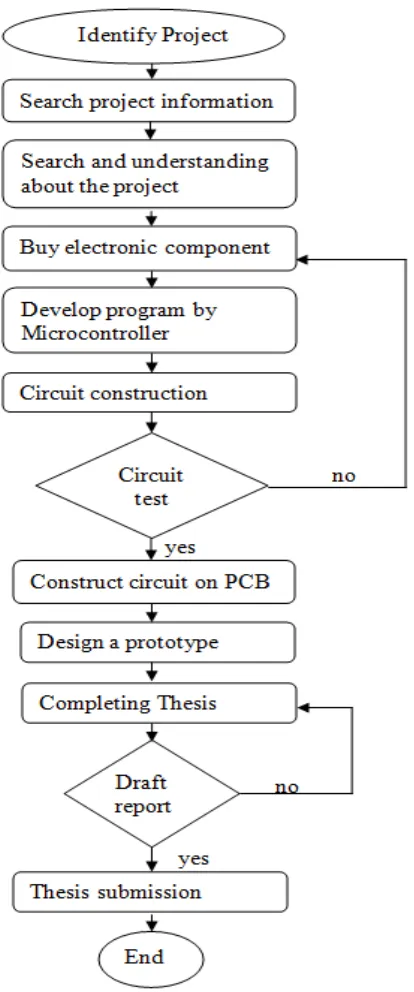
1.1 Flow Chart for Project Methodology 5
2.1 Infrared Light 9
2.2 Modulation signal 9
2.3 Transmit infrared signal 11
2.4 Transmitter with emitter follower 12
2.5 Block diagram of IR receiver 12
2.6 IR Transmitter 13
2.7 Remote control decoder for up to 20 subaddresses with 6 + 1-bit parallel
outputs (RECS80 code). 14
2.8 Receiver Circuit 15
2.9 Digital Room Thermometer Circuit 16
2.10 Temperature Circuit 17
2.11 Motor Circuit 19
2.12 PIC burner 24
2.13 PIC16F877A 25
xiii
2.15 DS 1820 Pin Assignment 28
2.16 Liquid Crystal Display (LCD) 30
3.1 Flowchart of project methodology 33
3.2 Continue from flowchart of project methodology 34 3.3 Several components that related to circuit project 36
3.4 Ultra Violet ray exposure 37
3.5 Developer 38
3.6 Etching Equipment 39
3.7 Cutting PCB board 40
3.8 Drilling the PCB board 40
4.1 Motor Circuit 43
4.2 Temperature Circuit 44
4.3 Top view of Temperature Circuit 45
4.4 Bottom view of Temperature Circuit 45
4.5 Top view Motor Circuit 46
4.6 Top view of Transmitter Circuit 47
4.7 Bottom view of Transmitter Circuit 47
4.8 Top view of Receiver Circuit 48
xiv
7. LIST OF APPENDIX
APPENDIX A: DIFFERENCES OF TEMPERATURE SENSOR 53 APPENDIX B: GANTT CHART FOR FINAL YEAR PROJECT 54 APPENDIX C: TEMPERATURE CIRCUIT SOURCE CODE 55
APPENDIX D: MOTOR CIRCUIT SOURCE CODE 62
APPENDIX E: PIC 16F877A 64
APPENDIX F: DIFFERENCES BETWEEN PIC16F877 AND PIC16F877A 75
1
CHAPTER I
INTRODUCTION
1.1 Background Project
Ventilation systems are an integral part in the building. Ventilation is the process to refresh the environment in a room by reducing the temperature to improve the quality of air in the room. This system is designed to control the temperature in the room automatically.
2
1.2 Problem Statement
Ventilation systems in buildings controlled by centralized control systems. Therefore, the ventilation system cannot control the temperature in each room. Then the room temperature is always changing and sometimes drastic changes (eg days of rain or night). Thus, the environment is not comfortable as the temperature is very cold will take place on human life. Second, the controls are used at present by the people there are some unexpected things happen. For example, when a rainy day, the ventilation system will lower the temperatures by using the manual method and vice versa. For this reason, an automatic control system is needed.
1.3 Project objective:
Due to the problem statement stated above, it’s cleared that the objectives of the project is:
To develop and implement an automatic control ventilation system.
To design a smart and intelligent system of automatic control room temperature.
To build an accurate and sensitive circuit to control the room’s temperature according to any changes of temperature that user want.
3
1.4 Scope of work
There are several process was involved to complete this Smart Control Ventilation for Room. This system was consisting of several devices such as PIC, LCD display, Infrared connection and DC geared Motor.
Beside the hardware, there are two programs that used in the project. The software is Proteus Professional 6 and PIC C Compiler. Proteus Professional 6 is used to simulation of work and to design the circuit on PCB board. While PIC C Compiler is used to compile the C language code to HEX code so that it can be compatible with the PIC program.
The following shows all the circuit that applied in this project:
a. Transmitter and Receiver Circuit
This circuit was used to transmit the signal from user to the system. The Transmitter and Receiver Circuit was used infrared medium and the signal that has transmitted will receive and send to the PIC.
b. Temperature Circuit
4
c. Motor Circuit
Motor Circuit will run when it received signal from PIC Microcontroller. Motor will run backward or forward according the data that were received.
d. Power Supply Circuit
5
[image:19.595.223.430.170.666.2]1.5 Project Methodology
6
1.6 Project Outline
As provided in the format of the thesis, there are five chapters as whole. In the first chapter, it focuses on a brief introduction about the project being carried. Important things in this chapter is the problem statement, purpose and scope of the project objectives are emphasized in this section.
Chapter II is usually focused on the literature review, including relevant theory and previous work on the project described in this chapter. It discusses the theory of infrared remote control, IR range of reference, the reference temperature range and the microcontroller is used.
Chapter III consists of the project methodology. It also includes information on research and experiments conducted during the project development. This would explain the theory of concepts and principles used in order to complete the project. In this chapter, the function of each part used has been explained clearly.
Chapter IV consists of the results and analysis. It describes and details the components of focus for the project.
7
CHAPTER II
LITERATURE REVIEW
2.1 Introduction
Literature Review is important in each project as a base for gathering information necessary to complete the project. All information is gathered from various sources such as:-
1. Journal 2. Books
3. Conference Transcript 4. Thesis
8
After searching through all this various material, all information will be filtered to be related to Smart Control Ventilation System for Building. The information that will be focused on this chapter is about some reference circuit of automatic controlled room temperature and its main components that to be used.
2.2 IR Remote control theory
The cheapest way to remotely control a device within a visible range is via Infra-Red light. Almost all audio, video and temperature equipment can be controlled this way nowadays. Due to this wide spread use the required components are quite cheap, thus making it ideal for own projects. This part of knowledge base will explain the theory of operation of IR remote control, and some of the protocols that are in used in consumer electronics.
2.2.1 Infrared light
Infra-Red actually is normal light with a particular colour. Human cannot see this colour because the wave length of 950nm and it below the visible spectrum. That is one of the reasons why I choose the Infrared connection because human want to use it but they are not interested in seeing it. Another reason is because IR LEDs are quite easy to find, and it is was be very cheap.
2.2.2 Modulation
Modulation is the
With modulation signal
receiver will be tuned to that
attention.
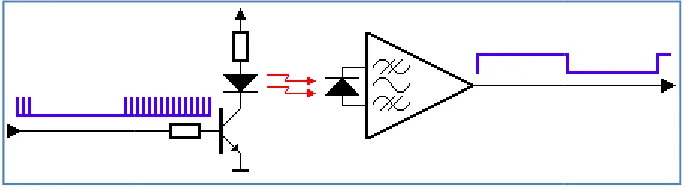
In the figure 2.2
the transmitter on the left side. The
other side.
In serial communication
'space' is the default signal, which is the off state in the transmitter case. No light is
emitted during the 'space' state. During the 'mark'
[image:23.595.196.472.103.242.2]pulsed on and off at a particular frequency. Frequencies between 30kHz and 60kHz
Figure 2.1: infrared light
Modulation is the best answer to make the signal stand out above the noise. signal, the IR light source blink in a particular frequency. The IR
ill be tuned to that frequency. This blinking as attracting the receiver's
Figure 2.2: Modulation signal
In the figure 2.2, the modulated signal was sending the signal into IR Led the transmitter on the left side. The signal was detected signal of the receiver at the
In serial communication, it were usually speak of 'marks' and 'spaces'. The 'space' is the default signal, which is the off state in the transmitter case. No light is
emitted during the 'space' state. During the 'mark' state of the signal the IR light is
pulsed on and off at a particular frequency. Frequencies between 30kHz and 60kHz 9
answer to make the signal stand out above the noise.
, the IR light source blink in a particular frequency. The IR
. This blinking as attracting the receiver's
was sending the signal into IR Led of
of the receiver at the
were usually speak of 'marks' and 'spaces'. The
'space' is the default signal, which is the off state in the transmitter case. No light is
state of the signal the IR light is
[image:23.595.148.491.435.530.2]10
are commonly used in electronics. At the receiver side a 'space' is represented by a high level of the receiver's output. A 'mark' is then automatically represented by a low level.
The real relationship between the 'marks' and 'spaces' and the 1-s and 0-s depends on the protocol that is being used.
2.2.3 Transmitter
The transmitter usually is a battery powered handset. It was consume as little power, and the IR signal should also be as strong as possible to achieve an acceptable control distance.
Many circuit are designed to be used as IR transmitters. Nowadays, very low power microcontrollers are used in IR transmitters and the reason that, they are more flexible in their use. When no button is pressed, the circuit are in a very low power sleep mode, in which hardly any current is consumed. The processor wakes up to transmit the appropriate IR command only when a key is pressed.
Quartz crystals are seldom used in such handsets. They are very fragile and tend to break easily when the handset is dropped. Ceramic resonators are much more suitable, because they can withstand larger physical shocks.