The Development of Vegetable Value Chains Integrated with Community
Capacity – An Initial Study in the Southern Philippines
J. Cavaye, G. Palaniappan and O. Nicetic S. Concepcion
The University Queensland University of the Philippines, Mindanao, Gatton, Queensland, Australia Davao, The Philippines
A. Abamo B. Aspera
Visayas State University Landcare Foundation of the Philippines Baybay City, The Philippines Manila, The Philippines
P. Nuevo
University of the Philippines, Los Banos, The Philippines
Keywords: market opportunity, smallholders, poverty, vegetable value chains
Abstract
This study involved smallholders in assessing and prioritising potential improvements to value chains and opportunities for associated improvements in community capacity and sustainability. While value chain development is relatively well-known, the contribution of improved value chains to sustainable improvements in smallholder livelihoods and the function and capacity of rural communities is unclear. Also the capacity and function of communities is likely to influence the development of value chains. The study investigated value chains for five vegetables: eggplant (Solanum
melongena L.), tomato (Solanum lycopersicum L.), sweet pepper (Capsicum annuum L.),
ampalaya (Momordica charantia L.) and leafy vegetables. It identified community issues and the circumstances of smallholders and local community capacity at five sites - Leyte, Bohol, Samar, Misamis Oriental and Davao. Group discussions and interviews were conducted and data collected on community and value chain characteristics. The study found that smallholders face a range of logistic, economic and commercial barriers to the effective marketing of vegetables including poor post-harvest handling, poor roads, lack of consumer feedback and inconsistent supply. Many farmers also lacked resources to buy seeds and other inputs and borrowed money at high interest from wholesalers to fund basic farm operations. Key community issues were internal migration affecting the structure and function of communities, inability to afford to send children to school consistently, lack of access to health and other services and malnutrition especially among children. Three value chains were identified as priorities for development - supermarket-led, wholesaler -led and farmer cluster-led. Increased smallholder income was likely to lead to long term community benefits with income was most likely to go towards sending children to school, improved health care and improvements to housing and living conditions. It would also be invested in farm inputs such as seed and fertiliser and in reducing debt. Communities can support value chains through improved organisation and leadership.
INTRODUCTION
Smallholder vegetable farmers face many production, logistic and economic difficulties. Production issues include poor soil fertility and productivity, lack of appropriate technologies, improper water and soil conservation management, the high cost of fertilizers and limited capital (Tulin et al., 2010). Lamban et al. (2011) have identified the relationship between the sustainability of natural resource use and the profitability of farming as a “major concern” (p.153) for smallholder vegetable farmers in the southern Philippines.
Smallholder farmers also face a lack of crop handling and post-harvest infrastructure including poor roads, poor storage facilities and lack of cool chain systems (Murray-Prior et al., 2006). Moreover, they operate within poorly developed marketing systems that provide no consumer feedback other than prices (Murray-Prior et al., 2006). Most smallholder vegetable farmers are unaware of the quantities of vegetables planted in their regions, their customers’ quality requirements, preferred varieties, the seasonality of production and the supply and demand situation in both domestic and export markets. Murray-Prior et al. (2006) describe vegetable chains as simple and dominated by the role of wet markets in transferring products from producers to consumers. Smallholders have little bargaining power with traders and wholesalers, receiving as little as 20-40% of the retail price of vegetables (Murray-Prior et al., 2006). Intermediaries at the processor and retail level in agricultural supply chains, can consolidate and exert power over smallholders (Digal and Concepcion, 2008). Individual small farmers face significant disadvantages in meeting the large volume and quality demands of institutional buyers.
Smallholders are subject to the economic consequences of these poor marketing systems, poor quality product and inconsistencies in supply (Murray-Prior et al., 2006¸ Axalan et al., 2011). Poor product quality and inconsistent supply limit smallholder participation in institutional markets and supermarket chains where they face unfavourable terms of payment and penalties due non-compliance (Batt, 2007; Batt and Concepcion, 2011). These factors combine to contribute to farmers being chronically poor (average income <USD$1400/year), leading to rural communities with high rates of poverty (national average of 25%), and low food security compounded by low levels of education and inadequate health care (Virola, 2009; UNDP, 2012).
There is a major opportunity to enhance vegetable value chains to improve product value throughout the chain and improve smallholder income. Total national vegetable consumption is increasing at 1.6% per annum (Digal and Montemayor, 2007; FAO, 2007) which is associated with a rise in average household incomes (Batt, 2007). There is increasing demand for fresh produce from consumers with rising incomes, greater consciousness of the health benefits of fruit and vegetables, and more retail competition from modern supermarkets. A key priority of the Philippines Development Plan (PDP) 2011-2016 is to strengthen linkages between farmers and the agribusiness sector. The plan particularly focuses on the participation of poor farmers in markets through strengthening human capital and improved income opportunities, particularly value chain approaches (National Economic and Development Authority, 2011).
While value chain development is relatively well-known, the contribution of improved value chains to sustainable improvements in smallholder livelihoods and the function and capacity of rural communities is unclear. It is not clear how the development of value chains is supported by local communities such as how farmers organise, cooperate, access information and share knowledge to improve. There is also little information about how the benefits of value chain improvements may lead to sustainable community improvements such as enhanced community capacity, infrastructure, organisation, leadership and services.
for communities including increased profitability, improved institutional linkages, and the expansion of small enterprises and the empowerment of women. The survival of clusters depends largely on social factors including the level and effectiveness of cluster collaboration, commitment, leadership, communication, collective decision making and institutional support (Digal and Concepcion, 2008; Montiflor et al., 2008; Batt et al, 2010; Axalan et al. 2011).
Research was conducted to identify opportunities for improvements to vegetable value chains and to identify what community benefits may be derived from enhanced value chains. Interventions to improve value chains and community capacity are the subject of ongoing research not reported in this paper.
METHODOLOGY
The study assessed value chains and community characteristics using a set of qualitative methods - focus group discussions, semi structured interviews, observations of community meetings and relationship mapping. These methods were conducted across 5 sites involving 10 communities - Davao (Saloy and Kahusayan), Bohol (Pilar, Bilar, Calape and Sierra Bullones), Misamis Oriental (Barangay Luna and Barangay Tambobo-an), Samar and Leyte. Information gained about value chains included methods of marketing, volume of vegetables and communication between market segments. Information gained about community characteristics included demographics, community issues, community organisation and options to benefit from improved value chains. Participants ranked issues by compiling individual ranking scores.
At community sites, input was gained from smallholder farmers with the following numbers of participants in each community – Saloy (21), Kahusayan (8), Pilar (15), Bilar (10), Calape (18) and Sierra Bullones (12), Barangay Luna(10), Barangay Tambobo-an (10), Samar (6) and Leyte (6). Scoping discussions were also conducted with other key informants including municipal government officials (20), Department of Agriculture staff (30), university researchers (15), a Church leader (1) and private organisation staff (7).
Sites were selected using that criteria that mostly smallholder farmers were present, farmers were vegetable growers supplying to markets, areas were established productive vegetable areas, willingness to change and access to villages. Dialogue with participants during interviews and discussions were conducted in local language, Tagalog, and recorded in field diaries. They were then transcribed and translated to English.
Value Chain Analysis
In addition to community discussions of value chains, current supply chains and market opportunities for five vegetables, eggplant (Solanum melongena L.), tomato (Solanum
lycopersicum L.), sweet pepper (Capsicum annuum L.), ampalaya (Momordica charantia L.)
and leafy vegetables were assessed at four sites – Davao, Bohol, Samar and Ormoc. A rapid appraisal based on a ‘walking the chain’ approach (Collins and Dunne, 2008) was conducted. Semi-structured interviews were carried out with participants in vegetable supply chains including farmers and collectors (9), wholesalers (14), retailers (11) and consumers (21). Marketing information such as volume of vegetables marketed, estimated losses, yield estimates, price etc. was collated and included with interview responses.
Secondary data
production systems, the current marketing situation and possible community implications of enhanced value chains.
Data Analysis
Notes which recorded feedback from participants across all methods were collated for each site. These site notes were then compiled across sites. Notes were systematically reviewed for common points and themes related to four topics - existing value chains, existing community issues, opportunities to improve value chains, and likely improvements to communities from improved value chains. Key points were collated under these topics and other points and themes were also identified.
RESULTS
Vegetable Value Chains
The value chain aspect of the study showed that there were many problems in vegetable supply chains, including high wastage (due to pests, diseases, transport damage, improper packing, grading and sorting), lack of supply and inconsistent quality. These problems were mainly associated with two issues in the chain. Firstly, at the upstream end of the chain, collectors and wholesalers faced difficulty working with small independent farmers who produced limited volumes of variable quality and inconsistent supply. These farmers often struggled with lack of irrigation, lack of knowledge of production systems and lack of access to resources such as credit.
Secondly, at the business-to-business level, the relationship between buyers and sellers was largely transactional and focused on price negotiation. As a result, there was no coordination or cooperative effort between buyers and sellers (such as wholesalers and retailers) on how to deal with wastage, inconsistent supply, or problems with grading, sorting and packing. This meant that there was no coordination in the chain to create value for consumers.
Many of the issues identified cannot be solved by simply enhancing cooperation between buyers and sellers in dyadic relationships. Rather, solutions will require coordination and cooperation among all members of the chain to increase production, improve quality, reduce wastage and cut costs. Hence, any intervention to link smallholder farmers with their markets should incorporate whole-of-chain management models with a focus on value creation for consumers, and subsequent benefits to other chain members.
The study identified three possible whole chain management models that could each rely on a different chain leader. They are 1) supermarket as chain leader, 2) wholesaler as chain leader, and 3) a large farmer or a farmer cluster as chain leader.
Community Capacity
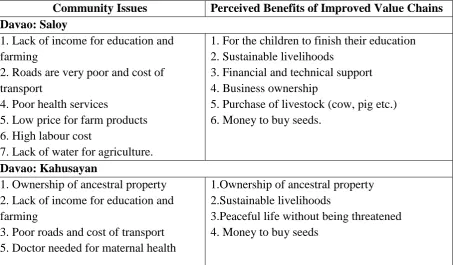
The existing community issues raised by respondents are shown in Table 1. The issues were very consistent across all sites but they were ranked in different order in different locations. The most common priorities across all sites were lack of education, poor transport and road infrastructure, high costs of production, debt and lack of access to finance, unemployment and lack of access to services, particularly health services (Table 1).
major post-harvest handling losses, increased costs and limited relationships between farmers and other value chain participants.
Social connections between smallholders and other participants in value chains were limited by power arrangements, poor transport, lack of confidence and awareness and a tradition of selling in wet markets. Interaction between smallholders was supported by organisations and activities such as Farmer Field Schools (FFS), Rural Improvement Clubs (RIC) and development institutions like Catholic Relief Services (CRS).
The key benefits of improved value chains identified by respondents in the various communities is summarised in Table 1. Income was most likely to go towards sending children to school, improved health care and improvements to dwellings and living conditions. It would also be invested in buying farm inputs such as seed and fertiliser and reducing debt.
DISCUSSION
The issues identified in communities are consistent with previous findings. The high priority given to the education of children is considered as an investment so that children can earn higher incomes and support their families (Yamauchi and Tiongco, 2013). A consequence of high fertility in rural poor countries has resulted in too little family income to invest in children (Petrou and Kupek, 2010).
The availability and cost of farm inputs and inadequate credit facilities are limitations for small farmers which have been reported by Balisacan (2011). Inadequate roads are a major constraint for small farmers increasing their cost of production and limiting their access to markets (Olsson, 2009). Ensuring access to health care is an important persistent concern in the Philippines. The climate, topography and other spatial factors affect the pace of communities towards human development targets (Collas-Monsoda and Ducanes, 2004).
Many of the social issues raised represent societal marginality where people are marginalised by their underlying social conditions. This includes limited livelihood options including poor infrastructure, lack of skills and restricted employment opportunities. Participants also emphasised being marginalised due to lack of power to alter their situation, lack of access to ancestral lands and little participation in public decision-making.
Smallholders perceived that the potential community impacts of improved value chains were not only through the possibility of improved smallholder income, but also through improved leadership, skills, organisation and confidence from participation in value chains. This is consistent with community development principles and approaches (Ife and Tesoriero, 2006). It illustrates the connection between communities and value chains and supports Hinrichs (2000) who showed clear links between agricultural markets and community involvement.
CONCLUSION
ACKNOWLEDGEMENTS
The authors wish to acknowledge participants who agreed to participate in the study. The financial support of the Australian Centre for International Agricultural Research for this research is gratefully acknowledged.
Literature cited
Balisacan, A.M. 2011. What has really happened to poverty in the Philippines? New measures, evidence, and policy implications, University of the Philippines School of Economics.
Australian Centre for International Agricultural Research 2012. Philippines Annual Operational Plan 2012–13.
Axalan, J., Israel, F., Concepcion, S., Batt, P., Murray-Prior, R., and Loma, L. 2011. Socio-economic impact of cluster marketing: the case of Ned Landcare Association sweet pepper cluster. Acta Horticulturae 895: 37-44.
Batt, P. J. 2007. The Vegetable Industry in the Philippines, Australian Centre for International Agricultural Research, Canberra.
Batt, P., Concepcion, S., Murray-Prior, R. and Israel, F. 2010. Experiences in linking smallholder vegetable farmers to the emerging institutional market in the Philippines. ISHS 28th International Horticultural Congress, Lisboa Conference Centre, Portugal, August 22-27, 2010.
Batt, P. J. and Concepcion, S. B. 2011. Enhanced profitability of selected vegetable value chains in the Southern Philippines;Component 4: Value Chain Analysis. Australian Centre for International Agricultural Research, Canberra.
Collas-Monsoda, S. and Ducanes, G. M. 2004. Philippines’ progress towards the millennium development goals: geographical and political correlates of subnational outcomes. Journal of Human Development, 5: 121–149.
Collins, R. and Dunne, A. 2008. A rapid supply chain appraisal approach for agribusiness development projects, Acta Horticulturae 794: 73-79.
Digal, L. and Montemayor, R. 2007. The Philippines Vegetable Industry: Trends, issues and policy implications. International Federation of Agricultural Products (IFAP) on the Participation of Producers in Dynamic Agri-Food Chains: A Program of Support to Producer Organizations (Asia Component), September 2006 - 2007.
Digal, L. and Concepcion, S.B. 2008. Small Producer Groups in Restructuring Philippine Vegetable Industry. II International Symposium on Improving the Performance of Supply Chains in the Transitional Economies. Acta Horticulturae 794: 99-107.
Food and Agriculture Organisation 2007. FAO Statistics (Faostat), www.fao.org. Hinrichs, C. C. 2000. "Embeddedness and Local Food Systems: Notes on Two Types of
Direct Agricultural Markets. J. of Rural Studies. 16(3):295–303
Ife, J., and F. Tesoriero. 2006. Community Development: Community-based Alternatives in an Age of Globalisation. Third Edition. Sydney, NSW: Pearson Education Australia. Lamban, A., dela Cerna, A., Montiflor, M., Bacus, R., Concepcion, S., Batt, P., and Prior, R.
2011. Factors affecting farmers’ adoption of natural framing technologies in New Albay, Maragusan, Compostela Valley, Philippines. Acta Horticulturae 895:153-161.
Montiflor, M., Batt, P. and Murray-Prior, R. 2008. Cluster farms in Mindanao: Are smallholder farmers’ expectations being fulfilled? Banwa, 8 (2): 39-54.
Murray-Prior, R., Batt, P., Rola-Rubzen, F., McGregor, M., Concepcion, S., Rasco, L., Digal, L., Montiflor, M., Hualda, L., Migalbin, L., and Manalili, N. 2006. Global value chains: a place for Mindanao producers? Acta Horticulturae 699:307-315.
Olsson, J. 2009. Improved road accessibility and indirect development effects: evidence from rural Philippines. J. of Transport Geography 17:476-483.
Petrou, S. and Kupek, E. 2010. Poverty and childhood undernutrition in developing countries: A multi-national cohort study. Social Science and Medicine, 71:1366-1373.
Rapusas, R. 2008. Linking farmers to market: some success stories in the Philippines. In: Linking farmers to market: some success stories from Asia-Pacific Region, Asia-Pacific Association of Agricultural Research Institutions (APAARI), FAO Regional Office for Asia and the Pacific (FAO RAP), Bangkok, Thailand.
Tulin, A.B., Quinones, C.M., Rallos, R., Mercado, A., Salvani, J., Lapoot, C., Justo, V., and Dorahy, C. 2010. Evidence-based nutrient management strategy in identifying fertility status and soil constraints for vegetable production in the southern Philippines. Proc. of the 19th World Congress of Soil Science, Soil Solutions for a Changing World, Brisbane Australia 1-6 August.
United Nations Development Programme. 2012. Achieving the MDGs and Reducing Human Poverty
Virola, R. A. 2009. National Statistics. Makati City, Philippines: National Statistical Coordination Board.
Yamauchi, F. and Tiongco, M. 2013. Why women are progressive in education? Gender disparities in human capital, labor markets, and family arrangement in the Philippines. Economics of Education Rev. 32:196-206.
[image:7.595.72.526.493.758.2]Table
Table 1. A summary of community issues and potential benefits from improved value chains in each community (priority ranked)
Community Issues Perceived Benefits of Improved Value Chains Davao: Saloy
1. Lack of income for education and farming
2. Roads are very poor and cost of transport
4. Poor health services
5. Low price for farm products 6. High labour cost
7. Lack of water for agriculture.
1. For the children to finish their education 2. Sustainable livelihoods
3. Financial and technical support 4. Business ownership
5. Purchase of livestock (cow, pig etc.) 6. Money to buy seeds.
Davao: Kahusayan
1. Ownership of ancestral property 2. Lack of income for education and farming
3. Poor roads and cost of transport 5. Doctor needed for maternal health
1.Ownership of ancestral property 2.Sustainable livelihoods
Bohol Island: Pilar 1. Unemployment 2. Malnutrition
3. Poor school attendance
4. Lack of access to certified seeds and water
5. Poor infrastructure, roads and transport
6. High household costs
1.Improved nutrition 2.Greater income
3.More school attendance 4. Better health care
Bohol Island: Sierra Bullones
1. Poor access and affordability of seeds 2. Labour costs
3. Poor roads and transport
4. Middlemen obtain about 50% of crop value
5. Lack of post-harvest storage or refrigeration
1. Improved production for own consumption 2. More fresh vegetables in the local diet 3. Greater assurance of quality and safety 4. More resources to educate children 5. Assist neighbours and the Barangay
Bohol Island: Calape
1. Lack of education and training 2. Unemployment
3. Poor roads – postharvest damage 4. Tenant farmers - 25% share to landowners
5. Lack of irrigation and cost of carrying water
1. Improved income – educate children 2. Increased employment on farms 3. Sell products to urban areas
4. Better nutrition -reduced malnutrition 5. Avoiding or reducing debt
Bohol Island: Bilar
1.School leavers have skills but can’t find a job
2.Most people have limited education and skills
3.High levels of debt for some people 4. High cost of farm inputs
5.Lack of irrigation for all farms 6. Training to improve skills e.g. organics
1. Improved income – educate children 2. Supply and quality of fresh vegetables 3. Revenue for local government and projects 4. Reduced debt and borrowing
5. Improved roads
6. Fewer young people not attending school
Misamis Oriental: Barangay Luna, Claveria 1. No support for marketing produce
2. Poor roads from farm to market 3. Poor local market
4. High cost of farm inputs
5. No money for children’s education 6. Lack of capital for farming
Misamis Oriental: Barangay Tambobo-an, Claveria 1. No support for marketing their
produce
2. No roads from farm to market 3. No money for children’s education
1. Having a peaceful community 2. No drug addiction
3. May become a town with more shops
Samar: Catbalogan 1. Limited area for planting 2. Theft of produce
3. Poor school facilities
1. Education children for stable employment 2. Malnutrition addressed
Leyte: Department of Agriculture 1. Illicit drugs
2. Child labour
3. Lack of income to send children to school
4. Lack of sanitation 5. Health – malnutrition