Contents lists available atScienceDirect
Marine Policy
journal homepage:www.elsevier.com/locate/marpol
An appeal for a code of conduct for marine conservation
Nathan J. Bennett
a,b,c,⁎, Lydia Teh
d, Yoshitaka Ota
d, Patrick Christie
b,e, Adam Ayers
f, Jon C. Day
g,
Phil Franks
h, David Gill
i, Rebecca L. Gruby
j, John N. Kittinger
k,x, J. Zachary Koehn
l,
Nai
‘
a. Lewis
m, John Parks
n, Marjo Vierros
o, Tara S. Whitty
p, Aulani Wilhelm
k,m, Kim Wright
q,
Jaime A. Aburto
r, Elena M. Finkbeiner
c,s, Carlos F. Gaymer
r, Hugh Govan
t,y, Noella Gray
u,
Rebecca M. Jarvis
v,w, Maery Kaplan-Hallam
a, Terre Satter
fi
eld
aaInstitute for Resources, Environment and Sustainability, University of British Columbia, Canada
bSchool of Marine and Environmental Affairs, University of Washington, USA cCenter for Ocean Solutions, Stanford University, USA
d Nereus Program and Institute for Oceans and Fisheries, University of British Columbia, Canada
eHenry M. Jackson School of International Studies, University of Washington, USA
fJoint Institute for Marine and Atmospheric Research (JIMAR), NOAA Pacific Islands Fisheries Science Center, USA gARC Centre for Coral Reef Studies, James Cook University, Australia
hInternational Institute for Environment and Development (IIED), London, UK
iLuc Hoffmann Institute, World Wildlife Fund International, Switzerland & National Socio-Environmental Synthesis Center (SESYNC), University of Maryland, USA jDepartment of Human Dimensions of Natural Resources, Colorado State University, USA
kCenter for Oceans, Conservation International, USA
lSchool of Aquatic and Fishery Sciences, University of Washington, USA
mBig Ocean
nMarine Management Solutions, USA
oCoastal Policy and Humanities Research, Canada
pCenter for Marine Biodiversity and Conservation, Scripps Institution of Oceanography, University of California San Diego, USA
qCoastal, Marine and Island Environments Program, Indigenous and Community Conserved Areas (ICCA) Consortium, Canada
rMillennium Nucleus for Ecology and Sustainable Management of Oceanic Islands (ESMOI), Universidad Católica del Norte, Chile
s Hopkins Marine Station, Stanford University, USA
tLocally-Managed Marine Area Network, Fiji
uDepartment of Geography, University of Guelph, Canada
vInstitute for Applied Ecology New Zealand, School of Science, Auckland University of Technology, New Zealand
wSydney Institute of Marine Science, Australia
xCenter for Biodiversity Outcomes, Julie Ann Wrigley Global Institute of Sustainability, Arizona State University, USA
ySchool of Government, Development & International Affairs (SGDIA), University of the South Pacific (USP), Fiji
A R T I C L E I N F O
Keywords: Marine conservation Code of conduct Environmental governance Environmental management Conservation planning Conservation social science
A B S T R A C T
Marine conservation actions are promoted to conserve natural values and support human wellbeing. Yet the quality of governance processes and the social consequences of some marine conservation initiatives have been the subject of critique and even human rights complaints. These types of governance and social issues may jeopardize the legitimacy of, support for and long-term effectiveness of marine conservation. Thus, we argue that a clearly articulated and comprehensive set of social standards - a code of conduct - is needed to guide marine conservation. In this paper, we draw on the results of an expert meeting and scoping review to present key principles that might be taken into account in a code of conduct, to propose a draft set of foundational elements for inclusion in a code of conduct, to discuss the benefits and challenges of such a document, and to propose next steps to develop and facilitate the uptake of a broadly applicable code of conduct within the marine conservation community. The objectives of developing such a code of conduct are to promote fair conservation governance and decision-making, socially just conservation actions and outcomes, and accountable conservation
practi-http://dx.doi.org/10.1016/j.marpol.2017.03.035
Received 1 February 2017; Received in revised form 27 March 2017; Accepted 27 March 2017
⁎Corresponding author.
E-mail addresses:[email protected](N.J. Bennett),[email protected](L. Teh),[email protected](Y. Ota),[email protected](P. Christie),
[email protected](A. Ayers),[email protected](J.C. Day),[email protected](P. Franks),[email protected](D. Gill),[email protected](R.L. Gruby), [email protected](J.N. Kittinger),[email protected](J.Z. Koehn),[email protected](N. Lewis),[email protected](J. Parks),[email protected](M. Vierros), [email protected](T.S. Whitty),[email protected](A. Wilhelm),[email protected](K. Wright),[email protected](J.A. Aburto),
[email protected](E.M. Finkbeiner),[email protected](C.F. Gaymer),[email protected](H. Govan),[email protected](N. Gray),[email protected](R.M. Jarvis), [email protected](M. Kaplan-Hallam),terre.satterfi[email protected](T. Satterfield).
tioners and organizations. The uptake and implementation of a code of conduct would enable marine conservation to be both socially acceptable and ecologically effective, thereby contributing to a truly sustainable ocean.
1. Marine conservation: In need of a social standard
Action is needed to conserve and manage the marine environment in order to maintain healthy ecosystems and human wellbeing. This is particularly true in a world with mounting anthropogenic threats, including overfishing, pollution, coastal population growth, biodiver-sity loss, habitat destruction and climate change [1–3]. The interna-tional community has responded by pushing for increased marine conservation and management. Notable examples include the Conven-tion on Biological Diversity (Aichi Target 11) and United NaConven-tions Sustainable Development Goals (Goal 14)[4,5]. Both platforms articu-late targets of 10% protection of marine and coastal areas in marine protected areas (MPAs) by 2020. In a motion approved at the recent 2016 World Conservation Congress in Honolulu, the International Union for the Conservation of Nature (IUCN) is advocating for an even more ambitious goal of 30% coverage in MPAs (See: https://portals. iucn.org/congress/motion/053). Some conservation organizations are even promoting a goal of 50% through the Nature Needs Half move-ment[6,7]. Indeed, marine conservation targets, supported by regional initiatives and national efforts, have led to a significant increase in the scope and scale of marine conservation efforts globally[8]. Further, MPAs are just one tool in a suite of marine conservation and manage-ment actions –e.g.,fisheries management, ecosystem-based manage-ment, marine spatial planning, nature-based adaptation measures, blue carbon projects, etc. - that are being promoted and implemented around the world in response to resource degradation, climate change and scarcity.
Yet in the push to rapidly increase marine management and conservation interventions with the aim of reversing downward envir-onmental trends[8,9], there is a real danger that the marine conserva-tion community may promote acconserva-tions that are socially unjust or inappropriate. Past research has demonstrated unsatisfactory govern-ance and decision-making processes and unintended negative social consequences that can occur in the creation of terrestrial protected areas in a variety of different settings[10–12]. Such critical reviews of conservation practice have documented a lack of consultation, physical displacement, perpetration of violence, cultural disruption, social marginalization, loss of livelihoods, and increased poverty. Recently, the UN Rapporteur of the Human Rights Council recently released a report on human rights violations related to conservation of terrestrial biodiversity[13].
While these types of issues have been long recognized in terrestrial conservation, there is evidence of similar problems occurring in some marine conservation initiatives. For example, recent accounts have documented marine conservation initiatives that lack consultation or consent prior to implementation[14–16], fail to account for the rights and needs of local people [17–19], physically displace communities [20,21], produce inequitable social impacts[22–24], disempower local communities [25,26] and undermine traditional and functioning re-source management regimes[27]. These issues have led some scholars and practitioners to question whether some marine conservation initiatives should be labeled as a form of “ocean grabbing” when governance processes are poor or when rights and resources are taken from small-scale fishers, indigenous peoples, and/or coastal commu-nities[28,29].
Issues such as these can produce several well-documented chal-lenges for conservation. First, some actions might be deemed unjust or unlawful, which might lead to complaints to human rights bodies or lengthy court battles [13,17]. Actions that contravene fundamental human rights or ignore indigenous rights in the name of marine
conservation are not only unacceptable, they are also counter-produc-tive. Second, for conservation funders and NGOs, these critiques also pose a significant risk to the “brand”of organizations and the social license of conservation[12,30]. This can lead to justifiable activism against individual NGOs or conservation by local communities, indi-genous groups or small-scale fisheries organizations, or in global conservation fora[29,31–33]. Third, there is the risk that unacceptable governance, actions or impacts will produce local opposition, slow progress towards targets, and, ultimately, undermine the effectiveness and success of marine conservation[14,23].
We recognize that there are numerous examples of positive marine conservation initiatives that incorporate participatory planning pro-cesses [34–37], that have taken into account social and cultural considerations[38,39], that consider livelihoods and are co-managed [40–43], that recognize local and indigenous community initiatives to conserve local resources[25,35,44], and that have produced positive social outcomes to the benefit of natural resource management efforts [45–48]. Furthermore, generally speaking, there is good will within the international community to consider the concerns and needs of people when designing conservation actions. Marine conservation is often motivated by both ecological and social concerns[49]. There is also increasing attention to good governance [50,51] and the human dimensions of marine conservation [39,42,52,53]. Yet, overall, it is difficult to determine the extent to which past marine conservation processes and actions have been inclusive and just in practice. To improve the quality of governance, the social benefits and the success of marine conservation efforts, we feel it is justified and important for there to be a solid and defensible foundational platform for future action.
Thus, rather than dwell on past mistakes, we issue a call to action and propose a way forward to reduce the occurrence of poor govern-ance and negative impacts in future efforts to achieve marine con-servation objectives. Specifically, we argue that there is a well-recognized gap and need for a code of conduct to guide the actions of all members of the marine conservation community. This is exemplified by the increasing number of individuals and organizations–including local communities, practitioners, academics and NGOs - that are calling for a foundational set of guiding principles or social standards to guide conservation practitioners [28,54–56]. Notably, one outcome of a recent global Think Tank on the Human Dimensions of Large Scale Marine Protected Areas – attended by more than 125 scholars, practitioners, funders and managers from around the world - was a call by a group of those present for the development of such a code of conduct for marine conservation [57,58]. Many other professions, including doctors, lawyers, engineers, accountants and teachers, have codes of conduct to establish afirm foundation for practice. However, there is no similar social standard or mechanism to guide the actions of individual conservation practitioners, organizations or governments or to hold them accountable. AHippocratic Oathis needed for conserva-tion.
2. Towards a code of conduct for marine conservation
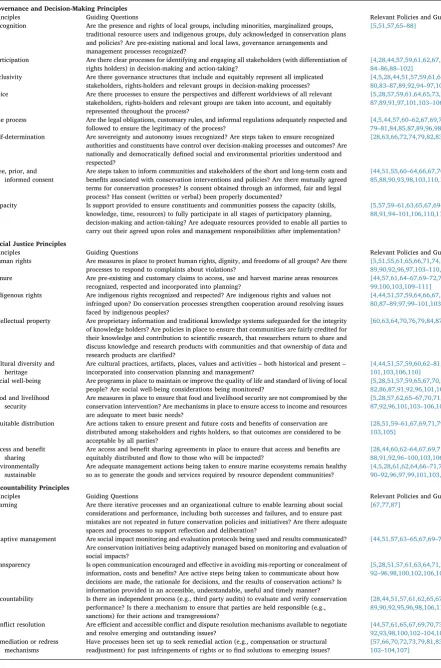
Table 1
Review of key principles, guiding questions and reference documents for a code of conduct for conservation.
Governance and Decision-Making Principles
Principles Guiding Questions Relevant Policies and Guidelines
Recognition Are the presence and rights of local groups, including minorities, marginalized groups, traditional resource users and indigenous groups, duly acknowledged in conservation plans and policies? Are pre-existing national and local laws, governance arrangements and management processes recognized?
[5,51,57,65–88]
Participation Are there clear processes for identifying and engaging all stakeholders (with differentiation of rights holders) in decision-making and action-taking?
[4,28,44,57,59,61,62,67,68,70–75,77–79, 84–86,88–102]
Inclusivity Are there governance structures that include and equitably represent all implicated stakeholders, rights-holders and relevant groups in decision-making processes?
[4,5,28,44,51,57,59,61,63–65,69–71,77,79, 80,83–87,89,92,94–97,100,101,103–105] Voice Are there processes to ensure the perspectives and different worldviews of all relevant
stakeholders, rights-holders and relevant groups are taken into account, and equitably represented throughout the process?
[5,28,57,59,61,64,65,73,74,77,79–81,83–85, 87,89,91,97,101,103–106]
Due process Are the legal obligations, customary rules, and informal regulations adequately respected and followed to ensure the legitimacy of the process?
[4,5,44,57,60–62,67,69,70,72,74,76,77, 79–81,84,85,87,89,96,98,100–104,107,108] Self-determination Are sovereignty and autonomy issues recognized? Are steps taken to ensure recognized
authorities and constituents have control over decision-making processes and outcomes? Are nationally and democratically defined social and environmental priorities understood and respected?
[28,63,66,72,74,79,82,83,87,105,109]
Free, prior, and informed consent
Are steps taken to inform communities and stakeholders of the short and long-term costs and benefits associated with conservation interventions and policies? Are there mutually agreed terms for conservation processes? Is consent obtained through an informed, fair and legal process? Has consent (written or verbal) been properly documented?
[44,51,55,60–64,66,67,70,72,73,79,82,84, 85,88,90,93,98,103,110,111]
Capacity Is support provided to ensure constituents and communities possess the capacity (skills, knowledge, time, resources) to fully participate in all stages of participatory planning, decision-making and action-taking? Are adequate resources provided to enable all parties to carry out their agreed upon roles and management responsibilities after implementation?
[5,57,59–61,63,65,67,69–71,74,78,84,86, 88,91,94–101,106,110,112,113]
Social Justice Principles
Principles Guiding Questions Relevant Policies and Guidelines
Human rights Are measures in place to protect human rights, dignity, and freedoms of all groups? Are there processes to respond to complaints about violations?
[5,51,55,61,65,66,71,74,76,79–84,86,87, 89,90,92,96,97,103–110,114–116] Tenure Are pre-existing and customary claims to access, use and harvest marine areas resources
recognized, respected and incorporated into planning?
[44,57,61,64–67,69–72,74,79,87,90,92,93, 99,100,103,109–111]
Indigenous rights Are indigenous rights recognized and respected? Are indigenous rights and values not infringed upon? Do conservation processes strengthen cooperation around resolving issues faced by indigenous peoples?
[4,44,51,57,59,64,66,67,69–72,74,77,79, 80,87–89,97,99–101,103,109,110,117]
Intellectual property Are proprietary information and traditional knowledge systems safeguarded for the integrity of knowledge holders? Are policies in place to ensure that communities are fairly credited for their knowledge and contribution to scientific research, that researchers return to share and discuss knowledge and research products with communities and that ownership of data and research products are clarified?
[60,63,64,70,76,79,84,87,98,100–102]
Cultural diversity and heritage
Are cultural practices, artifacts, places, values and activities–both historical and present– incorporated into conservation planning and management?
[4,44,51,57,59,60,62–81,83,85–94,96–99, 101,103,106,110]
Social well-being Are programs in place to maintain or improve the quality of life and standard of living of local people? Are social well-being considerations being monitored?
[5,28,51,57,59,65,67,70,73,75,77–79,81, 82,86,87,91,92,96,101,103,105,110] Food and livelihood
security
Are measures in place to ensure that food and livelihood security are not compromised by the conservation intervention? Are mechanisms in place to ensure access to income and resources are adequate to meet basic needs?
[5,28,57,62,65–67,70,71,74,78,79,81–84, 87,92,96,101,103–106,109,112,117]
Equitable distribution Are actions taken to ensure present and future costs and benefits of conservation are distributed among stakeholders and rights holders, so that outcomes are considered to be acceptable by all parties?
[28,51,59–61,67,69,71,79,82,85–89,95–100, 103,105]
Access and benefit sharing
Are access and benefit sharing agreements in place to ensure that access and benefits are equitably distributed andflow to those who will be impacted?
[28,44,60,62–64,67,69,71,76,82,84,85,87, 88,91,92,96–100,103,106,109,110] Environmentally
sustainable
Are adequate management actions being taken to ensure marine ecosystems remain healthy so as to generate the goods and services required by resource dependent communities?
[4,5,28,61,62,64,66–71,73,74,77–79,87, 90–92,96,97,99,101,103,110,116,117]
Accountability Principles
Principles Guiding Questions Relevant Policies and Guidelines
Learning Are there iterative processes and an organizational culture to enable learning about social considerations and performance, including both successes and failures, and to ensure past mistakes are not repeated in future conservation policies and initiatives? Are there adequate spaces and processes to support reflection and deliberation?
[67,77,87]
Adaptive management Are social impact monitoring and evaluation protocols being used and results communicated? Are conservation initiatives being adaptively managed based on monitoring and evaluation of social impacts?
[44,51,57,63–65,67,69–71,73,88–90,93]
Transparency Is open communication encouraged and effective in avoiding mis-reporting or concealment of information, costs and benefits? Are active steps being taken to communicate about how decisions are made, the rationale for decisions, and the results of conservation actions? Is information provided in an accessible, understandable, useful and timely manner?
[5,28,51,57,61,63,64,71,73,77,79,85,87–90, 92–96,98,100,102,106,108,109,112,116]
Accountability Is there an independent process (e.g., third party audits) to evaluate and verify conservation performance? Is there a mechanism to ensure that parties are held responsible (e.g., sanctions) for their actions and transgressions?
[28,44,51,57,61,62,65,67,69–71,73,79,87, 89,90,92,95,96,98,106,116,117]
Conflict resolution Are efficient and accessible conflict and dispute resolution mechanisms available to negotiate and resolve emerging and outstanding issues?
[44,57,61,65,67,69,70,73,79,83,85,87,89, 92,93,98,100,102–104,106,107,110,117] Remediation or redress
mechanisms
Have processes been set up to seek remedial action (e.g., compensation or structural readjustment) for past infringements of rights or tofind solutions to emerging issues?
Second, we convened meeting of experts as a side event at the IUCN 2016 World Conservation Congress in Honolulu, Hawaii to discuss acceptable and unacceptable processes and practices in the context of marine conservation. Our overall sample (n =18) for the meeting was opportunistic. We identified and invited scholars (n =12) and practi-tioners (n =6) involved in marine conservation and management who were already going to be present at the IUCN congress. During the meeting, which was facilitated by the lead author of this paper, we clarified the rationale for a code of conduct and the parties to whom the code would apply, brainstormed other relevant codes and international policy documents, discussed the aims and principles that might be included in a code of conduct, examined the potential benefits and challenges of a code of conduct, and explored next steps in the development and promotion of a code of conduct within the marine conservation community. Notes were taken during the workshop and later analyzed for key themes by the lead author of this paper. Third, to arrive at a summative list of principles, we conducted an inductive review of conservation policies and standards, foundational interna-tional policy documents from organizations such as the FAO, the United Nations, the CBD and the IUCN, and peer-reviewed literature as identified by the authors and workshop participants. This paper presents the results from both the expert meeting and scoping review.
2.1. Key principles and objectives
In convening this discussion, we recognized that there already exists a diverse set of codes of conduct or similar documents related to conservation that have emerged from different international policy contexts[59,60,61], that pertain to different scales from local to global [62,63]and that deal with specific concerns such as rights or culture [55,64]. However, a broadly applicable guidance document that identifies key responsibilities and accountabilities does not exist for marine conservation. Such a document would need to be relevant to the
diverse parties engaged in marine conservation–including researchers, governments, NGOs, private sector and local organizations– and to different types and scales of initiatives. It would need to consider distinct societal perceptions of and aspirations for the ocean, unique access regimes and ways that people interact with the ocean in various contexts, the trans-boundary nature of many marine resources, and the shared legacy and common responsibility associated with areas beyond national jurisdiction. The guiding responsibilities and accountabilities identified in the document would also need to apply to different processes associated with marine conservation (e.g., research, policy development, decision-making, management, public outreach/engage-ment), including at different stages within the process (e.g., prior to entry, during entry, in the planning phase, during implementation, in ongoing management and in monitoring and adaptation).
It was agreed that a primary focus of such a code of conduct is the key principles that should guide marine conservation actions. Key considerations that emerged from this policy and literature review ranged from fundamental concerns such as protection of basichuman rights [65,66] to more aspirational goals related to equity in the distribution of costs and benefits [4,60]. Drawing on the results of the expert meeting and the scoping review, we present a comprehensive list of the key principles that both experts and policy documents suggested ought to guide conservation. We present these principles along with a set of guiding questions and supporting references to key policy and guidance documents (Table 1). Most of the principles are well-recognized and developed concepts in international conventions and agreements, that many countries are signatory to, as well as in conservation policy documents (Appendix A).
Based on this review of principles and our discussions at the expert meeting at the World Conservation Congress, we also propose a draft set of objectives and recommendations that should be considered in the development of a marine conservation code of conduct (Box 1). Our draft proposal for a code of conduct includes three broad objectives–
Box 1
–Draft proposal of objectives and recommendations for a code of conduct for marine conservation, which will need to be reviewed, tested and refined by a broader group of stakeholders and practitioners.
Towards a Code of Conduct for Marine Conservation.
(Draft Objectives and Recommendations for Further Discussion and Development). I. Fair conservation governance and decision-making processes
•
Ensurerecognitionof and respect for the presence and rights of local communities, indigenous people, traditional users and marginalized populations.•
Facilitate decisions through participatory processes, which are inclusive of stakeholders and rights-holders and give equal voice – irrespective of gender, ethnicity, ability, age, language, religion, socioeconomic status or nationality.•
Followdue processand respect the right ofself-determinationfor sovereign nations and autonomous groups.•
Documentfree, prior and informed consent.•
Ensure availability of adequateresources and capacityto support collaboration during planning stages and in effective management. II. Socially-just conservation actions and outcomes•
Protect inherent and fundamentalhuman rights, dignity and freedoms.•
Recognize and respect localtenureandindigenous rightsto resources, traditional and cultural practices, including affirming existing areas and territories conserved and sustainably used by indigenous peoples and local communities.•
Protectintellectual propertyandcultural diversity and heritage.•
Consider the needs and aspirations of stakeholders and rights holders to maintain and make efforts to increasesocial wellbeing.•
Maintainfood and livelihood securityfor local people and communities.•
Promoteequitable distributionof benefits and costs, including fairaccess and benefit sharing agreements.•
Ensure that actions taken increaseenvironmental sustainabilityand the provisioning of ecosystem goods and services. III. Accountable conservation initiatives and organizations.•
Employ a process of planning, iterativelearningandadaptive managementbased on social considerations, including incorporating lessons from past mistakes in future initiatives.•
Commit to adhering to these principles and adopt a policy oftransparencyandaccountability that includes a system of downward accountability, independent auditing and graduated sanctions for transgressions.fair governance and decision-making, socially just actions and out-comes, and accountable organizations and initiatives. These three central objectives are supported by a set of recommendation statements that contain the principles (underlined terms) from the scoping review. We emphasize that this draft set of objectives, recommendations and principles should be further tested and refined by a community of practice through time.
2.2. The benefits and challenges of a code of conduct
We propose three primary benefits or applications for this set of objectives and guiding principles. First, as an educational or capacity building tool, the code can familiarize emerging conservation profes-sionals with the issues and inspire the next generation of conserva-tionists to engage with conservation in ways that are appropriate and mindful of differing social, cultural, economic and institutional contexts to facilitate more effective outcomes. Second, as a guidance document, the code would serve as a reference or set of guidelines for conservation organizations in order to promote more just and equitable conservation policies and practice. This would enable early and proactive engage-ment with appropriate actions rather than waiting and reacting when conflict arises. It might also serve as a reference for developing more context, project or organization specific codes of conduct. Finally, as an accountability mechanism, the code might form the basis of a set of measurable performance indicators that could be used to hold members (i.e., donors, NGOs, governments, researchers, individual practitioners) of the marine conservation community accountable for their actions. On this last point, we emphasize that there is currently a lack of reliable accountability mechanisms in conservation–in particular, for interna-tional conservation funders and NGOs who may lack sufficient over-sight[56,118]. Clear accountability is necessary to ensure legitimacy and social license. In short, the code of conduct might function as either “a carrot” (an incentive mechanism to encourage and reward good performance) or “a stick” (an enforcement mechanism to deter bad performance) depending on how it is operationalized. For example, communities might use a code of conduct as a reference either to proactively inspire appropriate conservation or reactively to hold conservation agencies and organizations accountable who are working in their area.
While there are clear benefits, we also recognize that there are some potential challenges. A code of conduct runs the risk of becoming a simple checklist that enables a“lowest common denominator” effect, whereby individuals or organizations only complete the minimum requirements. There is also the risk that conservation professionals will only abide by the outlined principles in the short term, instead of the sustained and continuous engagement that is required to build im-proved relations and increase the likelihood of conservation success. Finally, while a high-level code can provide generic guidance, con-servation professionals will likely need to test and validate or reconfi-gure these principles in different locales and sites. A result could be negotiation of local or regional codes that are mutually agreed with those implicated. Cognizant of these challenges, we emphasize that adapting these principles and ongoing monitoring is needed to ensure such a code of conduct is developed and applied in a way that is both legitimate and effective for different socio-political contexts.
2.3. The way forward: Developing, promoting and implementing a code of conduct
The initial workshop on the code of conduct and this scoping paper are the first steps in what we hope will be a longer process of developing, promoting and implementing a broadly applicable code of conduct for marine conservation. While we present a review of principles inTable 1and a draft set of objectives and recommendations in Box 1, the development of a legitimate and recognized code of conduct will require a longer process of engagement, development, and
negotiation with a broader constituency and more diverse group of stakeholders at different scales. An essential next step is to develop an understanding of what enables a code to be effective in application–for example, through reviewing and evaluating the impacts of past processes and codes to determine what has worked or has not worked to foster change in conservation practice or encourage accountability.
A number of different groups should be engaged throughout the process of developing, promoting and implementing a code of conduct. These groups include international conservation and intergovernmental bodies (e.g., the International Union for the Conservation of Nature, Secretariat of the Convention on Biological Diversity, the Food and Agriculture Organization of the United Nations), bi-and multi-lateral conservation initiatives, governments and agencies, conservation fun-ders and NGOs, civil society and community-based organizations, and academics. Capacity,financing, and skilled group facilitation will be needed for these parties to meaningfully participate and contribute. Ultimately, the success of such an initiative will rely on central individuals and organizations that are willing to champion and support the cause. Conservation policy focused meetings that would provide an opportunity to move the discussion and initiative forward include, among others, the upcoming United Nations Conference to Support the Implementation of Sustainable Development Goal 14 (New York, June 2017), IUCN International Marine Protected Areas Congress (IMPAC4, Chile, September 2017), and future Conferences of the Parties to the Convention on Biological Diversity.
Once developed, further action would be required to present the code in different formats to inspire actions – such as educational manuals for practitioners, or clear practical guidelines for conservation organizations who want to implement the code or adapt it to different contexts. Guidance documents should be developed that articulate clear indicators, metrics and monitoring mechanisms to help organizations identify the level to which different considerations have been imple-mented, clearly differentiating between unacceptable actions, minimal standards and aspirational higher standards, and to provide guidance on how to achieve standards.
3. An appeal for action
The development and implementation of a code of conduct for marine conservation is warranted, urgent and past due. In the 21st century ocean, narratives and realities of scarcity, resource degradation and climate change may be increasingly used to justify actions that might not have been deemed socially acceptable under previously “normal” circumstances [120]. When done for the sake of marine conservation, unacceptable or unlawful actions may undermine legiti-macy and support and jeopardize the long-term success and eff ective-ness of conservation efforts. Given continuing change and uncertainty, ecological rationales alone will not be enough to guide conservation actions. Proactive attention to social considerations will pay dividends and help to avoid costly mistakes for conservation[52]. Both social and natural sciences will play vital and complementary roles in supporting the dual priorities of socially responsible and ecologically effective conservation policies and practice.
Finally, we put forward these ideas and discussion with some humility, cognizant of the limited representation, and thus experiences and perspectives, of those present at the workshop and the authorship team. Yet, there was significant collective knowledge and experience in our group and the principles presented in this paper are well grounded in foundational policy documents and have emerged as lessons learned from numerous past conservation initiatives. As a result we recommend that conservation organizations and practitioners proceed with proac-tive consideration and application of the foundational elements of a code of conduct that we present here now to different contexts - until such time as a formalized process of development and review has been completed by a relevant international body and through an inclusive process. We also emphasize the importance of educating conservation professionals and organizations about best practices.
In closure, we re-issue the appeal for the development of a comprehensive and broadly accepted code of conduct to facilitate marine conservation processes and actions that are fair, just and accountable, while supporting the achievement of ecological eff ective-ness. This will help to achieve a truly sustainable approach to ocean conservation.
Acknowledgements
This project was completed in collaboration with the Nippon Foundation-Nereus Program (http://www.nereusprogram.org). We also acknowledge the support of the Social Science and Humanities Research Council (SSHRC) of Canada. The lead author acknowledges additional support from the Liber Ero Postdoctoral Fellowship Program (http://liberero.ca), the Banting Postdoctoral Fellowship Program and affiliations with the OceanCanada Partnership (http://oceancanada. org), the Too Big To Ignore Global Partnership for Small-Scale Fisheries Research (http://toobigtoignore.net) and the Community Conservation Research Network (http://www.communityconservation.net).
Appendix A. Supporting information
Supplementary data associated with this article can be found in the online version athttp://dx.doi.org/10.1016/j.marpol.2017.03.035.
References
[1] B.S. Halpern, S. Walbridge, K.A. Selkoe, C.V. Kappel, F. Micheli, C. D’Agrosa, J.F. Bruno, K.S. Casey, C. Ebert, H.E. Fox, R. Fujita, D. Heinemann, H.S. Lenihan, E.M.P. Madin, M.T. Perry, E.R. Selig, M. Spalding, R. Steneck, R. Watson, A global map of human impact on marine ecosystems, Science 319 (2008) 948–952,http:// dx.doi.org/10.1126/science.1149345.
[2] M. Allsopp, R. Page, P. Johnston, D. Santillo, State of the world's oceans, Springer, New York, NY, 2009.
[3] IPCC, Climate Change 2014: impacts, Adaptation and Vulnerability, International Panel on Climate Change, United Nations Environment Program, New York, NY, 2014.
[4] CBD, Aichi Biodiversity Targets, Conv. Biol. Divers.〈http://www.cbd.int/sp/ targets〉(accessed 23 March 2013), 2010.
[5] United Nations, Sustainable Development Goals, United Nations, New York.
〈http://www.un.org/sustainabledevelopment/oceans/〉(accessed 29 September 2016), 2015.
[6] H. Locke, Nature needs half: a necessary and hopeful new agenda for protected areas, Parks 19 (2013) 9–18.
[7] E.O. Wilson, Half-Earth: Our Planet's Fight for Life, W. W. Norton & Company, 2016.
[8] L. Boonzaier, D. Pauly, Marine protection targets: an updated assessment of global progress, Oryx 50 (2016) 27–35,http://dx.doi.org/10.1017/
S0030605315000848.
[9] J. Lubchenco, K. Grorud-Colvert, Making waves: the science and politics of ocean protection, Science 350 (2015) 382–383,http://dx.doi.org/10.1126/science. aad5443.
[10] D. Brockington, J. Igoe, Eviction for conservation: a Global overview, Conserv. Soc. 4 (2006) 424.
[11] P. West, J. Igoe, D. Brockington, Parks and peoples: the social impact of protected areas, Annu. Rev. Anthropol. 35 (2006) 251–277,http://dx.doi.org/10.1146/ annurev.anthro.35.081705.123308.
[12] M. Dowie, Conservation Refugees: The Hundred-Year Conflict Between Glocal Conservation and Native Peoples, MIT Press, Cambridge, MA, 2009.
[13] V. Tauli-Corpuz, Report of the Special Rapporteur of the Human Rights Council on the rights of indigenous peoples, United Nations General Assembly, New York, 2016.〈https://muse.jhu.edu/article/457004/summary〉(accessed 29 September 2016).
[14] N.J. Bennett, P. Dearden, Why local people do not support conservation: community perceptions of marine protected area livelihood impacts, governance and management in Thailand, Mar. Policy 44 (2014) 107–116,http://dx.doi.org/ 10.1016/j.marpol.2013.08.017.
[15] C.F. Gaymer, A.V. Stadel, N.C. Ban, P.F. Cárcamo, J. Ierna, L.M. Lieberknecht, Merging top-down and bottom-up approaches in marine protected areas planning: experiences from around the globe, Aquat. Conserv. Mar. Freshw. Ecosyst. 24 (2014) 128–144,http://dx.doi.org/10.1002/aqc.2508.
[16] A. Cisneros-Montemayor, A. Vincent, Science, society, andflagship species: social and political history as keys to conservation outcomes in the Gulf of California, Ecol. Soc. 21 (2016).http://dx.doi.org/10.5751/ES-08255-210209.
[17] O.B.L, affairs correspondent S. Jones, UN ruling raises hope of return for exiled Chagos islanders, The Guardian.〈https://www.theguardian.com/world/2015/ mar/19/un-ruling-raises-hope-of-return-for-exiled-chagos-islanders〉(accessed 2 December 2016), 2015.
[18] O. Aburto-Oropeza, C. López-Sagástegui, M. Moreno-Báez, I. Mascareñas-Osorio, V. Jiménez-Esquivel, A.F. Johnson, B. Erisman, Endanger. Species, Ecosyst. Integr., Human. Livelihoods, Conserv. Lett. (2016),http://dx.doi.org/10.1111/ conl.12317.
[19] T. Pullar-Strecker, Maorifisheries trust takes crown to high Court over Kermadec ocean sanctuary, StuffN. Z. (2016), 〈http://www.stuff.co.nz/environment/ 78060924/maori-fi sheries-trust-takes-crown-to-high-court-over-kermadec-ocean-sanctuary〉(accessed 31 May 2016).
[20] A. Orozco-Quintero, Uvinje, Tanzania - an indigenous community erased in the name of conservation, Ecologist (2014), 〈http://www.theecologist.org/News/ news_analysis/2579479/uvinye_tanzania_an_indigenous_community_erased_in_ the_name_of_conservation.html〉(accessed 18 October 2016).
[21] H. Cross, Displacement, disempowerment and corruption: challenges at the interface offisheries, management and conservation in the Bijagós Archipelago, Guinea-Bissau, Oryx, 2015, pp. 1–9,http://dx.doi.org/10.1017/
S003060531500040X.
[22] E.G. Oracion, M.L. Miller, P. Christie, Marine protected areas for whom? Fisheries, tourism, and solidarity in a Philippine community, Ocean Coast. Manag. 48 (2005) 393–410,http://dx.doi.org/10.1016/j.ocecoaman.2005.04.013.
[23] E.M. De Santo, Missing marine protected area (MPA) targets: how the push for quantity over quality undermines sustainability and social justice, J. Environ. Manag. 124 (2013) 137–146,http://dx.doi.org/10.1016/j.jenvman.2013.01.033. [24] V. Kamat,“The Ocean is our Farm”: marine Conservation, Food Insecurity, and
Social Suffering in Southeastern Tanzania, Hum. Organ 73 (2014), pp. 289–298. [25] J.A. Aburto, C.F. Gaymer, G. Cundill, Towards local governance of marine
resources and ecosystems on Easter Island, Aquat. Conserv. Mar. Freshw. Ecosyst. (2016),http://dx.doi.org/10.1002/aqc.2665.
[26] M. Cormier-Salem, J. Panfili, Mangrove reforestation: greening or grabbing coastal zones and deltas, Case Stud. Senegal, Afr. J. Aquat. Sci. 41 (2016) 89–98,http:// dx.doi.org/10.2989/16085914.2016.1146122.
[27] S. Gelcich, G. Edwards-Jones, M.J. Kaiser, J.C. Castilla, Co-management Policy Can Reduce Resilience in Traditionally Managed Marine Ecosystems, Ecosystems 9 (2006) 951–966,http://dx.doi.org/10.1007/s10021-005-0007-8.
[28] N.J. Bennett, H. Govan, T. Satterfield, Ocean grabbing, Mar. Policy 57 (2015) 61–68,http://dx.doi.org/10.1016/j.marpol.2015.03.026.
[29] C. Pedersen, T. Feodoroff, R. Reuter, J. Franco, N. Buxton, M.C. Barbesgaard, P. Vervest, Glob. Ocean Grab: A Prim., Transnatl. Inst., Masifundise, Afr. Kontakt World Forum Fish. Peoples (2014).
[30] W. Huismann, D. Osmers, PandaLeaks: The Dark Side of the WWF, 1 edition, CreateSpace Independent Publishing Platform, 2014.
violence and abuse, (n.d.).http://www.survivalinternational.org/news/11107,
〈http://www.survivalinternational.org/news/11107〉(accessed 2 December 2016).
[33] WFFP, Worldfisheries day: WFFP denounces“false solutions”to climate change, World Forum Fish. People (2015), 〈http://worldfi shers.org/2015/11/20/world-fisheries-day-wffp-denounces-false-solutions-to-climate-change/〉(accessed 11 December 2015).
[34] E. Fox, M. Miller-Henson, J. Ugoretz, M. Weber, M. Gleason, J. Kirlin, M. Caldwell, S. Mastrup, Enabling conditions to support marine protected area network planning: california's Marine Life Protection Act Initiative as a case study, Ocean Coast. Manag. 74 (2013) 14–23,http://dx.doi.org/10.1016/j.ocecoaman.2012. 07.005.
[35] L. Nowlan, Brave New Wave, Marine spatial planning and Ocean regulation on Canada's Pacific, J. Environ. Law Pract. 29 (2016) 151–198.
[36] J.D. Aguirre, B. Bollard-Breen, M. Cameron, R. Constantine, C.A.J. Duffy, B. Dunphy, K. Hart, J.E. Hewitt, R.M. Jarvis, A. Jeffs, R. Kahui-McConnell, M. Kawharu, L. Liggins, A.M. Lohrer, I. Middleton, J. Oldman, M.A. Sewell, A.N.H. Smith, D.B. Thomas, B. Tuckey, M. Vaughan, R. Wilson, Loved to pieces: toward the sustainable management of the WaitematāHarbour and Hauraki Gulf (Part 2), Reg. Stud. Mar. Sci. 8 (2016) 220–233,http://dx.doi.org/10.1016/j. rsma.2016.02.009.
[37] Day, The Great Barrier Reef Marine Park - the grandfather of modern MPAs, in: G. Wescott, J. Fitzsimons (Eds.), Big Bold Blue Lessons Aust. Mar. Prot. Areas, Csiro Publishing, Australia, 2016.
[38] T. Agardy, Ocean Zoning: making Marine Management More Effective, Earthscan, 2010.
[39] N.C. Ban, M. Mills, J. Tam, C.C. Hicks, S. Klain, N. Stoeckl, M.C. Bottrill, J. Levine, R.L. Pressey, T. Satterfield, K.M. Chan, A social–ecological approach to con-servation planning: embedding social considerations, Front. Ecol. Environ. 11 (2013) 194–202,http://dx.doi.org/10.1890/110205.
[40] A.C. Alcala, G.R. Russ, No-take Marine Reserves and Reef Fisheries Management in the Philippines: a New People Power Revolution, AMBIO J. Hum. Environ. 35 (2006) 245–254,http://dx.doi.org/10.1579/05-A-054R1.1.
[41] H. Govan, A. Tawake, K. Tabunakawai, A. Jenkins, A. Lasgorceix, A.M. Schwarz, B. Aalbersberg, B. Manele, C. Vieux, D. Notere, others, Status and potential of locally-managed marine areas in the South Pacific: Meeting nature conservation and sustainable livelihood targets through wide-spread implementation of LMMAs, SPREP/WWF/WorldFish-Reefbase/CRISP, 2009.
[42] J.E. Cinner, C. Huchery, M.A. MacNeil, N.A.J. Graham, T.R. McClanahan, J. Maina, E. Maire, J.N. Kittinger, C.C. Hicks, C. Mora, E.H. Allison, S. D’Agata, A. Hoey, D.A. Feary, L. Crowder, I.D. Williams, M. Kulbicki, L. Vigliola, L. Wantiez, G. Edgar, R.D. Stuart-Smith, S.A. Sandin, A.L. Green, M.J. Hardt, M. Beger, A. Friedlander, S.J. Campbell, K.E. Holmes, S.K. Wilson, E. Brokovich, A.J. Brooks, J.J. Cruz-Motta, D.J. Booth, P. Chabanet, C. Gough, M. Tupper, S.C.A. Ferse, U.R. Sumaila, D. Mouillot, Bright spots among the world's coral reefs, Nat. Adv. Online Publ. (2016),http://dx.doi.org/10.1038/nature18607.
[43] J.E. Cinner, T.R. McClanahan, M.A. MacNeil, N.A.J. Graham, T.M. Daw, A. Mukminin, D.A. Feary, A.L. Rabearisoa, A. Wamukota, N. Jiddawi, S.J. Campbell, A.H. Baird, F.A. Januchowski-Hartley, S. Hamed, R. Lahari, T. Morove, J. Kuange, Comanagement of coral reef social-ecological systems, Proc. Natl. Acad. Sci. 109 (2012) 5219–5222,http://dx.doi.org/10.1073/pnas. 1121215109.
[44] G. Borrini-Feyerabend, N. Dudley, T. Jaeger, B. Lassen, N. Pathak Broome, A. Philips, T. Sandwith, Governance of protected areas: From understanding to action, IUCN, Gland, Switzerland, 2013.
[45] G.R. Russ, A.C. Alcala, A.P. Maypa, H.P. Calumpong, A.T. White, Marine reserve benefits localfisheries, Ecol. Appl. 14 (2004) 597–606,http://dx.doi.org/10. 1890/03-5076.
[46] C. Leisher, P. van Beukering, L. Scherl, Nature’s investment bank: How marine protected areas contribute to poverty reduction, The Nature Conservancy/WWF International, 2007.
[47] M.B. Mascia, C.A. Claus, R. Naidoo, Impacts of marine protected areas onfishing communities, Conserv. Biol. 24 (2010) 1424–1429,http://dx.doi.org/10.1111/j. 1523-1739.2010.01523.x.
[48] T.A. Oliver, K.L.L. Oleson, H. Ratsimbazafy, D. Raberinary, S. Benbow, A. Harris, Positive Catch and Economic Benefits of Periodic Octopus Fishery Closures: do Effective, Narrowly Targeted Actions“Catalyze”Broader Management? PLOS One 10 (2015) e0129075,http://dx.doi.org/10.1371/journal.pone.0129075. [49] H. Tallis, J. Lubchenco, Working together: a call for inclusive conservation, Nature
515 (2014) 27–28,http://dx.doi.org/10.1038/515027a.
[50] G. Borrini-Feyerabend, M. Pimbert, M.T. Farvar, A. Kothari, Y. Renard, Sharing Power: Learning-by-doing In Co-management Of Natural Resources Throughout The World, Earthscan, London, UK, 2007.
[51] M. Lockwood, Good governance for terrestrial protected areas: a framework, principles and performance outcomes, J. Environ. Manag. 91 (2010) 754–766, http://dx.doi.org/10.1016/j.jenvman.2009.10.005.
[52] N.J. Bennett, R. Roth, S.C. Klain, K. Chan, P. Christie, D.A. Clark, G. Cullman, D. Curran, T.J. Durbin, G. Epstein, A. Greenberg, M.P. Nelson, J. Sandlos, R. Stedman, T.L. Teel, R. Thomas, D. Veríssimo, C. Wyborn, Conservation social science: Understanding and integrating human dimensions to improve conserva-tion, Biol. Conserv. (2016),http://dx.doi.org/10.1016/j.biocon.2016.10.006. [53] D.A. Gill, M.B. Mascia, G.N. Ahmadia, L. Glew, S.E. Lester, M. Barnes, I. Craigie,
E.S. Darling, C.M. Free, J. Geldmann, S. Holst, O.P. Jensen, A.T. White, X. Basurto, L. Coad, R.D. Gates, G. Guannel, P.J. Mumby, H. Thomas, S. Whitmee, S. Woodley, H.E. Fox, Capacity shortfalls hinder the performance of marine protected areas globally, Nature (2017),http://dx.doi.org/10.1038/nature21708.
[54] Natural Justice, Community Protocols.〈http://www.community-protocols.org/ community-protocols〉(accessed 29 September 2016), 2016.
[55] Survival International, Draft code of conduct: indigenous Peoples and conserva-tion NGOs, Surviv. Int. (2010).
[56] G. Lhuilier, A Time for Reigning In?SUMADRA Report74 (2016) 40–43. [57] H.D. LSMPA, Community of Practice, A Practical Framework for Addressing the
Human Dimensions of Large-Scale Marine Protected Areas, University of Washington, Seattle, WA, 2016.
[58] P. Christie, N.J. Bennett, N. Gray, T.’Aulani Wilhelm, N. Lewis, J. Parks, N. Ban, R. Gruby, L. Gordon, J. Day, S. Taei, A. Friedlander, Why people matter in ocean governance: Incorporating human dimensions into large scale marine protected areas, Mar. Policy. (in review).
[59] G. Borrini, A. Kothari, G. Oviedo, Indigenous and local communities and protected areas: towards equity and enhanced conservation: guidance on policy and practice for co-managed protected areas and community conserved areas, IUCN, Gland, Switzerland, 2004.
[60] C.B.D. Nagoya, Protocol on access to genetic resources and the fair and equitable sharing of benefits arising from their utilization to the convention on biological diversity, Secr. Conv. Biol. Divers. (2011).
[61] FAO, Voluntary guidelines on the responsible governance of tenure of land, fisheries and forests in the context of national food security, Food and Agriculture Organization of the United Nations, Rome, 2012.
[62] J. Parks, W. Aalbersberg, N. Salafsky, Principles for Community-Based Marine Conservation in the Indo-Pacific (Fiji), University of the South Pacific Press, Suva, 2001.
[63] LMMA, Our promises to each other: Our commitment to communities (LMMA Social Contract), Locally Managed Marine Area (LMMA) Network, Suva, Fiji, 2014.
[64] CBD, Tkarihwaié:ri - Code of Ethical Conduct to Ensure Respect for the Cultural and Intellectual Heritage of Indigenous and Local Communities Relevant to the Conservation and Sustainable Use of Biological Diversity, Convention on Biological Diversity Secretariat, Montreal, QC, 2011.
[65] United Nations, The Universal Declaration of Human Rights, United Nations General Assembly, Paris, France, 1948.
[66] H. Jonas, J. Makagon, D. Roe, Conservation standards: from rights to responsi-bilities, International Institute for Environment and Development, London, UK, 2016.
[67] CBD, Programme of Work, Conv. Biol. Divers.〈https://www.cbd.int/protected/ pow/learnmore/intro/#element2〉(accessed 28 March 2014), 2010.
[68] CBD, Programme of Work on Protected Areas - Goal 1. 1.〈http://www.cbd.int/ protected/pow/learnmore/intro/〉(accessed 4 February 2015), 2004. [69] CBD, Addis Ababa principles and guidelines for the sustainable use of biodiversity,
Secretariat of the Convention on biological diversity, Montreal (2004). [70] CBD, Akwé kon: voluntary guidelines for the conduct of cultural, environmental,
and social impact assessments regarding developments proposed to take place on, or which are likely to impact on, sacred sites and on lands and waters traditionally occupied or used by indigenous and local communities (Montreal, Quebec, Canada), Secr. Conv. Biol. Divers. (2004) (Montreal, Quebec, Canada). [71] FAO, Voluntary guidelines to support the progressive realization of the right to
adequate food in the context of national food security, adopted by the 127th Session of the FAO Council, November 2004, Food and Agriculture Organization of the United Nations, Rome, 2004.
[72] ILO, Convention C169 - Indigenous and Tribal Peoples Convention (No. 169), International Labor Organization, Geneva, 1989.〈http://www.ilo.org/dyn/ normlex/en/f?P=NORMLEXPUB:12100:0::NO::P12100_ILO_CODE:C169〉 (ac-cessed 29 September 2016), 1989.
[73] IUCN, TheIUCN Green List of Protected and Conserved Areas - Global Standard, IUCN, Gland, Switzerland, 2016.
[74] N. Lewis, J. Day, D. Wagner, C.F. Gaymer, A. Friedlander, J. Parks, T. Aulani Wilhelm, S. White, C. Sheppard, M. Spalding, S. Brooke, H. Hirsh, G. San Martin, A. Skeat, S. Taei, T. Teroroko, J. Evans, Guidelines for the Design and Management of Large-Scale Marine Protected Areas, IUCN/CBD/Big Ocean, Gland, Switzerland, 2016.
[75] UNESCO, Convention for the Safeguarding of the Intangible Cultural Heritage, United Nations Environment Programme, Paris, 2005.〈http://core.ac.uk/ download/pdf/12820816.pdf〉(accessed 30 September 2016). [76] UNESCO, Universal Declaration on Cultural Diversity, United Nations
Environment Programme, New York, 2001.〈http://philpapers.org/rec/BOTJLH〉
(accessed 30 September 2016).
[77] Cancun UNFCCC, Agreements - Appendix I, Paragraph 2, United Nations.〈http:// cancun.unfccc.int/〉(accessed 30 September 2016), 2010.
[78] United Nations, Non-Legally Binding Instrument on All Types of Forests, United Nations General Assembly, New York, 2008.〈http://www.un.org/esa/forests/ documents/un-forest-instrument/〉(accessed 30 September 2016).
[79] United Nations, United nations declaration on the rights of indigenous peoples, United Nations, Washington, DC.〈http://www.converge.org.nz/pma/DRIPGA. pdf〉(accessed 27 October 2015), 2007.
[80] United Nations, Declaration on the Rights of Persons Belonging to National or Ethnic, Religious and Linguistic Minorities, United Nations General Assembly, 1992,〈http://www.un.org/documents/ga/res/47/a47r135.htm〉(accessed 30 September 2016).
[81] United Nations, Convention on the Rights of the Child, United Nations Office of the High Commissioner on Human Rights, New York, 1989.〈http://www.ohchr. org/en/professionalinterest/pages/crc.aspx〉(accessed 30 September 2016). [82] United Nations, Declaration on the Right to Development, United Nations General
(ac-cessed 30 September 2016).
[83] United Nations, International Covenant on Civil and Political Rights, Article 49, U. Nations Off. High. Comm. Human. Rights (1966).
[84] World Bank, Environmental and Social Framework: setting Environmental and Social Standards for Investment Project Financing, World Bank, Washington, D.C., 2016.
[85] B. Tapela, B. Büscher, L. Maluleke, W. Twine, C. Steenkamp, Guidelines for negotiating social research in communities living adjacent to transboundary protected areas: kruger National Park, University of Johannesburg, Johannesburg, 2009.
[86] S.M. Garcia, The FAO definition of sustainable development and the Code of Conduct for Responsible Fisheries: an analysis of the related principles, criteria and indicators, Mar. Freshw. Res. 51 (2000) 535–541.
[87] Canadian Council for International Co-operation, Code of Ethics and Operational Standards, Canadian Council for International Co-operation, Ottawa, ON, 2009.
〈http://www.ccic.ca/_files/en/about/001_code_ethics_operational_standards_e. pdf〉.
[88] P. Franks, K. Schreckenberg, Advancing equity in protected area conservation, IIED, London, UK, 2016.
[89] J. Graham, B. Amos, T. Plumtree, Governance principles for protected areas in the 21st century, Institute on Governance, Parks Canada, and CIDA, Ottawa, ON, 2003.
[90] IUCN, Conservation International, Wetlands International, WWF, Conservation and Human Rights Framework - Conservation Initiative on Human Rights, n.d.
〈http://cmsdata.iucn.org/downloads/cihr_framework_feb_2010.pdf〉.
[91] D.J. Macintosh, E.C. Ashton, Princ. a Code Conduct Manag. Sustain. Use Mangrove Ecosyst. (2005), 〈http://dspace.costi.gov.lk:8080/xmlui/handle/123456789/ 188〉(accessed 4 November 2015).
[92] FAO, IFAD, UNCTAD, World Bank Group, Principles for Responsible Agricultural Investment that Respects Rights, Livelihoods and Resources, FAO UN, Rome, Italy, 2010.
[93] R. Knight, M. Brinkhurst, J. Vogelsang, Community land protection Facilitators guide (accessed 25 February), Namati, N. D. (2016), 〈https://namati.org/ resources/community-land-protection-facilitators-guide/〉(accessed 25 February). [94] Cross Red, The code of conduct principles of conduct for the International red
cross and red Crescent movement and NGOs in disaster response programmes, Red. Cross (1996), 〈http://www.au.af.mil/AU/awc/awcgate/ndu/davidson_ humanitarian.pdf〉(accessed 28 June 2016).
[95] ISEAL, Setting Social. Environ. Stand.: ISEAL Code Good Pract. (2014). [96] FAO, Voluntary guidelines for securing sustainable small-scalefisheries in the
context of food security and poverty eradication, Food and Agriculture Organization of the United Nations, Rome, 2015.〈http://www.fao.org/ documents/card/en/c/21360061-9b18-42ac-8d78-8a1a7311aef7/〉(accessed 29 October 2015).
[97] CBD, COP 10 Decision X/2. Strategic plan for biodiversity 2011–2020, (2010).
〈https://www.cbd.int/decision/cop/?Id=12268〉(accessed 2 December 2016). [98] CBD, Bonn guidelines on access to genetic resources and fair and equitable sharing
of the benefits arising out of their utilization, Secretariat of the Convention on Biological Diversity, Montreal, Quebec, Canada, 2002.
[99] FAO, Global Plan of Action for Animal Genetic Resources and the Interlaken Declaration, Food and Agriculture Organization of the United Nations, Interlaken, Switzerland, 2007.
[100] FAO, International treaty on plant genetic resources for food and agriculture, Food and Agriculture Organization of the United Nations, Rome, 2005.〈http://books. google.com/books?hl=en&lr=&id=3j6leJSP2xgC&oi=fnd&pg=PR9&dq= %22that+plant+genetic+resources+for+food+and+agriculture+are+a +common+concern%22+%22transition+to+undertake+such+tasks+needs +urgently+to+be%22+%22Plan+of+Action+and+for+sustainable +agricultural+development+for+this+and
%22+&ots=ADbmD8WKpq&sig=r4c_n330Y-HqGhxBpPUnVTl-tiw〉(accessed 30 September 2016).
[101] UNCED, Non-Legally Binding Authoritative Statement of Principles for a Global Consensus on the Management, Conservation and Sustainable Development of All Types of Forests, United Nations General Assembly.〈http://www.un.org/ documents/ga/conf151/aconf15126-3annex3.htm〉(accessed 30 September 2016), 1992.
[102] Aarhus UNECE, Convention on Access to Information, Public Participation in
Decision-Making and Access to Justice in Environmental Matters, United Nations Economic Commission for Europe, Aarhus, Denmark, 1998.〈http://heinonline. org/hol-cgi-bin/get_pdf.cgi?handle=hein.journals/mistjintl7§ion=22〉 (ac-cessed 30 September 2016).
[103] OECD Secretariat, FAO-OECD Guidance for Responsible Agricultural Supply Chains, OECD. mneguidelines.oecd.org/rbc-agriculture-supply-chains.htm (ac-cessed 6 July 2016), 2015.
[104] United Nations, International Convention on the Elimination of All Forms of Racial Discrimination, United Nations Office of the High Commissioner on Human Rights, New York, 1969.〈http://www.ohchr.org/EN/ProfessionalInterest/Pages/ CERD.aspx〉(accessed 30 September 2016).
[105] United Nations, International Covenant on Economic, Social and Cultural Rights, Article 27, United Nations Office of the High Commissioner on Human Rights, 1966.
[106] FAO, WFP, IFAD, Principles for Responsible Investment in Agriculture and Food Systems, 2014.
[107] UN Human Rights Office of the High Commissioner, Guiding Principles on Business and Human Rights: implementing the United Nations“Protect, Respect and Remedy”Framework, United Nations, New York and Geneva, 2011. [108] Secretariat for the Voluntary Principles on Security and Human Rights, The
Voluntary Principles on Security and Human Rights, Secretariat for the Voluntary Principles on Security and Human Rights (2000), 〈http://www.
voluntaryprinciples.org/〉(accessed 4 November 2015).
[109] O. De Schutter, Large-scale land acquisitions and leases: a set of core principles and measures to address the human rights challenge, Brief. Note Geneva UN Off. High. Comm. Hum. Rights 11 June 2009 (2009), 〈http://search.oecd.org/site/ swacmali2010/44031283.pdf〉(accessed 28 June 2016).
[110] H. Jonas, D. Roe, J.E. Makagon, Human Rights Standards for Conservation: an Analysis of Responsibilities, Rights and Redress for Just Conservation, IIED, London, UK, 2014.
[111] J. Day, N. Dudley, M. Hockings, G. Holmes, D. Laffoley, S. Stolton, S. Wells, Guidelines for applying the IUCN Protected Area Management Categories to Marine Protected Areas, IUCN, Gland, Switzerland, 2012.〈https://portals.iucn. org/library/sites/library/files/documents/PAG-019.pdf〉(accessed 6 July 2016). [112] The Sphere Project, The Core Humanitarian Standard and the Sphere Core
Standards Analysis and Comparison, 2015.〈http://www.spherehandbook.org/ ~sh_resources/resources/Sphere_Core_Standards_and_CHS.pdf〉.
[113] FAO, Report and Documentation Of The Expert Workshop On Marine Protected Areas And Fisheries Management: Review Of Issues And Considerations, Rome, 12–14 June 2006, FAO/Japan Governement Cooperative Programme, Rome, 2007.
[114] D. Roe, G. Oviedo, L. Pabon, M. Painter, K. Redford, L. Siegele, J. Springer, D. Thomas, K. Walker Painemilla, Conservation and human rights: the need for international standards, IIED, London, UK, 2010.〈https://dlc.dlib.indiana.edu/ dlc/handle/10535/6247〉(accessed 27 June 2016).
[115] Core Humanitarian Standard, Core Humanitarian Standard on Quality and Accountability, CHS Alliance, Group URD and the Sphere Project.〈https:// corehumanitarianstandard.org/files/files/Core%20Humanitarian%20Standard %20-%20English.pdf〉, 2014.
[116] UN Global Compact, The Ten Principles, (n.d.).〈https://www.unglobalcompact. org/what-is-gc/mission/principles〉(accessed 28 June 2016).
[117] IIED, Conservation Initiative on human Rights, Int. Inst. Environ. Dev. (2016),
〈http://www.iied.org/conservation-initiative-human-rights〉(accessed 14 November 2015).
[118] P. West, Conservation Is Our Government Now: the Politics of Ecology in Papua New Guinea, Duke University Press, 2006.
[119] S. Wells, P.F.E. Addison, P.A. Bueno, M. Costantini, A. Fontaine, L. Germain, T. Lefebvre, L. Morgan, F. Staub, B. Wang, A. White, M.X. Zorrilla, Using the IUCN Green List of Protected and Conserved Areas to promote conservation impact through marine protected areas: marine Protected Areas and the IUCN Green List of Protected Areas, Aquat. Conserv. Mar. Freshw. Ecosyst. 26 (2016) 24–44, http://dx.doi.org/10.1002/aqc.2679.