ABSTRACT
This project is about to designing Braille to Roman Text Converter using PIC Microcontroller. The whole system of this project combines infrared sensor, comparator, "Peripheral Interface Controller" (PIC) rnicrocontroller and Liquid Crista] Display (LCD). Translation using current method need to translate letter by letter and not practical if we are in emergency situation. So the main purpose of this project is to translate Braille writing faster, easy and can be used by anyone even with zero knowledge of Braille writing. Infrared sensor used to detect raise dot of Braille and translate using microcontroller. The Roman text output display then on LCD.
©
Universiti Teknikal Malaysia Melaka1
CHAPTER I
INTRODUCTION
1.1 Project Overview
This project is to build a prototype circuit to convert Braille character to
Roman text by using PIC microcontroller. Braille character used by blind people to
read and write, is made up of six dot positions, containing two columns of three dots
each. The difference height of each dot will be sensed by using infrared sensor and
represent as binary code. Microcontroller then used it to read the binary code and
convert it to Roman text. The output will be displayed on LCD.
1.2 Problem Statement
Braille writing use by blind people. Normal people like us not necessary to
used this writing but sometimes we need to translate these writing especially when
we communicate with blind people. We can use books/website to translate each
alphabet but it is time consuming and not practical if we are in emergency situation
or we need the answer quick. With Braille converter, translation to Roman text will
become more easily and can be used by anyone even with zero knowledge of Braille
2
1.3 Project Objective
In order to ensure that the project objectives are met, one should:
1. To sense dots in Braille character cell using optical sensor
2. To develop PIC program to convert binary to Roman text
3. Built suitable Braille cell prototype that can be sense by optical sensor
1.4 Scope of Work
Scope of this project consists of two major mart, hardware and software.
1.4.1 Hardware
This part is focusing on hardware development for infrared sensor circuit and
comparator. The circuit will use six infrared and the output of each sensor must be in
5V or 0V. The HIGH and LOW voltage will be read by microcontroller as 1 and 0.
1.4.2 Software
This part is focusing on the programming aspect to read data from sensor and
convert to. The suitable program arrangement needs to be programmed to ensure
synchronization between sensor and program.
The program will be written using C language. The output of the will be
displayed on LCD. Testing and calibration on real hardware will be carried out to
ensure it is functionally correct.
1.5 Project Methodology
Basically, this project starts with study all the research and study journals,
3
study on available design. Then study the C language and simulation using PIC C
Compiler software. After that is circuit designing using simulation software, Proteus
7 to simulate the circuit and microcontroller’s programming. Lastly construct a
prototype circuit and test the circuit with real device. Troubleshoot the prototype if it
is not functioning as expected.
1.6 Report Structure
This report divides to five chapters where Chapter 1 is an introduction of this
report which explains briefly about Braille writing. This chapter includes the project
introduction, project objective, problem statements, scope of work, brief explanation
about project methodology and the report structure.
Chapter 2 is background study where details research on the Braille writing,
PIC Microcontroller, Infrared sensor, LCD and other theory related with this project.
Chapter 3 is project methodology which explaining step by step about the
whole method being used for this project. This chapter contains the methods used
such as data collecting, process and analyzing of data and flowchart.
Chapter 4 covers about the circuit used in this project, simulation and
practical results.
Chapter 5 is conclusion of this project. Any suggestion regarding of this
4
CHAPTER II
LITERATURE REVIEW
2.1 Introduction
For implementation of this project, several methodologies have been
employed and need to be understood thoroughly. This chapter covers the study of
Braille writing, infrared sensors, PIC 16f877A microcontroller (hardware and
software) and LCD.
2.2 Braille
The Braille system is a method that is widely used by blind people to read
and write. Braille was devised in 1821 by Louis Braille, a Frenchman. Each Braille
character or cell is made up of six dot positions, arranged in a rectangle containing
two columns of three dots each. A dot may be raised at any of the six positions to
form sixty-four (26) permutations, including the arrangement in which no dots are
raised. For reference purposes, a particular permutation may be described by naming
the positions where dots are raised, the positions being universally numbered 1 to 3,
from top to bottom, on the left, and 4 to 6, from top to bottom, on the right. For
example, dots 1-3-4 would describe a cell with three dots raised, at the top and
5
of horizontal Braille text are separated by a space, much like visible printed text, so
that the dots of one line can be differentiated from the Braille text above and below.
Punctuation is represented by its own unique set of characters.
The Braille system was based on a method of communication originally
developed by Charles Barbier in response to Napoleon's demand for a code that
soldiers could use to communicate silently and without light at night called night
writing. Barbier's system was too complex for soldiers to learn, and was rejected by
the military. In 1821 he visited the National Institute for the Blind in Paris, France,
where he met Louis Braille. Braille identified the major failing of the code, which
was that the human finger could not encompass the whole symbol without moving,
and so could not move rapidly from one symbol to another. His modification was to
use a 6 dot cell — the Braille system — which revolutionized written communication
for the blind.
2.2.1 The Braille Alphabet
Braille can be seen as the world's second (after Barbier's night writing
system) binary encoding scheme for representing the characters of a writing system.
The system as originally invented by Braille consists of two parts:
1. A character encoding for mapping characters of the French language to tuples
of six bits or dots.
2. A way of representing six-bit characters as raised dots in a Braille cell.
Today different Braille codes (or code pages) are used to map character sets
of different languages to the six bit cells. Different Braille codes are also used for
different uses like mathematics and music. However, because the six-dot Braille cell
only offers 64 possible combinations, of which some are omitted because they feel
the same (having the same dots pattern in a different position), many Braille
characters have different meanings based on their context. Therefore, character
6
In addition to simple encoding, modern Braille transcription uses contractions
to increase reading speed.
2.2.2 The Braille Cell
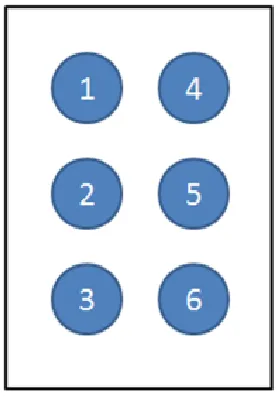
Braille generally consists of cells of six raised dots arranged in a grid of two
dots horizontally by three dots vertically. The dots are conventionally numbered 1, 2,
and 3 from the top of the left column and 4, 5, and 6 from the top of the right
[image:23.612.257.397.273.473.2]column.
Figure 2.1 Braille Dot Arrangements
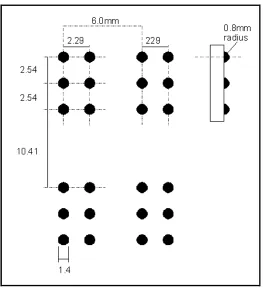
The presence or absence of dots gives the coding for the symbol. Dot height
is approximately 0.02 inches (0.5 mm); the horizontal and vertical spacing between
dot centers within a Braille cell is approximately 0.1 inches (2.5 mm); the blank
space between dots on adjacent cells is approximately 0.15 inches (3.75 mm)
horizontally and 0.2 inches (5.0 mm) vertically. A standard Braille page is 11 inches
by 11.5 inches and typically has a maximum of 40 to 43 Braille cells per line and 25
7
Figure 2.2 Braille Size
As originally conceived by Louis Braille, a sequence of characters, using the
top four dots of the Braille cell, represents letters a through j. Dot 3 is added to each
of the j symbols to give letters k through t. Both of the bottom dots (dots 3 and 6) are
added to the symbols for "a" through e to give letters u, v, x, y, and z. The letter w is
an exception to the pattern because French did not make use of the letter "w" at the
time Louis Braille devised his alphabet, and thus he had no need to encode the letter
"w".
English Braille codes the letters and punctuation, and some double letter
signs and word signs directly, but capitalization and numbers are dealt with by using
a prefix symbol. In practice, Braille produced in the United Kingdom does not have
capital letters.
2.2.3 Letters, Numbers and Symbol