Deoptimization
Benson Yee Hin Cheng,aEmilio Ortiz-Riaño,aAitor Nogales,aJuan Carlos de la Torre,bLuis Martínez-Sobridoa
Department of Microbiology and Immunology, University of Rochester, Rochester, New York, USAa; Department of Immunology and Microbial Science, The Scripps Research Institute, La Jolla, California, USAb
ABSTRACT
Arenaviruses have a significant impact on public health and pose a credible biodefense threat, but the development of safe and
effective arenavirus vaccines has remained elusive, and currently, no Food and Drug Administration (FDA)-licensed arenavirus
vaccines are available. Here, we explored the use of a codon deoptimization (CD)-based approach as a novel strategy to develop
live-attenuated arenavirus vaccines. We recoded the nucleoprotein (NP) of the prototypic arenavirus lymphocytic
choriomenin-gitis virus (LCMV) with the least frequently used codons in mammalian cells, which caused lower LCMV NP expression levels in
transfected cells that correlated with decreased NP activity in cell-based functional assays. We used reverse-genetics approaches
to rescue a battery of recombinant LCMVs (rLCMVs) encoding CD NPs (rLCMV/NPCD) that showed attenuated growth kinetics
in vitro
. Moreover, experiments using the well-characterized mouse model of LCMV infection revealed that rLCMV/NP
CD1and
rLCMV/NP
CD2were highly attenuated
in vivo
but, upon a single immunization, conferred complete protection against a
subse-quent lethal challenge with wild-type (WT) recombinant LCMV (rLCMV/WT). Both rLCMV/NP
CD1and rLCMV/NP
CD2were
genetically and phenotypically stable during serial passages in FDA vaccine-approved Vero cells. These results provide proof of
concept of the safety, efficacy, and stability of a CD-based approach for developing live-attenuated vaccine candidates against
human-pathogenic arenaviruses.
IMPORTANCE
Several arenaviruses cause severe hemorrhagic fever in humans and pose a credible bioterrorism threat. Currently, no FDA-licensed
vaccines are available to combat arenavirus infections, while antiarenaviral therapy is limited to the off-label use of ribavirin, which is
only partially effective and is associated with side effects. Here, we describe the generation of recombinant versions of the prototypic
arenavirus LCMV encoding codon-deoptimized viral nucleoproteins (rLCMV/NP
CD). We identified rLCMV/NP
CD1and rLCMV/
NP
CD2to be highly attenuated
in vivo
but able to confer protection against a subsequent lethal challenge with wild-type LCMV. These
viruses displayed an attenuated phenotype during serial amplification passages in cultured cells. Our findings support the use of this
approach for the development of safe, stable, and protective live-attenuated arenavirus vaccines.
A
renaviruses cause chronic infections of rodents across the
world, and human infections occur through mucosal
expo-sure to aerosols or by direct contact of abraded skin with
infec-tious materials (
1
). Several arenaviruses, chiefly Lassa virus
(LASV), the causative agent of Lassa fever (LF) in West Africa, and
Junín virus (JUNV), the causative agent of Argentine hemorrhagic
fever (AHF) in Argentina, cause hemorrhagic fever (HF) disease
in humans that is associated with high morbidity and significant
mortality and pose important public health problems in their
ar-eas of endemicity (
1–3
). Notably, increased travel has led to the
importation of LF cases into metropolitan areas around the globe
where LASV is not endemic (
1
,
4
,
5
). Moreover, the recent
iden-tification of two novel HF-causing arenaviruses, Chapare virus in
Bolivia (
6
) and Lujo virus in South Africa (
7
), have raised concerns
about newly emerging HF arenaviruses. In addition, evidence
in-dicates that the prototypic arenavirus lymphocytic
choriomenin-gitis virus (LCMV), distributed worldwide, is a neglected human
pathogen of clinical significance (
8–10
). Moreover, arenaviruses
pose a credible biodefense threat, and six of them, including
LCMV, LASV, and JUNV, are classified as category A agents (
2
,
11
). Public health concerns posed by human-pathogenic
arenavi-ruses are aggravated by the lack of Food and Drug Administration
(FDA)-approved vaccines and the limitation of current
antiarena-viral therapy to the off-label use of ribavirin, which is only partially
effective and is associated with side effects (
12–15
). The
signifi-cance of arenaviruses in human health and biodefense readiness,
together with the limited existing armamentarium to combat
them, highlights the urgent need to develop vaccines and therapies
to combat human-pathogenic arenaviruses.
Candid no. 1, a JUNV live-attenuated strain, has been shown to
be an effective vaccine against AHF (
16
), but outside Argentina,
Candid no. 1 has achieved only investigational new drug status
(
17
), and yet unpublished studies done by Paessler and colleagues
Received24 November 2014Accepted26 December 2014
Accepted manuscript posted online14 January 2015
CitationCheng BYH, Ortiz-Riaño E, Nogales A, de la Torre JC, Martínez-Sobrido L.
2015. Development of live-attenuated arenavirus vaccines based on codon deoptimization. J Virol 89:3523–3533.doi:10.1128/JVI.03401-14.
Editor:D. S. Lyles
Address correspondence to Luis Martínez-Sobrido,
[email protected], or Juan Carlos de la Torre, [email protected].
B.Y.H.C. and E.O.-R. contributed equally to this work.
Supplemental material for this article may be found athttp://dx.doi.org/10.1128 /JVI.03401-14.
Copyright © 2015, American Society for Microbiology. All Rights Reserved.
doi:10.1128/JVI.03401-14
on November 7, 2019 by guest
http://jvi.asm.org/
at the University of Texas Medical Branch (UTMB)—Galveston
have shown that Candid no. 1 does not protect against LF.
More-over, there is only limited information regarding long-term
pro-tective immunity conferred by Candid no. 1. Likewise, although
cases of reversion of Candid no. 1 to a more virulent strain have
not been reported, its phenotypic stability remains uncertain, as a
single amino acid change on the viral glycoprotein (GPC) can
affect JUNV virulence (
18
,
19
). Likewise, there is evidence
suggest-ing the potential genetic and phenotypic instability of the existsuggest-ing
Candid no. 1 vaccine strain of JUNV (
20
).
Despite significant efforts to develop vaccines against LF, not a
single LASV vaccine candidate has entered a clinical trial.
How-ever, the Mopeia virus (MOPV)/LASV reassortant ML29 has
shown promising safety and efficacy profiles in animal models,
including nonhuman primates (
21–23
), but limited knowledge
about the mechanisms of ML29 attenuation has raised the
con-cern that additional ML29 mutations, or reassortants between
ML29 and circulating LASV strains, could result in viruses with
enhanced virulence. Likewise, a replication-competent attenuated
recombinant vesicular stomatitis virus (VSV) expressing LASV
glycoprotein has been reported to elicit protective immune
re-sponses in nonhuman primates against a lethal LASV challenge
(
24
). Nevertheless, epidemiological studies indicate that the most
feasible approach to control LF would be a live-attenuated
vac-cine, due to the ability to induce robust and long-term cellular and
humoral immune responses following a single immunization (
3
,
25
,
26
).
Redundancy in the genetic code results in many amino acids
being encoded by more than one codon (
27
). A codon usage bias
exists where synonymous codons are used at different frequencies
by an organism to incorporate the same amino acid residue into a
protein (
28
). Codon optimization is a frequently used strategy to
improve expression of genes in heterologous systems (
29–32
),
whereas all mammals exhibit essentially the same codon bias (
33
,
34
). Conversely, replacement of commonly used codons with
nonpreferred codons, or codon deoptimization (CD), can
dra-matically decrease gene expression (
35
). Proteins encoded by
mammalian viruses are subjected to the codon usage bias of the
cells they infect; therefore, CD is predicted to adversely affect viral
protein translation, which could result in viral attenuation (
36–
38
). Accordingly, several RNA viruses have been effectively
atten-uated by CD of a single or a limited number of viral gene products
(
36–38
). In this study, we explored whether the concept of
CD-based live-attenuated vaccine could be implemented with the
pro-totypic arenavirus LCMV in a well-characterized mouse model of
infection.
Arenaviruses are enveloped viruses with a bisegmented,
single-stranded, negative-sense RNA genome (
1
). Both the large (L) and
small (S) genome RNA segments use an ambisense coding strategy
to express two viral proteins. The L segment encodes the
RNA-dependent RNA polymerase (L) and the matrix RING finger (Z)
protein, whereas the S segment encodes the nucleoprotein (NP)
and glycoproteins GP1 and GP2, which mediate virus receptor
recognition and cell entry (
1
). NP is the most abundant viral
poly-peptide in infected cells and virions and the main component of
the virus ribonucleoprotein (vRNP), which directs replication and
transcription of the viral genome (
1
). NP interacts with Z to
me-diate the incorporation of vRNPs into mature infectious virions
(
39
,
40
), and NP has also been shown to counteract the cellular
host type I interferon (IFN-I) response (
41–46
). Because NP has
multiple critical functions in the arenavirus life cycle, we chose to
investigate if CD of NP resulted in viruses that were highly
atten-uated
in vivo
but still able to afford protection against a
subse-quent challenge with wild-type (WT) recombinant LCMV
(rLCMV/WT). For this, we used reverse-genetics (
47–49
) and CD
(
33–35
) approaches to rescue recombinant LCM viruses with
dif-ferent degrees of CD NPs (rLCMV/NP
CD). We present evidence
that the magnitude of CD of LCMV NP correlated with its reduced
expression and functional activity. Likewise, we show that it is
feasible to rescue rLCMV encoding CD NPs that exhibit modestly
reduced growth properties in cultured cells, whereas
in vivo
they
are highly attenuated and able to confer efficient protection
against a lethal challenge with rLCMV/WT. These results raise the
possibility of using a similar CD approach for the design of
live-attenuated vaccines for the prevention of HF disease caused by
human-pathogenic arenaviruses.
MATERIALS AND METHODS
Cells and viruses.Human lung adenocarcinoma epithelial (A549; ATCC CCL-185), human embryonic kidney (293T; ATCC CRL-11268), African green monkey kidney epithelial (Vero; ATCC CCL-81), and baby hamster kidney (BHK-21; ATCC CCL-10) cells were grown in Dulbecco’s modi-fied Eagle’s medium (DMEM) (Mediatech, Inc.) supplemented with 10% fetal bovine serum (FBS), 2 mML-glutamine, penicillin (100 units/ml), and streptomycin (100 units/ml) and maintained in a 5% CO2humidified atmosphere at 37°C. Recombinant LCMV (Armstrong strain; ARM53b) and wild-type (rLCMV/WT) and CD NP (rLCMV/NPCD) viruses were rescued and propagated in BHK-21 cells as described previously (48). Sendai virus (SeV), Cantell strain, was grown in 10-day-old embryonated chicken eggs (50).
Plasmids.Hemagglutinin (HA)-tagged LCMV NP (51) and LCMV L (52) pCAGGS expression plasmids have been described previously. Gen-eration of fully CD LCMV NP (LCMV NPCD) was done byde novo syn-thesis in which each wild-type codon was replaced with the codon least represented in mammalian genomes (Biomatik). LCMV NPCDwas am-plified by PCR and cloned into pCAGGS HA-COOH (51) using SacI and KpnI restriction enzymes. To generate LCMV NPCDchimeras, restriction sites were used to subclone LCMV NPWTPCR products into LCMV NPCD. Plasmids for the rescue of rLCMV/NPCDwere obtained by ampli-fying LCMV NPCD from pCAGGS HA-COOH and cloning into the mouse pPol-I GP/BbsI vector plasmid (47,49). All plasmids were gener-ated using standard cloning techniques. The primers used to generate the described plasmid constructs are available upon request. Plasmid con-structs were verified by DNA sequencing (ACGT).
Immunofluorescence assays (IFA).To evaluate LCMV NPCDprotein expression, 293T cells (1.8⫻105cells/well; 24-well plate format) were transiently transfected in suspension with 1g of LCMV NP expression plasmids using LPF2000 (Invitrogen). Empty-plasmid-transfected cells were included as a negative control. LCMV NPWTwas used as a positive control. At 48 h posttransfection (p.t.), cells were fixed with 4% parafor-maldehyde in phosphate-buffered saline (PBS), permeabilized with 0.1% Triton X-100, and blocked using 2.5% bovine serum albumin (BSA) di-luted in 1⫻PBS. After blocking, the cells were incubated with an anti-HA monoclonal antibody (Sigma) and probed with a fluorescein isothiocya-nate (FITC)-conjugated rabbit anti-mouse secondary antibody (Dako). LCMV NP expression was observed under a Leica fluorescence micro-scope (40). The microscope images were colored using Adobe Photoshop CS4 (v11.0) software.
Protein gel electrophoresis and Western blot (WB) analysis.Human 293T cells (3⫻106cells/well; 6-well plate format) were transiently trans-fected in suspension with 1g of the indicated LCMV NP pCAGGS ex-pression plasmid. Empty- and LCMV NPWTplasmid-transfected cells were included as negative and positive controls, respectively. At 48 h p.t., cells were collected and lysed with 400l of lysis buffer (10 mM Tris-HCl,
on November 7, 2019 by guest
http://jvi.asm.org/
pH 7.4, 5 mM EDTA, 100 mM NaCl, 1% NP-40, and a complete cocktail of protease inhibitors [Roche]). A 20-l aliquot of the total cell lysates was separated on SDS-12% PAGE and transferred onto nitrocellulose mem-branes (Bio-Rad). The memmem-branes were incubated with an anti-HA monoclonal antibody (Sigma) and probed with a secondary horseradish peroxidase (HRP)-conjugated anti-mouse antibody (GE Healthcare). LCMV NP expression was detected using a chemiluminescence kit (Den-ville Scientific). Cellular GAPDH (glyceraldehyde-3-phosphate dehydro-genase) was used to normalize the amount of lysates and was detected using a polyclonal antibody to GAPDH (Abcam). Protein band intensities were quantified using ImageJ software (NIH) (51). Band quantifications were normalized according to GAPDH expression, assigning 100% inten-sity to LCMV NPWT. LCMV NPCDexpression levels were then normal-ized by their intensity relative to that of LCMV NPWT.
MG assay.Human 293T cells (6.5⫻105cells/well; 12-well plate for-mat; triplicates) were cotransfected using LPF2000 with 0.6 g of pCAGGS L, 0.15g of the indicated pCAGGS LCMV NP constructs or empty plasmid, 0.5g of a green fluorescent protein (GFP), aGaussia
luciferase (Gluc) dual-reporter minigenome (MG) plasmid driven by a human polymerase I promoter (hpPol-I GFP/Gluc) (47), and 0.1g of a mammalian expression vector encodingCypridinaluciferase (Cluc) un-der the control of the constitutively active simian virus 40 (SV40) pro-moter (pSV40-Cluc; New England BioLabs) (53) to normalize transfec-tion efficiencies. An empty pCAGGS plasmid was used to keep the amount of transfected plasmid DNA constant (47). At 48 h p.t., reporter gene expression was assessed by fluorescence microscopy (GFP) using a Leica fluorescence microscope and luciferase activity (Gluc) was assessed using a Lumicount luminometer (Packard) (47). The microscope images were colored using Adobe Photoshop CS4 (v11.0) software. Luciferase gene activities were determined using the BioluxGaussiaandCypridina
Luciferase Assay kits (New England BioLabs). Reporter gene activation (Gluc) is indicated as fold induction over the negative pCAGGS empty-plasmid control (47). The mean value and standard deviation were calcu-lated and statistical analysis using a two-tailed Studentttest was done using Microsoft Excel software.
IFN-I inhibition assays.The fluorescence- and luminescence-based assays to evaluate the activity of LCMV NP counteracting the induction of IFN-I production have been described previously (42–44). Briefly, 293T cells (4⫻105cells/well; 12-well plate format; triplicates) were cotrans-fected with 1g of the firefly luciferase (Fluc) reporter gene driven by the beta interferon (IFN-) promoter (pIFN-Fluc), 1g of the GFP/chlor-amphenicol acetyltransferase (CAT) reporter gene driven by the IFN- promoter (pIFN-GFP/CAT), 0.15 g of the indicated LCMV NP pCAGGS expression plasmids, and 0.1g of aRenillaluciferase (Rluc) reporter gene under the control of an SV40 promoter (pRL SV40; Pro-mega) to normalize for transfection efficiencies, using a calcium phos-phate-based mammalian transfection kit (Stratagene) (42–44). After overnight transfection, cells were infected with Sendai virus, Cantell strain (50), for an additional 24 h. IFN-gene promoter activation was then evaluated by GFP expression using a Leica microscope and by Fluc activity using the Dual Luciferase reporter kit (Promega). Reporter gene activa-tion is shown as relative light units (RLU) compared to SeV-infected cells in the absence of LCMV NP (empty plasmid). The mean value and stan-dard deviation were calculated and statistical analysis using a two-tailed Studentttest was done using Microsoft Excel software.
Virus rescues and growth kinetics.All the rLCM viruses used in this study are based on the ARM53b strain (54). To rescue rLCMV, BHK-21 cells (1⫻106cells/well; 6-well plate format) were cotransfected with 0.8 g of pCAGGS NP, 1g of pCAGGS L, 1.4g of the mouse pPol-I L, and 0.8g of the mouse pPol-I S containing LCMV NPCD, using LPF2000 (48). At 12 h p.t., the medium was replaced with 2 ml of postinfection medium (a 1:2 ratio of 10% FBS DMEM and Opti-MEM). At 72 h p.t., the cells were trypsinized, scaled up into 10-cm dishes, and maintained for 3 days before tissue culture supernatants (TCS) were collected and assessed for the presence of virus (47). Briefly, serial dilutions of TCS were used to
infect Vero cells (4⫻104cells/well; 96-well plate format; triplicates), and titers were determined as focus-forming units (FFU)/ml (47) using an LCMV NP-specific monoclonal antibody (clone 1.1.3) (55). To evaluate viral growth kinetics, BHK-21, A549, and Vero cells (1.25⫻105cells/well; 24-well plate format; triplicates) were infected (multiplicity of infection [MOI], 0.01) and TCS were collected at the indicated time points and titrated as described above. The mean value and standard deviation were calculated using Microsoft Excel software.
Reverse transcription (RT)-PCR.BHK-21 cells (5⫻105cells/well; 6-well plate format) were infected (MOI, 0.01), and at 72 h p.i., total cellular RNA was prepared using TRIzol (Invitrogen). Random hexamers were used for initial cDNA synthesis using Superscript II reverse trans-criptase (Invitrogen). cDNA was amplified by PCR using a combination of LCMV NPWT- or NPCD-specific primers. The amplified gene products were examined on a 1% agarose DNA gel and analyzed by sequencing (ACGT).
Viral stability.Vero cells (1⫻106cells/well; 6-well plate format) were infected (MOI, 0.1), and at 48 h p.i., TCS were collected and diluted 1:10 in reduced-serum cell medium (2% DMEM) before subsequent infec-tions in Vero cells. Infected cells from each passage were collected for RNA extraction, and LCMV NP was amplified by RT-PCR and sequenced (ACGT).
Mouse experiments.To evaluate the virulence of rLCMV/NPCD chi-merasin vivo, B6 mice (6-week old immunocompetent males;n⫽8) were infected intracranially (i.c.) (103PFU) with each of the indicated rLCM viruses. The mice were monitored daily for development of clinical symp-toms and survival for 12 days. To evaluate the protection efficacy of rLCMV/NPCD, mice were immunized with PBS or with either rLCMV/WT or rLCMV/NPCDintraperitoneally (i.p.) (105PFU;n⫽8). At 4 weeks postinfection, the mice were lethally challenged with rLCMV/WT (i.c.; 103PFU) and monitored for development of clinical symptoms and survival over 12 days. All animal experiments were done under protocol 09-0137 and approved by The Scripps Research Institute IACUC.
RESULTS
Effect of CD on LCMV NP expression and function.
We selected
NP as a target to examine the potential of a CD-based approach for
the generation of an LCMV live-attenuated arenavirus vaccine,
because NP plays critical roles in viral RNA replication and gene
transcription (
1
,
39
,
52
) and contributes to LCMV’s ability to
counteract the host IFN-I response to viral infection (
41–45
,
56
,
57
).
To evaluate the effect of CD on LCMV NP expression and
function, we reengineered its open reading frame (ORF) by
incor-porating at each amino acid position the least frequently used
codon in mammalian cells but preserving the intact LCMV NP
WTamino acid sequence (
Fig. 1A
; see Fig. S1 in the supplemental
material). For this, we synthesized
de novo
the NP cDNA to
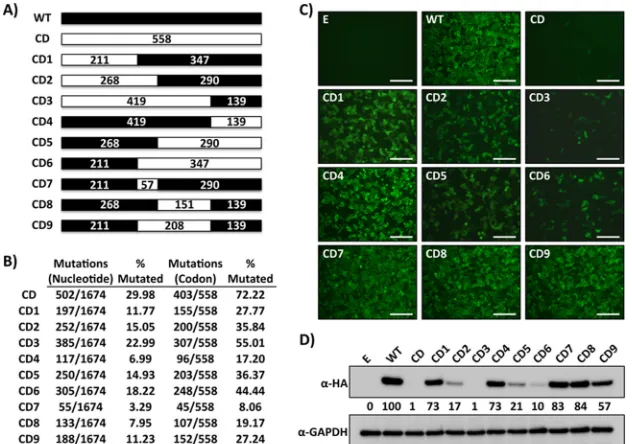
intro-duce a total of 502 nucleotides of silent mutations into the LCMV
NP ORF, which affected 403 out of 558 amino acids (72.22%) (
Fig.
1B
). The resulting LCMV NP
CDwas cloned into the pCAGGS
protein expression plasmid, which provided an HA tag at the C
terminus (
51
). Expression levels of LCMV NP
CDwere
signifi-cantly reduced in human 293T cells, as determined by IFA and WB
assays (
Fig. 1C
and
D
). Accordingly, reduced NP expression levels
in cells transfected with LCMV NP
CD, compared to cells
trans-fected with the same amount of plasmid expressing LCMV NP
WT,
correlated with a dramatic decrease of NP activity in viral
replica-tion and transcripreplica-tion using an MG rescue assay (
47
,
49
,
52
) (
Fig.
2
), as well as in its ability to inhibit activation of the IFN-

pro-moter in a cell-based reporter assay (
42–44
) (
Fig. 3
).
on November 7, 2019 by guest
http://jvi.asm.org/
Functional characterization of LCMV NP
CDchimeric
con-structs.
The strong decrease in expression and function of LCMV
NP
CDsuggested that rescue via reverse genetics of rLCMV
con-taining the NP
CDORF (rLCMV/NP
CD) might not be feasible,
which was confirmed by our several independent failed attempts
to rescue rLCMV/NP
CD(data not shown). We reasoned that this
obstacle could be overcome by finding a level of CD that resulted
in NP expression levels compatible with the generation of a viable
rLCMV. We therefore generated a collection of chimeric
con-structs containing varying lengths of CD sequences at the N
ter-minus (NP
CD1–3) and C terminus (NP
CD4 – 6) and the central
re-gion (NP
CD7–9) of LCMV NP (
Fig. 1A
and
B
), all containing a
C-terminal HA tag to facilitate their detection (
51
). Next, we
ex-amined the correlation between the expression levels of these
LCMV NP
CDs and their degrees of CD by IFA (
Fig. 1C
) and WB
(
Fig. 1D
). Constructs NP
CD1, NP
CD4, NP
CD7, NP
CD8, and NP
CD9,
which contained
⬍
30% CD, displayed expression levels similar to
those obtained with a construct expressing LCMV NP
WT. On the
other hand, constructs NP
CD2, NP
CD5, and, to a lesser extent,
NP
CD6, which contained 30 to 50% CD, were moderately affected
in protein expression, whereas LCMV NP
CD3, containing
⬃
55%
CD, was severely affected in its expression, to levels comparable to
those of LCMV NP
CD. We next examined whether the magnitude
of the effect on protein expression caused by the different degrees
of CD correlated, as predicted, with the effects observed on LCMV
NP functional activities. For this, we evaluated the activities of the
LCMV NP
CDchimeric constructs in the MG rescue assay (
47
,
49
,
52
) and in cell-based reporter assays that measured IFN-
pro-moter activation (
42–44
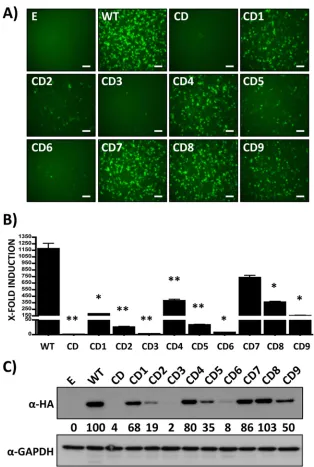
). Levels of viral replication and gene
ex-pression of the MG, as determined by GFP exex-pression (
Fig. 2A
)
and
Gaussia
luciferase activity (
Fig. 2B
), correlated with the degree
of CD and protein expression afforded by each LCMV NP
CDcon-struct (
Fig. 2C
).
LCMV (and other arenavirus) NP has been shown to block
IFN-I induction during viral infection (
42–44
). This anti-IFN
ac-tivity of arenavirus NP has been attributed to a recently identified
3
=
-5
=
exoribonuclease domain in the C terminus of NP, which is
thought to digest double-stranded RNA (dsRNA) substrates
formed during viral replication in an attempt to mask infection
from cellular detection (
56–60
). Thus, we evaluated whether
re-duced protein expression levels would affect the abilities of
differ-ent NP chimeras to inhibit SeV-mediated activation of an IFN-
promoter (
42–44
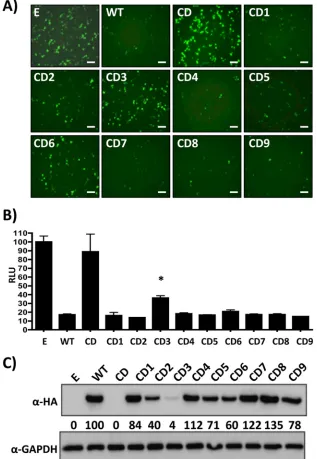
). The magnitude of LCMV NP
CD-mediated
in-hibition of IFN-
promoter activation in response to SeV
infection, as determined by GFP expression (
Fig. 3A
) or firefly
luciferase activity (
Fig. 3B
), correlated with LCMV NP expression
levels (
Fig. 3C
). These results demonstrated that the degree of
CD (NP
WT⬎
NP
CD7⬎
NP
CD4⬎
NP
CD8⬎
NP
CD1⫽
NP
CD9⬎
NP
CD2⫽
NP
CD5⬎
NP
CD6⬎
NP
CD3⬎
NP
CD) correlated well with
reduced levels of LCMV NP expression and its functional
activi-ties.
Generation of recombinant viruses expressing LCMV NPCD
chimeric constructs (rLCMV/NP
CD).
We next used
reverse-ge-netics approaches (
47
,
49
,
52
) to rescue rLCMV containing NPs
with different degrees of CD that were predicted to be viable based
on results from expression and function analyses of the
corre-sponding NP
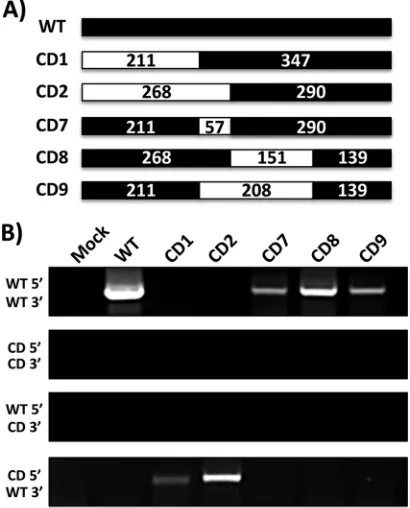
CDconstructs. The identity of the rescued rLCMV
was confirmed by RT-PCR using RNA extracted from infected
BHK-21 cells and primers specific for LCMV NP
WTor NP
CD(
Fig.
4
), followed by sequencing of the amplified PCR products (data
FIG 1Characterization of CD LCMV NP chimeras. (A) Schematic representation of LCMV NPCDchimeras. Wild-type LCMV NP (NPWT) regions are represented by black boxes. The white boxes represent LCMV NPCD. The numbers indicate the amino acid lengths of the respective regions. (B) Nucleotide and amino acid changes in LCMV NPCDchimeras. The discrepancies between mutated codons and the amino acid lengths indicated in panel A are due to codons that are already deoptimized in LCMV NPWTor that encode either methionine or tryptophan. (C and D) LCMV NPCDchimera expression levels. Human 293T cells were transiently transfected with expression plasmids encoding LCMV NPCDchimeras and evaluated at 48 h p.t. for protein expression by IFA (C) and WB (D) using an anti-HA mouse monoclonal antibody. Empty plasmid (E) and LCMV NPWTwere included as negative and positive controls, respectively. GAPDH expression levels were used as loading controls. Representative images of three independent transfection experiments are shown. (D) The numbers indicate the percentages of LCM NPCDexpression compared to that of LCMV NPWTafter normalization with GAPDH. (C) Scale bars⫽100m.on November 7, 2019 by guest
http://jvi.asm.org/
[image:4.585.135.451.67.289.2]not shown). We evaluated the growth kinetics of the rescued
rLCMV/NP
CDin BHK-21 (
Fig. 5A
), A549 (
Fig. 5B
), and Vero
(
Fig. 5C
) cells. We observed a correlation between the expression
levels of LCMV NP
CDchimeras and their ability to replicate in the
different cell lines (rLCMV/NP
CD7⬎
rLCMV/NP
CD8⬎
rLCMV/
NP
CD9⬎
rLCMV/NP
CD1⬎
rLCMV/NP
CD2). Importantly,
rLCMV/NP
CD7, rLCMV/NP
CD8, and rLCMV/NP
CD9were slightly
attenuated compared with rLCMV/WT. As expected, based on the
degree of CD, rLCMV/NP
CD1and rLCMV/NP
CD2were the most
attenuated rLCM viruses in all the cell lines tested. Interestingly,
viral attenuation was more pronounced in A549 cells than in Vero
or BHK-21 cells. These differences could be due to species-specific
codon usage (CD was based on mammalian codon usage), tRNA
availability in the different cell lines, or a decrease in viral fitness
in IFN-I-competent A549 cells compared to IFN-I-deficient
BHK-21 and Vero cells (
42
,
61
). Intriguingly, rLCMV/NP
CD1and
FIG 2Functional characterization of LCMV NPCDchimeras in viral replication and transcription. Human 293T cells were transiently cotransfected (triplicates) with the indicated pCAGGS LCMV NPCDexpression plasmids, together with pCAGGS LCMV L, the human LCMV MG plasmid pPol-I GFP/Gluc, and an SV40Cypridinaluciferase expression plasmid (pSV40-Cluc), to normalize transfection efficiencies. (A and B) At 48 h p.t., MG activities were evaluated by GFP (A) and Gluc (B) expression. Representative images of three independent transfections are shown. Luciferase activity is represented as fold induction over cells transfected with empty plasmid (E) in place of LCMV NP. The error bars indicate standard deviations. *,Pⱕ0.05; **,Pⱕ0.005. (C) LCMV NPCDexpression levels in collected total cell lysates were determined by WB using an anti-HA mouse monoclonal antibody and an HRP-conjugated rabbit anti-mouse polyclonal antibody. GAPDH was included as a loading control. The numbers indicate the percentages of LCMV NPCDexpression compared to that of LCMV NPWTafter normalization to GAPDH. Scale bars, 100m.
on November 7, 2019 by guest
http://jvi.asm.org/
[image:5.585.134.448.63.530.2]rLCMV/NP
CD2kinetics were very similar in all three cell lines
tested, while their expression levels (
Fig. 1
) and their activities in
the minigenome assay (
Fig. 2
) using plasmid-based transfections
seemed different.
Safety and protective efficacy of rLCMV/NPCD
viruses.
To
assess the potential use of a CD-based approach for the
develop-ment of arenavirus live-attenuated vaccine candidates, we
evalu-ated the virulence and protective efficacies of selected rLCMV/
NP
CDin vivo
using the well-characterized mouse model of LCMV
infection. To that end, we infected 6-week-old male B6 mice i.c.
with 10
3PFU of rLCMV/WT, rLCMV/NP
CD1
, rLCMV/NP
CD2,
and rLCMV/NP
CD7(
Table 1
). As predicted, by day 6 p.i., all mice
infected with rLCMV/WT developed clinical symptoms of LCM
disease and died within 8 days after inoculation. Mice infected
with rLCMV/NP
CD7exhibited the same morbidity and mortality
as mice infected with rLCMV/WT. In contrast, all mice infected
with rLCMV/NP
CD1and rLCMV/NP
CD2survived and remained
free of clinical symptoms throughout the duration of the
experi-FIG 3Inhibition of IFN-promoter activation by LCMV NPCDchimeras. Human 293T cells were transiently cotransfected with the indicated pCAGGS LCMV NPCDexpression plasmids, along with pIFN-GFP/CAT and pIFN-Fluc, and an SV40-drivenRenillaluciferase plasmid (pRL SV40) to normalize transfection efficiencies. At 24 h p.t., the cells were infected with SeV (MOI, 3), and 24 h later, IFN-promoter activity was determined by GFP (A) and Fluc (B) activities. (A) Mean values and standard deviations are shown. Statistical analysis using a two-tailed Studentttest was done using Microsoft Excel software. *,Pⱕ0.05. (B) Representative images of three independent transfections are shown. Luciferase activity is represented as RLU normalized to cells transfected with empty plasmid (E) in place of LCMV NP. (C) LCMV NPCDexpression levels in total cell lysates were determined by WB using GAPDH as a loading control. The numbers indicate the percentages of LCMV NPCDexpression compared to that of LCMV NPWTafter normalization with GAPDH. Scale bars, 100m.on November 7, 2019 by guest
http://jvi.asm.org/
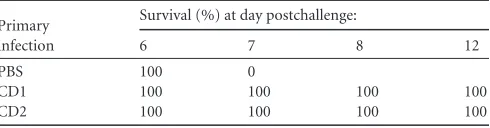
[image:6.585.134.451.70.529.2]ment (12 days). Moreover, they were fully protected against an i.c.
lethal challenge with rLCMV/WT administered 4 weeks after the
initial infection (
Table 2
). These findings indicated that rLCMV/
NP
CD1and rLCMV/NP
CD2had a highly attenuated phenotype
in
vivo
while retaining the ability to trigger a protective immune
response against a subsequent rLCMV/WT lethal challenge. We
then assessed whether, in a commonly used protocol of LCMV
immunization (10
5PFU; i.p. route), rLCMV/NP
CD1
and rLCMV/
NP
CD2were also capable of inducing protective immunity against
a subsequent rLCMV/WT lethal challenge (10
3PFU, i.c.) (
Table
3
). All mice immunized i.p. with rLCMV/WT, rLCMV/NP
CD1, or
rLCMV/NP
CD2survived the challenge and remained free of
clin-ical symptoms throughout the duration of the experiment (12
days). As expected, all mock (PBS)-immunized mice developed
severe clinical symptoms and died within 8 days of the i.c.
chal-lenge with rLCMV/WT. Altogether, these results demonstrate the
feasibility of using rLCMV/NP
CDto develop safe and protective
live-attenuated vaccines.
Genetic and phenotypic stability of rLCMV/NPCD.
Due to the
high mutation rates associated with RNA viruses, it was important
to determine that serial passages of attenuated rLCMV/NP
CDin
Vero cells, which mimics the process of manufacturing and
gen-erating stocks of vaccine in an FDA-approved cell line, did not
accumulate genetic changes that could affect the attenuated
phe-notype. To examine this, we conducted serial passages of rLCMV/
WT, rLCMV/NP
CD1, and rLCMV/NP
CD2in Vero cells and
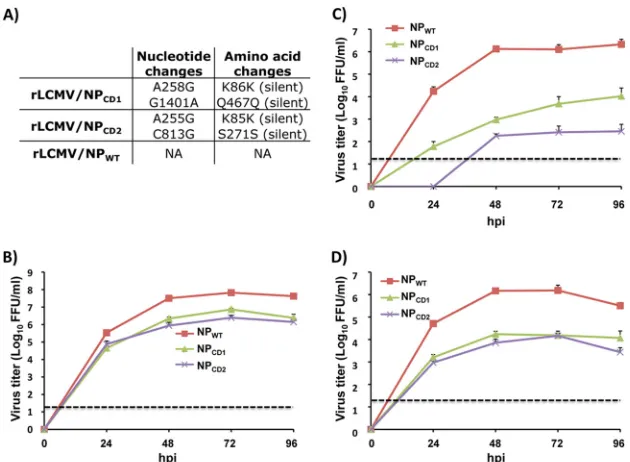
deter-mined the NP sequence at passage 10 (P10) for each of the viruses.
We found only two silent mutations in rLCMV/NP
CD1and
rLCMV/NP
CD2(
Fig. 6A
). We next assessed whether these
muta-tions in rLCMV/NP
CD1and rLCMV/NP
CD2restored rLCMV/
WT-like growth properties in cultured cells or altered the
in vivo
attenuated phenotype. P10 of both rLCMV/NP
CD1and rLCMV/
NP
CD2exhibited growth kinetics properties in BHK-21 (
Fig. 6B
),
A549 (
Fig. 6C
), and Vero (
Fig. 6D
) cells similar to those observed
for the corresponding parental rLCMV/NP
CD1and rLCMV/
NP
CD2viruses. More importantly, all the mice infected (i.c.; 10
3PFU) with rLCMV/NP
CD1or rLCMV/NP
CD2P10 survived and
remained free of any noticeable clinical symptoms through the
entire duration of the study (data not shown).
DISCUSSION
Genome scale changes in codon pair bias have been successfully
used to generate attenuated viruses exhibiting properties
amena-FIG 4Confirmation of rLCMV/NPCD. (A) Schematic representation ofrLCMV/NPCDrescued viruses. Wild-type LCMV NP regions are represented by black boxes. The white boxes represent LCMV NPCD. The numbers indicate the amino acid lengths of the respective regions. (B) Genetic characterization of rLCMV/NPCD. BHK-21 cells were mock infected or infected (MOI, 0.01) with either rLCMV/NPWTor rLCMV/NPCDchimeras. At 72 h p.i., cells were collected and rLCM viruses were characterized by RT-PCR using the indicated primers. The RT-PCR products were analyzed on a 1% agarose gel.
FIG 5rLCMV/NPCDgrowth kinetics. BHK21 (A), A549 (B), and Vero (C) cells were infected with the indicated viruses (MOI, 0.01), and viral titers in TCS were determined by immunofocus assay (FFU/ml) at the indicated times postinfection. The dashed lines indicate the limit of detection (20 FFU/ml).
on November 7, 2019 by guest
http://jvi.asm.org/
[image:7.585.319.523.64.496.2] [image:7.585.61.266.69.323.2]ble for the development of live-attenuated vaccines (
36–38
).
These approaches, however, require the use of computer
algo-rithms to design viral genomes with appropriate pair-deoptimized
codons (
36–38
), and the use of alternative codon pair
deoptimi-zation might result in different degrees of attenuation. In this
work, we used a more direct approach to engineer rLCMVs in
which the majority of the amino acid residues of the viral NP are
encoded by the least-preferred codon in mammalian cells, which
was predicted to result in reduced protein expression and,
there-fore, viral attenuation. We selected NP for our initial studies to
explore the effect of CD of the arenavirus genome, because NP is
the most abundant viral protein present in infected cells and
viri-ons (
1
) and NP also plays many essential roles in the virus life cycle
(
40
,
41
,
44
,
45
,
51
). We succeeded in generating a variety of
rLCMV/NP
CDviruses that were highly attenuated
in vivo
but able
to induce protection against a subsequent lethal challenge with
rLCMV/WT.
CD for the generation of live-attenuated vaccine candidates
offers several unique advantages over other current strategies.
First, a CD live-attenuated vaccine contains hundreds of silent
mutations at the nucleotide level that would make viral reversion
to a virulent WT phenotype extremely unlikely, if not impossible
(
36–38
). Concern about reversion to a virulent phenotype is
par-ticularly important for RNA viruses, because their error-prone
replication machinery has the potential for rapid evolution (
62
).
Thus, in the case of the influenza virus live-attenuated vaccines,
viral attenuation is produced by 4 amino acid changes in the viral
polymerase subunits (K391E, E581G, and A661T in PB1; N265S in
PB2) and 1 amino acid change in the viral NP (D34G) (
63
). These
amino acid changes confer a temperature-sensitive phenotype on
the virus, allowing its replication only at 33°C (
63
). Due to the
potential to revert to a pathogenic phenotype, as well as the ability
to cause symptoms associated with natural influenza virus
infec-tion, the influenza virus live-attenuated vaccine is limited to use in
healthy individuals 5 to 65 years old with a competent immune
system but excluded for use in immunocompromised individuals
and pregnant women (
64–67
). Notably, in the case of the
live-attenuated vaccine Candid no. 1 strain of JUNV, a single amino
acid mutation in the viral GPC (F427I) (
18
,
19
) has been shown to
confer the phenotype of the pathogenic XJ13 strain of JUNV, the
causative agent of AHF in humans (
68
), which raises significant
safety concerns. In our studies, 10 sequential passages of rLCMV/
NP
CD1and rLCMV/NP
CD2in Vero cells, a cell substrate approved
by the FDA for production of human vaccines, resulted in two
silent point mutations in each of the viruses that did not affect
their attenuated phenotype either in cultured cells or
in vivo
.
Nev-ertheless, we cannot formally rule out the possibility that
accumu-lation of compensatory mutations during scale-up vaccine
production could result in enhanced NP expression and the
emer-gence of a virus genotype associated with increased virulence.
Sec-ond, CD does not affect the viral protein sequence, and thus, the
virus retains an intact antigenic repertoire identical to that of WT
virus, which should help to generate comparable B and T cell
immune responses. Third, generation of CD live-attenuated
vac-cine can be rapidly achieved by combining the
de novo
synthesis of
CD genes (or gene segments) with our state-of-the-art
plasmid-based reverse-genetics technologies (
47–49
). Moreover, it should
be noted that reassortment between a circulating pathogenic
are-navirus strain and a CD live-attenuated areare-navirus vaccine it is
highly unlikely to result in a genetic combination associated with
increased virulence compared to the already circulating
patho-genic strain. A similar argument is applicable to potential
recom-bination events between a pathogenic circulating arenavirus strain
and its corresponding CD-based live-attenuated arenavirus
vac-cine. Moreover, it should be noted that the characteristics of the
ribonucleoprotein (RNP) complex responsible for directing RNA
replication and gene transcription of negative-strand (NS) RNA
viruses, including arenaviruses, determines that recombination
events are highly unlikely to occur during multiplication of NS
RNA viruses.
[image:8.585.42.286.87.170.2]Contrary to the situation observed with other viruses slated for
CD (
36–38
), we were not able to generate an rLCMV containing a
fully CD NP due to the very low NP expression levels and
corre-sponding reduced functional properties (
1
). Thus, we first had to
identify the optimal degree of CD in LCMV NP that allowed us to
rescue a viable CD rLCMV. We observed that the degree of CD
introduced in LCMV NP correlated with NP expression and
func-tionality. Importantly, this approach allowed us to generate
rLCMVs displaying different degrees of attenuation
in vitro
and
in
TABLE 1In vivoattenuation of rLCMV/NPCDcorrelates with the degree of codon deoptimizationa
rLCMV
Survival (%) at day p.i.:
6 7 8 12
PBS 100 100 100 100
WT 100 37.5 0
CD1 100 100 100 100
CD2 100 100 100 100
CD7 100 25 0
aSix-week-old male B6 mice (n⫽8) were infected (i.c; 103PFU) with the indicated
[image:8.585.297.547.88.159.2]rLCM viruses or inoculated with the virus diluent, PBS. The mice were monitored daily for morbidity and mortality until the experimental endpoint (12 days p.i.).
TABLE 2Ability of rLCMV/NPCDto protect against an rLCMV/WT lethal challengea
Primary infection
Survival (%) at day postchallenge:
6 7 8 12
PBS 100 0
CD1 100 100 100 100
CD2 100 100 100 100
a
Mice (n⫽8) infected (i.c; 103
PFU) with rLCMV/NPCD1or rLCMV/NPCD2(Table 1)
were fully protected against a subsequent lethal challenge with rLCMV/WT (i.c; 103
PFU). The mice were monitored daily for morbidity and mortality until the experimental endpoint (12 days p.i.).
TABLE 3Immunization with rLCMV/NPCD1or rLCMV/NPCD2 induces protection against a lethal challenge with rLCMV/WTa
Immunization
Survival (%) at day postchallenge:
6 7 8 12
PBS 100 25 0
WT 100 100 100 100
CD1 100 100 100 100
CD2 100 100 100 100
aSix week-old male B6 mice (n⫽8) were immunized with the indicated viruses (i.p.;
105
PFU) or inoculated with the virus diluent (PBS) and infected for 4 weeks with rLCMV/WT (i.c.; 103PFU). The mice were monitored daily for morbidity and
mortality.
on November 7, 2019 by guest
http://jvi.asm.org/
[image:8.585.42.287.625.689.2]vivo
based on their levels of CD. Unexpectedly, we could not
res-cue rLCMV/NP
CD4or any rLCMV containing CD sequences at
the C-terminal end of LCMV NP, the reason for which remains to
be determined. Whether similar levels of attenuation and
protec-tion efficacy could be achieved by CD of similar NP regions in
other arenaviruses, including those causing HF disease in humans,
is currently being evaluated. Nevertheless, our findings support
the idea that a CD-based strategy might be effective for the
devel-opment of a safe, stable, and protective live-attenuated vaccine to
combat human-pathogenic arenaviruses. Moreover, this
CD-based approach could be used in combination with our
triseg-mented arenavirus platform (
47
,
69
,
70
), which could facilitate the
development of attenuated recombinant trisegmented
arenavi-ruses expressing antigens from different human pathogens to
fa-cilitate the development of recombinant live-attenuated vaccines
that could induce protection against several different human
pathogens.
ACKNOWLEDGMENTS
Research in the L.M.-S. laboratory is funded by NIH grants RO1 AI077719 and R03AI099681-01A1. Research in the J.C.D.L.T. laboratory is sup-ported by grants RO1 AI047140, RO1 AI077719, and RO1 AI079665. E.O.-R. is supported by a postdoctoral Fellowship for Diversity and Aca-demic Excellence from the Office for Faculty Development and Diversity at the University of Rochester.
REFERENCES
1.Buchmeier MJ, Peter CJ, de la Torre JC.2007. Arenaviridae: the viruses and their replication, vol 2. Lippincott Williams and Wilkins, Philadel-phia, PA.
2.Borio L, Inglesby T, Peters CJ, Schmaljohn AL, Hughes JM, Jahrling PB, Ksiazek T, Johnson KM, Meyerhoff A, O’Toole T, Ascher MS,
Bartlett J, Breman JG, Eitzen EM, Jr, Hamburg M, Hauer J, Henderson DA, Johnson RT, Kwik G, Layton M, Lillibridge S, Nabel GJ, Osterholm MT, Perl TM, Russell P, Tonat K, Working Group on Civilian Biode-fense.2002. Hemorrhagic fever viruses as biological weapons: medical and public health management. JAMA287:2391–2405.http://dx.doi.org /10.1001/jama.287.18.2391.
3.McCormick JB, Fisher-Hoch SP.2002. Lassa fever. Curr Top Microbiol Immunol262:75–109.
4.Holmes GP, McCormick JB, Trock SC, Chase RA, Lewis SM, Mason CA, Hall PA, Brammer LS, Perez-Oronoz GI, McDonnell MK, Paulis-sen JP, Schonberger LB, Fisher-Hoch SP.1990. Lassa fever in the United States. Investigation of a case and new guidelines for management. N Engl J Med323:1120 –1123.
5.Isaacson M.2001. Viral hemorrhagic fever hazards for travelers in Africa. Clin Infect Dis33:1707–1712.http://dx.doi.org/10.1086/322620. 6.Delgado S, Erickson BR, Agudo R, Blair PJ, Vallejo E, Albarino CG,
Vargas J, Comer JA, Rollin PE, Ksiazek TG, Olson JG, Nichol ST.2008. Chapare virus, a newly discovered arenavirus isolated from a fatal hemor-rhagic fever case in Bolivia. PLoS Pathog4:e1000047.http://dx.doi.org/10 .1371/journal.ppat.1000047.
7.Briese T, Paweska JT, McMullan LK, Hutchison SK, Street C, Palacios G, Khristova ML, Weyer J, Swanepoel R, Egholm M, Nichol ST, Lipkin WI.2009. Genetic detection and characterization of Lujo virus, a new hemorrhagic fever-associated arenavirus from southern Africa. PLoS Pat-hog5:e1000455.http://dx.doi.org/10.1371/journal.ppat.1000455. 8.Fischer SA, Graham MB, Kuehnert MJ, Kotton CN, Srinivasan A,
Marty FM, Comer JA, Guarner J, Paddock CD, DeMeo DL, Shieh WJ, Erickson BR, Bandy U, DeMaria A, Jr, Davis JP, Delmonico FL, Pavlin B, Likos A, Vincent MJ, Sealy TK, Goldsmith CS, Jernigan DB, Rollin PE, Packard MM, Patel M, Rowland C, Helfand RF, Nichol ST, Fish-man JA, Ksiazek T, Zaki SR, LCMV in Transplant Recipients Investi-gation Team.2006. Transmission of lymphocytic choriomeningitis virus by organ transplantation. N Engl J Med354:2235–2249.http://dx.doi.org /10.1056/NEJMoa053240.
9.Palacios G, Druce J, Du L, Tran T, Birch C, Briese T, Conlan S, Quan PL, Hui J, Marshall J, Simons JF, Egholm M, Paddock CD, Shieh WJ, Goldsmith CS, Zaki SR, Catton M, Lipkin WI.2008. A new arenavirus FIG 6Genetic and phenotypic stability of rLCMV NPCDchimeras. (A) Genetic stability. Vero cells were infected (MOI, 0.1) with rLCMV/NPWT, rLCMV/ NPCD1, and rLCMV/NPCD2viruses. At 48 h p.i., TCS were collected and used to infect (1:10 dilution) fresh Vero cells for 10 passages. Total RNA from last-passage (P10)-infected Vero cells was extracted and used for RT-PCR of LCMV NP. The PCR products were sequenced, and the mutations identified in LCMV NP are indicated. (B to D) Growth kinetics. BHK-21 (B), A549 (C), and Vero (D) cells were infected with rLCMV/NPWT, rLCMV/NPCD1, and rLCMV/NPCD2P10 viruses (MOI, 0.01), and the viral titers at the indicated times postinfection were determined by immunofocus assay (FFU/ml). The error bars indicate standard deviations.
on November 7, 2019 by guest
http://jvi.asm.org/
[image:9.585.135.450.65.296.2]in a cluster of fatal transplant-associated diseases. N Engl J Med358:991– 998.http://dx.doi.org/10.1056/NEJMoa073785.
10. Schafer IJ, Miller R, Stroher U, Knust B, Nichol ST, Rollin PE.2014. Notes from the field: a cluster of lymphocytic choriomeningitis virus in-fections transmitted through organ transplantation—Iowa, 2013. MMWR Morb Mortal Wkly Rep63:249.
11. Charrel RN, de Lamballerie X.2003. Arenaviruses other than Lassa virus. Antiviral Res57:89 –100.http://dx.doi.org/10.1016/S0166-3542(02)00202-4. 12. Kilgore PE, Ksiazek TG, Rollin PE, Mills JN, Villagra MR, Montenegro MJ, Costales MA, Paredes LC, Peters CJ.1997. Treatment of Bolivian hemorrhagic fever with intravenous ribavirin. Clin Infect Dis24:718 –722. http://dx.doi.org/10.1093/clind/24.4.718.
13. Levingston Macleod JM, D’Antuono A, Loureiro ME, Casabona JC, Gomez GA, Lopez N.2011. Identification of two functional domains within the arenavirus nucleoprotein. J Virol85:2012–2023.http://dx.doi .org/10.1128/JVI.01875-10.
14. McKee KT, Jr, Huggins JW, Trahan CJ, Mahlandt BG.1988. Ribavirin prophylaxis and therapy for experimental Argentine hemorrhagic fever. Antimicrob Agents Chemother32:1304 –1309.http://dx.doi.org/10.1128 /AAC.32.9.1304.
15. Snell N.1988. Ribavirin therapy for Lassa fever. Practitioner232:432. 16. Maiztegui JI, McKee KT, Jr, Barrera Oro JG, Harrison LH, Gibbs PH,
Feuillade MR, Enria DA, Briggiler AM, Levis SC, Ambrosio AM, Halsey NA, Peters CJ.1998. Protective efficacy of a live attenuated vaccine against Argentine hemorrhagic fever. AHF Study Group. J Infect Dis177: 277–283.http://dx.doi.org/10.1086/514211.
17. Emonet SF, Seregin AV, Yun NE, Poussard AL, Walker AG, de la Torre JC, Paessler S.2011. Rescue from cloned cDNAs and in vivo character-ization of recombinant pathogenic Romero and live-attenuated Candid #1 strains of Junin virus, the causative agent of Argentine hemorrhagic fever disease. J Virol85:1473–1483.http://dx.doi.org/10.1128/JVI.02102 -10.
18. Albarino CG, Bird BH, Chakrabarti AK, Dodd KA, Flint M, Bergeron E, White DM, Nichol ST.2011. The major determinant of attenuation in mice of the Candid1 vaccine for Argentine hemorrhagic fever is located in the G2 glycoprotein transmembrane domain. J Virol85:10404 –10408. http://dx.doi.org/10.1128/JVI.00856-11.
19. Droniou-Bonzom ME, Reignier T, Oldenburg JE, Cox AU, Exline CM, Rathbun JY, Cannon PM.2011. Substitutions in the glycoprotein (GP) of the Candid#1 vaccine strain of Junin virus increase dependence on human transferrin receptor 1 for entry and destabilize the metastable conforma-tion of GP. J Virol85:13457–13462.http://dx.doi.org/10.1128/JVI.05616 -11.
20. Contigiani M, Medeot S, Diaz G. 1993. Heterogeneity and stability characteristics of Candid 1 attenuated strain of Junin virus. Acta Virol 37:41– 46.
21. Carrion R, Jr, Patterson JL, Johnson C, Gonzales M, Moreira CR, Ticer A, Brasky K, Hubbard GB, Moshkoff D, Zapata J, Salvato MS, Luka-shevich IS.2007. A ML29 reassortant virus protects guinea pigs against a distantly related Nigerian strain of Lassa virus and can provide sterilizing immunity. Vaccine 25:4093– 4102. http://dx.doi.org/10.1016/j.vaccine .2007.02.038.
22. Lukashevich IS, Carrion R, Jr, Salvato MS, Mansfield K, Brasky K, Zapata J, Cairo C, Goicochea M, Hoosien GE, Ticer A, Bryant J, Davis H, Hammamieh R, Mayda M, Jett M, Patterson J.2008. Safety, immu-nogenicity, and efficacy of the ML29 reassortant vaccine for Lassa fever in small non-human primates. Vaccine26:5246 –5254.http://dx.doi.org/10 .1016/j.vaccine.2008.07.057.
23. Lukashevich IS, Patterson J, Carrion R, Moshkoff D, Ticer A, Zapata J, Brasky K, Geiger R, Hubbard GB, Bryant J, Salvato MS.2005. A live attenuated vaccine for Lassa fever made by reassortment of Lassa and Mopeia viruses. J Virol79:13934 –13942.http://dx.doi.org/10.1128/JVI .79.22.13934-13942.2005.
24. Geisbert TW, Jones S, Fritz EA, Shurtleff AC, Geisbert JB, Liebscher R, Grolla A, Stroher U, Fernando L, Daddario KM, Guttieri MC, Mothe BR, Larsen T, Hensley LE, Jahrling PB, Feldmann H.2005. Develop-ment of a new vaccine for the prevention of Lassa fever. PLoS Med2:e183. http://dx.doi.org/10.1371/journal.pmed.0020183.
25. Fisher-Hoch SP, McCormick JB.2004. Lassa fever vaccine. Expert Rev Vaccines3:189 –197.http://dx.doi.org/10.1586/14760584.3.2.189. 26. Lukashevich IS.2012. Advanced vaccine candidates for Lassa fever.
Vi-ruses4:2514 –2557.http://dx.doi.org/10.3390/v4112514.
27. Ikemura T.1982. Correlation between the abundance of yeast transfer
RNAs and the occurrence of the respective codons in protein genes. Dif-ferences in synonymous codon choice patterns of yeast and Escherichia coli with reference to the abundance of isoaccepting transfer RNAs. J Mol Biol158:573–597.
28. Gustafsson C, Govindarajan S, Minshull J.2004. Codon bias and heter-ologous protein expression. Trends Biotechnol22:346 –353.http://dx.doi .org/10.1016/j.tibtech.2004.04.006.
29. Andre S, Seed B, Eberle J, Schraut W, Bultmann A, Haas J. 1998. Increased immune response elicited by DNA vaccination with a synthetic gp120 sequence with optimized codon usage. J Virol72:1497–1503. 30. Kane JF.1995. Effects of rare codon clusters on high-level expression of
heterologous proteins in Escherichia coli. Curr Opin Biotechnol6:494 – 500.http://dx.doi.org/10.1016/0958-1669(95)80082-4.
31. Smith DW.1996. Problems of translating heterologous genes in expres-sion systems: the role of tRNA. Biotechnol Prog12:417– 422.http://dx.doi .org/10.1021/bp950056a.
32. Yadava A, Ockenhouse CF.2003. Effect of codon optimization on ex-pression levels of a functionally folded malaria vaccine candidate in pro-karyotic and eupro-karyotic expression systems. Infect Immun71:4961– 4969. http://dx.doi.org/10.1128/IAI.71.9.4961-4969.2003.
33. Ikemura T.1985. Codon usage and tRNA content in unicellular and multicellular organisms. Mol Biol Evol2:13–34.
34. Nakamura Y, Wada K, Wada Y, Doi H, Kanaya S, Gojobori T, Ikemura T.1996. Codon usage tabulated from the international DNA sequence databases. Nucleic Acids Res24:214 –215.http://dx.doi.org/10.1093/nar /24.1.214.
35. Zhou J, Liu WJ, Peng SW, Sun XY, Frazer I.1999. Papillomavirus capsid protein expression level depends on the match between codon usage and tRNA availability. J Virol73:4972– 4982.
36. Burns CC, Shaw J, Campagnoli R, Jorba J, Vincent A, Quay J, Kew O. 2006. Modulation of poliovirus replicative fitness in HeLa cells by deop-timization of synonymous codon usage in the capsid region. J Virol80: 3259 –3272.http://dx.doi.org/10.1128/JVI.80.7.3259-3272.2006. 37. Mueller S, Papamichail D, Coleman JR, Skiena S, Wimmer E.2006.
Reduction of the rate of poliovirus protein synthesis through large-scale codon deoptimization causes attenuation of viral virulence by lowering specific infectivity. J Virol80:9687–9696.http://dx.doi.org/10.1128/JVI .00738-06.
38. Yang C, Skiena S, Futcher B, Mueller S, Wimmer E.2013. Deliberate reduction of hemagglutinin and neuraminidase expression of influenza virus leads to an ultraprotective live vaccine in mice. Proc Natl Acad Sci U S A110:9481–9486.http://dx.doi.org/10.1073/pnas.1307473110. 39. Groseth A, Wolff S, Strecker T, Hoenen T, Becker S.2010. Efficient
budding of the Tacaribe virus matrix protein z requires the nucleoprotein. J Virol84:3603–3611.http://dx.doi.org/10.1128/JVI.02429-09. 40. Ortiz-Riano E, Cheng BY, de la Torre JC, Martinez-Sobrido L.2011.
The C-terminal region of lymphocytic choriomeningitis virus nucleopro-tein contains distinct and segregable functional domains involved in NP-Z interaction and counteraction of the type I interferon response. J Virol 85:13038 –13048.http://dx.doi.org/10.1128/JVI.05834-11.
41. Borrow P, Martinez-Sobrido L, de la Torre JC.2010. Inhibition of the type I interferon antiviral response during arenavirus infection. Viruses 2:2443–2480.http://dx.doi.org/10.3390/v2112443.
42. Martinez-Sobrido L, Emonet S, Giannakas P, Cubitt B, Garcia-Sastre A, de la Torre JC.2009. Identification of amino acid residues critical for the anti-interferon activity of the nucleoprotein of the prototypic arenavirus lymphocytic choriomeningitis virus. J Virol83:11330 –11340.http://dx .doi.org/10.1128/JVI.00763-09.
43. Martinez-Sobrido L, Giannakas P, Cubitt B, Garcia-Sastre A, de la Torre JC.2007. Differential inhibition of type I interferon induction by arenavirus nucleoproteins. J Virol81:12696 –12703.http://dx.doi.org/10 .1128/JVI.00882-07.
44. Martinez-Sobrido L, Zuniga EI, Rosario D, Garcia-Sastre A, de la Torre JC.2006. Inhibition of the type I interferon response by the nucleoprotein of the prototypic arenavirus lymphocytic choriomeningitis virus. J Virol 80:9192–9199.http://dx.doi.org/10.1128/JVI.00555-06.
45. Pythoud C, Rodrigo WW, Pasqual G, Rothenberger S, Martinez-Sobrido L, de la Torre JC, Kunz S. 2012. Arenavirus nucleoprotein targets interferon regulatory factor-activating kinase IKKepsilon. J Virol 86:7728 –7738.http://dx.doi.org/10.1128/JVI.00187-12.
46. Rodrigo WW, Ortiz-Riano E, Pythoud C, Kunz S, de la Torre JC, Martinez-Sobrido L.2012. Arenavirus nucleoproteins prevent activation
on November 7, 2019 by guest
http://jvi.asm.org/
of nuclear factor kappa B. J Virol86:8185– 8197.http://dx.doi.org/10.1128 /JVI.07240-11.
47. Cheng BY, Ortiz-Riano E, de la Torre JC, Martinez-Sobrido L.1 August 2013. Generation of recombinant arenavirus for vaccine development in FDA-approved Vero cells. J Vis Exphttp://dx.doi.org/10.3791/50662. 48. Flatz L, Bergthaler A, de la Torre JC, Pinschewer DD.2006. Recovery of
an arenavirus entirely from RNA polymerase I/II-driven cDNA. Proc Natl Acad Sci U S A103:4663– 4668.http://dx.doi.org/10.1073/pnas.06006 52103.
49. Ortiz-Riano E, Cheng BY, Carlos de la Torre J, Martinez-Sobrido L. 2013. Arenavirus reverse genetics for vaccine development. J Gen Virol 94:1175–1188.http://dx.doi.org/10.1099/vir.0.051102-0.
50. Basler CF, Wang X, Muhlberger E, Volchkov V, Paragas J, Klenk HD, Garcia-Sastre A, Palese P.2000. The Ebola virus VP35 protein functions as a type I IFN antagonist. Proc Natl Acad Sci U S A97:12289 –12294. http://dx.doi.org/10.1073/pnas.220398297.
51. Ortiz-Riano E, Cheng BY, de la Torre JC, Martinez-Sobrido L.2012. Self-association of lymphocytic choriomeningitis virus nucleoprotein is mediated by its N-terminal region and is not required for its anti-interferon function. J Virol86:3307–3317.http://dx.doi.org/10.1128/JVI .05503-11.
52. Lee KJ, Novella IS, Teng MN, Oldstone MB, de La Torre JC.2000. NP and L proteins of lymphocytic choriomeningitis virus (LCMV) are suffi-cient for effisuffi-cient transcription and replication of LCMV genomic RNA analogs. J Virol74:3470 –3477. http://dx.doi.org/10.1128/JVI.74.8.3470 -3477.2000.
53. Nakajima Y, Kobayashi K, Yamagishi K, Enomoto T, Ohmiya Y.2004. cDNA cloning and characterization of a secreted luciferase from the lumi-nous Japanese ostracod, Cypridina noctiluca. Biosci Biotechnol Biochem 68:565–570.http://dx.doi.org/10.1271/bbb.68.565.
54. Salvato M, Borrow P, Shimomaye E, Oldstone MB.1991. Molecular basis of viral persistence: a single amino acid change in the glycoprotein of lymphocytic choriomeningitis virus is associated with suppression of the antiviral cytotoxic T-lymphocyte response and establishment of persis-tence. J Virol65:1863–1869.
55. Rodrigo WW, de la Torre JC, Martinez-Sobrido L.2011. Use of single-cycle infectious lymphocytic choriomeningitis virus to study hemorrhagic fever arenaviruses. J Virol85:1684 –1695.http://dx.doi.org/10.1128/JVI .02229-10.
56. Hastie KM, Kimberlin CR, Zandonatti MA, MacRae IJ, Saphire EO. 2011. Structure of the Lassa virus nucleoprotein reveals a dsRNA-specific 3=to 5=exonuclease activity essential for immune suppression. Proc Natl Acad Sci U S A108:2396 –2401.http://dx.doi.org/10.1073/pnas.101640 4108.
57. Qi X, Lan S, Wang W, Schelde LM, Dong H, Wallat GD, Ly H, Liang Y, Dong C.2010. Cap binding and immune evasion revealed by Lassa nucleoprotein structure. Nature468:779 –783.http://dx.doi.org/10.1038 /nature09605.
58. Hastie KM, King LB, Zandonatti MA, Saphire EO.2012. Structural basis
for the dsRNA specificity of the Lassa virus NP exonuclease. PLoS One 7:e44211.http://dx.doi.org/10.1371/journal.pone.0044211.
59. Hastie KM, Liu T, Li S, King LB, Ngo N, Zandonatti MA, Woods VL, Jr, de la Torre JC, Saphire EO.2011. Crystal structure of the Lassa virus nucleoprotein-RNA complex reveals a gating mechanism for RNA bind-ing. Proc Natl Acad Sci U S A108:19365–19370.http://dx.doi.org/10.1073 /pnas.1108515108.
60. Reynard S, Russier M, Fizet A, Carnec X, Baize S.2014. Exonuclease domain of the Lassa virus nucleoprotein is critical to avoid RIG-I signaling and to inhibit the innate immune response. J Virol88:13923–13927.http: //dx.doi.org/10.1128/JVI.01923-14.
61. Karki S, Li MM, Schoggins JW, Tian S, Rice CM, MacDonald MR.2012. Multiple interferon stimulated genes synergize with the zinc finger antivi-ral protein to mediate anti-alphavirus activity. PLoS One7:e37398.http: //dx.doi.org/10.1371/journal.pone.0037398.
62. Drake JW, Holland JJ.1999. Mutation rates among RNA viruses. Proc Natl Acad Sci U S A96:13910 –13913.http://dx.doi.org/10.1073/pnas.96 .24.13910.
63. Jin H, Lu B, Zhou H, Ma C, Zhao J, Yang CF, Kemble G, Greenberg H. 2003. Multiple amino acid residues confer temperature sensitivity to hu-man influenza virus vaccine strains (FluMist) derived from cold-adapted A/Ann Arbor/6/60. Virology306:18 –24.http://dx.doi.org/10.1016/S0042 -6822(02)00035-1.
64. Cooksley CD, Avritscher EB, Bekele BN, Rolston KV, Geraci JM, Elting LS.2005. Epidemiology and outcomes of serious influenza-related infec-tions in the cancer population. Cancer104:618 – 628.http://dx.doi.org/10 .1002/cncr.21203.
65. Ljungman P, Andersson J, Aschan J, Barkholt L, Ehrnst A, Johansson M, Weiland O.1993. Influenza A in immunocompromised patients. Clin Infect Dis17:244 –247.http://dx.doi.org/10.1093/clinids/17.2.244. 66. Muir D, Pillay D.1998. Respiratory virus infections in
immunocompro-mised patients. J Med Microbiol47:561–562.
67. Toback SL, Beigi R, Tennis P, Sifakis F, Calingaert B, Ambrose CS. 2012. Maternal outcomes among pregnant women receiving live attenu-ated influenza vaccine. Influenza Other Respir Viruses6:44 –51.http://dx .doi.org/10.1111/j.1750-2659.2011.00266.x.
68. McKee KT, Jr, Mahlandt BG, Maiztegui JI, Eddy GA, Peters CJ.1985. Experimental Argentine hemorrhagic fever in rhesus macaques: viral strain-dependent clinical response. J Infect Dis152:218 –221.http://dx .doi.org/10.1093/infdis/152.1.218.
69. Emonet SF, Garidou L, McGavern DB, de la Torre JC.2009. Generation of recombinant lymphocytic choriomeningitis viruses with trisegmented genomes stably expressing two additional genes of interest. Proc Natl Acad Sci U S A106:3473–3478.http://dx.doi.org/10.1073/pnas.0900088106. 70. Popkin DL, Teijaro JR, Lee AM, Lewicki H, Emonet S, de la Torre JC,
Oldstone M.2011. Expanded potential for recombinant trisegmented lymphocytic choriomeningitis viruses: protein production, antibody pro-duction, and in vivo assessment of biological function of genes of interest. J Virol85:7928 –7932.http://dx.doi.org/10.1128/JVI.00486-11.
on November 7, 2019 by guest
http://jvi.asm.org/