City, University of London Institutional Repository
Citation
:
Roper, A. (2014). Accessibility of computer therapy and technology for people with aphasia. ACM SIGACCESS Accessibility and Computing(108), pp. 50-53. doi:10.1145/2591357.2591366
This is the accepted version of the paper.
This version of the publication may differ from the final published
version.
Permanent repository link:
http://openaccess.city.ac.uk/13714/Link to published version
:
http://dx.doi.org/10.1145/2591357.2591366Copyright and reuse:
City Research Online aims to make research
outputs of City, University of London available to a wider audience.
Copyright and Moral Rights remain with the author(s) and/or copyright
holders. URLs from City Research Online may be freely distributed and
linked to.
City Research Online: http://openaccess.city.ac.uk/ [email protected]
Accessibility of Computer Therapy and Technology for
People with Aphasia
Abi Roper
Division of Language and Communication Science & Centre for Human Computer Interaction Design
City University London
Northampton Square, London, EC1V 0HB, UK [email protected]
Abstract
Language difficulties present within aphasia can substantially affect a user’s ability to access and interact with technology. Surprisingly however, there is comparatively little research into the impact of this condition upon accessibility. The described project aims to examine general technology access and confidence in users with aphasia. It
additionally seeks to shed light on the specific cognitive and linguistic factors affecting rehabilitative therapy technology use. Using an interdisciplinary approach, outcomes are intended to provide new language and technology insights to both the
accessibility and the speech and language therapy communities.
Overview
Aphasia affects an estimated 1 million people in America (NAA, 2013) and 250,000 in the United Kingdom (Connect, 2013). It impairs people’s ability to use language without affecting their general intelligence. It can affect speaking, understanding reading and/or writing and is caused by brain injury – most commonly stroke - with
approximately 1/3 of people who have had a stroke being affected (Connect, 2013). Speech and Language Therapists aim to improve communication in aphasia, e.g. through targeted language exercises. When problems are very severe, alternative non-verbal forms of communication, such as gesture, may be promoted within
rehabilitation. [Within the context of aphasia therapy, the term gesture is used to refer to a pantomime action, which can be used to stand in for a specific object or person in the absence of a spoken label for that object or person. For example, to replace the spoken word “drink” you might mould your hand as if you were holding a cup and then lift the hand to your mouth as if drinking.]
The aim of this inter-disciplinary research project is to combine and develop insights from the fields of human computer interaction design and of language and
communication science to examine technology accessibility for people with aphasia both at a general level and also, more specifically, in relation to aphasia rehabilitation for gesture.
Exploration of Issues
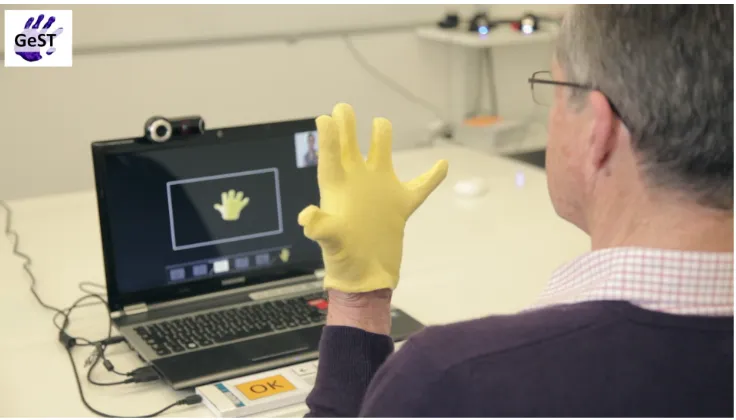
The above issues are being explored in relation to an existing computer gesture therapy tool, GeST (Figure 1).
GeST was created in consultation with representatives with aphasia and is intended to be accessible for self-administered therapy practice by those severely affected by aphasia (Galliers et al., 2011; Gallers et al., 2012). The tool is operated via an accessible, external keypad and uses vision-based gesture recognition to identify practiced
gestures.
GeST software comprises three activity levels; the first providing simple video
presentation of target gestures, the second introducing practice activities within a 3D virtual environment, and the third demonstrating video vignettes of the gestures being used in real-life situations. A pilot trial of GeST with 9 people indicated that regular use over a 6 week period enabled users to produce an increased number of gestures clear enough to be identified by strangers (Marshall et al., 2013).
Methods
[image:3.612.123.491.196.406.2]Building on methods developed within the above pilot trial, the current study will provide GeST therapy to 30 further participants with severe aphasia and measure the effects of its more intensive use over a 5-week period. Measurements of participants’ abilities to demonstrate communicative gestures – both during assessment and
additionally within in a more real-life context - will be taken before and after this period to monitor improvement. To investigate the impact of difficulties with language
processing, sequencing and visuo-spatial skills upon access to computer therapy,
detailed measures of cognition and language will be taken (CAT - Swinburn et al., 2004, CLQT – Helm-Estabrooks, 2001). Results of these assessments will then be examined in relation to the number of hours of computer use and the scale of improvements in gesture made by each individual.
Video recordings of participants using GeST at both early and later stages in their practice phase will be analysed to record instances of successful and unsuccessful interaction with the tool. These will then be examined in relation to individual users’ performance on cognitive and language measures to assess whether the chosen measures can effectively predict levels of successful interaction with GeST.
Finally, a newly developed measure of technology confidence will be used to examine the effect of exposure to GeST on participants’ attitudes towards other everyday
technologies. This aims to further unravel pilot participant reports of having reduced access to technologies such as microwaves, washing machines and computers as a consequence of their aphasia. The technology confidence measure will additionally be administered to an age-matched group of people without aphasia to allow for
interpretation of results in specific relation to the presence of aphasia.
Progress to date
Following the development of research methodology detailed above, data collection for the described project is currently under way. 10 users have so far taken part in the described protocol. A further 20 will receive GeST during the following year. Results will be analysed following completion of data collection.
Intended Contribution and Conclusions
Findings are intended to contribute to the growing evidence base surrounding
technology use in healthcare, specifically in relation to people with aphasia, a group largely under-represented in the existing literature. The analysis of detailed cognitive and language assessment data, as well as timing and usage information, in relation to participants’ communicative gains following computer therapy aims to shed light on issues of efficacy and accessibility in computer aphasia rehabilitation. Furthermore, the collection of data specifically related to reports of confidence in technology-use for people with severe aphasia aims to contribute to a wider discussion regarding the role of language in the successful navigation of the technological systems becoming increasingly integral to many facets of modern everyday life.
References
Allen, M., McGrenere, J. and Purves, B. The Design and Field Evaluation of PhotoTalk: a digital image communication application for people with aphasia. in 9th international
ACM SIGACCESS conference on computers and accessibility. ASSETS’07. (New York,
Bhogal, S.K., Teasell, R., and Speechley, M. (2003) Intensity of aphasia therapy impact on recovery. Stroke, 34, 987 – 993.
Caute, A., Pring, T., Cocks, C., Cruice, M., Best, W. & Marshall, J. (2013) Enhancing
communication in aphasia through gesture and naming therapy. Journal of Speech, Language and Hearing Research, 56, 337-351
Daeman, E., Dadlani, P., Du, J., Li, Y., Erik-Paker, P., Martens, J., and De Ruyter, B. (2007). Designing a free style, indirect, and interactive storytelling application for people with aphasia. Human Computer Interaction – INTERACT 2007, Lecture Notes in Computer Science, 4662/2007, 221- 234.
Galliers, J., Wilson, S., Muscroft S., Marshall, J., Roper, A., Cocks, N., Pring. T. (2011).
Accessibility of 3D Game Environments for People with Aphasia: An Exploratory Study. in
The 13th international ACM SIGACCESS conference on computers and accessibility.
ASSETS’11. (Dundee, UK, 2011), ACM Press, 139-146.
Galliers, J., Wilson, S., Roper, A., Cocks, N., Marshall, J., Muscroft, S., and Pring, T. (2012). Words are not enough: empowering people with aphasia in the design process. in
Proceedings of the12th Participatory Design Conference: Research Papers – Volume 1,
(Roskilde, DK, 2012), ACM Press, 51-60.
Helm-Estabrooks, N. (2001) Cognitive Linguistic Quick Test, San Antonio, TX: The Psychological Corporation.
Katz, R. C., Hallowell, B., Code, C., Armstrong, E., Roberts, P., Pound, C. & Katz, L. (2000) A multinational comparison of aphasia management practices. Int J Lang Comm Dis, 35, 303 – 314.
Koppenol, T., Al Mahmud, A., and Martens J.B, (2010) When Words Fall Short: Helping People with Aphasia to Express. Proc. ICCHP 2010, Part II, 45–48.
Marshall, J., Roper, A., Galliers, J., Wilson, S., Cocks, N., Muscroft, S., and Pring, T. (2013) Computer delivery of gesture therapy for people with severe aphasia. Aphasiology, 27 (9), 1128-1146.
McCall, D., Virata, T., Linebarger, M., and Berndt, R.S. (2009) Integrating technology and targeted treatment to improve narrative production in aphasia: A case study.
Aphasiology, 23 (4). 438-462.
National Aphasia Association Aphasia FAQ page: Retrieved 13th June 2013 from
http://www.aphasia.org/Aphasia%20Facts/aphasia_faq.html.
Swinburn, K., Porter, G. and Howard, D. (2004) Comprehensive Aphasia Test. New York, Psychology Press.
UK Connect charity questions and answers page, (2013). Retrieved 13th June 2013, from Connect: http://www.ukconnect.org/aphasiaquestionsandanswers_302.aspx
About the Author: