R
E
S
E
A
R
C
H
Abstract
To be successful in the competitive workforce markets, graduates nowadays need more than just disciplinary skills and knowledge. The changes in how businesses operate, have brought about the need to develop highly skilled workforce that is equipped with generic skills, such as communication, creativity and problem solving, next to their discipline-relevant knowledge. To provide these sets of skills Universities are engaging in project-based learning with industrial partners. Such modules should provide the development of both sets of skills and thus produce highly employable students. In this paper perceptions of
marketing and engineering students related to the project-based learning outcomes are explored, to determine how they rate the acquisition of relevant employment skills in the studied modules. The findings show, that the students appreciate the project-based approach, specifically with relation to their project management and team-working skills, there is however improvement possible in the discipline-based aspects of their learning.
Key words
project-based learning, disciplinary knowledge, generic skills, case studies, marketing, engineering
1. Introduction
In today’s global environment only the companies with a highly-skilled workforce can handle the competitive edge and nature of the markets. It is therefore crucial, that Universities train highly-skilled graduates that can deliver both, the discipline based skills, as well as more generic attributes, including communication skills, problem solving, collaboration, creativity and critical thinking skills. The 21st century workforce should namely have a new mind and a set of skills that would enable them to work well in the ever-changing business environment (Musa et al, 2012). As Mills and Treagust (2003) note graduates have a good knowledge of their discipline, but are unable to apply that knowledge in practice, indicating the need for greater emphasis on softer skills, relevant in the market place.
In the past decade, different university programmes have undergone an intensive curriculum redesign in order to adapt their educational initiatives to the emerging needs of the 21st century. Globalisation and technological
developments have influenced and changed industrial and business demands, and consequently brought about new social and business rules and norms, (i.e. migration and long distance cooperation using advanced IT
communication channels), which have extensively changed the job roles people undertake.
All these trends represent an additional push that demands from the students that they gain the full knowledge of traditional, core university subjects, along with acquiring valuable competences of teamwork, creative thinking, cooperation, language and presentation skills, at the same time. The way the product lifecycles have shortened, the student’s transition from an educational environment to real life practice has also shortened (Vukasinovic and Fain, 2014). When they leave the University they are expected to have acquired an integrated set of skills that will enable them to lead and manage projects smoothly, with as short as induction as possible.
The response of Universities to these trends placed major focus on developing project-based modules. The main objective of such modules has been to engage the students with the industrial and business environment and teach them the procedures and practices needed to solve different real-life problems in smaller teams.
This paper reflects on two project-based modules, one within marketing and the other within engineering design, to explore the perceptions students have of these approaches and to outline the challenges they might face. Conceptualisation of project-based learning is important for both, students and teachers, due to the growing need to be prepared for the global landscape and to maintain relevance of the curriculum content in relation to the changing cultural and institutional needs (Du et al, 2009). This paper contributes to this conceptualisation through exploring the key learning principles that underpin project-based learning in two separate contexts to validate their applicability across disciplines.
2. Teaching and learning in marketing and engineering environments
2.1 Project-based learning
Literature suggests that project-based learning addresses transfer of knowledge, which may be defined as the ability to extend what has been learned within one context to
Beverly WAGNER, University of Ljubljana, Slovenia
R
E
S
E
A
R
C
H
other, new contexts (Brandsfort et al, 1999). This is an important component of both, engineering competency development (Byrnes, 1996) and marketing management. Emerging evidence suggests that project-based learning encourages and supports collaborative work
(Christophersen et al, 1994); it also improves retention and enhances design thinking (Dym et al, 2005) and bridges the gap between theory and practice (Du et al, 2009). As the work of de Graaff and Kolmos (2003; 2007) suggests these common principles of project-based learning can be captured in three approaches:
collaborative, cognitive and contents learning, which enables adaptation to a given disciplinary needs.
Cognitive learning approach is related to utilizing the users’ experience through a clearly defined project or problem within a project (Kolmos et al, 2009). This normally takes place within a collaborative setting, where teams are created and encouraged to be self-directed. The content within such a setting is usually interdisciplinary, based on translating theory into practice and vice versa.
This ultimately means that the set of skills developed is not based solely on the discipline, but incorporates the transformational skills, such as teamwork and
communication. These become relevant across disciplines, and will be further explored in engineering and marketing education.
2.2 Engineering education
An important characteristic of product development is a high proportion of tacit knowledge (Zavbi and Vukasinovic, 2014). Engineers need an extensive understanding of how things work, how they can be build and what the
relationships between constructs are. Next to clear engineering knowledge, the above mentioned development needs an integrated approach towards engineering education that builds on the five key competences: (1) design capability including intelligence, imagination, creativeness, inventiveness, artfulness, technicality, pragmatism and productiveness, (2) design attitude including the way of thinking about practical creativeness, motivation and inspiration of creating useful things, enjoyment of inventing artefacts and mind set related to materialization and realization, (3) design knowledge, gained through lectures, industrial case studies, projects and self-management, (4) design skills, such as multi-disciplinary cooperation, application of research and design methods, communication and exchange of
technical information, analysis of complex design problems and task allocation, combining creative capacities with system development capacities, project management, and prototyping and testing, and (5) design experience, or the
familiarity gained from seeing and doing things in the course of acting as a designer, and the obtained feelings and reflections related to designing and designs (van Doorn et al. 2008). Project based learning is believed to be one of the most suitable pedagogies for learning engineering design (Zavbi and Vukasinovic, 2014, Christophersen et al, 1994, Dym et al, 2005). It facilitates knowledge transfer, encourages and supports collaborative work and improves design thinking skills. It is also widely accepted that it stimulates the development of various tacit knowledge of students and teachers (Inkpen and Dinur 1998, Eris and Leifer 2003, Frishammar and Ylinenpää 2007).
Despite this apparent emphasis on the relevant skills, engineering curricula is still too focused on engineering science and technical skills and does not provide an overall design experience to students (Mills and Treagust, 2003). Furthermore, due to this structured approach, graduates do not receive sufficient training in communication and team work. Project-based learning presents an opportunity for students to gain these skills through interdisciplinary learning within a wider business or industry context. Mills and Treagust (2003) suggest that this provides students with a wider understanding of the applicability of their engineering skills and knowledge.
2.3 Marketing education
R
E
S
E
A
R
C
H
things in extremely short periods of time, based
predominantly on a critical review and analysis of what is happening in the business and social environment.
Different approaches in practice therefore demand different approaches in teaching. What the students need to learn, understand and acquire is not only the concepts relevant to the practice of marketing, but also the skills relevant to dealing with constant change in their social, political, technical and economic environment. The marketing discipline “values insights generated from the variety of different paradigmatic positions to be found in the discipline” (Shankar 2009, cited in Brownlie et al 2009: 640), and therefore students need to embrace and understand these positions to be able to become part of the marketing communities of practice in their professional lives.
As Middendorf and Pace (2004) propose, learning to think and work as a marketer is more complex that generally appears to be the case to professionals in marketing and students therefore need a chance to perfect the skills in order to succeed. This is achieved through active, collaborative and inquiry-based learning. The engagement between students and teachers is high throughout their time at the University and most of the interaction is case-based, giving the students insight into modern practices and professional approach towards marketing. In that sense, marketing discipline can be classified as pedagogy of uncertainty (Shulman, 2005). Not just the practice of marketing but the knowledge transfer between teachers and students is highly interactive and characterised by risk taking, excitement and uncertainty. Applying the theoretical concepts to practical examples is the baseline of teaching in marketing, along with critical thinking and reflection on established practice. This suggests marketing students engage in project-based learning early on in their curriculum, therefore the integration of their cognitive, collaborative and content learning is more balanced.
Methodology
This study employed a quantitative approach to explore the relevance of discipline-based and generic skills for
engineering and marketing students. The two disciplines were chosen, as they stem from two different perspectives of doing business, thus they could provide relevant insight into what approaches would need to be further integrated in education to enable further development of
‘employable’ graduates. Marketing as a discipline is heavily based on integrating theory and practice, thus project-based learning is embedded into the curriculum from early stages of education, whereas the engineering education needs to provide the student with strong discipline-related
skills at the forefront, to enable translation of knowledge into practice. As indicated above, the development of different sets of skills seems to be relevant for the two disciplines, thus an integrated exploration would enable insight into the successful delivery of project-based learning within a wider context.
The participants of the study were Master students of engineering and marketing that were engaged in two different project-based modules. The marketing students participated in solving an industrial marketing problem, whereas the engineering students were engaged in developing a new product for an industrial partner. The objectives of both project-based modules was to provide a reach, real-life situation for the students, so they can experience a work type situation within their discipline. Both groups of students had to engage with a real company in providing a solution to the problem and at the end of the modules presented their findings and
recommendations to the client.
The questionnaire used to explore the perceptions of the chosen students was developed based on previous studies (for details see Musa et al, 2012 and Okudan and Rzasa, 2006) and contained 49 items. The first part measured the student perception of discipline relevant skills, whereas the second part of the questionnaire focused on
measuring the students perception of how successful their project-based learning was in improving their teamwork, project management, communication skills and
interpersonal skills. Students were also asked about their perception of the teaching approach and final results of the module. The questionnaire employed a 1-5 Lickert type scale with 1 being ‘strongly disagree’ and 5 being ‘strongly agree’. Later in statistical analysis this scale was shifted accordingly to +-2 scale for better graphical presentation of the results.
The students were also asked to comment on the overall satisfaction with the modules in an open-ended question. Some of their comments will be elaborated upon in support of the survey findings.
40 marketing and 32 engineering students participated in the survey, giving a comparable sample to explore project-based outcomes for both disciplines.
Findings
R
E
S
E
A
R
C
H
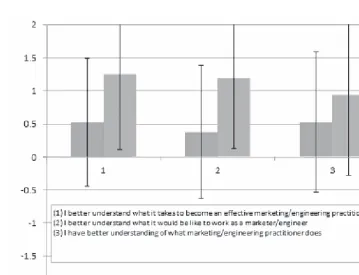
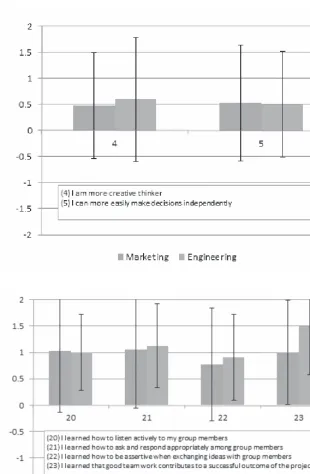
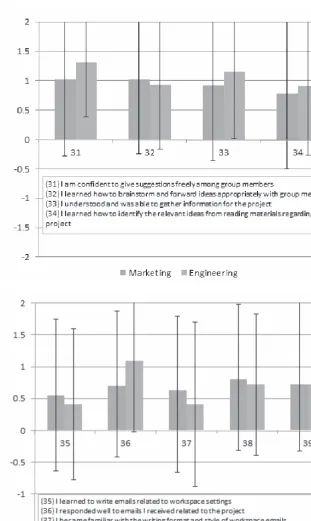
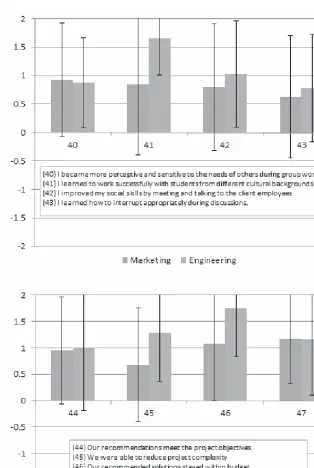
will be analysed to provide further insight into the project-based approach. The results are graphically represented in charts on Figures 1 to 7, where solid columns represent average value while narrow interval bars represent +-sigma/standard deviation value.
The first questions the students were asked related to the discipline based work. They had to express their agreement with the following statements: (1) I better understand what it takes to become an effective marketing/engineering practitioner; (2) I better understand what it would be like to work as a marketer/engineer, and (3) I have better understanding of what marketing/engineering practitioner does.
Figure 1 shows the responses to the relevant questions, where above 0 is ‘agree’ (1) and ‘strongly agree’ (2) and below 0 is ‘disagree’ (-1) and ‘strongly disagree’ (-2).
As can be seen, the engineering students perceived the relevant disciplinary gain stronger than the marketing students. This can be explained through the fact that the discipline itself requires strong discipline-related knowledge (Zavbi and Vukasinovic, 2014), whereas marketing is at the intersection of several different skills, thus it might have not been completely clear to the students, which ones are solely related to practicing marketing (Shulman, 2005). This is in line with the pedagogies suggested for the two
disciplines in theory. For engineering students their
engineering knowledge became visible through the project-based approach, whereas for the marketing students the approach was considered business as usual, thus they were less able to gage the benefits project-based learning brings to them in relation to disciplinary knowledge, as they have been educated in this way from the beginning.
The students were then further asked to evaluate, if they are (4) a more creative thinker and (5) can make decisions more independently as the result of the project-based learning. As Figure 2 shows, the results are just above average, indicating that both, marketing and engineering students acknowledge they have learned these general skills, however it seems further focus needs to be placed on making these skills more explicit and relevant to the students.
The students were also asked about their perception of team working within the project. They evaluated how they: (20) learned to listen actively to other team members, (21) learned how to ask and respond among the team members, (22) to be assertive while exchanging ideas with other team members, and (23) teamwork contributes to a successful outcome of the project (Figure 3).
[image:4.652.71.430.129.403.2]Interestingly enough, both groups of students responded similarly and confirmed that team working contributed to a
R
E
S
E
A
R
C
H
successful outcome of the project. Engineering students felt stronger about this, indicating that the explicit result that they were able to see, touch and feel at the end of the project potentially contributed to this.
The students were further asked about their project management activities: (31) giving suggestions freely among team members, (32) brainstorming and forwarding ideas within the team, (33) gathering information for the project, and (34) identifying relevant ideas from reading project material (Figure 4).
Again, both of the groups agreed that these skills
[image:5.652.60.371.115.590.2]influenced the project outcomes. For engineering students the sharing of suggestions was the key skill that was supported through their project-based learning, whereas the marketing students placed more emphasis on brainstorming. This again indicates the relevance of discipline-based skills. The engineering students engage with similar developments throughout their education and thus writing reports and gathering information for the project is something they have been doing so far, whereas for marketing a structured brainstorming approach might be a novelty.
Figure 2. Student responses on general skills.
R
E
S
E
A
R
C
H
The next set of questions explored the perceptions of communication-related skills such as: (35) writing emails related to workplace settings, (36) responding to project-related communication, (37) writing format of workplace communication, (38) organising ideas in preparation of interim reports, and (39) writing reports based on findings (Figure 5).
[image:6.652.75.387.119.640.2]It is interesting to note (Figure 5) that engineering students appreciated the development of skills related to project-based communication more, whereas the marketing students placed greater emphasis on written communication. This might be due to the fact that engineering students engage in lab work and writing reports on a more regular basis and therefore consider this as business as usual, whereas the marketing classroom
Figure 4. Student perceptions of project-relevant skills.
R
E
S
E
A
R
C
H
work is more discussion based and thus their
communication skills are developing on a more regular basis.
The final two sets of questions investigated the relevance of gaining interpersonal skills (Figure 6) and the satisfaction with the project outcomes (Figure 7). The students evaluated if they: (40) became more perceptive and sensitive to the needs of others during group work, (41) learned to work successfully with people from other cultural backgrounds, (42) improved their social skills through interaction with the team and the client, (43) learned how to interrupt appropriately during discussions.
With regard to the project outcomes they evaluated how and if (44) their recommendations met the project objectives, (45) they were able to reduce project complexity, (46) their recommended solution stayed within the budget, and (47) their outcomes met the company’s needs.
[image:7.652.59.373.123.591.2]It is interesting to note the relevance of working with different cultural backgrounds for the engineering students. The results might come from the fact, that this was the first interaction of the students beyond their home University and thus their experience at this point was limited.
Figure 6. Student perceptions of interpersonal skills.
R
E
S
E
A
R
C
H
Marketing students have engaged with different cultures from the start on the other hand and placed more emphasis on sensitivity to others. Marketing courses teach students to be sensitive to specific target groups,
considering social or cultural differences, while basic engineering courses teach students to solve core technical problems, which are generally culturally independent, so most engineering students had practically no intercultural working experience prior this course.
Engineering students did not collaborate with the students coming from different cultural environments to the common place, i.e. the same University, taking the same study programme, but had to cooperate with students who were living in different cultural environments, following different curriculums during the time-being of the project. This experience emphasised their first inter-cultural experience even more.
Both groups seemed to be satisfied with the project outcomes, not surprisingly the engineering students emphasised the relevance of reducing project complexity, whereas marketing students focused more on the relevance of the outcomes to the client.
These individual results indicate that overall the students did acknowledge the relevance of both, disciplinary and transformational skills, however engineering students placed more emphasis on the later, as these skills were somewhat new to them. This supports the notion that project-based learning engages students on all three levels: cognitive, collaborative and content (Du et al 2009).
To explore the topic further, a set of constructs relevant for this study was calculated and explored: discipline, team
work, project management, communication, interpersonal skills and the teaching approach. To ensure reliable data was gathered on the relevant constructs, a reliability analysis was performed for both groups of answers. The results are shown in Table 1. As can be seen, all Chronbach Alpha’s are above .7 indicating a sufficient reliability for the studied constructs. This resulted in variable transformation being performed, to enable the exploration of the relationships between the key concepts.
Means were calculated for the constructs to show overall perception of the students in relation to the studied constructs. Interestingly, the marketing students seemed to be less satisfied with the project results, compared to engineering students, whereas the engineering students were critical of the project process. It seems the major benefit for both groups were project management and team working skills. This supports current findings within the field, as other studies have shown that a successful project is a result of effective teamwork, which also helps to develop individual soft skills, such as project
management (Musa et al, 2012). What is worth noting is the contrast in perception of how the process of
[image:8.652.71.541.128.318.2]elements of uncertainty and unpredictability that has numbers of various origins (e.g. wrong, insufficient or changes of project input parameters, communication issues, management problems, etc.). On the opposite, marketing students rely on communication and creativity more and focus on management of the project rather than the process (i.e. Okudan and Rzasa, 2006). It is however worth noting that both groups of students value the project-based approach mostly above average and also appreciate the learning process.
Generally, engineering goals are more specific, which requires also specific paths, and does not support wider deviations from the goal course (path is the function of the goals), while in marketing, it is more difficult to specifically determine the goals, which allows broader exploration of various paths to obtain optimal results (goal is the function of the paths). First, engineering approach can thus cause unexpected problems and frustrations as engineers have to follow specific path to achieve the goal set in advance. However, this approach enables clear evaluation of final achievements. On the opposite side, marketing approach gives much more freedom and less frustration to choose the ways to the final goal, but open opportunities always leave some doubts, if something else and better could be achieved at the end.
These findings are further supported by the answers students gave, when asked about why they chose the module. 28 out of 40 marketing students emphasised the link between theory and practice that the project-based approach enabled. As one of the student commented “the course is more practical and provides opportunities to utilize the knowledge learned in real life.” This was also evident with the engineering students, as 14 out of 32 chose the course as it included working on a real-life engineering problem. Interestingly though, 22 out of 32 engineering students emphasised that teamwork was the most beneficial skill gained, whereas the answers from marketing students were more scattered and included leadership, active learning, time management and corporate engagement as some of the key skills learned.
Discussion and conclusions
The presented study aimed at exploring how project-based learning is perceived among different disciplines and marketing and engineering were studied to provide some insight.
According to Ramsden (1984) manipulation of concepts and objects, procedure building and emphasis on rules and methods go hand in hand with operational learning, usually characteristic for science approaches to learning,
whereas interpretation of relationships between general concepts is usually more likely to be associated with learning in social sciences and arts. Our results are coherent with his findings, as the students’ evaluation of project process and outcomes reflects that marketing students placed major emphasis on the relationships and process, whereas the engineering students were more outcome oriented. This somewhat contradicts Welsh and Dehler (2012), who propose that design and design thinking are at the heart of user-centred processes and should thus be employed across disciplines to enable integrative learning. The findings in this study indicate, that although at opposite poles of disciplines, the two studied project-based learning approaches are both developing student’s user-centred approach regardless of their discipline. The key are transformational, general skills and no matter the discipline, a project-based approach can provide student with an integrative learning experience, making them more employable in the future.
References
Bransford, J. D., Brown, A. L., Cocking, R. R. (Eds.) (1999), How People Learn: Brain, Mind, Experience and School; National Academy Press; Washington, D.C.
Brownlie, D., Hewer, P. & Tadajewski, M. (2009) Thinking ‘Communities of Academic Practice’: on space, enterprise and governance in marketing academia. Journal of Marketing Management, (Vol 25(7/8), pp. 635-642).
Byrnes, J.P. (1996) Cognitive Development and Learning in Instructional Contexts. Allyn and Bacon; Boston, Massachusetts.
Christophersen, E., Coupe, P. S., Lenschow, R. J., & Townson, J. (1994) Evaluation of Civil and Construction Engineering Education in Denmark. Centre for Quality Assurance and Evaluation of Higher Education in Denmark, Copenhagen.
Cooper R.G. (2014) What’s Next?: After Stage‐Gate Progressive companies are developing a new generation of idea‐to launch processes. Research‐Technology
Management. (pp. 20‐31).
Du, X. Y., De Graaff, E. and Kolmos, A. E. (2009). Research on PBL Practice in Engineering Education, Sense
Publishers.
R
E
S
E
A
R
C
Dym, C.L., Agogino, A. M., Eris, O., Frey, D. D., & Leifer, L.J. (2005) Engineering Design Thinking, Teaching, and Learning. Journal of Engineering Education(Vol. 94(1), pp. 103-120).
Eris, O., & Leifer, L. (2003) Facilitating Product
Development Knowledge Acquisition: Interaction between the Expert and the Team. International Journal of Engineering Education,(Vol 19(1), pp. 142–152).
Frishammar, J., and Ylinenpää. H. (2007) Managing Information in New Product Development: A Conceptual Review, Research Propositions and Tentative Model. International Journal of Innovation Management, (Vol 11(4), pp. 441–467).
Graaff, E. de & Kolmos, A., (2003). Characteristics of Problem-based Learning, International Journal of Engineering Education, Vol. 19, No. 5, p657-662.
Graaff, Erik de and Kolmos, Anette., (2007). Management of Change Implementation of Problem Based and Project-Based Learning in Engineering, Netherlands: Sense Publishers.
Inkpen, A. C., & Dinur, A. (1998) Knowledge Management Processes and International Joint Ventures. Organization Science, (Vol 9(4), pp. 454–468).
Kolmos, A., de Graaff, E., & Du, X. (2009). Diversity of PBL—PBL Learning Principles and Models. In X. Du, E. de Graaff & A. Kolmos (Eds.), Research on PBL Practice in Engineering Education(pp. 9-21). Rotterdam: Sense.
Middendorf, J. and Pace, D. (2004) Decoding the disciplines: A model for helping students learn disciplinary ways of thinking. New Directions for Teaching and Learning, 2004
Mills J E and D F Treagust (2003). Engineering education— Is problem-based or project-based learning the answer? Australasian Journal of Engineering Education, 3 (2), 2-16.
Musa, F., Mufti, N., Latiff, R. A., & Amin, M. M. (2012) Project-based learning (PjBL): inculcating soft skills in 21st Century Workplace, Procedia - Social and Behavioral Sciences (Vol. 59, pp. 565-573).
Okudan, G. E. and Rzasa, S. E. (2006) A project-based approach to entrepreneurial leadership education. Technovation(Vol. 26, pp. 195-210).
Ramsden, P. (1984). The context of leaning. In F. Marton, D. Hounsell, and N. Entwistle, N. (eds), The experience of Learning. Edinburgh: Scottish Academic Press.
Shankar, A. (2009) Reframing critical marketing. Journal of Marketing Management. (Vol. 25(7-8), pp. 681-696).
Shulman, L. S (2005) Pedagogies of Uncertainty. Liberal Education. Also at: http://www.aacu.org/
liberaleducation/le-sp05/le-sp05feature2.cfm
van Doorn, E., Moes, N., & Fain, N. (2008) Attitude development in designer's education. In: Proceedings of the TMCE 2008.
Vukasinovic, N. & Fain, N. (2014). A decade of project based design education: is there a future? Paper presented at the Proceedings of 13th International Design
Conference, Dubrovnik, Croatia.
Welsh, M. A., & Dehler, G. E. (2013). Combining critical reflection and design thinking to develop integrative learners. Journal of Management Education, (Vol. 37, pp. 771-802).
Zavbi, R. & Vukasinovic, N. (2014) A concept of academia-industry collaboration to facilitate the building of technical and professional competencies in new product
development. International journal of engineering education. (Vol. 30(6), pp. 1562-1578).