City, University of London Institutional Repository
Citation
:
Panourgias, N.S., Nandhakumar, J. and Scarbrough, H. (2014). Entanglements
of creative agency and digital technology: A sociomaterial study of computer game
development. Technological Forecasting and Social Change, 83(1), pp. 111-126. doi:
10.1016/j.techfore.2013.03.010
This is the published version of the paper.
This version of the publication may differ from the final published
version.
Permanent repository link:
http://openaccess.city.ac.uk/4293/
Link to published version
:
http://dx.doi.org/10.1016/j.techfore.2013.03.010
Copyright and reuse:
City Research Online aims to make research
outputs of City, University of London available to a wider audience.
Copyright and Moral Rights remain with the author(s) and/or copyright
holders. URLs from City Research Online may be freely distributed and
linked to.
Entanglements of creative agency and digital technology:
A sociomaterial study of computer game development
Nikiforos S. Panourgias
a,⁎
, Joe Nandhakumar
a, Harry Scarbrough
ba
Information Systems and Management Group/Innovation, Knowledge and Organisational Networks Research Centre, Warwick Business School, University of Warwick, Coventry, CV4 7AL, UK
b
Keele Management School, University of Keele, Staffordshire, ST5 5BG, UK
a r t i c l e i n f o
a b s t r a c t
Article history:
Received 2 December 2011
Received in revised form 29 March 2013 Accepted 30 March 2013
Available online 30 April 2013
Digital technology, with its distinctive characteristics that result from the fundamental process of digitalization that underpins it, is seen as fundamentally altering processes of creativity. However, we currently have limited understanding of creativity in relation to the development of digital technology. Computer game development, with its combination of esthetic, affective and cultural use features and highly sophisticated digital technologies, is a valuable setting for investigating these issues. In this paper, we explore how computer games are shaped through the interplay between the creative intentions of developers and the digital technologies involved in their production and playing. Drawing on in-depth studies conducted at three leading computer game development studios and a leading producer of the software system used in game development, this paper shows how the game developers' creative ideas for imagined novel game-playing experiences relate to a) the development of relevant digital technologies, and b) the emergence of new game development practices. The article goes on to propose a view of creativity as an on-going flow that, following an initial‘creative impulse’, ripples through the sociomaterial entanglements of a particular setting, reconfiguring them in the process and spreading out in time and space in often unexpected ways.
© 2013 The Authors. Published by Elsevier Inc. Keywords:
Computer games Creativity Digital technology Creative agency Practices Sociomateriality Game engines
1. Introduction
Creativity and its relation to technological innovation are increasingly of interest to both researchers [1–5]and policy makers alike[6–11]. Recently, much interest has been directed towards the role of digital technology in reconfiguring creative and cultural industries such as advertising, architecture, fashion, music, film, publishing, performing arts, and design[10,12–17]. Less attention has been given, however, to how creativity and creative intentions in such areas are related to the development
of digital technologies. In this paper, we seek to address this under-researched relationship between creativity and digital technologies. Moreover, in doing so we aim to avoid the dichotomies between the technological (material) and the creative (social/human) elements of agency and production that have limited the analysis of this relationship in the past
[18–22].
The broad aim of this paper, then, is to contribute to theory in this area by improving our understanding of creativity in relation to the development of digital technology. We focus this concern empirically through a study of the way in which game developers' creativity and digital technologies are mobilized in the production of computer games, focusing on the central technological artifact of the‘game engine’.
The computer game sector is seen as relevant to the exploration of creativity in relation to digital technology because the development of computer games involves combining the esthetic, affective and cultural features that are crucial to new ⁎Corresponding author. Tel.: +44 24 76150909; fax: +44 24 7615 0498.
E-mail addresses:[email protected](N.S. Panourgias),
[email protected](J. Nandhakumar),[email protected]
(H. Scarbrough).
0040-1625 © 2013 The Authors. Published by Elsevier Inc.
http://dx.doi.org/10.1016/j.techfore.2013.03.010
Contents lists available atScienceDirect
Technological Forecasting & Social Change
Open access under CC BY license.
playing experiences with the highly sophisticated digital technologies that support them. To date, only limited attention has been given to this dynamic interplay between creative intentions and emerging digital technologies[23–28]. Our study seeks to address this gap in the literature by focusing on the implications of the‘game engine’ —the software (sometimes referred to as middleware) that interacts with the hardware of the platform (e.g. console, PC) on which the game will be played, to help realize novel, game-playing experiences. This focus is chosen because the game engine seems to present an important technological constraint on what can be done in a game (e.g. in terms of graphics or gameplay)[29,30]. For example, 3D objects cannot be rendered on the screen if the game engine is only capable of supporting and displaying 2D graphics. If a particular imagined game-playing feature in the design of the game is not supported by the game engine, it cannot be implemented in the game unless the game engine can be modified to support it. Furthermore, because of the interdependence between the game engine and the hardware of a console or PC on which the game is to be played (e.g. computer chips, memory capacity, graphics accelerators, drivers), even if the game engine can be modified to support a feature, the final result may be too functionally unstable to be useful. Thus, the game might slow down because the rendering of high quality graphics uses too much of the processing capacity or memory of the hardware platform.
One approach through which we can gain a better insight into these interdependencies without recourse to dichoto-mizing human and material agency is the ‘sociomaterial’ analytic perspective[18–22,31–37]. Adopting this approach in our study, therefore, enables us to view human and material agencies as constitutively‘entangled’, thus contrib-uting novel insights to the understanding of the relationship between creativity and digital technologies.
The remainder of this paper is arranged as follows. First, through a review of past work on creativity from a number of different fields of enquiry, we identify and present key aspects of how creativity and digital technology development relate to each other. Second, we discuss how the research approach we adopt focusing on‘sociomaterial entanglements’can provide a new way of understanding the relationship between human agency and materiality that avoids artificial dualisms and reductions. We then go on to describe our empirical setting and present our account and analysis of the interplay between the conceptualization of novel game-playing experiences by the developers and the development of‘game engine’technology. We then draw on the empirical account to discuss the findings and the implications of these findings for theory, finishing with an outlining of some brief conclusions.
2. Conceptualizing creativity
The notion of creativity is at the center of interest in a number of fields. In psychology the focus has tended to be on creativity in relation to insights, traits, and behaviors of individuals and their thought processes [38,39]. Beyond psychology, creativity has been proposed as a fundamental part of all agency[40]denoting a“phase of action that emerges in response to the interruption of habitual activity”in action-based theorizations of macrosocial phenomena[41]. In many areas of enquiry, however, there has been a growing move towards social views of creativity that
focus on the relationships and interactions of individuals with each other and the external world [42–46]. Most prominent among such views is the position of Bourdieu, who rejects the “charismatic ideology of creation”found in studies of cultural production and which“directs the gaze towards the apparent producer”[44]. Instead, Bourdieu sees the creative autonomy of agents as always conditioned by a‘field’in which agents struggle for possible positions in relation to the ‘capital’ — resources which can be economic, political, cultural, and symbolic[44]—of that field. Seen in this way, creativity is located in the relations between ‘habitus’, ‘field’, and ‘capital’ which condition the autonomy of an agent. Central to this analysis is the concept of what Bourdieu terms the“space of possibles”, which addresses the factors that constrain and facilitate this positioning. This space defines“the thinkable and the unthinkable, the do-able and the impossible for agents in the field”[46]depending on“the categories of perception constitutive of a certain habitus”[44]
and enables agents to “see possible courses of action and intervention” [46]. Creative moments are, therefore, always “dependent on the possibilities present in the positions inscribed in the field”[46]and creative action is part of a“habitual and embodied action that admits the possibility of intelligent and strategic improvisation, at least within existing cultural frame-works”[41].
Creativity in terms of the relationship between the individual and the environment has also been theorized through a systems approach that focuses on the broader social, organizational, cultural and symbolic domains of the environ-ment and how these relate to the individual involved in a creative endeavor[42]. In this view, creativity and novelty are defined in contrast to“existing objects, rules, representations, or notations” that constitute these domains, by affecting changes to these that are“transmitted through time”[42]. The focus of investigation then becomes to identify how creativity and novelty are produced through the interactions between social fields, cultural domains, and individuals. Other studies in this direction have focused on how creativity and innovation are generated in organizations [1–5,23], how organizational arrangements relate to the creative outputs of individuals
[47–50], and the importance of collective as well as individual creativity can be accounted for [51]. There is also a growing interest in creativity at a more macro level in studies of management and public policy in relation to“creative indus-tries”and“cultural industries”and what distinguishes these from each other and from other industries[6,10,11,52,53].
Much existing literature relating to creativity is concerned with the recombination of existing ideas, forms, and tech-niques as a way of arriving at new solutions and addressing new situations[51,54]. Other studies have viewed creativity in terms of explicitly esthetic, affective, and cultural concerns of particular art forms and how these can relate to issues of organization and management associated with the develop-ment of‘cultural products’[52,55–58]. Such cultural produc-tion is seen as depending on the imaginaproduc-tion and ideas of those developing the product but which are bounded by motifs, forms, genres, and techniques in general use[10,11,23,25,28].
2.1. Creativity and technology
it is the technology of pigments and color in relation to drawing and painting [59], construction technologies in relation to architecture[60,61], or the introduction of the synthesizer to music [62,63], the materiality of technology seems to both enable and constrain what is possible in terms of the realization of ideas and conceptualizations for cultural products[64].
Digital technology has distinctive characteristics that result from an underpinning process of digitalization, and is seen as fundamentally altering processes of innovation and creativity
[65,66]. The interplay between ubiquitous digitalization and the convergence between representational forms has resulted in the blurring of conventional distinctions between‘ techno-logical’ products centered on operational functionality and ‘cultural’ products whose production and consumption is subject to socially complex and subjective responses [67]. This poses some new questions about creativity and digital technology, including whether there is something distinctive and definable that can be termed‘digital creativity’.
With digital technology becoming increasingly part of what Bourdieu terms‘cultural production’, the relationship between the symbolic, esthetic, and affective concerns of those developing cultural products and the technologies involved in their production and distribution has become more significant and problematic. This problematic relation-ship can be traced back to the early introduction of digital technology into the domain of cultural production, when tensions began to emerge (and persist) between‘ program-ming’ and ‘creativity’. Writers have asked, for example, whether it is necessary for artists using digital technology to be able to write their own computer code or whether they risk being“slaves to the significant decisions”of those who make the technologies[68]. Alternatively, others have argued that creativity in such a context might be better understood in terms of the dynamics of an agent's“creative knowledge and expertise”, and the agent's ability to“liaise with experts in other fields” [68]. Furthermore, digital technologies are constantly and rapidly evolving, “not just in the technical sense”(e.g. increasing CPU power, new storage media) but in the more sophisticated sense of“new computing paradigms” which change the structuring of “creative aspirations and performance”[68]. In addition, there is also the question of whether creativity is involved in the programming itself and not simply the cultural production which the programming supports.
2.2. Creativity and computer game development
Many of these issues arise in relation to the development of computer games, making this a valuable research setting in which to examine the researched and under-theorized relationship between creativity and digital tech-nology. For example, game developers, regardless of their area of expertise, rely on a plethora of software applications and digital tools (e.g. 3D digital art processing packages, digital animation packages, game-world editors) to develop their inputs for a game. Many of these are off-the-shelf software products, but some may be specifically adapted to their needs or have been adapted or even developed in-house. There are digital technologies involved in games (e.g. what is referred to as the ‘game engine’), however, which are more than the‘tools of the trade’of the developers
in their day-to-day work but which go, instead, to the heart of how a computer game works and is rendered by the electronic hardware on which it will be played. These affect the creative aspirations of the developers to a greater extent
[30,69] in terms of: how graphics are rendered on the computer screen as a game is played; what quality this rendering can have; how much memory or CPU power will be used during a scene; what kind of movements the characters can make; where they can go; what can be seen of the game-world in a particular moment; and so on.
There is an expanding body of research focusing on computer games and the creativity and organizational arrangements involved in their development. One such study by Tschang examined how competing business and production interests in game development studios have resulted in an increasing tension between rationalization and creativity and shifts“between more and less innovative products”[23]. Others have focused on how game firms have attempted to manage the tension between“creativity and expression of artistic values”and “the economics of mass entertainment”[25]. Another study argues that the distinctive development process for computer games, that combines aspects of traditional project management (e.g. well-defined scope, deadlines and budgets) with the flexibility needed for creativity, might move towards greater “professionalism” through particular leadership approaches and an“ institution-alizing of creativity”[28].
Different notions of creativity underpin these key studies. Tschang adopts a combinative view of creativity[4,51]where the difference between creativity and innovation is small, and new products are developed through the recombination of existing ideas from different sources into new products[23]. Creativity, thus, underlies the“development of the next dominant designs, linking innovative behavior in the form of an organizational model of search and adaptation to the evolution and possible emergence of such designs”[23]. Similarly, there is an implicitly combinative view of creativity in the study of computer game development by Cohendet and Simon where creativity results from the bringing together and integrating of inputs from different“communities of specialists”, and results depend on the way this integration is achieved and the degree of tightness or slack imposed on the dynamics of those relations[25]. For Zackariasson et al. on the other hand, while there is an association between the concepts of innovation and creativity, the“revelation, surprise, or astonishment”found in creativity is seen as distinguishing creativity from innovation[28]. This, in turn, has important practical implications in the management of the development of computer games because, unlike innovation and new product development, these aspects of creativity make it difficult to anticipate, specify, and quantify goals. Goals thus have to remain emergent—resulting in progress being difficult to ascertain as ends and means become complexly intertwined
[28].
Taken together, the different strands of work highlighted above raise important questions regarding the relationship between creativity and digital technology found in computer game development in terms of the boundaries between technological development and creative endeavor and the implication this has on the locus and nature of creative agency. Motivated by these concerns, through our study of computer game development we sought to address the overarching question of the dynamic interplay between creativity and digital technology, and how that interplay can be better addressed in our theorizing. This concern was then reflected in two further questions. The first, being as follows: ‘How does creative agency manifest itself within computer game development, and how does this relate to the development of technological innovation within that sector?’ And the second: ‘How does a focus on the ‘sociomaterial entanglements’of human and material agencies enhance our understanding of this interaction between creative agency and the design of digital technologies?’
3. Research approach and setting
A central challenge in studying the relationship between digital technology and creativity in the development of computer games is how to reconcile analytically the techno-logical and the human/social in a way that avoids resorting to conventional reductions and dualities in favor of one or the other. Theoretical approaches to this relationship that consider the technological and social as inextricably entangled in sociomaterial practices[20–22]can help shed a new light on the relationship between digital technology and the conceptu-alization of products with important affective and cultural dimensions such as computer games, thereby contributing to the theorization of‘digital creativity’.
3.1. Sociomateriality and the following of entanglements
The sociomaterial perspective rejects the conventional view that things, technologies, people, and organizations have inherently determinate meanings, boundaries, or proper-ties[32], making them self-contained entities that influence each other through impacts or interaction[20]. Rather, they are seen as constitutively entangled and separable only for analytical purposes. Hence, the focus of research informed by this perspective is on the temporal unfolding and reproduction of meanings, boundaries, and properties through the tracing of the sociomaterial entanglements of human and material agencies that contribute equally to the building of further sociomaterial associations[33].
While elaborated in greater depth elsewhere [22], the notion of sociomaterial entanglement effectively involves moving away from an idea of interactions of separate entities “with inherent boundaries and properties” to one where there is an“ontological indeterminacy”, that is, an insepara-bility of agentiallyintra-acting ‘objects’and ‘agencies’[31]. While the notion of interaction presumes pre-formed sub-stances of entities that enter into relations, intra-actions perform relations such that“the boundaries and properties of the‘components’of phenomena become determinate”[31]. Objectsemergefrom these intra-actions and do not precede or cause them. The meshes of“intra-actions”between many
entities in flux give shape and substance to them (even if temporarily and locally), and perform relations that provide distinctions[72]. Agencies gain specificity and directionality through their developing relationality; their performed relations[32]. It is in the“ongoing flow of agency through which (…) causal structures are stabilized and destabilized” and“relations of exteriority, connectivity, and exclusion are reconfigured”, with agency not being“an attribute, but the ongoing reconfiguring of the world” [32]. Differentiating, therefore, is not about “othering or separating but on the contrary about making connections”[32].
By focusing on the entanglement of things and people in the co-development of both novel game-paying experiences and digital technologies in the development of computer games, our study seeks to show how the temporal unfolding of these entanglements takes place and what this tells us about the distinctive character of creativity.
3.2. Empirical focus
The central focus of our investigation was the relationship between game developers' desire to create novel game-playing experiences and the‘game engine’. The‘game engine’is a crucial part of a computer game, being the software that interacts with the hardware of the target platform (e.g. console, PC) on which the game will be played, translating the digital objects that make up the game (referred to by game developers as“assets”) from the specific formats they were originally developed in, into the code that can be run by the different hardware components of the game platform[29,30,69,73]. The rendering component of the engine, for example, generates on the screen the 2D and/or 3D graphics for the game from a mathematical description of objects based on geometry, viewpoint, texture, lighting, and shading information. The‘physics engine’deals with collision detection and responses using algorithms that check for the intersection of two given mathematically represented ‘solid’ objects, simulating what happens once a collision is detected and without which characters would go through walls and other obstacles. It is also the‘game engine’that handles sound processing[73], scripting control for calling up other software applications in the game, animation, the artificial intelligence through which characters not controlled by the player(s) interact in the game[30], networking needs, data streaming, memory management, threading, streaming, and the scene graphs that arrange the logical and spatial representation of a graphical scene[69,74,75].
3.3. Research setting
The research setting for our study encompassed three leading UK-based computer game developer studios (GameCo1,
GameCo2 and GameCo3 —all pseudonyms) and one of the
leading developers world-wide of the‘physics engine’ compo-nent of‘game engines’(EngineCo—pseudonym).
on behalf of external publishers and intellectual property rights holders.
The second site was GameCo2, a leading game development company that since its formation in 1997 has developed a series of commercially successful, critically-acclaimed and award-winning strategy, action role-playing, and simulation games.
The third study was conducted at GameCo3. Since its establishment in 1992, GameCo3 has, through the acquisition of other UK studios, become one of the largest UK computer game developers; what has started to be referred to in the UK game development sector as a “superstudio”. The company produces games both under its own brand and for third-party clients and has enjoyed significant commercial success. It is now a multi-platform and multi-genre developer operating out of four different locations around the UK. In addition to its game business the company also has some print publishing activities.
Since its founding in 1998, EngineCo has become a leading provider of real-time collision detection and physical simulation middleware used in ‘game engines’by computer game de-velopers and by digital graphic animation studios world-wide. Its‘physics engine’component is in over 250 launched computer game titles, with many more in development.
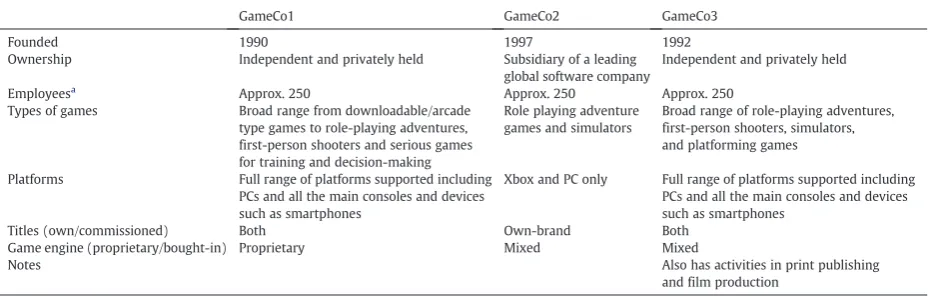
Of particular interest in the choice of these sites were: a) the spread they provided in terms of the relationships they had in place between game developers and game engine technolo-gies, and b) the chance afforded by the use of one of the development studios of the‘physics engine’of the game engine supplier studied. Key differences and similarities between the three studios are presented inTable 1below.
In terms of the different arrangements regarding the use of game engine technologies, GameCo1 developed its own game engines through its own in-house game engine technology unit, which, in addition to supplying them to the GameCo1 studio also licenses them to third-party clients for use in their own games.
The game engines at both GameCo2 and GameCo3, were a combination, assembled/integrated in-house, of in-house and externally supplied components. It was the‘physics engine’ component of GameCo2's game engine that was developed and supplied by EngineCo.
The relationship between GameCo2 and EngineCo meant that it was possible to observe directly as they occurred, issues relating to how new game-playing experiences imagined by the developers at GameCo2 would come-up against specific limitations of the game engine and how the developers went about trying to overcome them. It was then possible to supplement these observations with targeted interviews of the‘physics engine’specialist at the development studio, who was also responsible for liaising with the ‘physics engine’ supplier regarding the development of new and the maximiz-ing of existmaximiz-ing ‘physics engine’ functionalities, as well as someone from the‘physics engine’side with a similar role. This made it possible to focus, in some detail, on particular episodes of creative aspirations coming up against technolog-ical limitations and provide quite a micro level picture of the sociomaterial practices involved in the resolution of these situations.
Furthermore, despite the differences in arrangements across the three studios, it was possible to see common approaches in terms of the practices involved in the management of the tension between creative aspirations and game engine limitations. That means that a certain generalizability of the findings in terms of these practices could be expected. In addition, because of the relative longevity of these studios in a sector that is characterized by commercial and corporate volatility, the practices they have in place could be seen as having a degree of persistence and industry acceptance.
3.4. Data collection
Data collection involved, primarily, a combination of in-depth interviews and observations at three computer game developer studios and the developer of‘game engines’. In total, twenty-five interviews were carried out with developers and managers at the three studios and a number of other companies involved in the development of computer games. In addition to in-depth interviews, shorter more targeted interviews were also used for specific questions relating to key aspects of the game develop-ment process that emerged during observations.
[image:6.544.39.506.532.680.2]The observational evidence was recorded primarily in note form continuously during the time at the studios, usually contemporaneously. Field notes were supplemented
Table 1
Summary of key characteristics of studios studied.
GameCo1 GameCo2 GameCo3
Founded 1990 1997 1992
Ownership Independent and privately held Subsidiary of a leading global software company
Independent and privately held
Employeesa
Approx. 250 Approx. 250 Approx. 250 Types of games Broad range from downloadable/arcade
type games to role-playing adventures, first-person shooters and serious games for training and decision-making
Role playing adventure games and simulators
Broad range of role-playing adventures, first-person shooters, simulators, and platforming games
Platforms Full range of platforms supported including PCs and all the main consoles and devices such as smartphones
Xbox and PC only Full range of platforms supported including PCs and all the main consoles and devices such as smartphones
Titles (own/commissioned) Both Own-brand Both Game engine (proprietary/bought-in) Proprietary Mixed Mixed
Notes Also has activities in print publishing
and film production
a
by sketches drawn by the developers as they explained something either to the researcher or to each other, printouts of key documents used in the development process, screen grabs of computer applications and displays.
3.5. Analytical approach
In order to follow the sociomaterial entanglements of this setting, we adopt the approach proposed by Nicolini [76]
(based on Latour[34,77–79]) for the study of sociomaterial practices. This involved the“trailing”of sociomaterial connec-tions, using the metaphor of“zooming in”and“zooming out”. This metaphor is used to describe the“switching of theoretical lenses and re-positioning in the field”that is necessary so that “certain aspects of the practice are fore-grounded while others are bracketed[76]. This movement is necessary because of the specific challenges associated with surfacing practices and the
way they constitute “the unspoken and scarcely notable
background of everyday life”that therefore“need to be drawn to the fore, made visible and turned into an epistemic object in order to enter discourse”[76].
In our study, the first“zoom in”movement involves applying conceptual tools and perspectives to different aspects of a practice through a detailed study of its discursive and material accomplishment[76]. The“zooming out movement”relates to the shifting of analytical attention from the local observation of a practice to“the connection between the here-and-now of the situated practicing and the-elsewhere-and-then of other prac-tices”[76]. This double movement then makes it possible to understand both“the conditions of the local accomplishment of practice and the ways in which practices are associated into broad textures to form the landscape of our daily (organiza-tional) life”[76].
In our empirical setting, we first“zoom in”to the level of interactions at which the issues regarding the relationship between the‘game engine’and proposed new game-playing experiences are played-out. We thus focus our empirical attention on describing an episode observed involving the development of certain particular game-playing features for which the capabilities of the ‘physics engine’were at the center of the attention of the development team being studied at GameCo2 and which involved significant collabo-ration between the‘physics engine’ specialist of GameCo2 and his counterparties at EngineCo.
This first part of the analysis was concerned with tracing the trajectory[80,81], or design path[82]through which a specific aimed-for playing experience imagined by the game developers comes up against the technological limitations of a game engine, moves. During this tracing the analysis focuses on the design tasks and design problems encountered
[82], the different ways considered of resolving them, and what implications these resolutions have on both the outcome for the game feature, but also the entities and groups that it comes into contact with along this trajectory.
This tracing was based primarily on observations and provides a first mapping of entities, interactions, and outcomes over time as the design path of the imagined game-playing feature unfolds. The empirical account of this mapping de-scribes the entities involved and the relationships between them and how these change as development decisions are made. In addition to observations this part of the analysis
draws on targeted interviews with some of the key individuals involved to also highlight what alternatives may have been possible under different circumstances.
We then ‘zoom out’, focusing on the analysis of the empirical material collected from all sites, identifying and presenting the wider sociomaterial practices relating to how the tension between creative aspirations and game engine technologies is addressed across all three of the studios. Our concern here was with the interplay between novel game-playing experiences and the‘game engine’, and how this was managed over a longer time scale.
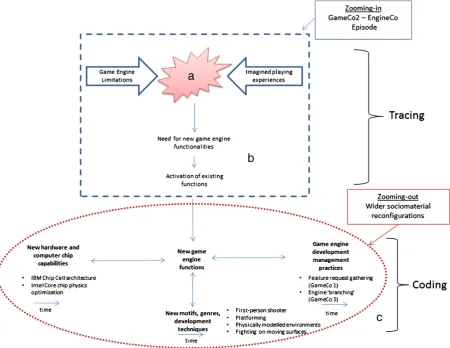
This stage of the analysis involved the coding of interview transcripts in order to identify passages relating to game engines. An initial coding of interview transcripts was employed to identify passages relating to game engines and was followed by a second coding of the resulting identified passages according to the key categories that emerge from the tracing undertaken in the‘zooming-in’episode between GameCo2/EngineCo (presented inFig. 2 inSection 4.3). In this way a combination of both inductive and deductive analysis[83]was employed in order to gain a view of the relations between things, people and events involved in the articulation of creative aspirations and technological devel-opment in this setting.
The initial tracing thus provides an outline of the sociomaterial practices through which an imagined novel playing experience is related to game engine technologies at a local (project/studio) and time-limited (project) level, while the next stage of the analysis focused on how the local and time-limited path traced in the episode related to more general and long-term sociomaterial practices.
4. Empirical account and analysis
In our account of the empirical setting studied, we start with a brief description of the key technological artifact that conditions the creative autonomy of game developers: the ‘game engine’. We then go on to illustrate how a creative idea in the form of a proposed novel game-playing experience for the game collides with the technical limitations of the existing game engine, and how the developers deal with this in order to realize their creative aspiration. We then‘zoom-out’in order to show how these particular, specific, and temporally limited local practices link to others at a more general level and with a longer time horizon. Through this zooming-out, we aim to show how the local difficulties of establishing a connection between novel game-playing feature and‘game engine’may ultimately result in changes in technology and the practices of game developers more generally.
4.1.“Zooming in”: connecting an intended game-playing feature to the‘physics engine’
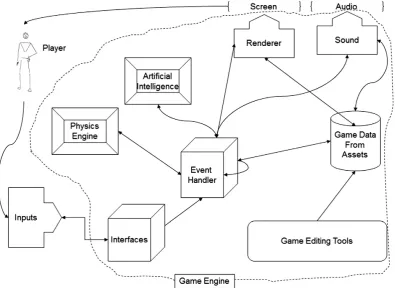
The key components that typically make up a game engine and how they relate to one another and the playing of the game are summarized inFig. 1below.
trigger a response in the game (e.g. generating commands for the renderer to display the new situation in the game on the screen using game data compiled from the assets developed during the production of the game). An EngineCo engineer-ing manager explains the game engine as follows:
“Games can be thought of architecturally as consisting of a series of functional engines and a database of resources and rules. Not all games have that kind of architecture, but that's kind of the generic architecture. There's not one engine. You're talking about multiple engines. In our case, we provided the physics engine, but you have your rendering libraries, which are normally provided by the graphics card manufacturers or bundled with consoles. (…) That rendering function is an engine in itself. Another engine would be Artificial Intelligence; the logic that goes behind the behavior of non-controllable characters”.
During the research it was possible to see across all three studios the centrality of the‘game engine’in the develop-ment process and its resulting significance for the design teams' ability to creatively formulate new experiences and features in the games under development.
4.1.1. The‘moving barges functionality’episode
One such episode was observed at GameCo2 and related to the‘physics engine’component of the‘game engine’. It centered on the development of a location in the game that the design team had envisioned as having the look and feel of a newly
industrializing region. The design team sought to use this location as a new and atmospheric game-playing experience by incorporating the passing canal barges that helped make up the scene in the gameplay itself. The idea was that the game's hero could use them as platform for fighting or to travel to another location in the game.
When it came to start work on the region, level editors were involved in assembling the location in the gameworld, artists developing digital art assets to populate it with, and animators developing animation sequences for the action. The design team, however, found that they were struggling to develop the necessary “moving barges” functionality. The problem was seen as residing with the‘physics engine’component of the overall‘game engine’. The question for the team was whether the studio's existing ‘physics engine’ could support this functionality. This would need to be modeled as two plat-forms/surfaces that were solid and on which characters could stand without falling through. These platforms would also need to move in relation to each other but also in relation to the wider scene. At the same time, the characters on them would also move so that it appeared that they were standing on them (characters and platforms could not be the same‘entities’, so both had to move in the same way together).
[image:8.544.74.470.384.672.2]The‘physics engine’specialist and other programmers at GameCo2 had worked on the modeling described above, but the problem proved to be more complex than originally anticipated and one that would require intervention in the ‘physics engine’. This, in turn, would require the ‘physics engine’supplier EngineCo to liaise with the development
studio in terms of guiding the studio's game engine specialist programmer about how to adjust the engine to make possible this complex modeling.
The specialist programmer in charge of the physics engine at GameCo2, described the situation as follows:
“One might know that a certain function is available and activating it may look straight forward, but integrating it with the highly specific surrounding game environment can be very complex and unpredictable”.
Initial attempts to develop a fix for this problem made the whole game“slow down to a slide show”. Subsequently, the team then used a demonstrator tool from EngineCo to look directly at the data and propose a solution. But this also produced a solution that was too costly to be workable. Eventually, a staff member from EngineCo needed to be directly involved with the team over a period of several days to help produce a workable solution. This involved a compromise in which the hero would be able to stand on the barges, but would not be able to fight on them. From the perspective of the engine developers at EngineCo, these temporary collaborations and the tools involved were seen as crucial to the development of their own digital technologies. An engineering manager explained this as follows:
“The physics engine is always shipped with a bunch of source code demonstrators that show you how you might use it. So the demonstrator is a really key part of this process because it provides a template for the games developers then to extend and expand and be creative with. While top games pro-ducers, publishers and development houses, are the creative engine, at the same time, they don't always know what they can do. They need to be shown how to use physics. (…) There's an ongoing dynamic between the studios and the [engine] developers, and at the same time, between the developers of a game and their audience.’
In this episode then, it was possible to see in a local and temporally delimited setting the intricate interactions be-tween the designers' ideas for novel game features and the
technical features of the ‘game engine’as the development team struggled to establish an articulation between the two. The two entities here were less mutually dependent than mutually constitutive. Hence, if the necessary functionality and performance could not have been achieved, the‘moving barges’feature might have had to be abandoned until a new version of the‘physics engine’was eventually developed and made available by EngineCo and integrated into the overall ‘game engine’of‘GameCo2’.
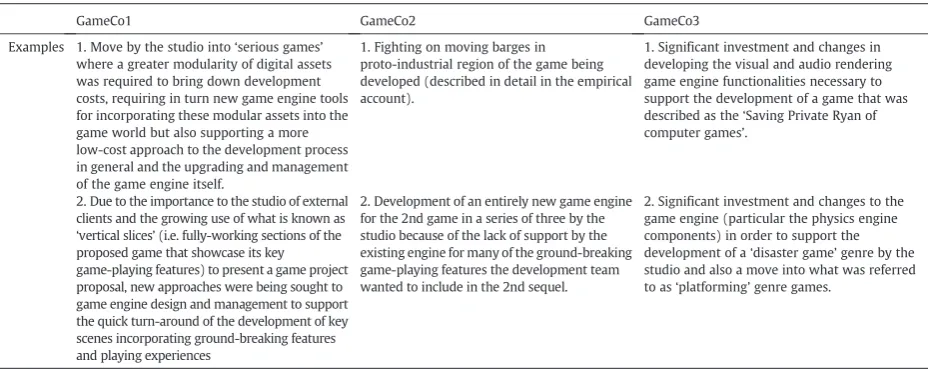
While this was a single episode from one studio, similar situations occurred across the three studios and were raised by our informers, highlighting common issues about how the creative aspirations of the developers encountered the tech-nological limitations of the‘game engine’and how these were dealt with. We provide the more relevant examples from our empirical material inTable 2below.
4.2.“Zooming out”: creativity, technological development, and changing development practices
‘Zooming out’from this specific episode, it is possible to see how, through the sociomaterial practices observed and the connections they establish, the initial creative aspirations of the developers ripple out from the local attempt to establish a connection between a novel playing feature and‘game engine’ towards broader level reconfigurations and changes.
Thus, in the episode from GameCo2 above, the collaborative connection between the GameCo2 and EngineCo developers that was established through the‘game engine’meant that new functionalities for the‘physics engine’were surfaced. Ultimate-ly, the connection between the‘physics engine’developers at EngineCo and computer hardware developers and vendors, could even highlight the potential limitations of the computer chipsets themselves, suggesting areas for future improvement. This is made clear in this extract from our interview with the engineering manager from EngineCo:
[image:9.544.43.509.504.689.2]“Chip manufacturers are now lured by the role of the games industry, and as part of that, the engine companies.
Table 2
Examples from across the three studios studied where the creative aspirations of the game developers came up against the limitations of the game engine technology.
GameCo1 GameCo2 GameCo3
Examples 1. Move by the studio into‘serious games’
where a greater modularity of digital assets was required to bring down development costs, requiring in turn new game engine tools for incorporating these modular assets into the game world but also supporting a more low-cost approach to the development process in general and the upgrading and management of the game engine itself.
1. Fighting on moving barges in proto-industrial region of the game being developed (described in detail in the empirical account).
1. Significant investment and changes in developing the visual and audio rendering game engine functionalities necessary to support the development of a game that was described as the‘Saving Private Ryan of computer games’.
2. Due to the importance to the studio of external clients and the growing use of what is known as
‘vertical slices’(i.e. fully-working sections of the proposed game that showcase its key game-playing features) to present a game project proposal, new approaches were being sought to game engine design and management to support the quick turn-around of the development of key scenes incorporating ground-breaking features and playing experiences
2. Development of an entirely new game engine for the 2nd game in a series of three by the studio because of the lack of support by the existing engine for many of the ground-breaking game-playing features the development team wanted to include in the 2nd sequel.
What you have [with games] are perhaps the most computationally difficult, challenging and demanding commercial products out there. (…) Gaming pushes the boundary absolutely. It will continue to do so because the realism of the virtual world can only be made more convincing by increasing the complexity of the models, the number of polygons, the number of particles, the number of actors, the number of AIs (artificial intelligence algorithms) running at any one time. The chip companies (…) are treating the games industry as an area offirst preference.”
He then went on to discuss the way that the cell architecture for IBM chips that also run the Xbox and PS3 game consoles was specifically designed for game computation and how Intel worked closely with EngineCo to optimize physics behaviors for platforms based on its Core chip architecture.
So while a creative feature might have had to be compromised on this occasion, the technological advancements and in-novations necessary to make the creative ambitions of the developers possible in the future are simultaneously being made visible in the process. This in turn, contributes to the trajectory of development for future hardware for PCs and game consoles, and by extension, the emerging forms, genres, and techniques of game development that can eventually be supported.
In addition, the tensions between imagined novel game features and ‘game engine’technologies illustrated by the
“moving barges” episode at GameCo2 feed through to
longer-term and more general practices of computer game development as a whole.
This was seen as a crucial factor for the studios in relation to the genres and game playing experiences they could work with. Here, we observed that, due to the high cost of developing or buying-in game engine functionalities, development studios often reuse their engine for a number of different games, altering its functionality or improving its performance incre-mentally, project-by-project. As such, the‘game engine’has important installed-base characteristics that can have an effect on what can and cannot be done in a new computer game, as the programming manager from EngineCo explains:
“What the engine can do is give you the functionality you expect at the price you can afford, be it in Euros or CPU speed and frame rate. It is the engine which provides you with a simulable world, but it doesn't provide you with gameplay. There's a kind of world you can work within. You don't have to do one thing or another; it just exists. You've got the model and let it run. But enhancing that over the years to includefirst person shooter perspective and the physically modeled environment as a real thing requires the developers of that game to change their thinking about the game.”
The game engine and the difficulties of developing it, therefore, have important implications for a game studio in terms of the gameplay that can be realized and, as a result, the range of experiences that could be provided to the user. Because of this, all three of the game studios in our study not only sought to modify the game engine as issues arose during the development of the game (as illustrated through the
‘moving barges’episode), but had also instituted practices for
the active and on-going long-term management of ‘game
engine’development in order to support—or at least avoid constraining—the creativity of the developers.
The physics engine specialist at GameCo2, for example, explained how the interactions with EngineCo could take on a longer term focus on the functionalities to be built into new versions of the engine, in addition to addressing the kind of immediate concerns raised by the‘moving barges’episode above. He explained that “engine developers, just like any other business, have to make money by identifying needs from the studios and then responding to them, so it is in their interest to have such processes in place, but these, in the best case will be over a time horizon of at least 6 months”.
At GameCo1 the studio had created its own development tools and‘game engine’with an internal technology division servicing the needs of both the internal development teams as well as external third-party clients to which the company's development tools and‘game engine’technology are licensed. The‘game engine’team interacted in face-to-face meet-ings with game development teams on a regular basis, usually with the senior managers of the engine team liaising with senior managers of the game production team to discuss high level issues and long-term requests for features. As the director of development explained, “these meetings occur quite frequently at the start of projects as some game teams might need brand new features from the tools to add to their game and obviously the sooner the tools team know and schedule for this, the better”.
In addition to these high-level interactions between ‘game engine’specialists and game developers, at GameCo1 there were also more general day-to-day interactions during the development of a game.“We have quite strict systems in place to capture communications and requests between tools [development teams] and games [developers]”, explained the director of development, pointing to the use by the studio of a combination of databases and online forums for these purposes. The database in particular was used to capture everything from small changes and bug-fixing requests to the logging of larger features for further discussion at company level. It was then able to direct requests for parts of the development tools or engine functionalities to specific people in the‘game engine’division. The same system was also used for liaising with the external ‘game engine’ clients of the company for similar purposes.
GameCo3 also relied primarily on its own proprietary‘game engine’technology. An executive producer here commented: “The technology you use (…) is inherent to how good the game is and how easy it is to make. We have an engine we've coded pretty much from the ground up, and is many years in the making”. While there was a general view at this studio that their tools were“sufficiently mature”to provide most func-tionalities that might be required when developing a game, there was an acknowledgement there will be some part of a particular feature“within the script of the game or within the actual game itself — for example a particular artificial intelligence behavior or a particular tack” —that has to be developed from scratch.
genre, (…) all of a sudden, we had to do grappling and climbing walls or floating through air with a gigantic great
big cape behind you—even double jumps were something
brand new that had to be thrown in—and you rely on your [engine] team to code those in for you”, explained the company's executive producer.
In order to minimize the cost of such ‘game engine’ improvements, GameCo3 developers would typically work through to a certain point in developing a particular game on what they called“the main branch of the engine”. This would be“picking-up updates”from all of the different projects going on at the company. As the GameCo3 producer explained, the only additions that would be allowed to be made at that “shared stage”of the‘game engine’would be“things that have gone through the‘head’of programming, or the deputy, or a senior‘lead’programmer who is allowed to add to the engine”. As he pointed out, the aim was to ensure that changes to the engine were useful more widely beyond a particular game under development;“So, for example, if they write a particular animation blueprint system, it is not just for their own game, but they must write it with benefits for other [projects] in mind also”.
Once an individual game at GameCo3 was into what was referred to as the “polish and fixing phase” and moving towards an “alpha” and “beta” version, the‘leads’ on the project would have to make a decision as to when to“cut the game free”from the‘main branch’of the engine.“Then, at that point, we plow our own furrow [in relation to‘game
engine’ modifications and improvements] and we won't
accept any new features in from other games because they may break our game and they may cause unnecessary bugs”, explained the executive producer.
4.3. Analysis
Through the focus in our empirical account on the sociomaterial connections between the imagining of novel game-playing experiences by game developers and the development of relevant digital technologies, we have sought to highlight, as illustrated in Fig. 2 below, the following: a) what issues are thrown-up in the encounter between technological challenges and imagined new game-playing experience for a computer game; b) what is involved in attempting to overcome the limitations of an existing ‘game engine’ in order to realize that imagined game-playing experience; and c) how such issues are dealt with over a longer timeframe, not only by game developers and‘game engine’specialists, but also on a wider plane that encompasses more generally developers of the digital technologies (a, b, and c here refer to the different stages marked with those letters inFig. 2).
By tracing at GameCo2 the design path of the developers' imagined‘moving barges’feature when it encountered the technological limitations of the game engine, we were able to identify thedesign tasksanddesign problemsencountered, the different ways of resolving them, and what implications these solutions had, not only for the development outcome, but also for the entities and groups that were implicated in this path. In this way it was possible to describe the entities involved and the relationships between them and how these changed as development decisions were made. In addition it
was possible to focus on what alternatives might have been possible under different circumstances.
As we depict inFig. 2, through the confrontation of the imagined playing experience and game engine limitations described in the‘moving barges’episode (a), aneed for new game engine functionalities(Fig. 2) was surfaced. Initially the game engine specialists at the studio had sought ways to model the new imagined feature through the existing functionalities of the game engine. Despite a working prototype having been developed, this was found by the GameCo2 developers to use too many computing resources, impacting the rest of the game scene in a detrimental way in terms of the performance of the game software (i.e. slow speed of rendering and interaction). To overcome this difficulty, the studio's specialist game engine programmer in collaboration with a specialist programmer from EngineCo, the game engine development company, both remotely (online, by telephone) and face-to-face (planned EngineCo specialist visit to GameCo2 studio) sought toactivate alternative existing game engine features(b) through which a different and more efficient (in terms of computing resources) modeling of the imagined game-playing feature might be achieved.
If successful, the new approach developed would have been incorporated into the new game. If not, a further design choice/decision would have had to be made. The develop-ment team from GameCo2 had to decide, therefore, between three courses of possible action: The first possibility was to persist with the imagined novel game-playing experience and work with the game engine supplier to develop the new game engine functionality necessary to support the full implementation in a more computer resource efficient way, but subject to project scheduling and budgetary limitations or their possible reconfiguration. The second possibility was to have pursued a reduced implementation of the imagined feature that would not impact the performance of the game software to the extent that the full imagined feature would. The third was to drop the imagined feature for the game in question entirely, retaining the idea for possible use in future games or sequels.
In terms of understanding the relationship between creativ-ity and technological innovation it was the first and third options that were of greater interest to our research questions. With the second option, there was little novelty, creativity, or technological development resulting: no new technology would be developed nor any radically new game playing experience or game development motif enabled. In the ‘moving barges’ episode relating to GameCo2 and EngineCo we observed, the eventual design choice was moving towards option two, although there was some consideration of option one, with some discussions between the EngineCo support team and the GameCo2 team working on the‘moving barges’feature about whether it might be feasible to take that route instead.
genres, motifs, and development techniques in computer game production.
This range of choices was also in evidence in some of the examples from the other game studios as described in
Table 2. In particular at GameCo3, for example, the impor-tance of achieving a cinematic visual and audio richness in the‘Saving Private Ryan of computer games’project led to instances where, according to the accounts of the developers interviewed, similar choices to those observed in the‘moving barges’episode had to be made between imagined playing experience and game engine limitations. Furthermore, be-cause achieving this cinematic quality was seen as so central to the playing experience imagined by the team, budgetary and timing project constraints were had been frequently revisited and altered in order to allow for the necessary game engine improvements to support this creative aspiration. The choice of altering project parameters in order to accommo-date significant new game engine functionality development was also highlighted at GameCo2, in accounts from those interviewed there about their work on the previous game in the series to the one we had observed them developing. They explained how the studio had decided, when developing the sequel to the first title of the series, to build an entirely new game engine in order to support the creative aspirations and
imagined playing experiences of the development team at considerable expense and schedule over-runs.
As shown above, in our analysis, the tracing of the specific instantiation of related sociomaterial practices offered by the ‘moving barges’episode was used as a roadmap to analyze other examples of tensions between the creative intentions of game developers and game engine limitations. By doing so with the other examples of tensions between the creative intentions of game developers and game engine limitations from across the three studios (e.g.Table 2), it was possible to see how stretching the limits of‘game engine’capability can relate to longer-term and wider technological changes.
[image:12.544.46.497.51.399.2]Out of the accounts relating to the ‘moving barges’ episode and past comparable efforts involving our GameCo2 and EngineCo informers the multiple temporalities and different forms of collaboration involved in this confrontation between creative aspirations and technological limitations were also initially revealed. On the one hand, they had immediate and unpredictable demands for new game engine functions that emerged out of the more immediate creative ambitions and concerns of a specific development project. On the other, there were more long-term and steady-state technology development cycles relating to the more regular and incremental enabling of the creative aspirations of the
Fig. 2.‘Zooming-in’and‘zooming out’ —illustration of the relationship between the episode of the creative aspirations of the game developers coming up against
game developers through on-going game engine manage-ment and updating practices. Again, this division between immediate and unpredictable project-generated demands for new game engine functionalities and the more long-term and steady-state need for improvements surfaced out of the detailed study of the ‘moving barges’ episode, was also encountered in the less detailed accounts of similar examples of creative aspirations of game developers coming up against the limitations of game engine technology we came across (Table 2).
Abstracting from the empirical material presented, then, some more general points emerge: i) the relationships between computer technology capabilities, game development tech-niques, and engine management practices (as illustrated in
Fig. 2) are central to managing tensions between new imagined game playing experiences and game engine limitations; ii) the realization or not of the creative aspirations of developers passes through the relations between these categories (com-puter hardware, game development techniques, and engine management practices); and iii) in order to gain an under-standing of the dynamics of these relations and how creativity and technological innovation relate to each other, it is important to focus on these categories not as being static and well-defined, but as intra-acting, with the categories them-selves and their boundaries emerging out of these intra-actions. In addition, there is a trail, observed across all three sites, that links localized emergent creative intentions to wider and more sustained creativity-enabling technology development prac-tices that spans organizational and sectoral boundaries and eventually can feed back into the development practices of the game studios themselves.
5. Discussion
Our empirical account focused on showing how developers sought to creatively produce imagined game-playing experi-ences which were novel, highly affective and culturally laden. When these imagined experiences encountered the techno-logical limitations of the game engine, a process of testing the boundaries of existing technological capabilities was initiated as the developers sought to extract the maximum from the computing resources made available by the existing techno-logical configurations and revealed the limitations of these configurations in the process.
Based on our analysis of this empirical material, we propose a view of creativity as an on-going flow that, following an initial ‘creative impulse’, ripples through the sociomaterial entangle-ments of a particular setting, reconfiguring them in the process and spreading out in time and space in often unexpected ways. Seen in this way, creativity is performed through processes of materialization.
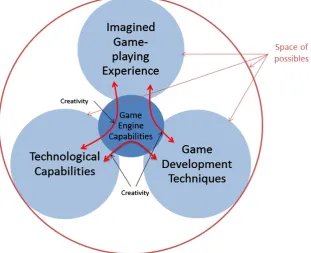
Fig. 3below seeks to provide a visual correlate for this analysis, summarizing the sociomaterial connections that emerge from our study.
Here, we observe that while creativity might betriggeredby the developers imagining a new playing experience for a game under development, it then ripples through the resulting mesh of relations established, leading to changes and reconfigurations in both technologies and development techniques. At the same time, this initial creative impulse will itself be altered and translated through its interactions with the game engine
developers and the existing repertoire of development tech-niques of the studio.
The two research questions through which this theoriza-tion of creativity we propose emerges and which we discuss now in more detail were: a) how does the creative agency manifested in computer game development relate to the development of digital technologies; and b) how does a focus on the‘sociomaterial entanglements’of human and material agencies enhance our understanding of this interaction.
5.1. Creative agency and technological development
In relation to our first question and the relationship between creativity and digital technology production, our study provides a number of insights.
Firstly, it shows how the expanding of what Bourdieu refers to as the “space of possibles” [43,44]for the entire‘field’of computer game development takes place. When examining how expanding the‘space of possibles’in computer game develop-ment takes place it can be seen that this ‘field’ is neither autonomous nor self-contained. Technological capabilities (cap-ital) and development techniques (habitus) change as a result of connections with ‘capital’ and ‘habitus’ in other fields (e.g. computer games and physics engines, or computer games and computer hardware), which are in turn also altered in the process. This reciprocal shaping serves to highlight the impor-tance of the distinction betweeninteractionandintra-actionthat is a central notion in the sociomateriality literature[31,32].
Second, the study also shows how, rather than clear boundaries between creativity and technological innovation, we see instead a continuous and co-evolving mutual shaping of entities where boundaries are not fixed but in a state of flux. Such a view brings into question explanations of creativity developed around a clear definition of entities such as ‘creative agent’ [43,44,84] and of the separation between technological and creative industries[6,10,11,52]. The digital technologies that are seen as fundamentally changing creative processes and modes of production are not being developed independently from the affective and cultural concerns associated with creativity and cultural production. What we see in the game development setting is collaboration across organizational and industry boundaries, and among groups and individuals with disparate forms of specialist expertise, with creativity becoming conse-quentially more widely distributed across these boundaries.
Third, by addressing this research question, our study also makes a contribution to the debate on whether cultural producers also need to be able to write their own computer code, or whether such producers risk being “slaves to the significant decisions”of those who make the technologies[68]. Here, our study of imagined novel computer game playing experiences suggests that creative agency is located in the dynamics of agents' “creative knowledge and expertise”and their ability to“liaise with experts in other fields”[68]. While an initial creative impulse or trigger was important in terms of initiating the circulation of creativity, such creativity itself was distributed and the realization of the creative aspiration of the developers had more to do with this collaboration, and its management and orchestration.
our study of the relationship between the creativity going into designing and developing imagined novel computer game experiences and the digital technologies that underpin these games shows that creative agency cannot be meaningfully divorced from the technologies that it relates to. Changes in one will always trigger changes in the other, and vice versa. This is why they can profitably be seen as mutually constitu-tive, or co-evolving[70], rather than one simply supporting the other[68]. It is this that leads us towards a view of creativity as an on-going flow—or circulation—that, following an initial ‘creative impulse’, ripples through the sociomaterial entangle-ments of a particular setting, reconfiguring them in the process and spreading out in time and space in often unexpected ways. This more distributed view of creativity suggests that the notions of “co-creative productive agents” and “emergent co-creative relations”advanced in relation to player-generated game features and design[70], may well have relevance to more traditional corporate and commercial models of computer game development and production as well. Seen in this way, questions of who is the creator, who the technologist and who the user[70,84], emerge as retrospective sense-making based on an act of separating that can obscure important connections or associations. Instead, by tracing sociomaterial entanglements it is possible to see how the creativity of the game designers in imagining new game-playing features and experiences is translated into technological innovations at both the software (game engine), but potentially even the hardware (computer chips) levels through the articulations traced.
Furthermore, the specifically digital quality of these entan-glements also enhances the mobility and connectivity of the creative inputs of the game designers and enables their propagation across many different contexts (e.g. game devel-opment, game engine develdevel-opment, computer software and
hardware development, other cultural products, other digital innovations). One can see how, using an approach of trailing, or tracing, sociomaterial connections, a novel game-playing expe-rience imagined by the designers of a computer game can be related to the development of new and more powerful hardware and software for use in a diverse range of activities that may even be far-removed from the game sector, thereby enhancing creativity in these other areas too.
Finally, our study also raises some important issues regard-ing the role and implication of non-human entities in the kind of processes of co-creation and co-evolution identified and described in this paper. AsFig. 3shows, the game engine is central to the propagation of creativity as outlined in our analysis. This is because so much of the collaboration involved in realizing an imagined playing experience is centered on the game engine. The game engine specialist at GameCo2 may be speaking on the phone, exchanging emails, or sharing diagnostic tool data with the developers at EngineCo regarding expanding the functionality of the physics engine, but it is within the code of the engine itself (to which the EngineCo developers can have remote access) that they actually work together and make interventions and co-create. It is then, through the resulting changes in the code of the engine that new possibilities of game development technique will be propagated back; not only to the studio's development team, but also through the game development sector more generally as other developers and studios seek to leverage these new functionalities too and use them to realize their own creative aspirations.
5.2. The sociomaterial entanglements of digital creativity
[image:14.544.116.428.56.309.2]In relation to our second question and the importance of focusing on sociomaterial entanglements in order to understand