City, University of London Institutional Repository
Citation
:
Micic, T., Velimirovic, N. & Stojic, D. (2013). Stochastic process model for timber-concrete composite beam deterioration. Paper presented at the 11th International Conference on Structural Safety and Reliability, ICOSSAR 2013, 16-06-2013 - 20-06-2013, Columbia University, New York, USA.This is the accepted version of the paper.
This version of the publication may differ from the final published
version.
Permanent repository link:
http://openaccess.city.ac.uk/8002/Link to published version
:
Copyright and reuse:
City Research Online aims to make research
outputs of City, University of London available to a wider audience.
Copyright and Moral Rights remain with the author(s) and/or copyright
holders. URLs from City Research Online may be freely distributed and
linked to.
1 INTRODUCTION
[image:2.595.50.257.649.732.2]Composite structural systems are designed to take ad-vantage of compatibility of materials under loading. The timber-concrete composite (TCC) structure is a structural system in which a timber beam is connect-ed to an upper concrete flange using different types of connectors. The best properties of both materials can be exploited because bending and tensile forces induced by gravity loads are resisted primarily by the timber and compression by the concrete topping systems, while the connection system transmits the shear forces between the two components. In Yeoh et al. (2011) is given a survey on the state-of-the-art of timber-concrete composite research in the recent years.
Figure 1. Cross section of timber-concrete composite beam.
In the last decade, timber-concrete composite sec-tions are increasingly used in Europe due to
sustain-able nature of constituent materials, aesthetics, light weight structures, fast construction times, etc. As the market share for this form of construction is increas-ing, so is the possibility of costly remedial actions for non-conforming sections. Timber-concrete com-posite structural systems are successfully used in highway bridges, hangar aprons, wharves, piers, platforms and as well in upgrading and post-strengthening of existing timber floors in residen-tial/office buildings as well as new constructions for buildings.
By connecting a concrete slab to timber beam it is possible to significantly increase the stiffness of the section compared to timber floors while at the same time improve the acoustic separation and increase the thermal mass, important to reduce the energy consumption needed to heat and cool the building. On the other hand, by replacing the lower part of a reinforced concrete section, which is ineffective be-cause of the cracking induced by tensile stresses, with timber joists or a solid timber deck, it is possi-ble to achieve better performing structure. In par-ticular such composite sections enable rapid erec-tion of the timber part, particularly if prefabricated offsite, due to its lower weight, benefits of perma-nent formwork for the concrete topping, reduced load imposed on the foundation, reduced mass and, hence, reduced seismic effects, etc. (Lukaszewska et al. 2008)
Stochastic process model for timber-concrete composite beam
deterioration
T. Micic
City University London, United Kingdom
D. Stojic, N. Velimirovic
University of Nis, Faculty of Civil Engineering and Architecture, Serbia
The increase in depth of the cross section of a composite element compared to the cross sections of its individual sub-elements results in a longer inter-nal moment arm. Consequently, the normal strains resulting from an arbitrary external load are reduced within the structure. For a very stiff connection, the concrete slab is mainly exposed to compression, while tensile stresses are concentrated in the wooden part. This means that both materials, concrete with its high compression capacity and timber with its high tensile capacity in the grain direction, are being used effectively.
It is apparent that the critical part of any compo-site structure is the connection between the constitu-ent materials. Shear connector, apart from being stiff, needs to have a certain strength or shear ca-pacity. A failure of the shear connector in a compo-site structure could lead to a global collapse of the beam if the individual components are unable to take the full load effects. The balance between the num-ber anf the stiffness of the connectors is a matter of design so in practice for exisitn beams there will be a rather large variability in the composition of the section and therefore its capacity. In addition to a high level of stiffness and strength, a good post-peak behaviour is often a concern for a shear connector. A desirible post-peak behaviour for the connectors is considered to be ductile as it gives users a warning in case of an imminent collapse and it is preferred to the failure of concrete or tensile/bending-failure mode of wood that are sudden and brittle. Inevitably over the long term behavior of shear connectors is uncertain and site specific so sophisticated predic-tions for the section capacity for an exisitng beam are needed.
In the first timber-concrete composite structures the connection systems used were influenced by tra-ditional timber construction. There are many joints traditionally used in timber structures that have been adapted to be used in timber-concrete structures. Among those, nails are most frequently used con-nector at present in timber-concrete applications. Other types of fasteners, such as screws, dowels or bolts, have also been used, but they have in most cases the disadvantage of requiring pre-drilling. One attempt to improve the mechanical behaviour of dowels was made by using them combined with epoxy resin. It is useful to note that long-term tests in both uncontrolled and controlled climatic condi-tions were performed on dowel-type fasteners by Dias (2005).
2 LONG-TERM BEHAVIOUR OF
TIMBER-CONCRETE COMPOSITE
As with other structures sustained load on timber-concrete composite structures causes gradual in-crease of deformation and deflection. Changes in the
moisture content of the timber section caused by variations in relative humidity and variations in the environmental temperature will accelerate the de-formations and associated reductions in strength, and may lead to excessive deflection in the long-term, Fragiacomo, (2006). Current design code, Eurocode 5, suggests limit values of l/250 to l/200 for long-term deflections of simply supported beams where l
is the span length. For medium to long span beams and/or heavy environmental conditions (e.g. bridges or roof structures), the serviceability limit state of maximum deflection may be the most severe design criterion.
In order to consider fully the long term behaviour time dependent behaviour of constituent materials needs to be considered. Concrete displays creep and shrinkage effects however timber behaviour is sensi-tive to the environmental effects such as the mois-ture content. Published records of long-term loading experiments have demonstrated that connections can creep, even more than timber, and the viscous be-havior is influenced by timber moisture content changes. The environmental thermo-hygrometric variations affect the behavior of TCC’s since they cause inelastic strains in timber and concrete, influ-ence the elastic modulus of timber and the mechano-sorptive creep of all components. Because of the long term processes that occur in the component ma-terials the stress and strain distribution within the timber concrete composite section change in time, Fragiacomo (2006).
Standard four loading conditions are often used to establish the stress and strain distribution in a tim-ber-concrete composite beam. These are dead and live loads, those arising from different response to environmental conditions from both concrete slab and timber beam. As a result the overall deflection of the composite beam will be affected. Hence, it is often recommended that the loading conditions to be considered are:
-permanent and variable actions;
-inelastic strains due to concrete shrinkage,
-annual variations of environmental temperature and relative humidity:
-daily variations of temperature,
For example a decrease in temperature produces a larger shrinkage of concrete slab compared to timber beam, with an overall increase in deflection. In the same manner, an increase in relative humidity leads to timber moistening with swelling and an overall increase in deflection of the beam.
beams with flexible connection. A simplified ap-proach to evaluate the long-term response of timber-concrete composite beams as proposed by Fragiacomo and Ceccotti (2006) is implemented.
In order to enable efficient management of struc-tures in terms of required maintenance, repair and/or replacement, it is essential to be able to capture the uncertain nature of the deterioration process. In par-ticular for timber-concrete composite beams, com-ponent materials will deteriorate at different pace over the life-cycle. Any analytical model designed to estimate the long term behaviour of timber-concrete composite sections has to include such diverse ef-fects that develop at different times in the lifecycle such as timber creep , timber shrinkage and swelling following reductions and increases in its moisture content, and/or temperature, respectively, etc. Equal-ly for concrete effects of creep, drying shrinkage, thermal strains and cracking in tensile zones have to be included. Furthermore the shear connectors are flexible, apart from few exceptions, and exhibit both creep and mechano-sorptive creep. However, given the complexities of the phenomena involved, as mentioned above, closed form solutions will have limited validity in real conditions, and since it is im-possible to test sufficiently diverse systems under all combinations of environmental conditions they may encounter, numerical modeling is often applied. Fur-thermore, in ideall circumstances one would wish to consider as many of the significant variables as pos-sible and equally the measure of uncertainty associ-ated with each variable. Since early seventees, struc-tural reliability methods have emerged as a partial solution as they have enabled inclusion of uncertain-ties at least in some form and usually by introducing relevant random variables. In recent years, however, it has emerged that for decision making purpose random variable models have limitations as they are unable to capture temporal effects that could be very relevant for long lifecycles such as those in con-struction. These issues are even further relevant when a composite section such as the one considered here is concerned. Rather slowly, but since the late nineties, continuous stochastic processess have emerged as an alternative approach to random varia-ble models to provide predicted profiles for componental deterioration. As an alternative to con-tinuous stochastic processes discrete stochastic pro-cess have also been in use where management of in-frastructure was of concern but these models can sometimes result in udully conservative estimates, Ohadi and Micic (2011).
3 CONTINUOUS GAMMA PROCESS
MODELLING
The continuous gamma process belongs to a gen-eral class of stochastic processes, referred to as the
Markov process. Gamma process is a stochastic pro-cess with independent non-negative increments that are gamma distributed with identical scale parame-ter. Abdel-Hameed (1977), was the first to propose the gamma process as a proper model for deteriora-tion occurring random in time. The gamma process is suitable to model gradual damage monotonically accumulating over time, such as wear, fatigue, cor-rosion, crack growth, ecor-rosion, consumption, creep, swell, etc. An advantage of gamma processes is that the required calculations are relatively straightfor-ward, Van Noortwijk ( 2009).
Firstly, the gamma process is defined in mathe-matical terms as follows. A random quantity X has a gamma distribution with shape parameter k > 0 and scale parameter θ > 0 if its probability density func-tion is given by:
x x
k k
x
Ga k
k exp
) (
1 )
,
( 1 (1)
where
0 1 )
(
z
z a e dz
z
a (2)
is the gamma function for a > 0. Furthermore, we assume k(t) to be a non-decreasing, right-continuous, real-valued function for t ≥ 0, with k(0) ≡ 0. The gamma process with shape function k(t) > 0 and scale parameter θ > 0 is considered a continuous-time stochastic process {X(t); t ≥0}with the follow-ing properties:
(i) X(0) = 0 with probability one;
(ii) ΔX(t) = X(t +Δt) - X(t) ~ Ga(Δk(t),θ),
where Δk(t) = k(t +Δt) - Δk(t) for any t ≥ 0 and Δt > 0;
(iii) For any choice of
n ≥ 1 and 0 ≤ t0< t1< … < tn < ∞, the random variables
X(t0), X(t1) - X(t0), …, X(tn) - X(tn-1) are in-dependent.
(3)
Let X(t) denote the deterioration at time t, t ≥ 0, and let the probability density function of X(t), in con-formity with the definition of the gamma process, be given by
) ), ( ( ) (
)
( x Ga xk t
fX t (4)
with expectation and variance
( ) )) (
(X t k t
The coefficient of variation is defined by the ratio of the standard deviation and the mean
) ( 1 )) ( ( )) ( ( )) ( ( t k t X E t X Var t X
Cov (6)
It is evident here that in comparison with standard random variable representation for deterioration where coefficient of variation is constant stochastic process representation offers improved model of time related effects.
3.1 Parameter estimation of gamma process models
For modeling of the temporal variability in the deterioration, key input is the trend of the expected deterioration increasing over time. Empirical studies show that the expected deterioration at time t can of-ten be represented as a power law:
k t ctb
t X
E( ( )) ( ) (7)
for some physical constants c > 0, b > 0 and θ > 0. There is often engineering knowledge available about the shape of the expected deterioration in terms of the parameter b, so that this parameter may be assumed constant. Some examples of expected deterioration according to a power law are the ex-pected degradation of concrete due to corrosion of reinforcement (linear: b = 1; sulphate attack (para-bolic: b = 2); diffusion-controlled ageing (square root: b = 0.5; creep (b = 1/8), and the expected scour-hole depth (b = 0.4). The gamma process is called stationary if the expected deterioration is lin-ear in time, i.e., when b = 1 and non-stationary when
b≠1, Van Noortwijk (2009).
For the practical consideration of expected dete-rioration in terms of power law, parameters c and θ
have to be assessed using available techniques. These could be expert judgment and/or statistics. Cinlar et al. (1977) demonstrated how a non-stationary gamma process can be transformed into a stationary gamma process and how the parameters of a gamma process can be estimated using the Method of Moments and the Method of Maximum Likeli-hood.
In order to apply the gamma process model to practical examples, statistical methods for the dete-rioration parameter estimation are required. We can assume that a typical data set for the structure con-sists of inspection times ti, i = 1, . . . ,n, where 0 = t0 < t1< t2 < · · · < tn, and corresponding observations of the cumulative amounts of deterioration xi, i = 1, . . . , n, where 0 = x0≤x1≤x2≤ · · · ≤xn. For our gamma process model we require the shape function k(t) =
ctb and scale parameter θ. We can assume that the value of the power b is known, but c and θ are un-known. The two most common methods of
parame-ter estimation are Maximum Likelihood Method and Method of Moments. Here we apply Maximum Likelihood Method. The latter is considered more appropriate and applied here.
The maximum-likelihood estimators for c and θ
can be obtained by maximising the logarithm of the likelihood function of the increments. The likelihood function of the observed deterioration increments
δi = xi–xi−1, i = 1, . . . , n, is a product of independent
gamma densities:
i t t c i ni ib ib c t t b i b i n i i i n i t X t X n b i b i b i b i i i t t c t t c Ga f c l exp )) ( ( 1 ) ), ( ( ) ( ) , ,..., ( 1 ) (
1 1 ( )
1 1 1 ) ( ) ( 1 1 1 1 (8)
Further, we consider the first partial derivatives of the log-likelihood function of the increments with respect to c and θ
0 ) , ,..., ( log 1 c c
l n (9)
0 ) , ,..., ( log 1 c
l n (10)
From the last two equations, the maximum-likelihood estimates c and θ can be obtained:
b n n t c x ˆ ˆ (11)
[tibt i1
b ]{ log
i( ˆc[ti bt
i1
b ])} i1
n
tnblog xn
ˆ
ctnb
(12)
where the function ψ() is digamma function and can be computed numerically.
Given the maximum-likelihood estimator of θ, the expected deterioration at time t can be written as
b n n t t x t X E )] ( [ (13)
Because cumulative amounts of deterioration are measured, the last inspection (at time tn) contains the most information and the expected deterioration at the last inspection is:
n n x
t X
4 APPLICATION OF GAMMA PROCESS FOR A SAMPLE COMPOSITE SECTION
In this paper we consider a timber-concrete com-posite section where glued steel bars are used as shear connectors. We focus on modeling the deterio-ration of mid-span deflection of the timber-concrete composite beam over time and under sustained load. Only if there is sufficient knowledge of the condi-tion of the timber-concrete composite beam, further actions such as maintenance planning can be carried out in the most efficient way. Therefore, the pro-gress of the deterioration of the considered beam and the estimate of its remaining lifetime, have to be quantified. As we mentioned earlier, given the com-plexities of the phenomena involved in long-term behaviour of timber-concrete composite sections, closed form solutions will have limited validity in real conditions. In practice it is impossible to set up experimental programme for such structures to re-flect all permutations of environmental conditions they may encounter and often numerical modeling is applied, with aim to incorporate as many of the sig-nificant variables as possible. This is rather cumber-some approach. Our initial approach is to generate the deterioration model at time t from outcomes that can be a result from expert judgement. This is to simulate that the condition of the beam is monitored through periodic inspections and in that way inspec-tions reveal the progress of the deterioration of the beam.
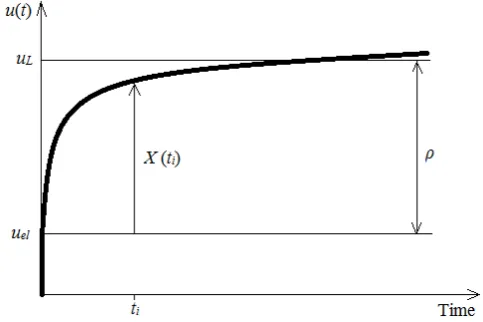
For now we follow the deterioration progress through the increase in mid-span deflection. This de-flection measure for the timber-concrete composite beam over time is generally uncertain and non-decreasing, thus it can be regarded as a continuous gamma process. A timber-concrete composite beam will reach serviceability limit state when mid-span deflection reaches assumed limit values uL that is say
l/250 for long-term deflections according to Eurocode 5. In our case, where a simply supported beam of span 4.2m is considered that limit value on the long term deflection is 16.8 mm. Due to the na-ture of this composite section the initial deflection is assumed to be the elastic deflection uel. Thus we de-fine mid-span deflection of the beam at time t as:
) ( )
(t u X t
u el (14)
Where the X(t) is the long term change (increase) in deflection. Thus we can identify the critical level of the stochastic process X(t) as ρ
el L u
u
(15)
Once the deterioration process X (t) reaches this critical level ρ, a timber-concrete composite beam will reach serviceability limit. Figure 2 shows trend of the expected progress of mid-span deflection of
[image:6.595.316.558.70.231.2]the timber-concrete composite beam over time under sustained load.
Figure 2. Trend of the expected mid-span deflection increasing over time under sustained load
We recall that the expected deterioration at time t
can be described using a power law function and therefore the expected deterioration at time t can be written as ctbfor c, b > 0. In order to find the relation between the degradation level of mid-span deflec-tion and time we first fitted a number of determinis-tic curves that present theoredeterminis-tical models of behav-iour of the TCC beam over time. This way it was possible to apply least-square fitting approach to the available data to get power b. The parameter esti-mate of the power factor used here was b= 1/8, that suggests that the deterioration is non-linear in time and we can assume that the expected value of the stochastic gamma process follows a non-linear pow-er function. Shape and scale parametpow-ers have been established using the method of maximum likelyhood. Thus with those parameters that define the continuous gamma process representation of deterioration for the generic timber-concrete composite section has been established.
In Table 1 the maximum likelihood estimates of the parameters of the gamma process in various years of observing.
[image:6.595.311.567.631.709.2]
Table 1.Gamma process parameters for timber concrete com-posite section estimated at different time for the generic struc-ture.
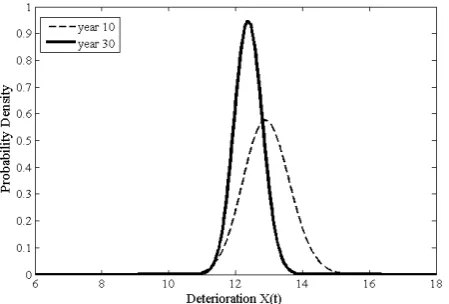
Figure 3 demonstrates the use of Gamma process representation to predict expected deterioration X(t) at certain target year from different inspection (in-formation gathering) years.
Year Shape k(t) Scale Θ
Figure 3. Comparison of expected deterioration u(t) at year 60, using the prediction from years 10 and 30
It is evident that gamma process representation provides a refined prediction for deterioration pro-cess. As expected the increased number of inspec-tions (by year 30) are reflected fully.
5 DISTRIBUTION OF SERVICEABILITY LIFETIME
For practice the estimate of the time when the structure would reach serviceability limit of some form would be of interest to owners and stake hold-ers. The serviceability lifetime T can be defined as the first time when the sample path of X (t) exceeds the limit ρL. Due to the gamma distributed deteriora-tion, the serviceability lifetime can then be written as:
FT(t)Pr(T t X(t)L) fX(t)(x)dx(k(t),L/)
(k(t))
xL
(16) where
x t t a e dtt x
a, ) 1
( (17)
is the incomplete gamma function for x≥ 0 and
a > 0. Using the chain rule for differentiation, the probability density function of the serviceability life-time T is
) ( ' ) ~ ( ) / , ~ ( )) ( ( ) / ), ( ( ) ( ) ( ~ t k k k t t k t k t t f t k k T (18)
under the assumption that the shape function k(t) is differentiable. The partial derivative in Equation 18 can be calculated using numerical techniques.
Fol-lowing the recommendation from Van Noortwijk et al. 2007 using a series expansion and a continued fraction expansion, it is possible to compute the first and second partial derivatives with respect to x and a
of the incomplete gamma integral, Equation 19.
) ( ) , ( ) ( ) ( 1 ) , ( 0 1 a x a a dt e t a x a P x t t a
(19)The first two moments of the serviceability life-time T are then expressed as
0 )) ( 1 ( )(T F t dt
E T (20)
02) 2 (1 ( ))
(T t F t dt
E T (21)
which need to be evaluated numerically as well.
5.1 Distribution of remaining serviceability lifetime
The distribution of remaining lifetime, the re-maining time to the certain critical level ρL of the gamma process, given its value at time τ, X (τ) = xτ < ρL, is readily established using the independent in-crements property as
FT(t)Pr(T t X()x) Pr(X(t)X()Lx) (k(t),(Lx) /)
(k(t))
(22)
for t ≥ τ. As inspection outcomes become available parameters of the gamma process can be updated and, consequently, the remaining serviceability life-time distribution can be updated.
The probability density function of the remaining serviceability lifetime is
fT(t) t
(k(t),(Lx) /)
(k(t))
t
(k,(Lx) /)
(k)
kk(t)
k'(t)
(23)
under the assumption that the shape function k(t-τ) is differentiable. Probability density function of re-maining serviceability lifetime has no closed form expression but it can be evaluated numerically as al-ready explained.
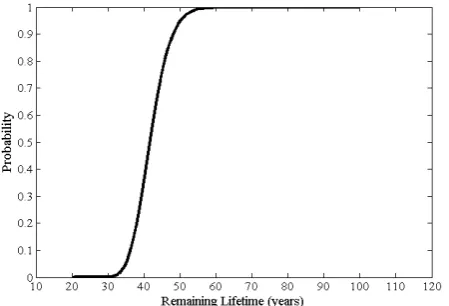
Figure 4. Cumulative distribution function for remaining ser-viceability lifetime using inspection outcomes in year 20
It is interesting to present remaining serviceabil-ity lifetime as the survival curve plotted on a log scale as shown in Figure 5.
Figure 5. Survival function of remaining serviceability lifetime at year 20
The survival function shown in Figure 5 is obvi-ously very useful for management of structures as it can be established as site specific on the basis of in-spection outcomes. It remains to be considered in the future how to model the variability in quality of in-spection techniques as it will have major impact on the survival function.
6 CONCLUSIONS
In this paper we have considered a new continous stochastic process model that can capture the true nature of deterioration of timber-concrete composite beams. As an illustrative example the gradual in-crease in mid-span deflection during application of sustained load on timber-concrete composite struc-tures is considered. An explicit function has been identified for the long term effects of various deteri-oration mechanisms that act over the lifecycle on timber concrete composite simply supported beam deterioration. It has been identified that, for such beams, component materials will deteriorate at
dif-ferent pace over the life-cycle and the stochastic process approach would be able to capture site spe-cific effects. The modelling is demonstrated in the paper by considering the effect of the variable time of inspection have been carried out. Application of continuous gamma process for deterioration model-ing for target lifecycle is included in the paper. As the increasing deflection can lead to violation of ser-viceability limit state the remaining serser-viceability lifetime is of interest and therefore considered in this paper. Using the requirement of serviceability limit state the example of gamma process representation for the remaining life distribution function is includ-ed. Furthermore, it is demonstrated that it is possible to generate the ‘survival’ curve for the structure on the basis of site specific inspection and the selected serviceability criteria.
REFERENCES
Abdel-Hameed M. 1975. A gamma wear process. IEEE Trans-action on Reliability.24(2):152–3
Cinlar, E., Z. P. Bazant and E. Osman, 1977. Stochastic pro-cess for extrapolating concrete creep. J Eng Mech Div.103:1069–88.
Dias, A. M. P. G. 2005. Mechanical behaviour of timber-concrete joints. Ph.D. thesis, Univ. of Coimbra, Portugal. Fragiacomo, M. 2006. Long-term behaviour of timber-concrete
composite beams. II: Numerical analysis and simplified evaluation. J. Struct. Eng., 132(1), 23–33.
Fragiacomo, M. and Ceccotti, A. 2006. Simplified approach for the long-term behaviour of timber-concrete composite beams according to the Eurocode 5 provisions. Proc., Meet-ing thirty-nine of the WorkMeet-ing Commission W18-Timber Structures, CIB, International Council for Research and Innovation, Florence, Italy, August 28-31, paper No. CIB-W18/39-9-1, 12pp.
Lukaszewska, E. H. Johnsson, M. Fragiacomo, 2008. Perfor-mance of Connections for Prefabricated Timber–Concrete Composite Floors, Materials And Structures. 41: 1533-1550.
Ohadi, A. and T. Micic,2011. Stochastic process deterioration modelling for adaptive inspection, Proc. of the 11th Int. Conf. on Appl. of Statistics and Probability in Civil Engineerin. 1085-1091, Taylor & Francis.
Pandey, M.D., X-X Yuan and J.M. Van Noortwijk 2005. Gamma process model for reliability analysis and re-placement of aging structural components, Proc. ICOSSAR, 311, June 22-25, 2005, Rome, Italy.
Pandey, M.D., Yuan, X.X. and Van Noortwijk J.M. 2009. The Influence of Temporal Uncertainty of Deterioration in Life Cycle Management of Structures, Structure & Infrastruc-ture Engineering. 5(2), 145-156.
Van Noortwijk, J.M. 2009. A survey of the application of gamma processes in maintenance. Journal of Reliability Engineering and System Safety. 94: 2-21.
Van Noortwijk, J.M., J.A.M. van der Weide, M.J.; Kallen and M.D. Pandey, 2007. Gamma Processes and Peaks-Over-Threshold Distributions for Time-Dependent Reliabil-ity. Reliability Engineering and Systems Safety. 92(12), 1651-1658.