City, University of London Institutional Repository
Citation
:
Massand, E., Bowler, D. M., Mottron, L., Hosein, A. and Jemel, B. (2013). ERP Correlates of Recognition Memory in Autism Spectrum Disorder. Journal of Autism and Developmental Disorders, 43(9), pp. 2038-2047. doi: 10.1007/s10803-012-1755-xThis is the accepted version of the paper.
This version of the publication may differ from the final published
version.
Permanent repository link: http://openaccess.city.ac.uk/5379/
Link to published version
:
http://dx.doi.org/10.1007/s10803-012-1755-xCopyright and reuse:
City Research Online aims to make research
outputs of City, University of London available to a wider audience.
Copyright and Moral Rights remain with the author(s) and/or copyright
holders. URLs from City Research Online may be freely distributed and
linked to.
Dermot M Bowler1
Laurent Mottron2
Anthony Hosein2
Boutheina Jemel2
1City University London and 2Hôpital Rivière-des-Prairies, Université de Montréal,
Montréal
Running Head: Recognition Old/New effect in ASD
Correspondence to: Esha Massand
Autism Research Group
Department of Psychology
City University
Northampton Square
London EC1V 0HB
UK
Tel: 0207 040 8380
Fax: 0207 040 8581
Abstract
Recognition memory in Autism Spectrum Disorder (ASD) tends to be
undiminished compared to that of typically developing (TD) individuals (Bowler,
Gardiner and Gaigg, 2007), but it is still unknown whether memory in ASD relies on
qualitatively similar or different neurophysiology. We sought to explore the neural
activity underlying recognition by employing the old/new word repetition event-related
potential (ERP) effect. Behavioural recognition performance was comparable across
both groups, and demonstrated superior recognition for low frequency over high
frequency words. However, the ASD group showed a parietal rather than anterior onset
(300-500 ms), and diminished right frontal old/new effects (800-1500 ms) relative to TD
individuals. This study shows that undiminished recognition performance results from a
pattern of differing functional neurophysiology in ASD.
Keywords: Memory, Autism Spectrum Disorder, Event-Related Potential, Recognition,
Old/New effect
One of the intriguing features of ASD is the profile of memory abilities often observed in this population. In general, HFA individuals show comparable immediate memory, cued recall (Boucher and Lewis, 1989) and recognition (Bowler, Gardiner & Gaigg, 2007) but impairments on measures of free recall. Some individuals with autism present exceptional memory performance in their domain of expertise (eg. Mottron et al., 1998). They characteristically fail to use semantic relations amongst studied items to aid free recall (Bowler, Matthews and Gardiner, 1997; see Tager-Flusberg, 1991, for similar findings in LFA individuals). Although first noted by Boucher and Warrington (1976), this pattern of spared and impaired memory performance has been developed by Bowler and Gardiner into the
Task-Support Hypothesis (TSH), (Bowler et al., 1997; 2004), which states that the performance of individuals with ASD will be closer to that of TD individuals if support is provided at test. Support is defined as any information relevant to the resolution of the task being present in the test materials. Supported test procedures include cued recall and recognition, where participants are presented with a clue (the studied word) and are asked whether or not it figured in the study list. In contrast, tasks such as free recall do not offer this kind of support, and often show diminished performance in individuals with ASD. This is especially the case when the task involves multiple trials (Bowler, Gaigg & Gardiner, 2008b; Bowler, Mottron & Limoges, 2009) or the use of semantic relations among studied items to enhance recall (Bowler, Matthews & Gardiner, 1997).
Confirming evidence for the TSH and for difficulties in processing inter-item relations has been provided by numerous subsequent studies. In one example, Bowler, Gaigg and Gardiner (2008a) tested the effects of item versus context relatedness on recall and recognition in adults with ASD by asking individuals to study a series of words presented on a screen, inside a red rectangle. Participants were asked to ignore context words (words that were either related or unrelated to the study words) that were presented outside the red rectangle. Participants then took part in a forced-choice recognition memory test that included both studied (inside the rectangle) and context (outside the rectangle) words. The results revealed that both groups recognised more target words than context words, and more related words than unrelated words. However despite this apparent typical memory performance, when the experiment was repeated with a recall rather than forced choice task, the recall of individuals with ASD, unlike that of the comparison participants, was not enhanced for related words. These findings show that contextual semantic relations are encoded sufficiently for people with ASD to benefit from them under recognition but not free recall test procedures.
Recognition Old-New effect in ASD 2
need for task support at retrieval suggests an underlying atypicality in the functioning of the memory system in individuals with ASD, which implies that when they perform memory tasks, they may be employing different underlying processes either at a cognitive or a neural level.
One way of studying neural processes underlying recognition memory uses the method of event-related potentials (ERPs, see Kutas & Federmeier, 2011; Rugg & Curran, 2007 for reviews). Many studies have demonstrated ERP differences between old (studied) and new (unstudied) items, such as words (Sanquist, Rohrbaugh, Syndulko & Lindsley, 1980; Rugg & Nagy, 1989), faces (Münte, Brack, Grootheer, Wieringa, Matzke, & Johannes, 1997; Guillem, Bicu, & Debruille, 2001) and objects (Van Petten, Senkfor, & Newberg, 2000). In general, ERPs are more positive in response to correctly recognised items relative to new items. This positive potential difference, referred to as Old-New ERP effect (Rugg, Cox, Doyle & Wells, 1995), occurs at ~300ms post stimulus and lasts several hundred milliseconds. Further investigations of memory-related ERP indices identified three spatio-temporally distinct old-new ERP effects underlying specific memory retrieval processes (see Rugg & Curran, 2007 for a review). These ERP-memory related indices, although their respective memory-related functions are still controversial, encompass (1) an early mid-frontal old-new effect (300–500 ms) indexing familiarity judgements (Curran, 2000; Curran & Cleary, 2003; Curran & Dien, 2003), or semantic memory (Voss and Paller, 2008; 2009) and (2) a parietal, positive ERP effect (400–800 ms) related to recollection (i.e., the “parietal old-new effect”;
Allan, Wilding, & Rugg, 1998; Curran, 2000; Curran & Cleary, 2003; Curran & Dien, 2003), and a sustained positive ERP potential over right frontal scalp sites, associated with retrieval processes, whenever a retrieval attempt is ambiguous, requires evaluation, such as in source memory tasks (Allan & Rugg, 1997, 1998; Allan, Dolan, Fletcher & Rugg, 2000; Curran, Schacter, Johnson & Spinks, 2001; Donaldson & Rugg, 1999; Johnson, Kounios & Nolde 1996; Ranganath & Paller, 2000; Wilding & Rugg, 1997a,b; Wolk, Sen, Chong, Riis, McGinnis & Holcomb et al., 2009).
ERP methodology has proved useful in revealing atypical neural processes in the context of intact behavioural performance in various clinical groups. One such group that has particular relevance for ASD is the healthy ageing population. Memory in healthy aging, in common with ASD is characterised by better performance on supported tasks such as cued recall and recognition, (Craik & Anderson, 1999). Outside the memory domain, there are also
similarities between healthy ageing and ASD, for example in terms of diminished ‘theory of mind’ (Slessor, Phillips & Bull, 2007) and impaired executive function (Buckner, 2004), making
healthy ageing a useful heuristic for studying memory in ASD. Recognition memory in healthy ageing is reliably accompanied by significantly diminished Old-New word event-related potential (ERP) effects (Guillaume, Clochon, Denise, Rauchs, Guillery-Girard & Eustache et al., 2009).
frequency manipulation check. We tested a sample of ASD and age and IQ-matched TD individuals.
Method
Participants
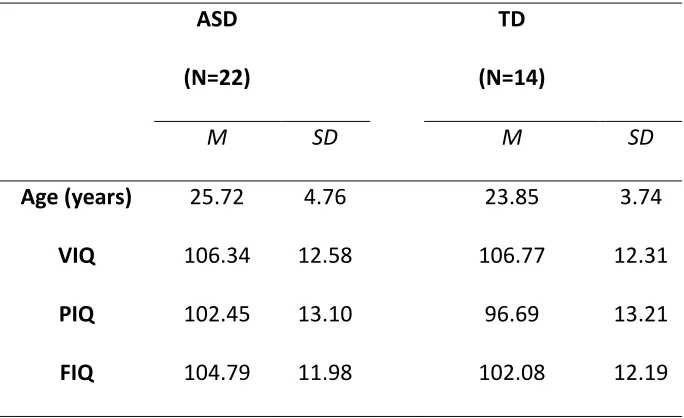
Twenty-two participants with ASD (2 females) meeting DSM-IV-TR criteria (American Psychiatric Association, 2000) for ASD and 14 TD participants (2 females) took part in the study. ASD participants were of average FSIQ and matched closely to TD participants on gender, chronological age and FSIQ (as assessed by the Wechsler Adult Intelligence Scale III, Wechsler, 1997). Averages for age and IQ are presented in Table 1.
Participants were recruited from the Autism Specialized Clinic (Rivière-des-Prairies Hospital, Montreal). Diagnoses were based on the Autism Diagnostic Interview-Revised (ADI-R; Lord, Rutter & Le Couteur, 1994) and/or the Autism Diagnostic Observation Schedule (Lord, Risi, Lambrecht, Cook, Lenventhal & DiLavore et al., 2000).
TD participants were recruited from a panel maintained by the same institution, and all participants had normal or corrected to normal vision. Informed consent was obtained from each participant and the study was approved by the ethics committees at City University London and Hôpital Rivière-des-Prairies, Montreal.
INSERT TABLE 1 HERE
Stimuli
The experimental stimuli were 300 target and 150 lure French words, individually extracted from the Desrochers & Bergeron (2000) corpus of 1,916 French nouns. Fewer targets than lures were used to reduce the time burden for participants, and, because the hit rate for lures was higher than for targets (thus proportions were equated). Three out of 6 blocks were comprised of 13 high frequency words, and 12 low frequency words, and the other three blocks comprised 13 low and 12 high frequency words.
Half target words and half lure words were of low frequency, (Targets: mean = 2.51 ± SEM = 0.12; Lures: mean = 2.37 ± SEM = 0.15; t(223) = 0.69, n.s.), and the other half were of high frequency (Targets: mean = 251.92 ± SEM = 13.31; Lures: Mean = 254.31 ± SEM = 23.1;
t(223) = 0.096, n.s.) according to Baudot frequency index (Baudot, 1992). Low and high frequency target and lure words contained equivalent numbers of syllables (2.18 ± 0.07 and 2.13 ± 0.09 respectively for low frequency target and lure words, and 2.23 ± 0.07 and 2.36 ± 0.14 respectively for high frequency target and lure words; all t values < 0.68, n.s.) and letters (7.05 ± 0.16 and 7.01 ± 0.24 respectively for low frequency target and lure words, and 6.69 ± 1.56 and 6.85 ± 0.23 respectively for high frequency target and lure words; all t values < 0.91,
Recognition Old-New effect in ASD 4
words = 4.63 ± 0.07, all t values < 0.89, n.s.). Additional words with similar characteristics were used for the practice block.
Presentation
The experiment took place in a dimly lit and sound attenuated laboratory. Participants sat opposite a 17 inch computer screen, with their head restrained with a chin rest at a 60 cm viewing distance. Word presentation length varied from 2.5 cm to 11 cm and resulted in a minimum visual angle of 2.39° and a maximum viewing angle of 10.47°.
Participants completed one practice block and 6 experimental blocks, where each block comprised a study phase immediately followed by a test phase. The participants were instructed to study the words for a later memory test in which they were to decide whether the test word was presented in the study list (old-new response).
During the experimental blocks, each study list had 50 items (half LFW and half HFW) with an additional two buffer items (one buffer item at either end of the study list). At test, the 50 study items and twenty-five lures were presented. The blocks were presented in a random sequence and words were randomly ordered within blocks and balanced for orthographic/syllable length and imageability. During the study phase words appeared at a constant presentation rate of one every 2000 ms (1400 ms word presentation and 600 ms fixation on a central point measuring 0.8 cm). During the test phase participants were instructed to fixate on a central point for 600 ms, which was replaced by the test word for 200 ms. The word was then replaced by a fixation cross for 1500 ms, followed by an old-new response prompt. The next trial began once the participant had made their response.
EEG/ERP Acquisition
The electrical brain activity (electroencephalogram, EEG) was continuously recorded from 58 Ag/AgCl scalp electrodes mounted on an easy cap during the test phase. Electrode
impedances were kept below 5kΩ. Bipolar electrooculogram (EOG) recordings were made
using electrodes placed below and above the dominant eye (vertical EOG), and electrodes placed lateral to each eye (horizontal EOG). Signals from all electrodes were amplified with a bandpass from DC to 100 Hz, digitized at a 1024 Hz sampling rate and online referenced to the left earlobe. The right earlobe was actively recorded as an additional reference channel.
To compute the ERPs, only artifact-free trials to old and new words associated with correct answers were used. Epochs of continuous EEG, including a 200 ms pre-stimulus and 1700 ms post-stimulus period, were averaged from each subject separately 1) for old and new words and 2) for old and new items separately for low and high frequency words. ERP difference waves were also computed to visualise the magnitude and topographical distribution of old-new effects in ASD and TD participants: 1) for all words (i.e., old minus new words) and 2) for high and low frequency words (i.e., old high minus new HFW, old low minus
new LFW).
Data analysis
For the behavioural data, the proportion of hits (i.e, correct old responses to studied words) and false alarms (i.e., incorrect old responses to unstudied word) for each ASD and TD participant were calculated for all words and separately for low and high frequency words. Accuracy scores were corrected for guessing by subtracting the proportion of false alarms from the proportion of hits.
For the electrophysiological results, mean ERP amplitude measures were computed at each scalp electrode using three time-windows: 300-500 ms, 500-800 ms, and 800-1500 ms, encompassing the latency period of the mid-frontal old-new effect, the parietal old-new effect, and the late frontal old-new effect. These measurements were performed on the ERP averages for old and new words, both collapsed and separately for low and high frequency words.
A series of ANOVAs were conducted. To reduce Type 1 error as result of multiple comparisons, electrodes were clustered into five bilateral and three midline scalp regions of interest; left and right Fronto-Temporal (AF7/F7/F5/FT7/FC5, and AF8/F8/F6/FT8/FC6), left and right Frontal (AF3/F1/F3/FC1/FC3, and AF4/F2/F4/FC2/FC4), left and right Temporal (T7/C5/C3/TP7/CP5, and T8/C6/C4/TP8/CP6), left and right parietal (CP1/CP3/P3/P1, and CP4/CP2/P2/P4), left and right Occipito-Temporal (P7/P5/PO7/PO3, and P8/P6/PO8/PO4), and midline Frontal (Fpz/Fz/FCz), Central (C1/Cz/C2/CPz), and Parieto-Occipital regions (Pz/POz/O1/O2/Oz).
The magnitude and scalp distribution of Old-New ERP effects between groups were assessed with the ERP amplitudes. To ensure that topographic comparisons of ERPs were not confounded by differences in the magnitude of the Old-New effect, significant interactions involving Region by experimental, and/or by group factors were further investigated after vector-length normalization of the ERP amplitude measurements (McCarthy & Wood, 1985).
Results
Behavioural results
Recognition Old-New effect in ASD 6
was 0.61). There was a main effect of word Frequency (F (1, 34) = 45.58, p<.01) where recognition was greater for LFW (M = 0.66) compared to HFW (M = 0.51). There was no word Frequency x Group interaction (F (1, 34) = 0.10, p = n.s.) demonstrating that both groups recognised more low frequency than high frequency words). Both groups recognised a similar proportion of false alarms (F (1, 34) = 0.004, p = n.s.), and both groups also made more false alarm judgements to HFW (M = 0.15, SD = 0.14) than LFW (M = 0.10, SD = 0.10), (F (1, 34) = 14.05, p<.01).
INSERT TABLE 2 HERE
ERP results
The analyses of the electrophysiological data were conducted primarily to investigate potential differential old-new effects between ASD and TD groups. At this stage of analyses, trials corresponding to low and high frequency words were collapsed. The mean number of artifact-free trials with correct answers included for the ERP averaging of old and new words for ASD and TD groups, was 171.3 (S.D. = 49.7) and 156.8 (S.D. = 39.3) for old words, and 99.9 (S.D. = 29.6) and 102.8 (S.D. = 17.2) for new words respectively. The number of trials did not differ between the two groups (independent samples t-test (34) < .94; p > .3). Secondly, we examined old-new ERP effects with respect to word frequency. The ERP averages for these analyses also included equivalent number of trials for ASD and TD groups (independent samples t-test (34) < .95; p > 0.3). The mean number of averaged trials, for ASD and TD groups, was 78.7 (S.D. = 26.4) and 71.5 (S.D. = 20.8) for old HFW, 92.6 (S.D. = 25.1) and 84.9 (S.D. = 21.5) for old LFW, 48.2 (S.D. = 15.3) and 49.2 (S.D. = 9.4) for new HFW, and 51.7 (S.D. = 14.5) and 53.1 (S.D. = 9.8) for new LFW respectively. The minimum number of trials per subject across the Old/ New and High/ Low conditions was 18.
Old/new ERP effects
INSERT FIGURE 1 HERE
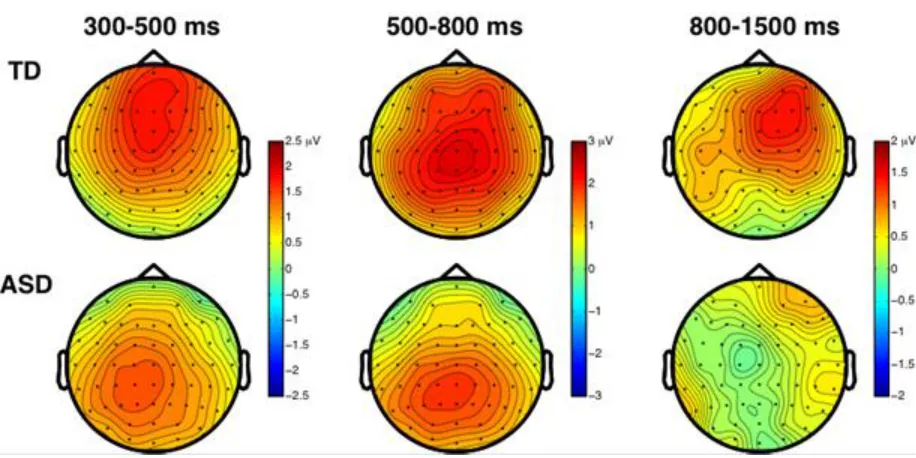
The ERP waveforms to old and new words are shown at nine electrode locations in Figure 1, separately for the ASD and TD groups. For both groups, there were consistent ERP amplitude differences between old and new words, with old words eliciting greater positive ERP voltages than new words, known as old-new ERP effect. Figure 2 displays a 2D scalp distribution of the old-new ERP differences in the 300-500 ms, 500-800 ms and 800-1500 ms for TD and ASD groups. These old-new effects appear remarkably similar to other published studies (Rugg & Doyle, 1992; Rugg et al., 1995; Rugg & Curran, 2007).
INSERT FIGURE 2 HERE Old-New ERP effects for low and high frequency words
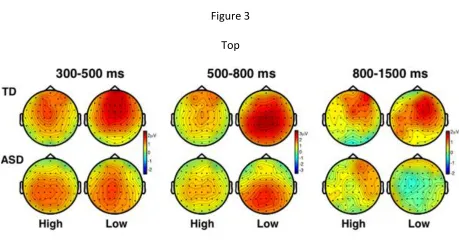
As can be seen in Figure 3, old-new ERP effects appear to be larger for low than for high frequency words (consistent with previous studies that have manipulated word frequency, Rugg and Doyle, 1992; Rugg, Cox, Doyle & Wells, 1995; Russler, Probst, Johannes & Munte, 2003). ANOVAs with Old-New, word Frequency, Region and Laterality as within-subjects factors and Group as a between-within-subjects factor yielded significant main effects of Old-New and of word Frequency in the 300-500 ms (mid-frontal old-new), 500-800 ms (parietal old-new), and 800-1500 ms (late frontal old-new) time-windows, for both lateral (F
(1,34) > 4.71, p < .04) and midline regions (F (1,34) > 5.45, p < .03). These simple effects however did not interact with Group (F (1,34) < 1.47, p > .2). Moreover, the topographical distributions of these effects varied as a function of word frequency and group (cf. Figure 3). As there were no group differences, the primary analyses were restricted to data collapsed across high and low word frequency.
The old-new ERP effects in TD participants were characterized by three spatially and temporally different ERP effects (cf. Figure 2), consistent with the old-new ERP effects reported in previous studies (e.g., Curran, 2000; Duzel et al., 1997): a mid-frontally distributed old-new ERP effect in the 300-500 ms time-window, a parietal old-new ERP effect in the 500-800 ms time-window (parietal old-new), followed by a long-lasting right-frontal old-new ERP effect in the 800-1500 ms time window (late frontal old-new). The old-new ERP effects, albeit present in ASD participants displayed striking topographical differences (cf. Figure 2). More specifically, old-new effect in the ASD group had a left parietal distribution during the time-range of the mid-frontal old-new effect (300-500 ms). Furthermore, while the old-new effect between 500 and 800 ms was parietal in ASD participants, similar to TD participants, the late frontal old-new effect between 800-1500 ms was markedly reduced in the ASD group. These effects were statistically assessed using ANOVAs with Group (2 levels; TD, ASD) as a between-subjects factor and Old-New (2 levels; Old, New), Region (and laterality for measures computed on the 5 lateral regions) as within-subjects factors, performed separately in the 300-500 ms (mid-frontal old-new), 500-800 ms (parietal old-new), and 800-1500 ms (late frontal old-new) time-windows.
ANOVA results yielded significant Old-New effects in the three time-windows, for lateral (F(1,34) > 10.68, p < .002) and midline regions (F(1,34) > 5.77, p < .025).
Recognition Old-New effect in ASD 8
Bonferroni corrections, computed for only the right frontal scalp region, shows a significant Old-New effect for TD (t(13)= 2.91, p = .024, ) and not for ASD (t(21) = 1.8, p = .16).
Misses
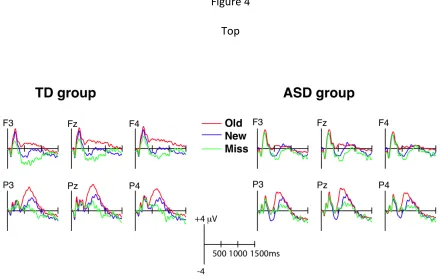
To enable comparisons for missed (studied but not recognised) words, the ERPs were compared to those for Old and New words (HFW and LFW collapsed) in each group. The data are presented in Figure 4. Number of miss ERP trials in the TD group: M = 71, SD = 28; ASD group: M = 79, SD = 40.
INSERT FIGURE 4 HERE
The ERPs for missed studied words were more negative than for New words in both groups, and there were no striking group differences in the ERPs.
Discussion
The aim of the present study was to test the hypothesis that despite comparable behavioural performance on recognition memory tests by individuals with ASD, the need for task support on memory tests might be reflected in atypical underlying neural activity at retrieval. Specifically, we investigated whether or not comparable recognition memory performance in ASD was associated with the same ERP old-new effects observed in typical individuals, that is, (1) an early mid-frontal old-new effect (300–500 ms), (2) a parietal, positive ERP effect (400–800 ms) and, (3) a sustained positive ERP potential over right frontal scalp sites. When participants were required to make old-new judgments of high and low frequency words in a recognition memory task, we replicated previous studies (Bowler et al., 2000; Bowler et al., 2007) by finding no behavioural difference between ASD and TD groups in the proportion of words correctly recognised. In addition, we found that both participant groups showed the well-established recognition memory advantage for low frequency words (Glanzer & Bowles, 1976; Guttentag & Carroll, 1994).
The undiminished behavioural performance of the ASD group was accompanied by group differences in ERP activity. Topographical differences in the Old-New effect were observed between groups from 300-500ms, where TD individuals, in addition to showing larger old-new effects for low frequency versus high frequency words (Rugg and Doyle, 1992; Rugg et al., 1995), showed an anterior onset (300-500ms) whereas the focus was at left posterior and parietal regions for individuals with ASD. In addition, the Old-New effect was attenuated at right frontal regions from 800-1500ms in the ASD group. We also observed a parietal focus of activity from 300-800ms in the ASD group, which contrasts with joint frontal and parietal activity for TD individuals1.
These results show that even during supported recognition memory test conditions (according to the TSH, Bowler et al., 1997; 2004), individuals with ASD show neural activity that is different from that of TD individuals. Recognition memory of individuals with ASD stems from enhanced involvement of the semantic (indexed by ‘Know’ responses in a
recognition memory test, see Tulving, 1985) and diminished involvement of the episodic memory systems (indexed by ‘Remember’ responses) (Bowler, Gardiner & Grice, 2000; Bowler, Gardiner & Gaigg, 2007). These studies drew on the distinction made by Tulving (2002), between episodic and semantic memory systems, which to some extent mirrors a distinction made by Mandler (2008), who argues for the memory processes of familiarity and recollection (see Gardiner, 2008 for further discussion). According to Tulving, semantic
memory allows the conscious experience of ‘knowing’ in the absence of recollecting specific
contextual details about the study episode. Episodic memory on the other hand, is concerned with the storage of contextually rich, personally experienced and unique events and allows
‘remembering’. Although ERP-related studies of memory have used both the semantic/episodic and the familiarity/recollection distinctions, here, we discuss our findings in terms of the episodic/semantic distinction, simply because the majority of studies of memory in ASD have used this framework. In TD individuals, the earlier on-setting mid-frontal Old-New effect is reliably found to accompany ‘Know’ judgements in Remember-Know tasks (Rugg & Curran 2007; Curran, 2000; Mecklinger, 2000) and the parietal old-new from 400-800ms (Voss & Paller 2008; Friedman & Johnson 2000; Paller & Kutas 1992) as well as late-onsetting right frontal positivity (Wilding & Rugg, 1996; Wolk, et al., 2009) have been reliably associated with episodic ‘Remember’ responses.
The topographical differences observed in the present study for ASD individuals in these time windows suggest that both the semantic and episodic memory systems engage partially different neural generators in ASD compared to those engaged by individuals with typical development. More specifically, the early mid-frontal Old-New effect observed for the TD group was absent for ASD individuals, who instead showed only a parietal focus, which provides evidence to suggest that semantic judgements may not be performed typically in ASD. Whereas parietal activity was observed for the ASD group from 400-800ms, activity for the TD group in this time period was more widespread, including anterior positivity. The fact that individuals with ASD show reduced ‘Remember’ responses in behavioural tests (Bowler et al, 2000, 2007) is also consistent with the attenuation of the old-new effect at right frontal regions reported here.
The pattern of between-group ERP differences just described suggests that rather than recognition being supported by early Old-New effects associated with knowing in TD, recognition in ASD seems to be exclusively associated with later parietal Old-New effects linked with remembering in TD. This finding of undiminished later parietal effects in ASD is paradoxical, given the behavioural evidence of diminished episodic and typical semantic responses (Bowler et al., 2000a, b, 2007). It implies that the neurophysiological correlates of semantic memory rather than episodic memory are compromised in ASD and is precisely the opposite of what has been concluded on the basis of behavioural evidence.
Recognition Old-New effect in ASD 10
Acknowledgements
Recognition Old-New effect in ASD 12
References
Allan, K., Dolan, R. J., Fletcher, P. C. & Rugg, M. D. (2000). The role of the right anterior prefrontal cortex in episodic retrieval. Neuroimage, 11 (3), 217-227.
DOI:10.1006/nimg.2000.0531
Allan K, & Rugg M. D. (1997). An event-related potential study of explicit memory on tests of cued recall and recognition. Neuropsychologia, 35, 387–97.
DOI:10.1016/S0028-3932(96)00094-2
Allan K, & Rugg M. D. (1997). An event-related potential study of explicit memory on tests of cued recall and recognition. Neuropsychologia, 35, 387–97.
DOI:10.1016/S0028-3932(96)00094-2
Allan K, & Rugg M. D. (1998). Neural correlates of cued recall with and without retrieval of source memory. Neuroreport, 9 (15), 3463-3466.
DOI:10.1097/00001756-199810260-00023
Allan, K., Wilding, E. L., & Rugg, M D. (1998). Electrophysiological evidence for dissociable processes contributing to recollection. Acta Psychologia, 98, 231-252.
DOI:10.1016/S0001-6918(97)00044-9
Ally, B. A., Waring, J. D., Beth, E. H., McKeever, J. D., Milberg, W. R. & Budson, A. E. (2008). Aging memory for pictures: Using high density event-related potentials to understand the effect of aging on the picture superiority effect. Neuropsychologia, 46 (2), 679-689. DOI:10.1016/j.neuropsychologia.2007.09.011
American Psychiatric Association, (2000). Diagnostic and Statistical Manual of Mental Disorders DSM-IV-TR (4th ed. Revised). Washington, DC: APA.
Baron-Cohen, S., Leslie, A. M. & Frith, U. (1985). Does the autistic child have a ''theory of mind''? Cognition, 21 (1), 37-46. DOI:10.1016/0010-0277(85)90022-8
Barth, C., Fein, D., & Waterhouse, L. (1995). Delayed match-to sample performance in autistic children. Developmental Neuropsychology, 11, 53–69. DOI:10.1080/87565649509540603
Baudot, J. (1992). Fréquence d'utilisation des mots en français écrit contemporain. Montreal: Les presses de l'Université de Montréal.
Boucher, J., & Lewis, V. (1989). Memory impairments and communication in relatively able autistic children. Journal of Child Psychology and Psychiatry, 30, 99–122.
DOI:10.1111/j.1469-7610.1989.tb00771.x
Boucher, J. & Warrington, E. (1976). Memory Deficits in Early Infantile Autism: Some similarities to the Amnesic syndrome. British Journal of Psychology, 67 (1), 73-78. DOI:10.1111/j.2044-8295.1976.tb01499.x
Bowler, D. M., Gaigg, S. B. & Gardiner, J. M. (2008a). Effects of related and unrelated context on recall and recognition by adults with high-functioning autism spectrum disorder.
Neuropsychologia, 46 (4), 993-999. DOI:10.1016/j.neuropsychologia.2007.12.004
Bowler, D. M., Gaigg, S. B. &, Gardiner, J. M. (2008b) Subjective organisation in the free recall of adults with Asperger's syndrome. Journal of Autism and Developmental Disorders, 38, 104-113. DOI:10.1007/s10803-007-0366-4
Bowler, D. M., Gaigg, S. B. & Gardiner, J. M. (2009). Free recall learning of hierarchically organised lists by adults with Asperger's syndrome: additional evidence for diminished relational processing. Journal of Autism and Developmental Disorders. 39, 643-650. DOI:10.1007/s10803-008-0659-2
Bowler, D. M., Gardiner, J. M. & Bertholier, N. (2004). Source memory in adolescents and adults with Asperger's syndrome. Journal of Autism and Developmental Disorders. 34 (5), 533-542. DOI:10.1007/s10803-004-2548-7
Bowler, D. M., Gardiner, J. M., & Gaigg, S. B. (2007). Factors affecting conscious awareness in the recollective experience of adults with Asperger's syndrome. Consciousness and Cognition, 16, 124–143. DOI:10.1016/j.concog.2005.12.001
Bowler, D. M., Gardiner, J. M., & Grice, S. (2000). Episodic memory and remembering in adults with Asperger's syndrome. Journal of Autism and Developmental Disorders, 30, 305–316. DOI:10.1023/A:1005552811441
Bowler, D. M., Matthews, N. J., & Gardiner, J. M. (1997). Asperger's syndrome and memory: Similarity to autism but not amnesia. Neuropsychologia, 35, 65–70.
DOI:10.1016/S0028-3932(96)00054-1
Recognition Old-New effect in ASD 14
Buckner, R. (2004). Memory and executive function in aging and AD: Multiple factors that cause decline and reserve factors that compensate. Neuron, 44, 195–208.
DOI:10.1016/j.neuron.2004.09.006
Craik, F. I. M., & Anderson, N. D. (1999). Applying cognitive research to problems of aging. In D. Gopher & A. Koriat (Eds.), Attention and performance XVII: Cognitive regulation of
performance: Interaction of theory and application (pp. 583–615). Cambridge, MA: MIT Press.
Curran, T. (2000). Brain potentials of recollection and familiarity. Memory and Cognition, 28,
923–938. DOI:10.3758/BF03209340
Curran, T. & Cleary, A. M. (2003). Using ERPs to dissociate recollection from familiarity in picture recognition. Cognitive Brain Research, 15, 191-205.
DOI:10.1016/S0926-6410(02)00192-1
Curran, T. & Dien, J. (2003). Differentiating amodal familiarity from modality-specific memory processes: An ERP study. Psychophysiology, 40 (6), 979-988.
DOI:10.1111/1469-8986.00116
Curran, T. Schacter, D. L., Johnson, M. K. & Spinks, R. (2001). Brain potentials reflect
behavioural differences in true and false recognition. Journal of Cognitive Neuroscience, 13, 201-216. DOI:10.1162/089892901564261
Desrochers, A., & Bergeron, M. (2000). Valeurs de fréquence subjective et d'imagerie pour un échantillon de 1,916 substantifs de la langue française. Canadian Journal of Experimental Psychology, 56, 274–325. DOI:10.1037/h0087347
Donaldson, D. I. & Rugg, M. D. (1999). Event-related potential studies of associative recognition and recall: electrophysiological evidence for context dependent retrieval processes. Cognitive Brain Research, 8 (1), 1-16. DOI:10.1016/S0926-6410(98)00051-2
Düzel, E., Yonelinas, A. P., Mangun, G. R., Heinze, H. J., & Tulving, E. (1997). Event-related brain potential correlates of two states of conscious awareness in memory. Proceedings of the National Academy of Sciences of the United States of America, 94(11), 5973–5978.
DOI:10.1073/pnas.94.11.5973
Friedman, D., & Johnson, J. R. (2000). Event-Related potential (ERP) studies of memory encoding and retrieval: a selective review. Microscopy Research and Technique, 51, 6–28. DOI:10.1002/1097-0029(20001001)51:1<6::AID-JEMT2>3.0.CO;2-R
Gardiner, J. M. (1988). Functional aspects of recollective experience. Memory and Cognition, 16, 309–313. DOI:10.3758/BF03197041
Gardiner, J. M., & Java, R. I. (1990). Recollective experience in word and nonword repetition.
Memory and Cognition, 18, 23–30. DOI:10.3758/BF03202642
Gardiner, J. M., Richardson-Klavehn, A. & C. Ramponi, C. (1997). On reporting recollective experiences and "direct access to memory systems". Psychological Science, 8, 391–394. DOI:10.1111/j.1467-9280.1997.tb00431.x
Glanzer, M., & Bowles, N. (1976). Analysis of the word-frequency effect in recognition memory. Journal of Experimental Psychology: Human Learning and Memory, 2, 21–31. DOI:10.1037/0278-7393.2.1.21
Guillaume, C., Clochon, P., Denise, P., Rauchs, G., Guillery-Girard, B., Eustache, F., et al. (2009). Early age-related changes in episodic memory retrieval as revealed by event-related potentials. NeuroReport, 20, 191–196. DOI:10.1097/WNR.0b013e32831b44ca
Guillem, F., Bicu, M., & Debruille, J. B. (2001). Dissociating memory processes involved in direct and indirect tests with ERPs to unfamiliar faces. Cognitive Brain Research, 11, 113–125. DOI:10.1016/S0926-6410(00)00070-7
Guttentag, R. E., & Carroll, D. (1994). Identifying the basis for the word frequency effect in recognition memory. Memory, 2, 255–273. DOI:10.1080/09658219408258948
Halford, G. S. (1993). Children's understanding: The development of mental models. Hillsdale, NJ: L. Erlbaum.
Hedden, T., & Gabrieli, J. D. (2004). Insights into the ageing mind: a view from cognitive neuroscience. Nature Reviews Neuroscience, 5, 87–96. DOI:10.1038/nrn1323
Hill, E. L. (2004). Evaluating the theory of executive dysfunction in autism. Developmental Review, 24, 189-233. DOI:10.1016/j.dr.2004.01.001
Johnson, M. K., Kounios, J. & Nolde, S. F. (1996). Electrophysiological brain activity and memory source monitoring. Neuroreport, 7 (18), 2929-2932.
DOI:10.1097/00001756-199611250-00025
Recognition Old-New effect in ASD 16
Lord, C., Rutter, M. & LeCouteur, A. (1994). Autism Diagnostic Interview-Revised: A revised version of a diagnostic interview for caregivers of individuals with possible pervasive developmental disorders. Journal of Autism and Developmental Disorders, 24 (5), 659-685. DOI:10.1007/BF02172145
Lord, C., Risi, S., Lambrecht, L., Cook, E. H., Leventhal, B. L., DiLavore, P. C., Pickles, A. & Rutter, M. (2000). The Autism Diagnostic Observation Schedule- Generic: A standard measure of social and communication deficits associated with the spectrum of autism. Journal of Autism and Developmental Disorders, 30 (3), 205-223.
DOI:10.1023/A:1005592401947
Mandler, G. (1980). Recognizing: The judgment of previous occurrence. Psychological Review,
87(3), 252–271.
DOI: 10.1037/0033-295X.87.3.252
Mandler, G. (2008). Familiarity Breeds Attempts A Critical Review of Dual-Process Theories of Recognition. Perspectives on Psychological Science, 3 (5), 390-399.
DOI: 10.1111/j.1745-6924.2008.00087.x
McCarthy, G., & Wood, C. C. (1985). Scalp distributions of event-related potentials: An ambiguity associated with analysis of variance models. Electroencephalography and Clinical Neurophysiology, 62, 203–208. DOI:10.1016/0168-5597(85)90015-2
Mecklinger, A. (2000). Interfacing mind and brain: a neurocognitive model of recognition memory. Psychophysiology, 37, 565–582.
DOI:10.1111/1469-8986.3750565
Mottron, L., Belleville, S. & Stip, E., (1996). Proper Name Hypermnesia in an autistic subject.
Brain & Language, 53, 326-350. DOI: 10.1006/brln.1996.0052
Mottron, L., Belleville, S., Stip, E., Morasse, K., (1998) Atypical memory performances in an autistic savant. Memory, 6(6), 593-607.DOI:10.1006/brln.1996.0052
Münte, T. F., Brack, M., Grootheer, O., Wieringa, B. M., Matzke, M., & Johannes, S. (1997). Event-related brain potentials to unfamiliar faces in explicit and implicit memory tasks.
Neuroscience Research, 28, 223–233. DOI:10.1016/S0168-0102(97)00047-3
Paller, K. A., & Kutas, M. (1992). Brain potentials during retrieval provide neurophysiological support for the distinction between conscious recollection and priming. Journal of Cognitive Neuroscience, 4, 375–391. DOI:10.1162/jocn.1992.4.4.375
Ranganath, C. & Paller, K. A. (2000). Neural correlates of memory retrieval and evaluation.
Cognitive Brain Research, 9 (2), 209-222. DOI:10.1016/S0926-6410(99)00048-8
Rugg, M. D. & Allan, K. (2000). Memory retrieval: an electrophysiological perspective. In M. S. Gazzaniga (2nd ed.). The New Cognitive Neurosciences (pp. 805-816). Cambridge: MIT Press.
Rugg, M. D., & Curran, T. (2007). Event-related potentials and recognition memory. Trends in Cognitive Sciences, 11, 251–257. DOI:10.1016/j.tics.2007.04.004
Rugg, M. D., Cox, C. J. C., Doyle, M. C., & Wells, T. (1995). Event-related potentials and the recollection of low and high frequency words. Neuropsychologia, 33(4), 471–484.
DOI:10.1016/0028-3932(94)00132-9
Rugg, M. D., & Doyle, M. C. (1992). Event-Related Potentials and Recognition Memory for Low- and High- Frequency Words. Journal of Cognitive Neuroscience, 4 (1), 69-79.
DOI:10.1162/jocn.1992.4.1.69
Rugg, M. D., & Nagy, M. E. (1989). Event-related potentials and recognition memory for words. Electroencephalography and Clinical Neurophysiology, 72, 395–406.
DOI:10.1016/0013-4694(89)90045-X
Rugg, M. D., Otten, L. J. & Henson, R. N. A. (2002). The neural basis of episodic memory: evidence from functional neuroimaging. Philosophical Transactions of the Royal Society of London, Series B, 357, 1097-1110.
DOI:10.1098/rstb.2002.1102
Russler, J., Probst, S., Johannes, S. & Munte, T. F. (2003). Recognition memory for high- and low-frequency words in adult normal and dyslexic readers: An event-related brain potential study. Journal of Clinical and Experimental Neuropsychology, 25 (6), 815-829.
DOI:10.1076/jcen.25.6.815.16469
Sanquist, T. F., Rohrbaugh, J. W., Syndulko, K., & Lindsley, D. B. (1980). Electrocortical signs of levels of processing: perceptual analysis and recognition memory. Psychophysiology, 17, 568–
576. DOI:10.1111/j.1469-8986.1980.tb02299.x
Slessor, G., Phillips, L. H., & Bull, R. (2007). Exploring the specificity of age differences in Theory of Mind tasks. Psychology and Aging, 22, 639–643.
Recognition Old-New effect in ASD 18
Tager-Flusberg, H. (1991). Semantic processing in the free recall of autistic children. British
Journal of Developmental Psychology, 9, 417–430. DOI:10.1111/j.2044-835X.1991.tb00886.x
Tulving, E. (1985). Memory and consciousness. Canadian Psychologist, 26, 1–12. DOI:10.1037/h0080017
Tulving, E. (2002). Episodic Memory: from mind to brain. Annual Review of Psychology, 53, 1–
25. DOI:10.1146/annurev.psych.53.100901.135114
Van Petten, C., Senkfor, A. J., & Newberg, W. M. (2000). Memory for drawings in locations: spatial source memory and event-related potentials. Psychophysiology, 37, 551–564. DOI:10.1111/1469-8986.3740551
Voss, J. L., & Paller, K. A. (2008). Neural substrates of remembering: electroencephalographic studies. In J. Byrne (Ed.), Learning and Memory: A Comprehensive Reference (Vol. 3, pp. 79–
98). Oxford: Elsevier Press. DOI:10.1016/B978-012370509-9.00106-6
Voss, J. L. & Paller, K. A. (2009) Remembering and knowing: electrophysiological distinctions at encoding but not retrieval. Neuroimage, 46 (1), 280-289.
DOI:10.1016/j.neuroimage.2009.01.048
Wilding, E. L. & Rugg, M. D. (1996). An event-related potential study of recognition memory with and without the retrieval of source. Brain, 119, 889-905.
DOI:10.1093/brain/119.3.889
Wilding, E. L. & Rugg, M. D. (1997a). Event-related potentials and the recognition memory exclusion task. Neuropsychologia, 35 (2), 119-128.
DOI:10.1016/S0028-3932(96)00076-0
Wilding, E. L. & Rugg, M. D. (1997b). An event-related potential study of memory for words spoken aloud or heard. Neuropsychologia, 35 (9), 1185-1195.
DOI:10.1016/S0028-3932(97)00048-1
Figure 1 top
Top
Figure 1: ERP traces to Old (in red) and New (in blue) words for TD (N = 14) and ASD (N = 22)
Recognition Old/New effect in ASD 2
Figure 2
[image:28.612.90.548.163.392.2]Top
Figure 2: 2D scalp distributions of Old/New mean ERP amplitude differences (Old minus New
words) in the 300-500 ms, 500-800 ms and 800-1500 ms for TD (N = 14) and ASD (N = 22)
Figure 3
Top
Figure 3: 2D scalp distributions of Old/New mean ERP amplitude differences (Old minus New
words) for high and low frequency words in the 300-500 ms, 500-800 ms and 800-1500 ms for
Recognition Old/New effect in ASD 4
Figure 4
Top
Figure 4: ERP traces to Old (red), New (blue) and Missed (green) words for TD (N = 14) and
ASD (N = 22) groups shown at nine selected electrodes.
Figure 2. 2D scalp distributions of Old/New mean ERP amplitude differences
(Old minus New words) in the 300-500 ms, 500-800 ms and 800-1500 ms for TD
(N = 14) and ASD (N = 22) groups.
Figure 3. 2D scalp distributions of Old/New mean ERP amplitude differences
(Old minus New words) for high and low frequency words in the 300-500 ms,
500-800 ms and 800-1500 ms for TD (N = 14) and ASD (N = 22) groups.
Figure 4. ERP traces to Old (red), New (blue) and Missed (green) words for TD
ASD
(N=22)
TD
(N=14)
M SD M SD
Age (years) 25.72 4.76 23.85 3.74
VIQ 106.34 12.58 106.77 12.31
PIQ 102.45 13.10 96.69 13.21
[image:32.612.85.427.100.309.2]FIQ 104.79 11.98 102.08 12.19
Table 1.
Mean and standard deviation for age and IQ measures (WAIS-III or WISC-III) for the TD
Table 2
Mean and standard deviation of accuracy scores (proportions) for the TD and ASD
groups are displayed separately for High and Low frequency words.
TD (N=14) ASD (N=22) Both Groups (N=36)
High Low High Low High Low
M SD M SD M SD M SD M SD M SD
Hits 0.64 0.17 0.72 0.18 0.68 0.16 0.79 0.10 0.66 0.16 0.76 0.14
FA 0.15 0.13 0.10 0.07 0.14 0.15 0.11 0.12 0.15 0.14 0.10 0.10
Author Note
Dr. Esha Massand, Department of Psychology, City University London, UK.
Professor Dermot M. Bowler, Department of Psychology, City University London, UK.
Professor Laurent Mottron, Université de Montréal, Montréal, Canada.
Anthony Hosein, Université de Montréal, Montréal, Canada.
Dr. Boutheina Jemel, Université de Montréal, Montréal, Canada.
Dr. Esha Massand is now at the Center on Human Development and Disability, University of
Washington, Seattle, WA, USA.
Acknowledgements
The authors would like to thank the individuals who participated in the study. The
first author was supported by a research studentship and international exchange scholarship
from the Department of Psychology, City University, London.
Correspondence concerning this article should be addressed to Dr. E. Massand,