City, University of London Institutional Repository
Citation
:
Huang, Tori Yu-wen (2012). Intuition and emotion: examining two non-rational approaches in complex decision making. (Unpublished Doctoral thesis, City University London)This is the draft version of the paper.
This version of the publication may differ from the final published
version.
Permanent repository link:
http://openaccess.city.ac.uk/2073/Link to published version
:
Copyright and reuse:
City Research Online aims to make research
outputs of City, University of London available to a wider audience.
Copyright and Moral Rights remain with the author(s) and/or copyright
holders. URLs from City Research Online may be freely distributed and
linked to.
City Research Online: http://openaccess.city.ac.uk/ [email protected]
INTUITION AND EMOTION: EXAMINING TWO NON-RATIONAL APPROACHES IN
COMPLEX DECISION MAKING
Tori Yu-wen Huang
A THESIS
in
Management
in
Partial Fulfilment of the Requirements for the
Degree of Doctor of Philosophy
City University London
Cass Business School
Faculty of Management
September 2012
List of Tables ... 5
List of Figures ... 6
Chapter 1 Overview ... 9
1.1 Introduction ... 9
1.2 Research theme ... 11
Chapter 2 Intuitive Interruptions in Analysis: A normative theory for complex decision making ... 13
2.1 Introduction ... 13
2.2 Decision Quality ... 14
2.3 Intuition ... 15
2.4 Interaction between Intuition and Analysis ... 16
2.5 Three Scenarios of Intuitive Interruptions in Analytic Processes ... 17
2.5.1 One injection of intuition at the end ... 18
2.5.2 One injection of intuition at the beginning ... 18
2.5.3 Multiple injections of intuition ... 20
2.6 The Concept of Switch ... 21
2.6.1 Externally driven versus internally driven ... 22
2.6.2 Rational choice versus affect driven ... 22
2.7 Benefits of Interrupting Intuitions in Analysis ... 23
2.7.1 Interrupting intuition redirects analysis ... 24
2.7.2 Interrupting intuition focuses analysis ... 25
2.7.3 Switching in action ... 26
2.8 Discussion ... 28
2.8.1 The caveats ... 29
2.8.2 Implications for research... 30
2.8.3 Managerial implications ... 31
2.9 Conclusion ... 31
Chapter 3 Intuitive Interruptions in Entrepreneurs’ Complex Decision Making ... 32
3.1 Introduction ... 32
3.2 The Theory of Intuitive Interruptions in Entrepreneurship ... 34
3.2.1 Intuitive interruptions and opportunity recognition ... 34
3.3.2 Methodological implications ... 40
3.3.3 Practical implications ... 41
3.4 Conclusion ... 41
Chapter 4 Escalation of Commitment: A study of hope ... 42
4.1 Escalation of Commitment ... 43
4.2 Hope ... 47
4.3 Hypotheses ... 48
4.4 Research Design ... 50
4.4.1 The decision task ... 51
4.4.2 Procedure ... 51
4.4.3 The sample ... 52
4.4.4 Video coding ... 53
4.4.5 Justification for methodological choices ... 53
4.5 Measures ... 54
4.5.1 Control variables ... 54
4.5.2 Independent variables ... 55
4.5.3 Dependent variable ... 56
4.6 Analyses ... 57
4.6.1 Choice of model ... 57
4.6.2 Data structure ... 57
4.7 Results ... 57
4.7.1 Descriptive statistics ... 58
4.7.2 Hypothesis testing ... 63
4.7.3 Robustness check ... 67
4.8 Discussion ... 67
4.8.1 Theoretical implications ... 68
4.8.2 Limitations and future research ... 72
4.9 Conclusion ... 74
Chapter 5 Performance and Dynamic Efficacy in a Team Decision Task ... 75
5.1 Self-efficacy and Team Efficacy ... 77
5.2 Depressive Realism ... 78
5.3 Hypotheses ... 79
5.4.4 Justification for methodological choices ... 83
5.5 Analyses ... 84
5.6 Results ... 85
5.6.1 Descriptive statistics ... 85
5.6.2 Tests of hypotheses ... 85
5.7 Discussion ... 91
5.7.1 Theoretical implications ... 91
5.7.2 Limitations ... 93
5.7.3 Future research ... 94
5.8 Conclusion ... 95
Chapter 6 Summary of Findings ... 96
References ... 99
Appendices ... 119
Appendix 1. Lab protocol ... 119
Appendix 2. Pre-simulation questionnaire ... 122
Appendix 3. In-simulation questionnaire ... 133
Appendix 4. Post-simulation questionnaire... 134
Appendix 5. Debrief form ... 136
Appendix 6. IOU note ... 138
Table 2-1 Quantity x Determinacy Matrix: Uncertainty vs. ambiguity ... 24
Table 4-1 Descriptive Statistics and Correlations of Study Variables ... 59
Table 4-2 Descriptive Statistics and Correlations of Study Variables (cont’d) ... 60
Table 4-3 Event History Models ... 64
Table 4-4 Event History Models (cont’d) ... 66
Table 5-1 Descriptive Statistics and Correlations of Study Variables ... 87
Table 5-2 Regression Models for Self-efficacy ... 88
Figure 2-2 One injection of intuition at the beginning ... 19
Figure 2-3 Multiple injections of intuition ... 21
Figure 2-4 Conceptual model ... 28
Figure 4-1 Simulation performance by month ... 61
Figure 4-2 Hope, engagement, and worry by month ... 62
Figure 4-3 Kaplan-Meier survival function ... 63
Figure 4-4 Path model ... 67
Figure 5-1 Conceptual model ... 81
[image:7.595.138.507.136.329.2]Chapter 1 Overview
1.1 I
NTRODUCTION
This thesis investigates non-rational approaches to complex decision making. Decision making is defined as the choosing among alternative courses of action and the approaches people adopt in terms of the types of search, deliberation, and selection procedures they use in such processes (Janis & Mann, 1977). The degree of complexity of a decision relates to the amount of information from alternatives and attributes that needs to be integrated (Hogarth et al., 1992). As such, a complex decision is one that most likely involves more than two alternatives, a number of attributes to be considered and some information about each of these.
and units in organisations might dominate the decision making based on their own preferences (Pfeffer & Salancik, 1974; Stagner, 1969).
Simon (1972) pointed out that real-life decision makers—unlike the theorised, perfectly rational decision makers who maximise and optimise—simplify their calculations and “satisfice” (i.e., settle for a satisfactory, rather than an approximate-best, decision). Similarly, Miller and Starr (1967) asserted that there is simply no way to combine all the considerations into a single, objective utility measure, even if the decision maker can provide honest ratings of subjective utility value. Simon’s (1955, 1956) proposal has since inspired a rich stream of empirical research attesting to the notion of bounded rationality. Among them, the most influential work—what is now the judgment and decision-making paradigm—was that of Daniel Kahneman and Amos Tversky, who demonstrated in simple but provocative ways the mistakes people make when applying simple inferential rules to making judgments (Kahneman, Tversky, & Mar, 1979; Amos Tversky, Kahneman, & Slovic, 1974).
inevitable such that people want to and try to be rational but fail to” misses the point originally put forth by Simon that bounded rationality is a result of adaptation to the environment. Non-rational approaches such as emotion and intuition can be functional in decision making. Emotions direct attention and help people attend to immediate needs (Keltner & Gross, 1999; Levenson, 1994). Intuition, informed by prior experience and existing knowledge, usually produces reasonably accurate inferences (Gigerenzer & Goldstein, 1996; Amos Tversky et al., 1974). Intuition and emotions are both adaptive mechanisms that help people navigate through an environment of high uncertainty and ambiguity more efficiently. Although these non-rational approaches sometimes go wrong—as demonstrated extensively by Kahneman and Tversky and others—most of the time they help people remain boundedly rational—that is, rational in an adaptive way.
1.2 R
ESEARCH THEME
This thesis departs from the passiveness and negativity of bounded rationality and focuses on the use of non-rational decision approaches in individual and team decision making. I aim to explore how non-rational approaches can be used by individual and teams—as “administrative men,” not “economic men” (Simon, 1955, p. 9)—in complex decision making in situations of high uncertainty and ambiguity.
be available to the decision makers and not all information available might be processed. In these situations of bounded rationality, decision makers resort to non-rational approaches. Intuition and emotions, as studied in this thesis, serve as aids to decision making that complement imperfect information and limited cognitive capacity.
Chapter 2 Intuitive Interruptions in
Analysis: A normative theory for
complex decision making
This paper offers a normative theory about how people should make complex decisions in organisations. Drawing on extant literature, logic, and decision examples, I explain that the best way for people to combine analysis and intuition in complex decision making is to allow intuition to interrupt the analytic processes. Intuitive interruptions offer benefits that are particularly helpful in ambiguous environments. I derive implications from this argument and propose possibilities for future research.
2.1 I
NTRODUCTION
Decision making is probably the most important act in organisational life. Individuals in organisations make numerous decisions every day, most of which are quite complex. In this paper, I offer a theory for how to best combine analysis—a rational decision approach—and intuition—a non-rational decision approach—in individuals’ complex decision making.
not rely primarily on either one of the approaches make better decisions (Hough & Ogilvie, 2005; Mintzberg, 1976; Robey & Taggart, 1981). In line with this assertion, pioneering studies have shown that adaptive decision makers employ a mix of analysis and intuition when making complex decisions (Blattberg & Hoch, 1990; Dunwoody et al., 2000; Isenberg, 1984; Prietula & Simon, 1989). However, thus far, no research has explained how exactly to best combine analysis and intuition in complex decision making. To fill this void, I attempt to offer such a theory, thereby contributing to existing research on complex decision making by proposing intuitive interruptions as a way to combine analysis and intuition in complex decision making. I demonstrate through an example how intuitive interruptions can present themselves in decision-making processes, what triggers them, and the functions they serve in order to increase decision quality. This theory is important as it enables the field of decision making to specify the optimal, mixed use of analysis and intuition. It should matter to decision researchers, intuition researchers, as well as real-world managers striving to become adaptive decision makers. In the following sections, I review the relevant literature before presenting the example and proposing the theory.
2.2 D
ECISION
Q
UALITY
decision quality. I concur with Forbes (2007) that decision quality is an individual-level latent construct leading to important outcomes that are significant to the decision maker across levels.
2.3 I
NTUITION
Following the latest development of intuition research in psychology and management (Sinclair, 2011a), intuition is defined as “direct knowing.” Intuition is a product of the subconscious processing of information; as people are unaware of the process, they are unable to articulate it. Such processing can be holistic (i.e., processing less information in a “jigsaw puzzle” manner) or inferential (i.e., navigating through large amount of information using shortcuts of quick matching); it can rely on both deliberative and experiential systems.1 Although the processing is subconscious, the product can surface
in the consciousness and be integrated into reasoning.2 Recent research suggests that
intuition manifests itself in many forms, including expertise (i.e., automaticity in familiar tasks), creation (i.e., a new idea that does not follow existing logic), and foresight (i.e., an accurate prediction of the future). Intuition is not an affect or emotion, but is often accompanied by it, such as in a confirmatory feeling (Khatri, Ng, & Alvin, 2000; Sinclair, 2010) or a sense of unease in moral decision making. Some scholars term intuition as “affectively charged judgments” (Hodgkinson, Langan-Fox, & Sadler-Smith, 2008; Pratt & Dane, 2007). However, affect and emotion are mere correlates and not essential components of intuition (Hogarth, 2001). Hunches and gut feelings—quick judgments without reasoning (Sadler-Smith & Shefy, 2004; Slovic, 2007)—as well as heuristics—simple decision rules based on experienced-based pattern recognition
1 The key to this new proposal is that one can deliberate without being consciously aware
(Sinclair, 2011b), which significantly differs from previous theories that associates the deliberate system with consciousness and awareness or the experiential system with subconsciousness (Epstein, Pacini, Denes-Raj, & Heier, 1996).
2 My stance differs from what Sinclair (2011b) terms “mode of reception,” which suggests that how
intuition surfaces in the consciousness can vary in its form as a thought or a feeling or through other
senses. In the theory of intuitive interruptions, intuition is a thought, which can be accompanied by
(Gigerenzer & Todd, 1999; Amos Tversky et al., 1974)—are behavioural manifestations of intuition.
2.4 I
NTERACTION BETWEEN
I
NTUITION AND
A
NALYSIS
Traditionally, dual process theory distinguishes between the two systems of information processing in the human mind (Chaiken & Trope, 1999). On one side is the rational, deliberate (Hogarth, 2005), and slow system of thought based on effortful, rule-based, exhaustive processing of information (McClelland, McNaughton, & O’Reilly, 2002; Sherry & Schacter, 1987)—termed System 2 by Stanovich and West (2000) and Kahneman (2003). On the other side is the non-rational, tacit, and fast system of thought involving the automatic, associative, and selective processing of information (Lieberman, 2000)—labelled System 1 (Kahneman, 2003; Stanovich & West, 2000). Such theoretical classification, along with the popularized belief of the “split brain”, often gives a false sense of independence of the two systems. In the latest development of intuition research, more emphasis is placed on how they interact seamlessly (Sinclair, 2011b). Scholars have proposed that intuition does not necessarily come from System 1; indeed, it can also come from System 2 (e.g., unconscious thought, pattern matching in naturalistic decision making) (Sinclair, 2011b). In this paper, to explain how intuition can interrupt analysis, I adopt the labels analysis and intuition to represent the two types of thought. Analysis is defined as the conscious, rule-based, exhaustive processing of information whereas intuition is the output of subconscious processing—be it holistic (System 1) or inferential (System 2)—of limited information.
such as analysis and intuition, should work together, not compete with each other in complex decision making.
Indeed, pioneering studies demonstrate that adaptive decision makers employ a mix of analysis and intuition in their decision making (Blattberg & Hoch, 1990; Dunwoody et al., 2000; Isenberg, 1984). Blattberg and Hoch (1990a) found that a combination of database model and managerial intuition always outperforms either of these decision inputs alone. Through in-depth interviews, Isenberg (1984) found that senior executives rely heavily on a mix of intuition and analysis. These findings are in line with the notion of “whole-brain thinkers” (Taggart et al., 1985)—namely, individuals who do not rely primarily on either one of the systems appear to be better decision makers (Hough & Ogilvie, 2005; Mintzberg, 1976; Patton, 2003; Robey & Taggart, 1981). However, in these studies, the actual process of combining analysis and intuition remains a black box.
2.5 T
HREE
S
CENARIOS OF
I
NTUITIVE
I
NTERRUPTIONS IN
A
NALYTIC
P
ROCESSES
the individual, which also includes cases when the decision maker utilises intuitive or analytic inputs from others but ultimately makes the decision alone.3
2.5.1 O
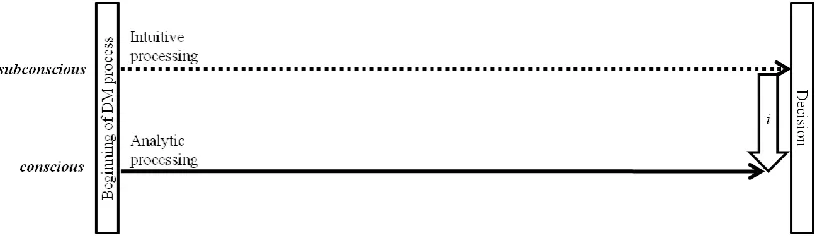
NE INJECTION OF INTUITION AT THE END [image:19.595.96.509.420.538.2]Imagine a human resource (HR) executive trying to select among six job candidates (i.e., known alternatives) for a position that is key to the future of the company. She first conducts a thorough analysis of the candidates, carefully weighing all attributes, calculating consequences, and comparing them to her goal (i.e., selecting the best candidate at a reasonable cost who can add value to the company). As a result of the analysis, she shortlists two candidates. However, based on the analyses, no clear winner emerges: Neither is better than the other on the key attributes. Unable to make a choice based on her analyses, she turns to her intuition and picks one of them without further reasoning. She cannot articulate the reasoning behind this choice. In this mode, analysis is first performed on all alternatives along all attributes, which requires exhaustive information processing. However, the ultimate choice of an alternative is intuitive—commonly portrayed in managerial intuition research as relying on intuition to reach a complex decision (Agor, 1989). This scenario is illustrated in Figure 2–1.
Figure 2-1 One injection of intuition at the end
2.5.2 O
NE INJECTION OF INTUITION AT THE BEGINNINGAdopting a different approach, the HR executive first intuitively picks two of the six candidates, already having a favourite in mind. She does not have clear reasoning
3 In the current discussion, I do not address the possibility of unconscious thought or telepathic
behind this choice, but this approach undoubtedly helps her reduce the cognitive load of evaluating all candidates. Furthermore, she intuitively decides to only look at work experience and expected salary—a decision likely based on her previous experience in recruiting, which had signified that these two criteria tend to be the most important. The subsequent analysis is quite simple and fast. She picks her favourite candidate after confirming that he has more previous experience than the other candidate but expects a similar salary.
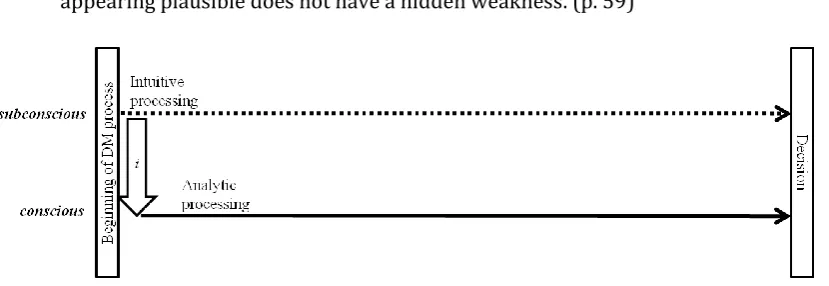
In this mode, decision makers first shortlist one or a few alternatives intuitively and then perform limited information processing to analyse this partial set before a final decision can be reached (see Figure 2–2). Sometimes a course of action has already been chosen intuitively and the analysis is used to confirm or disconfirm such a choice. For instance, in his description of chess masters, Simon (1987) provided a clear example of such interaction between analysis and intuition in chess playing:
[image:20.595.96.511.426.569.2]Even under tournament conditions, good moves usually come to a player’s mind after only a few seconds’ consideration of the board. The remainder of the analysis time is generally spent verifying that a move appearing plausible does not have a hidden weakness. (p. 59)
Figure 2-2 One injection of intuition at the beginning
This mode corresponds to what is described in previous research as using the analytic system to monitor the intuitive system (Kahneman, 2003). Klein (2004) proposed a recognition-primed decision model in which:
thinking (i.e., the analysis) to see if that course of action really would work. (G. Klein, 2004, p. 65; notation added)
Similarly, Shapiro and Spence (1997) suggested that managers initially use a gut-level, intuitive response, followed by analytical reasoning.
2.5.3 M
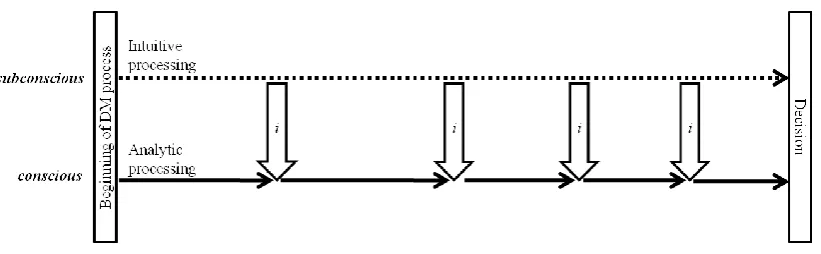
ULTIPLE INJECTIONS OF INTUITIONAdopting yet a different approach, the HR executive starts with an analytic process to identify her goals and produce a list of attributes for evaluating the candidates. She then intuitively ranks the importance of the attributes: work experience and expected salary first, qualifications second, then other skills. References are considered with the least weight unless they signify something exceptionally negative. This intuitive input helps the HR executive focus the subsequent rounds of analytic processes via which she evaluates the six candidates. She applies an intuitive cut-off point of five years of experience, which reduces the set of candidates to three. She then continues the analysis on the remaining attributes on her list, dropping one more candidate based on inferior qualifications. At this point, she is left with two candidates, one of whom becomes favoured based on his total scores on the attributes. She decides to interview the two finalists once more. During the interviews, she has a gut feeling that her favourite candidate is highly qualified, but has passed the “prime” of his career and is looking for a place to relax. She thus intuitively decides to add a new attribute: career aspiration. This motivates another round of analysis as the information is not readily available. She realises that she actually needs reliable references from her personal network in the industry. She also decides to reintroduce a third candidate from the rejected pile back into the set, whom the HR executive remembered as being extremely motivated. Ultimately, her hunch that her original favourite candidate “has peaked” is confirmed. Based on the new evidence, she selects the candidate whom she had dropped earlier, who has “enough” experience but is “still hungry” for more achievement.
Figure 2-3 Multiple injections of intuition
To date the interaction between intuition and analysis has not been extensively discussed in the literature. However, traces of this mode of multiple interruptions of intuition in analytic processes can be found. Multiple occurrences of intuition are implicitly present in research on rational decision making, termed as heuristics (i.e., inferential intuitions) (Gigerenzer & Goldstein, 1996; Luce, 1956; Simon, 1987b, 1990). Similarly, an implicit assumption of analysis underlies research on managerial intuition. Intuition is often portrayed, but not explicitly stated, as appearing during analysis. Intuitive decision makers, after getting an intuitive spark, continue working on issues “until they find a match between their gut and their head” (Isenberg, 1984, p. 86). These hints support the plausibility of multiple injections of intuition in analytic processes.
2.6 T
HE
C
ONCEPT OF
S
WITCH
To capture the process of intuitive interruptions in analysis, I propose the term switch
in which the analysis is going. This point will be further articulated in Section 3.7. At this point in discussion, it is clear that one injection in the beginning or at the end of analysis implies one switch whereas multiple injections imply multiple switches. As switching back and forth requires different mechanisms, particularly from the perspective of mood and cognition theories, the concept of the switch is necessary in facilitating discussions on the antecedents of intuitive interruptions in the following.
2.6.1 E
XTERNALLY DRIVEN VERSUS INTERNALLY DRIVENSwitching is sometimes externally driven. Decision makers, being constrained or required by their decision environment, can employ the switch spontaneously and passively. A passive switch from analysis to intuition occurs when a lack of information forces decision makers—after analysing the available information as much as they can—to switch to intuition or enter an incubation period before they can resume the process again with new insight or new information (Helie & Sun, 2010). A switch from intuition to analysis is required when, for example, individuals are required to present formal analysis to support their proposed solution, which in fact is an intuitive one. Switches can also be internally driven. Individuals can predetermine switch as a cognitive strategy and constantly remind themselves to be creative or “think outside of the box” when careful analysis is insufficient for generating a satisfactory solution. Similarly, for those who are prone to intuiting, a self-driven switch from intuition to analysis (G. Klein, 2004; Shapiro & Spence, 1997; Sun, Slusarz, & Terry, 2005) is a different kind of cue for one to “think twice” before diving into the decision. Intuition researchers assert that such skills can be developed through training (Vaughan, 1989).
2.6.2 R
ATIONAL CHOICE VERSUS AFFECT DRIVENpositive affective state, an “intuitive” mode is seen as being more suitable (Sinclair, Ashkanasy, Chattopadhyay, & Boyle, 2002). Meanwhile, when in a negative affective state, people tend to (a) perceive the overall situation as unfavourable and enter a scrutinising, “find fault” mode; (b) associate the situation with negative outcomes, which bring about doubts and worries; and (c) engage in detailed and careful analysis to avoid mistakes in an attempt to improve the current affective state (Elsbach & Barr, 1999; R. Erber & M. W. Erber, 1994; Parrott & Sabini, 1990). In this case, an analytic mode is seen to be the most fitting.
Following this logic, switches between analysis and intuition can be triggered by a change of affective state. A switch from intuition to analysis can follow a sudden bad mood, whereas a switch from analysis to intuition might be caused by an inflow of positive emotions. As described in previous research, these moods and emotions can come from either inside (“integral affect”) or outside (“incidental affect”) the decision situation (Pham, 2007). Examples of these, respectively, are negative feedback for the current task and a generally positive mood from the pleasant weather.
The implications of the relationship between affective states and switching between the two types of thoughts are two-fold. First, active switching is possible through the manipulation of mood. It seems highly probable to use emotions as initiators of intuition or analysis, such as deliberately putting oneself in a good mood to initiate intuition, considering that it can hardly be achieved directly through a conscious choice. Second, the implication of the affect-switch link lies in the “regulation” mechanism (Gross, 1999): How to be able to intuit even when in an extreme state of anger or sadness or analyse carefully even when in absolute excitement is an awareness and skill that can be learned. Such skills prevent individuals from becoming overwhelmed by emotions and enable them to function properly in both modes.
2.7 B
ENEFITS OF
I
NTERRUPTING
I
NTUITIONS IN
A
NALYSIS
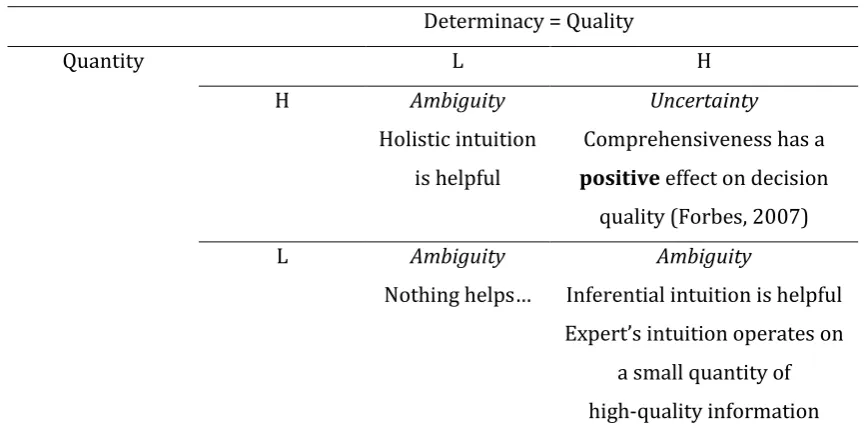
external environment in making strategic decisions. Integrating the work of Ellsberg (1961) and Huber and Daft (1987), Forbes (2007) theorises that comprehensiveness is only beneficial in situations of high quantity and high determinacy of information—what he terms uncertainty—but not in other situations in the “quantity x determinacy” matrix—what he terms ambiguity. Quantity implies the availability of information in the environment whereas determinacy is the degree to which the meaning of information is clear, which implies its usefulness or quality. Forbes’s (2007) proposal—namely, only under uncertainty does comprehensiveness have a positive effect on decision quality—reconciles previous research about the effect of comprehensiveness on decision quality. However, in situations of ambiguity in which comprehensiveness has no effect, it remains unclear what can be suggested to decision makers as a suitable approach to complex decision making. Drawing from recent research on intuition, I propose that allowing intuition to interrupt the analytic processes of complex decision making helps decision makers deal with ambiguity (Table 2-1). The mechanism I propose echoes Mintzberg’s (1976) assertion that intuition must be translated into logical order if it is to be put to use. I elaborate on this proposition in the following discussion.
Table 2-1 Quantity x Determinacy Matrix: Uncertainty vs. ambiguity
Determinacy = Quality
Quantity L H
H Ambiguity
Holistic intuition is helpful
Uncertainty
Comprehensiveness has a
positive effect on decision quality (Forbes, 2007) L Ambiguity
Nothing helps…
Ambiguity
Inferential intuition is helpful Expert’s intuition operates on
a small quantity of high-quality information
Intuition research often implicitly projects intuition as a provider of new perspectives, which motivates subsequent analysis (Agor, 1989; Behling & Eckel, 1991; Claxton, 1998; Isaack, 1978; Sadler-Smith & Burke, 2009). Studying senior managers’ thinking processes, Isenberg (1984) found that intuition appears in the forms of hunches and gut feelings in analytic processes, alarming decision makers—like warning bells (Rowan, 1989)—that something is not quite right even when backed by full analysis. For instance, “The data on the group were inconsistent and unfocused. I had the sense that they were talking about a future that just was not going to happen, and I turned out to be right.” (Quote from a CFO of a leading technical products company in Isenberg, 1984, p. 85).
This description of the function of intuition corresponds well to a particular type of intuition: holistic intuition. Recent research reveals that intuition can be the outcome of different types of processing. Holistic intuitions are products of information processing in a “jigsaw puzzle” manner that enables decision makers to see a complex situation as a synthesised whole instead of odd bits and pieces. For instance, extensive research has been conducted on the holistic processing in face recognition—namely, the integration of facial features and their spatial relations into a whole representation (Tanaka & Farah, 1993). Seeing “the whole picture” of a decision sometimes generates innovative insights that do not follow the logic of the current analysis. Such intuitive insight motivates subsequent analysis and changes the course of thinking. J. Baron (2008) illustrated this process with the following example: “Initially the executive saw only a single possibility—to go along—but some evidence against that possibility presented itself, specifically, an intuition or uneasy feeling. Such intuitions are usually a sign that more evidence will be found” (p. 9). The executive’s intuition uncovered a whole new aspect of the situation—namely, the morality of the plan—and directed a further round of information search and analysis (J. Baron, 2008). Interrupting intuition reveals a new aspect of the decision to be further analysed.
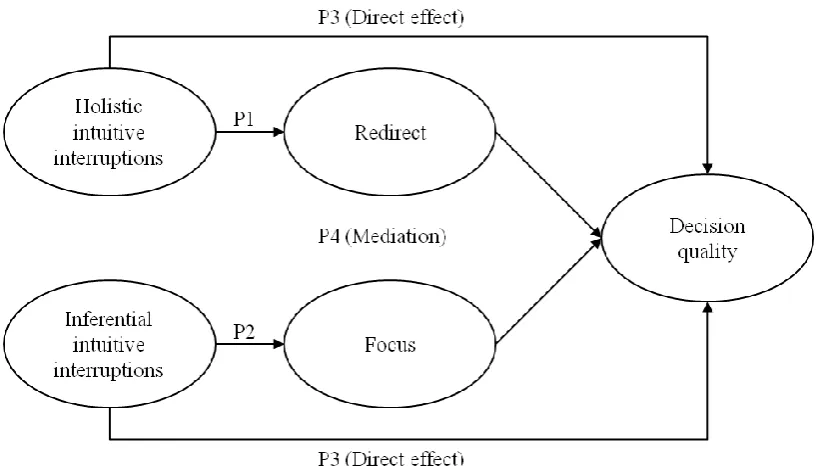
Proposition 1: Interruption of holistic intuition is positively related to the redirection of analytic processes.
2.7.2 I
NTERRUPTING INTUITION FOCUSES ANALYSISprocessing load and accelerate analytic processes (Kahneman & Klein, 2009). For instance, the ranking of attributes in terms of importance and the sequence of consideration is often determined intuitively. When an attribute is not quantifiable, “as good as”, “worse than”, and “good enough” judgments are often called for without much conscious reasoning. For example, in the satisficing heuristic, decision makers typically set an “acceptable” level for all “important” attributes and then find the first alternative that is “good enough” in terms of these attributes (Luce, 1956; Simon, 1987b, 1990). These arbitrary elements represent possible intuitive input. Another example is the lexicographic heuristic, such as the “take the best” heuristic (Gigerenzer & Goldstein, 1996), which involves identifying the “most important” attribute and then choosing the best alternative based on that attribute. In this decision-making strategy, the ranking of attributes in terms of importance, which could be determined intuitively, has a significant impact on the final choice.
Such “intuition as heuristics” (Akinci & Sadler-Smith, 2012) correspond to one type of intuition: inferential intuition (i.e., automated responses frozen into habit). In their recent call to synthesise naturalistic decision-making research and the heuristics and biases paradigm, Kahneman and Klein (2009) concurred that heuristics and experts’ intuition, or intuitive expertise, are closely related constructs that share the same basis—namely, inferential intuitions. Although heuristics and biases research focuses on the “inaccuracy” while expertise research focuses on the “accuracy of intuition”, they both subscribe to the mechanism of inferential intuition (i.e., navigating through large amount of information using shortcuts to make quick matches). Interruptions of inferential intuitions in the analysis—that is, introducing cut-off points, ranking the importance of attributes, and sequencing their consideration—reduce the information-processing load and narrow the focus of any subsequent analysis.
Proposition 2: Interruption of inferential intuition is positively related to the focusing of analytic processes.
2.7.3 S
WITCHING IN ACTIONtheir consequences cannot be accurately calculated and evaluated, which happens when attributes are not well specified, ranked, or sequenced. Consequently, alternatives cannot be valued on each attribute.
As proposed by Forbes (2007), comprehensiveness (i.e., pure analysis) is not beneficial in ambiguous decision environments: When there is little information, there is not much to analyse. When there is information but a low level of determinacy, more analysis leads to “paralysis” (Langley, 1995) as more conflicting results will prevent decision makers from reaching the decision. In these ambiguous situations, intuitive interruptions benefit the decision process in a number of ways. When there is little information but the available information is of high determinacy, inferential intuitions help decision makers achieve higher decision quality through the activation of experts’ scripts (i.e., memory structure based on extensive experiences which can operate on a limited amount of information yet remain accurate). The key mechanism, as previously discussed, is quick pattern matching. The necessary condition for this mechanism to work is that the quality (i.e., determinacy) of information is high. Inferences made on low-quality information will inevitably be false. Injections of inferential intuition, once allowed entry into the decision process, focus subsequent analysis by reducing the set of alternatives and by ranking and sequencing attributes.
In another type of ambiguous situation where information is of high quantity but of low determinacy, holistic processing helps decision makers synthesise the implicit connections and recognise the situation as a whole. Decision makers are therefore able to filter out “noise” (i.e., irrelevant information) and uncover good-quality information amongst the bad. This is based on the assumption that low determinacy of information is caused by a mix of high-quality (accurate) and low-quality (inaccurate and false) information.4 In other words, among the conflicting results produced by the
information in the environment, one or several of them would be true. Holistic intuitions, once allowed entry into the decision process, redirect subsequent analysis by revealing
4 In the case of “zero” determinacy (i.e., the information is completely false and of no value), this
new perspectives and adding new alternatives and attributes. Drawing from the above arguments, I make the following propositions.
Propositions 3: In ambiguous environments, allowing intuition to interrupt analysis leads to a higher decision quality than not allowing intuition to interrupt analysis (i.e., pure analysis) in complex decision making.
Proposition 4a: The redirecting benefit of holistic intuition mediates the relationship between holistic intuitive interruptions and decision quality.
Proposition 4b: The focusing benefit of inferential intuition mediates the relationship between inferential intuitive interruptions and decision quality.
[image:29.595.89.499.335.568.2]The conceptual model is graphically illustrated in Figure 2-4.
Figure 2-4 Conceptual model
2.8 D
ISCUSSION
Isenberg, 1984; Mintzberg, 1976; Prietula & Simon, 1989; Robey & Taggart, 1981). The theory of intuitive interruptions reconciles decision research, which favours rational approaches rooted in neo-classical economic theories (Allison, 1971; Ansoff, 1965), with intuition research, which advocates the power of non-rational approaches (Agor, 1989; Hogarth, 2001; G. Klein, 2004; Pratt & Dane, 2007). By pointing out that intuition is beneficial when it interacts with analysis, I hope to help the two camps meet halfway.
2.8.1 T
HE CAVEATSwhereas novices can function just as well as experts in an ambiguous environment with low determinacy and a high quantity of information. In summary, although the assumption of the current theory is that it is always possible to use either type of thought across tasks of different levels of complexity, it is reasonable to say that individual differences in the frequency, preferences, and mastery of intuitive interruptions as well as the switching between modes can impact decision quality.
2.8.2 I
MPLICATIONS FOR RESEARCHThe intuitive interruptions theory generates insights and new directions for research on decision making. First, intuitive interruptions can help explain the empirical paradox of “combined” speed and comprehensiveness in strategic decision making. Eisenhardt (1989) found that, in high-velocity environments, fast decision makers use more information, develop more alternatives, and have superior performance. From the information-processing perspective, the positive link between fast speed and the large amount of information processed is puzzling. According to the current theory, multiple injections of intuition can help focus analysis by bringing decision makers’ attention to important information and reducing the overall processing load while simultaneously considering more alternatives and attributes. Intuitive interruptions redirect and motivate subsequent analysis when information is lacking and focus and accelerate subsequent analysis when information overloads. Intuitive interruptions explain the combination of fast speed and comprehensive analysis of important information, which characterises fast and effective strategic decision makers.
decisions leads to more intuitive input into the decision process. Polychronic decision makers, compared to monochromic ones, might find it easier to allow interrupting intuitions into their analysis for each of their decisions and enjoy higher decision quality. I offer these thoughts to be examined empirically in future research.
2.8.3 M
ANAGERIAL IMPLICATIONSTraditionally, practitioner literature and academic research have advised managers to use intuition at one point in time to make a major decision (Agor, 1989). Practitioner books often overstate the benefits of intuition whereas academic research informs managers that experts’ intuition is useful for making instant major decisions. Conversely, I argue that having the full expertise to make a complex decision in an instant is not common in business. Complex decision making is more often a thought journey, and the level of experience often varies between the elements that constitute a complex decision. The theory of intuitive interruptions informs managers how to use intuition “at discretion” during complex decision making. Intuition does not have to be used only once to serve as the sole basis of decision. Decision makers can use intuition before and after analysis as well as at multiple times during the decision process. Allowing interrupting intuitions to guide their analytic process is beneficial to complex decision making.
2.9 C
ONCLUSION
Chapter 3 Intuitive Interruptions in
Entrepreneurs’ Complex Decision
Making
This research note applies the theory of intuitive interruptions to entrepreneurship and argues that entrepreneurs can benefit from allowing intuitions to interrupt analysis in their complex decision-making process in the entrepreneurial environment—an environment that is often highly ambiguous. In this chapter, I illustrate how intuitive interruptions can aid different cognitive activities involved in the entrepreneurial process—namely, opportunity discovery and improvisation. I offer possibilities for future research on entrepreneurial cognition.
3.1 I
NTRODUCTION
develop opportunities by rehearsing possibilities in their minds ("counterfactual thinking and mental simulation"; Gaglio, 2004). In its spirit, this stream of research goes beyond personality traits and finds specific mental processes that characterise such entrepreneurial thinking. (For reviews, see R. K. Mitchell et al., 2007; 2002; 2004.) Although greatly insightful, little research to date has conceptualised in detail how information is processed and organised in entrepreneurs’ mind, which might be what is fundamentally driving them to think and perceive the world differently from non-entrepreneurs. Recently, entrepreneurship scholars have advocated for the need to consider the role of intuition in entrepreneurial cognition (Blume & Covin, 2011; J. R. Mitchell, Friga, & Mitchell, 2005). Researchers have clearly demonstrated that entrepreneurs often use intuition to explain their actions (J. R. Mitchell et al., 2005), and enough reasons exist to believe that entrepreneurs, being in their decision environment, do use intuition in their decision making. In the past, intuition as a construct has been rejected due to the methodological challenges to measuring it; such challenges have not yet been resolved by psychology research (Dane & Pratt, 2009; J. R. Mitchell et al., 2005). However, Blume and Covin (2011) argue that, as entrepreneurs so frequently attribute their action to intuition, understanding entrepreneurial intuition is critical, regardless of its actual use. Grounded in information-processing theories (Simon, 1979) and the classic notion of bounded rationality (Simon, 1957), this paper tries to join this stream of research by proposing a specific cognitive process from which entrepreneurs can benefit, thereby allowing intuitive interruptions into their analyses. This process, as proposed in the intuitive interruptions theory (Chapter 2), often manifests as a switch from analysis to intuition, then from intuition back to analysis.5 The current proposal
draws from current research on intuition (Sinclair, 2011a) and complements the framework of entrepreneurial intuition proposed by Mitchell et al. (2005). Equipped with knowledge about the role of intuition in entrepreneurial thinking, efforts to determine how entrepreneurs think differently can proceed to the next level, where we are able to explain why they can perform certain cognitive activities (e.g., identify opportunities and improvise more efficiently than non-entrepreneurs).
5 Exceptions are the cases of one injection of intuition at the beginning or the end of the decision
The chapter is structured as follows. First, I summarise in brief the theory of intuitive interruptions. I then discuss roles of intuitive interruptions in opportunity discovery and improvisation, two of the important entrepreneurial actions found in previous research. I conclude with implications for entrepreneurship theory and practice.
3.2 T
HE
T
HEORY OF
I
NTUITIVE
I
NTERRUPTIONS IN
E
NTREPRENEURSHIP
In Chapter 2, the theory of intuitive interruptions was proposed. Drawing on Forbes’s (2007) proposal that comprehensiveness (i.e., pure analysis) is only beneficial to decision quality in an information environment with high determinacy and quantity (i.e., under uncertainty), I propose that in two types of ambiguous environment, interruptive intuitions in analysis can help decision makers achieve higher decision quality. In an environment with high quantity but low determinacy of information, holistic intuitions (i.e., synthesised output of jigsaw puzzle-like processing) interrupt analysis and redirect subsequent analysis by revealing a new perspective and adding new alternatives and attributes. In an environment with high determinacy but low quantity of information, inferential intuitions (i.e., frozen-into-habit automated responses from extensive prior experience) interrupt the analysis and focus subsequent analysis by reducing the set of alternatives and ranking and sequencing attributes. In other words, through the focusing on and redirection of benefits of inferential and holistic intuitions, respectively, intuitive interruptions contribute to higher decision quality.
I will now proceed to the entrepreneurial context to elaborate upon intuitive interruptions in entrepreneurship. Entrepreneurs, being in their ambiguous decision environment (Alvarez & Busenitz, 2001; Begley & Boyd, 1987; McMullen & Shepherd, 2006), benefit from interrupting intuitions in complex decision-making processes in different cognitive activities in the entrepreneurial process. This discussion includes an attempt to apply the new theory of intuitive interruptions in entrepreneurship and offer rudimentary ideas of how the two types of interrupting intuitions can help entrepreneurs navigate the entrepreneurial environment.
3.2.1 I
NTUITIVE INTERRUPTIONS AND OPPORTUNITY RECOGNITIONelements of an opportunity are often seemingly unrelated ideas that exist in distant geographical or knowledge spaces (Gregoire, Barr, & Shepherd, 2006). Entrepreneurs, who are attuned to subtle changes in the environment, can rely on holistic intuitions to “connect the dots” (R. A. Baron, 2006) and notice opportunities while others cannot (Gaglio & Katz, 2001). On one hand, noticing without searching for hints lacks intention, which implies subconscious information processing. As proposed in the theory of intuitive interruptions, holistic intuitions help people see the whole picture and are most useful in generating new possibilities in the ongoing analysis. Such alertness to opportunities (Busenitz, 1996; Minniti, 2004) is an effortless act that cannot be forced and is often times different from common logic. On the other hand, the ability to discover opportunities is an entrepreneurial expertise—something only entrepreneurs can do and something serial entrepreneurs are expected to do better than novices (R. Mitchell & Chesteen, 1995; Sarasvathy, 2008). Theoretically, the existing knowledge structure built on experience from previous ventures should facilitate the discovery of opportunities (J. R. Mitchell et al., 2005). However, thus far, entrepreneurship research has not empirically examined experts’ intuition of serial entrepreneurs in terms of its effectiveness in continuously discovering opportunities.
Mitchell et al. (2005) proposed that intuition is only relevant to entrepreneurship research within the boundaries of opportunity recognition. In these authors’ formulation, entrepreneurial intuition is most likely to be observed at the level of the cognitive process, or executive control system, that is closest to consciousness.6 They
argued that entrepreneurial awareness is an expert script stored in the executive control system that “enables the process whereby an individual comes to consciousness of an opportunity” (p. 661). This seems to point to entrepreneurial intuition as a type of
6 This claim is somewhat confusing for several reasons. (1) Consciousness is defined as
expert intuition. The theory of intuitive interruptions concurs that intuition is a product of nonconscious processes that can surface onto consciousness—that is, interrupt analysis. However, it does not make the assumption that entrepreneurial intuition can only be inferential. Holistic intuition, which can come from memory structures “further away” from the consciousness, is also crucial in opportunity discovery as it helps entrepreneurs connect seemingly unrelated ideas.
3.2.2 I
NTUITIVE INTERRUPTIONS AND IMPROVISATIONEntrepreneurs improvise in the founding of new ventures as well as in emergent firm strategies and competencies—that is, during and after start-up (Baker et al., 2003). Drivers of improvisation include having a historical record within good references, not having a formal plan available, facing time pressures (Leybourne, Sadlersmith, & Sadler-Smith, 2006), and the decision maker having no previous experience in the task. Improvisation as a concept originated from performance art and refers to “creat[ing] and perform[ing] spontaneously or without preparation” (Oxford Dictionary, 2000). In organisation studies, improvisation is defined as “the spontaneous and creative process of attempting to achieve an objective in a new way” (Vera & Crossan, 2004, p. 733) and “the convergence of planning and execution” (Moorman & Miner, 1998). These two definitions combined imply a novelty element and a “plan as you go” strategy that is often required in dynamic and turbulent environments into which new information constantly flows (Baker et al., 2003; Moorman & Miner, 1998) and improvisational actions are initiated based on the conditions of time pressure, ambiguity, and uncertainty (Vera & Crossan, 2004). In organisational studies, improvisation has been studied as an organisational-level construct. However, entrepreneurship scholars have studied the improvisation of entrepreneurial individuals, such as the work on bricolage (Baker et al., 2003; Baker & Nelson, 2005).
shares similarity with improvisation.7 Recent research shows that entrepreneurs’
ability to improvise is positively related to venture performance and is positively moderated by their self-efficacy (Hmieleski & Corbett, 2008).
Indeed, scholars recognise the important role of intuition in improvisation such that improvisation has been defined as “intuition guiding action in a spontaneous way” (Crossan & Sorrenti, 1997). Creativity and spontaneity are defined as the fundamental dimensions of improvisation encompassing other frequently mentioned aspects, such as intuition, flexibility, and the use of materials at hand (Vera & Crossan, 2004). The kind of intuition involved in improvisation, as described by improvisation researchers, seems to be inferential. For example, Crossan (1998, p. 593), following Weick (1998), defined intuition involved in improvisation as “the rapid processing of experienced information.” In her study, the ability of theatre actors to improvise comes from years of theatrical training and performing experience. In other words, good improvisation is built upon traditional skills in a particular domain (Crossan, 1998). More specifically, the author argues:
given that there is little or no time between conceiving of and executing an action in improvisation, whether improvisation produces coherent action depends fundamentally on the existence of a large number and variety of procedural routines that can be recombined to fit in a given context. (p. 709)
These descriptions of improvisation clearly point to the role of inferential intuitions, which are manifestations of experience and practice. However, the following description hints that a role for holistic intuition also exists: “learning from the environment often requires that individuals break out of their traditional frames of reference to see the environment in its full richness and complexity. Doing so requires the application of intuition”(Crossan, 1998, p. 595).
7 However, Baker et al. (2003) clarify that improvisation implies bricolage, but bricolage does
Moorman and Miner’s (1998b) description of jazz composition demonstrates that improvisation seems to depend on a mix of holistic intuition and inferential intuition. For example, on one extreme, the first level of improvisation involves “modest adjustments to a pre-existing piece or process. […] musicians often begin with ‘the head’ of a piece, playing the song and its standard chords, but making slight modifications in style and emphasis.” On the other extreme, “the improviser discards clear links to the original referent and composes new patterns. The improviser may begin with a standard head but moves on to melodic improvisations that have internal patterns unrelated to the original harmonic, rhythmic, or melodic structures” (p. 703). In the former, more inferential intuitions might be involved than holistic intuitions. In the latter, more holistic intuitions might be involved than inferential intuitions. Moreover, the composition of a whole song most likely involves multiple interruptions of intuition—some holistic, some inferential.
Moorman and Miner (1998b) argued that improvisation is influenced by two types of memory: procedural and declarative. Procedural memory stores action sequences, scripts, and routines while declarative memory consists of ideas and facts (Miner & Mezias, 1996). Procedural memory seems to be closely related to inferential intuition as “a key characteristic of procedural memory is that it becomes automatic or accessible unconsciously” (Moorman & Miner, 1998b, p. 708)—that is, a frozen-into-habit automated response stored in action scripts that are speedy and effortless. Meanwhile, declarative memory consists of the general knowledge or principles of things that can be applied to different situations, for example in jazz composition, the musical theory about chord progression or rhythmic pattern (Moorman & Miner, 1998b). This seems to correspond to holistic intuition as “the importance of declarative knowledge in making sense out of new situations, deriving meaning from unstructured situations, or using principles to predict outcomes” (p. 710).
why holistic intuition should be slower. Third, it is true we do not expect inferential intuition to generate something new as its function is to focus analysis (i.e., scope it down, not expand it). Thus, there seem to be some consistencies as well as inconsistencies between improvisation theory and the theory of intuitive interruptions. These ideas are offered for future research.
There are two more insights from this cross-comparison. First, it is clear in intuition literature that the basis of inferential intuition is expertise (i.e., existing knowledge structure built on prior experience and extensive practice). However, it has not been clearly specified from which kind of knowledge structure holistic processing can draw. Drawing from improvisation theory, it seems that general knowledge not specific to the current task might help people organise information. Another possibility is that the activation of inferential or holistic intuition and the memory that one draws from are determined by the degree of similarity between the situation at hand and experienced situations stored in the memory. Second, improvisation theory views the two types of memory as complementary competencies that offset one another's weaknesses (Moorman & Miner, 1998b). Improvisation scholars have suggested a number of ways to combine declarative memory and procedural memory to achieve higher coherence, speed, and novelty altogether, such as using declarative memory to make creative use of procedural memory. The lesson that intuitive interruptions theory can take from this is that the degree to which intuitive interruptions increase decision quality might depend on how well one mixes inferential intuition and holistic intuition to benefit from their complementarities. These ideas are also offered for future research.
3.3 D
ISCUSSION
from less successful entrepreneurs, and expert entrepreneurs from novice entrepreneurs.
3.3.1 T
HEORETICAL IMPLICATIONSThe key contribution of this chapter to entrepreneurial cognition research is the proposal of intuitive interruptions as a new framework for studying entrepreneurial intuition. The uniqueness of this framework, compared to previous proposals such as Mitchell et al.’s (2005), is the emphasis on the combined use of intuition and analysis—how intuitions interrupt and rejuvenate analytic processes—instead of solely relying on intuition. This is consistent with recent studies that provide empirical evidence suggesting that analysis and intuition are dual processes instead of two extremes along a single continuum (Hodgkinson, Sadler-Smith, Sinclair, & Ashkanasy, 2009). Entrepreneurs, and any individuals, can tap into both. I draw from the latest advances of intuition research that specify two different types of processing—inferential and holistic—that both produce intuitions. This new development in the intuition literature potentially reconciles previous research on expert intuition and creative intuition as well as many other streams of research, including entrepreneurial intuition (see Chapter 2).
3.3.2 M
ETHODOLOGICAL IMPLICATIONS3.3.3 P
RACTICAL IMPLICATIONSGiven the benefits of intuition as proposed by the current theory and all other intuition theories, an important question remains: How do we cultivate intuition? As intuition comes to mind in fleeing moments, one obvious suggestion is to allow random thoughts into the thinking process and not to fixate on logical analysis. Seemingly illogical ideas can be exactly the kind of intuition that changes the direction of thinking or injects new possibilities into the stagnant analysis. Dane (2011) recently proposed mindfulness—being and feeling present (Brown & Ryan, 2003)—as an aid for capturing fleeing intuitions. He argued that intuitions easily slip through our mind without receiving consideration. Being mindful implies attending to both internal and external stimuli. These are untested propositions offered for future research.
3.4 C
ONCLUSION
Chapter 4 Escalation of
Commitment: A study of hope
This study was designed to examine the role of hope in escalation decision making. It was hypothesised that, when faced with continuous negative feedback in an unfavourable situation, teams who remain hopeful persist (at an increasing cost), engage in the situation, and worry about the future. Hope is defined and measured as a mix of emotion and cognition, while engagement and worry are captured as video-coded behavioural displays. A longitudinal simulation design is employed, in which teams underwent multiple rounds of feedback and investment. Data from 66 teams reveal that the likelihood of teams quitting the simulation task is lower when teams experience hope. Displayed engagement and worry mediated the relationship between hope and the likelihood of teams quitting the course of action. Theoretical and practical implications of the findings are discussed at the end of this chapter.
How and why do people choose to continuously invest resources into a failing course of action against negative signals? Extant research offers economic and behavioural explanations for the phenomenon of escalation of commitment. People who see chances in recovering current losses in the future (Bazerman, Giuliano, & Appelman, 1984) and want to avoid wastefulness (A Tversky et al., 1985) escalate their commitment rationally. People who feel personally responsible and the need to justify their initial decisions escalate their commitment and persist in unfavourable situations irrationally (B. M. Staw, 1981; B. M. Staw, Hall, & Pondy, 1976; B. M. Staw & Ross, 1987). In these prevailing explanations of escalation of commitment, an underlying factor seems to be missing: What is the mentality that people rely on when framing the situation as a smaller future loss instead of a sure loss now? When faced with sunk cost, how can wastefulness possibly be avoided? What is being expected of the future such that the initial decision to enter the course of action can be justified? The fundamental element missing from the discussion thus far is a positive, but not necessarily rational, belief about the future.
theories, hope is defined as a positive psychological state about the future—that is, the belief that the currently unfavourable situation will improve. In an escalation situation, hope entails the expectation of turning the situation around (Brockner, 1992). It is only when the future turns out better can the current loss be recovered and a gain becomes possible, can sunk cost not be wasteful, and can the eventually positive outcome justify the initial decision to enter the course of action.
Historically, behavioural explanations to escalation of commitment have been pitched against economic explanations. Although an interaction between these two has been proposed by escalation researchers, it remains under-researched (B. M. Staw, 1981, 2005). In this paper, I propose that hope, as a positive psychological state, implies people’s beliefs about project economics, which was previously positioned as an economic reason of escalation. I argue that, in unfavourable, uncertain situations, this belief is rarely rational. Moreover, hope is the latent factor of previous behavioural explanations. As a result, I contribute to the literature by offering a new explanation for escalation of commitment. To this end, I will demonstrate empirically the effect of hope above and beyond the known social-psychological drivers and discuss how the hope theory of escalation complements and potentially underlies previous explanations. I will start by reviewing the literature on escalation of commitment and hope, followed by deriving hypotheses of the effect of hope on escalation tendency and the mediating mechanisms.
4.1 E
SCALATION OF
C
OMMITMENT
M. Staw & Fox, 1977). These psychological factors are more powerful than economic factors such that individuals’ continuous investment is rarely a rational effort. The self-justification explanation presented in Staw’s three studies is rooted in dissonance theory (Festinger, 1954) and focused on the individual level. Two of Staw’s subsequent studies (Fox & Staw, 1979; B. M. Staw & Ross, 1980) examined social factors behind leaders’ escalation of commitment. People who are facing job insecurity and policy resistance are more likely to persist in an action involving an increasing cost (Fox & Staw, 1979); the social norm of being consistent also adds to the pressure to persist (B. M. Staw & Ross, 1980).
In 1981, Staw proposed the first comprehensive theoretical framework of escalation of commitment, in which he proposed the four major determinants of escalation behaviour: motivation to justify previous decisions, norms for consistency, probability of future outcomes, and value of future outcomes—the former two are behavioural and irrational, corresponding to his previous work, whereas the latter two are economic and rational, corresponding to classic economic explanations such as sunk cost and prospect theory (B. M. Staw, 1981). A key distinguishing logic behind this contrast is retrospective rationality versus prospective rationality. Decision makers in prospect theory behave according to their framing of situations, particularly the perception of losses (Whyte, 1986). People who frame the situation as some chance to have a smaller loss, no loss, or even a gain in the future are likely to persist and invest more whereas people who frame the situation as a sure loss now are be more likely to cut losses and exit (Bazerman et al., 1984). Similarly, those who perceive prior investment as sunk cost engage in actions to avoid wastefulness and therefore persist (Arkes & Blumer, 1985). These explanations are different from behavioural explanations (e.g., self-justification) in that decision makers look into the future rather than the past.
with the effects of economic drivers, making it difficult to draw a line between them. Subsequent research began to address this issue.
In a case study of the world’s fair Expo 1986 in Vancouver, Ross and Staw (1986) found a more complex picture of escalation of commitment. Project factors (consideration of economic value of a project) and psychological factors such as self-justification are strong drivers of behaviour in the early stages of escalation whereas structural factors such as the tremendous impact at the societal level that exceeds the project itself and the belief that the decision maker’s political reputation is at stake become forceful drivers of escalation (B. M. Staw & Ross, 1987). The implication of this more complex picture is two-fold. First, behavioural factors and economic factors seem to interact such that escalation behaviour is not clearly rational or irrational, but a mix of both. Second, the interplay of micro and macro factors is also at work.
Almost simultaneously, a stream of research emerged that focused on the phenomenon of “entrapment”, paralleling escalation of commitment. Joel Brockner and his colleagues conducted a series of studies and found a number of contributing factors to persistence and escalating behaviour, such as modelling behaviour (Brockner et al., 1986; Brockner, O’Malley, Hite, & Davies, 1987), audience and face saving effect (Brockner et al., 1982; Brockner, Rubin, & Lang, 1981) and self-identity protection (Brockner et al., 1986; Sandelands, Brockner, & Glynn, 1988).
revenue picture of the future. Whyte (1986) proposed that prospect theory can more readily explain escalation behaviour than self-justification. He argued that, in a continuous decision-making process, the framing of a subsequent decision will reflect the success or failure of the previous decision. Individuals in a gain framing (from previous success experience) will be risk adverse whereas individuals in a loss framing (from previous failure experience) will be risk seeking, which naturally manifests in the escalation of commitment (i.e., further investment). Bowen (1987) positioned escalation of commitment as a decision dilemma instead of a decision error: Equivocal feedback, as defined and manipulated in previous laboratory studies, renders that decision makers simply cannot prejudge the future effectiveness of continuing or discontinuing any course of action. The ambiguity of feedback resides in the lack of predictive power of future performance and credible criteria or standards against which to compare feedback. He concluded that “one technically cannot err in an ill-structured situation” (p. 63). Brockner (1992) reviewed empirical evidence supporting the self-justification theory and proposed that alternative explanations—particularly situational and individual factors derived from the literature on group polarization, modelling, and self-presentation theory—should complement it, rather than replace it.