City, University of London Institutional Repository
Citation
:
Ul Asad, H. and Jones, K. (2015). Inevitability of Phase-locking in a Charge
Pump Phase Lock Loop using Deductive Verification. Paper presented at the 25th edition on
Great Lakes Symposium on VLSI, 20-05-2015 - 22-05-2015, Pittsburgh, USA.
This is the accepted version of the paper.
This version of the publication may differ from the final published
version.
Permanent repository link: http://openaccess.city.ac.uk/12327/
Link to published version
:
Copyright and reuse:
City Research Online aims to make research
outputs of City, University of London available to a wider audience.
Copyright and Moral Rights remain with the author(s) and/or copyright
holders. URLs from City Research Online may be freely distributed and
linked to.
City Research Online:
http://openaccess.city.ac.uk/
[email protected]
Inevitability of Phase-locking in a Charge Pump Phase
Lock Loop using Deductive Verification
Hafiz ul Asad
City University LondonEC1 0HB London,UK
[email protected]
Kevin D. Jones
Plymouth University PL4 8AA Plymouth,UK[email protected]
ABSTRACT
Phase-locking in a charge pump (CP) phase lock loop (PLL) is said to be inevitable if all possible states of the CP PLL eventually converge to the equilibrium, where the input and output phases are in lock and the node voltages vanish. We verify this property for a CP PLL using deductive verifica-tion. We split this complex property into two sub-properties defined in two disjoint subsets of the state space. We de-ductively verify the first property using multiple Lyapunov certificates for hybrid systems, and use the Escape certificate for the verification of the second property. Construction of deductive certificates involves positivity check of polynomial inequalities (which is an NP-Hard problem), so we use the sound but incomplete Sum of Squares (SOS) relaxation al-gorithm to provide a numerical solution.
Categories and Subject Descriptors
B.7.2 [INTEGRATED CIRCUITS]: Design Aids— Ver-ification and Simulation
General Terms
Verification
Keywords
Deductive Verification; AMS Circuits; Lyapunov Certificate; Escape Certificate; SOS Programming
1.
INTRODUCTION
Formal methods are in their infancy in Analog and Mixed Signal (AMS) circuits verification. Start up problems (In-evitability) have been very common in PLL circuits, i.e., for certain initial states of voltages on the nodes, the cir-cuits do not converge to the desired behaviour. Furthermore, when perturbed by an external disturbance, designers need to know if the system will return to the desired behaviour.
Hybrid systems are well known modelling paradigm for a CP PLL [16], [2], [6]. Techniques for the verification of hybrid
Permission to make digital or hard copies of all or part of this work for personal or classroom use is granted without fee provided that copies are not made or distributed for profit or commercial advantage and that copies bear this notice and the full cita-tion on the first page. Copyrights for components of this work owned by others than ACM must be honored. Abstracting with credit is permitted. To copy otherwise, or re-publish, to post on servers or to redistribute to lists, requires prior specific permission and/or a fee. Request permissions from [email protected].
GLSVLSI’15,May 20–22, 2015, Pittsburgh, PA, USA. Copyrightc 2015 ACM 978-1-4503-3474-7/15/05 ...$15.00. http://dx.doi.org/10.1145/2742060.2742072.
systems can be classified as, reach-set methods, abstraction based methods, and certificate based methods. Reach-set method has been used to prove the inevitability property. Hundreds of discrete transitions are required by the hybrid model of the CP PLL before it reaches the locking state. This results in a large number of continuous set computations fol-lowed by the guard conditions describing the switching laws, making the reachability computations prohibitively expen-sive.
In this paper, we use certificate based deductive verifi-cation of the inevitability of phase-locking in higher order CP PLL circuits. Due to its complexity, we adopt a two-pronged verification approach and divide the inevitability property in to the conjunction of two sub-properties. Ver-ification of these two properties determine the truth value of the inevitability property in two disjoint subsets of the state space. The first property specifies, that in a compact set, all system trajectories eventually converge to the equi-librium locking state. The second property is specified, such that trajectories in the second subset, will eventually escape the set and reaches the set where the first property holds. The first property is verified by computing an attractive invariant region (ROA), utilizing the deductive Lyapunov stability theory for hybrid systems [5]. We construct multi-ple Lyapunov certificates for different modes of the CP PLL hybrid system. The maximized level curves of these Lya-punov certificates characterize the level sets whose union is the ROA. Similarly, we use Escape certificates to verify the second property, and establish that trajectories in the second set will eventually leave and reach the ROA. Our certificate (Lyapunov-Escape) based deductive approach in-volves checking positivity of polynomial inequalities, which is an NP-hard problem. Therefore, we utilize the sound but incomplete SOS relaxation to construct these certificates.
1.1
Related Work
Inevitability of an equilibrium state is closely related to the global asymptotic stability of a dynamical system . Lya-punov theory is a well known approach for the verification of such properties [5]. Hybrid system models have differ-ent flavours that can be found in [8],[1]. Here we consider the framework outlined in [4]. In the last decade, SOS pro-gramming has been the major tool used in the algorithmic construction of Lyapunov certificates for continuous as well as hybrid systems [9], [11]. Barrier certificates has been used for safety verification of the hybrid systems in [11]. Deduc-tive verification of continuous and hybrid systems have been demonstrated in [14], [13].
This paper is organized as follows: In Sec.II, we introduce the preliminaries of this paper. Sec.III illustrates verification of the inevitability of phase-locking in CP PLL. Experimen-tal results are shown in Sec.IV. Sec.V concludes the paper.
2.
PRELIMINARIES
2.1
Hybrid Systems Model
We use the hybrid system formalism described in [4]. We consider a hybrid system described by the tuple (C,F,D,G). Here,{C = S
i∈ICCi} ⊂ R n
, and {D =S
i∈IDDi} ⊂ R n
are the flow set and jump set for i ∈ N, respectively. IC andID are finite disjoint index sets and it is possible that
Ci∩Di 6= ∅. The flow and jump maps are, respectively,
F =S
i∈ICFi, and G =
S
i∈ICGi, where each Fi :R n×
Rm →Rm+n, and, Gi = Rn → Rn. These two mappings
characterize the continuous and discrete evolution of the sys-tem, whereasCiand Di describe subsets ofRn where such
evolution may occur. We represent a hybrid system Has
H=
(
˙
x=Fi(x, u)∈ F x∈ C, u∈ U
x+=Gi(x)∈ G x∈ D
(1)
Here u ∈ U ⊂ Rm is a vector of uncertain parameters.
The state of the hybrid system consists of alternate flows in jumps throughC andD according toFi andGi, respec-tively. This hybrid phenomena can be described by a notion of time called hybrid time.
Definition 1(Hybrid Time Domain).
A setT ⊂R≥0×Nis a hybrid time domain if
T = j−1
[
j=0
([tj, tj+1], j)
where 0 =t0≤t1≤t2≤, ..., with the last interval possibly
of the form [tj, tj+1]× {j}, [tj, tj+1)× {j}, or [tj,∞)× {j}.
Definition 2(Hybrid Arc).
A mappingx:T →Rnis a hybrid arc ifT is a hybrid time
domain and for eachj∈N, the functiont7→x(t, j) is locally
absolutely continuous on the intervalIj={t: (t, j)∈ T }. We denote by domx, the domain of the hybrid arc which is the hybrid time domain. A hybrid arcxis a solution to the hybrid systemH, ifx(0, j)∈ C ∪Dand (i) for eachj∈N
such thatIjhas a non-empty interior,
˙
x(t, j) =Fi(x(t, j)), ∀t∈Ij,
[image:3.595.319.547.55.149.2]x(t, j)∈Ci, ∀i∈IC, ∀t∈[min Ij, sup Ij) (2)
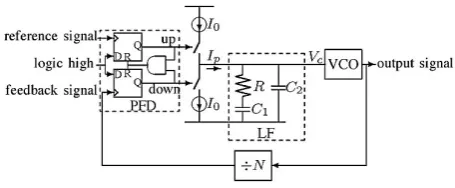
Figure 1: Charge Pump (CP) Phase Lock Loop (PLL)
Assumption 1.
The flow mapsFi(x, u) and the jump mapsGi(x) are poly-nomials.
Definition 3 (Equilibrium point).
A pointx(t, j)∈ C ∪ Dis called an equilibrium, if∃t, ∃j, Fj(x(t, j), u) = 0.
Definition 4 (Inevitability of Equilibrium).
The equilibrium pointxeis said to be inevitable, if∀x(0, j)∈
C ∪ Dand bounded t,x(t, j)→xe.
2.2
CP PLL Model
A CP PLL circuit consists of a reference signal, a phase frequency detector (PFD), a charge pump (CP), a loop filter (LF), and a voltage controlled oscillator (VCO). In this pa-per we consider a single path higher order (Third and fourth) CP PLL shown in Fig. 11. We use a behavioural model of the PLL, where we consider a linear model for VCO, a lin-ear model for the third order LF, and a non-linlin-ear model for the PFD. We denote byφref, andφV CO, the phases of the reference and VCO output feedback signals respectively. We model the CP PLL as a hybrid system such that the non-linearities of the PFD is modelled as a piecewise continuous signal. Ignoring the cycle slip phenomena, the PFD output in the form of the charge pump currentIp, is given by the following piecewise linear inclusion:
Ip=
∈[IpUIPU] UP=1, Down=0, 0≤φV CO<2π≤φref
∈[IpDIPD] UP=0, Down=1, 0≤φref <2π≤φV CO
∈[0R 0R] UP=0, Down=0, 0≤φ
V CO, φref <2π (3) We denote the three modes as mode1 (UP=0, Down=0), mode2 (UP=1, Down=0) and mode3 (UP=0, Down=1). The transition from one mode to another is based on the reference and feedback signals hitting the 2πthreshold. Due to the cyclic behaviour of the PLL and to keep the anal-ysis modulo 2π, we need to ensure the phases remain in the range 0 ≤ φV CO, φV CO < 2π (Similarly φref) after resetting the PFD. This is achieved by resetting the two phases such that (φref := 0, φV CO := φV CO−2π), and (φref :=φref −2π, φV CO := 0), while taking transitions from mode1 to mode2 and mode1 to mode3, respectively. Identity resets are used for transitions from mode2 to mode1 and mode3 to mode1.
Our model consists of the state variables, φV CO, φref, voltagev1across the capacitorC1, and the voltagev2across
the capacitor C2 (Fourth order has an additional voltage
variable across the third capacitor). Let fV CO, and fref, represent the frequencies of the VCO output and the
refer-1Third order shown here,fourth order has an additional
ence signal respectively. If Kp is the gain of the LF, then
fV CO = Kpv2/2π+fO, where fO is the free running fre-quency of the VCO. Therefore, ˙φV CO= 2πfV CO/N, φ˙ref = 2πfref. By Kirchhoff’s current law and using the three modes of the PFD, we get the following hybrid system of the third order CP PLL
H= ˙ v1 v2 φref
φV CO
=A v1 v2 φref
φV CO
+BIp+c x∈ C,
x+=G
i(x) x∈ D
(4)
where,A=
−1/RC1 1/RC1 0 0
1/RC2 −1/RC2 0 0
0 0 0 0
0 Kp/N 0 0
, B= 0
Ip/C2
0 0
,c=
0 0 2πfref 2πfo/N
,Ipas given by Eq. 3.
From the three modes and their invariants, we can easily find the sets C, D, and the jump maps Gi(x). We notice, that the state variablesφref andφV COdo not settle to zero in their steady state. Instead the system has a limit cycle like behaviour in the (φref, φV CO) plane. Here, we are interested in the stability of the equilibrium point (locking condition) where the difference of these two phases becomes zero. We therefore, use the differenceφref−φV COas a state variable instead ofφref, andφV CO.
Remark 1.
This change of state variables transforms all jump mapsGi in to identity maps (Gi(x) =x), as the same constant 2π is subtracted fromφV CO and φref, leaving their difference
φref−φV CObefore and after the jumps unchanged.
2.3
Attractive Invariants in Hybrid Systems
using Lyapunov Certificates
Contrary to the safety, where existence of an invariant set is sufficient for proving/dis-proving the property, we use the concept of “attractive invariants” to verify inevitability prop-erty. These are compact semi-algebraic sets inheriting the properties of invariance and attractivity; trajectories stay there indefinitely and eventually converge to the equilibrium state. Stability and attractivity concepts for an equilibrium state of the continuous dynamical systems are discussed in [5], and have been extended to hybrid systems in [4]. The equilibrium point,xe = 0, is called asymptotically stable if it is both stable and attractive. There are several versions of the stability theorems for hybrid systems based on the global Lyapunov certificate, and multiple Lyapunov certifi-cates [12]. We use the following theorem of asymptotic sta-bility of the equilibrium and define the attractive invariant.
Theorem 1.
Let,I0 ⊆IC be the set of indices that contain the equilib-rium. For a hybrid system Hhaving an equilibrium point
xe= 0, if there exist Lyapunov certificatesVisuch that,
1. Vi(x)>0, ∀i∈IC, ∀x∈ C \xe,
2. Vi(0) = 0, ∀i∈ I0,
3. ∂Vi
∂x(x)Fi(x, u)<0, ∀i∈IC, ∀x∈ C \xe, Fi∈ F,
u∈ U,
4. Vj(Gi(x))−Vj0(x)≤0, ∀j∀j0∈IC, j6=j0,
∀i∈ID, ∀x∈ D \xe, Gi∈ G,
thenxeis asymptotically stable. Furthermore, the setAI=
S
i(Vi≤c i
max)⊂ C ∪ Dis an “attractive invariant” set. Proof. Similarly to [12].
2.4
Escape of Trajectories from a Set using
Escape Certificates
In this paper, we also use an another important charac-teristic of the trajectories in a semi-algebraic set and term it as the “Escape” property. This property ensures that tra-jectories in a compact set can not converge to an invariant set (Equilibrium,Limit Cycle), and will eventually leave that set.
Proposition 1.
For a compact setX ⊂Ci,if there is a differentiable Escape certificate,E:Rn→R, and >0,such that
∂E
∂x(x)Fi(x, u)≤ −ε, ∀x∈ X, u∈ U (5)
then∀x(t, i)∈ X, x(t+T, i)∈ X/ , T > t.
Proof. Assume that there exists x0 ∈ X such that x(t, i)
starting atx0 remain inX ast→ ∞. From Eq. 5,
E(x) =R∞
0
∂E
∂x(x)Fi(x, u)≤ −ε. As t → ∞, E(x)→ −∞. This contradicts the assumption asE(x) should be bounded if x(t, j) has to remain in the bounded set X. Therefore,
x(t, j) has to eventually “Escape” the setXin finite time.
Lemma 1.
If the hybrid arcx(t, j) is bounded and belong to a setXfor the hybrid time (t, j)≥0, thenx(t, j) approaches a compact invariant set as (t, j)→ ∞.
Proof. See [5].
2.5
SOS Programming
Our deductive verification approach involves checking the positivity of polynomials in semi-algebraic sets. To solve this NP-Hard problem, a sound relaxation method based on SOS programming has been presented in [10], [12]. A sufficient condition for a multivariate polynomialp(x) to be non-negative everywhere, is that it can be decomposed as a sum of squares of polynomials. A polynomialp(x) is a sum of squares, if there exist polynomialsp1(x), ...,pm(x) such that p(x) = Pm
i=1p 2
i(x). We denote the set of polynomials inn variables with real coefficients by Pn. A subset of this set is the set of SOS polynomials innvariables denoted bySn. For a differentiable scalar polynomialq:Rn→R, we define
the 0-sub-level-set ofqas Z(q) ={x∈Rn|q(x)≤0}. We
present an important lemma to be used for polynomial level sets operations such as intersection, union, and set inclusion [15].
Lemma 2.
For polynomialsp1, p2∈ Pn, if there exist SOS polynomials
s0, s1 ∈ Snsuch that
s0−s1p1 +p2 = 0∀x∈Rn (6)
ThenZ(p1)⊂ Z(p2)
3.
VERIFICATION OF INEVITABILITY OF
PHASE-LOCKING IN CP PLL
To verify inevitability of the CP PLL equilibrium, we in-troduce two compact setsS1, andS2, such thatS1∩ S2 =
∅,andS1∪ S2 =C ∪ D. We define two properties whose ver-ification implies verver-ification of the inevitability of the equi-librium.
Property 1.
∀x(0, j)∈ S1, x(t, j)→xefort→ ∞.
Property 2.
∀x(0, j)∈ S2 = (C ∪ D)\ S1, x(t, j)∈ S1 fort→b∈R>0.
If we denote the inevitability property by ϕ, Property.1 byϕ1 and Property.2 by ϕ2 , thenϕ=ϕ1∧ϕ2. A hybrid arcx satisfiesϕ iff it satisfiesϕ1 inS1 and ϕ2 inS2, i.e.,
∀x∈ C ∪ D, x|=ϕ ⇐⇒ (x|=ϕ1∀x∈ S1) ∧(x|=ϕ2∀x∈ S2). We verify propertyϕ1 using Lyapunov certificates, and propertyϕ2 using Escape certificates.
Theorem 2.
If there are feasible Lyapunov certificates (fulfilling Th. 1),
{V1, V2, V3}, then, x |= ϕ1, ∀x(0, j) ∈ S1 = {(V1 ≤
γ1max)∪(V2 ≤ γ2max)∪(V3 ≤ γ3max)}, and AI = S1 is the attractive invariant set.
Proof. Follows directly from Th. 1, since the level sets de-fined by the level curves of the Lyapunov certificates repre-sent attractive invariant sets with the negative Lie-derivative along the system trajectories. Therefore, eventually all sys-tem trajectories starting in these level sets converge to the equilibrium phase-locking state.
Theorem 3.
If in a compact setS2, such thatS1∪ S2 =C ∪ D, whereS1 is an attractive invariant set, we have an Escape certificate
E=∪i∈{1,2,3}Ei(x) ∀x∈ S2, then,∀x(t, j)∈ S2,x(t, j)∈
S1 ast+j→ ∞.
Proof. Follows directly from Lemma. 1. The boundedness of x(t, j) is guaranteed by the supply voltage and ground of the CP PLL circuit. Existence of an Escape certificate forx(t, j) ∈ S2 (Prop. 1), guarantees that trajectories will eventually leaveS2, and being the only invariant set, they will eventually reachS1.
Following Th. 2, we verifyϕ1 using Alg. 1. The truth value of ϕ1 depends on the existence of the attractive invariant setS1. The setS1 is computed from the maximized level sets defined by the three candidate Lyapunov certificates
V1, V2, V3, Line (1-6). We compute these certificates using
SOS programming and a mathematical technique called the S-procedure (to incorporate domain constraints [3]). We en-code the verification ofϕ1 as two SOS programs. The first SOS program is given below:
(a) Vi(x)−−P nCi k=1s
(ik)
1 (x)gik(x)∈ Sn, ∀x6= 0,
i∈ {1,2,3},∀k∈ {1, .., nCi},s
(ik) 1 ∈ Sn, (b)
−∂Vi
∂x(x)Fi(x, u)−−
PnCi k=1s
(ik)
2 (x)gik(x)−
Pm j=1s
(j)
3 (x)aj(u)
∈ Sn,
∀i∈ {1,2,3},∀k∈ {1, .., nCi}, ∀j∈ {1, .., m},s
(ik) 2 ,
s(3j)∈ Sn,
Algorithm 1Verification of Propertyϕ1
INPUT: : Hybrid System Model of CP PLL
OUTPUT: : ϕ1 Verified/No-answer, S1 1: S1← ∅
2: forn←1ton←3do
3: Vn←P arametrize(Vn) ;Setting degree ofVnPolynomials 4: end for
5: if Vn,∀n∈ {1,2,3}, are feasible (fulfilling Th. 1)then 6: Vmultiple← {Vmultiple, Vn}, ∀n∈ {1,2,3}
7: S1 ← (Vmultiple(1) ≤ γ1max) ∪(Vmultiple(2) ≤
γ2max)∪(Vmultiple(3)≤γ3max) 8: x|=ϕ1, ∀x∈ S1
9: break
10: else
11: Vn←Inf easible
12: Increase degree of Lyapunov Certificates 13: end if
14: if degree = maximum possible value & S1 =∅then
15: No Answer aboutϕ1 16: end if
17: returnS1
(c)
Vj(x)−Vj0(Gi(x))−s(4i0)(x)hi0(x)−
PmDi k=1 s
(ik)
5 (x)hik(x)
∈ Sn, ∀j∀j0∈ {1,2,3},
j6=j0, ∀i∈ {1,2,3,4},∀k∈ {1, .., nDi},
s(4i0)≥0, s (ik)
5 ∈ Sn, >0
HereVi(x), Vj(x), Vj0(x), s1(ik), s(2ik), s3(j), s(4i0), s(5ik), are
polynomials of degreed.
SOS constraints (a) and (b) enforce positive definiteness on the Lyapunov certificates, and negative semi-definiteness on their Lie-derivatives respectively. Furthermore, these con-straints have to be satisfied in their respective domainsCi‘s, where, Ci = {x∈ Rn : gik ≥ 0, for k ∈ {1, .., nCi}, i ∈
{1,2,3}}. Constraint (b) also ensures parameters u to belong to the set,{a(u)≥0, forj∈ {1, .., m}}. Constraint in (c) ensures that Lyapunov certificatesVj(x) decrease along the discrete jumps in the sets,Di={x∈Rn :hik≥0, hi0 =
0, for k ∈ {1, .., nDi}, i ∈ {1,2,3,4}}, through the map-pingsGi(x)‘s. SOS polynomialss(1ik), s
(ik) 2 , s
(j) 3 , s
(i0) 4 , s
(ik) 5
are used to enforce domain constraints through the S-procedure. A feasible solution of the above SOS program results in Lya-punov certificatesVi. If this SOS program is infeasible, then either the program is repeated for an increased degree dof the polynomials, or we conclude that the truth value of the propertyϕ1 can not be established Line (11-16).
The second SOS program for maximizing the level curves for everyVi≤(γi∈R>0) is (Line-7),
maximize γi
subject to s5 + nCi
X
k=1
s6ik(−gik)−(Vi−γi) += 0,
s5, s6ik ∈ Sn, i∈ {1,2,3}, k∈ {1, ..., nCi}. This algorithm maximizes the level curves of the Lyapunov certificates Vi such that Z(Vi−γi) ⊂ Z(−gik), for k ∈
{1, .., nCi}(Lemma. 2). The setS1 =
S3
Algorithm 2Verification of Propertyϕ2
INPUT: : Hybrid System Model of CP PLL, Set S2 =
∪i∈1,2,3S2i
OUTPUT: : ϕ2 Verified/No-answer 1: fori←1toi←3do
2: Ei←P arametrize(Ei) ;Setting degree ofEiPolynomials 3: end for
4: if Ei,∀i∈ {1,2,3}, are feasible (fulfilling Prop. 1)then 5: Emultiple← {Emultiple, Ei}, ∀i∈ {1,2,3}
6: x|=ϕ2, ∀x∈ S2 =∪i∈1,2,3S2i 7: else
8: Ei←Inf easible
9: Increase degree of Escape Certificates 10: end if
11: if degree = maximum possible value & Eiare Infeasible
then
12: No Answer aboutϕ2 13: end if
14: returnTruth value ofϕ2
Similarly, following Th. 3, we verify propertyϕ2 utilizing Alg. 2. We search for three Escape certificates (Prop. 1) in three disjoint sets S2i, i ∈ {1,2,3}, such that S2 =
∪i∈1,2,3S2i. After parametrizing the three Escape certifi-cates, we establish the feasibility of these Escape certificates by the following SOS program,
−∂Ei
∂x(x)Fi(x, u)−
nCi
X
k=1
s(1ik)(x)g2ik(x)−.. m
X
j=1
s(2j)(x)aj(u) +ε∈ Sn
s(1ik), s (j)
2 ∈ Sn, ε >0
This SOS program ensures that the Lie-derivative of Ei is strictly negative in the set, S2i = {x ∈ Rn : g2ik ≥ 0, fork∈ {1, .., nCi}, i∈ {1,2,3}}. The second constraint in this SOS program is such that the parameters u belong to the set,{a(u)≥0, forj∈ {1, .., m}}. Here εis a small positive real number. Feasibility of this SOS program indi-cates existence of the Escape certifiindi-cates for each mode of the CP PLL hybrid system, and consequently the property
ϕ2 is verified Line(4-6). Alternatively, in case of infeasible solution of the SOS program, we increase the degree of the Escape certificates and repeat the process Line(8-10). If the propertyϕ2 is still not verified, we conclude inconclusiveness about the truth value ofϕ2 (respectivelyϕ) Line 12.
4.
EXPERIMENTAL EVALUATION
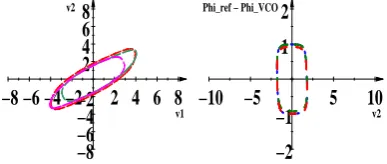
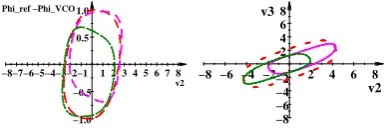
We used YALMIP [7] solver within MATLAB for the verification of the inevitability property (respectively sub-properties) on a 2.6 GHZ Intel Core i5 machine with 4 GB of memory. The CP PLL parameters are listed in Table. 1, with all phases normalized by 2π. We computed degree-6 multi-ple Lyapunov certificates for the third order, and degree-4 multiple Lyapunov certificates for the fourth order CP PLL. Their attractive invariant sets as projected onto different planes are shown in Fig. 2, and Fig. 3 respectively. We con-structed three Escape certificates for each mode of the the third order and fourth order CP PLL hybrid models. For both benchmarks, we computed degree 2 Escape certificates for mode2 and mode3. For mode1, we computed degree 12
Parameters Third Order Fourth Order
C1 [1.98 2.2]e−12F [31 29]e−12F C2 [6.1 6.4]e−12F [3.2 3.4]e−12F
C3 [1.8 2.2]e−12F
R [7.8 8.2]e3Ω [48 52]e3Ω
R2 [7 9]e3Ω
fref 27MHZ 5MHZ
fO 27e3MHZ 5MHZ
Ip [495 505]e-6A [395 405]e-6A
[image:6.595.327.547.52.160.2]Kp [198 202] [495 502]
Table 1: PLL Parameters used in the Experimentation
−8 −6 −4 −2
2 4 6 8
−8
−6
−4
−2
2
4
6
8
v1 v2
−10
−5
5
10
−2
−1
1
2
[image:6.595.340.534.193.275.2]v2 Phi_ref − Phi_VCO
Figure 2: 3-OrderAIProjected onto(v1, v2), and(v2,(φref− φV CO)
and degree 10 Escape certificates for third and fourth order CP PLL respectively. We chose, ε= 1e−4, for all Escape certificates. We noticed that decreasing the value of ε re-sulted in a higher degree Escape certificate for both bench-marks. However, this is at the cost of higher computation time. We therefore opted for the value 1e−4. A simula-tion trace along with the derivative of the Escape certificate patched up from the three Escape certificates of each bench-mark are depicted in Fig. 4 and Fig. 5 respectively. Note that due to space constraints, we have shown projections on only two planes for each benchmark. Simulation traces show that the derivative of the Escape certificate is negative along the trajectories. Computation time of different steps of our verification methodology is given in Table. 2. Though the maximum degree of certificates (Lyapunov,Escape) for the fourth order is less than that of the third order, however, the dimensionality factor is dominant as far as the computation time is concerned.
Results show the effectiveness of our approach to the ver-ification of the inevitability property of a complex real cir-cuit. We have proved the inevitability property avoiding hundred of discrete transitions as well as the complex con-tinuization as in [2]. Computation time is comparable to [2], and infact is less by an order of atleast three consider-ing their approach usconsider-ing griddconsider-ing of the state space for a third order PLL only. Our Lyapunov and Escape certificate based deductive methods, though needs user input in the formalization of the problem, are applicable to infinite do-main (oppose to bounded) and avoid approximating (under or over) solutions of the differential equations. Furthermore, SOS based relaxation, in addition to solve the NP-hard prob-lem of positivity check, offers an easy way of incorporating parameter variations as well.
5.
CONCLUSION
sta-Verification Step 3-Order Time(Sec) 4-Order Time(Sec) Attractive Invariants 1381.7(Degree 6) 10021(Degree 4)
Max.Level Curves 15.5 12
[image:7.595.67.281.52.87.2]Escape Certificates 100 900
Table 2: Computation Time of the Inevitability Verification
−8−7−6−5−4−3−2−1 1 2 3 4 5 6 7 8
−1.0 −0.5 0.5 1.0
v2 Phi_ref −Phi_VCO
−8 −6 −4 −2 2 4 6 8
−8 −6 −4 −2 2 4 6 8
[image:7.595.321.535.55.159.2]v2 v3
Figure 3: 4-OrderAIProjected onto(v2, v3), and(v2,(φref− φV CO)
bility of hybrid systems and Non-linear continuous systems theory, and came up with some interesting local properties. Successful verification of these local properties resulted in the global inevitability property verification of a CP PLL. Involving an NP-Hard problem of checking the positivity of polynomials inequalities, we used the sound SOS relaxation algorithm for the verification of these properties. Experimen-tal results show the effectiveness of our approach avoiding expensive discretization and reach set computations.
6.
REFERENCES
[1] T. A.Henzinger, P.-H. Ho, and H. Wong-Toi. Algorithmic analysis of nonlinear hybrid systems. IEEE Transactions on Automatic Control, 43(4):540–554, Apr 1998.
[2] M. Althoff, A. Rajhans, B. H. Krogh, S. Yaldiz, X. Li, and L. Pileggi. Formal verification of phase-locked loops using reachability analysis and continuization. In Proceedings of the International Conference on Computer-Aided Design ICCAD, pages 659–666, 2011. [3] S. P. Boyd, L. El Ghaoui, E. Feron, and
V. Balakrishnan.Linear matrix inequalities in system and control theory, volume 15. SIAM, 1994.
[4] R. Goebel, R. G. Sanfelice, and A. R. Teel.Hybrid dynamical systems: modeling, stability, and robustness. Princeton University Press, 2012. [5] H. K.Khalil.Nonlinear Systems. Prentice Hall, third
edition, 2002.
[6] H. Lin, P. Li, and C. J. Myers. Verification of digitally-intensive analog circuits via kernel ridge regression and hybrid reachability analysis. In Proceedings of the 50th Annual Design Automation Conference, page 66. ACM, 2013.
[7] J. Lofberg. Yalmip: A toolbox for modeling and optimization in matlab. InComputer Aided Control Systems Design, 2004 IEEE International Symposium on, pages 284–289. IEEE, 2004.
[8] J. Lygeros, K. H. Johansson, S. N. Simi´c, J. Zhang, and S. S. Sastry. Dynamical properties of hybrid
automata.IEEE TRANSACTIONS ON
AUTOMATIC CONTROL, 48(1):2–17, January 2003. [9] A. Papachristodoulou and S. Prajna. On the
construction of lyapunov functions using the sum of squares decomposition. In41st IEEE Conference on Decision and Control, volume 3, pages 348–3487, 2002.
v2
-4 -2 0 2 4 6
Phi
ref
- Phi
VCO
-1 -0.5 0 0.5
v1
-4 -2 0 2 4 6
v2
-2 0 2 4 6 Escape Derivative Hybrid Trajectory
Figure 4: 3-Order Derivative of Escape Certificates, Trajectory Trace Projected onto(v1, v2), and(v2,(φref−φV CO))
v2
0 5 10
Phi
ref
- Phi
VCO
-2 -1.5 -1 -0.5 0 0.5
v2
0 5 10
v3
0 5 10
Escape Derivative Hybrid Trajectory
Figure 5: 4-Order Derivative of Escape Certificates, Trajectory Trace Projected onto(v2, v3), and(v2,(φref−φV CO))
[10] P. A. Parrilo.Structured semidefinite programs and semialgebraic geometry methods in robustness and optimization. PhD thesis, Citeseer, 2000.
[11] S. Prajna and A. Jadbabaie. Safety verification of hybrid systems using barrier certificates. InHybrid Systems: Computation and Control, pages 477–492. Springer, 2004.
[12] S. Prajna and A. Papachristodoulou. Analysis of switched and hybrid systems-beyond piecewise quadratic methods. InAmerican Control Conference, 2003. Proceedings of the 2003, volume 4, pages 2779–2784. IEEE, 2003.
[13] T. Sturm and A. Tiwari. Verification and synthesis using real quantifier elimination. InProceedings of the 36th international symposium on Symbolic and algebraic computation, pages 329–336. ACM, 2011. [14] A. Taly and A. Tiwari. Deductive verification of
continuous dynamical systems. InLIPIcs-Leibniz International Proceedings in Informatics, volume 4. Schloss Dagstuhl-Leibniz-Zentrum f¨ur Informatik, 2009.
[15] T. Wang, S. Lall, and M. West. Polynomial level-set method for polynomial system reachable set estimation. 2013.
[16] J. Wei, Y. Peng, G. Yu, and M. Greenstreet. Verifying global convergence for a digital phase-locked loop. In Formal Methods in Computer-Aided Design
(FMCAD), 2013, pages 113–120. IEEE, 2013.
[17] M. H. Zaki, S. Tahar, and G. Bois. Formal verification of analog and mixed signal designs: A survey.
[image:7.595.77.272.120.184.2] [image:7.595.322.534.204.303.2]