City, University of London Institutional Repository
Citation
: Thomas, K. (2016). Democratic Support and Globalization. In: Vowles, J. and
Xezonakis, G. (Eds.), Globalization and Domestic Politics: Parties, Elections, and Public Opinion. (pp. 209-234). UK: Oxford Univeristy Press. ISBN 9780198757986This is the accepted version of the paper.
This version of the publication may differ from the final published
version.
Permanent repository link:
http://openaccess.city.ac.uk/15515/Link to published version
:
Copyright and reuse:
City Research Online aims to make research
outputs of City, University of London available to a wider audience.
Copyright and Moral Rights remain with the author(s) and/or copyright
holders. URLs from City Research Online may be freely distributed and
linked to.
City Research Online: http://openaccess.city.ac.uk/ [email protected]
Democratic Support and Globalization
Kathrin Thomas,
University of Vienna [email protected]
Word count: 9841 (including all tables and references)
Abstract
This chapter explores the impact of globalization on satisfaction with democracy in a comparative perspective. It explicitly tests whether globalization fosters or constrains support for democracy and if its potential negative effects vanish once countries compensate for the potential negative effects of globalization. The analyses rely on survey data collected by the Comparative Study of Electoral
Systems to indicate citizens’ support for democracy. Globalization is captured by
the KOF Index of Globalization. Not only does the KOF index allow testing for the general impact of globalization on democratic support, it also enables a
distinction between the economic, social and political components of
globalization. It thus provides a test of the global drivers of democratic support. Multilevel logistic regressions analyze the data. The results indicate that
globalization has a throughout positive impact on citizens’ satisfaction with
Introduction
In recent years, a continuous decline in support for democracy, which manifests itself in declining trust in democratic institutions, parties and politicians,
decreasing turnout, and increasing support for non-democratic movements, has been observed across countries. Researchers, who engage in an ongoing debate on support, have outlined that economic and social developments as well as new forms of activism undermine political authority, limit governability and cause legitimacy problems (e.g., Norris 2011; Kriesi et al. 2008; Kriesi et al. 2006; Dalton 1999; Birch 1984; Offe 1979; Habermas 1973). For example, citizens are said to lose trust in the capability of democratic governments in dealing with every-day issues and consequently lose confidence in democracy itself. However, empirical research indicates that citizens’ general support for democracy around the globe is relatively stable. Empirical studies do not find any indicators
suggesting a decline in democratic support or evidence for a crisis of democracy (Klingemann 1999; Norris 1999; Norris 2011). While citizens may criticize specific policies and incumbent governments, they still express general support for democracy as a whole (Dalton 1999, also Easton 1975). To this end, the empirical evidence suggests that satisfaction with democracy has, in fact,
strengthened over time, but not weakened (Norris 2011, also Fuchs, Guidorossi, and Svensson 1998; Fuchs und Klingemann1995), although studies also suggest that it varies with the political context (Norris 2011; Klingemann 1999; Dalton 1999; Tóka 1998).
and loser (Aarts, Thomassen, and van Ham 2014; Kriesi et al. 2006; 2008; Rodik 2011; Rodik 1997; Held 1991). But, it remains unclear whether or not themerits of globalization outweigh its disadvantages and are able to close the gap between winners and losers in the long run (Dalton 2004; Inglehart 2000; Inglehart 1999). Particularly, national policies enacted in the aftermath of the World Financial and the Euro Crises may have led to negative evaluations of democracy and a decline in support. Few studies, which rely on micro- and/or macro-level indicators to predict satisfaction with democracy, draw inconsistent conclusions. On the one hand, economic growth and development seem to foster satisfaction (Schäfer 2012: 2), but it does not address how different socio-economic groups (winners and losers) are affected. On the other hand, research on the socio-economic differences between winners and losers indicate support for the constraint framework: Citizens at the margin of the economic order appear to be less satisfied with the way democracy works (Aarts, Thomassen, and van Ham 2014). While these studies indicate that economic consequences related to globalization may affect democratic support, they neither systematically nor directly explored the impact of globalization on satisfaction with democracy. If economic growth and development generally increase support, but a widening gap between winners and losers constrains support, it is important to test whether this impact is directly related to globalization and if it is also present when countries compensate for the negative effects of globalization.
This volume empirically explores the impact of globalization on electoral democracy in more detail to analyze in how far globalization might constrain electoral democracy, whether or not the process is reducing economic
inequalities between countries, and if it can generate incentives and policies through which governments can compensate for the inequality and increased insecurity that many associate with globalization within countries (see
Introductory Chapter by Vowles and Xezonakis). The chapter at hand contributes
to these debates by systematically analyzing how globalization affects citizens’
compensation arguments looking at general democratic support.
Conceptualizing Democratic Support
Easton (1975) distinguishes between diffuse and specific support for democracy. While the latter refers to the idea that people may like or dislike very specific policies, political leaders, political processes or institutions, the former refers to the notion that support may also be defined in more general terms. Diffuse support for democracy should be relatively stable in comparison to specific support, which seems to correspond with more recent empirical results (e.g., Dalton 1999). Both concepts provide important insights to how citizens feel about democracy, but while the concept of specific support is important to analyze citizens’ political attitudes towards very specific democratic processes
or actors, diffuse support gives an important overall indication of the legitimacy of democracy.
such.
However, general satisfaction with democracy also provides a useful overall summary of support for existing political systems, which remains largely distinct
from citizens’ support for very particular political authorities and which
evaluates the overall performance of democracy across multiple dimensions (Clarke, Dutt, and Kornberg 1993). Empirical evidence lends confidence in the use of this measure as an indicator of general support for democracy: Criticism against the use of satisfaction with democracy – and conclusions drawn on its basis – fall short as they do not suggest that the measure is meaningless per se, but it is more than adequate for the task as long as its use is theoretically well motivated and confined to a relatively narrow definition of democratic system support (Andersen 2002). Based on the assumption that satisfaction with democracy is not a perfect, but a useful and adequate indicator of diffuse democratic support, it is employed for the following analysis as the dependent variable.
Micro- and Macro-Level Effects on Democratic Support
Previous studies on democratic support have emphasized the impact of micro-level characteristics. For instance, studies suggest that general satisfaction with democracy depends on the individuals’ perceived or actual electoral success.
‘Citizens who cast their vote for the winning party are more inclined to display
faith in the way democracy works, because they like and/or trust the
party/candidate who has been elected’ (Blais and Gélineau 2007). Indeed,
support for democracy, but these effects are only present for electoral losers (Anderson 2012). In addition, studies suggest that it may not be winning or losing per se that drives satisfaction with democracy, but rather whether or not people have already been satisfied with democracy before the election took place
– so-called ex-ante satisfaction (Blais and Gélineau 2007). In how far the
expectation of electoral success actually enhances democratic support remains unclear, however. More recent research further suggests that satisfaction with democracy grows with increasing socio-economic resources such as education and income (Castillio 2006; Schäfer 2012; Aarts, Thomassen, and van Ham 2014): Those at the margin of the economic order (little education, low income) appear to be less satisfied with the way democracy works.Admittedly, the differences between socio-economic groups are quite small. In addition, while assuming that the gap between groups occurred with increasing globalization, this idea is not directly or effectively tested.
While micro-level factors seem to be relevant to democratic support, prior research also emphasizes the impact of macro-level contextual effects. For instance, the age of democracy has been linked to general support for
democracy. Accordingly, democracy satisfaction is significantly higher in the established democracies in comparison to new democracies (Klingemann 1999). In addition, institutional differences are relevant and explain variation in
support. For example, satisfaction with democracy is higher in countries with majoritarian electoral rules or moderate multiparty systems as well as in parliamentary democracies compared to presidential ones (Norris 1999). The differences across regime types are relatively small, however. Further tests of the institutional argument show that democratic support is also dependent on how citizens perceive the accountability and representativeness of a political system (Aarts and Thomassen 2008). Citizens seem to be more satisfied with the way democracy works, if they perceive the system to be more representative. Similarly, democracy satisfaction is higher, when the political system is
compared to the impact of representativeness. In conclusion, democracy
satisfaction is led by the ‘representation function’, but to a lesser degree by the
‘accountability function’. These observations also correspond with comparative
research on the patterns of the winner-loser taxonomy and its impact on
democratic support: Losers in consensual democracies generally display higher levels of satisfaction with democracy than losers in majoritarian systems
(Anderson and Guillory 1997; Anderson and Tverdova 2001). These findings
also coincide with Anderson’s (2012) observations on democratic support and
the impact of broader party representation and convergence. Furthermore, macro-level economic conditions matter. Prior work indicates that democratic
support may be related to citizens’ perceptions of the economic conditions in
their countries (Tóka 1998). If the economy performs badly, general satisfaction with democracy decreases. Further tests of this economic hypothesis suggest that poor economic conditions such as unemployment and inequality increase discontent and dissatisfaction (Wagner, Schneider, and Halla 2009; Schäfer 2012). In addition, Schäfer’s (2012) observations also re-emphasize the
connection of individual-level and contextual factors: If unemployment rates are higher on the macro-level, the impact of individual-level unemployment is also higher, but only among electoral losers.
Globalization
The above review indicates that economic, political, but also cultural change
induced by globalization may matter. Globalization is ‘the process of creating
networks among actors at multi-continental distances, mediated through a
variety of flows including people, information and ideas, capital and goods. It […]
erodes national boundaries, integrates national economies, cultures, technologies and governance, and produces complex relations of mutual
political globalization. While a composite measure of globalization may affect satisfaction with democracy in a particular way, its dimensions could have different impacts. For instance, structural changes in the economy on the micro- and macro-level (e.g., higher unemployment, increasing economic inequalities) may decrease satisfaction with democracy. In addition, if political globalization
leads to ‘neo-liberal convergence’ (Huber and Stephens 2001; Kitschelt et al.
1999; Mishra 1999, but also Haupt 2010; Adams et. al 2009) and reduces electoral accountability (Hellwig and Samuels 2007), support for democracy should decrease. Further, social developments such as increased immigration, especially when linked to negative economic developments and perceived as a threat by citizens, may lead to a decrease in support for the democratic order. While globalization (and its dimensions) may constrain electoral democracy and democratic support by reducing electoral accountability and aggravating
economic insecurity and inequality, it is also possible that it increases general support for democracy in the long run, particularly if governments compensate for the negative effects within countries.
The Constraint Hypothesis
Following the former idea, globalization may constrain satisfaction with democracy. Scholars argue that globalization threatens national democracy (Rodik 2011): On the supply side, governments are less flexible to take
independent decisions as they act in a global framework of interdependencies with other governments and international institutions. On the demand side, citizens are less clear about the chains of accountability as policy making
becomes less transparent, because more global actors are involved. People may further feel that interconnected markets, governments and societies are
threatening their national identities, nation-states and democratic government.
decisions (Hay 2004; Hays 2009). Policy makers’ accountability towards their
citizens is limited by interconnected global markets, especially in terms of economic outcomes (Garrett 2001; Hellwig and Samuels 2007). For example, policies directed to tackle the World Financial and Euro Crises have shown that countries do not act in economic isolation, but that joint strategies are required. Thus, policy makers are constrained to choose from a smaller range of policy alternatives and depend on cooperation with other actors. One consequence may be neoliberal convergence and a general shift towards center-right policies (Drezner 2001; Burgoon 2001; Keohane 1985).In short, globalization produces common inputs, which, in the absence of institutional compensation, lead to convergent outcomes (Hay 2004; Hays 2009).
Social globalization may have a similar impact. On the supply side, governments have to deal with new issues in respect of heterogeneity and multiculturalism. For instance, questions related to religion and immigration. At the same time, citizens appear to reclaim their roots and identities, which is demonstrated by the rise of radical nationalist groups, as well as attempts to independent nation-building, e.g., in Scotland or Catalonia.
Global political networks may further limit policy makers to a smaller range of policy alternatives and force them to opt for policies that are not best for their countries. In addition, political globalization may cause inertia and
disenchantment amongst voters, resulting in a decrease in voter turnout and other forms of political participation. For citizens, it may be more difficult to identify the chains of accountability and to distinguish between different political choices. If voters value broader representation more than
The Income- and Education-Related Constraint Hypothesis
Critics of globalization argue that the consequences of globalization especially affect poor people, more precisely those that fall below the average household income (Stiglitz 2000; Clark 2003). Empirical research has identified positive relationships between household income and democracy satisfaction – those with a higher household income are more satisfied with democracy (Castillio 2006). This is also supported by more recent research, which indicates that satisfaction is higher for those at the upper end of the economic order (e.g., high income and high levels of education) in comparison to those at the margin of the economic order (e.g., low income and low levels of education) (Schäfer 2012; Aarts, Thomassen, and van Ham 2014).
It is thus necessary to directly test the influence of globalization among social groups: Poorer citizens may be most affected by economic globalization as economic globalization is directly related to poverty and low income.
Unemployment or the need to live on low income should increase the likelihood of being dissatisfied with democracy in their countries. In short, deprivation effects due to economic globalization will more severely affect the poorest in a society (Castillo 2006).
If multiculturalism and immigration due to social globalization are viewed as a threat to the national economy and society, particularly by those with lower incomes, who are concerned about their jobs and link immigration to economic deprivation, social globalization should have a negative effect on satisfaction with democracy. Indeed, prior research indicates that economic motivations explain restrictive sentiments towards immigration (Citrin et al. 1997).
democracy among low income households. Low income groups may feel less encouraged to participate in politics, because the opportunity costs may be too high for them (Frey 1971). Political globalization further increases these costs not only, but particularly for the low income cohort. Those with low income may shy away from complex networks of policy making and internationalization as they their major concern is not politics, but rather their personal situation . Prior research indicates that low income groups are less likely to participate in
politics, especially when alternative channels of participation are concerned (Tolbert and McNeal 2003).
The Compensation Hypothesis
An alternative view on globalization and its impact is found in the compensation hypothesis. It states that countries, in which governments compensate for the negative effects of globalization, for example, by providing welfare and social policies to economic losers, the differences between winners and losers should be marginal (Burgoon 2001; Garett 1998). The political will to compensate and to keep or to expand the welfare system increases the likelihood that social democratic corporatism remains, even under the conditions of globalization (Hay 2004). If this is the case, globalization may contribute to the improvement of the living situation in all segments of a society in the long run and outweigh its negative effects by a more efficient allocation of production and investment (Garrett 2011; also Inglehart 2000; Garrett 2001; Kriesi et al. 2006; Kriesi et al. 2008). In turn, a strong incentive for governments to compensate for economic insecurities and inequalities due to globalization is created, even if a long -term effect holds off. This should also have a positive impact on general democratic support.
Governments that compensate for inequalities may enhance such change and contribute to creating an open, global identity based on multicultural societies. Previous studies have identified that citizens across the globe have developed a bicultural identity, which links their local identity to a global self or global culture as a result of social globalization (Arnett 2002, Jensen 2003; Jensen, Arnett, and McKenzie 2011).
If political globalization enforces the convergence of national macro-economic policies, it also has ‘magnified the role of (competing) supply-side economic strategies and intensified the importance of parties and partisan agency in the selection of those policies’ (Boix 1998). Further evidence for this claim is found in the party policy literature, which rejects the neoliberal convergence argument and suggests that parties shift into various different directions to create more choices for voters (Haupt 2010; Adams, Haupt, and Stoll 2009; Anderson 2012). These choices may then result in better representation and more civic
engagement (e.g., Aarts and Thomassen 2008; Anderson 2012) and consequently in an increase in democratic support.
Previous empirical evidence for the constraint (e.g., Drezner 2001) or the compensation framework (e.g., Burgoon 2001) is inconclusive. While a shift towards the center-right can be generally observed, it is unclear whether this is due to globalization or to other factors. In addition, the impact of globalization on satisfaction with democracy – either under the constraint or the compensation framework – has not been systematically addressed and explored by previous studies. While globalization may directly affect citizens’ support for democracy,
it is necessary to account for potential interactive effects across socio -economic groups. It is further important to explore how the different dimensions of globalization affect satisfaction with democracy under the differ ent conditions.
In order to investigate the impact of globalization on citizens’ support for
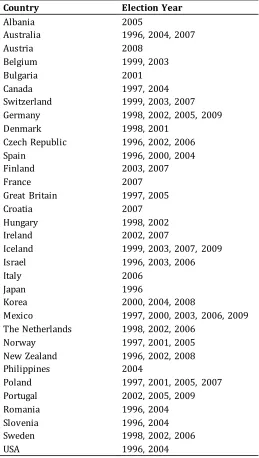
democracy appropriate indicators of citizens’ satisfaction with democracy and a reliable measure of globalization are required. The analysis below relies on individual-level data collected by the Comparative Study of Electoral Systems (CSES) (Modules 1 to 3) and contextual data by the KOF index of globalization. In total, it includes 33 countries and 70 elections around the globe (see Appendix A1).1
Support for democracy is indicated by respondents’ satisfaction with the way
democracy works in their country. The CSES consistently asks: “On the whole,
are you very satisfied, fairly satisfied, not very satisfied or not at all satisfied with
the way democracy works in [COUNTRY]?” Generally, satisfaction is measured
on a four-point scale, although a few countries use a five-point scale with a neutral mid-point to capture democratic support. In order to work with a strong comparable sample the models only include countries that asked the question on a four-point scale with no neutral option. The answers are recoded into a
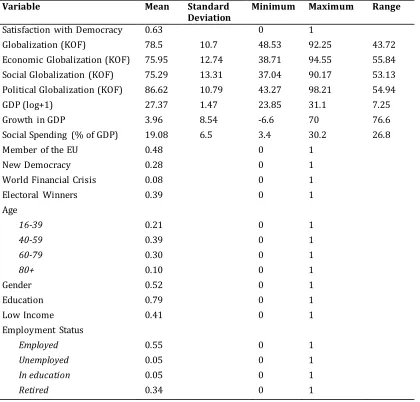
dichotomous variable that captures citizens’ satisfaction (=1) or dissatisfaction (=0) with democracy. In addition, the CSES asks about respondents’ vote choice, which allows creating a dichotomous variable for electoral winners (=1) and losers (=0). Furthermore, social-demographic characteristics (age, gender, education, income, and employment status) as well as continuous indicators for economic development (logged GDP, economic growth, and social spending) are included. Finally, dummy variables for EU membership (EU member=1), age of democracy (new democracy=1) and the World Financial Crisis (WFC=1) are added.2 See Appendix A2 for further information on the coding and Appendix A3
for additional descriptive statistics.
economic, the KOF project allows disaggregating social and political dimensions as well. As outlined above, globalization is ‘the process of creating networks among actors at multi-continental distances, mediated through a variety of glows including people, information and ideas, capital and goods’ (Dreher, Gaston, and
Martens 2008: 43). In total, the KOF index compiles information from 23
different variables in 123 countries into one single additive index, which can be disaggregated into three dimensions.3 In total, the KOF index compiles
information from 23 different variables in 123 countries into one single index.
Multi-level logistic models for binary dependent variables are fitted to explore the impact of globalization on satisfaction with democracy. Respondents in the CSES are nested in countries and election years. As each individual also shares
common characteristics with respondents from the same country on
unmeasured variables, the assumption of error independence is violated.
Consequently, it is not sufficient to rely on simple logistic regressions, which
would lead to incorrect standard errors. The logistic multi-level regression
models calculated here relax the assumption of independence. Random intercept
models were fitted that include both fixed effects at the level of individuals (level
1) and a random effect at the level of country/elections (level 2). The xtlogit
function in Stata is used to estimate a random-intercept logistic regression
model for binary dependent variables to account for the binary structure of the
dependent variable. This allows modeling the individual-level characteristics as
well as the country/election-level characteristics more accurately.
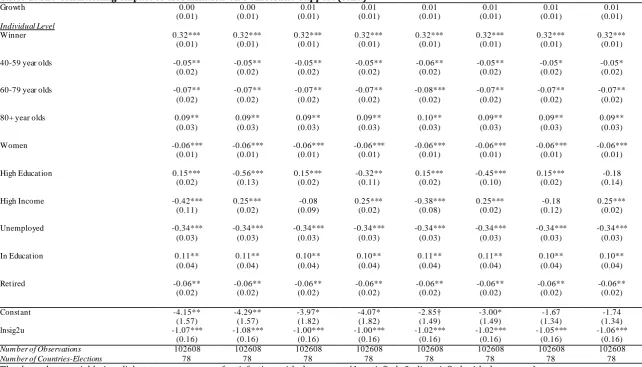
In total, 12 Models are presented here. Models 1 to 4 test the direct impact of the composite measure of globalization as well as of the disaggregate KOF measures on democratic support when controlling for individual and contextual variables. Model 5 to 12 investigate the income- and education-related constraint
income and education.4
[Figure 1 here]
Cross-national Variation in Democratic Support
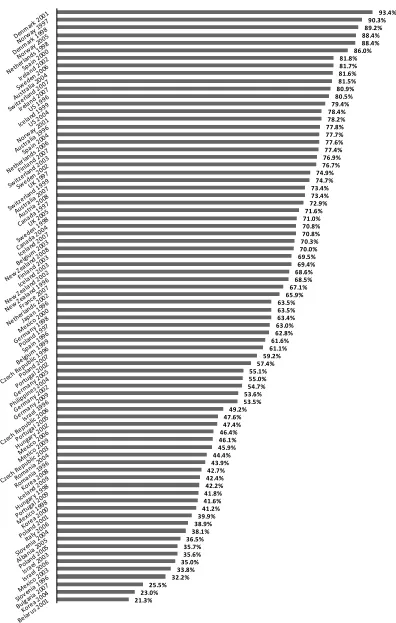
Figure 1 explores satisfaction with democracy by country and election year. It illustrates that citizens’ support for democracy indeed varies across contexts. On average, satisfaction with democracy is highest in Denmark (2001: 93.4%, but also in 1998: 89.2%) and Norway (1997: 90.3%). By contrast, it is lowest in Belarus (2001: 21.3%), South Korea (2004: 23.0%) and Bulgaria (2007: 25.5%). The descriptive results also reveal that dissatisfaction is most prominent in new democracies with the exception of Portugal (2009: 41.8%), Iceland (2009: 42.4%), and Italy (2008: 38.9%). However, dissatisfaction with democracy in these countries may be explained with economic downturn due to the World Financial and Euro Crises in 2008.
[Figure 2 here]
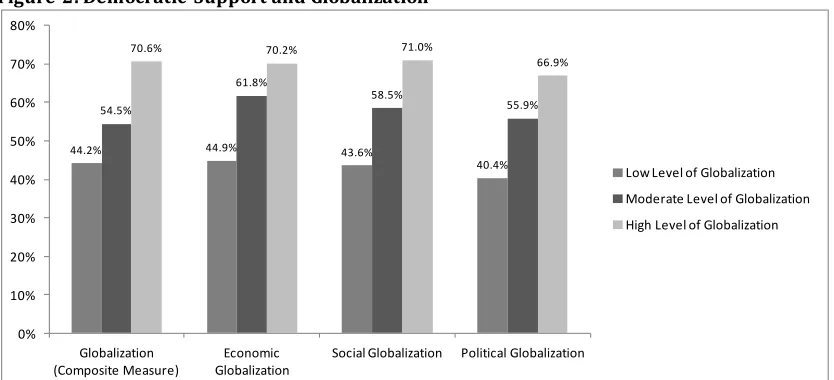
Figure 2 visualizes the relationship between globalization and satisfaction with democracy. The graph shows the proportion of people who were satisfied with democracy in countries with low, moderate, and high levels of globalization for the composite measure as well as the economic, social, and political dimension.5
The overall pattern is similar for all KOF measures and suggests that higher levels of globalization correspond with more democratic support. The graphs do hide potential cross-country and group variation, however. In order to
sophisticated methods are required.
[Table 1 here]
The Impact of Globalization on Democratic Support
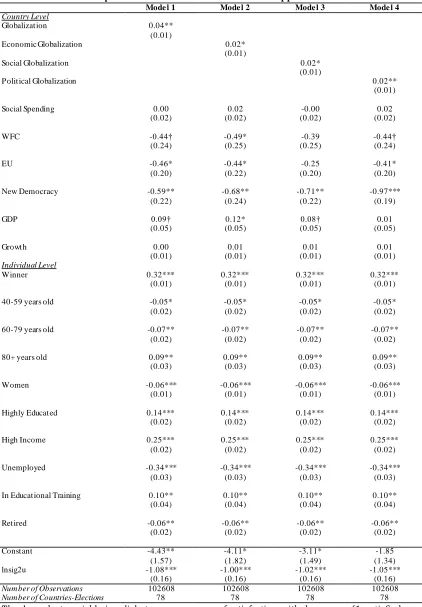
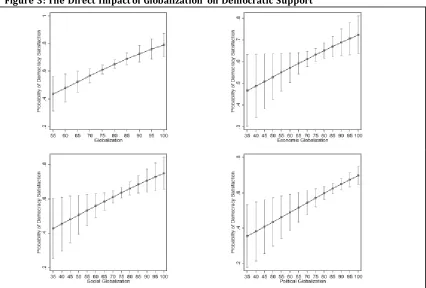
The raw results testing the direct impact of the globalization on satisfaction with democracy are presented in Table 1. The effect size of the coefficients appears to be rather small. However, considering the minimum and maximum values as well as the wide range of the variables (see Appendix A), the results need to be put in perspective and to be read in combination with the marginal effects. Thus, marginsplots are presented for the key relationships.
Model 1 reveals a positive impact of the composite measure of globalization on satisfaction with democracy (+0.04, p-value < 0.01): The more globalized a country is the more satisfied are citizens with the way democracy works. The predicted margins in the top left graph of Figure 3 display a steep upward trend. For emphasis, Israel in 1996 scores 60.4 on the composite KOF measure, which corresponds with a probability of 48.1% that the Israelis are satisfied with democracy. By 2006, the country has moved up on the KOF scale by 13 points to 73.4, which coincides with a 60.9% chance of democracy satisfaction. Hence, the likelihood of general democracy satisfaction in Israel has increased by 12.8% due to globalization within 10 years.6
In addition, social spending and economic growth do not appear to have an impact on satisfaction with democracy: although very small positive coefficients are found, they are not significant at conventional levels. The WFC (-0.44, p-value <0.1) and EU-membership (-0.46, p-value <0.05) significantly decrease
<0.01). High GDP (+0.09, p-value <0.1) positively influences democracy
satisfaction. The results further confirm some of the findings with regard to the impact of individual-level characteristics: electoral winners (+0.32, p-value <0.001), those with higher education (+0.14, p-value <0.001), and income (+0.25,
p-value <0.001) are more likely to be satisfied with democracy than their
counterparts. By contrast, females seem to be significantly less likely to support democracy than males (-0.06, p-value <0.001). In comparison to younger citizens aged 16 to 39, older citizens (people aged 80 and above: +0.09, p-value <0.01) appear to be more satisfied with democracy, whereas the middle aged (40 -59 year olds: -0.05, p-value <0.05 and 60-79 year olds: -0.07, p-value <0.05) are less likely to be satisfied with democracy when compared to the youngest cohort. Similarly, the unemployed (-0.36, p-value <0.001) and retired (-0.06, p-value <0.01) are less likely and those in educational training (+0.11, p-value <0.01) are more likely to support democracy in comparison to those in employment.
[Figure 3 here]
Models 2 to 4 conduct the same test for the disaggregate measures of
globalization. The impacts of economic, social, and political globalization follow a similar pattern. In all three models, the coefficients for these different
dimensions of globalization display positive and statistically significant results (economic and social globalization: +0.02, p-value < 0.05; political globalization: +0.02, p-value < 0.01). The top right graph (economic dimension) and the bottom two graphs (social and political globalization) in Figure 3 visualize these
relationships. All graphs show a similar upward trend suggesting that higher KOF scores on these dimensions increase the likelihood of democracy
satisfaction.
Republic. In 1996, the country has a moderate KOF score of 68.3, which
corresponds with a 59.1% chance of being satisfied with democracy. Ten years later, the country scores 85.9 on the KOF index of economic globalization, which means that the chances of being satisfied with democracy have increase d to 66.9% due to economic globalization.
To illustrate the direct effect of social globalization it is worth looking at Portugal. In 2002, the country scored 70.0 on the KOF index of social
globalization, which corresponds with a 61.0% chance that the Portuguese are satisfied with the way democracy works. By 2009, the country has moved up on the social globalization scale by 14.5 points to 84.5, which coincides with a 68.3% probability of being satisfied with democracy. Hence, the pro bability that citizens are satisfied with democracy in Portugal has increased by 7.3% due to social globalization.
Slovenia is an interesting example for the direct impact of political globalization. The country scored 43.3 on the KOF index of political globalization in 1996 –
there is a 40.8% chance that people are satisfied with democracy. Eight years later, Slovenia is a lot more politically integrated and scores 78.3 on the KOF index, which coincides with a 59.8% probability of being satisfied with
democracy. This is striking as there has been a 19% increase in the likelihood of
citizens’ satisfaction with democracy in Slovenia due to political globalization.
This may be related to Slovenia’s efforts to join the European Union in 2004.7
The Conditioning Impact of Globalization on Democratic Support
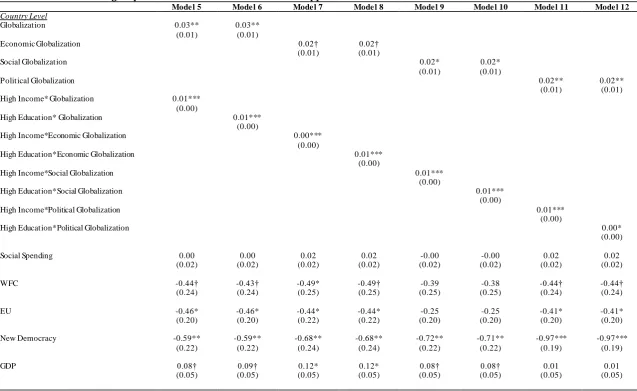
results for all models. The conditioning impact of the composite measure of globalization is tested in Models 5 (income-argument) and 6 (education-argument). The interesting results are revealed by the coefficients of the
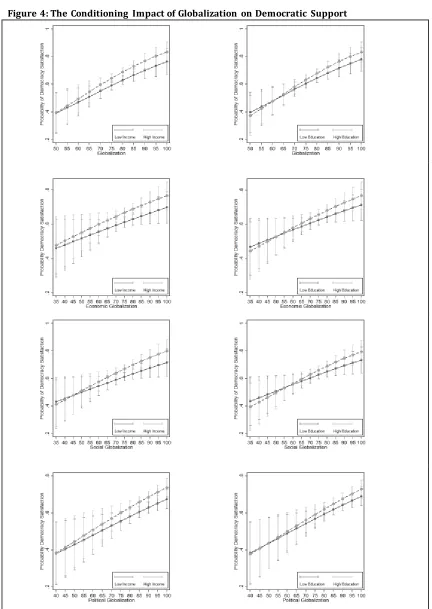
interactive terms. They uncover that citizens with higher income (+0.01. p-value <0.001) and better education (+0.01. p-value <0.001) are significantly more likely to be satisfied with democracy as globalization increases. Figure 4 plots the probability of being satisfied with democracy for high and low income groups as well as for high and low levels of education as globalization increases. The top two graphs of Figure 4 visualize these relationships for the composite measure of the KOF index (the top left graph for income, the top right graph for education). They re-emphasize that those at the lower margins of the economic order (low income or low education) are less likely to be satisfied with
democracy than those at the upper margins (high income or high education). For instance, while both income groups have a similar chance of being satisfied with the way democracy works at low levels of globalization (KOF=50, approximately 39%), the difference between high and low income groups in their probabilities of democracy satisfaction differ by approximately 7% at high levels of
globalization (KOF=95). Similarly, democratic support is almost equally low (37-39%) at low levels of globalization (KOF=50) for the well and less well educated, but a discrepancy of approximately 6% between these groups can be identified at high levels of globalization (KOF=95). Admittedly, the gaps between groups do not appear to be very wide, which confirms the suggestions made by earlier studies but that have not explicitly tested these relationships: Although those at the margin of the economic order are less likely to support democracy, the difference to their counterparts is relatively small.
Next, the disaggregated measures of globalization are discussed – the results are presented in Table 2: Models 7 and 8 investigate the conditional impact of
economic globalization, Models 9 and 10 explore the conditioning influence of social globalization, and Models 11 and 12 the effect of political globalization. The focus lies on the interactive terms between the disaggregate dimensions of globalization and income as well as education.
The identified patterns are similar for all three dimensions and across income and education groups. The coefficients for the interactive terms reveal small, but highly statistically significant effects, which suggest that high income groups are more likely to be satisfied with democracy as economic (+0.00, p-value < 0.001), social (+0.01, p-value < 0.001), or political globalization (+0.01, p-value < 0.001) increase in comparison to those from a low income cohort. The graphs on the left hand side of Figure 4 graphically display these results. In general, they suggest that the probability of being satisfied with democracy increases for both groups, but with that also the gap between the two cohorts widens. For economic
globalization, the graph suggests only little difference between income groups (KOF=35, 46.0% chance of democracy satisfaction for low income and 47.8% for high income groups) at low levels of globalization, but a difference of 6.7% in highly globalized countries (KOF=95, 74.8% chance of democracy satisfaction for low income and 68.1% for high income groups). For social globalization, the low income cohort even displays a marginally higher chance of democratic support (43.1%) at low levels of globalization (KOF=35) in comparison to the high income group (41.2%). However, the probabilities to support democracy increase more rapidly for those in the high income group as globalization increases than for the low income households. At high levels of social
democracy). The patterns for political globalization resemble those of economic globalization. Although both income groups have an about 38% chance of democracy satisfaction in less globalized countries (KOF=40), the gap widens as political globalization increases (high income=71.2%, low income=65.2% chance of democracy satisfaction).
[Figure 4]
Similarly, the tests for the education-related constraint hypothesis suggest that the well-educated display a higher probability to be satisfied with democracy as the disaggregate measures of globalization increase than those with lower levels of education (economic globalization: +0.01, p-value < 0.001; social globalization: +0.01, p-value < 0.001; political globalization: +0.00, p-value < 0.001). The plots on the right hand side of Figure 4 visualize these relationships. They suggest almost identical patterns when compared to income groups. Overall, democratic support appears to increase the more globalized a country is, but the gaps between education groups widen with higher KOF scores. At high levels of the KOF measures (KOF=95) the difference between well and less-well educated citizens ranges from 3.7% for political globalization to 5.3% for economic and 5.7% for social globalization.
with earlier findings on the impact of income and education on democratic support, which did not explicitly account for globalization (Aarts, Thomassen, and van Ham 2014). To directly test the compensation argument further interactive models were run. These included interaction between globalization and social spending. However, the results did not uncover any conclusive
evidence to support compensation theory. The interesting interactions between globalization and social spending, which represent a direct test of the
compensation argument, did not provide statistically significant evidence for an increase in support when compensation for the negative effects of globalization takes place. In fact, the coefficients, although not statistically significant,
suggested negative relationships.
Conclusions and Discussion
This chapter provided insights to the relationship between globalization and satisfaction with democracy relying on cross-national comparison. More precisely, it provides empirical tests of the constraint and compensation
framework, which this volume investigates with regard to electoral democracy. This research also ties in with prior studies that were unable to systematically analyze the relationship between democratic support and globalization.
Studies have suggested that support for democracy may be challenged by global changes related to the economic, social, and political consequences of
globalization. The positive effects hypothesis posits that in the long-run the global development of democracies leads to a better life for all societal groups and thus should enhance support for democracy. By contrast, constraint theory suggests that globalization reinforces the gap between the winners and losers of globalization and may lead to a decline in support for electoral democracy. However, if government policies compensate for the negative effects of
globalization within countries, these potential group differences should not be visible in citizens’ support for democracy.
individual dimensions) have a direct positive impact on satisfaction with democracy, which supports the positive effects hypothesis. However, the findings also suggest that globalization conditions democratic support. For instance, differences across income and education groups could be isolated, which suggest that globalization constrains democratic support at least to some extent and among those at the margin of the social order, the poor and the less-well educated. While these differences are statistically significant, they are also relatively small, which may lend some confidence that compensation for the negative effects of globalization takes place. Yet, the empirical evidence neither explicitly supports nor explicitly rejects the compensation argument with regard to democratic support. One reason for this may be that the compensation
framework could only be insufficiently tested here. In order to systematically analyze whether compensation policies directed to tackle potential deficiencies induced by globalization increase democratic support in the long-run, more sophisticated data and methods are required. (Cross-sectional) time-series analysis would be needed to identify whether compensation for economic disparities diminishes the gap between different income and education groups.
Yet, some of the results are surprising and offer new pathways for future investigations. For example, it is interesting that democratic support remains high, even in the aftermath of the World Financial and Euro Crises. In addition, the positive effect for social globalization is interesting. It is consistent with expectations outlined in the introductory chapter that points to an increase in well-being as a result of the internationalization of culture. Open and
heterogeneous societies are conducive to democracy and for citizens’ satisfaction
Figure 1: Democratic Support across Countries and Elections
Numbers represent average percentage by election and country. Source: CSES Modules 1, 2 and 3.
Figure 2: Democratic Support and Globalization
Note bars represent the proportion of people who are satisfied with democracy in countries with low, moderate or high levels of globalization.
Source: CSES Modules 1, 2, and 3.
44.2% 44.9% 43.6%
40.4% 54.5%
61.8%
58.5%
55.9% 70.6% 70.2% 71.0%
66.9%
0% 10% 20% 30% 40% 50% 60% 70% 80%
Globalization (Composite Measure)
Economic Globalization
Social Globalization Political Globalization
Low Level of Globalization
Moderate Level of Globalization
Table 1: The Direct Impact of Globalization on Democratic Support
Mode l 1 Mode l 2 Mode l 3 Mode l 4
Country Level
Globalization 0.04**
(0.01)
Economic Globalization 0.02*
(0.01)
Social Globalization 0.02*
(0.01)
Political Globalization 0.02**
(0.01)
Social Spending 0.00 0.02 -0.00 0.02
(0.02) (0.02) (0.02) (0.02)
WFC -0.44† -0.49* -0.39 -0.44†
(0.24) (0.25) (0.25) (0.24)
EU -0.46* -0.44* -0.25 -0.41*
(0.20) (0.22) (0.20) (0.20)
New Democracy -0.59** -0.68** -0.71** -0.97***
(0.22) (0.24) (0.22) (0.19)
GDP 0.09† 0.12* 0.08† 0.01
(0.05) (0.05) (0.05) (0.05)
Growth 0.00 0.01 0.01 0.01
(0.01) (0.01) (0.01) (0.01)
Individual Level
Winner 0.32*** 0.32*** 0.32*** 0.32***
(0.01) (0.01) (0.01) (0.01)
40-59 years old -0.05* -0.05* -0.05* -0.05*
(0.02) (0.02) (0.02) (0.02)
60-79 years old -0.07** -0.07** -0.07** -0.07**
(0.02) (0.02) (0.02) (0.02)
80+ years old 0.09** 0.09** 0.09** 0.09**
(0.03) (0.03) (0.03) (0.03)
Women -0.06*** -0.06*** -0.06*** -0.06***
(0.01) (0.01) (0.01) (0.01)
Highly Educated 0.14*** 0.14*** 0.14*** 0.14***
(0.02) (0.02) (0.02) (0.02)
High Income 0.25*** 0.25*** 0.25*** 0.25***
(0.02) (0.02) (0.02) (0.02)
Unemployed -0.34*** -0.34*** -0.34*** -0.34***
(0.03) (0.03) (0.03) (0.03)
In Educational Training 0.10** 0.10** 0.10** 0.10**
(0.04) (0.04) (0.04) (0.04)
Retired -0.06** -0.06** -0.06** -0.06**
(0.02) (0.02) (0.02) (0.02)
Constant -4.43** -4.11* -3.11* -1.85
(1.57) (1.82) (1.49) (1.34)
lnsig2u -1.08*** -1.00*** -1.02*** -1.05***
(0.16) (0.16) (0.16) (0.16)
Num ber of Observations 102608 102608 102608 102608
Num ber of Countries-Elections 78 78 78 78
The dependent variable is a dichotomous measure of satisfaction with democracy (1=satisfied, 0=dissatisfied with democracy).
Table 2: The Conditioning Impact of Globalization on Democratic Support
Mode l 5 Mode l 6 Mode l 7 Mode l 8 Mode l 9 Mode l 10 Mode l 11 Mode l 12
Country Level
Globalization 0.03** 0.03**
(0.01) (0.01)
Economic Globalization 0.02† 0.02†
(0.01) (0.01)
Social Globalization 0.02* 0.02*
(0.01) (0.01)
Political Globalization 0.02** 0.02**
(0.01) (0.01)
High Income* Globalization 0.01***
(0.00)
High Education* Globalization 0.01***
(0.00)
High Income*Economic Globalization 0.00***
(0.00)
High Education*Economic Globalization 0.01***
(0.00)
High Income*Social Globalization 0.01***
(0.00)
High Education*Social Globalization 0.01***
(0.00)
High Income*Political Globalization 0.01***
(0.00)
High Education*Political Globalization 0.00*
(0.00)
Social Spending 0.00 0.00 0.02 0.02 -0.00 -0.00 0.02 0.02
(0.02) (0.02) (0.02) (0.02) (0.02) (0.02) (0.02) (0.02)
WFC -0.44† -0.43† -0.49* -0.49† -0.39 -0.38 -0.44† -0.44†
(0.24) (0.24) (0.25) (0.25) (0.25) (0.25) (0.24) (0.24)
EU -0.46* -0.46* -0.44* -0.44* -0.25 -0.25 -0.41* -0.41*
(0.20) (0.20) (0.22) (0.22) (0.20) (0.20) (0.20) (0.20)
New Democracy -0.59** -0.59** -0.68** -0.68** -0.72** -0.71** -0.97*** -0.97***
(0.22) (0.22) (0.24) (0.24) (0.22) (0.22) (0.19) (0.19)
GDP 0.08† 0.09† 0.12* 0.12* 0.08† 0.08† 0.01 0.01
Table 2: The Conditioning Impact of Globalization on Democratic Support (cont.)
Growth 0.00 0.00 0.01 0.01 0.01 0.01 0.01 0.01
(0.01) (0.01) (0.01) (0.01) (0.01) (0.01) (0.01) (0.01)
Individual Level
Winner 0.32*** 0.32*** 0.32*** 0.32*** 0.32*** 0.32*** 0.32*** 0.32***
(0.01) (0.01) (0.01) (0.01) (0.01) (0.01) (0.01) (0.01)
40-59 year olds -0.05** -0.05** -0.05** -0.05** -0.06** -0.05** -0.05* -0.05*
(0.02) (0.02) (0.02) (0.02) (0.02) (0.02) (0.02) (0.02)
60-79 year olds -0.07** -0.07** -0.07** -0.07** -0.08*** -0.07** -0.07** -0.07**
(0.02) (0.02) (0.02) (0.02) (0.02) (0.02) (0.02) (0.02)
80+ year olds 0.09** 0.09** 0.09** 0.09** 0.10** 0.09** 0.09** 0.09**
(0.03) (0.03) (0.03) (0.03) (0.03) (0.03) (0.03) (0.03)
Women -0.06*** -0.06*** -0.06*** -0.06*** -0.06*** -0.06*** -0.06*** -0.06***
(0.01) (0.01) (0.01) (0.01) (0.01) (0.01) (0.01) (0.01)
High Education 0.15*** -0.56*** 0.15*** -0.32** 0.15*** -0.45*** 0.15*** -0.18
(0.02) (0.13) (0.02) (0.11) (0.02) (0.10) (0.02) (0.14)
High Income -0.42*** 0.25*** -0.08 0.25*** -0.38*** 0.25*** -0.18 0.25***
(0.11) (0.02) (0.09) (0.02) (0.08) (0.02) (0.12) (0.02)
Unemployed -0.34*** -0.34*** -0.34*** -0.34*** -0.34*** -0.34*** -0.34*** -0.34***
(0.03) (0.03) (0.03) (0.03) (0.03) (0.03) (0.03) (0.03)
In Education 0.11** 0.11** 0.10** 0.10** 0.11** 0.11** 0.10** 0.10**
(0.04) (0.04) (0.04) (0.04) (0.04) (0.04) (0.04) (0.04)
Retired -0.06** -0.06** -0.06** -0.06** -0.06** -0.06** -0.06** -0.06**
(0.02) (0.02) (0.02) (0.02) (0.02) (0.02) (0.02) (0.02)
Constant -4.15** -4.29** -3.97* -4.07* -2.85† -3.00* -1.67 -1.74
(1.57) (1.57) (1.82) (1.82) (1.49) (1.49) (1.34) (1.34)
lnsig2u -1.07*** -1.08*** -1.00*** -1.00*** -1.02*** -1.02*** -1.05*** -1.06***
(0.16) (0.16) (0.16) (0.16) (0.16) (0.16) (0.16) (0.16)
Num ber of Observations 102608 102608 102608 102608 102608 102608 102608 102608
Num ber of Countries-Elections 78 78 78 78 78 78 78 78
The dependent variable is a dichotomous measure of satisfaction with democracy (1=satisfied, 0=dissatisfied with democracy).
Figure 3: The Direct Impact of Globalization on Democratic Support
Figure 4: The Conditioning Impact of Globalization on Democratic Support
Appendix
[image:33.595.92.351.142.600.2]A1. Countries and Election Years
Table A1: Country Sample and Elections Years
Country Election Year
Albania 2005
Australia 1996, 2004, 2007
Austria 2008
Belgium 1999, 2003
Bulgaria 2001
Canada 1997, 2004
Switzerland 1999, 2003, 2007 Germany 1998, 2002, 2005, 2009
Denmark 1998, 2001
Czech Republic 1996, 2002, 2006 Spain 1996, 2000, 2004
Finland 2003, 2007
France 2007
Great Britain 1997, 2005
Croatia 2007
Hungary 1998, 2002
Ireland 2002, 2007
Iceland 1999, 2003, 2007, 2009 Israel 1996, 2003, 2006
Italy 2006
Japan 1996
Korea 2000, 2004, 2008
Mexico 1997, 2000, 2003, 2006, 2009 The Netherlands 1998, 2002, 2006
Norway 1997, 2001, 2005 New Zealand 1996, 2002, 2008 Philippines 2004
Poland 1997, 2001, 2005, 2007 Portugal 2002, 2005, 2009
Romania 1996, 2004
Slovenia 1996, 2004 Sweden 1998, 2002, 2006
USA 1996, 2004
A2. Coding and Data Sources
Satisfaction with democracy: “On the whole, are you very satisfied, fairly satisfied, not very satisfied or not at all satisfied with the way democracy works in [COUNTRY]?” Original coding
(1= very satisfied, 2 = fairly satisfied, 3 = [See variable notes], 4 = not very satisfied, 5= not at all satisfied) has been re-coded into a dummy variable 1 = satisfied and 0 = dissatisfied. Data sources: CSES Module 1 (A3001), Module 2 (B3012), Module 3 (C3019).
Globalization: KOF index of Globalization composite measure and disaggregate economic, social and political dimension. Continuous variables, higher values indicate more globalization.
GDP: Log+1 of GDP per capita in US Dollars as provided by the World Bank. Continuous variable, higher values indicate higher GDP per capita.
Growth in GDP: Annual in percentages as provided by the World Bank. Continuous variable, higher values indicate more growth in GDP.
Social Spending: Measured as the proportion of GDP as provided by the OECD.
EU: Dummy variable that equals 1 if country is a member state of the European Union, 0 otherwise.
World Financial Crisis: Dummy variable that equals 1 if election was held before 2007, 0 otherwise.
New democracies: Dummy variable that equals 1 if country is considered a new democracy, 0 otherwise. Coding of countries follows classification by Aarts and Thomassen (2008).
Winners/Losers: Recoded from CSES variables on vote choice in the last national election. Variable = 1 if the respondent has voted for winning candidate/party, 0 otherwise. Data sources: CSES Module 1 (A2030, A2031), Module 2 (B3018_1, B3018_2), Module 3 (C3023_LH_DC, C3023_LH_PL). Information on winning parties/candidates has been obtained from the Parliament and Government Composition Database (ParlGov) and the Parline data base.
Age: Continuous variable, re-categorized into four age groups:
Gender: Dummy variable that equals 1 if respondent is female, 0 if respondent is male. Recode from the CSES.
Education: Dummy variable that equals 1 if respondent has completed education to University entry level or higher and 0 otherwise. Recode from the CSES.
Employment status: Ordinal variable that equals 0 if respondent is employed, 1 of respondent is unemployed, 2 if respondents is education, 3 if respondent is retired and 4 for all other option. Recode from the CSES.
A3. Descriptive Results
Table A2: Descriptive Results
Variable Mean Standard
Deviation Minimum Maximum Range
Satisfaction with Democracy 0.63 0 1
Globalization (KOF) 78.5 10.7 48.53 92.25 43.72 Economic Globalization (KOF) 75.95 12.74 38.71 94.55 55.84 Social Globalization (KOF) 75.29 13.31 37.04 90.17 53.13 Political Globalization (KOF) 86.62 10.79 43.27 98.21 54.94
GDP (log+1) 27.37 1.47 23.85 31.1 7.25
Growth in GDP 3.96 8.54 -6.6 70 76.6
Social Spending (% of GDP) 19.08 6.5 3.4 30.2 26.8
Member of the EU 0.48 0 1
New Democracy 0.28 0 1
World Financial Crisis 0.08 0 1
Electoral Winners 0.39 0 1
Age
16-39 0.21 0 1
40-59 0.39 0 1
60-79 0.30 0 1
80+ 0.10 0 1
Gender 0.52 0 1
Education 0.79 0 1
Low Income 0.41 0 1
Employment Status
Employed 0.55 0 1
Unemployed 0.05 0 1
In education 0.05 0 1
References
Aarts, Kees and Jacques Thomassen. 2008. Satisfaction with democracy: Do institutions matter? Electoral Studies 27 (1), 5-18.
Aarts, Kees, Jacques Thomassen, and Carolien van Ham. 2014. Globalization, Representation, and Attitudes towards Democracy. Thomassen, Jacques (ed.) Elections and Democracy. Representation and Accountability. Oxford: Oxford University Press. 201-231.
Adams, James, Andrea B. Haupt, and Heather Stoll. 2009. What Moves Parties? The Role of Public Opinion and Global Conditions in Western Europe. Comparative Political Studies, 42 (5), 611-639.
Anderson, Christopher J. 1998. Parties, Party Systems, and Satisfaction with Democratic Performance in the New Europe. Political Studies 46 (3), 572-588.
Anderson, Christopher J. 2002. Good Questions, Dubious Inferences, and Bad Solutions: Some further Thoughts on Satisfaction with Democracy. Online: http://www2.binghamton.edu/cdp/docs/good-questions.pdf(last
accessed 12/02/2015).
Anderson, Christopher J. 2012. How Electoral Systems Shape What Voters Think About Democracy. Online:
http://rubenson.org/wp-content/uploads/2012/01/Anderson.pdf (last accessed: 12/0/2015). Anderson, Christopher J. and Christine A. Guillory. 1997. Political Institutions
and Satisfaction with Democracy: A Cross-National Analysis of Consensus and Majoritarian Systems. The American Political Science Review 91 (1), 66-81.
Anderson, Christopher J. and Yuliya V. Tverdova. 2001. Winner s, Losers, and Attitudes About Government in Contemporary Democracies. International Political Science Review 22 (4), 321-338.
Arnett, Jeffrey J. 2002. The Psychology of Globalization. American Psychologist 57 (10),774-783.
Blais, Andre and François Gélineau. 2007. Winning, Losing and Satisfaction with Democracy. Political Studies 55 (2), 425–441.
Boix, Carles. 1998. Political Parties, Growth and Equality: Conservative and Social Democratic Economic Strategies in the World Economy. Cambridge: Cambridge University Press.
Burgoon, Brian. 2001. Globalization and Welfare Compensation: Disentangling the Ties that Bind. International Organization 55 (3), 509-551.
Canache, Damarys, Jeffery J. Mondak, and Mitchell A. Seligson. 2001. Meaning and Measurement in Cross-National Research on Satisfaction with Democracy. Public Opinion Quarterly 65 (4), 506-528.
Castillo, Antonio M. J. 2006. Institutional Performance and Satisfaction with Democracy. A Comparative Analysis. Online:
http://www.cses.org/plancom/2006Seville/Castillo2006.pdf (Last accessed on 12/02/2015).
Clark, John D. 2003. Worlds Apart. Civil Society and the Battle for Ethical Globalization. London: Earthscan Publications Ltd.
Clarke, Harold D., Nitish Dutt, and Allan Kornberg. 1993. The Political Economy of Attitudes toward Polity and Society in Western European Democracies. Journal of Politics 33 (4), 998-1021.
Citrin, Jack, Donald P. Green, Christopher Muste, and Cara Wong (1997) Public Opinion toward immigration Reform: The Role of Economic Motivations. The Journal of Politics 59 (3), 858-881.
Dalton, Russell J. 1999. Political Support in Advanced Democracies. Norris, Pippa (ed.) Critical Citizens. Global Support for Democratic Governance. Oxford: Oxford University Press. 57-77.
Dalton, Russell J. 2004. Democratic Challenges, Democratic Choices: The erosion of Political Support in Advanced Industrial Democracies. Oxford: Oxford University Press.
Dreher, Axel, Noel Gaston, Pim Martens, and Lotte van Boxem. 2010. Measuring Globalization – Opening the Black Box. A Critical Analysis of Globalization Indices. Journal of Globalization Studies 1 (1), 166–185.
Measuring Globalization. Gauging Its Consequences. New York: Springer. 25-74.
Drezner, Daniel W. 2001. Globalization and Policy Convergence. International Studies Review 3 (1), 53-78.
Easton, David. 1975. A Re-Assessment of the Concept of Political Support. British Journal of Political Science 5 (4), 435-457.
Fuchs, Dieter, Giovanna Guidorossi, and Palle Svensson. 1998. Support for the Democratic System. In: Klingemann, Hans-Dieter and Dieter Fuchs (ed.) Citizens and the State. Oxford: Oxford University Press. 323-353.
Fuchs, Dieter and Hans-Dieter Klingemann (1995) Citizens and the State: A Changing Relationship? In: Klingemann, Hans-Dieter and Dieter Fuchs (ed.) Citizens and the State. Oxford: Oxford University Press. 1-24.
Frey, Bruno S. 1971. Why do High Income People Participate more in Politics? Public Choice 11 (1), 101-105.
Garrett, Geoffrey. 2001. Globalization and Government Spending around the World. Studies in Comparative International Development 35 (4), 30-29.
Garrett, Geoffrey. 1998. Partisan Politics and the Global economy. Cambridge: Cambridge University Press.
Habermas, Jürgen. 1975. Legitimation Crisis. Boston: Beacon Press.
Haupt, Andrea B. 2010. Parties’ Responses to Economic Globalization. What is
Left for the Left and Right for the Right? Party Politics 16 (1), 5-27. Hay, Collin. 2004. Common Trajectories, Variables Paces Divergent Outcomes?
Models of European Capitalism under Conditions of Complex Economic Interdependence. Review of International Political Economy 11(2), 231-262.
Hays, Jude C. 2009. Globalization and the New Politics of Embedded Liberalism. Oxford: Oxford University Press.
Held, David. 1991. Democracy, the nation-state and the global system. Economy and Society 20 (2), 138-172.
Inglehart, Ronald. 2000. Globalization and Postmodern Values. The Washington Quarterly 23 (1), 215-228.
Inglehart, Ronald. 1999. Postmodernization Erodes Respect for Authority, but Increases Support for Democracy. Norris, Pippa (ed.) Critical Citizens. Global Support for Democratic Governance. Oxford: Oxford University Press. 236-256.
Jensen, Lene A., Jeffrey J. Arnett, and Jessica McKenzie. 2011. Globalization and Cultural Identity. Schwartz, Seth J., Koen Luyckx, and Vivian L. Vignoles (ed.) Handbook of Identity Theory and Research. New York: Springer. 285-301.
Jensen, Lene A. 2003. Coming of Age in a Multicultural World: Globalization and Adolescent Cultural identity Formation. Applied Developmental Science 7 (3), 189-196.
Kitschelt, Herbert, Peter Lange, Gary Marks and John D. Stephens. 1999. Convergence and Divergence in Advanced Capitalist Democracies. In: Kitschelt, Herbert, Peter Lange, Gary Marks and John D. Stephens (ed.) Continuity and Change in Contemporary Capitalism. Cambridge: Cambridge University Press. 427-460.
Klingemann, Hans-Dieter. 1999. Mapping Political Support in the 1990s: A Global Analysis. Norris, Pippa (ed.) Critical Citizens. Global Support for Democratic Governance. Oxford: Oxford University Press. 31-56.
Kriesi, Hanspeter, Edgar Grande, Romain Lachat, Martin Dolezal, Simon Bornschier, and Timotheos Frey. 2006. Globalization and the
transformation of the national political space: Six European Countries Compared. European Journal of Political Research 45(6), 921-956. Kriesi, Hanspeter, Edgar Grande, Romain Lachat, Martin Dolezal, Simon
Bornschier, and Timotheos Frey. 2008. West European Politics in the Age of Globalization. Cambridge: Cambridge University Press.
Linde, Jonas and Joakim Ekman. 2003. Satisfaction with democracy: A Note on a Frequently Used Indicator in Comparative Politics. European Journal of Political Research 42 (3), 391-408.
Norris, Pippa. 1999. Insitutional Explanations for Political Support. Norris, Pippa (ed.) Critical Citizens. Global Support for Democratic Governance. Oxford: Oxford University Press. 217-234.
Norris, Pippa. 2011. Democratic Deficit. Critical Citizens Revisited. Cambrdige: Cambridge University Press.
Offe, Claus. 1979. Unregierbarkeit: Zur Renaissance konservativer
Krisentheorien. In: Habermas, Jürgen (ed.) Stichworte zur Geistigen Situation der Zeit Frankfurt: Suhrkamp. 294-238
Rodik, Dani. 2011. The Globalization Paradox. Why global Markets, States and
Democracy can’t coexist. Oxford: Oxford University Press.
Rodik, Dani. 1997. Has Globalization gone too far? Salem: Institute for International Economics.
Sassen, Saskia. 1999. Embedding the global in the national: implications for the role of the state. In: Smith, David A., Dorothy J. Solinger, and Steven Topik (ed.) States and Sovereignty in the Global Economy. London: Routledge. 158-171.
Schäfer, Armin. 2012. Affluence, Inequality and Satisfaction with Democracy. Online:
http://www.mpifg.de/projects/demokratie/downloads/satisfaction%202 012.pdf (last accessed 12/02/2015)
Stiglitz, Joseph. 2000. Democratic Development as the Fruits of Labor. Speech to the Industrial Relations Research Association, Boston, January 2000. Online:
https://www0.gsb.columbia.edu/faculty/jstiglitz/download/2000_Democr atic_Development_KEYNOTE.pdf (last accessed 12/02/2015).
The World Bank (www.worldbank.org). GDP in US Dollars [dataset]. Online: http://data.worldbank.org/indicator/NY.GDP.MKTP.CD (last accessed 16 February 2013).
The Comparative Study of Electoral Systems (www.cses.org). CSES Module 1 Full Release [dataset]. August 4, 2003 version.
The Comparative Study of Electoral Systems (www.cses.org). CSES Module 3 Third Advance Release [dataset]. March 31, 2011 version.
Tóka, Gábor. 1998. Political Support in East-Central Europe. In: Klingemann, Hans-Dieter and Dieter Fuchs (ed.) Citizens and the State. Oxford: Oxford University Press. 354-382.
Tolbert, Caroline J. and McNeal, Ramona S. 2003. Unravelling the Effects of the Internet on Political Participation. Political Research Quarterly 56 (2),175-185.
Notes
1 Countries that employed a different satisfaction with democracy scale, did not
allow sufficient coding of electoral winners and losers, and countries for whic h only insufficient contextual data could be linked were excluded from the
analysis.
2Additional models including variables for the regime type, disproportionality of
the legislature, and the population size were run. However, these variables displayed no effect on satisfaction with democracy and did not alter the results. They were thus excluded from the final models.
3 The sub-indices refer to actual economic flows (trade, foreign direct
investments, portfolio investments, income payments to foreign na tionals as percentages of the GDP), economic restrictions (hidden import barriers, mean tariff rate, taxes on international trade, capital account restrictions),
informational flows (internet users and television per 1000 people, trade in newspapers as percentage of GDP), personal contact (telephone traffic, transfers as percentage of GDP, international tourism, foreign population as the
percentage of the overall population, international letter per capita) and cultural proximity (Number of McDonald's restaurants, IKEA stores and per capita and trade in books as the percentage of GDP). Political Globalization is captured by the number of embassies in a country, membership in international
organizations, participation in UN Security Council missions and inter national Treaties.
4Additional interactive models were run to explore the compensation argument
by interacting the measures of globalization with social spending. However, none of the interaction contributed statistically significant results, which is why these models are not reported here.
5 Recodes are based on the distribution of the four indices – different ranges
apply. The composite measure ranges from 40 to 100. KOF scores of 40 to 59 indicate a low level of globalization. Scores of 60 to 79 a moder ate level and scores of 80 or above a high level of globalization. The same operationalization applies to the economic dimension. Social globalization ranges from 30 to 100. KOF scores of 30 to 59 indicate a low level of social globalization, scores of 60 to 79 a moderate and scores of 80 or above a high level of social globalization. The KOF index for political globalization ranges from 55 to 100. A KOF score between 55 and 70 indicates a low level of political globalization, a score of 70 to 84 a moderate and a score of 85 and above a high level of political globalization.
6 Further, by interacting social spending with the measure of globalization, a
direct test of the compensation argument was conducted. None of the models displayed a statistically significant effect of the interaction on satisfaction with democracy.
7 Although the effect of being an EU member vanishes when looking at the
disaggregate measures of globalization, it was investigate in two unreported models whether there is a conditioning effect of EU membership and