Effect of transverse magnetic fields on high harmonic generation
in intense laser-solid interaction
Jie Mu1, Fei-Yu Li2, Zheng-Ming Sheng1,2,∗ and Jie Zhang1
1 Key Laboratory for Laser Plasmas (MoE) and Department of Physics and Astronomy,
Shanghai Jiao Tong University, Shanghai 200240, China and
2 SUPA, Department of Physics, University of Strathclyde, Glasgow G4 0NG, UK
(Dated: June 20, 2016)
Abstract
The effect of transverse magnetic fields on surface high harmonic generation in intense laser-solid
interactions is investigated. It is shown that the longitudinal motion of electrons can be coupled
with the transverse motion via the magnetic fields, which lead to even-order harmonics under
nor-mal laser incidence. The dependence of the coupling efficiency and hence even harmonic generation
with preplasma scalelength and magnetic field strength are presented based upon particle-in-cell
simulations. When the magnetic field is parallel to the laser electric field, the spectral intensity of
the second harmonic is proportional to the magnetic field strength in a wide range up to 160MG,
while the situation with the magnetic field perpendicular to the laser electric field is more
compli-cated. The second harmonic generation due to the magnetic field also tends to increase with the
plasma density scalelengths, which is different from the high harmonics generation by the
oscillat-ing mirror mechanism. With the increase of the laser spot size from a laser wavelength λL, both the magnetic field induced harmonics and oscillating mirror high harmonics tend to increase first
and then become saturated after 3λL. The magnetic field induced second harmonic may be used to evaluate large self-generated magnetic fields developed near the critical density region and the
preplasma conditions.
INTRODUCTION
High harmonic generation in intense short-pulse laser interaction with solid targets con-tains rich information of the instantaneous dynamics that are deeply rooted in the highly nonlinear process. It thus has led to diverse applications such as measuring the hole-boring speed for fast ignition researches (Zepfet al., 1996; Wenget al., 2015) and sensing megagauss (MG) magnetic fields in solids heated by intense lasers (Tatarakis et al., 2002). Another major application is to produce extremely short light pulses down to attoseconds (Mairesse
et al., 2003; Foldes et al., 2003). Solid surface harmonics can provide intense enough at-tosecond pulses for probing ultrafast dynamics within the atomic timescale (Tsakiris et al., 2006). Polarization gating is used as a control of surface oscillations of solid targets to produce isolate attosecond pulses (Yeung et al., 2015).
In surface high harmonic generation (SHHG), an intense laser pulse is reflected by rel-ativistically oscillating layers of surface electrons driven by the laser pulse itself (Bulanov
et al., 1994; Lichters et al., 1996). Under normal incidence, the reflected pulses contain only odd harmonics polarized in parallel to the drive pulse, which have been modeled us-ing a sharp vacuum-plasma interface and follows the well-known selection rules (Lichterset al., 1996). In practice, additional conditions will also contribute, the first being preplasma expansion attributed to electron pre-heating arising from either the rising edge of incident pulses, prepulses, or a second pulse sent prior to the main pulse (Macpheeet al., 2010; Maet al., 2012). The efficiency of SHHG was found to be sensitive to the preplasma scale length (Ozaki et al., 2007), dramatically enhanced in certain range because of a lower density in-volved and deteriorated again for longer expansion (Dollaret al., 2013; Kahalyet al., 2013). The density gradient also plays a key role in the harmonic generation mechanism of coher-ent wake emission (Qu´er´e et al., 2006; Sheng et al., 2005). The fine control of preplasma expansion has become a critical step towards efficient SHHG.
quasi-static magnetic fields can also affect SHHG, which has not been clarified completely. In magnetized plasmas, the conversion of a fraction of a laser beam to its phase-mismatch second and third harmonics was analyzed with single particle model (Ghorbanalilu & Mo-hammad, 2012). It was also suggested that the coupling between the laser-driven oscillations and electron cyclotron motion in such magnetic fields can generate sidebands in the vicinity of harmonics (Zhenget al., 2002).
In this paper, we explore the effect of high transverse magnetic fields on SHHG using particle-in-cell (PIC) simulations. The full process should incorporate target expansion and magnetic field generation due to pre-heating in picoseconds and subsequent high harmonic generation through femtosecond main pulse interactions. Here, we simplify the treatment by combining a clean femtosecond drive pulse, an external magnetic field of over 10MG transverse to the laser direction and a pre-defined preplasma region. This can be used to mimic some conditions of relativistic laser-solid interaction under which high quasi-static magnetic fields at tens of MG level might exist, even though such high fields are currently not possible in laboratory with conventional technologies. As we shall see, the presence of transverse magnetic fields alters appreciably the electron dynamics near the target surface due to the cyclotron motion. Coupling with surface longitudinal oscillations, they lead to even-order harmonics for simple normal-incidence geometry. In particular, when the magnetic field is parallel to the direction of the laser electric field, the intensity of these even harmonics shows well-behaved dependence with the magnitude of the exerted magnetic field strength, readily observable in experiments. Thus, these results may not only allow the dynamic evolution of self-generated magnetic fields in the relativistic laser-solid interaction to be diagnosed via a pump-probe scheme, but also provide an active monitoring of surface dynamics by exerting a transverse magnetic field even if just at a few Tesla.
THEORY MODEL
n=n0ex/L
x y z
By0
Bz0
(a)
n0x y
z
(b)
vx(2ω0)
vosc(ω
0) vc[ωc(By0)]
x y
z
(c)
vx(2ω0)
vosc(
ω
0) vc[ωc(Bz0)]
0 0
B
⊥
E
0 0
B
P
E
E
0(ω0)
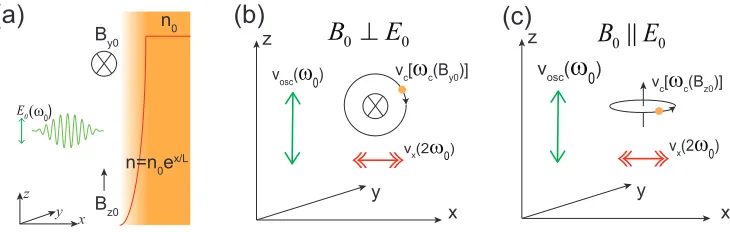
FIG. 1. (a) Sketch of the interaction configuration with the incident laser along the x direction and polarized along the z direction. (b) and (c) illustrate electron motion near the target surface under the interaction of incident laser and the transverse magnetic field either perpendicular or
parallel to the laser electric field, respectively.
oscillation along the laser electric field along the z direction at the laser frequency ω0 and the longitudinal oscillation along the x direction at 2ω0, which form the xz plane. The coupling of longitudinal and transverse oscillations only leads to odd harmonics with the same polarization of the driving laser. When there is a transverse magnetic field B0, these oscillations will couple with the cyclotron motion. In the case when this magnetic field is perpendicular to the laser electric field as shown in Fig. 1(b), the cyclotron motion will be within the xz plane. Therefore a new surface current component along the z direction at 2ω0 will appear. As a result, both odd and even harmonics will be produced with the same polarization of the driving laser, which is different from the case without the magnetic field. On the other hand, when this magnetic field is parallel to the laser electric field as shown in Fig. 1(c), the cyclotron motion will be in a plane perpendicular to the xz plane. Therefore a new surface current component along they direction at 2ω0 will appear. As a result, even harmonics polarized long the y direction will be produced, while only odd harmonics with the same polarization of the driving laser.
Mathematically, the above scenario can be described by the equation of electron motion coupled with the Maxwell’s equations. Under both the laser and magnetic fields, the equation of motion reads
dp
dt =−e[E+v×(B+B0)], (1)
[image:4.612.122.487.71.187.2]is the normalized laser vector potential with me and c being the electron mass and light speed in vacuum. By combining Eq. (1) and the Maxwell’s equations, the polarized vector potentials ay (p polarized) and az (s polarized) satisfy the following wave equations,
(∂x2− 1
c2∂ 2
t)ay = (
ωp
c )
2s y,
(∂x2− 1
c2∂ 2
t)az = (
ωp
c )
2s z,
(2)
with the source terms
sy =n p
1−β2 x
a0y
p
1 +a02 y +a0z2
,
sz =n p
1−β2 x
a0z
p
1 +a02 y +a0z2
.
(3)
Here, a0y =ay+eB0zm R
tβxdtanda
0
z =az−eB0ym R
tβxdtwithβx being the longitudinal electron velocity normalized byc,ωp =
p
n0e2/mε0is the plasma frequency defined by the maximum initial electron density n0,n is the electron density normalized by n0, and ε0 is the vacuum permittivity.
The above equations reduce to that derived in Ref. (Lichters et al., 1996) for B0y =
B0z = 0. For example, for an s-polarized drive laser pulse, both the density fluctuation n and longitudinal velocity βx contain only even-order harmonics of the laser frequency ωL. Coupling with transverse laser oscillations, they lead to only odd harmonics polarized in the same plane as the drive pulse. While for nonzeroB0, the presence of the magnetic field modifies the vector potentials in the source terms with an additional terms eB0zm Rtβxdt and
−eB0ym R
NUMERICAL SIMULATION RESULTS
One-dimensional particle-in-cell simulation
We start with one-dimensional (1D) PIC simulations using the OSIRIS code (Fonseca et al., 2002). The simulation box is initialized as 40λL long, divided into 4000 cells with 100 micro-particles per cell, whereλLis the incident laser wavelength. The solid target is uniform in x ∈ [0,2λL], with a preplasma attached in the front varying as n = n0exp(x/L) where
n0 = 40nc is the peak density, nc = 1.1×1021cm−3 is the critical density for λL = 1 µm, and L= 0.2 is the preplasma scale length. A linearly polarized laser pulse with normalized vector potential a = a0sin2(πt/TL) impinges from the left onto the target, where a0 = 0.5 corresponds to a peak intensity of 3.4×10¹⁷ W/cm2,τ = 9TLis the full pulse duration, and
TL = 2π/ω0 is the laser period. For clarity, we assume it is polarized along the z-direction and call it s-polarized. Ions are treated to be stationary background as they have little effect in this ultrafast process (Br¨ugge et al., 2012).
The reflected pulses are traced at x = −4 and the results (both time and frequency domains) are shown in Fig. 2 for different runs with or without external magnetic field in different directions. In the case without external magnetic field, only odd harmonics show up in s polarization and no harmonics is observed in p polarization, as shown by the black dashed lines in Figs. 2(a), 2(b) and 2(d), as expected in accordance with the selection rules (Lichters et al., 1996). The prominent new feature occurs for B0z = 17 MG, where a well-defined reflected pulse containing even-order laser harmonics now emerges in p-polarization as shown in Fig. 2(c). The even-order harmonics occur in s-polarization for B0y = 17 MG, as shown in Fig. 2(d). The parity of these even harmonics changes with the direction of the external magnetic field and they are always perpendicular to the magnetic field, a clear evidence of electron cyclotron motion as theoretically discussed above. The merit of employing parallel magnetic field and incident laser field is that the even harmonics can be well separated from the reflection of the drive pulse due to their different polarizations.
28 30 32 34 36 38 −0.01
0 0.01 0.02
t/T
L
eE
y
/m
ω 0
c
B =0 B z=17MG
28 30 32 34 36 38 −0.5
0 0.5
t/T
L
eE
z
/m
ω 0
c
B =0 B y=17MG
0 1 2 3 4
10−2 100
ω
r/ω0
Bz=17MG
0 1 2 3 4
100 102 104
ω
r/ω0
|FFT
(E z
)|/a.u.
B =0 B y =17MG
(a) (b)
(c) (d)
0
0 0
0
0 0
0
|FFT
(E y
)|/
a.u.
FIG. 2. (Color online) An s-polarized laser pulse is reflected by a solid target in different runs
without and with a homogeneous magnetic field applied either in y- or z-directions. The p- and
s-polarized components of the reflected electric field without the effect of magnetic field are plotted
in black dashed lines in (a) and (b). The p-polarized component of the reflected electric fieldEy in
B0z = 17MG and its Fourier transformed spectra are shown in red solid lines in (a) and (c). The s-polarized component of the reflected electric fieldEz inB0y = 17MG and its Fourier transformed spectra are shown in blue solid lines in (b) and (d).
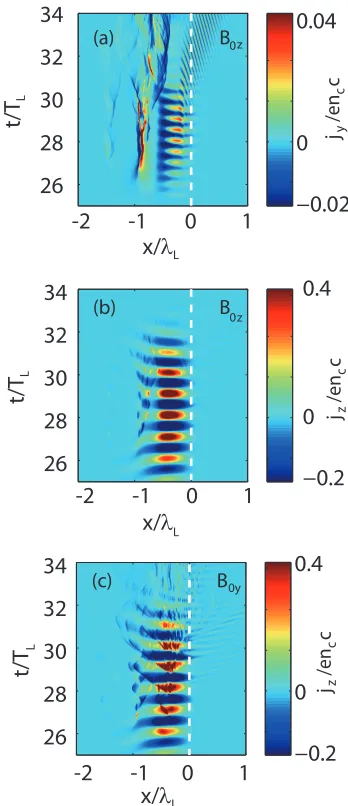
the presence of magnetic field B0z = 17MG, a new surface current jy at 2ω0 appears as shown in Fig. 3(a), resulting in the even harmonics in |F F T(Ey)| shown in Fig. 2(c). Note that there is a low frequency current component near x/λL ∼ −1 in Fig. 3(a), which can be attributed to the zero frequency component of the laser ponderomotive force and the charge separation fields at the front surface. The latter can drive longitudinal motion of electrons, which, when bended by B0z, leads to low frequency transverse currentsjy finally. The electric current component jz shown in Fig. 3(b) is dominated by oscillations at ω0, even though it contains odd harmonic components. Also note that the amplitude of jz is an order of magnitude higher than the amplitude ofjy. With the presence of magnetic field
[image:7.612.123.481.77.350.2]x/λ L
t/T
L
-2 -1 0 1
26 28 30 32 34
−0.02 0 0.04
j
/en c
c
y
x/λ
L
t/T
L
26 28 30 32 34
-2 -1 0 1 −0.2
0 0.4
j
/en c
c
z
(a)
(b)
x/λ
L
t/T
L
−0.2 0 0.4
26 28 30 32 34
-2 -1 0 1
j
/en c
c
z
B (c)
0
Bz
B0z
0y
FIG. 3. (Color online) Space-time plots of electric current componentsjy and jz versus coordinate
x and time t in units of λL and TL with a magnetic field applied either in z- or y-directions. (a) and (b) are for jy and jz respectively with B0z = 17MG, and (c) is for jz withB0y = 17MG. The dashed line shows the initial position of the critical plasma density.
is a kind of superposition of Fig. 3(a) and 3(b) and is dominated by the oscillation atω0 as expected.
[image:8.612.223.397.76.479.2]0 1 2 3 4 5 100
ω
r/ω0
B0z=17MG
By=17MG
0 100 200 300 0
10 20 30 40
B /MG
Bz
By
0 1 2
0 20 40 60
L/λ
B0z=17MG, x20
By=17MG
(a)
(b)
(c)
0
0
0
0 0
L |Ey
(
ω
)|,|E
z
(
ω)|/
a.u
|Ey
(
ω
)|,|E
z
(
ω
)|/
a.u
|Ey
(
ω
)|,|E
z
(
ω
)|/
a.u
FIG. 4. (Color online) (a) The Fourier transformed spectra of Ey with the magnetic field B0z = 17MG (blue solid) and Ez with B0y = 17MG (red dashed) with L = 0.2λL. (b) Scalings of the 2nd harmonic spectra |FFT(Ey)| (blue square) and |FFT(Ez)| (red circle) with the strength of the magnetic field B0z and B0y, respectively, with L = 0.2λL. (c) Scalings of the 2nd harmonic spectra |FFT(Ez)| (red circle) with B0y = 17MG and |FFT(Ey)|(blue square, multiplied by 20) withB0z = 17MG with the preplasma length.
[image:9.612.215.359.78.428.2]Ey with the magnetic field B0z can be used to measure the magnetic field by detecting the emission of the second harmonics or higher even harmonics. A drive pulse can be used to generate the magnetic field near the critical density region and a probe pulse can be used to measure the field (Kahalyet al., 2009). By changing the focusing positions and delay of the probe pulse, the distribution and temporal evolution of the magnetic field can be measured. So far we have fixed the preplasma scalelength to be L= 0.2λL. The coupling efficiency also depends on the L employed. Figure 4(c) shows the correlation for the magnetic field strengths in both transverse directions withB0z = 17MG (blue) and B0y = 17MG (red). The preplasma scale of the target plays a crucial role in the surface oscillations. With the parallel magnetic field B0z, the even harmonic intensity increases with the density scale length L when L < 0.2λL and then decrease with the further increase of L. This is similar to the odd harmonics produced without the effect of magnetic field (Dollar et al., 2013). With the perpendicular magnetic field B0y, longer preplasma with L >0.2λL can produce even harmonics more efficiently. This suggests that the perpendicular magnetic field leads to higher coupling at long density scalelength.
Multi-dimensional effects
We also run three-dimensional (3D) PIC simulations to check possible multi-dimensional effects on this process. The simulation box is set to be 20×20×20λ3
L inx×y×z directions, with 64×8×8 cells per wavelength. The plasma occupies a volume of 2×18×18λ3
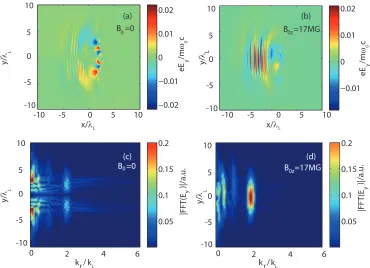
L with a sharp density front. An incident laser with a Gaussian transverse profilea=a0exp(−r2/σ20) is sent to the target from left, where σ0 = 2λL is the focal spot radius at waist. The other laser parameters are the same as in the 1D simulations with the laser field polarized along the z-direction. Despite much lower spatial resolutions compared with 1D simulation, they are fine enough to resolve the second harmonics.
x/λ L
y/
λ L
-10 -5 0 5 10 -10 -5 0 5 10 −0.02 −0.01 0 0.01 0.02 x/λ L y/ λ L −0.01 0 0.01 0.02
kr/ kL
y/
λ L
0 2 4 6
0.05 0.1 0.15 0.2 r/ k L y/ λ L 0.05 0.1 0.15 0.2 -10 -5 0 5 10
-10 -5 0 5 10
-10 -5 0 5 10 -10 -5 0 5 10
0 2 4 6
k |FFT(E y )|/a.u. |FFT(E y )|/a.u. eE y /m ω 0 c eE y /m ω0 c (a) (b) (c) (d)
B =0 B =17MG
B =0 B =17MG
0 0z
0 0z
FIG. 5. (Color online) The results of 3D PIC simulations. The electric field Ey of the horizontal section atz = 0 in the magnetic field B0z = 0 (a) and B0z = 17 MG (b). Plots (c) and (d) show the wave vector spectra |FFT(Ey)|for the fields given in (a) and (b), respectively. The laser focal spot size is 2λL.
(Gizzi et al.1996). While for the case of B0z = 17MG, the even harmonics generally share the same Gaussian transverse profile as the drive pulse. This magnetic field induced even harmonic is much higher than that produced due to the transverse gradients of the incident laser pulse.
[image:11.612.121.491.77.345.2]1 2 3 4 0
5 10 15
σ
0/λL
|E
y
(
ω
)|,|E
z
(
ω
)|/a.u
B
z=17MG,2
nd
B
z=0, 3 rd
FIG. 6. (Color online) Scaling of spectral intensity of the second harmonic |FFT(Ey)|(for B0z = 17MG) and third harmonic |FFT(Ez)| (for B0z = 0) with the laser focal spot size obtained in two-dimensional simulations. The electron density is steep at the surface.
found in 1D simulation, due to hole boring effect. The reflected pulse also experiences diffraction spreading transversely, leading to decaying of the harmonic radiation quickly with the increase of distance away from the target surface. The second harmonic generated with B0z = 0 is distributed more diversely with increasing σ0, with the amplitude and spectral intensity increasing at first and reaching saturation at σ0 = 3λL, beyond which it decreases.
CONCLUSION
[image:12.612.214.382.77.211.2]third harmonic tend to increase with the laser spot size. When the latter is larger than 3λL, the radiation fields become saturated. Additional even harmonic component generated due the transverse gradient of the incident laser pulse is found, which has radial polarization and emits with a conical distribution and is therefore distinctly different from the even harmonics induced by the magnetic field.